You know that moment when you walk into a master bedroom that’s supposed to be “finished” but something feels off? The furniture matches too perfectly, the lighting is either surgical or nonexistent, and the whole room has the personality of a hotel lobby that forgot to be interesting. I’ve been there. After six years of writing about interiors and redecorating my own bedroom three times (once because I made an expensive mistake with a velvet headboard that turned into a cat scratching post within a week), I finally figured out what separates a room that looks elevated from one that just looks decorated.
Most bedroom advice is uselessly vague. “Add layers,” they say. “Invest in quality,” they repeat. That’s not advice; that’s a fortune cookie. The real problem is that we’ve been told to follow formulas that work in showrooms but fall apart in real life—with its morning light, its stacks of half-read books, its one nightstand that’s slightly taller than the other because you found it at a flea market. The conventional wisdom doesn’t account for friction, for the way a room actually gets used at 10 p.m. when you’re exhausted or at 7 a.m. when you’re hunting for your glasses.
So here are 25 ideas that come from living with them, making mistakes, and learning what actually holds up. Some are cheap (under $30), some are a commitment, and at least half of them won’t show up in the usual listicles because they require you to ignore what everyone else is doing. You don’t need to do all of them. Pick three that make you pause, and start there.
1. The Low-Profile Platform Bed (No Footboard)
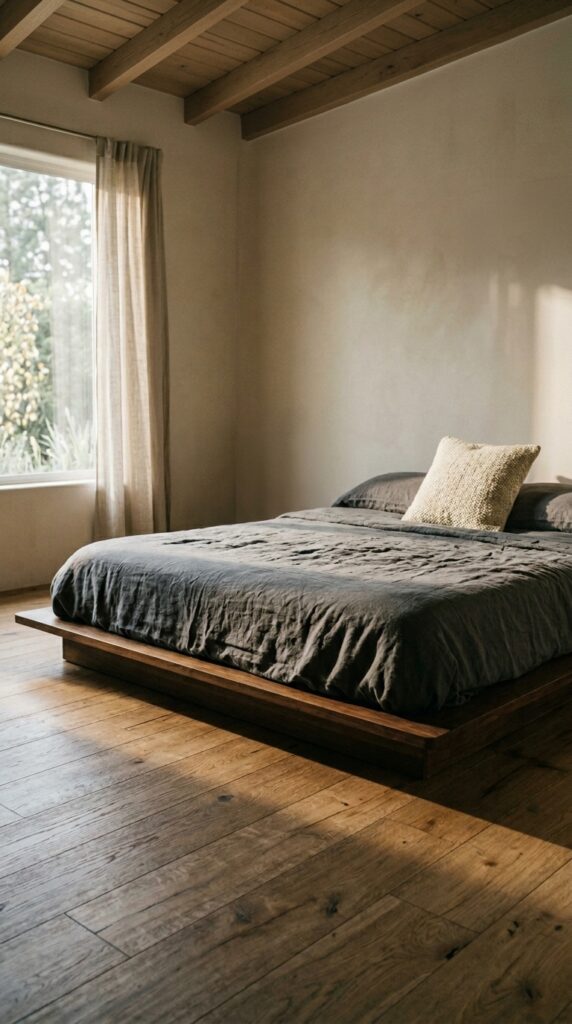
The fastest way to make a bedroom feel more spacious and calm is to lower the visual center of gravity. A platform bed that sits six to eight inches off the floor—no footboard, no heavy headboard that reaches halfway up the wall—does something strange and wonderful: it makes the ceiling feel higher because your eye isn’t getting stopped by furniture. I switched from a chunky sleigh bed to a simple walnut platform three years ago, and the room breathed out. The footboard, I realized, had been a psychological barrier, a thing to walk around.
Trade-off: getting in and out feels different, especially if you have knee issues. My father-in-law stayed with us once and called it “the Japanese torture bed.” He’s not wrong for his body. Also, dust collects under there faster than you’d think because there’s no footboard to block airflow. You’ll need to run a swiffer weekly. Cost for a solid wood platform bed runs $300 to $800. Avoid the cheap MDF versions—they sag in the middle within two years.
Pro tip: If you’re nervous about the low profile, add a shallow bench at the foot. It gives you a place to sit without adding back the visual weight of a footboard.
2. Hardwired Sconces (No Cords, No Table Lamps)
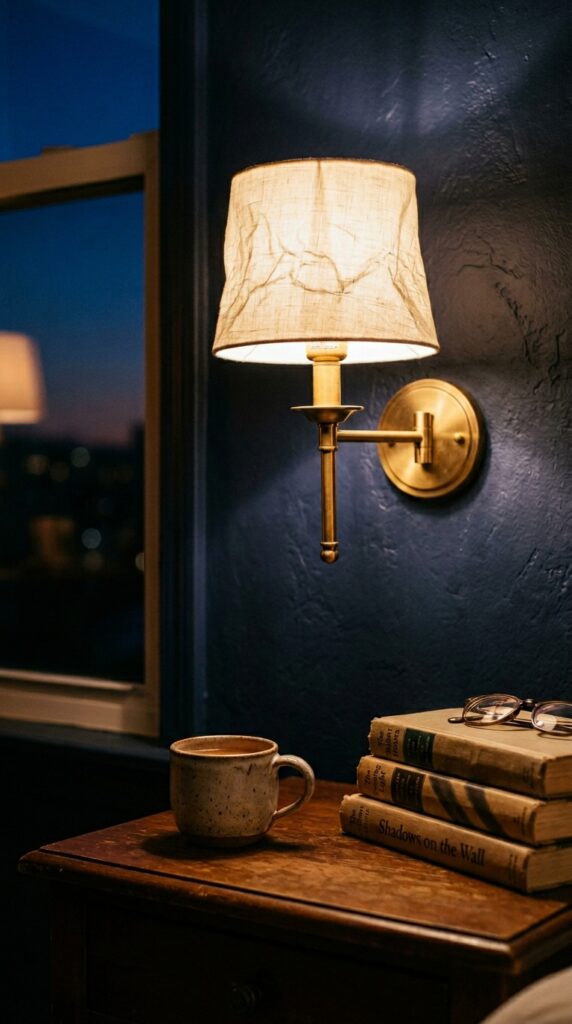
Table lamps take up real estate that your elbows, your water glass, and your phone deserve. Sconces mounted at shoulder height (about 28 inches above the mattress) free up that space and create a cleaner line. The real upgrade, though, is hardwiring them. Plug-in sconces with dangling cords look like a dorm room hack no matter how expensive the fixture is. I learned this the hard way after buying two beautiful ceramic sconces from a small studio, then using cord covers that still looked like an afterthought.
Hardwiring means hiring an electrician unless you’re comfortable cutting into drywall and running wire. That’s a $150 to $300 job depending on access from the attic or basement. But once it’s done, the room feels permanent and considered. One thing most guides skip: put each sconce on its own dimmer switch. Being able to set your side at 20% while your partner reads at 60% is a marriage saver. Cost for good sconces: $80 to $250 each.
Pro tip: Position sconces so the bottom of the shade is about six inches above the top of your pillow. Any lower and you’ll bump your head reaching for your alarm.
3. One Oversized Piece of Art, Not a Gallery Wall
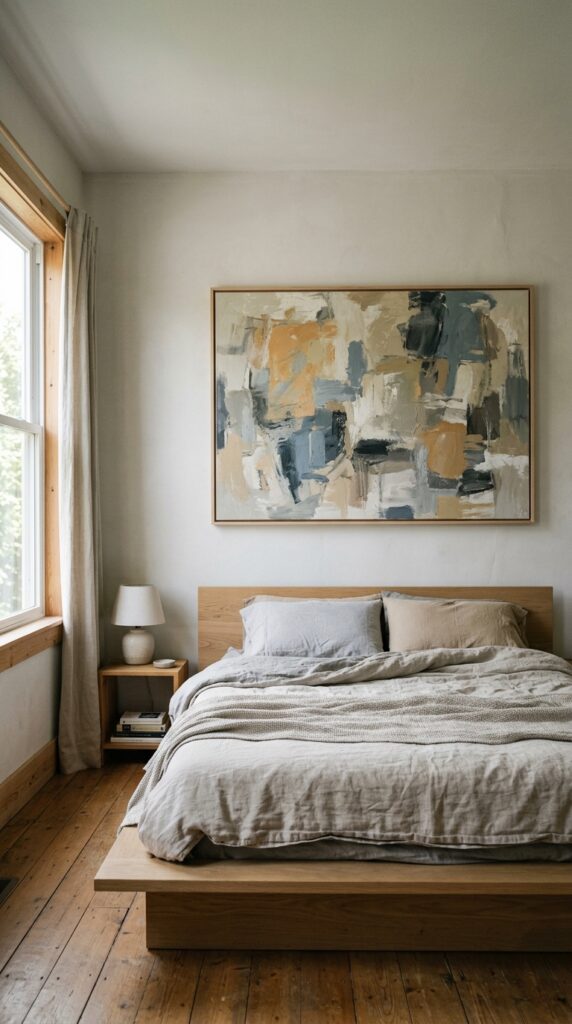
Gallery walls have become the shiplap of art displays. They’re everywhere, and most of them feel frantic—a collection of small frames trying desperately to add up to one big statement. Here is the honest truth: one large piece of art (or a diptych that functions as a single composition) is almost always more sophisticated than a dozen small ones. It gives the eye a place to rest. It doesn’t compete with your bedding, your headboard, or your lamp shades.
Finding affordable large art is genuinely hard. A 48×60 canvas from a real artist runs $800 to $3,000. But you have options: commission a student from a local art school ($300 to $500), buy a high-quality print on canvas ($150 to $300), or stretch your own fabric or paper ($50 if you’re brave). What ages badly: those mass-produced “abstract” canvases from home goods stores with generic swirls in beige and blue. They look fine on day one and depressing on day 365. The trade-off is commitment—a large piece dictates your color palette. You can’t just swap it out seasonally.
Pro tip: Hang the center of the artwork at 57 inches from the floor (standard gallery height). Most people hang art too high, and it floats uncomfortably above the bed instead of anchoring it.
4. A Foot-of-Bed Bench That Actually Works
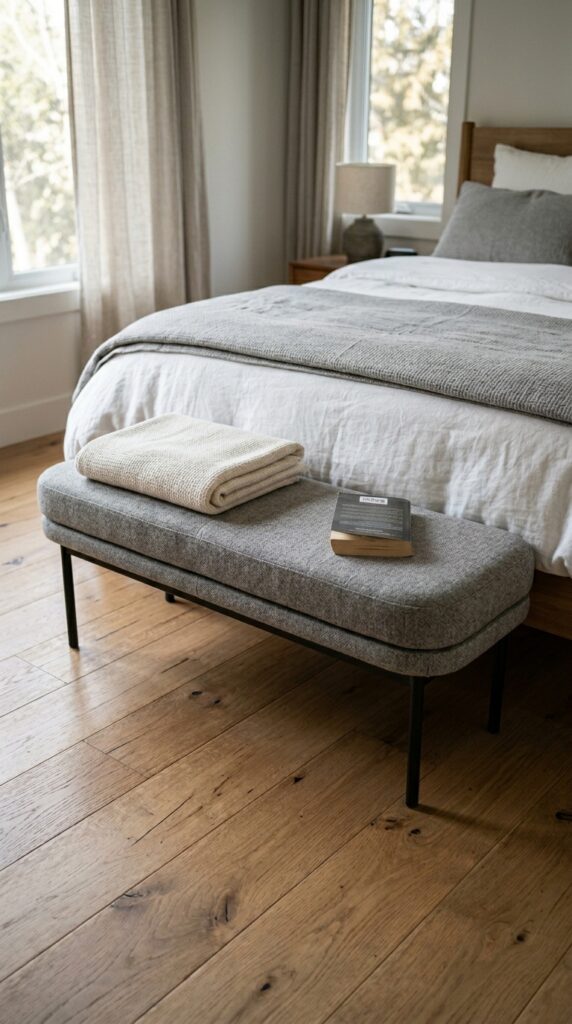
Most foot-of-bed benches are decorative nonsense—too small to sit on, too shallow to hold anything, just a fluffy rectangle that collects dust. The elevated version is a bench with actual purpose. Either it’s deep enough to sit on while putting on shoes (at least 15 inches of seat depth) or it has hidden storage for extra blankets. I found a tufted bench with a lift-up lid at an estate sale for $60, and it’s where I keep my winter duvet for six months of the year.
The material matters enormously. A linen bench looks beautiful for about four months before it shows every water spot, every cat hair, every ass print. Go with wool or performance velvet (the kind treated with stain resistance). Cost for a good one: $150 to $400. The version that holds up over time has a solid wood frame, not particle board. Test it by lifting one corner—if the whole thing twists, skip it. One trade-off: a bench at the foot of a king bed requires at least 36 inches of clearance between the footboard and the wall on the other side. Measure your walking path before buying.
Pro tip: If you don’t need storage, get a bench with an open metal or wood base instead of a solid front. It lets light and air pass through, so the room feels less crowded.
5. Two Rugs, Layered (The Right Way)
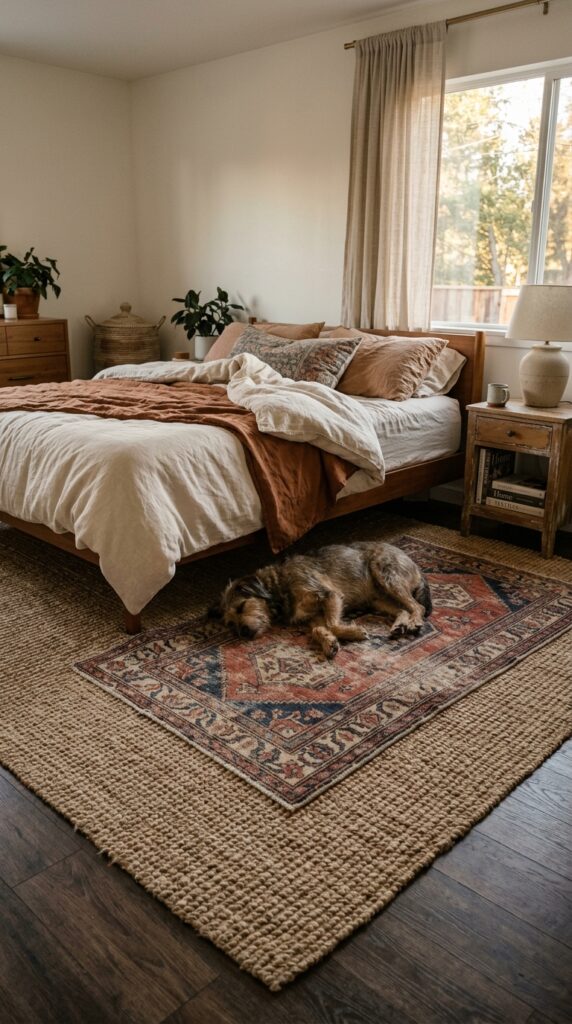
Layering rugs gives you texture and pattern without committing to a single expensive rug that might be wrong. The trick that most people miss: the bottom rug should be cheap, flat, and slightly too big. A 9×12 jute or sisal rug from a big box store costs under $150 and acts as a neutral foundation. The top rug should be the pretty one—a wool Persian-style runner or a small cowhide or a faded Turkish kilim—placed diagonally or offset so it covers the area where your feet hit the floor in the morning.
The friction: layered rugs are a tripping hazard if you don’t secure them. You need a non-slip pad under each layer, and you need to check that the top rug doesn’t curl at the edges. I used double-sided carpet tape on the corners of my top rug after my husband nearly face-planted at 2 a.m. Also, jute sheds. For the first six months, you’ll vacuum up brown fibers. That’s normal. Cost for the combination: $200 to $500. What doesn’t work: two thick, fluffy rugs layered on top of each other. You’ll feel like you’re walking on a waterbed.
Pro tip: Position the top rug so at least 18 inches of the bottom rug shows on all four sides. That reveals the layering as intentional, not accidental.
6. Paint the Ceiling a Darker Color Than the Walls
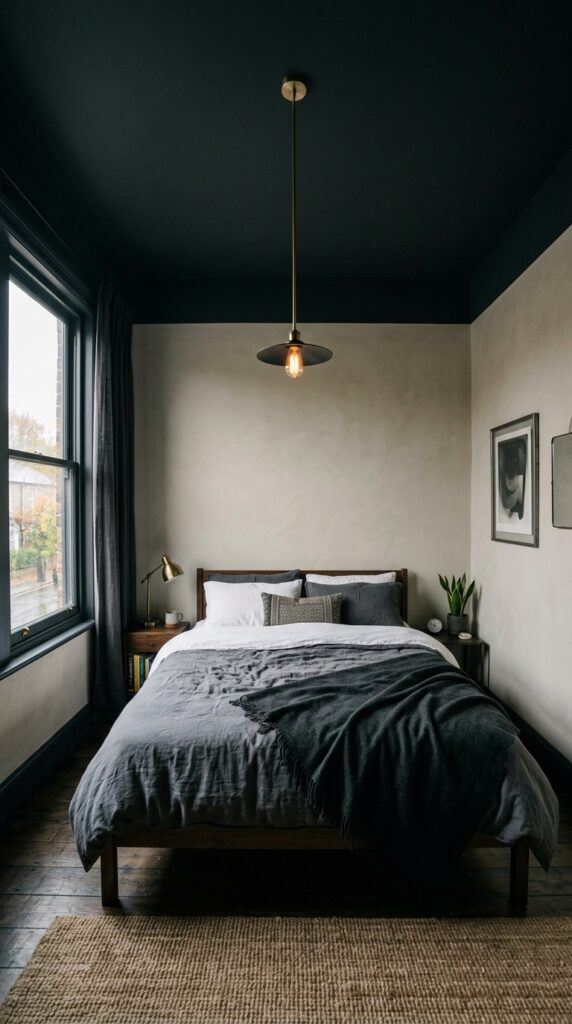
This sounds wrong until you see it. A ceiling painted a darker tone than the walls—think charcoal, deep olive, or a muddy blue—doesn’t make the room feel shorter. It makes the walls feel taller because your eye stops at the ceiling line instead of bouncing around. The ceiling becomes a defined plane rather than a forgotten fifth wall. I did this in my last apartment with Farrow & Ball’s “Down Pipe” on the ceiling and their “Old White” on the walls, and guests constantly asked if I’d raised the ceiling.
The non-negotiable: you need a matte or flat sheen on the ceiling. Any shine will reflect light in weird ways and show every roller mark. Also, this works best in rooms with at least 8-foot ceilings. A 7-foot ceiling with dark paint feels like a coffin. Under $50 for a gallon of good paint. The trade-off is commitment—once it’s dark, you’re not going back without two coats of primer and a sore neck. And if you have popcorn ceilings, don’t even try. Dark paint on textured ceilings looks like a dirty sponge.
Pro tip: Run painter’s tape along the wall-ceiling edge and use a small angled brush. Dark ceiling paint is unforgiving—one slip onto the wall means repainting that section of wall too.
7. Replace Closet Doors with Floor-to-Ceiling Curtains
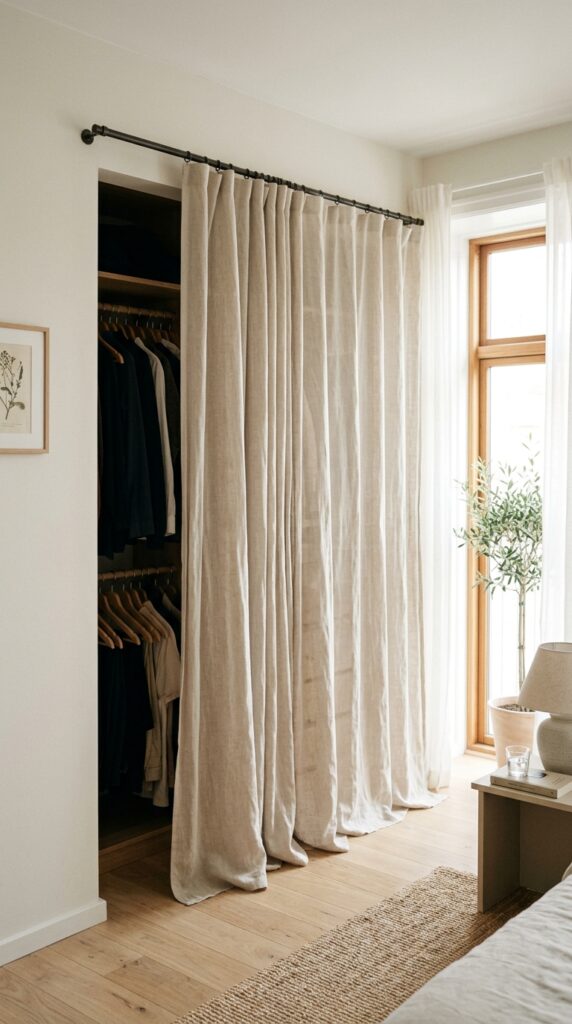
Bifold closet doors are the enemy of elegance. They rattle, they derail, they look like an office partition. Ripping them out and installing floor-to-ceiling curtains on a tension rod or a track system is a $100 fix that feels like a $1,000 upgrade. The key is fabric weight: too light (sheer polyester) and it looks like a dorm shower curtain. Too heavy (velvet) and it swallows the room. Linen, cotton canvas, or a heavyweight Belgian flax is the sweet spot.
The version that actually works: mount the rod an inch below the ceiling and let the curtains pool just a quarter inch on the floor (no dramatic puddling—that’s a dust trap). Make the curtains wide enough that when they’re open, they stack almost entirely off the closet opening. I used two panels per side, 100 inches wide total for a 60-inch opening. Cost: $80 to $200 depending on fabric. One thing nobody warns you about: curtains don’t block sound. If your closet is near the bed and you’re a rustler, you’ll hear every hanger. Also, dust collects on the top of the rod. Wipe it monthly.
Pro tip: Use a continuous track system instead of a rod if you want a truly seamless look. Rods have brackets that create visual breaks. Tracks are hidden behind the fabric.
8. A Canopy Bed with Sheer Panels (Yes, Really)
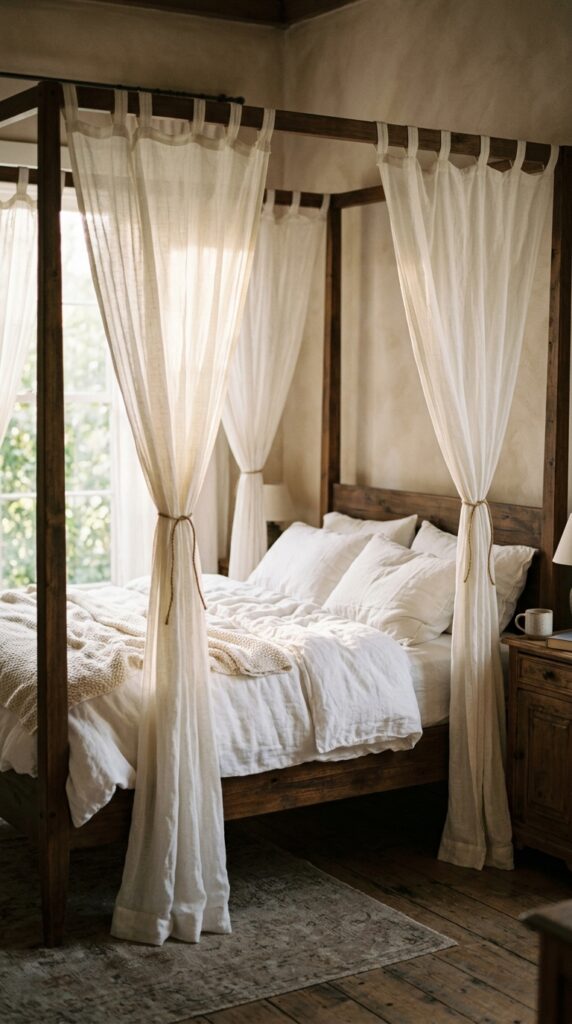
The canopy bed got a bad reputation from the 1990s, when everyone had brass frames with sagging polyester netting that looked like a quinceañera left behind. But a modern version—clean-lined wooden posts, no finials, four panels of unbleached linen that you can actually close—creates a sense of enclosure that makes a large bedroom feel intimate. I resisted this for years, thinking it was fussy. Then I stayed in a farmhouse in Tuscany with a canopy bed and understood: it’s not about drama. It’s about softening the hard edges of a room.
The honesty: this only works in a room with ceiling height over nine feet. A canopy in a standard 8-foot room looks like a hat that’s too small. Also, the panels need to be washed regularly. Linen gets musty if you never launder it, and removing four long panels from a high frame is a workout. Cost: $400 to $1,200 for a solid wood frame, plus $80 to $150 for the panels. The version that ages badly is any canopy with a dust cover on top. Dust covers trap dirt and look theatrical in a bad way.
Pro tip: Skip the tie-backs entirely. Let the panels hang straight most of the time, and only pull them back when you want to feel more open. The straight hang is cleaner.
9. A Real Chair (Not a Chaise)
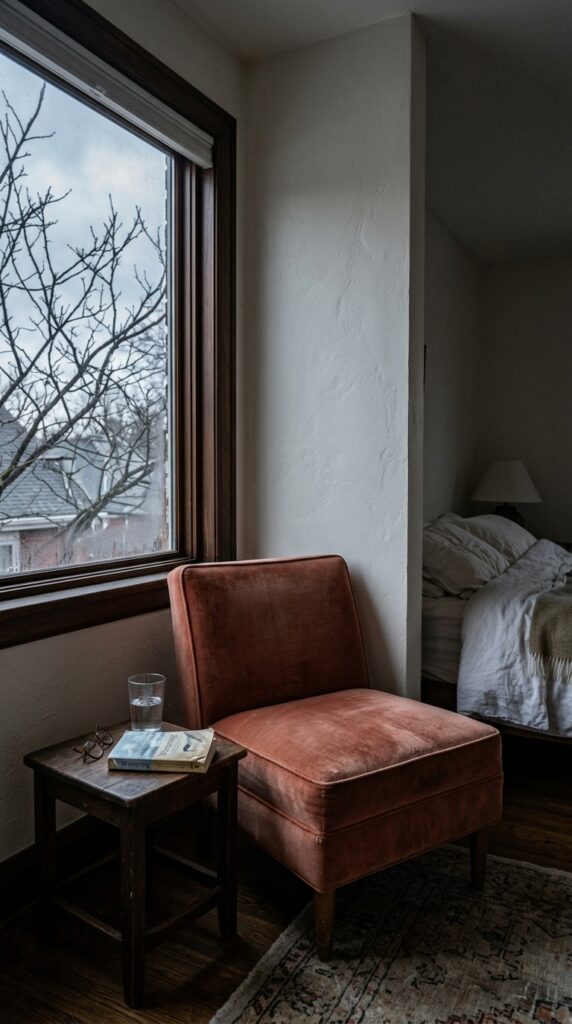
A chaise lounge is the lie we tell ourselves: that we’ll lounge dramatically with a novel and a cup of tea. In reality, a chaise takes up the space of a small car and gets used as a laundry pile. The elevated alternative is a slipper chair or a small bergère—compact, armless or short-armed, easy to move. It fits in a corner that would otherwise be dead space, and it becomes the spot where you actually sit to put on socks or make a phone call.
One thing most guides skip: the seat height should match your bed height within two inches. If your bed is high, a low slipper chair feels like a child’s seat. I made that mistake with a vintage chair that was 14 inches high next to a 24-inch bed. It looked absurd. Cost for a decent upholstered slipper chair: $150 to $400. The trade-off is floor space—even a small chair needs a 30-inch square clearance. In a bedroom smaller than 11×12, skip the chair entirely and use a padded bench at the window instead.
Pro tip: Put a small floor lamp behind the chair, not next to it. Backlighting creates a halo that separates the chair from the wall and makes the room feel layered.
10. Mismatched Nightstands (That Still Work Together)
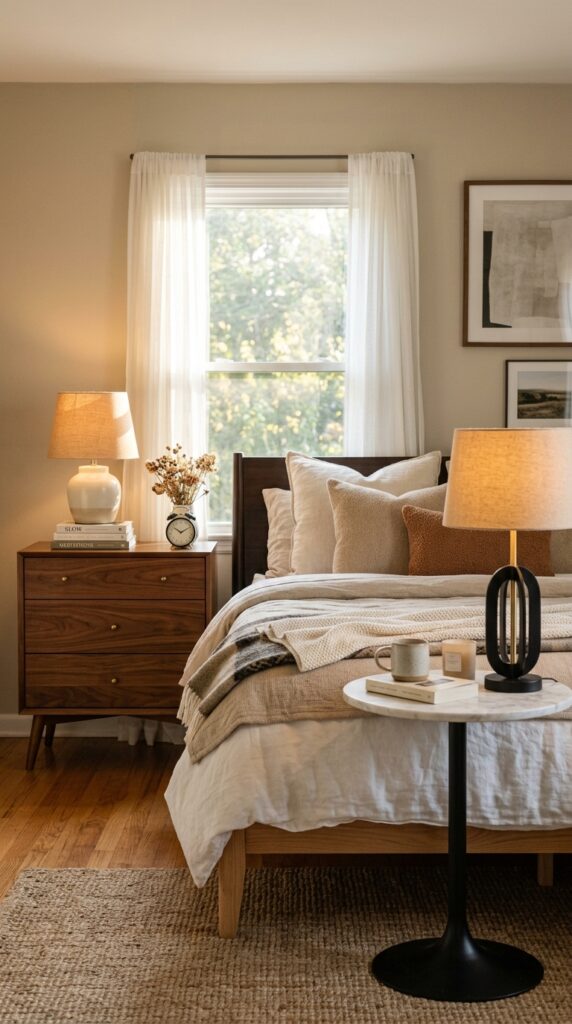
Matching nightstands from a bedroom set are the decor equivalent of a timeshare presentation. They’re fine, but they have no personality. The trick to mismatched nightstands is finding common ground. They don’t need to be the same wood or style, but they should share at least one attribute: similar height (within two inches), similar visual weight, or a repeated material. I have a vintage campaign chest on my side and a raw steel industrial stool on my husband’s side. What ties them together is that both have exposed metal hardware and roughly the same surface area.
The friction point: drawers vs. no drawers. One person will inevitably get more storage, and that can cause resentment. We solved it by putting a small valet tray on the stool side. Cost can be very low if you mix a flea market find ($20) with a new piece ($100 to $250). What fails: nightstands that are radically different heights. If one is 24 inches and the other is 30, your lamps will look drunk. Also, avoid combining a dark heavy piece with a light spindly piece. The weight imbalance will bug you every night.
Pro tip: Use lamps that are the same height even if the nightstands differ. The lamps create a horizontal line that tricks the eye into seeing symmetry.
11. A Valance or Cornice Board (Seriously, Consider It)
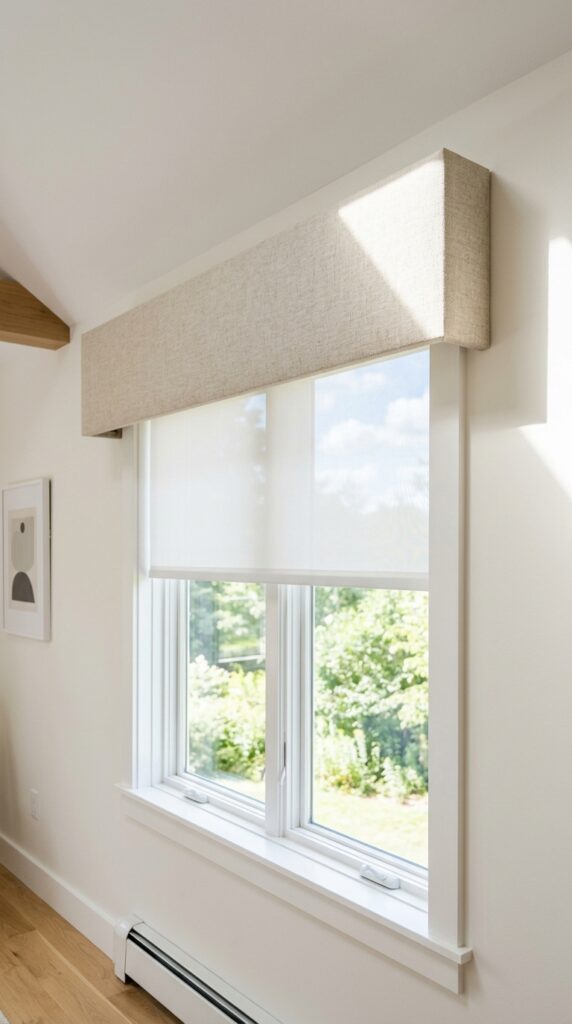
Valances and cornices got lumped in with the 1980s “swags and tails” nightmare, but a modern version—a simple upholstered box mounted at the ceiling—solves two problems. First, it hides ugly blinds or imperfect window trim. Second, it adds architectural interest to a room with boring windows. I installed a DIY cornice over a window that was off-center on the wall, and the cornice made the asymmetry read as intentional.
The version that works: a shallow depth (four to six inches), sharp square corners, wrapped in a plain fabric like linen or cotton canvas. No ruffles, no tassels, no curves. Under $80 if you build it yourself (plywood, foam, fabric, staple gun). Ready-made runs $120 to $250. The honest trade-off: cornices block the top few inches of window light. If you have a room that’s already dark, skip it. And they’re a pain to dust. The flat top collects a gray film that you’ll notice every time the sun hits it.
Pro tip: Mount the cornice so it overlaps the window frame by at least an inch on each side. That makes the window look wider than it actually is.
12. Full-Length Drapery Even on Small Windows
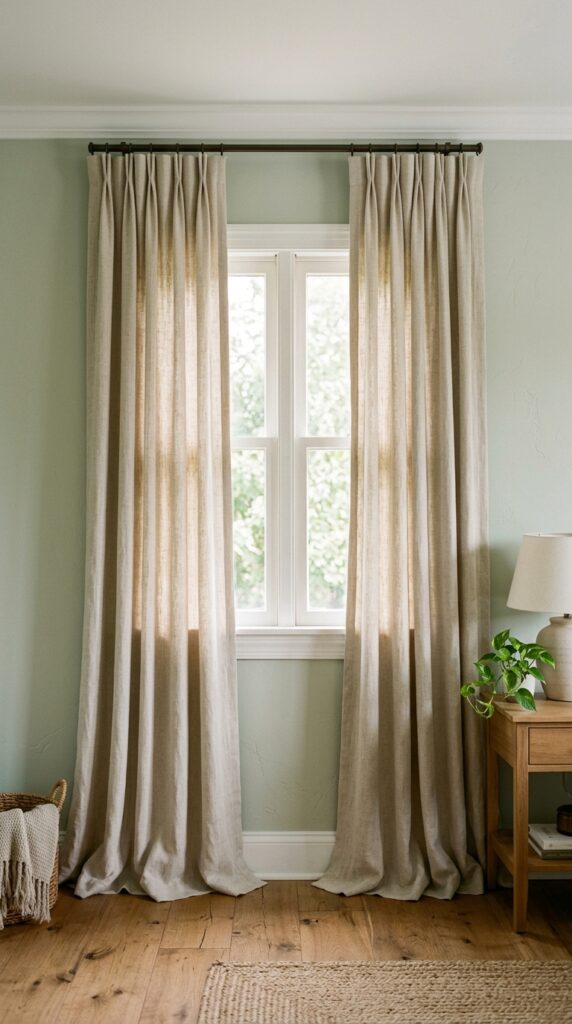
Most people hang curtain rods directly above the window frame, which makes the window look stubby and the ceiling feel lower. The correct move is to mount the rod two to six inches below the ceiling (or at the ceiling line if you have crown molding) and extend the rod so the curtains stack entirely off the window when open. This creates a full wall of fabric that tricks the eye into reading the window as much larger.
Here is the honest truth: you need curtains that are long enough to kiss the floor—no more than a half-inch gap. Anything shorter looks like pants that don’t fit. And you need enough width: the combined width of your panels should be two to three times the width of the window for proper fullness. Cost for good-quality ready-made linen panels: $60 to $150 per pair. The version that fails is cheap polyester panels with sewn-in hems that can’t be adjusted. They’ll gap awkwardly and look like a rented tuxedo.
Pro tip: Use a rod with return ends (the curved pieces that bring the rod back to the wall). Those returns prevent light from leaking around the sides and make the installation look built-in.
13. A Large Leaning Mirror (Anchored Properly)
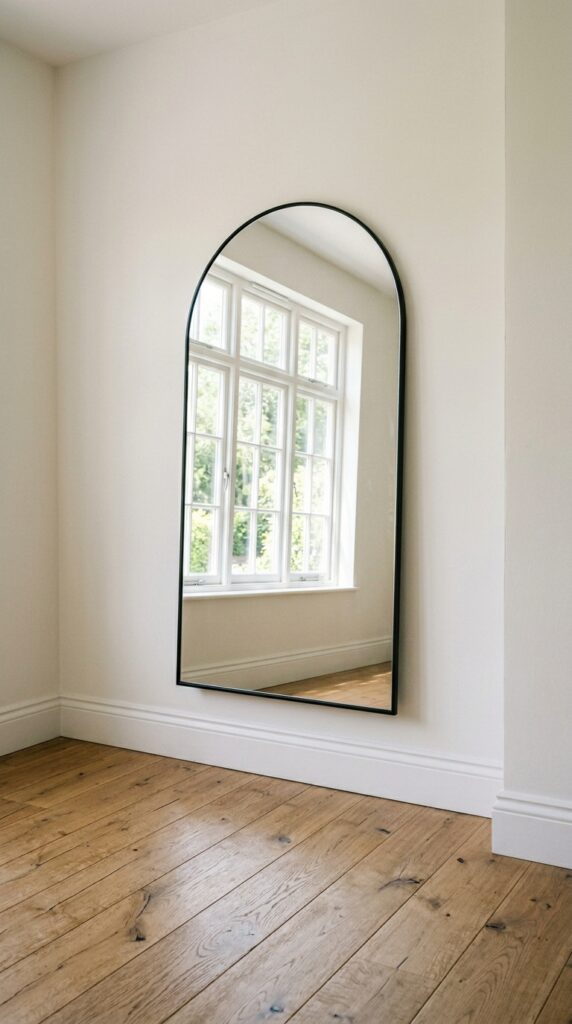
A leaning mirror—not hung, just propped—has a casual confidence that a hanging mirror lacks. It says you’re not trying too hard. But the number of people who skip anchoring is terrifying. A 40-pound mirror sliding off a hardwood floor is a broken mirror and a bruised foot waiting to happen. The correct setup: attach furniture anti-tip brackets to the back of the mirror and screw them into a wall stud. Or use heavy-duty mirror clips at the bottom edge. Under $20 for safety hardware. Do not skip this.
What to look for: a mirror at least 60 inches tall, with a frame that has some visual weight. Frameless mirrors look like gym equipment. Arched tops or beveled edges add interest. Cost for a decent large leaning mirror: $150 to $400. The trade-off is floor space—a leaning mirror needs to sit far enough from the wall that it doesn’t look like it’s falling, but close enough that it doesn’t block walking paths. About six to eight inches of lean is the sweet spot. One thing that ages badly: mirrored glass with a green tint. Spend a little more for low-iron glass with a clear cast.
Pro tip: Place the mirror so it reflects something beautiful—a window, a piece of art, a plant. If it reflects a closet door or a laundry basket, move it.
14. Upholster the Entire Wall Behind the Bed
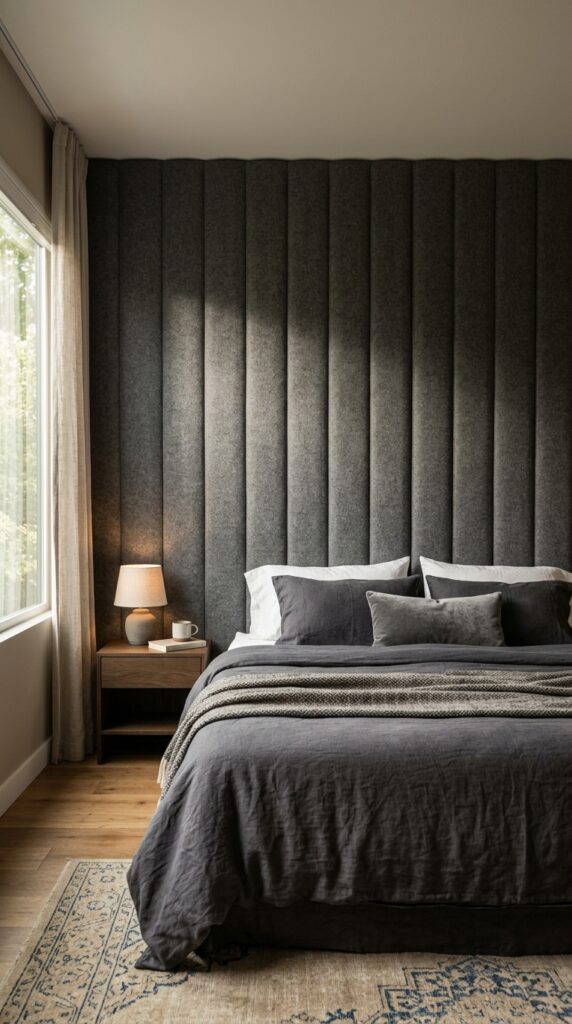
Forget an upholstered headboard. The real power move is doing the whole wall. It absorbs sound, adds serious texture, and makes the bed feel like it’s nested rather than just placed. I did this in a bedroom that had terrible acoustics (hardwood floors, plaster walls, no rugs yet), and the difference was immediate. The room went from echoey to intimate without adding a single piece of furniture.
The friction: this is not a weekend project unless you’re handy. You need plywood or MDF panels cut to size, foam padding (at least one inch thick), fabric, and a staple gun. Then you need to mount the panels to the wall, which means finding studs. Cost for a 10-foot wall: $300 to $600 in materials. Hiring someone doubles that. The version that fails: thin fabric without foam. It looks like a mattress on the wall. Also, dust accumulates along the top edge. Run a vacuum with a brush attachment along the seam weekly. And if you have pets that climb, skip this entirely. Cat claws will destroy it in a month.
Pro tip: Use wool felt or polyester acoustic panels instead of traditional upholstery foam. They’re fire-rated (important for a bedroom) and they don’t compress over time.
15. One Moody Wall (But Not an “Accent Wall”)
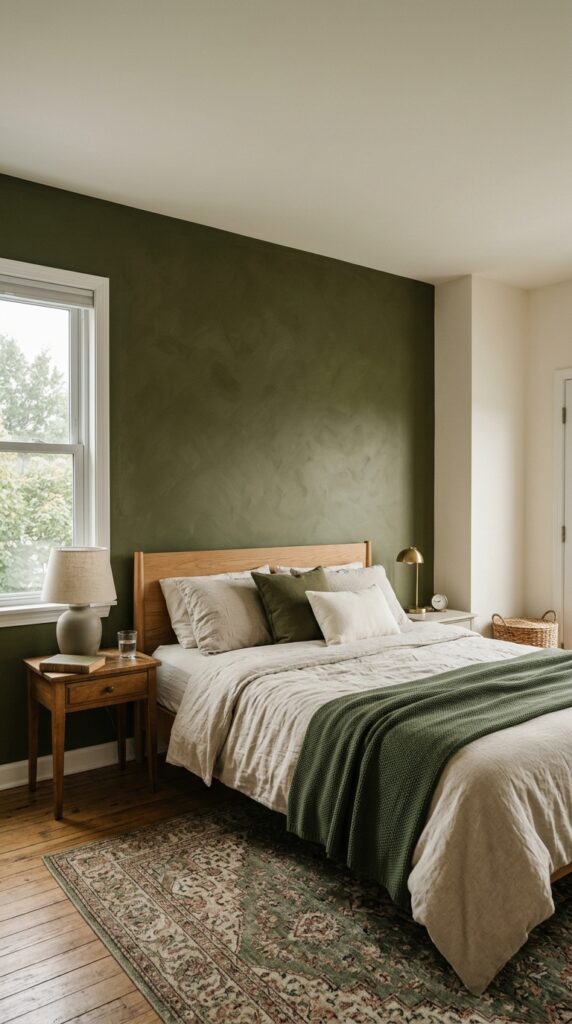
The phrase “accent wall” should be retired. It implies a pop of color for its own sake, usually a bright teal or a red that gives everyone a headache. The elevated version is a moody wall—a single wall painted a deep, desaturated color like olive, charcoal, or rust. The difference is that the moody wall doesn’t scream for attention. It recedes. It makes the room feel larger because the other walls fade into the background.
I painted the wall behind my bed in “Green Smoke” by Farrow & Ball, a gray-green that shifts throughout the day. The rest of the walls are a warm cream. The effect is that the bed feels anchored without being heavy. The rule: don’t use a bright or saturated color. No royal blue, no fire engine red. Those belong in a teenage bedroom or a sports bar. Cost: $50 to $80 for a gallon of quality paint. The trade-off is that a moody wall shows every scuff and bump. You’ll need to touch it up every year or so, and you can’t just spot-touch because the sheen will flash. You have to repaint the whole wall.
Pro tip: Paint the window trim on the moody wall the same dark color as the wall. White trim on a dark wall creates a harsh break. Blending the trim softens everything.
16. Unlacquered Brass Hardware (That Will Age)
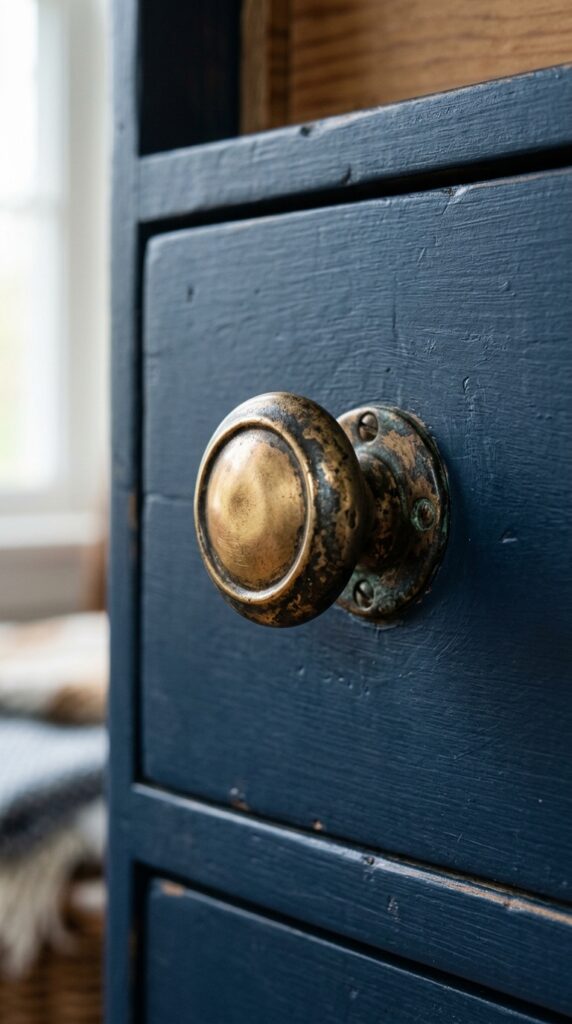
Most brass hardware you buy is lacquered, which means it stays shiny and yellow forever. Unlacquered brass does the opposite: it starts bright and then darkens, warms, and develops a patina from the oils in your hands. That aging is the whole point. It makes a bedroom feel lived-in and rich, not sterile. I swapped all the cheap satin nickel knobs on my dresser for unlacquered brass pulls three years ago, and every time I open a drawer, I see the places where my fingers have darkened the metal. It’s like a diary of use.
The catch: unlacquered brass is high maintenance. It will water-spot if you don’t dry it after cleaning. It will fingerprint. And if you live in a humid climate, it can develop a greenish verdigris that some people love and some people hate. Cost per pull: $8 to $25. For a dresser with eight pulls, that’s $64 to $200—not cheap, but you can do it gradually. The version that fails: using unlacquered brass in a bathroom or a bedroom where you use harsh cleaners. The chemicals will eat the patina unevenly. Stick to mild soap and water.
Pro tip: If you want to accelerate the patina, leave the hardware outside in a container with a sliced hard-boiled egg for a day. The sulfur fumes darken the brass quickly and evenly.
17. A Coverlet With Visible Weight (Skip the Fluffy Duvet)
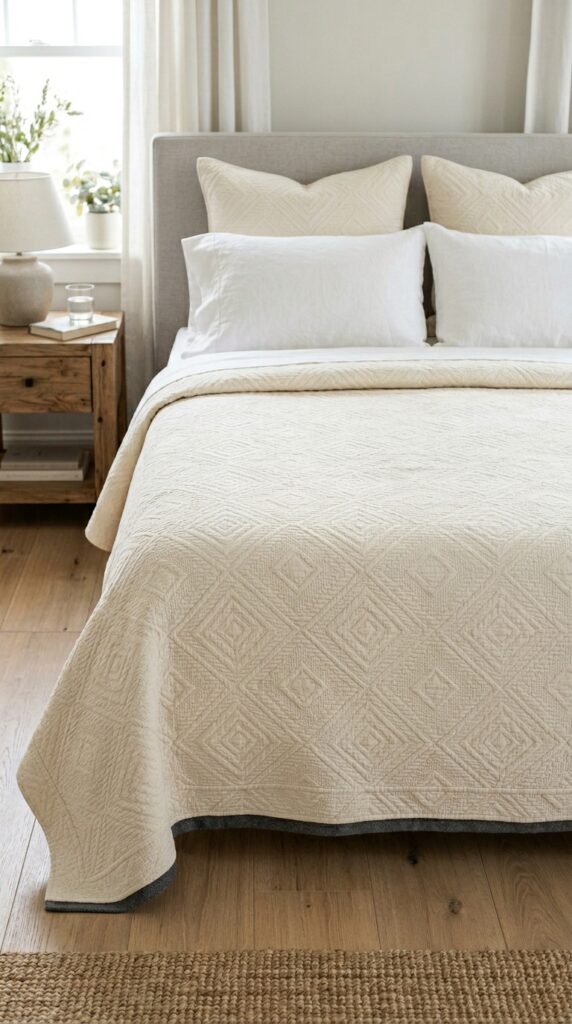
Fluffy duvets have their place (winter, cold climates, people who sleep cold), but for most of the year and for most of the look, a coverlet or a thin quilt creates a more elevated silhouette. It doesn’t bulge. It doesn’t require fluffing. It sits flat and lets the bed’s architecture show. I switched to a heavyweight cotton matelassé coverlet three years ago and haven’t gone back. The bed looks made even when I just straighten it quickly.
The material that works best: cotton matelassé, Belgian flax linen, or a thin washed wool. Avoid polyester “chenille” coverlets—they pill within two washes. Cost: $80 to $200. The trade-off is warmth. A coverlet alone isn’t enough for a cold bedroom. The solution is to layer: coverlet + a thin wool blanket + a duvet at the foot that you pull up only when needed. That layered look is actually more interesting than a single puffy rectangle. One thing that ages badly: coverlets with excessive stitching or embroidery. Simple quilting lines or a tone-on-tone pattern is timeless. Anything with slogans or giant medallions will embarrass you in two years.
Pro tip: Size up. A queen coverlet on a queen bed looks skimpy. Buy a king coverlet for a queen bed so it drapes generously over the sides.
18. A Real Tray (Not a Decorative One)
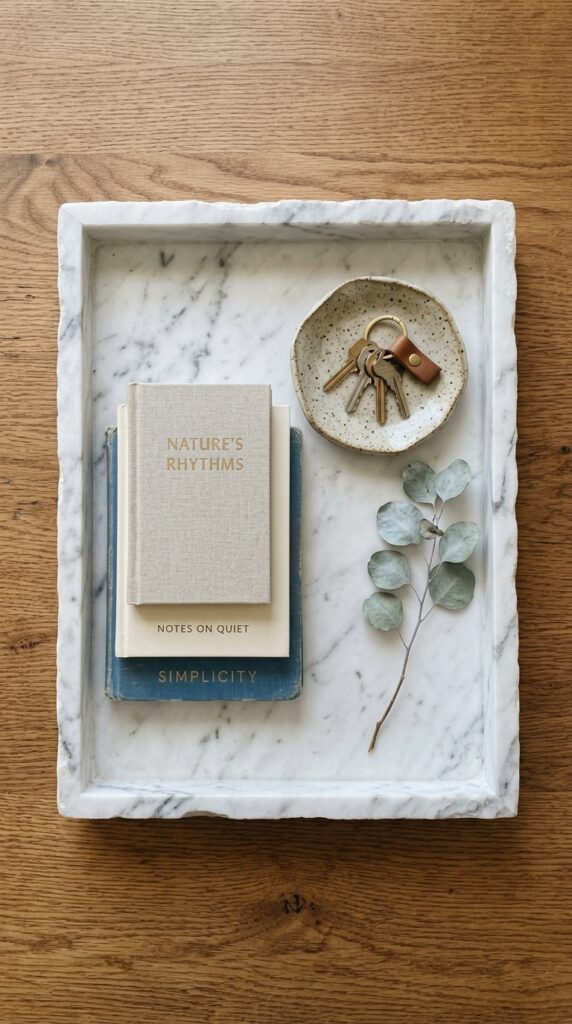
A tray on a nightstand or dresser is not a decoration. It’s a containment device. The human brain relaxes when objects are grouped together inside a defined boundary. A tray turns a scattering of things—phone, glasses, book, ring, lip balm—into a single visual unit. But the generic bamboo or metal tray from a discount store looks like what it is. The elevated version has weight and texture: marble, slate, thick leather, or solid walnut.
The sizes that actually work: a dresser needs a tray that’s at least 12×18 inches. A nightstand needs 8×10. Anything smaller and it looks like a coaster. Cost: marble trays run $40 to $100. Leather (good full-grain) is $60 to $150. The version that fails: a tray with tall sides. You want a shallow lip, half an inch or less. Tall sides hide the objects and make it look like a serving platter. Also, don’t overfill it. A tray with ten items is just a mess in a box. Three to five objects max.
Pro tip: Choose a tray material that contrasts with the surface it sits on. Dark marble on light wood. Light oak on a dark dresser. Contrast makes the tray read as intentional.
19. Pendant Lights Over Each Nightstand
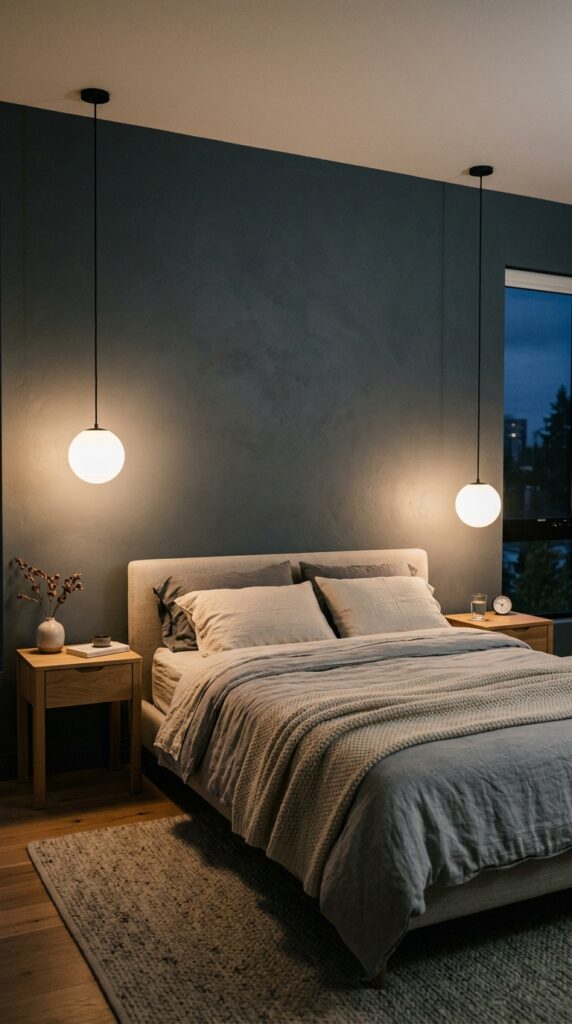
Sconces are safe. Pendants are a statement. Hanging a small pendant light over each nightstand frees up surface space and draws the eye upward, emphasizing ceiling height. The key is scale: the pendant should be no wider than the nightstand and should hang about 28 to 32 inches above the mattress. Any lower and you’ll bump your head. Any higher and it looks like a misplaced dining room fixture.
The honest friction: installing pendants requires ceiling work—cutting holes, running wire, potentially patching drywall. If you don’t have existing boxes above the bed, hire an electrician. Cost: $300 to $600 for two fixtures plus installation. That’s not nothing. But the result is more dramatic than sconces. What doesn’t work: using pendants with opaque shades. You want translucent glass or perforated metal so the light diffuses. A solid shade creates a harsh spot directly below and leaves the rest of the room dark. Under $50 for cheap fixtures, but spend at least $80 each for quality glass that won’t yellow from heat.
Pro tip: Put the pendants on a separate dimmer from the main overhead light. You want to be able to turn on just the pendants at night without blasting the room.
20. A Composition of Three Small Framed Objects
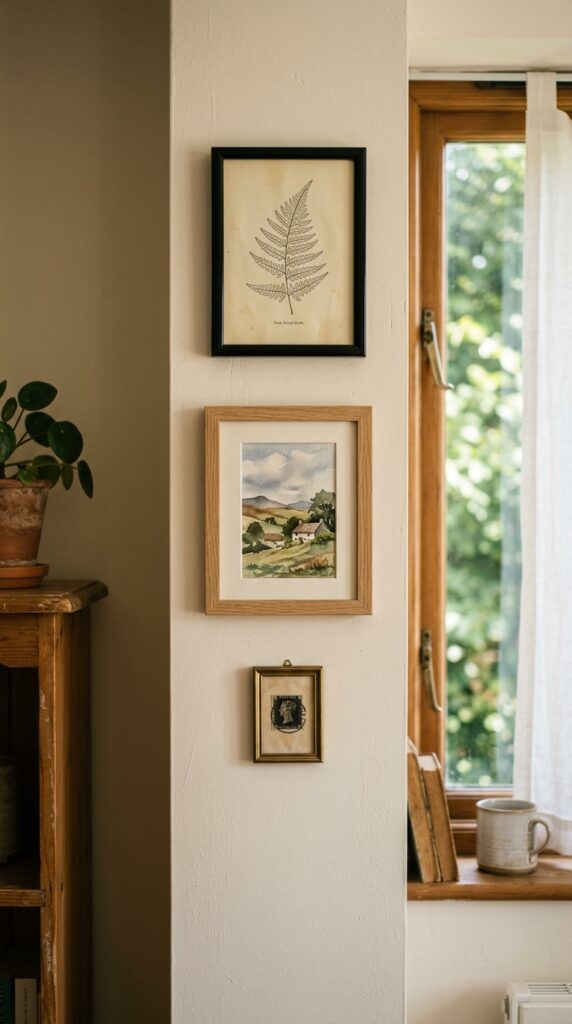
One large piece of art is the safest bet. But a well-executed grouping of three small pieces can be more personal and more flexible. The trick is that they don’t have to match. A print, a small textile, a pressed leaf in a floating frame—the variety is the point. What ties them together is either a shared color palette, a consistent frame material, or uniform spacing.
The spacing rule that works: three inches between frames. Two inches is too tight, four inches feels disconnected. Use a level and painter’s tape to map the positions before hammering. Cost: can be very low if you’re framing your own things ($20 to $60) or high if you buy original small works ($100 to $300). The version that fails: putting the three pieces in a straight horizontal line. That reads as a banner, not a composition. Vertical or a diagonal offset is better. Also, don’t hang them too high. The center of the grouping should be at eye level (57 inches).
Pro tip: Use picture hanging strips (Velcro style) for lightweight frames. You can adjust the spacing ten times without damaging the wall, which is essential because you will inevitably need to tweak it.
21. A Small Sculpture on a Pedestal (In a Corner)
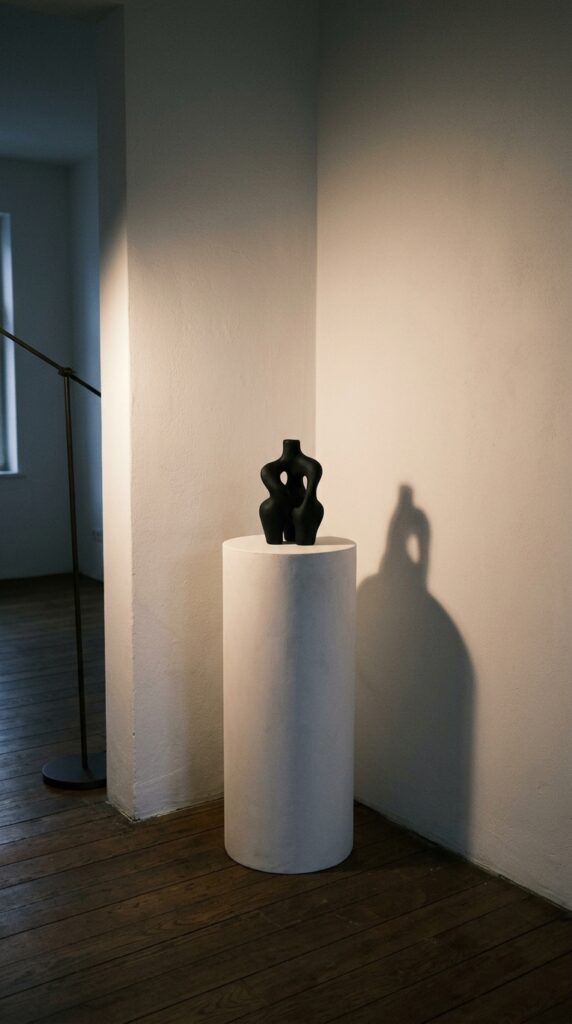
Empty corners are wasted opportunities. But filling them with a plant or a floor lamp is the obvious move. The unexpected one is a pedestal with a small sculpture. It doesn’t need to be expensive—a ceramic piece from a local potter ($40 to $100) on a simple plywood pedestal you paint yourself ($30) creates a moment of intentionality that most bedrooms lack.
The constraint: the pedestal needs to be tall enough (30 to 36 inches) so the sculpture sits at eye level when you’re standing. And the sculpture needs to be substantial enough that it doesn’t look like a knickknack. A tiny figurine on a tall pedestal is comical. Aim for something at least six inches in each dimension. The trade-off is floor space and the fact that you now have another surface to dust. Also, if you have toddlers or clumsy pets, this is a bad idea. A pedestal is a lever; a cat jumping on it will send everything flying. Under $100 total for a beginner version.
Pro tip: Position the pedestal so it’s lit from the side, not the top. Side lighting creates shadows that emphasize the sculpture’s form. Overhead lighting flattens it.
22. A Vintage Door as a Headboard
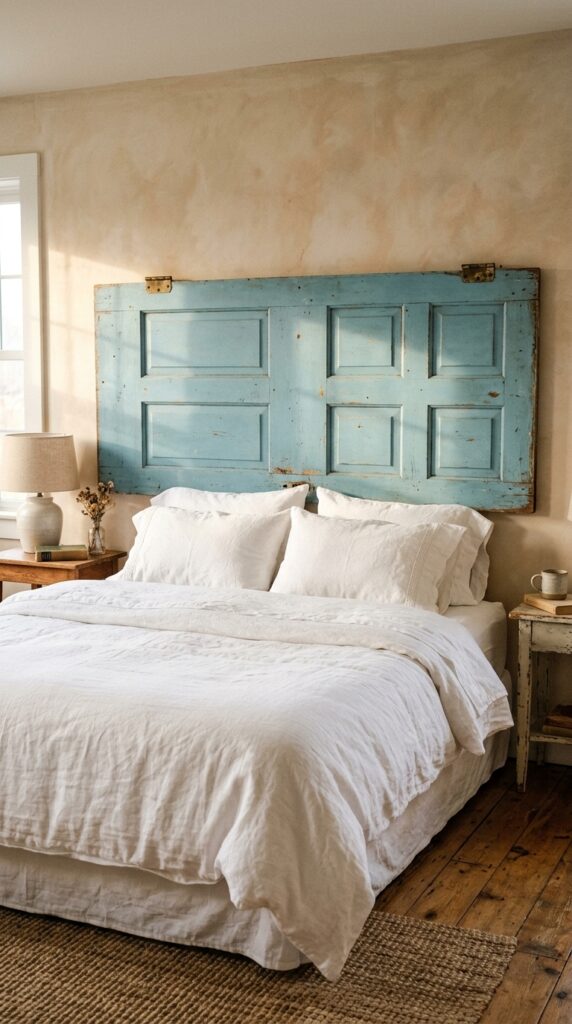
This is not for everyone. But if you have patience for hunting and a tolerance for imperfection, a vintage door makes a headboard with more character than anything you can buy new. The key is finding a solid wood door (not hollow core), at least 60 inches wide for a queen bed. Architectural salvage yards are the best source ($40 to $150). Paint colors from previous decades—faded mint, chipping cream, old ochre—are part of the appeal.
The practical nightmare: mounting a 60-pound door to the wall requires heavy-duty French cleats or lag bolts into studs. It’s not a one-person job. And the door will have lead paint if it’s old enough. You need to seal it with a clear topcoat or encapsulant. Cost including hardware and sealant: $100 to $250. The version that fails: a door that’s too narrow or too short. It needs to be at least as wide as the bed and tall enough to come up to at least 36 inches above the mattress. Anything smaller looks accidental.
Pro tip: Remove the doorknob hardware but leave the keyhole plate. That small detail is what makes it read as a door rather than just a big piece of wood.
23. A Window Bench With Cushions That Match the Bedding
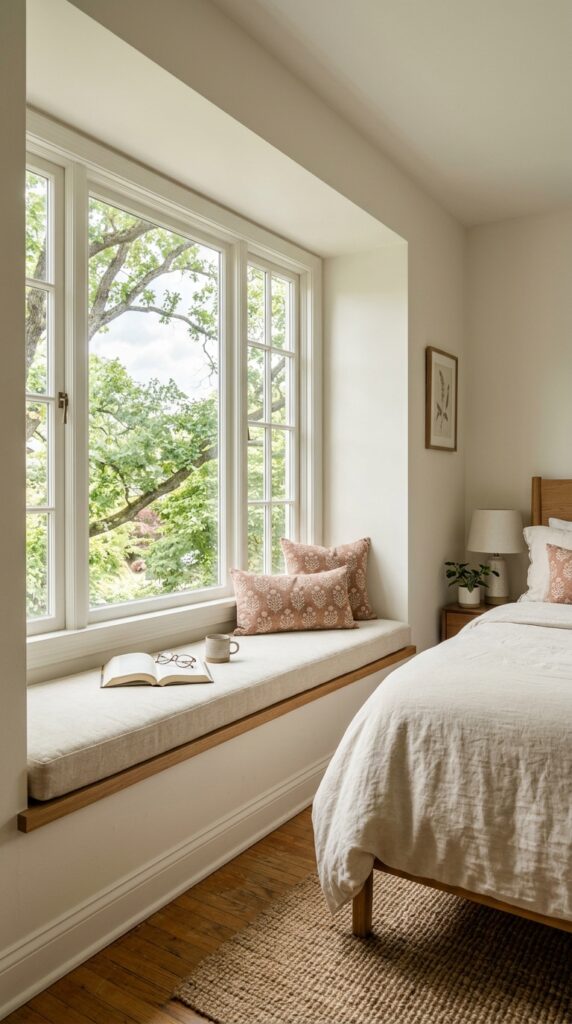
If you have a window that isn’t occupied by a radiator or a piece of furniture, a bench turns dead space into a destination. The elevated version isn’t a standalone bench shoved under a window; it’s a bench that’s either custom-built to fit the alcove or a piece that exactly matches the window width. Then—and this is the detail that ties the room together—upholster the cushion in the same fabric as your duvet or shams.
The repetition of fabric connects the bench to the bed, making the whole room feel designed rather than assembled. Cost for a custom cushion: $100 to $300. The bench itself: $150 to $500 depending on whether you build or buy. The trade-off: a window bench without a back is uncomfortable for long sits. It’s fine for putting on shoes or reading for ten minutes, but don’t expect to lounge there. Also, direct sunlight will fade the fabric within a year if it’s not UV-resistant. Either choose a fade-resistant fabric (solution-dyed acrylic) or accept that you’ll re-cover it eventually.
Pro tip: Add a lift-up seat to the bench for hidden storage of out-of-season bedding. A hinged top is easy to DIY with a piano hinge and gas struts.
24. A Folding Screen (Not Just for Dressing)
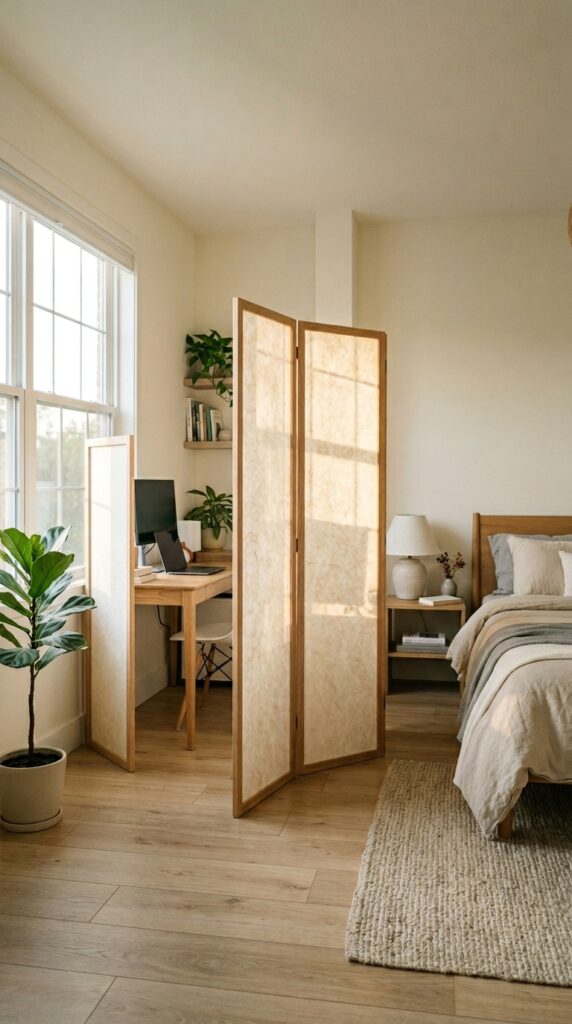
Bedrooms often have an awkward zone—a desk that doesn’t belong, a Peloton bike, a pile of boxes you’re pretending to deal with. A folding screen provides instant separation without renovation. But the trick is not to use a screen that looks like a prop from a 1990s mall store (black lacquer with gold dragons, please no). The modern screen is made from natural materials: wood frames with linen, rice paper, or cane panels.
The height matters. A screen under five feet tall hides nothing from a standing adult. Look for 70 to 72 inches. Cost: $150 to $400 for decent quality. The version that fails: a screen that’s too heavy. If you can’t easily fold and move it, you’ll leave it in one position forever, and you’ll resent the lost flexibility. Also, screens collect dust in every joint and crevice. You’ll need to wipe each panel individually. The trade-off is floor space—a three-panel screen typically takes up a footprint of about 18 inches by 48 inches when open.
Pro tip: Use a screen to create a “dressing area” by placing it behind an open closet or armoire. The screen gives you privacy without having to close a door.
25. A Dimmer Switch on Every Single Light
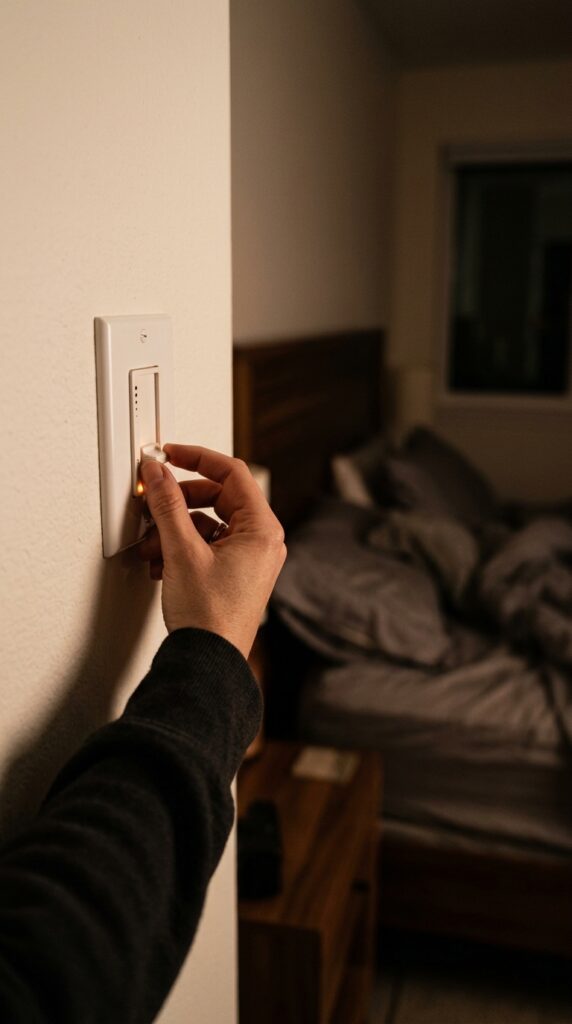
This is the least sexy idea on the list and the one that will improve your bedroom more than any piece of furniture. A bedroom without dimmers is a bedroom that only knows two settings: off and operating room. The ability to turn your overhead light to 15% for the final half hour of reading, or your sconces to 30% while you’re falling asleep, changes the way you use the room entirely.
The friction: not all dimmers work with all bulbs. LED bulbs require specific compatible dimmers. If you get it wrong, you’ll get flickering, humming, or a bulb that never fully turns off. Buy LED-compatible dimmers (they’ll say “C-L” or “LED” on the box) and stick with bulbs from the same brand. Cost per dimmer: $15 to $30. Installation is a DIY job if you’re comfortable turning off the breaker and wiring a switch. If not, an electrician will charge $100 to $150 for multiple switches in one visit.
The version that fails: using a dimmer with a built-in night light or a slide that’s too stiff. You want smooth, progressive dimming from 0 to 100. Test it before installing if possible. And one thing no one tells you: dimmers run warm. They’re designed to dissipate heat, but if your switch plate feels hot to the touch, you’ve exceeded the wattage rating. Add up the wattage of all bulbs on that circuit and stay under 80% of the dimmer’s max.
Pro tip: Install a dimmer with a “preset” feature that remembers your last setting. Then you can turn the light on at your preferred level without sliding every time.
Conclusion
You don’t need to do all 25. That’s not the point. The point is to recognize that an elevated bedroom isn’t about following a checklist—it’s about making choices that fit how you actually live. Start with the dimmers. I’m serious. For under $100 and an afternoon with a screwdriver, you change the entire mood of the room more than any piece of art or rug ever could. Then pick one surface-level move: swap your nightstand lamps for sconces, or layer a jute rug under your wool one, or paint that ceiling. Just one. Live with it for a month.
The rooms that feel truly elevated aren’t the ones with the most expensive things. They’re the ones where you can tell someone made deliberate choices—where the hardware is unlacquered brass that’s started to darken, where the art is hung at exactly the right height, where the light never shocks you awake. Those details don’t happen by accident. They happen because someone decided that how they wake up and fall asleep matters enough to fuss over a switch or drive to a salvage yard for a door.
So here’s the only rule worth remembering: your bedroom should be quieter than the rest of your house, in every sense. Less visual noise, less harsh light, less friction. The ideas above are just tools to get there. Now go dim something.