There is a difference between a dark room and a moody room. A dark room just lacks light. A moody room has atmosphere—it leans into shadow, celebrates low contrast, and wraps you in something that feels more like a refuge than a showroom. I learned this distinction the hard way after painting my first apartment bedroom charcoal gray and wondering why it felt like a cave instead of a sanctuary. The problem wasn’t the color. It was that I hadn’t considered texture, layering, or the way light moves across surfaces. Moody isn’t about absence. It’s about intention.
Most advice on moody bedrooms stops at “paint the walls dark” and calls it a day. That’s like saying a steak is done when it’s brown. The real work is in the details that keep a dark room from feeling like a basement: the sheen of the paint, the material of the curtains, the warmth of the bulbs, the unexpected moments of lightness that give the darkness something to push against. Without those counterpoints, you don’t have drama. You have depression.
What follows are 25 ideas that go one level deeper. Some are cheap (under $50), some are serious investments, and at least half of them are things you won’t find in every “dark bedroom” listicle because they require you to think about finishes, friction, and the way a room actually feels at 11 p.m. when you’re tired. Pick six or seven that resonate. Your bedroom should feel like a storm you choose to walk into, not one you’re trapped in.
1. Black Limewash Paint (Not Flat Black)
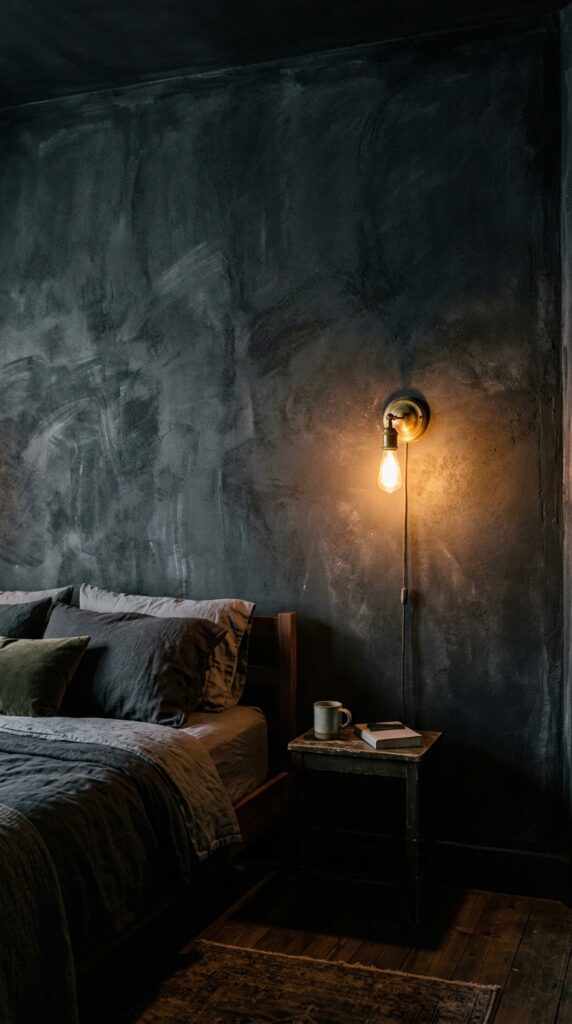
Flat black paint from a hardware store looks dead. It’s like a black hole—all absorption, no character. Limewash or mineral paint in black (or a very deep charcoal) has variation. It breathes. The application method (brush, not roller) leaves streaks and shifts in tone that make the wall feel like a surface that has history, not a featureless void. I used Portola’s “Raven” limewash in my current bedroom, and visitors always touch the wall. That’s the test.
The trade-off: limewash is expensive ($70 to $120 per gallon, and you need two coats) and it’s not scrubbable. If you touch it with a damp cloth, the pigment moves. Also, it smells like wet plaster for a week. But it ages beautifully—small chips and rub marks just add to the texture. Under $200 for a typical bedroom wall. The version that fails is any faux limewash roller kit. Real limewash is applied with a wide brush in random crisscross strokes. The kits look like bad sponge painting.
Pro tip: Don’t tape your edges with limewash. It bleeds under the tape unpredictably. Cut in freehand and accept a slightly organic edge.
2. Velvet Blackout Curtains (That Actually Pool)
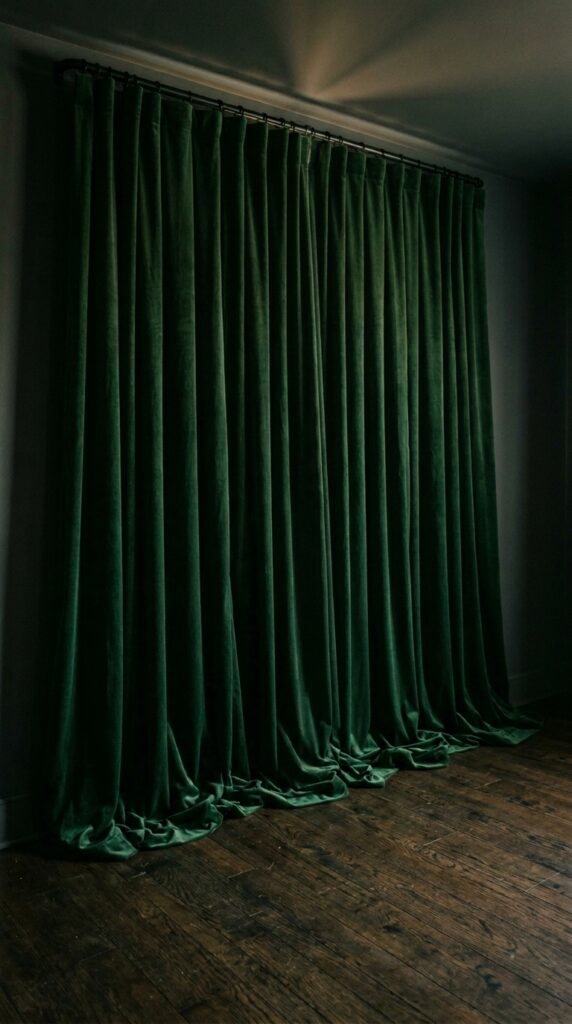
Moody rooms need curtains that mean business. Sheer linen is for airy bedrooms. You want velvet, velour, or heavy cotton sateen with a blackout lining. The fabric should be so dense that when you close them, the room goes to actual darkness—not “dim,” but pitch black at noon. That control over light is what lets you create drama on your own terms.
The pooling detail is non-negotiable for moody aesthetics. Curtains that hover an inch above the floor look cautious. Velvet that piles up in soft heaps on the floor (four to six inches of extra length) says “I’m not afraid of excess.” The cost of that pool: you’ll need at least 15% more fabric than standard length, and you’ll need to vacuum the dust that collects in the folds weekly. Expect to pay $200 to $500 for a pair of quality velvet blackout panels. The version that fails is cheap polyester velvet—it crushes permanently and reflects light in a greasy way.
Pro tip: Use a ceiling-mounted curtain track instead of a rod. It eliminates the light leak at the top and makes the curtains feel like a built-in architectural feature.
3. A Single Candle Sconce (Unbalanced)
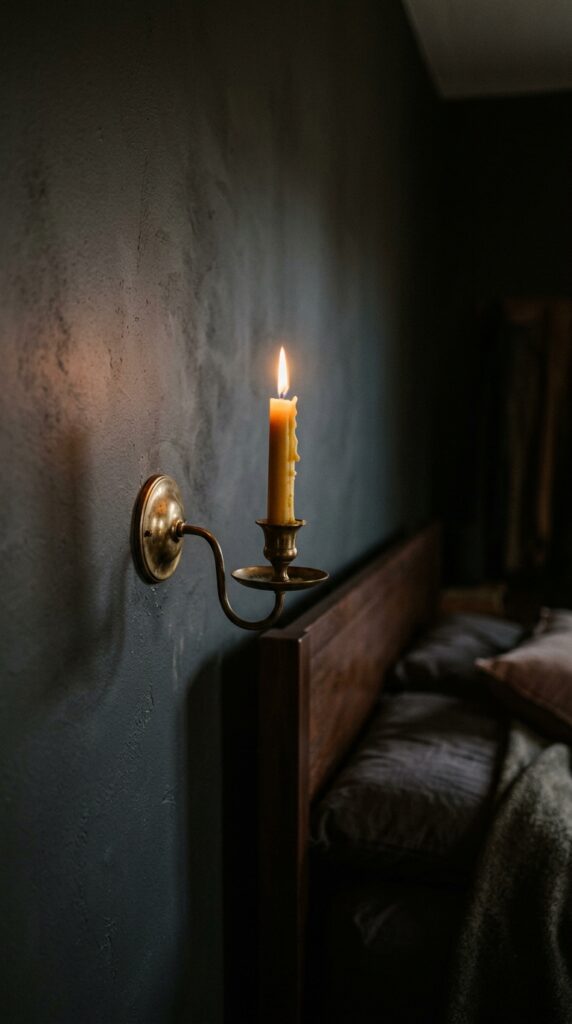
Matching sconces on either side of the bed is balanced. It’s safe. A single candle sconce, placed off-center or on just one side, is moody. It suggests that the room serves one person’s ritual at a time—reading alone, a late-night thought, a quiet moment before sleep. I removed one of my bedside sconces after living with two for years, and the room immediately felt more personal, less like a hotel.
The reality: candle sconces are not practical as primary lighting. You’ll still need another source for tasks. But as an accent that you light for 30 minutes each evening, they change the entire atmosphere. Look for sconces with a deep backplate to catch wax drips. Cost: $40 to $120 for the fixture, plus candles. The trade-off is that you’re dealing with open flame. Don’t put one near curtains or bedding, and never leave it burning unattended. Battery-operated flameless candles are an option, but they don’t flicker the same way. The cheap ones look like toys.
Pro tip: Use unscented beeswax candles. Scented candles in a bedroom compete with sleep and can trigger headaches. Beeswax burns clean and smells like nothing.
4. Crimson or Oxblood Bedding (Not Burgundy)
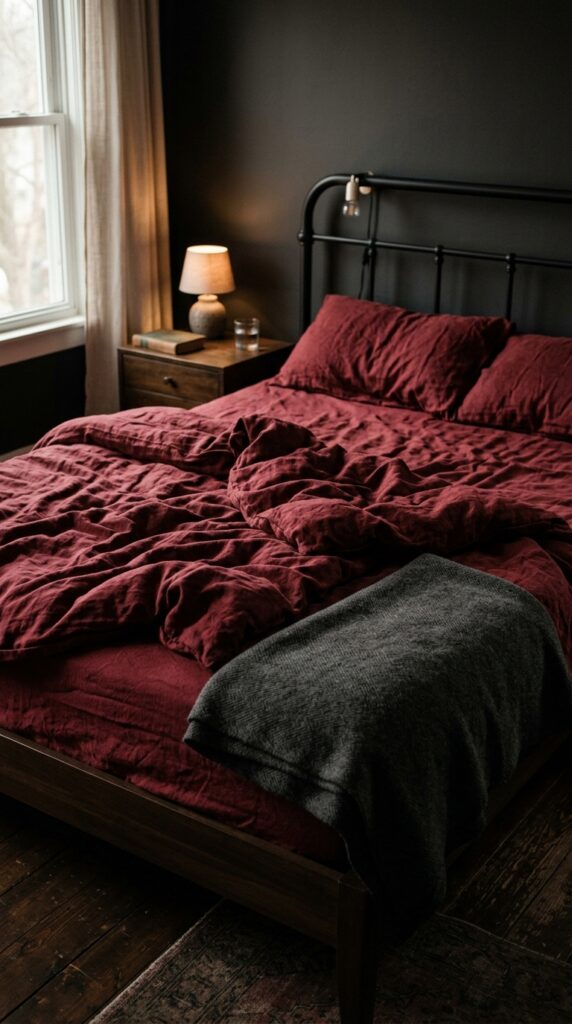
Red bedding is risky. Most reds look either Valentine’s Day or sports-team aggressive. But a deep, desaturated crimson—almost brown in low light—has a different effect. It reads as warm blood, as richness, as something slightly dangerous. I switched from white sheets to oxblood linen three months ago, and the bedroom went from serene to smoldering. It’s not for everyone. But if you want drama, this is it.
The trick is saturation: you want a red that’s so deep it’s almost black in shadow. Think “black cherry” or “old oxblood.” Avoid anything with orange undertones (that’s burgundy, and it reads as dated) or purple undertones (that’s merlot, and it reads as formal). Cost for a linen duvet cover in this color: $150 to $300. The trade-off: dark red shows every piece of lint, every pet hair, every crumb. You’ll be using a lint roller daily. Also, red dyes can bleed. Wash alone in cold water for the first three washes.
Pro tip: Pair oxblood bedding with charcoal or black sheets, not white. White sheets next to red create a graphic contrast that kills the mood. Stay in the same tonal family.
5. Dark Wood Floors or a Near-Black Stain
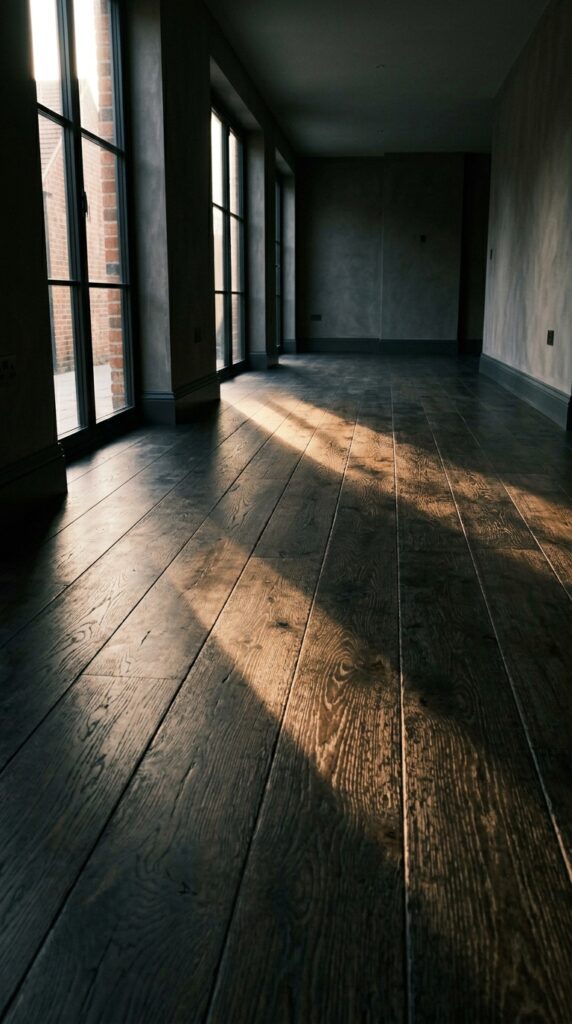
If you have light floors, a moody room will always fight itself. The floor is the largest surface in the room, and a pale oak or maple floor reads as bright even if the walls are black. The solution is either refinishing with a near-black stain or laying a dark floating floor. I refinished my bedroom floors with a “true black” stain from Bona, then sealed with matte polyurethane, and the room finally felt cohesive.
The friction: dark floors show every speck of dust, every hair, every footprint. You’ll be sweeping daily. Also, they make a room feel smaller and the ceiling lower—which is exactly what you want for moody, but it’s a trade-off. Cost to refinish an average bedroom: $300 to $600 if you DIY (rental sander, stain, sealer). Hiring out is $800 to $1,500. The version that fails: glossy dark floors. Shine bounces light and creates reflections that ruin the mood. Stick with matte or satin. And never use black paint on wood floors. It chips and looks like a high school theater set.
Pro tip: Test your stain on a hidden corner first. Many “black” stains dry more charcoal than black. You may need two applications or a tinted topcoat.
6. A Leather Headboard (That Will Scratch)
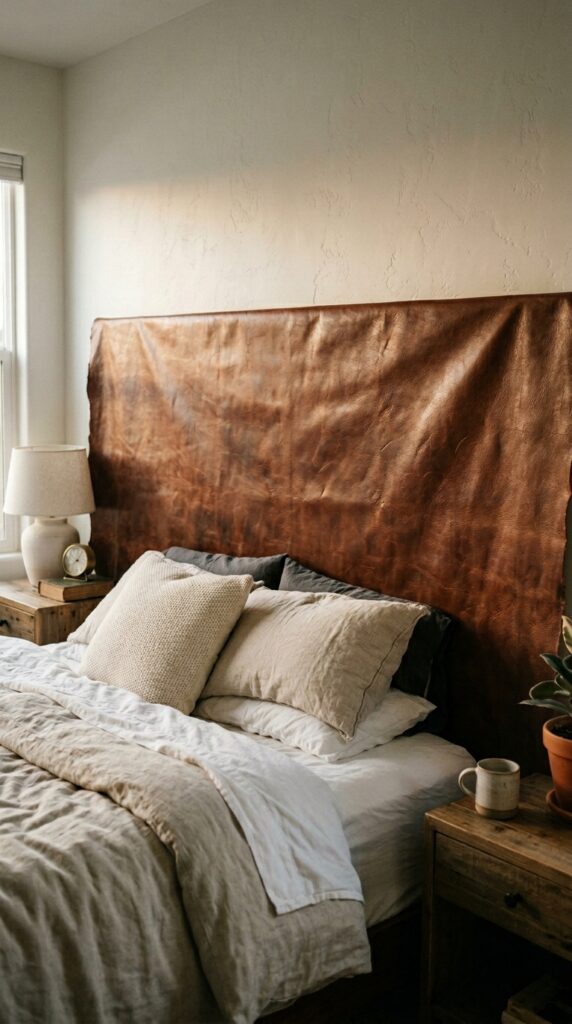
Fabric headboards are too soft for a truly moody room. Leather (or high-quality faux leather) has a different presence. It’s cool to the touch, slightly reflective, and it ages in a way that adds character. A leather headboard will scratch. It will show where your head has rested. It will darken where your hand touches it every night. That’s not damage. That’s patina.
The key is choosing a leather with visible grain and imperfections. Smooth, corrected-grain leather looks like plastic. Full-grain or top-grain with natural markings is what you want. Cost: $400 to $1,200 depending on size and leather quality. The trade-off is temperature—leather is cold in winter and can feel clammy if you lean against it with bare shoulders. Keep an extra pillow behind your back. Also, cats and leather don’t mix. One scratch from a playful claw is permanent. If you have pets, this is not your move.
Pro tip: Mount the headboard so it floats about two inches off the mattress. That gap prevents the pillow from pushing the headboard away from the wall over time.
7. Paint the Ceiling Gloss Black (Yes, Gloss)
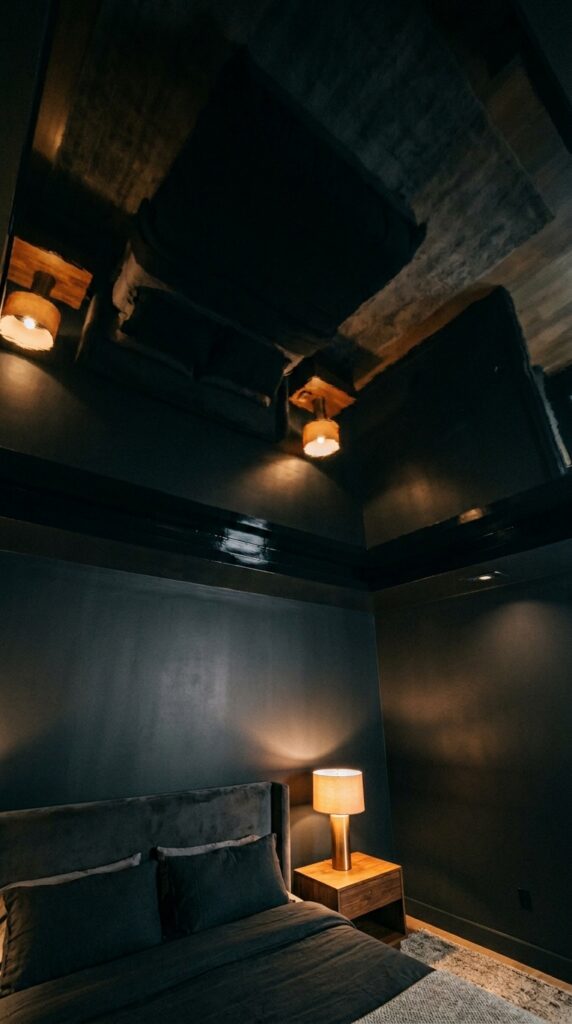
Earlier I said matte is your friend for moody walls. The ceiling is different. A high-gloss black ceiling reflects light and the room back at itself, creating the illusion of height and infinity. It’s a trick that sounds wrong but looks incredible. I saw this in a Brooklyn townhouse once and never forgot it. The ceiling was like a dark sky with city lights reflected in reverse.
The execution is brutal. Gloss paint shows every roller stroke, every drip, every speck of dust. You need a near-perfect ceiling surface to start (no popcorn texture, no patchy drywall seams). And you need a sprayer, not a roller. If you roll gloss black, you’ll see the lines forever. Cost for paint and sprayer rental: $100 to $200. Hiring a pro is $400 to $800. The trade-off: the gloss will highlight any imperfection in your drywall. If your ceiling has cracks or uneven patches, fix them first or abandon this idea. Also, high-gloss ceilings are a bitch to repaint. You’ll need to sand the entire thing to give the next coat something to grip.
Pro tip: Use a paint additive called Floetrol to slow drying time and let the gloss level out. Without it, the paint skins over before the brush marks can relax.
8. A Cluster of Salt Lamps (Not Just One)

One salt lamp is a cliché. A cluster of five or six is a mood. The aggregated light from multiple small salt lamps is warmer and more diffused than a single lamp, and the organic shapes of the raw salt crystals add texture that you don’t get from a standard light source. I have a cluster on a low cabinet in my bedroom, and it’s the last thing I look at before falling asleep.
The honest truth: salt lamps are hygroscopic—they attract moisture and can sweat or even drip water in humid climates. Put them on a waterproof surface (a ceramic plate or a piece of glass) or they’ll leave a rust ring on your wood furniture. Cost for a set of five small lamps: $40 to $80. The version that fails is buying one giant salt lamp. The big ones have uneven light distribution—bright at the bottom, dim at the top. Small ones clustered give a more even glow. Also, don’t believe the “negative ion” marketing. They’re pretty lights, not medical devices.
Pro tip: Put the cluster on a smart plug set to turn on at sunset and off at midnight. That way you don’t have to touch each lamp individually every night.
9. Burgundy Floral Wallpaper (Dark, Not Pretty)
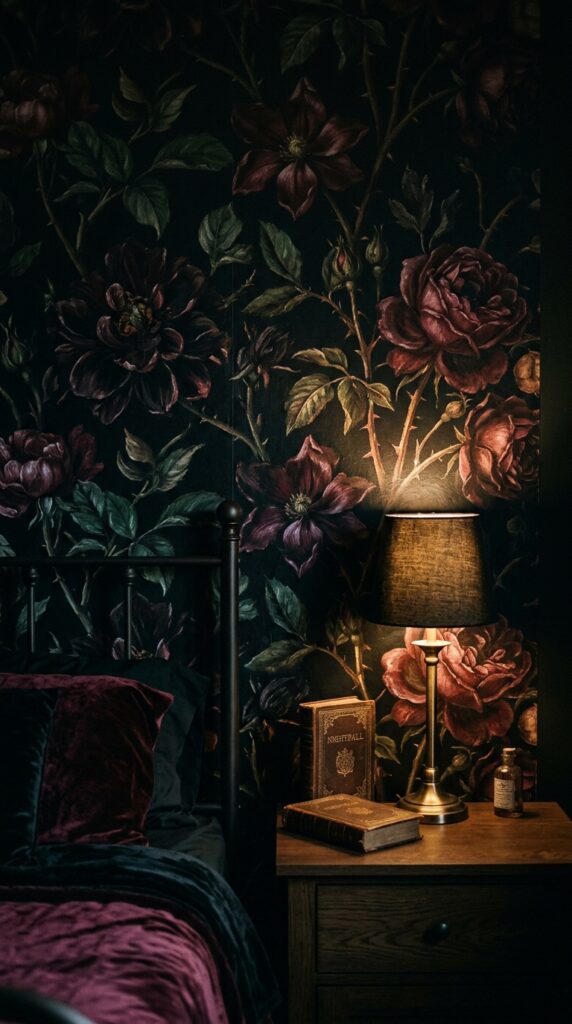
Floral wallpaper can be moody if you choose the wrong pattern on purpose. You don’t want cheerful English garden roses. You want something that looks like it was found in a decaying Victorian manor—deep burgundy blooms on a charcoal or black ground, maybe with metallic silver accents. I found a William Morris knockoff (“Strawberry Thief” in a dark colorway) and put it on one wall. It changed everything.
The friction: wallpaper is a commitment. Removal is a nightmare. And dark wallpaper makes a small room feel even smaller. Put it on one feature wall only, or in a room with at least 12×12 feet of floor space. Cost: $50 to $150 per roll (you’ll need two to three rolls for an accent wall). Installation is tricky—hire a pro for $200 to $400 or spend a weekend cursing at bubbles. The version that fails is cheap peel-and-stick in a dark pattern. The seams show, it peels at the edges in humidity, and the colors are never as rich as they look online.
Pro tip: Hang the wallpaper so the pattern repeats at the ceiling line, not centered on the wall. That way the pattern doesn’t look cut off awkwardly near the crown molding.
10. No Overhead Light. None.
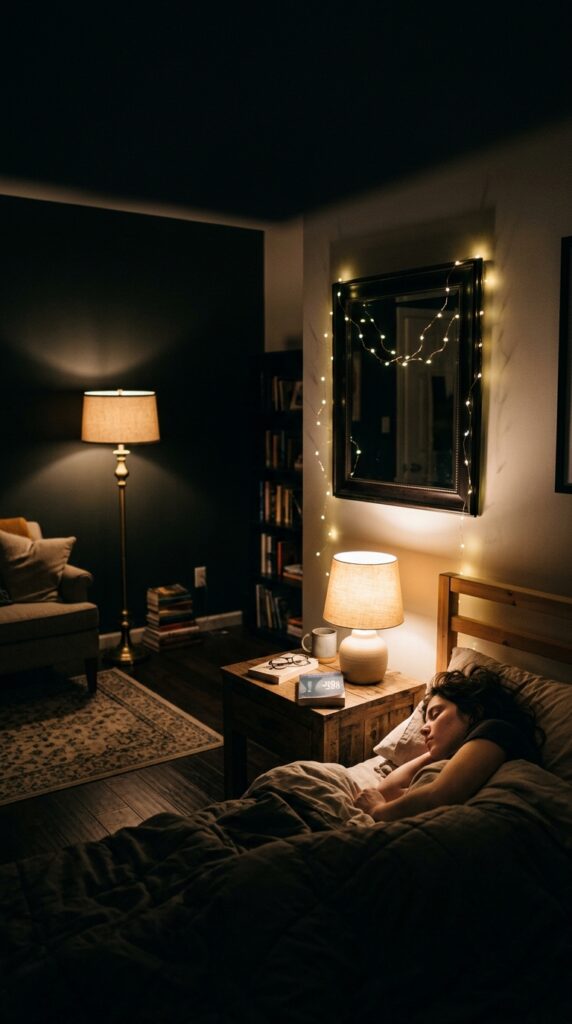
The fastest way to kill a moody atmosphere is to flip on a ceiling light. Overhead fixtures cast light from above, which is exactly how an interrogation room is lit. A moody bedroom has no overhead light at all. Just lamps, sconces, and candles placed at standing or seated height. The light comes from the sides and below, which is more flattering to human faces and creates shadow where you want it.
This means removing your ceiling fixture and capping the wires. That’s easy if you’re comfortable with electrical work (turn off the breaker, wire nut the hot and neutral, install a blank cover plate). If not, an electrician will charge $100 to $150. The trade-off is that you lose the ability to light the whole room at once. Cleaning or packing a suitcase becomes harder. Keep a standing lamp that you can point at what you’re working on. Cost: free to $150. The version that fails is using a dimmer as a substitute for removing the ceiling light. The fixture is still there, even at 10%. It’s an ugly architectural wart. Just remove it.
Pro tip: Replace the ceiling light with a flush-mount smoke detector if code requires something on the ceiling. Function over form, but invisible.
11. Wrought Iron Bed Frame (Thin and Dark)
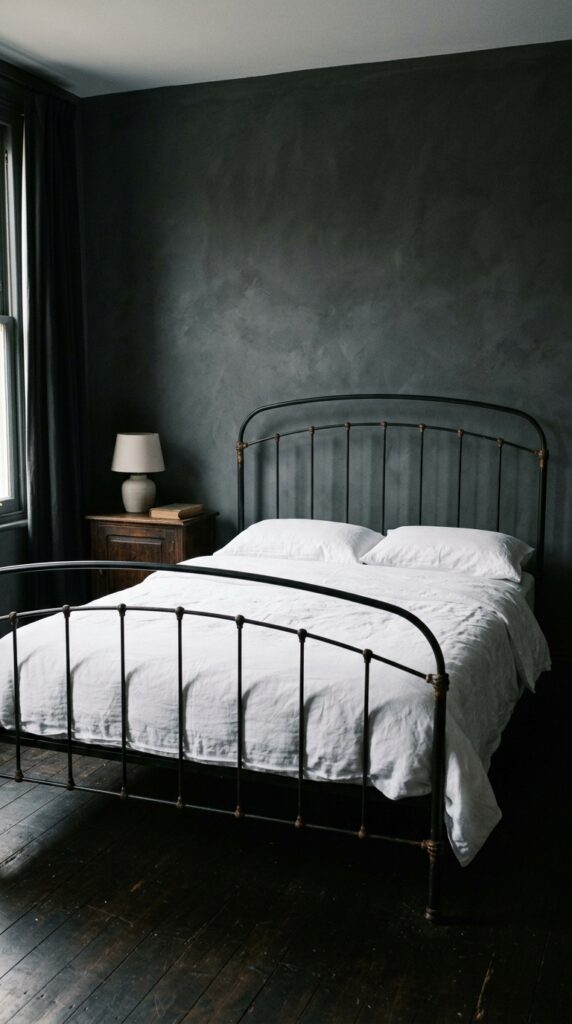
Wooden bed frames are warm. Wrought iron is cool, severe, and Gothic in the best way. A thin, unadorned iron bed frame (look for 19th-century reproductions with simple curves, no brass finials) doesn’t compete with dark walls. It disappears into them, leaving only the suggestion of a structure. I replaced a chunky walnut bed with a vintage iron bed from a salvage shop, and the room got lighter visually even though the walls stayed black.
The friction: iron beds can squeak. The joints where the rails meet the headboard and footboard loosen over time. You’ll need to tighten the bolts every six months or live with a rhythmic squeak every time you shift. Cost for a new reproduction: $300 to $700. Vintage can be cheaper ($100 to $300) but expect rust. The version that fails is a cheap “wrought iron style” bed made of hollow tubing. Real wrought iron is solid and heavy. The hollow stuff bends and snaps at the joints. Lift one corner before buying—if it’s light, walk away.
Pro tip: Paint a rusty iron bed with Rust-Oleum in matte black after sanding. It stops further rust and unifies the color. Wear a mask—old iron dust is nasty.
12. A Black Sheepskin Throw (Fake Is Fine)
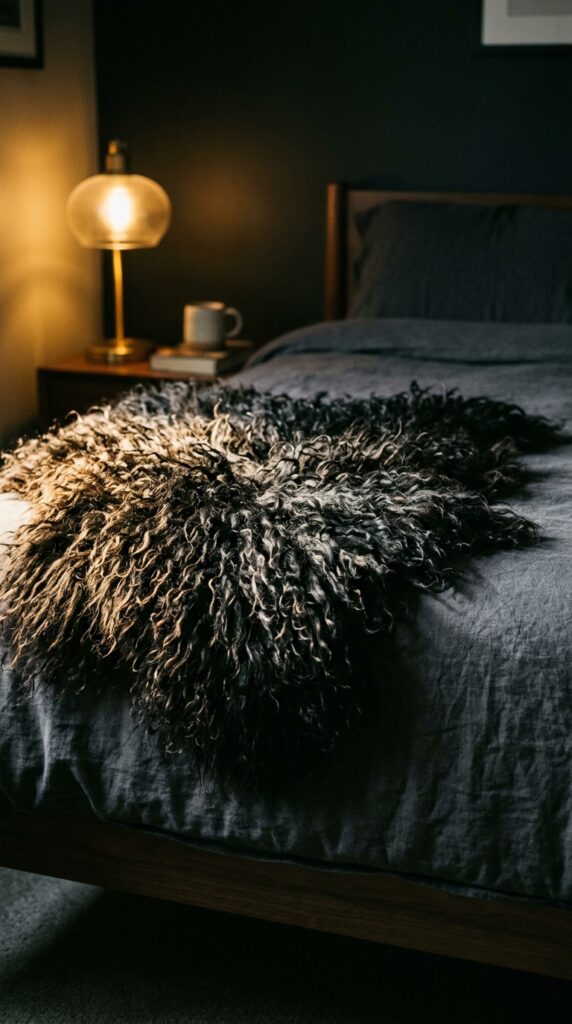
Texture is the secret weapon of moody rooms. When everything is dark, you need surfaces that beg to be touched. A black sheepskin (or a high-quality faux version) at the foot of the bed or draped over a chair adds an organic, almost primal texture that reads as luxurious but not precious. Real sheepskin is around $80 to $150; good faux is $30 to $60.
The trade-off: real sheepskin sheds. You’ll find little black fibers on your floor for months. And it’s a pain to clean—spot clean only, never machine wash. Faux is easier but looks synthetic in direct light. The version that ages badly is white or cream sheepskin in a moody room. The contrast is too high, and it reads as “ski lodge” instead of “brooding.” Black or charcoal only. Also, sheepskin on the floor as a rug is a mistake. It mats down and looks like a dead animal within a year. On the bed or a chair, it lasts much longer.
Pro tip: Faux sheepskin has come a long way. Look for “ultra-soft” or “mink” faux fur with a backing that breathes. Avoid anything with a shiny synthetic backing—it slides off the bed.
13. A Single Spotlight (Aim It at Something)

Most moody rooms use diffuse, soft light. That’s fine. But one focused spotlight—aimed at a piece of art, a sculpture, or even a textured wall—creates a moment of theater. The rest of the room stays dark, but that one illuminated object becomes an anchor. I put a small gimbal spotlight on a bookcase, aimed at a ceramic vessel, and now the room feels like a gallery after hours.
The tool: look for a “picture light” that mounts on the wall above the art, or a small track head on a ceiling-mounted rail. Cost: $30 to $100 for a basic fixture, plus $10 for a high-CRI bulb (you want color accuracy for art). The trade-off is that spotlights create hard shadows, which some people find harsh. Position the light so the beam hits the art at a 30-degree angle to minimize glare. And never aim a spotlight at a mirror—it will blind you from across the room. The version that fails is using a standard floodlight. You want a narrow beam (15 to 25 degrees).
Pro tip: Put the spotlight on a separate switch so you can turn on just that one light for dramatic effect. It’s the equivalent of candlelight but for art.
14. Paint Your Trim and Molding the Same Dark Color as the Walls
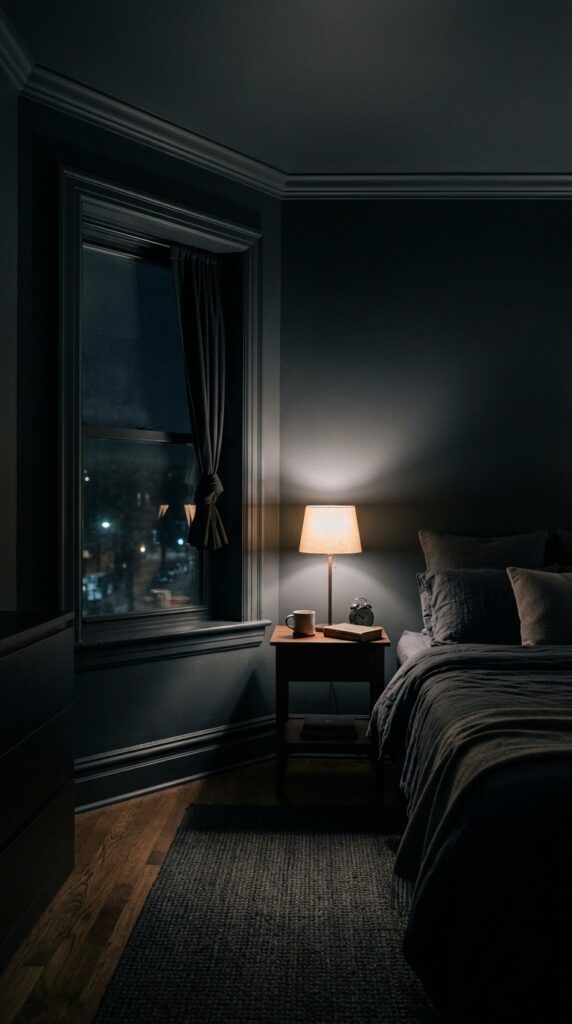
Conventional wisdom says trim should be lighter than walls (usually white). In a moody room, that rule ruins everything. White trim against a dark wall creates a graphic, high-contrast outline that fights the atmosphere you’re trying to build. The correct move is to paint the trim the exact same color as the walls, ideally in the same sheen (matte for both). The room becomes a continuous dark envelope.
I painted my window casings and baseboards black after living with white trim for a year, and the difference was shocking. The windows stopped looking like holes in the wall and started feeling like part of the dark architecture. Cost: an extra gallon of paint ($40 to $60). The trade-off is that dark trim shows dust and scuffs instantly. You’ll be wiping down baseboards weekly. Also, if you ever want to go back to light walls, painting over dark trim is a multi-coat nightmare. This is a committed moody-person move.
Pro tip: Use a satin or eggshell sheen on the trim if the walls are matte. The slight difference in reflectivity helps the trim read as a different element without adding contrast.
15. Copper or Rose Gold Accents (Very Sparingly)
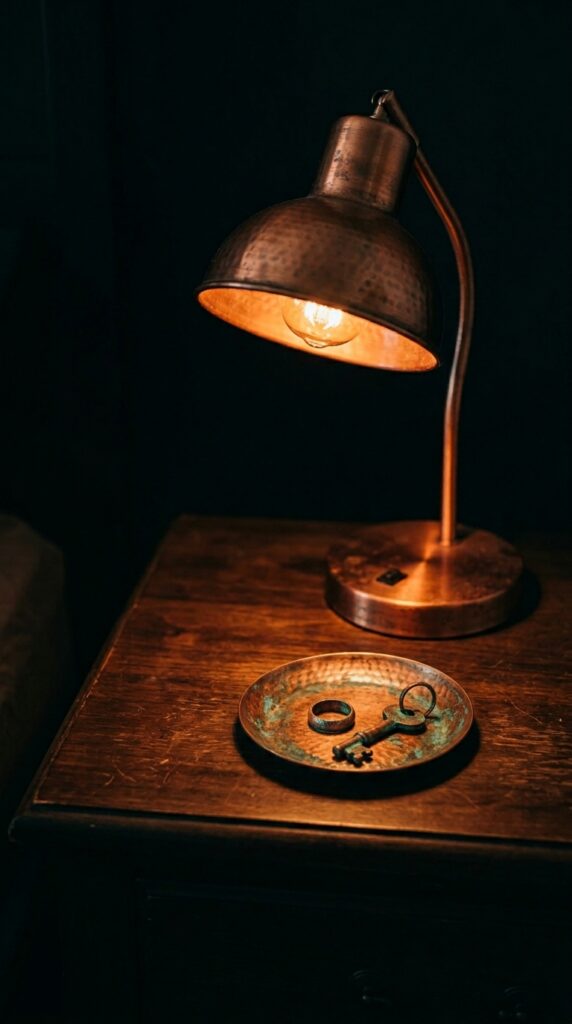
Brass and gold are expected in dark rooms. Copper is rarer and more interesting because it has orange-red undertones that contrast beautifully with black and charcoal. The rule is extreme restraint: one copper lamp, or a copper tray, or a single copper vase. Not all three. The room should have one copper note, like a single chord in a minor key symphony.
The material reality: copper oxidizes and darkens unevenly. Some people love that. Some people hate it. If you want it to stay shiny, you’ll need to polish it monthly with a copper cleaner. If you let it patina, it will turn brown and then greenish over years. Cost for copper accessories: $20 to $100 each. The version that fails is mixing copper with other warm metals (brass, gold) in the same room. They compete. Choose one warm metal and stick to it. Also, cheap copper-plated items wear through to silver-colored base metal. Buy solid copper or accept that the plating will fail.
Pro tip: Rub a thin layer of clear paste wax on polished copper to slow oxidation. Reapply every six months. For a patina look, skip the wax and let it go.
16. A Dried Floral Arrangement (Dark Palette)

Fresh flowers are cheerful. Dried flowers are poetic and slightly morbid, which is exactly right for a moody bedroom. The key is choosing dark, desaturated materials: dried hydrangeas (they turn deep burgundy and green-black), bunny tails (beige and soft), or preserved ferns (almost black). Avoid bright dried flowers like yellow strawflowers or pink statice—those belong in a farmhouse.
Cost is low if you dry your own ($10 for a bunch of fresh flowers, hang upside down for two weeks) or moderate if you buy preserved ($30 to $80 for a large arrangement). The trade-off: dried flowers are fragile. They crumble if touched, and they collect dust. You’ll need to gently blow dust off with a hairdryer on cool every few months. Also, they fade over time, especially in direct sun. Keep them out of bright windows. The version that fails is dried flowers sprayed with artificial color. They look fake and smell like chemicals.
Pro tip: Seal dried flowers with unscented hairspray from 12 inches away. It adds a layer of protection against crumbling without changing the color.
17. A Floor-Length Mirror in a Black Frame (Slightly Tarnished)
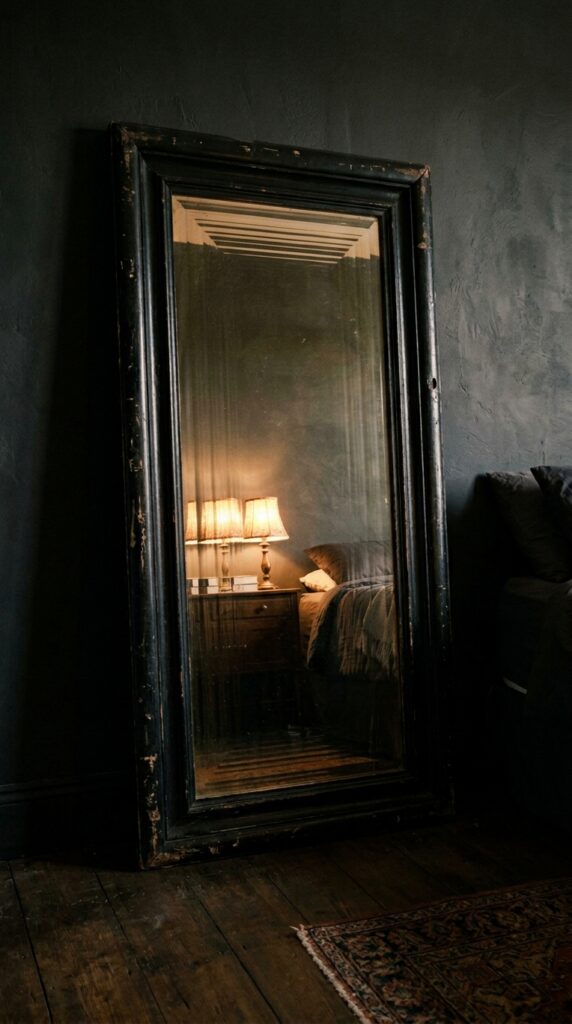
Mirrors in moody rooms serve a specific purpose: they create illusory depth. A dark room can feel claustrophobic without at least one reflective surface to suggest space beyond the walls. But the mirror should not be shiny and perfect. An antique or distressed mirror with a slightly cloudy finish, or a modern mirror with a black frame that absorbs light, works better than a bright silver frame.
The placement rule: position the mirror so it reflects the darkest part of the room, not a window or a lamp. A mirror reflecting a light source will bounce brightness around and kill the mood. You want it to reflect a shadowy corner, making that corner feel deeper. Cost: $100 to $400 for a large floor mirror. The version that fails is a frameless mirror. It’s too clean, too clinical. A frame grounds the mirror and makes it part of the room’s architecture. Also, never lean a mirror directly on the floor without a stopper. A 30-pound mirror sliding on hardwood is a recipe for disaster.
Pro tip: Rub a thin layer of dark wax (like Briwax) into a new black frame to give it an aged, slightly matte finish. New frames are often too shiny.
18. Tactile Throw Pillows in Dark Velvet, Leather, and Wool

Patterned pillows in a moody room often look busy. The better approach is monochromatic layering of textures: velvet, leather, wool, linen, and maybe a faux fur. All in the same dark family (black, charcoal, deep olive, oxblood). When the colors match, the eye reads the textures instead of fighting through patterns.
My current setup is a charcoal velvet lumbar, a black leather square, and a wool pillow with a chunky knit cover. They all sit on oxblood sheets. The room feels rich without a single floral or geometric pattern. Cost for three good pillows: $60 to $150. The version that fails is cheap synthetic velvet—it crushes and gets shiny spots where you rest your head. Also, leather pillows are not comfortable for leaning. Use them as front-layer decoration only, not for sleeping.
Pro tip: Buy inserts one size larger than the cover (e.g., 22×22 insert for a 20×20 cover). The overstuffing makes the pillow look plump and expensive.
19. A Dark Tulle Canopy (Unexpectedly Romantic)
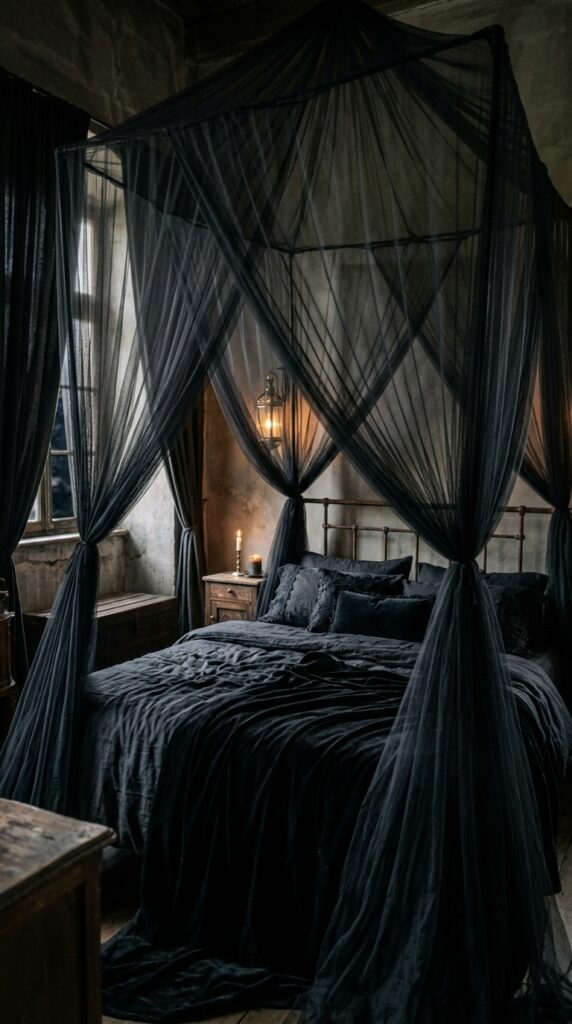
This is the riskiest idea on the list because it can tip into “goth teenager” territory fast. But when done correctly—black tulle, not white; loose gathering, not tight; no fairy lights woven in—a dark canopy creates a cocoon of immense intimacy. I saw this in a friend’s apartment and mocked it until I sat under it. The fabric softens everything. It feels like being in a tent as a child, but for adults.
The execution: you need a four-poster bed or a DIY frame (copper pipe works). Use black tulle or black organza—stiffer than tulle, less floppy. The fabric should be long enough to pool on the floor. Cost: $30 to $80 for fabric. The trade-off is that tulle catches every piece of lint and dust. You’ll need to take it down and wash it (gently, in a laundry bag) every two months. Also, it’s a fire hazard if you have candles nearby. Keep flames far away.
Pro tip: Don’t gather the tulle at a central point (that’s a wedding canopy). Gather it at the four corners separately, leaving the center open. That creates a draped, not tented, effect.
20. Black Window Film (For a Permanent Twilight)
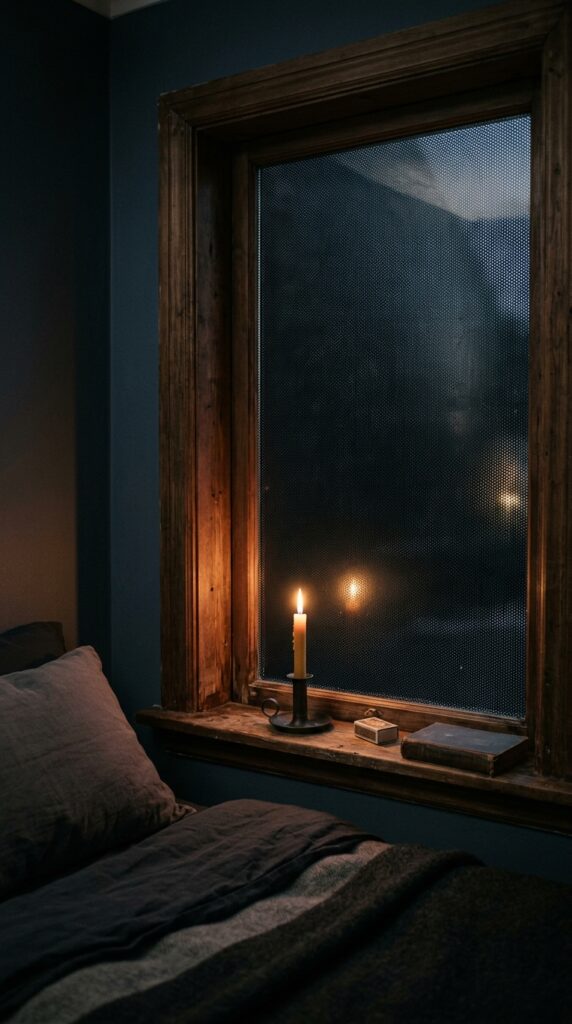
If you have a window that faces a brick wall, a parking lot, or a neighbor’s bedroom, black window film turns that eyesore into a dark panel that still lets in some light but kills the view entirely. Unlike blackout curtains, film doesn’t take up space or require hardware. It’s a commitment to permanent twilight.
The film is applied like any other window film (spray water, smooth out bubbles, trim edges). Cost: $20 to $50 for a roll. The trade-off: you lose the ability to open the window to see outside. If you’re claustrophobic, don’t do this. Also, the film makes the room darker even at noon. You’ll need lamps during the day. The version that fails is cheap film that turns purple from UV exposure within a year. Buy UV-stable blackout film. And never put it on a double-pane window that gets direct sun—the heat buildup can crack the seal between panes.
Pro tip: Apply the film to the inside of the glass, not the outside. Exterior film gets destroyed by weather and is harder to install.
21. An Industrial Pendant With an Edison Bulb (Just One)
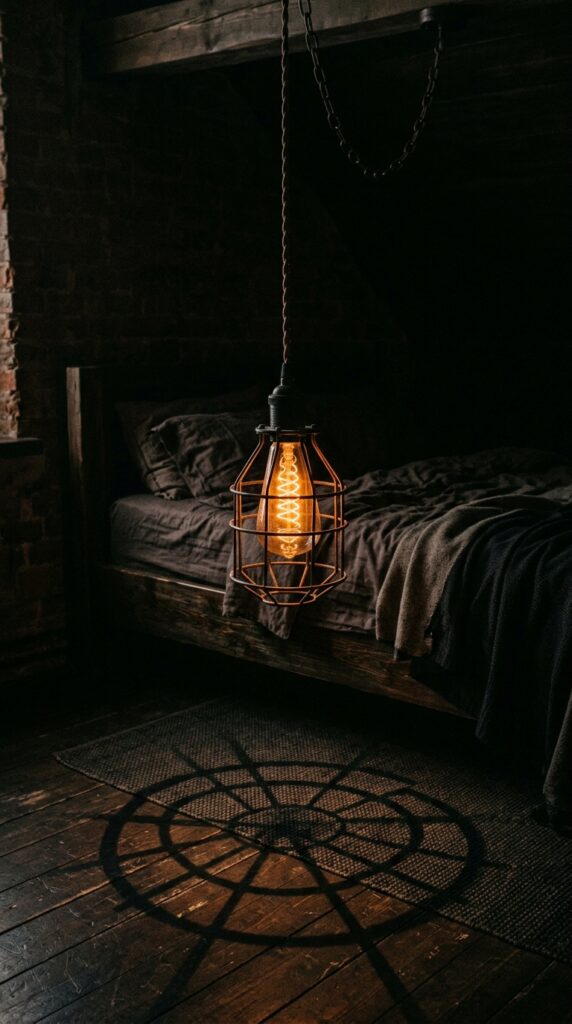
Industrial lighting is usually too harsh for a bedroom. But one pendant—hung low, with a dimmer, and fitted with a warm Edison bulb—creates a focal point that feels more like sculpture than light source. The key is that it’s the only industrial element in the room. One cage pendant, zero pipe shelves, no gear clocks. The restraint is what makes it moody instead of themed.
Installation requires ceiling work (or a plug-in cord kit that you run along the ceiling). Cost for the fixture: $50 to $150. Edison bulbs are cheap ($10 to $20) but burn out faster than LEDs. LED Edison-style bulbs exist but don’t have the same warm glow. The trade-off is that a pendant hung low enough to be dramatic (about 30 inches above the floor) is a head-banger hazard. Hang it over empty floor space, not over the bed or a walkway. The version that fails is using a clear glass shade. The bare bulb is already exposed. A clear shade adds nothing. Go with an open cage or a frosted glass shade that softens the light.
Pro tip: Use a dimmable Edison bulb and a dimmer switch. At full brightness, these bulbs are painfully bright. At 30%, they’re magical.
22. A Roman Shade in Dark Linen (Inside Mount)
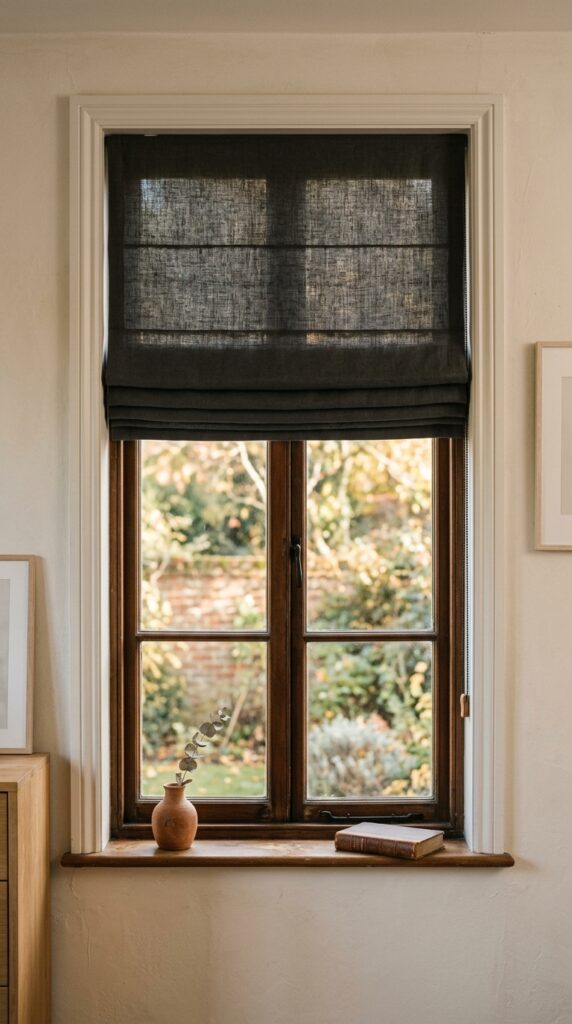
Curtains are dramatic, but sometimes you want something cleaner. A Roman shade in a dark, matte fabric (linen or cotton) mounted inside the window frame provides privacy and light control without the visual weight of floor-length drapes. The inside mount (recessed within the window casing) makes the shade look built-in and intentional.
The honest reality: Roman shades are expensive for what they are. A custom shade for a 36-inch window runs $150 to $300. Ready-made are cheaper ($60 to $120) but rarely fit perfectly. The trade-off is that they collect dust in the folds, and the cords can be a hazard if you have kids or pets (cordless lifts are safer). The version that fails is a Roman shade in a shiny fabric. The folds will reflect light in weird ways. Matte only. Also, never use a Roman shade as your only window covering if you need total blackout. Light leaks around the edges.
Pro tip: Line the shade with blackout fabric sandwiched between the face fabric and the backing. It adds weight (helps the shade hang straighter) and blocks more light.
23. A Black Tile Accent Wall (Peel and Stick, Done Right)
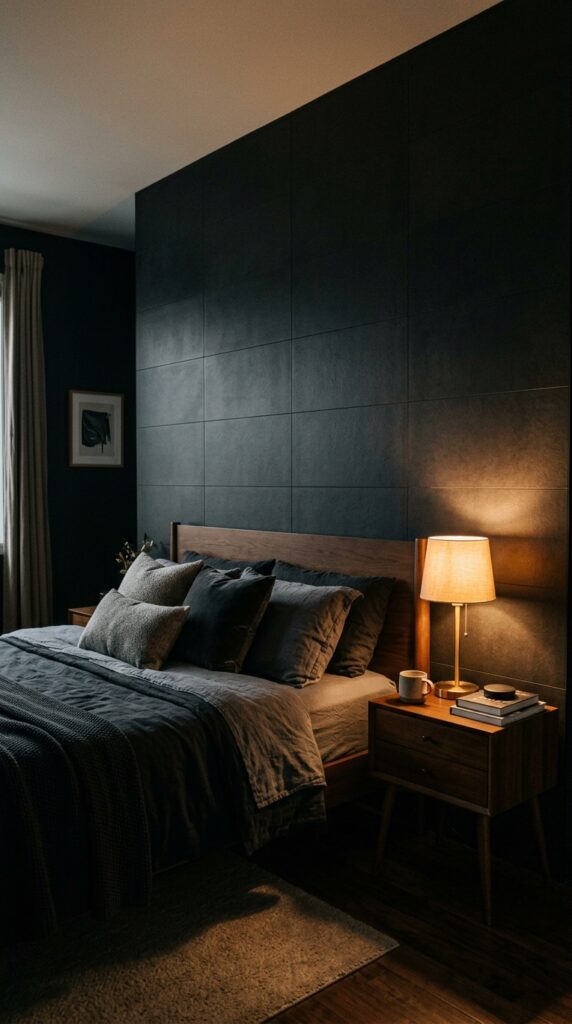
Tile in a bedroom sounds insane. But a single wall of large-format black tile (matte, not glossy) behind the bed creates a texture and permanence that paint can’t match. It’s a commitment, but so is a marriage. I’ve seen this in exactly two homes, and both times it stopped me cold. The tile reads as stone, as architecture, as something that will outlast the room’s current occupant.
The practical path is peel-and-stick tile sheets designed for backsplashes—but sized up. Look for 12×24 or 6×24 rectangles. Cost: $150 to $400 for a typical accent wall. Real tile (thinset, grout) is $300 to $800 and requires a pro. The trade-off: peel-and-stick tile will fail in humidity or if you ever try to remove it (it takes drywall with it). Also, the grout lines on peel-and-stick are fake (printed on the surface). Up close, they look printed. The version that fails is using small subway tile in a bedroom. It looks like a bathroom. Large format only.
Pro tip: If you use peel-and-stick, press each tile with a J-roller (a small rubber roller for wallpaper) to ensure full adhesion. Hand pressure isn’t enough.
24. A Black Platform Bed (Floating Effect)
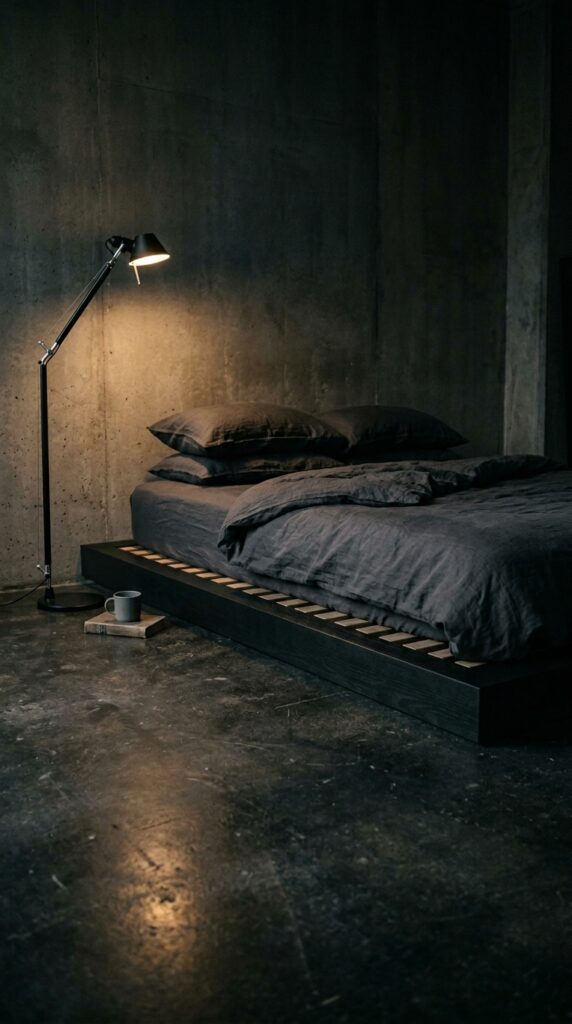
A bed that disappears into the floor is the ultimate moody move. A black platform bed—preferably with a slatted base that shows the floor through the gaps—has almost no visual weight. The mattress becomes the only mass. This works best with dark walls and dark floors, creating a continuous dark field interrupted only by the shape of the bedding.
IKEA’s MALM in black-brown is a budget option ($150 to $300). Better is a solid wood frame painted or stained black ($400 to $800). The trade-off: low beds are hard to get out of if you have mobility issues. Also, you lose under-bed storage. And black paint on a bed frame scratches easily—every time you move the mattress, you’ll see white wood underneath. The version that fails is a black metal bed frame with wheels. The wheels ruin the floating illusion. You want a solid base that sits directly on the floor or on very low legs (two inches max).
Pro tip: Use black sheets that match the frame and a black duvet cover. When the bed is made, the whole thing reads as a dark shape, not as distinct elements.
25. Matte Black Hardware (On Every Drawer and Door)
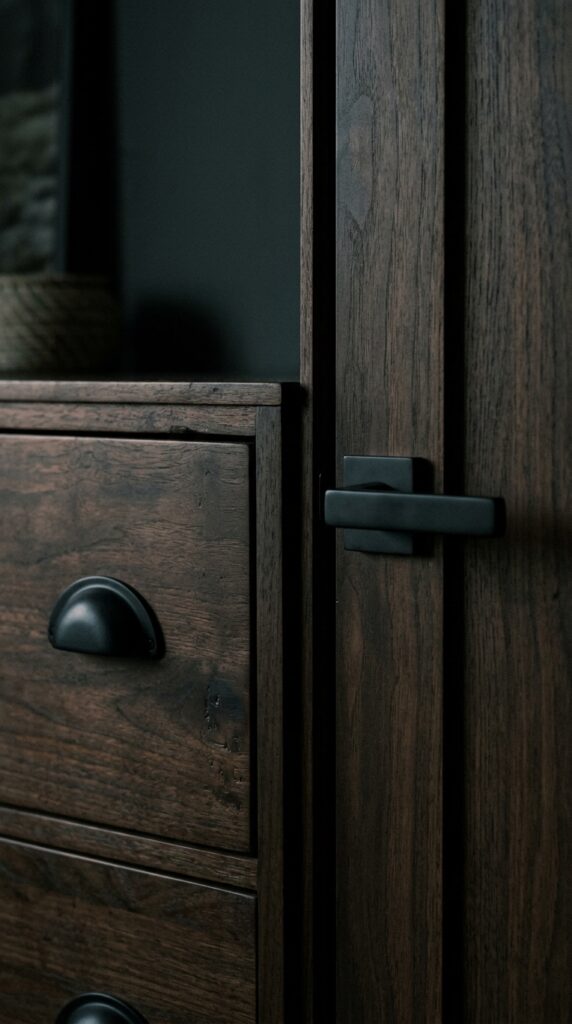
The final detail that pulls a moody room together is eliminating shine. Polished chrome, satin nickel, shiny brass—they all create small bright points that break the dark envelope. Matte black hardware (or oil-rubbed bronze) absorbs light instead of reflecting it. Swap out drawer pulls, cabinet knobs, door levers, and even switch plates. The room will feel more expensive not because you spent more, but because you removed visual noise.
Cost for a full bedroom’s worth of hardware (dresser, closet doors, nightstands): $50 to $150. The trade-off: matte black shows fingerprints and water spots worse than shiny finishes. You’ll be wiping down hardware constantly. Also, the coating can scratch off over time, revealing silver metal underneath. Buy from a reputable brand with good reviews about durability. The version that fails is mixing matte black with another metal finish in the same room. If you have a brass lamp, the black hardware will fight it. Commit to one metal throughout.
Pro tip: Use a microfiber cloth to clean matte black hardware. Paper towels leave lint that sticks to the matte surface and looks like dust.
Conclusion
A moody bedroom is not a dark bedroom. It’s a bedroom where the darkness has been shaped, textured, and lit with care. The worst mistake you can make is stopping at one layer—painting the walls black and then leaving the floors pale, the trim white, the hardware shiny. That’s not moody. That’s a room in progress. The best rooms on this list stack at least three of these ideas together: a dark limewash wall, layered velvet curtains, and a single candle sconce. Each element reinforces the others.
If you’re starting from zero, begin with the dimmers and the curtains. Those two changes—control over light and the ability to block it entirely—will transform your room more than any paint color. Then, and only then, decide how dark you actually want to go. Paint a test patch and live with it for a week. Some people discover they want full black. Others find that deep charcoal is their limit. Both are valid. The point is to end up in a room that feels like a conscious retreat, not an accidental cave.
Darkness is not the enemy of good design. Unconsidered darkness is. Now go make your bedroom feel like a secret you want to keep.