My first attempt at minimalism was an empty room with a mattress on the floor and a single chair. It lasted three weeks. I missed my books. I missed color. I realized I had confused “minimalist” with “empty.” The room wasn’t calm—it was sad. Real minimalism isn’t about how little you own. It’s about how carefully you choose what you keep. And most of what I kept was the wrong stuff.
The conventional advice on minimalist bedrooms is a disaster. They tell you to paint everything white, buy “multi-functional” furniture that does nothing well, and hide all your possessions in closet organizers that you’ll never maintain. The result is a room that looks like a hotel lobby—clean, cold, and completely devoid of personality. They forget that minimalism is supposed to make you feel lighter, not like you’re living in a magazine spread that’s about to be photographed.
I’ve spent years trying to get minimalism right. I’ve failed with stark all-white rooms that felt clinical, and with overly “wabi-sabi” rooms that just looked messy. These 25 ideas are what actually work: a clean bedroom that still feels like a human lives there. It’s about editing, not erasing. About materials that age well, not plastic that cracks. About decisions that last, not trends that fade. Some ideas are free (remove one thing). Some cost real money (buy the good version once). All of them have been tested against my own tendency to accumulate.
1. The 60 Percent Rule (Leave Empty Wall Space)
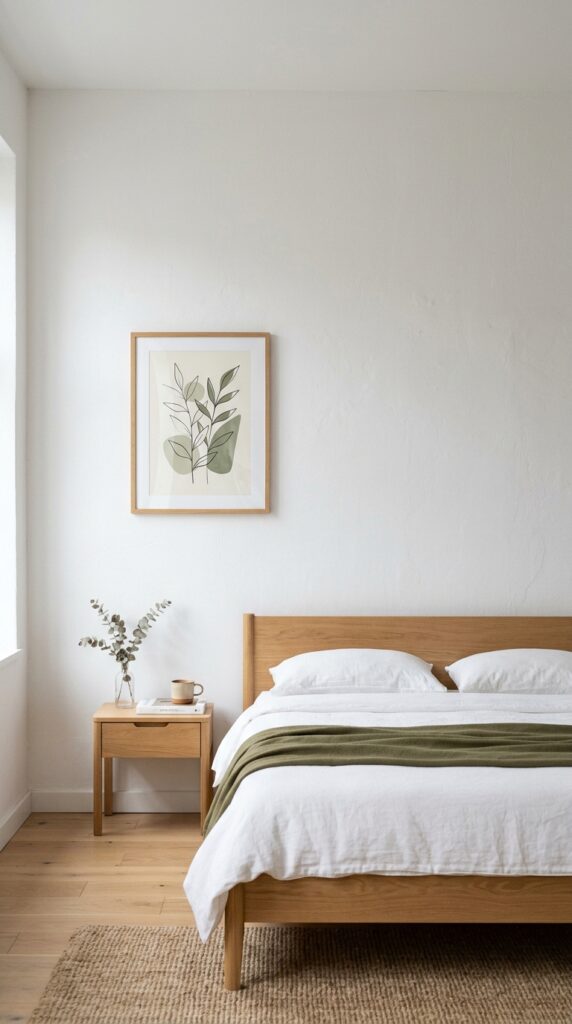
Here is a number I made up that actually works: leave 60 percent of your wall space empty. Not 50, not 70. Sixty. Take your total wall area, subtract windows and doors, and leave 60% of what’s left completely bare. No art, no shelves, no mirrors. The empty space is the design. I applied this rule to my bedroom and had to take down three framed prints. The room instantly felt larger and calmer. The remaining pieces became focal points instead of visual noise.
The hardest part is resisting the urge to “fill the wall.” You’ll feel like something is missing. It’s not. Leave it alone for two weeks. You’ll stop noticing the emptiness and start noticing the peace. Cost: free (remove things).
Measure your walls with a tape measure. Mark the 60% empty zones with painter’s tape. Live with the tape for a day before you move anything. The visual map helps.
2. The Hidden Cord System (No Visible Wires)
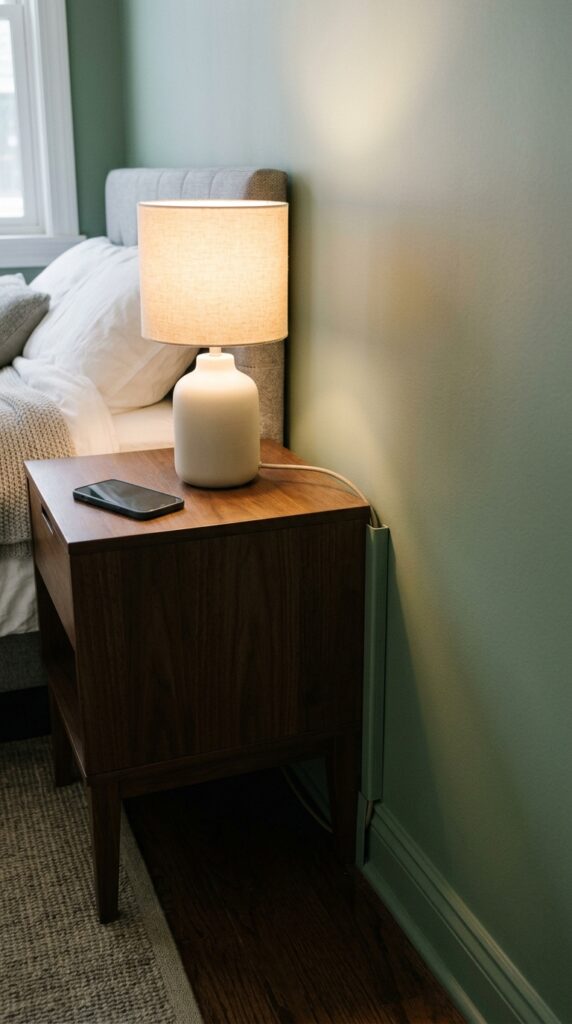
Visible cords are the enemy of minimalist calm. They’re visual clutter that you learn to ignore but never really stop seeing. I spent an afternoon hiding every cord in my bedroom: lamp cords, phone chargers, the cord from my noise machine. I used adhesive cord channels painted to match the wall ($10 for a pack). The room looked significantly cleaner. The mental effect was real—my brain stopped subconsciously tracking those black lines across the floor and wall.
The catch is that cord channels are permanent-ish. Once you stick them, they leave residue if removed. And if you rearrange furniture, you have to do it all over again. But minimalism is about committing to a layout. Cost: cord covers $10–$20, paintable or pre-painted white.
Run cords behind the bed frame or under the rug before resorting to cord channels. Invisible is better than hidden. Channels should be a last resort.
3. The Platform Bed With No Footboard (Visual Continuity)
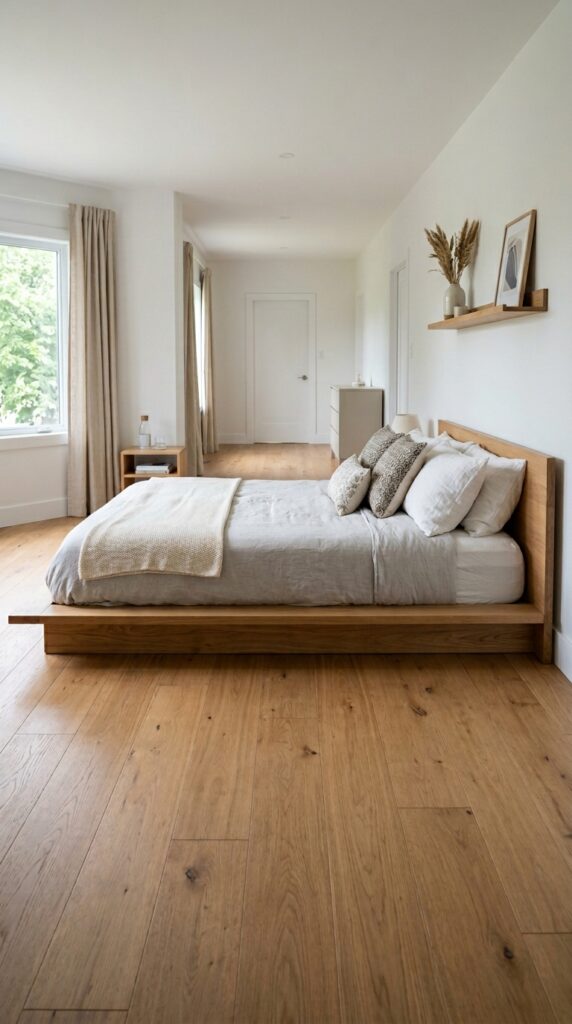
A footboard is a visual barrier. It stops your eye from moving across the bed. Platform beds without footboards are the most minimalist option—they let the mattress be the object, not the frame. I switched from a bulky sleigh bed to a simple wooden platform (no headboard, no footboard). The room immediately felt 20% larger. The bed now looks like a platform, not a piece of furniture. The platform also has built-in drawers, so I gained storage without adding visual bulk.
The downside is that without a footboard, your duvet can slide off the end. I solved this with a heavy duvet that stays put. Also, you can’t sit on the end of the bed and lean back. If you do that, get a bench. Cost: platform bed frame $150–$400.
Choose a platform with legs at least 6 inches off the floor. A flush-to-floor platform traps dust and looks like a box. Raised legs create visual lightness.
4. The Two-Color Rule (Plus One Neutral)
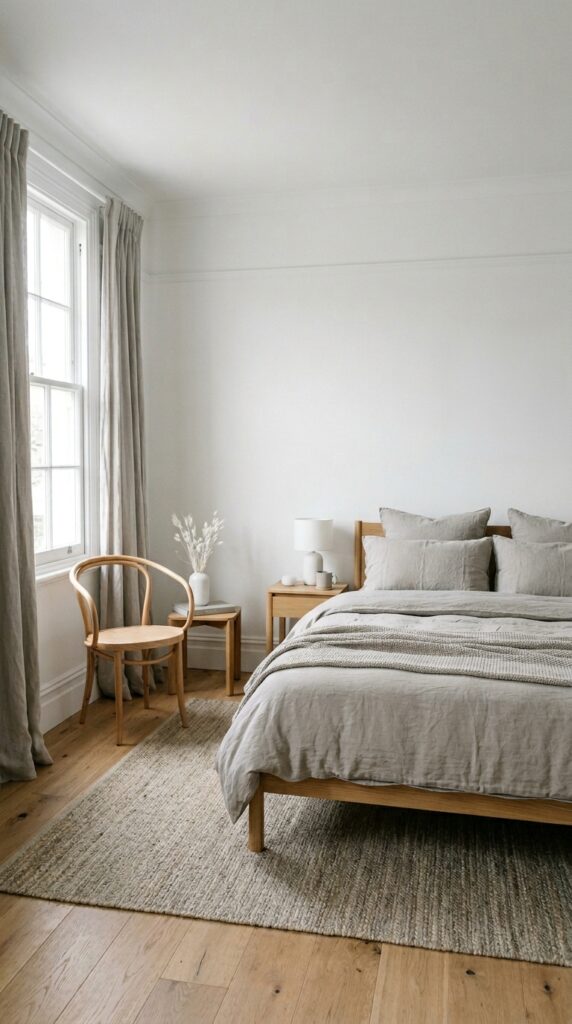
Minimalist color palettes fail when people add “just one pop of color.” That pop becomes a distraction. My rule: choose two colors (e.g., white and warm grey) plus one neutral wood tone. That’s it. My bedroom is white walls, cream bedding, and oak nightstands. No blue pillow, no green plant (plants are green—I use dried ones). The limitation forces the colors to work harder. The room looks expensive because it’s not fighting itself.
The neutral wood tone should be consistent. Don’t mix oak and walnut and pine. Pick one. I chose oak for everything—bed frame, nightstand, shelf. The repetition creates rhythm. Cost: free (edit what you have).
Write down your two colors on a sticky note. Before you buy anything new, check if it matches one of those colors. If it doesn’t, don’t buy it.
5. The Single Shelf Above The Bed (One Item Only)
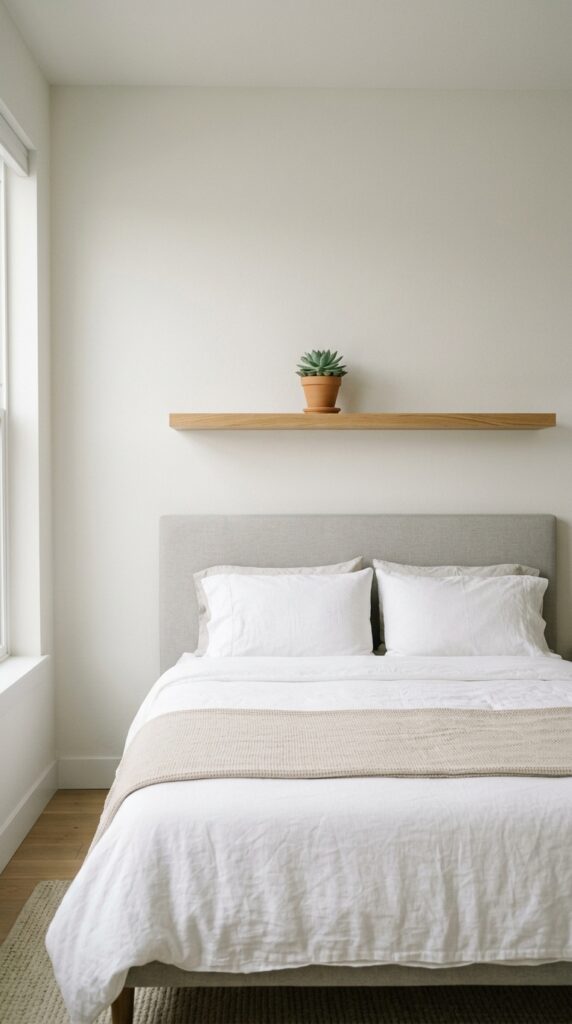
A shelf above the bed is useful, but minimalism demands restraint. I have a single 36-inch shelf above my bed. On it sits exactly one object: a small ceramic vase. That’s it. No books, no framed photos, no clutter. The shelf becomes a focal point because there’s nothing to distract. The empty space around the vase makes the vase matter. If you can’t commit to one object, don’t install the shelf.
The risk is that you’ll start putting things on the shelf. Keys, mail, a glass of water. Don’t. The shelf is for looking at, not for storing. If you need storage, get a different shelf in a different location. Cost: floating shelf $20–$50.
Mount the shelf into studs. The weight of even one object plus the shelf itself is enough to pull anchors out over time. Studs are non-negotiable above a bed.
6. The Drawer Dividers (Not Visible, But Vital)
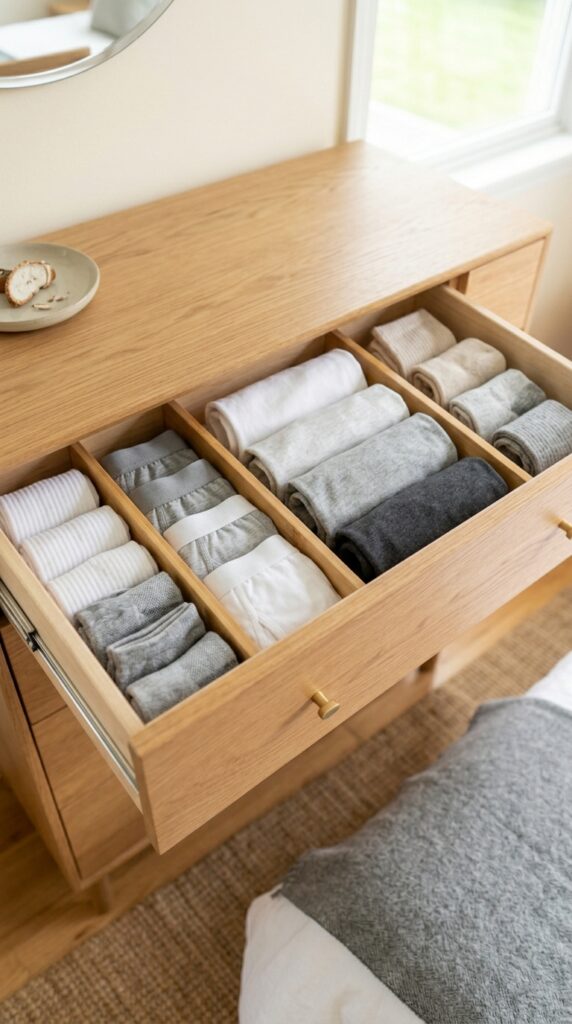
Minimalist bedrooms look clean because the mess is hidden. Drawer dividers are the unsung heroes. I use bamboo dividers ($15 for a set) to separate every drawer. Socks in one section, underwear in another, t-shirts folded vertically. The dividers mean I never rummage. I open the drawer, see everything, grab what I need. The drawer stays organized because the sections prevent migration. The bedroom stays minimalist because the clutter is contained.
Don’t buy the adjustable mesh dividers—they fall over. Bamboo or acrylic with a tight fit is better. Also, measure your drawer depth before buying. Cost: drawer dividers $10–$25 per set.
Fold t-shirts vertically (like files) instead of stacking them. Vertical folding lets you see every shirt at once and keeps the stack from toppling.
7. The Floor With Nothing On It (Except Furniture Feet)
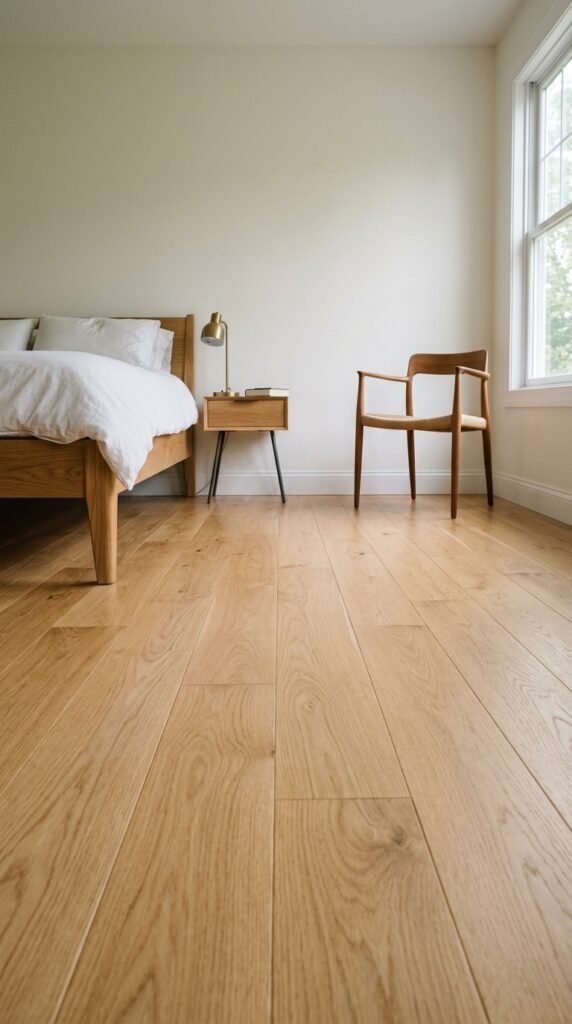
A minimalist floor has nothing on it. No rug (unless the floor is ugly), no clothes, no bags, no books, no electronics. The only things touching the floor are furniture feet. I removed my rug and never looked back. The wood floor is easier to clean, and the room feels larger because there’s no visual barrier between the furniture. The rule is simple: if it’s not furniture, it doesn’t belong on the floor. That means your gym bag goes in the closet, your book goes on the nightstand, your shoes go in a rack.
This is hard. We drop things. We set things down “just for a minute.” The key is to build a habit: before you leave the room, scan the floor. Pick up one thing. After a week, the floor stays clear naturally. Cost: free.
If you need a rug for warmth, choose one that goes entirely under the bed so no floor is visible. A rug that floats in the middle of the floor breaks the “nothing on the floor” rule.
8. The One Floating Shelf Per Wall (Maximum)
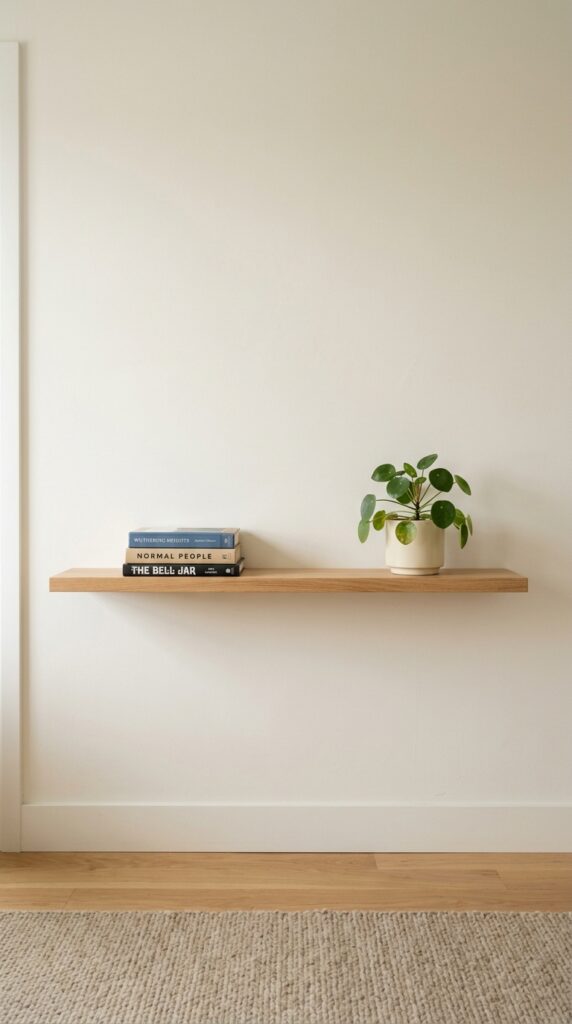
You can have shelves. But limit yourself to one shelf per wall maximum. Two shelves on the same wall creates a ladder effect that clutters the vertical space. I have one 48-inch shelf on one wall, placed low (30 inches from the floor). It holds my current reading stack and a small lamp. The wall above the shelf is empty. The wall below is empty. The shelf is a line, not a grid. It works because it’s the only horizontal line on that wall.
If you need more storage than one shelf can provide, you need a different solution (like a closed cabinet). Shelves are for display, not for storage. Cost: shelf $20–$60.
Position the shelf at a height that creates asymmetry. A shelf at 30 inches is unexpected. A shelf at 48 inches is standard and boring. Go lower or higher.
9. The Closed Storage (No Open Cubes)
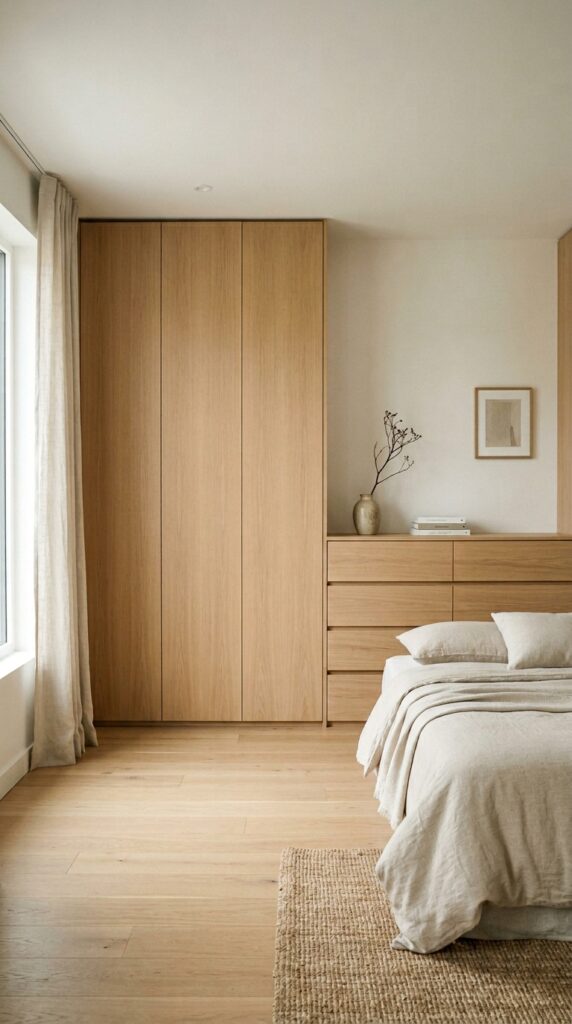
Open storage (cubes, shelves, pegboards) is the enemy of minimalist calm. It displays your possessions, which means your eye never rests. I removed all my open shelving and replaced it with closed cabinets. The room went from busy to peaceful overnight. The rule is simple: if you can see it, it’s visual noise. Close the doors. Draw the curtains. The goal is a room where no object demands attention until you open a drawer.
The trade-off is that closed storage makes you more likely to forget what you own. I label my drawers on the inside. A small label maker is $20. Cost: closed storage furniture $100–$500, label maker $15–$30.
If you can’t replace open shelves, add doors. A simple sliding door made of plywood costs $30 and turns open shelving into closed storage. Paint it to match the wall.
10. The Single Pendant Light (One Overhead Source)
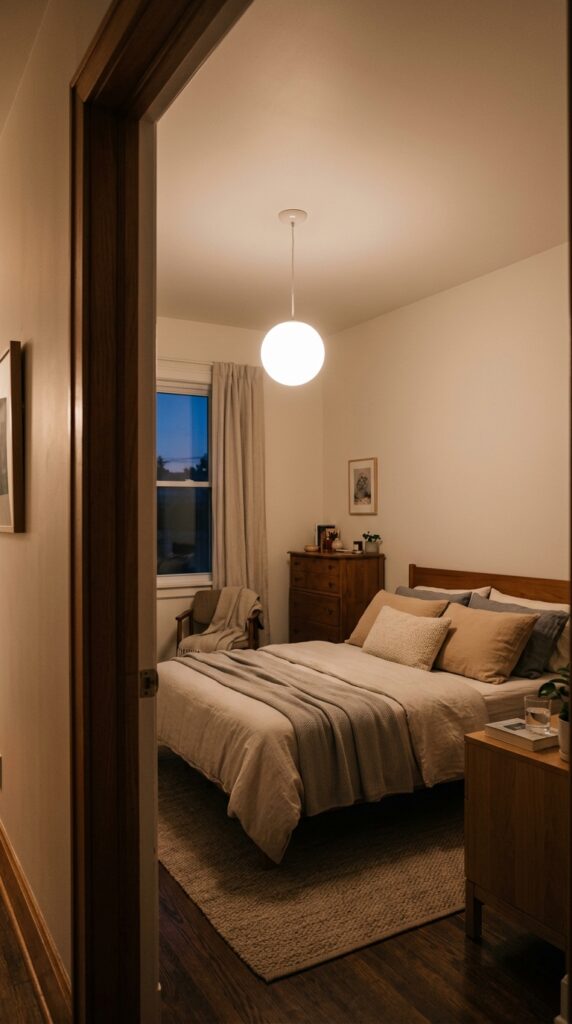
Minimalist lighting is about reduction. I replaced three table lamps, one floor lamp, and a ceiling fan with one central pendant light on a dimmer. The pendant is a simple white glass globe. When dimmed to 30%, it fills the room with soft, even light. When at full brightness, it’s enough for cleaning. The elimination of multiple light sources reduced visual clutter and decision fatigue. There’s only one switch. I don’t have to choose which lamp to turn on.
This only works if the pendant is dimmable and if your room is small enough for one light source to reach all corners. In a large room, you’ll need multiple. Also, you lose reading light in bed. I use a clip-on book light. Cost: pendant light $40–$100, dimmer switch $15.
Choose a pendant with a wide shade (12 inches or more). A narrow shade creates a focused cone of light, which leaves corners dark. A wide shade diffuses light evenly.
11. The Art At Staggered Heights (One Wall Only)
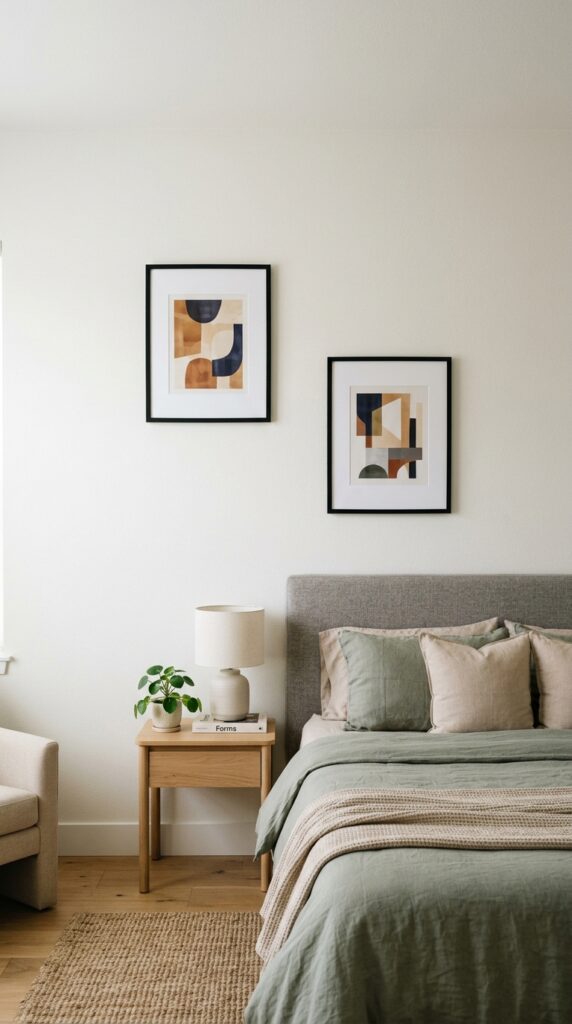
A single piece of art is the safest minimalist choice. But two pieces, hung at different heights, can be even more effective. I have two identical black-framed prints on one wall. One is hung with its center at 48 inches (standard). The other is hung with its center at 36 inches (lower). The eye moves between them. The staggered heights break the grid without adding more objects. The rest of the walls are empty.
The prints must be identical or very similar in style and frame. Mismatched frames ruin the effect. Also, don’t put art on more than one wall. One art wall, one focal point. Cost: prints $20–$50 each, frames $20–$40 each.
Test the heights by having a friend hold the art while you stand back. Move it up and down until the arrangement feels balanced, then mark the nail hole.
12. The Visible Floor Line (No Furniture Blocking Baseboards)
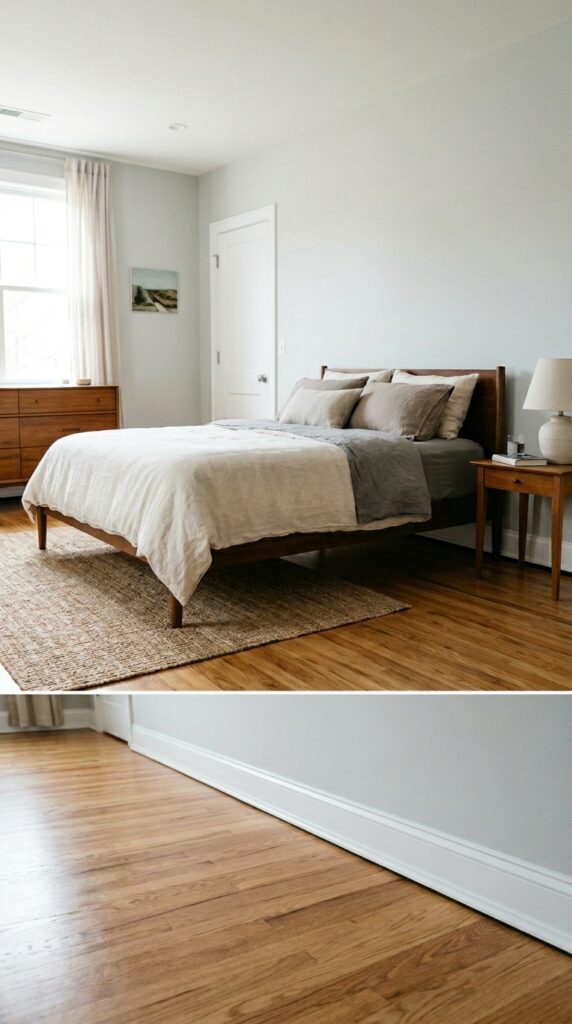
Furniture pushed flush against the wall looks heavy. I pulled every piece of furniture 2 inches away from the wall. The baseboard is now visible. The gap creates a shadow line that visually separates the furniture from the wall. The room looks like the furniture is resting on the floor, not leaning against the walls. It also makes cleaning easier—I can vacuum behind everything. The gap is small enough that I don’t lose functionality, but large enough to change the visual weight.
This doesn’t work for beds pushed into corners. But for dressers, nightstands, and desks, it’s transformative. Cost: free, plus some muscles.
Use felt pads under furniture feet to make pulling them away from the wall easier. The pads let you slide the furniture without scratching the floor.
13. The Solid Color Duvet (No Patterns, No Stripes)
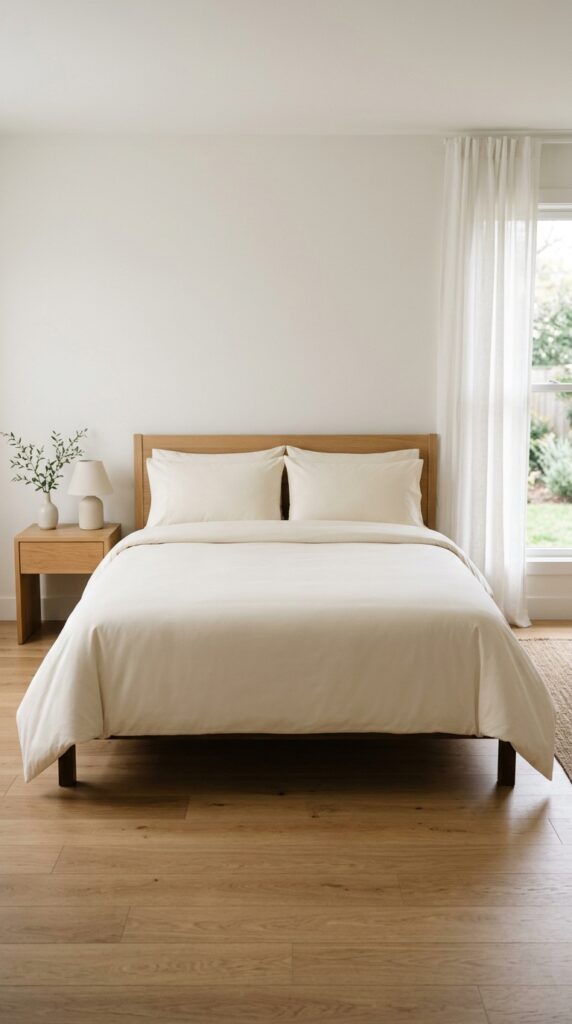
Patterned duvets are the enemy of minimalist calm. Stripes, florals, geometrics—they all create visual busyness. I switched from a striped duvet to a solid cream one. The bed became a field of calm. The pattern was replaced by texture (linen wrinkles) and light (shadows). The room felt larger because my eye wasn’t tracing the stripes. The rule is simple: if you can’t explain the pattern in two words, it’s too busy.
The challenge is that solid duvets show every stain. I use a duvet cover that I wash weekly. Cream hides more than white. Grey hides more than cream. But the lighter the color, the more visible the dirt. Cost: solid duvet cover $40–$100.
Choose a duvet cover with a zipper closure instead of buttons. Buttons create visual bumps. A zipper creates a clean, flat edge.
14. The No-Tech Bedroom (One Charging Station Outside)
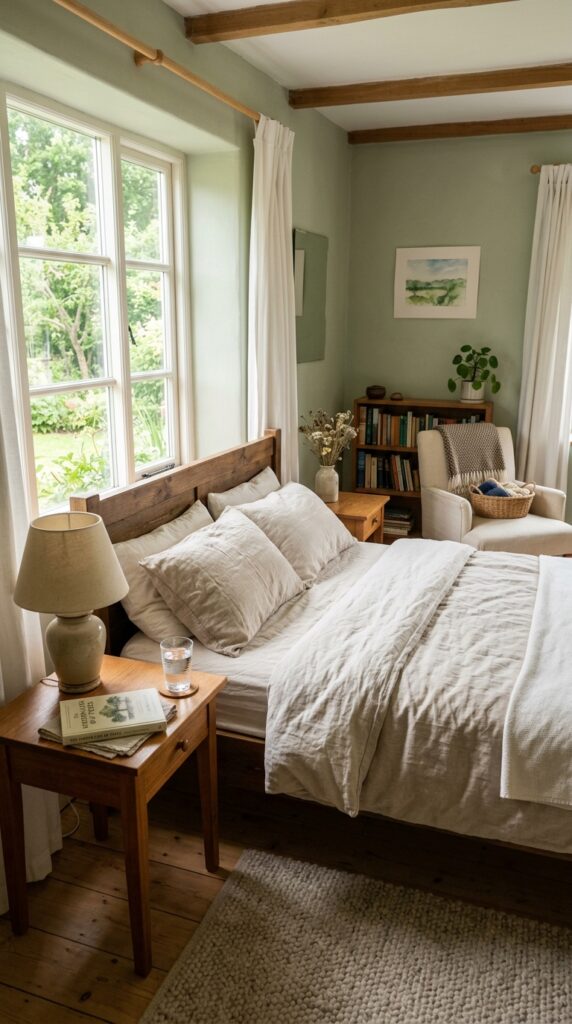
This is the hardest minimalist rule. I removed all electronics from my bedroom. The TV went to the living room. The phone charges in the hallway. The laptop lives in my office. The bedroom now contains exactly zero screens. The first week was difficult—I reached for my phone out of habit. The second week was easier. By the third week, I was sleeping better and reading more. The room feels like a sanctuary because it’s the only room without digital demands.
If you can’t remove all tech, at least hide it. A phone charging in a drawer is better than a phone on a nightstand. A laptop closed inside a desk is better than a laptop open. Out of sight, out of mind. Cost: free (move things).
Buy an analog alarm clock. A $15 clock is uglier than your phone, but it’s also not a phone. The trade-off is worth it for better sleep.
15. The Matching Hangers (All Identical)
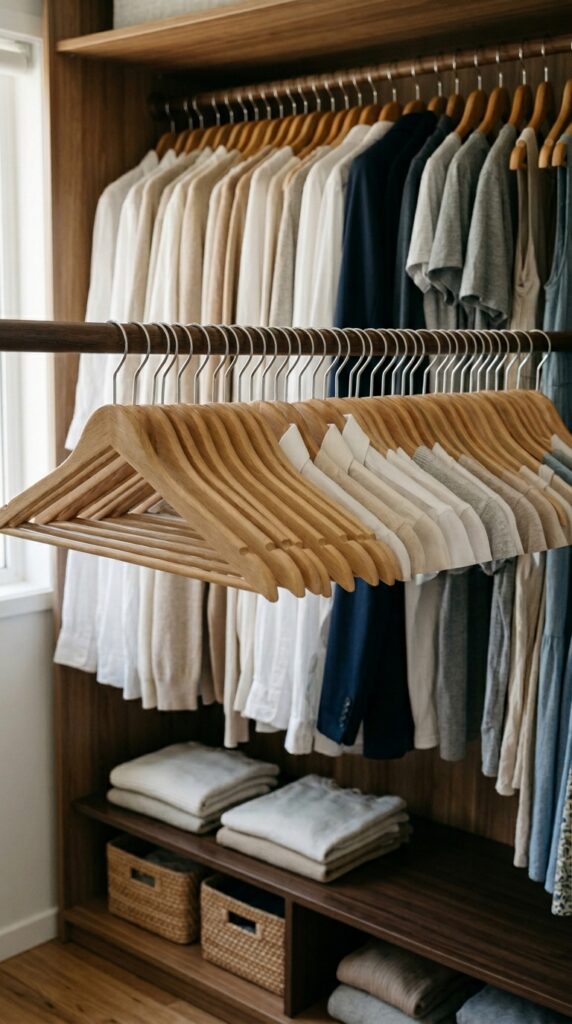
Your closet is part of your bedroom. A messy closet with mismatched hangers (plastic, wire, wood) creates visual stress every time you open the door. I replaced all my hangers with identical wooden ones. The cost was $30 for 30 hangers. The difference was immediate: the closet looked calm. The matching hangers also made my clothes look better because they hung at the same height. The rule is simple: every hanger in your closet should match.
Wooden hangers are thicker than plastic, so they take up more space. If your closet is tiny, use slim velvet hangers (all identical). They’re thinner and non-slip. Cost: wooden hangers $1–$2 each, slim velvet hangers $0.50–$1 each.
Donate your mismatched hangers to a thrift store. The act of removing them from your home is cathartic. You won’t miss them.
16. The Bare Window (No Curtains, No Blinds)
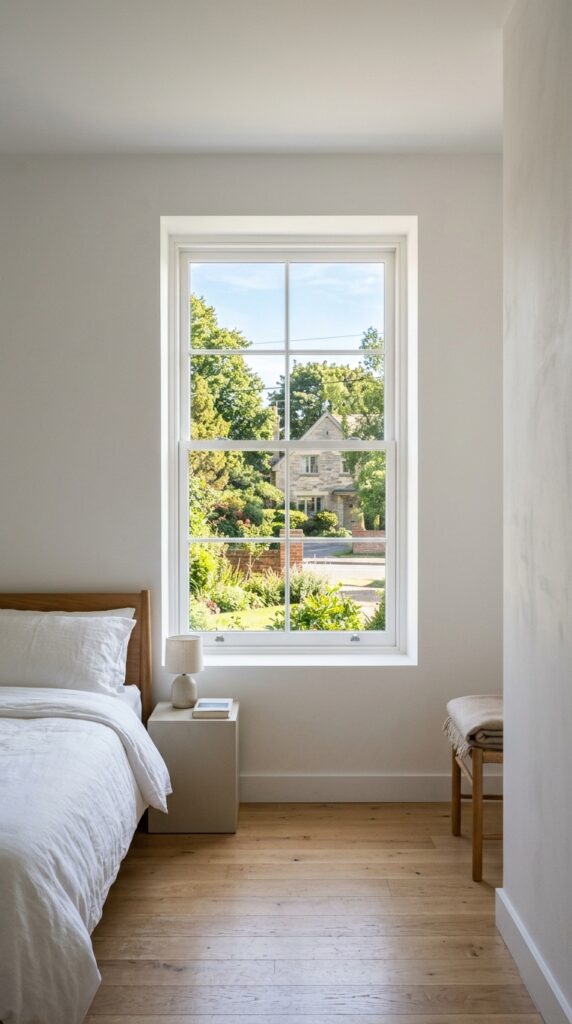
Curtains and blinds are visual clutter. They add horizontal lines, folds, and fabric. I removed all window treatments from my bedroom. The bare window looks like a hole in the wall, which makes the room feel larger because your eye travels out. The privacy trade-off is real: I live on a quiet street with no neighbors close by. If you need privacy, use a single roller shade in white (not blackout). Roller shades retract completely, so the window is bare when you want it to be.
If you need light control for sleep, install blackout shades behind a bare window look. The shade should be inside-mounted so it disappears into the frame when open. Cost: inside-mount roller shade $30–$60.
Before removing curtains, live without them for two days. If you feel exposed, add a single sheer roller shade. If you don’t, leave it bare.
17. The One Chair Rule (Maximum One Per Bedroom)
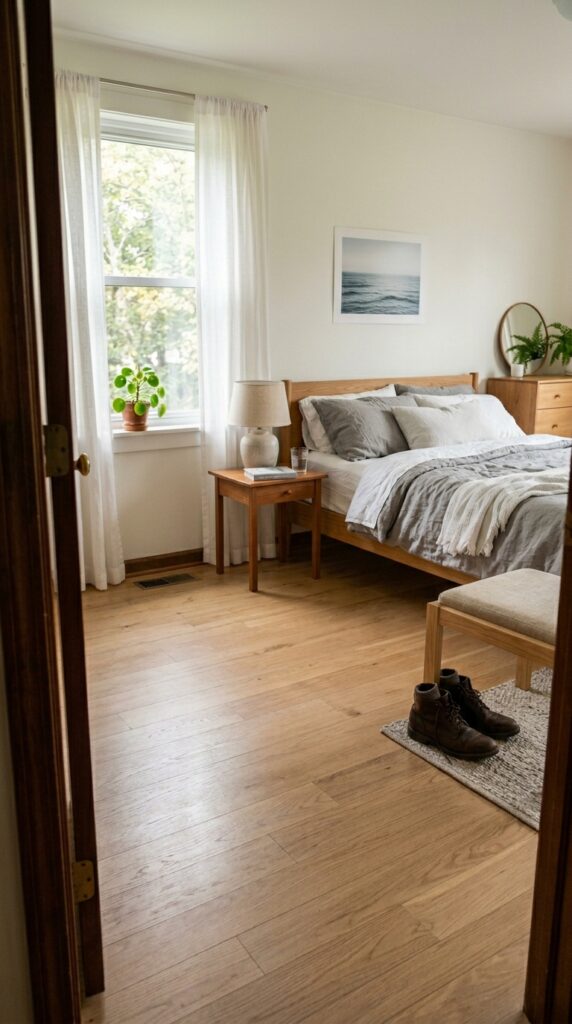
Bedrooms accumulate chairs. An armchair for reading, a desk chair, a dressing chair, a chaise. Each chair takes up floor space and adds visual weight. I reduced my bedroom to one chair. It’s a simple wooden chair with a removable cushion, used for putting on shoes and holding tomorrow’s clothes. The chair is in the corner where it doesn’t block the path. The rest of the seating happens on the bed. The room feels twice as large.
If you need a desk, use a wall-mounted folding desk with a stool that tucks underneath. If you need a reading spot, sit on the bed. If you need a place for guests, they can sit on the bed. One chair is enough. Cost: free (remove extras).
Choose a chair with legs, not a solid base. Legs let you see the floor underneath, which maintains visual lightness. A solid base looks heavy.
18. The No Nickel Or Chrome Rule (Brass Or Black Only)
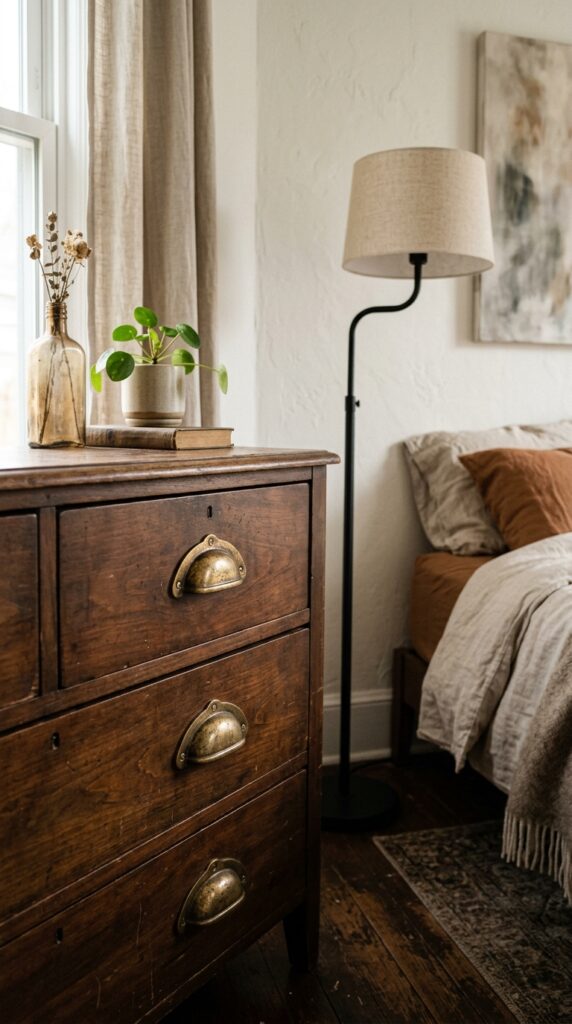
Chrome and nickel are cold, reflective, and dated. They catch the light and create glare. I replaced all the chrome hardware in my bedroom with brass (drawer pulls, lamp bases, curtain rod). The room became visually quieter. Brass and black finishes absorb light instead of reflecting it. The look is more timeless because it doesn’t scream “2015.” The catch is that brass is more expensive (a pack of brass drawer pulls is $20 vs $8 for chrome). But you buy them once.
If you can’t replace chrome fixtures, paint them. Matte black spray paint works on metal. Clean the surface, sand lightly, spray in thin coats. Cost: brass drawer pulls $15–$30, black spray paint $8.
Choose unlacquered brass if you want the metal to age. Choose lacquered brass if you want it to stay shiny. Both are better than chrome.
19. The Duvet Sized Down (One Size Smaller)
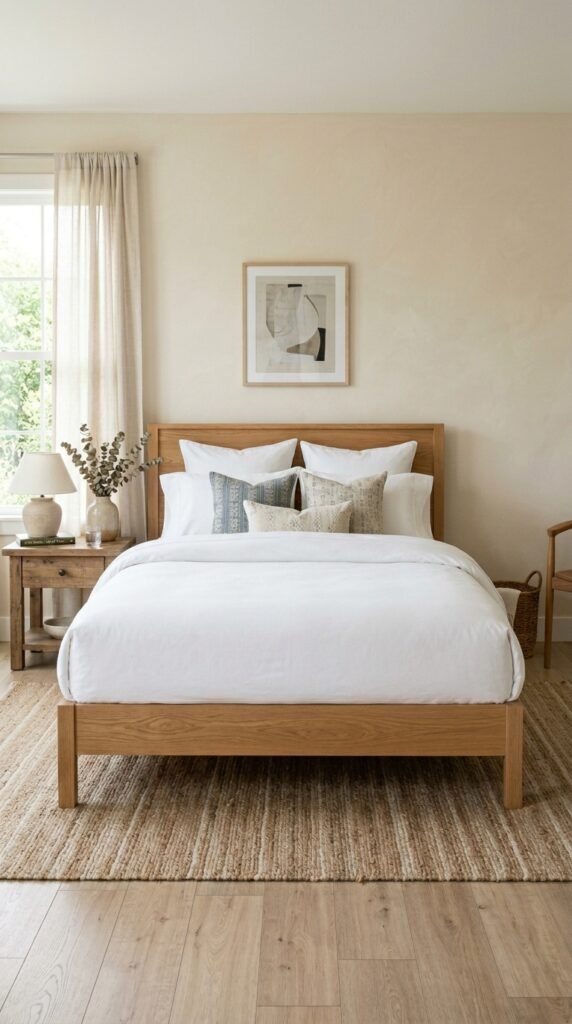
Standard advice says your duvet should be one size larger than your mattress (queen duvet on a full bed, king on a queen). That creates a lot of fabric. Too much fabric looks heavy. I switched to a duvet that’s the same size as my mattress (queen on queen). It doesn’t drape to the floor. The bed looks lighter and less bulky. The room feels larger because there’s less visual weight at floor level. The trade-off is that you have less blanket to wrap yourself in. If you’re a blanket hog, stick with the oversized version.
This works best with a platform bed that has low sides. If your bed frame has a high footboard, the smaller duvet will look like it doesn’t fit. Cost: free (use what you have).
Try tucking the oversized duvet into the sides of the bed frame. The tucking reduces the visible fabric without buying a new duvet.
20. The Three Outfit Rule (Visible Clothes)
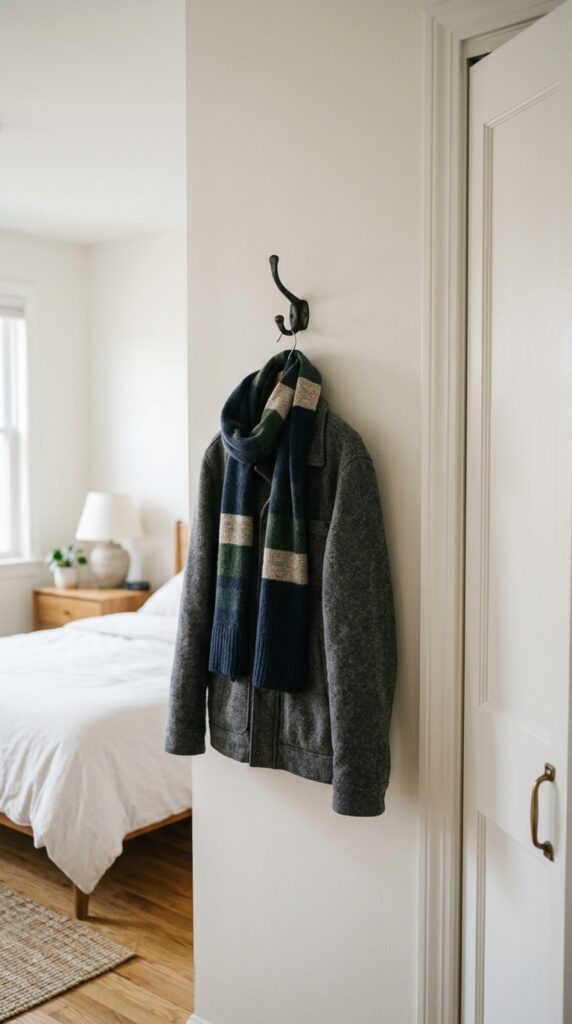
Visible clothes—draped over a chair, hanging on a hook, piled on a dresser—are visual clutter. I limit visible clothes to three items maximum: tomorrow’s outfit (hanging on one hook) and a robe (hanging on another). Everything else lives in the closet or drawers. The rule forces me to put away laundry immediately and decide what I’m wearing the night before. The room stays clean because clothes don’t accumulate on surfaces.
This is hard if you have a small closet. But that’s a storage problem, not a minimalist problem. Edit your wardrobe. Cost: free.
If you wear the same jacket every day, hang it on the hook. If you wear different jackets, store them in the closet. The hook is for the current outfit only.
21. The Symmetrical Layout (Everything Mirrored)
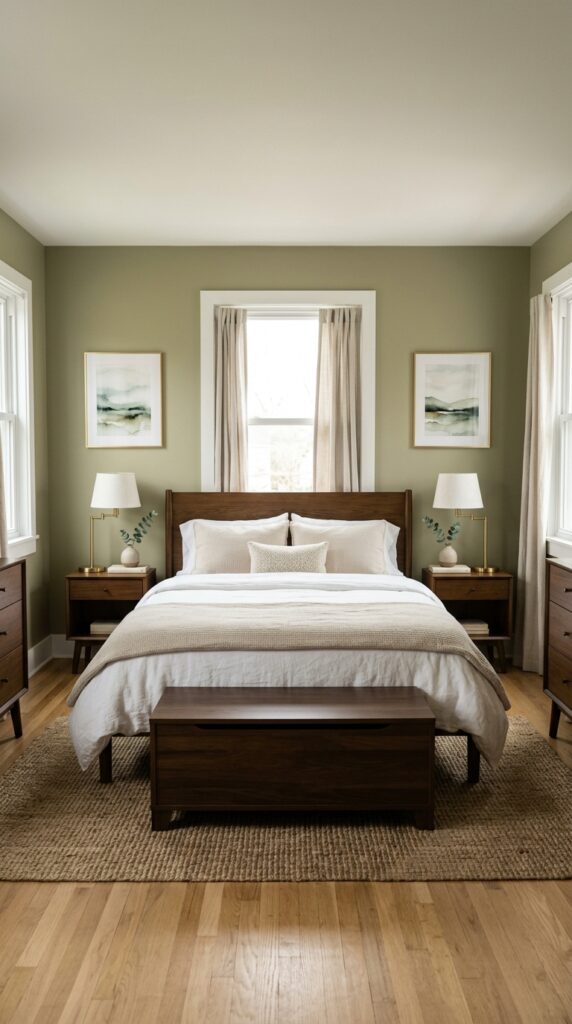
Asymmetry is interesting. Symmetry is calming. For a minimalist bedroom, choose symmetry. I centered my bed on the main wall, bought two identical nightstands, and put matching lamps on each. The room immediately felt more balanced. The symmetry reduces cognitive load—your brain doesn’t have to process differences. It just accepts the pattern. The cost is that you need two of everything. If you can’t afford two identical nightstands, skip the second one entirely (see idea #2 in this series).
The symmetrical layout only works if the bed is the focal point. If your room has a off-center window, you may need to break symmetry. In that case, use intentional asymmetry (one large piece on one side, one small on the other). Cost: second nightstand $50–$150.
If you can’t afford matching lamps, use matching shades on different bases. The shade is what the eye sees first. The base is secondary.
22. The No Plastic Gadgets (Visible Tech)
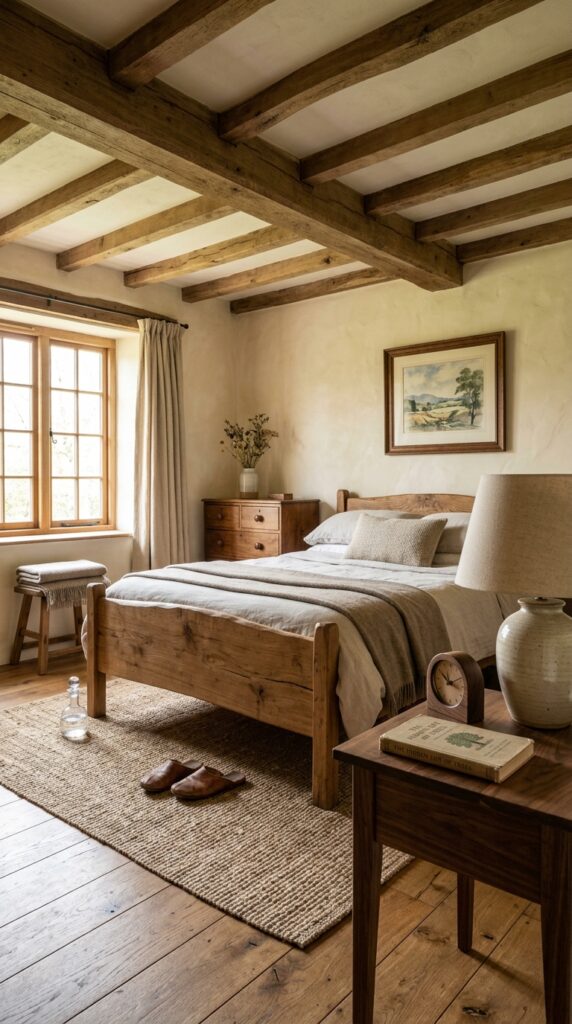
Plastic looks cheap and feels temporary. I removed all visible plastic from my bedroom. The white plastic phone charger went into a drawer. The plastic water bottle was replaced with a glass carafe. The plastic alarm clock was replaced with a wooden one. The room suddenly felt more expensive and more permanent. The rule is simple: if it’s made of plastic and visible, hide it or replace it.
The exception is electronics that can’t be hidden. Laptops, phones, and speakers are allowed but should be put away when not in use. Cost: glass carafe $15, wooden clock $20–$40.
Don’t buy new plastic things for your bedroom. That includes storage bins, hangers, and desk organizers. Choose wood, glass, or metal instead.
23. The Bed Skirt Removed (Visible Legs)
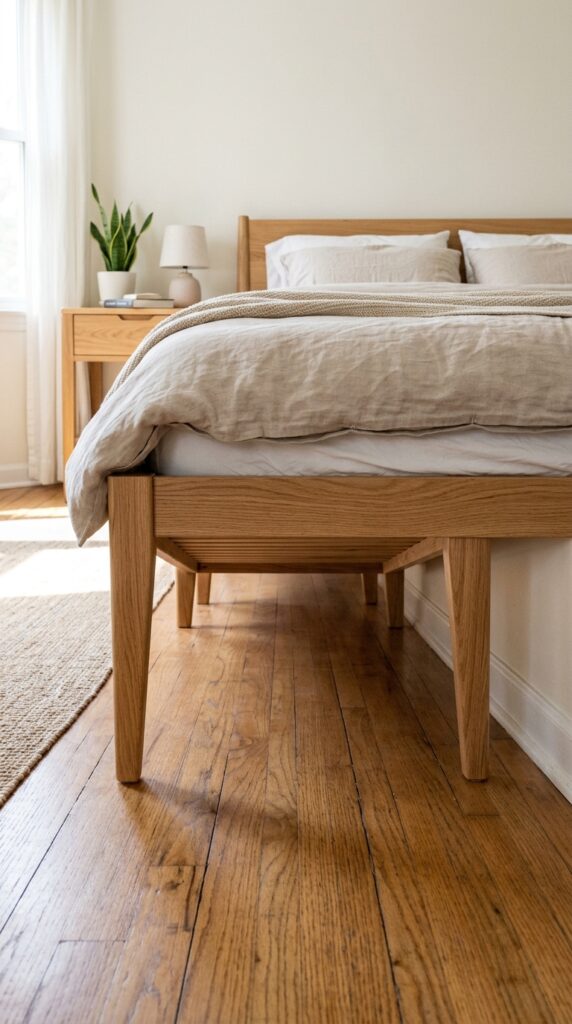
A bed skirt hides under-bed storage, but it also creates a solid visual block. I removed my bed skirt and left the legs visible. The gap between the floor and the bed frame adds lightness. The room feels larger because your eye can travel under the bed. The trade-off is that you can’t store things under the bed without them being visible. I moved my under-bed storage to a closet. If you need the storage, keep the skirt. If you want the openness, remove it.
If the under-bed area is dusty, the visible gap will show it. Vacuum under the bed weekly. Cost: free.
Choose a bed frame with legs that are visually light—thin metal or tapered wood. Chunky legs defeat the purpose of removing the skirt.
24. The White Sheets Only (No Colors, No Patterns)
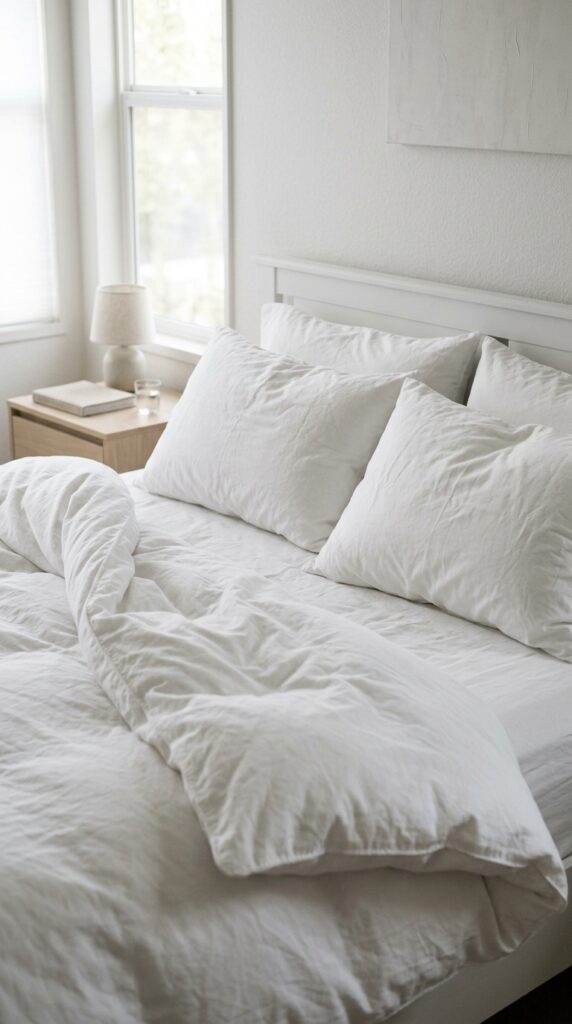
White sheets are the most minimalist choice. They’re timeless, they match everything, and they force you to wash them regularly (stains show immediately). I have three sets of white sheets and rotate them. The bed always looks fresh. The white-on-white with a white duvet creates a monochromatic block that recedes visually. The bed becomes a shape, not a collection of colored objects.
The downside is maintenance. White sheets need bleach or oxygen cleaner to stay bright. They also show every hair and lint speck. I keep a lint roller in the nightstand. Cost: white sheet set $40–$100.
Buy sheets with a high thread count (400-600). Low thread count white sheets look see-through and cheap. High thread count white sheets look substantial.
25. The Annual Edit Day (One Saturday Per Year)
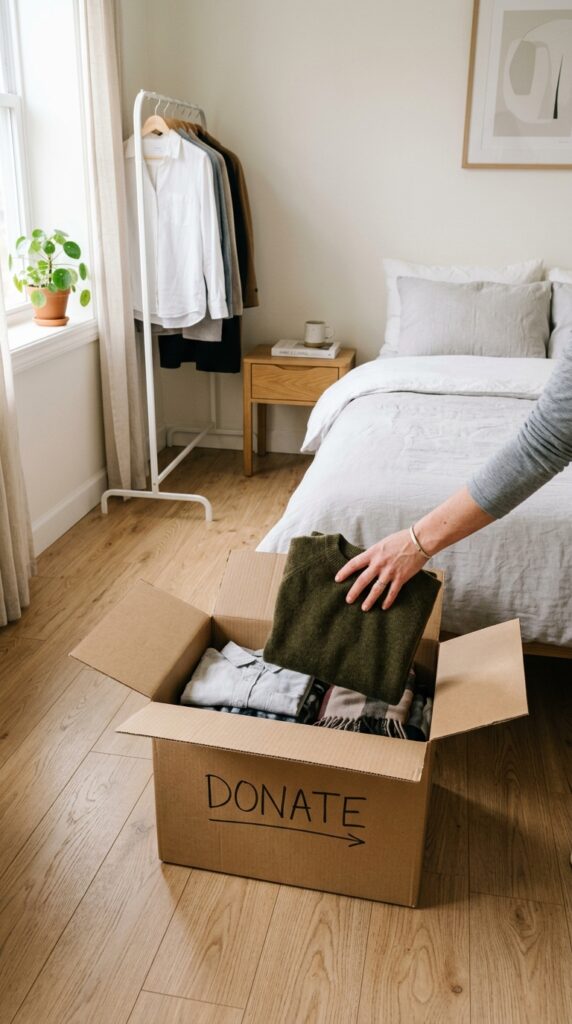
Minimalism isn’t a one-time purge. It’s a practice. I take one Saturday every year to edit my bedroom. I pull everything out of drawers, off shelves, and from under the bed. I touch every object. If I haven’t used it in a year, it goes in the donate box. The first year, I filled three boxes. The second year, one box. The third year, half a box. The room stays minimalist because I prune it regularly. The annual edit is easier than a constant battle.
The rule is simple: if you forgot you owned it, you don’t need it. If you kept it “just in case,” donate it. If it’s broken, throw it away. The annual edit is also a chance to clean—wipe down drawers, vacuum under furniture, dust baseboards. Cost: free, plus donate box.
Schedule the annual edit for the first Saturday of March. The post-holiday accumulation is fresh, and spring cleaning energy is high. Mark your calendar now.
The core decision of a minimalist bedroom is choosing what to remove, not what to add. You cannot buy your way to minimalism. You can only edit your way there. Every object in the room should earn its place. If it doesn’t serve a function or bring you genuine joy, it’s clutter. The goal is not an empty room—it’s a room where every object has a purpose and every empty space has a reason.
If you do one thing from this list, start with the 60 percent rule. Leave 60 percent of your wall space empty. Then edit your visible surfaces—nightstand, dresser, floor—until nothing remains except what you use daily. Those two changes will transform the room more than any purchase ever could. Then, next Saturday, do the annual edit. You’ll be surprised how much you’ve accumulated since you last looked.
A minimalist bedroom is not a deprivation. It’s a relief. It’s waking up to space instead of stuff. And that relief is worth every hard decision you make to get there. Now go edit something.