I once spent an entire afternoon moving my bed six inches to the left, then back, then two inches to the right, then back to the original spot. My partner walked in and said “it looks exactly the same.” But I could feel the difference. The door swing cleared the dresser by an extra inch. The path to the closet stopped feeling like a maze. Layout is not about what a room looks like. It’s about what a room lets you do without thinking.
Most bedroom design advice is just decoration with a thesaurus. They tell you which color to paint the wall or what style of headboard is “in.” They never talk about the actual geometry of living: where you put your coffee cup, how you open the closet door, whether you can make the bed without walking around it three times. A beautiful layout is not beautiful because of the furniture. It’s beautiful because the furniture disappears and the room just works.
I’ve lived in bedrooms shaped like shoeboxes, L-shapes, and one weird trapezoid that made me question the architect’s sobriety. I’ve learned that good layout is about three things: traffic flow, visual balance, and the surprisingly emotional weight of where your head points when you sleep. These 25 ideas are not decorating tips. They are spatial decisions. Some require moving heavy things. Some require admitting that your current arrangement is wrong. All of them will change how you feel in the room before you change a single pillow.
1. The Command Position (Face The Door, Not The Window)
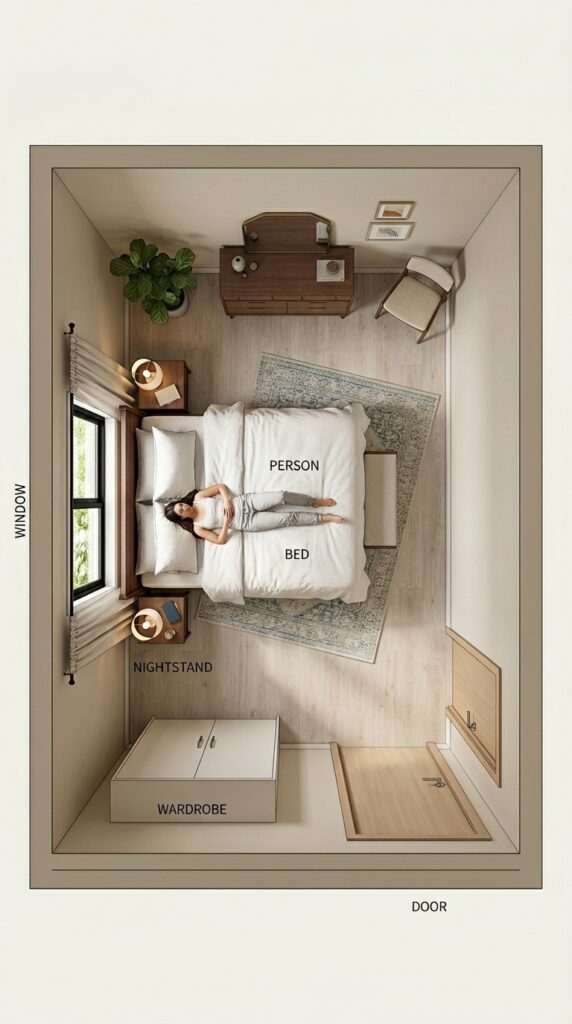
There’s an old feng shui principle called the “command position” that I dismissed as mystical until I tried it. The idea: place your bed so you can see the door while lying down, but you’re not directly in line with it. I moved my bed from under the window to the opposite wall. The change was immediate. I stopped feeling startled when my partner came in. I slept more deeply. It’s not magic—it’s evolutionary biology. Your nervous system relaxes when you can see the entrance.
The constraint: this sometimes puts the bed against a wall with outlets in the wrong places. Use an extension cord hidden under a rug. Also, if the door is directly opposite the bed, offset the bed a few feet so you’re not in a straight line. That “coffin position” (feet pointing at the door) is genuinely unsettling. Cost: free, just some heavy lifting.
Test this by lying on your current bed and looking at the door. If you have to turn your head or strain your neck, move the bed. Your spine will thank you.
2. The Thirty-Inch Rule (Don’t Block The Blood Flow)
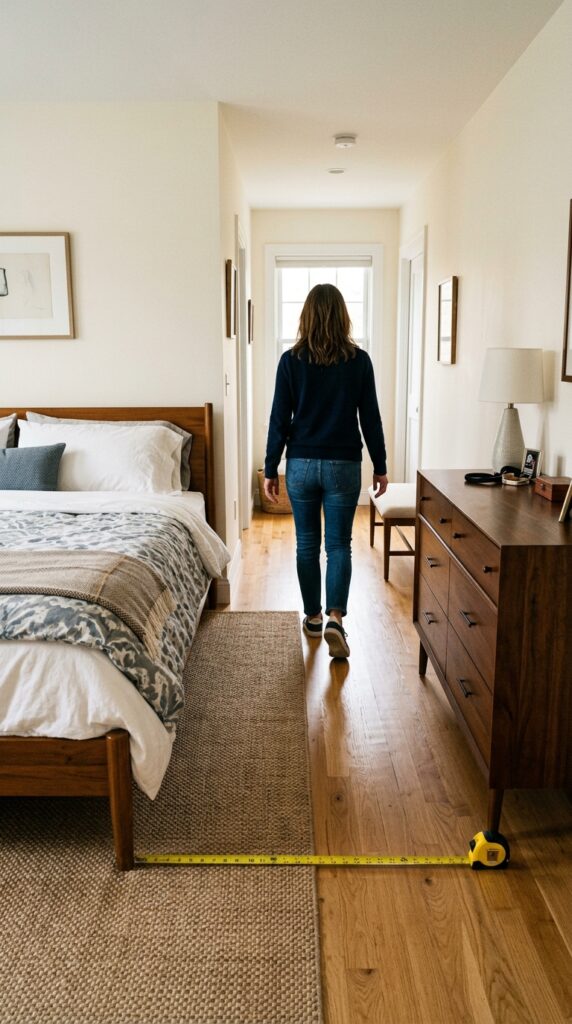
You need 30 inches of walking clearance. Not 28. Not 24. Thirty. I measured every path in my bedroom and found three places where I was squeezing past furniture. The dresser was 22 inches from the bed. The closet door hit the hamper. I moved two pieces of furniture and gained zero square footage but infinite comfort. The rule is simple: any path you walk more than three times a day needs 30 inches. That’s the bed-to-door path, the bed-to-closet path, and the path around the bed.
The trade-off is brutal: you may have to remove furniture to achieve this. I got rid of an armchair that was only used for laundry piles. The room felt bigger immediately because I wasn’t constantly dodging it. Cost: free, but you might lose a chair.
Measure your clearance at the narrowest point, not the average. One bottleneck ruins the whole flow. That narrow spot by the door is where you’ll stub your toe every morning.
3. The One-Nightstand Law (Both Sides Or Neither)
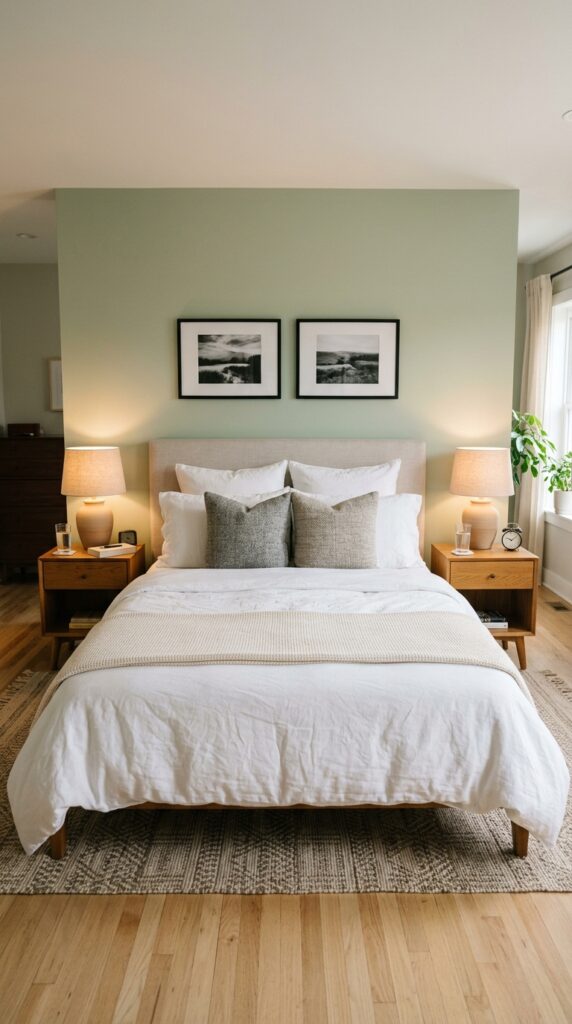
If you share a bed, you both need a nightstand. Not a shelf, not a stool, not the floor. A surface at the same height, with a lamp. I see so many bedrooms where one side has a proper nightstand and the other side has a precarious stack of books. That’s not a layout—that’s a hierarchy. I bought a second nightstand from a thrift store for $15 and painted it to match the first. Now we’re equals. The room looks balanced, and more importantly, no one is reaching for their glasses in the dark.
If you don’t have floor space for two nightstands, you don’t have space for a bed that size. Size down your bed or get narrower nightstands (12 inches deep instead of 18). Cost: second nightstand $15–$100.
Nightstands don’t have to match exactly. They just need to feel equal in weight and function. A floating shelf on one side and a small table on the other works if they’re the same height and depth.
4. The Window Offset (Break The Symmetry)
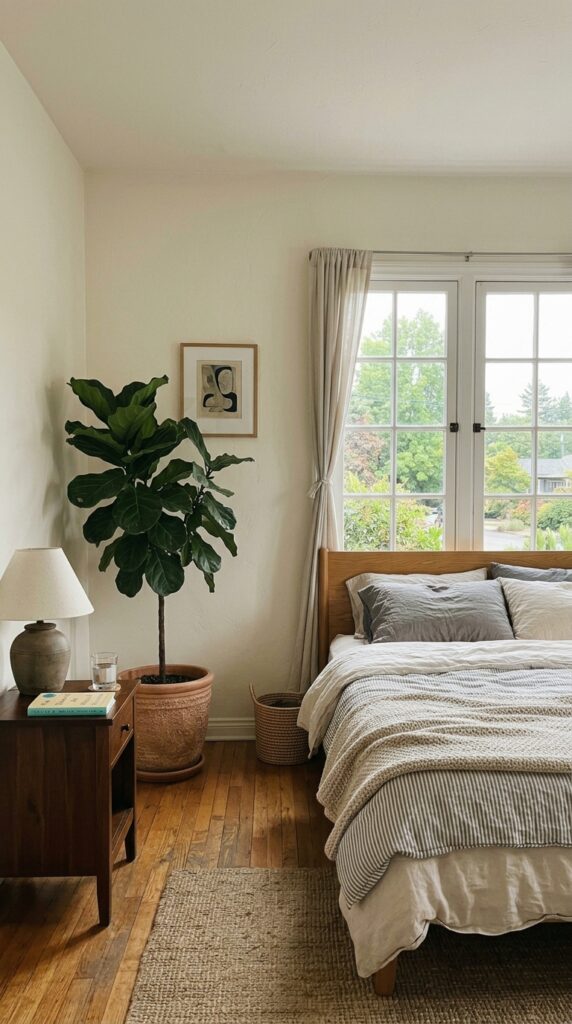
Almost every room has an off-center window. And almost everyone tries to center their bed under it, which leaves an awkward gap on one side. Stop doing that. Place your bed so its edge aligns with the window’s edge. The window becomes a deliberate asymmetry. Fill the empty wall space on the other side with a tall plant or a floor lamp. The room looks designed rather than forced. I did this in my last apartment and a friend said “your room looks bigger” even though I changed nothing else.
This only works if the window isn’t comically off-center. If the window is two feet from the corner, put the bed in the corner instead. Don’t fight the architecture. Cost: free.
Use a curtain rod that extends past the window on both sides equally. That visually centers the window even if the bed isn’t centered. Cheap trick, works every time.
5. The Negative Space Shelf (One Empty Wall Section)
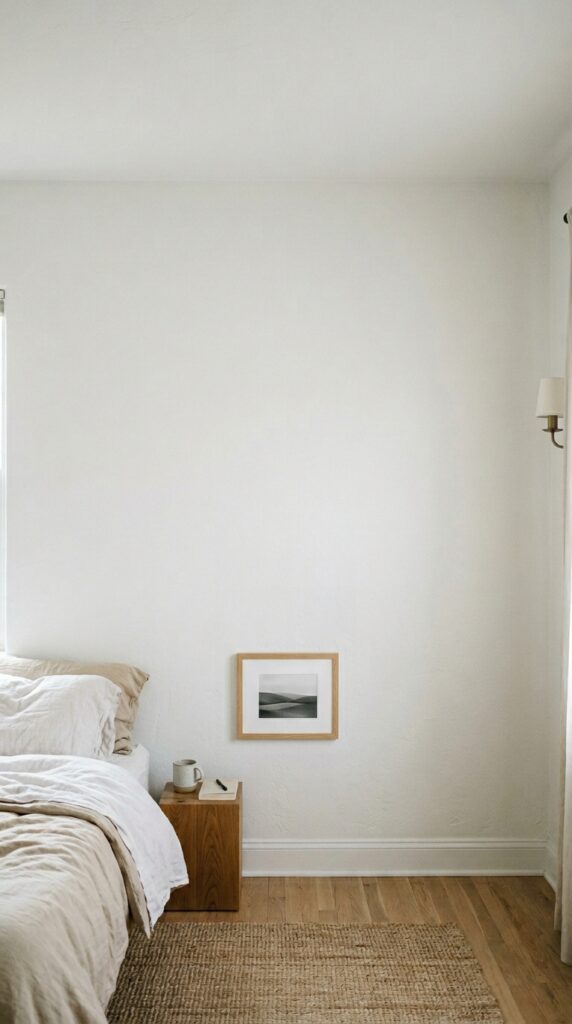
Every wall does not need furniture. I used to push dressers, bookshelves, and desks against every available surface. The room felt like a storage unit. Now I leave at least one wall completely empty—no furniture, no art, nothing. The empty wall makes the room feel twice as large because your eye has somewhere to rest. In my current bedroom, the wall opposite the bed is empty. I wake up and see space, not stuff.
The challenge is resisting the urge to “fill the wall.” You’ll feel like it’s wasted. It’s not. The emptiness is the point. If you absolutely need storage, use low furniture (30 inches or lower) so the wall still reads as mostly empty. Cost: free.
Take a photo of your room. Circle every piece of furniture touching a wall. Remove one thing. Live with it for a week. You won’t put it back.
6. The Corner Bed (For Oblong Rooms Only)
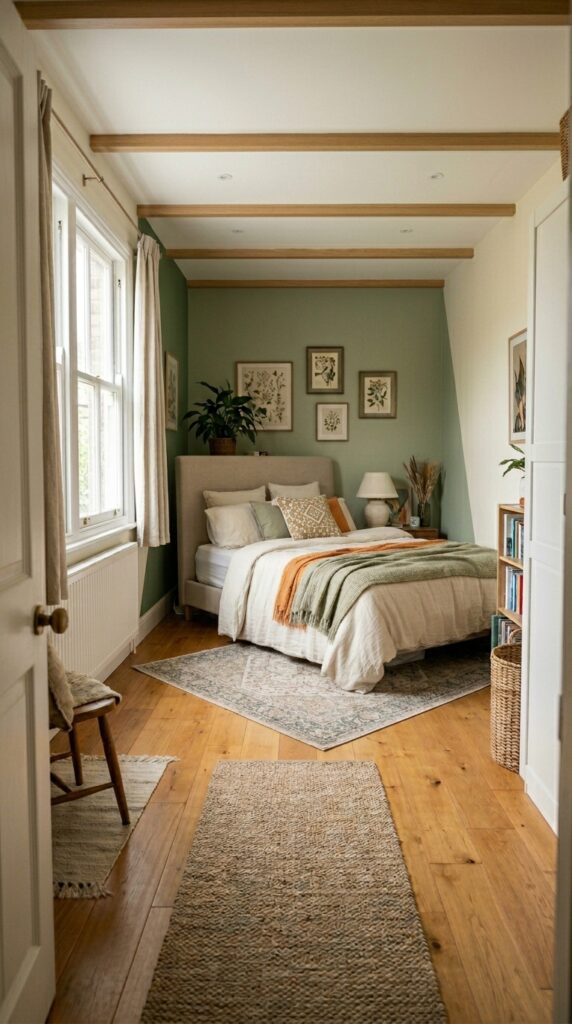
Everyone says never put a bed in the corner. They’re wrong for one specific room shape: the long, narrow rectangle where a centered bed blocks the only path. I once had a room that was 8 feet wide by 15 feet long. Centering the bed left 18 inches on either side—a tight squeeze. I rotated the bed 45 degrees into the corner, facing diagonally into the room. Suddenly I had a spacious triangle of floor on one side and a cozy nook on the other. It looked weird but worked perfectly.
The trade-off is that you lose the ability to have two nightstands. One side of the bed touches the wall. I used a wall-mounted shelf on that side. Also, making the bed is harder because you have to reach into the corner. But for a room that’s truly too narrow, the diagonal corner bed is the only solution. Cost: free.
Use a round rug under a diagonal bed. The curves soften the angles and make the unusual placement look intentional rather than desperate.
7. The Closet Facing The Bed (Mirror Placement)
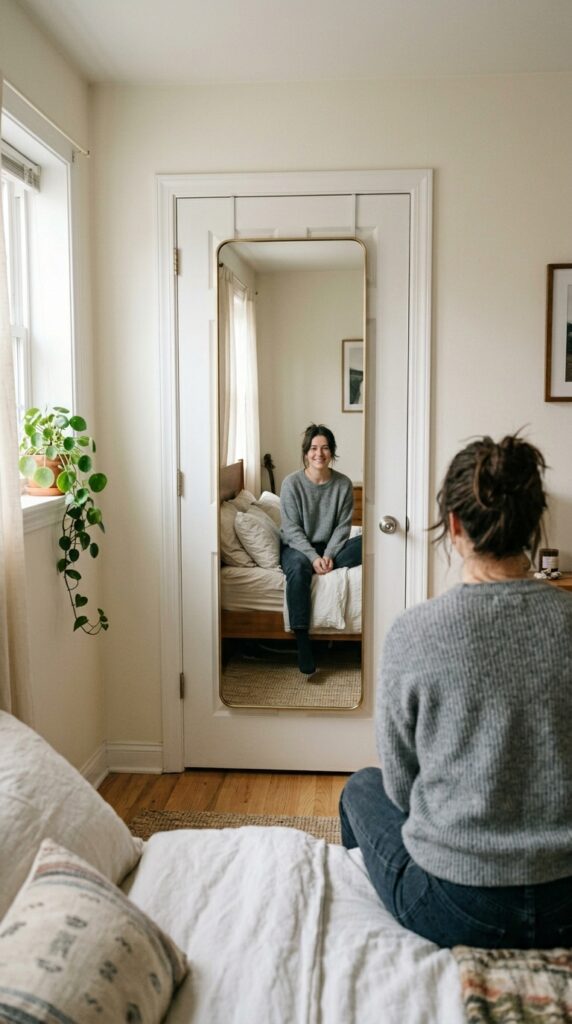
If your closet door faces the bed, put a mirror on that door. Not a small decorative one—a full-length mirror that spans most of the door. Now you have a functional mirror that takes zero floor space and reflects light back into the room. The key is positioning the bed so you don’t stare at your own reflection while trying to sleep. Offset the bed slightly, or use a bed canopy. I have a mirror on my closet door and I angle it away from the pillow by cracking the door open an inch. Problem solved.
The failure: a mirror that catches morning sun and blasts light into your face. Pay attention to where the sun hits. Cost: mirror $30–$80, mounting hardware $10.
If you hate seeing yourself in bed, hang a lightweight curtain over the mirror at night. A tension rod and a piece of fabric cost $15 and slide aside in the morning.
8. The Rug That Defines A Zone (Without Walls)
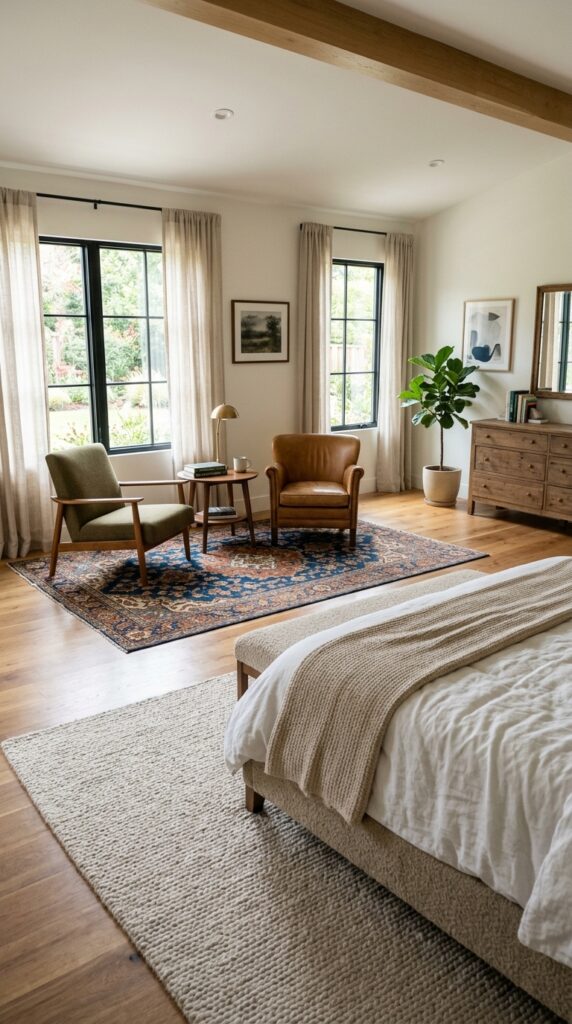
If your bedroom is large enough for a sitting area, you need to separate the zones visually. A rug under the chairs does that. The bed zone gets its own rug. The two rugs should be different but complementary—same color family, different pattern or shade. I have a wool rug under my bed and a jute rug under a reading chair. The eye reads them as two rooms. This works even in smaller rooms: a small rug under a desk defines it as a workspace, separating it from the sleeping zone.
The mistake is using rugs that are too small. A rug under a chair should extend at least 12 inches beyond the chair’s front legs. Otherwise it looks like a postage stamp. Cost: small rug $50–$150.
Overlap rugs slightly if you want a more bohemian look. The overlap creates a third zone where the two rugs meet. It’s a cheap way to add complexity.
9. The Bed Pulled From The Window (At Least 6 Inches)
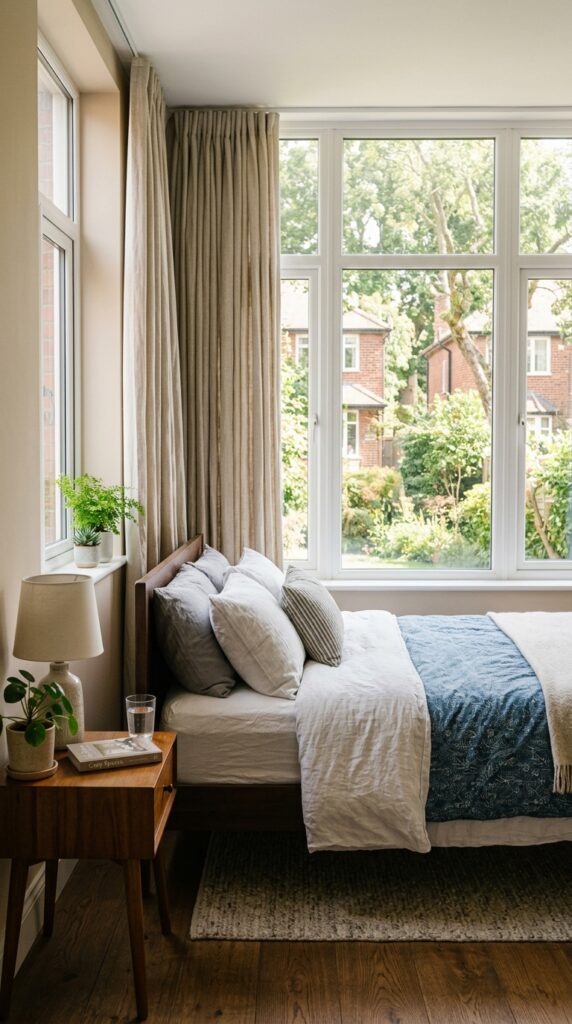
Pushing a bed directly against a window wall is a rookie mistake. The window radiates cold in winter and heat in summer. Condensation drips on your pillows. Curtains get trapped behind the headboard. I pulled my bed six inches away from the window wall and every problem stopped. The curtains hang freely. The air circulates behind the bed. The window can be opened without hitting the headboard. The room even looks better because you see a sliver of wall between the bed and the window.
This only works if you have the floor space to spare. In a tiny room, six inches might be impossible. In that case, at least leave two inches—enough for air to move. Cost: free.
If you can’t pull the bed away, install a window insulating film. It’s a plastic sheet that shrinks with a hair dryer. Costs $15 and stops the draft.
10. The Dresser As Nightstand (For One Side Only)
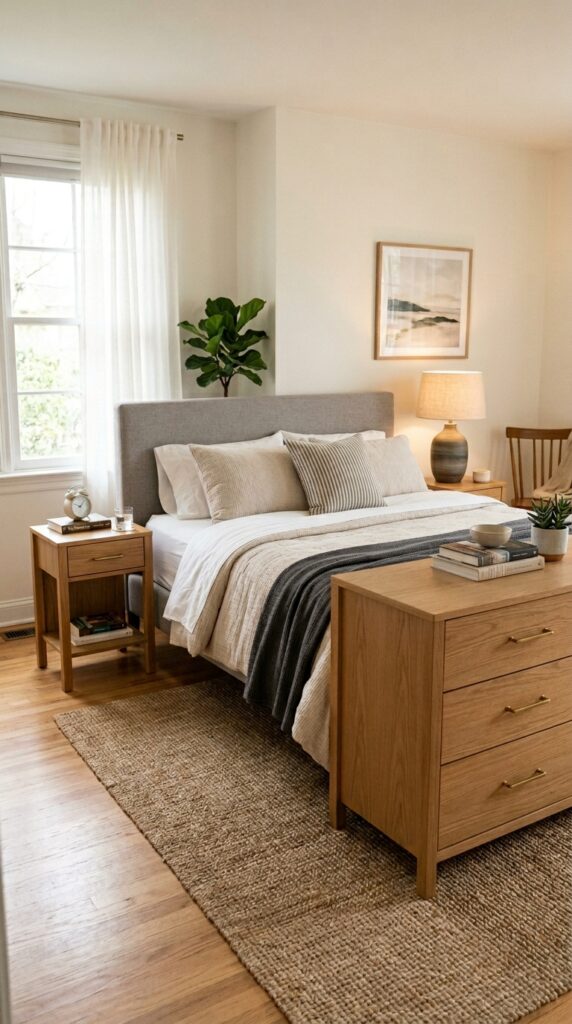
Sometimes you need storage more than symmetry. A low dresser (30 inches or lower) can serve as a nightstand on one side of the bed. The key is matching the height to the nightstand on the other side. I have a three-drawer dresser on my side and a small table on my partner’s side. The dresser is twice as wide, but the tops are level. The room feels balanced because the visual weight of the dresser is offset by the fact that it’s on my side (I’m taller, so it works).
The constraint: a wide dresser pushes the bed off-center. I centered the bed on the wall and let the dresser extend past the headboard. It looks a bit like a built-in. Cost: dresser $100–$300, or use one you already have.
Paint the dresser the same color as the wall to make it recede visually. The storage stays, the bulk disappears.
11. The Path That Never Crosses The Bed
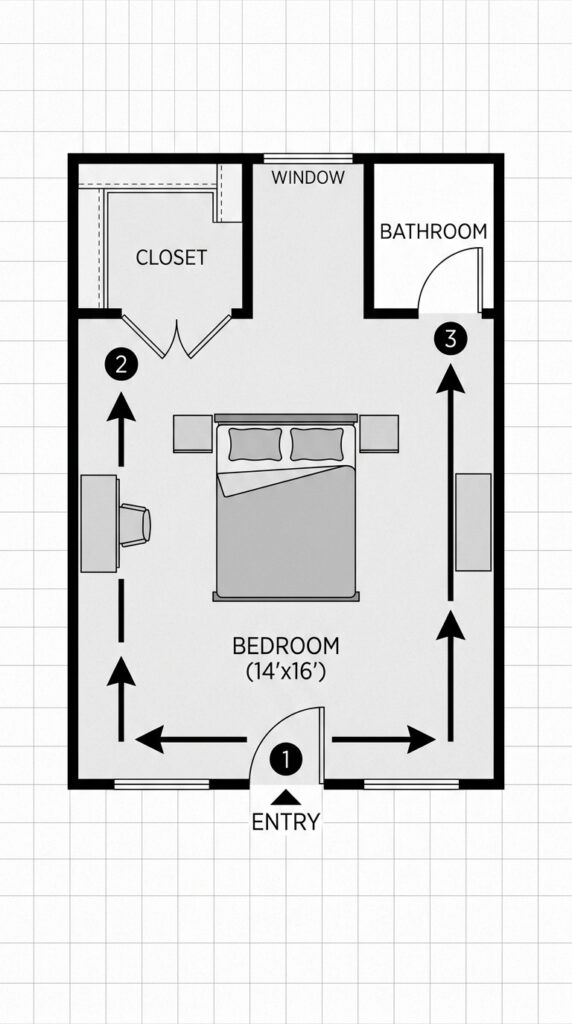
In a perfect bedroom layout, you can walk from the door to the closet and from the door to the bathroom without stepping around the bed. The bed becomes an island rather than an obstacle. I rearranged my furniture to achieve this and the difference in morning grogginess was real. No more half-asleep stubbed toes. No more walking into the bed frame because I misjudged the corner in the dark.
This sometimes means pushing the bed into a corner or against a wall. That’s fine. The corner bed is not a sin if it opens up a clear path. What matters is the path, not the bed’s pride. Cost: free.
Draw your room on graph paper. Mark the door, closet, bathroom. Then draw the shortest line from door to closet. If that line goes through the bed, move the bed or the closet.
12. The Vertical Storage Wall (Floor To Ceiling, One Side Only)
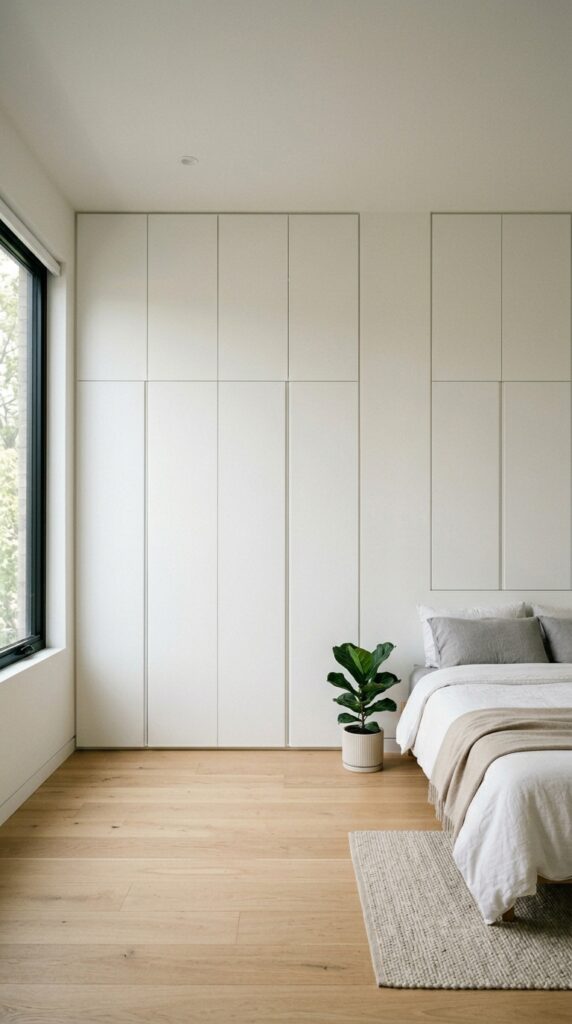
A room with storage scattered on every wall feels like a storage unit. A room with one floor-to-ceiling storage wall and nothing else on the other walls feels like architecture. I built a simple system of IKEA cabinets along one 12-foot wall. The cabinets go from floor to ceiling. They hold clothes, shoes, books, and杂物. The other three walls are almost empty. The room feels huge because your eye isn’t tripping over furniture everywhere.
This is a $500–$2000 commitment, but you can do it cheaply with wire shelving and a curtain. The principle is the same: one wall does all the work. Cost: budget version $150 (shelves + curtain), premium $1000+.
Paint the storage wall the same color as the cabinets so the whole thing disappears. White on white. Dark on dark. The seamlessness is the magic.
13. The Bed Floating In The Room (For Large Bedrooms Only)
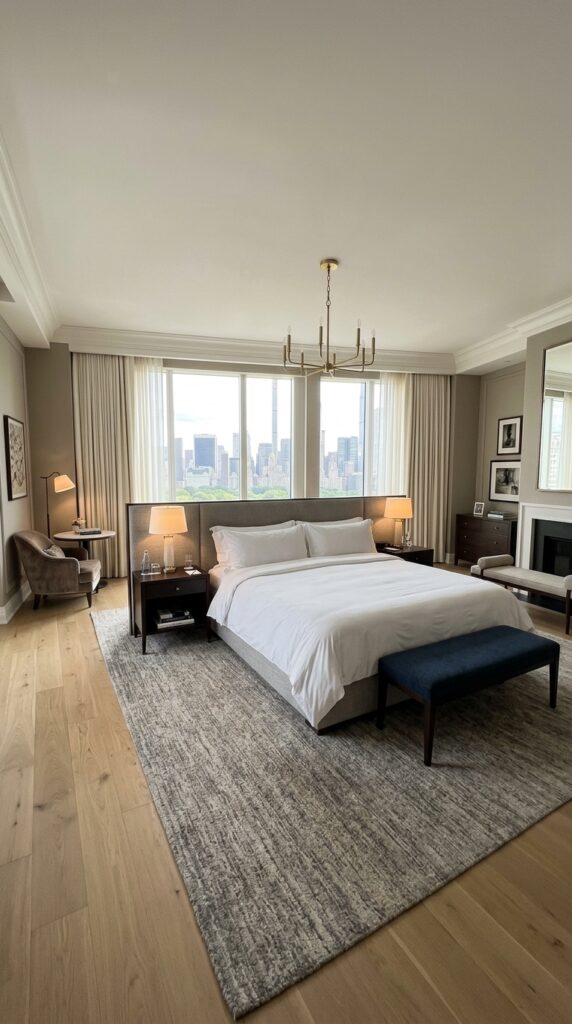
If you have a truly large bedroom (over 200 square feet), put the bed in the center of the room. Not against a wall. Float it. This is how luxury hotels do it. You need a headboard that looks good from both sides, or a bench at the foot to anchor it. I did this in a former master bedroom and felt like royalty. The path around the bed meant no one ever had to crawl over anyone else. It also made the room look smaller in a good way—more intimate, less like a gymnasium.
This requires at least 36 inches of clearance on all sides. If you can’t walk around the bed comfortably, don’t float it. Also, you’ll need a way to hide the cords for bedside lamps (run them under a rug). Cost: free, but you might need longer cords.
Put a large rug under the floating bed that extends at least two feet beyond the bed frame. The rug anchors the bed so it doesn’t look like a boat adrift.
14. The Door Swing Adjusted (Remove Or Reverse)
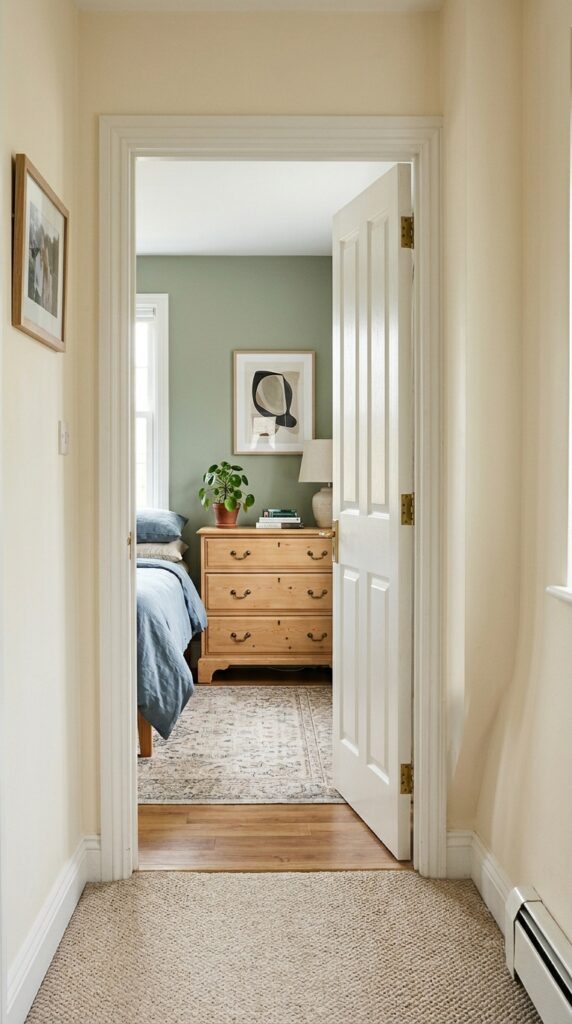
A door that swings into the bedroom kills the wall space behind it. That’s valuable real estate. I reversed the swing of my bedroom door so it opens into the hallway. The landlord didn’t notice (I changed it back before moving out). Suddenly I had room for a tall, narrow bookshelf behind the door. If you can’t reverse the swing, remove the door entirely and use a curtain (see earlier article). If you can’t do either, at least add hooks to the back of the door for robes and bags—that uses the space without needing floor clearance.
Reversing a door swing requires removing the door, chiseling new hinge mortises, and filling the old ones. It’s a weekend project. Or pay a handyman $100. Cost: free to $100.
Test if the door can swing outward by checking the hallway clearance. You don’t want to hit someone walking by. A pocket door is the best solution but expensive ($500+).
15. The Tall Element Beyond The Bed (Eye Lift)
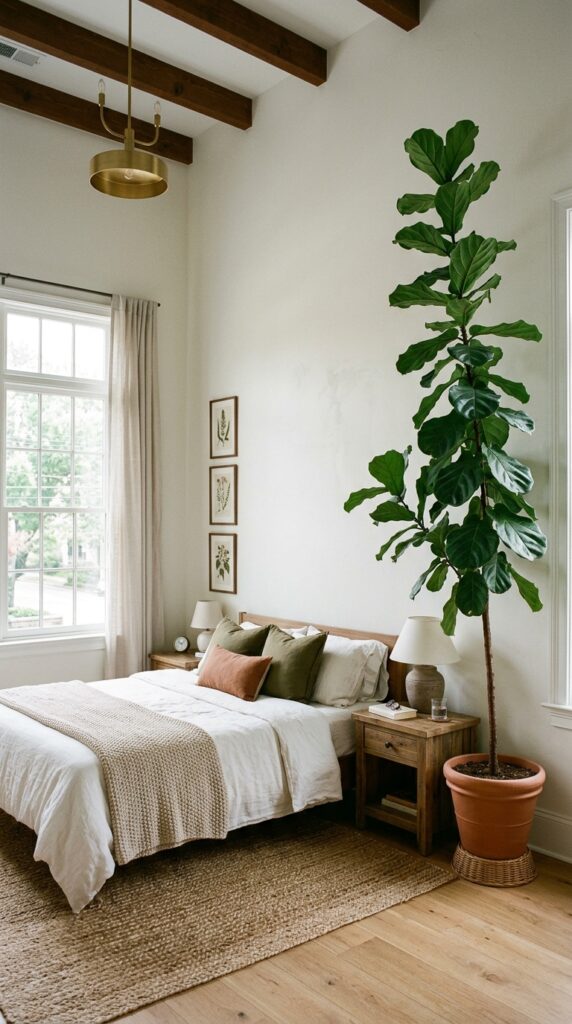
A bedroom with everything at the same height (dresser, nightstands, headboard) feels squat. Add one tall element—a floor lamp, a tall plant (fiddle leaf fig or snake plant), or a vertical piece of art. Place it just beyond the headboard on one side. The eye travels up the tall element, then across the room, then down. The room feels taller. I used a 6-foot floor lamp on the far side of my nightstand. The difference in perception was immediate.
Don’t put the tall element in the center of the room. That creates a pillar that blocks sightlines. Put it near the edge. Cost: floor lamp $40–$100, tall plant $30–$60.
Use a tall leaning ladder instead of a lamp. It’s cheaper ($20) and adds texture. Lean it against the wall behind the nightstand.
16. The Accidental Symmetry (Match What You Can’t Move)
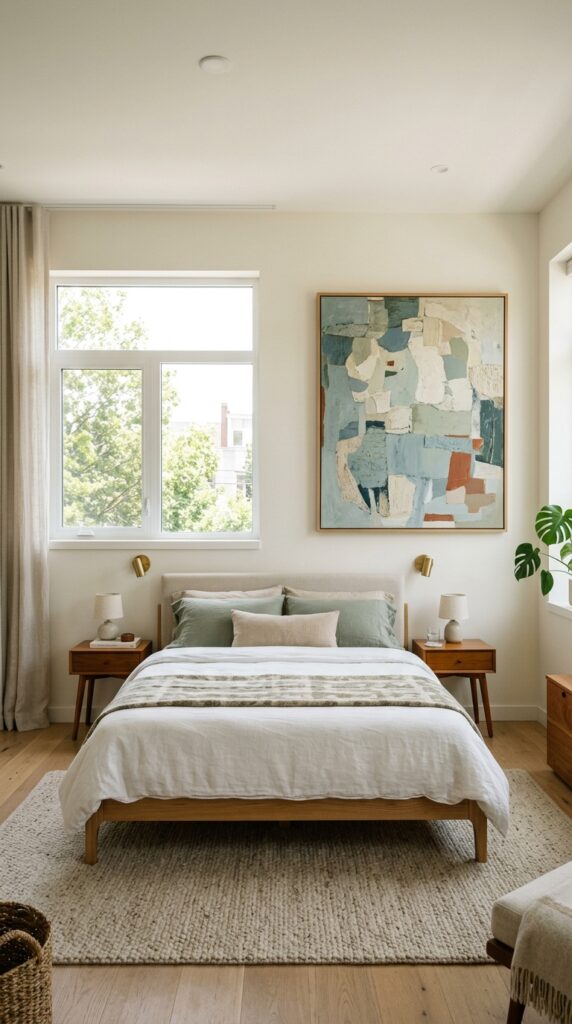
You can’t move the window. You can’t move the door. So make everything else symmetrical to those fixed points. I have a window that’s 18 inches from the left wall. I hung a tall bookshelf on the right wall at the same distance from the right wall. Now the window and the bookshelf mirror each other. The bed goes in the middle. The asymmetry cancels out. This takes some measuring, but it’s free and it works.
The trick is to find two fixed elements in the room (window, door, radiator, closet) and place furniture to mirror them. The eye reads the symmetry between the objects, not their position in the room. Cost: free.
Use painter’s tape on the floor to map out where furniture would go before you move it. Live with the tape for a day. Adjust the tape. Then move the furniture.
17. The Bed Angled Away From The Door (15 Degrees)
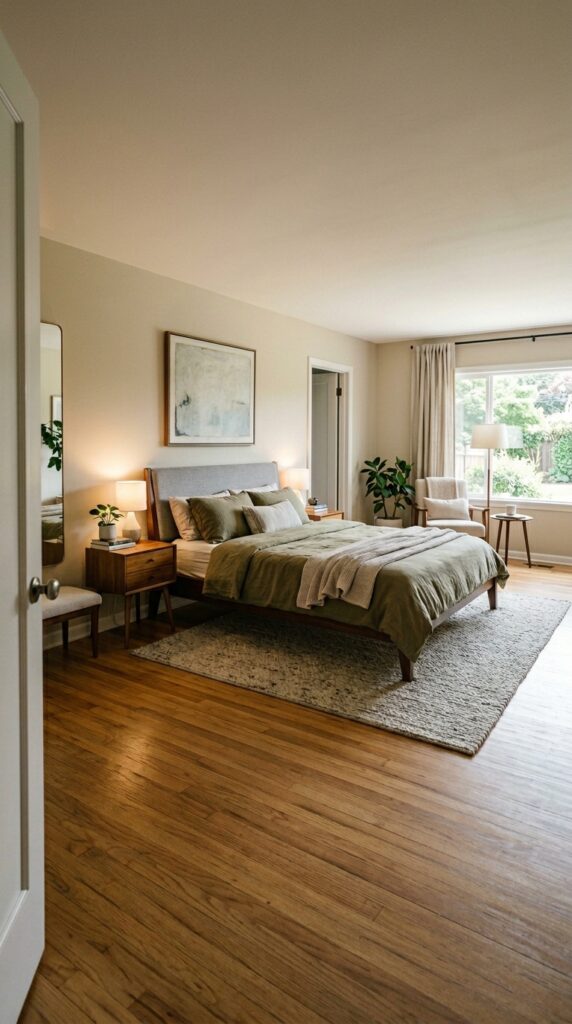
This is controversial. Angling a bed creates dead triangular space behind it. But in a large square room, a slight angle (10-15 degrees) can make the bed the focal point in a way that feels artistic rather than awkward. I tried this in a 15×15 room. The bed pointed toward the corner, not the door. The room felt like a gallery. The dead space behind the bed became a storage zone for luggage. It’s not for everyone, but if you’re tired of boxy layouts, try it.
The trade-off: you lose the ability to have symmetrical nightstands. One nightstand will be closer to the bed than the other. I used a floating shelf on the far side. Also, making the bed is slightly harder because you’re working at an angle. Cost: free.
Put a large round rug under an angled bed. The round shape accommodates the angle better than a rectangle, which would look crooked.
18. The Lamp That Doubles As Sculpture (Placement As Art)
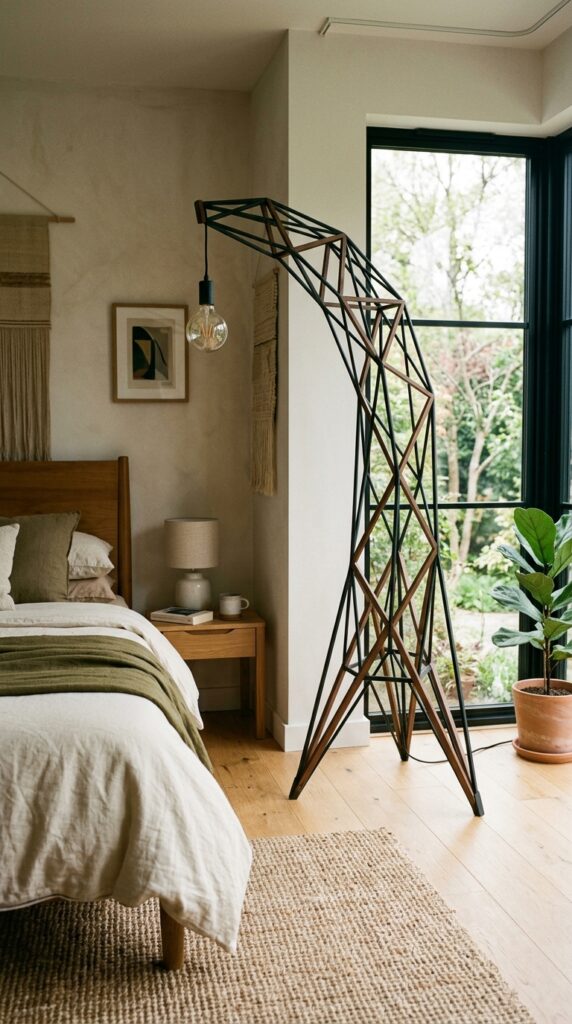
Most people put lamps only where they need light. That leaves corners empty. I bought a sculptural floor lamp—a brass arc lamp from a flea market for $40—and placed it in a corner that felt dead. The lamp serves no lighting function during the day. It’s just a shape. At night, I turn it on for ambient light. The room went from having three functional light sources to having four functional light sources and one beautiful object.
The mistake is placing it too close to the bed. A sculptural lamp needs breathing room. Give it a corner or a wall of its own. Cost: $40–$200.
Use a dimmable bulb in a sculptural lamp. At full brightness, it’s a task light. At 20%, it’s a moody object. Best of both worlds.
19. The Bed And Desk Swapped (Reconsider The Focal Wall)
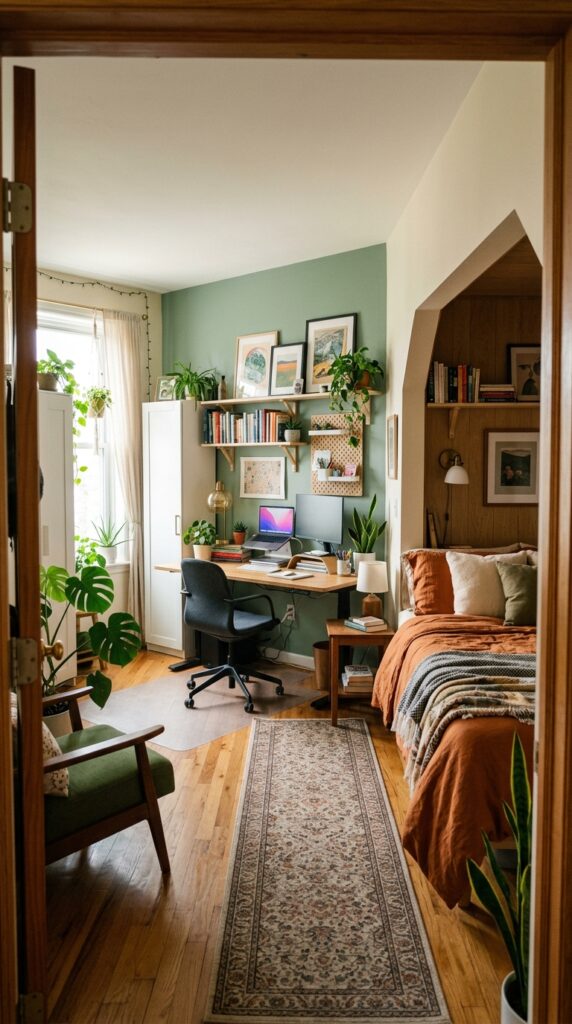
Everyone assumes the bed goes on the largest wall. That’s not a rule. If you work from home, put your desk on the largest wall and tuck the bed onto a smaller one. The bed doesn’t need to be the visual center of the room. I swapped these once and suddenly my desk (where I spend 8 hours) had a nice view of the door and window, while my bed (where I sleep) felt like a cozy nook. The room worked harder.
The constraint: the bed still needs clearance on at least one side. If the smaller wall can’t accommodate a bed with a 30-inch path, don’t do this. Also, consider the outlet placement—your desk needs power. Cost: free.
Use a room planning app like Roomstyler. You can drag furniture around virtually. It’s free and saves your back from moving heavy things twice.
20. The Headboard As Room Divider (For Studios)
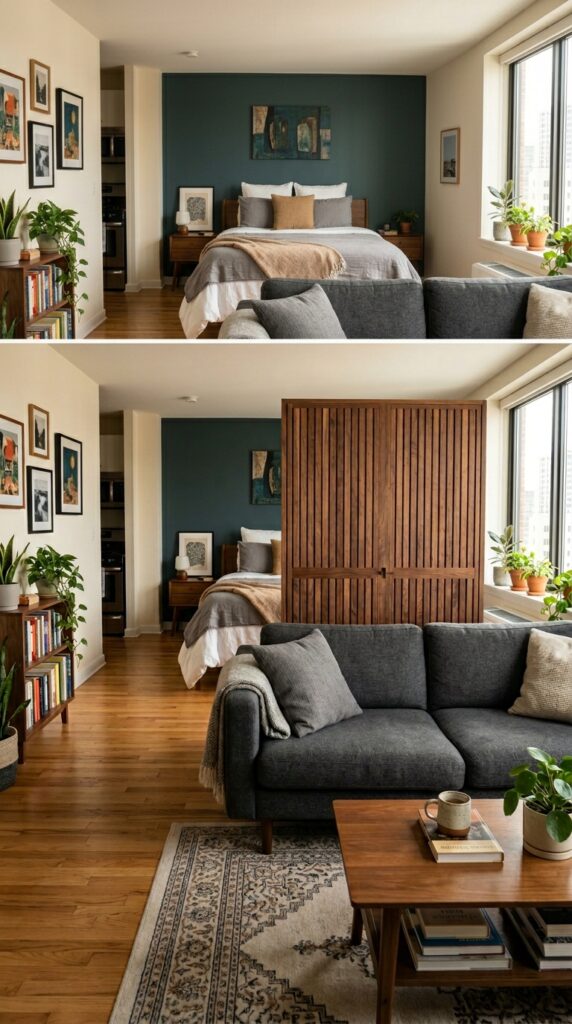
In a studio, the bed often faces the living area, making the whole space feel like a bedroom. Flip it around. Put a tall headboard (or a room divider that functions as a headboard) between the bed and the living area. The bed goes behind it. From the sofa, you see a nice piece of furniture, not your unmade pillows. I built a simple 48-inch tall plywood panel covered in fabric. It cost $60. The studio felt like a one-bedroom.
Make sure the headboard is anchored to the wall. A tall, freestanding panel will tip. Use L-brackets into a stud. Cost: $50–$200.
Use a Kallax-style shelf as a headboard divider. Open cubes on the living side hold books and plants. The bed side stays solid (add a backing panel).
21. The Corner Dresser (Diagonal, Not Flat)
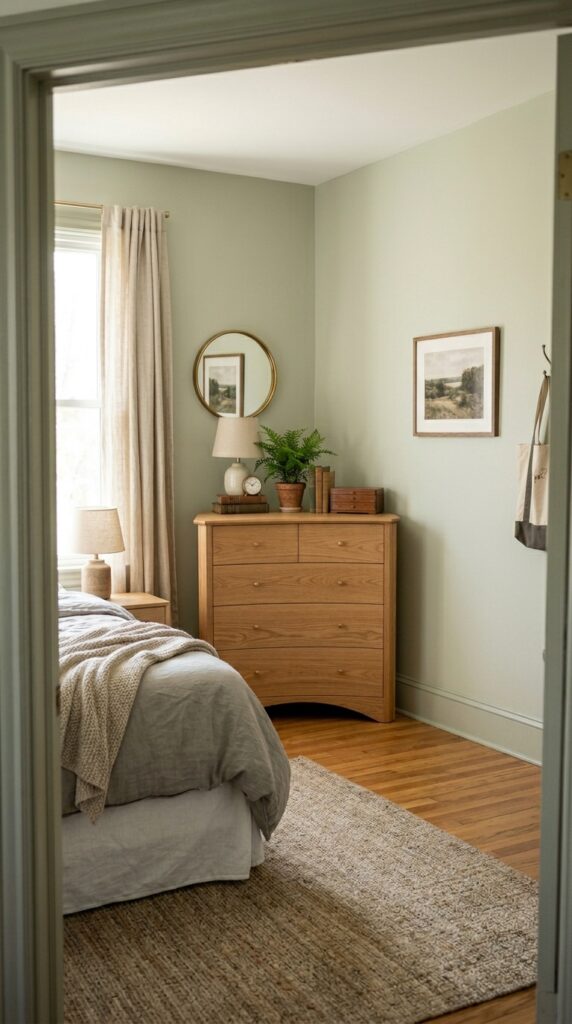
A dresser pushed flat into a corner is hard to use because the wall blocks the drawers on one side. Pull it out and rotate it 45 degrees so it sits diagonally. Now both sides of the dresser are accessible. The diagonal also breaks up the room’s right angles, making the space feel less boxy. I did this with a small chest of drawers in a tight bedroom. The diagonal dresser became a feature rather than an awkward afterthought.
This requires that the dresser is narrow enough to fit diagonally without blocking the path. Measure the diagonal depth before you try. Also, the back of the dresser will be visible. Paint it or cover it with fabric. Cost: free.
Put a tall plant behind the diagonal dresser. The plant fills the triangular gap between the dresser and the walls and softens the angles.
22. The Art Hung At Sitting Height (Not Standing)
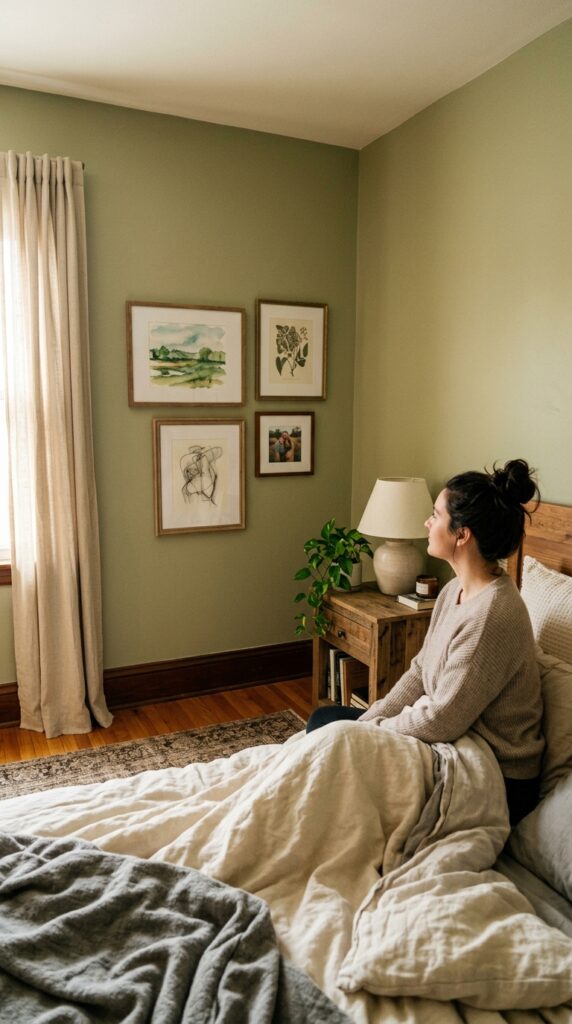
Standard gallery height (57 inches to center) assumes you’re standing. In a bedroom, you’re usually sitting or lying down. So hang art lower. I dropped my bedroom art so the center is at 48 inches. When I sit up in bed, the art is at eye level. The room feels more personal, less like a museum. The lower art also balances the visual weight of the bed.
If you have tall ceilings, you might need to go even lower. Test by sitting in bed with a friend holding the art. Mark the spot. Then hang it. Cost: free.
For art above the bed, ignore all rules. Hang it so the bottom edge is 8-12 inches above the headboard. That’s the only exception to the 48-inch rule.
23. The Bench At The Foot (Angled, Not Parallel)
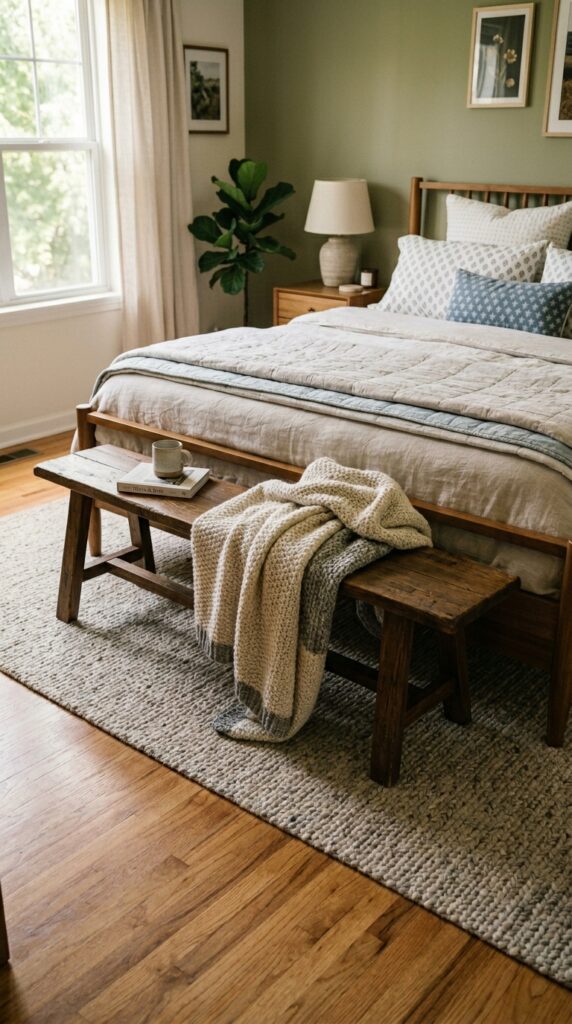
A bench at the foot of the bed is a classic layout move. But a bench that’s perfectly parallel to the bed looks like a punishment. Angle it slightly—10 degrees off parallel. The angle softens the line. It also makes the bench easier to sit on because you’re not facing the bed directly. I angled my bench toward the window. Now it’s a spot to put on shoes while looking outside.
This only works if the bench is at least 12 inches shorter than the bed on each side. If the bench is the same width as the bed, angling it will make it stick out into the path. Cost: free.
Use a round ottoman instead of a bench. A circle has no parallel. It can’t look rigid. Plus, it’s softer on shins.
24. The Clear Path To The Window (Emergency Egress)
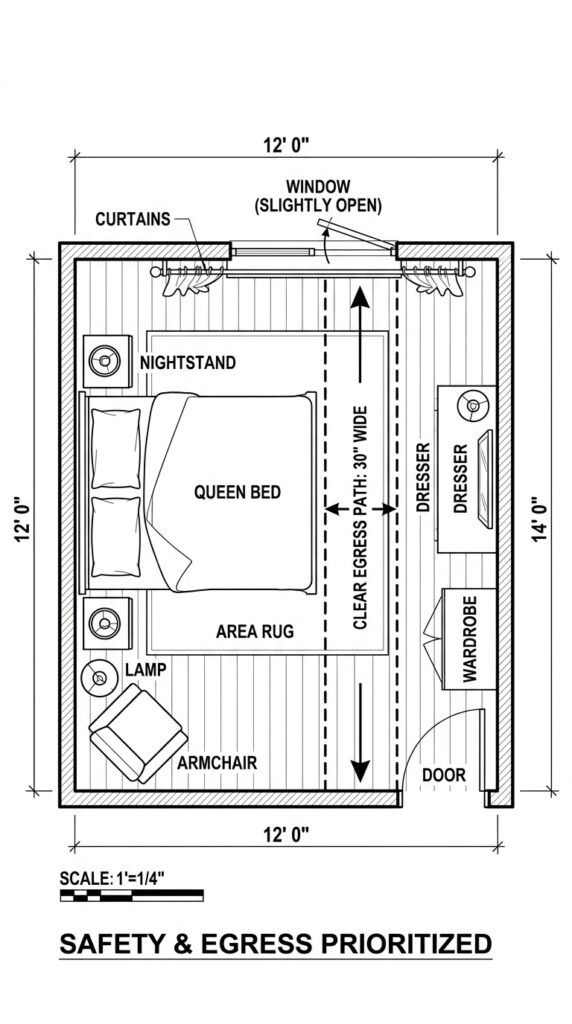
This is not about aesthetics. It’s about not dying in a fire. Your window is an emergency exit. You need a clear path from your bed to that window. I rearranged my furniture so nothing blocks the path. It took moving a bookcase. Now, in the dark, I could get to the window in three steps. Most people don’t think about this until it’s too late. Don’t be most people.
The constraint is obvious: you lose that wall space. But you gain the knowledge that you won’t trip over a hamper in a smoke-filled room. Cost: free.
Test the path at night with your eyes closed. Walk from your pillow to the window. If you bump into anything, move it today. Not next week. Today.
25. The Floor Plan You Draw First (Before You Buy Anything)
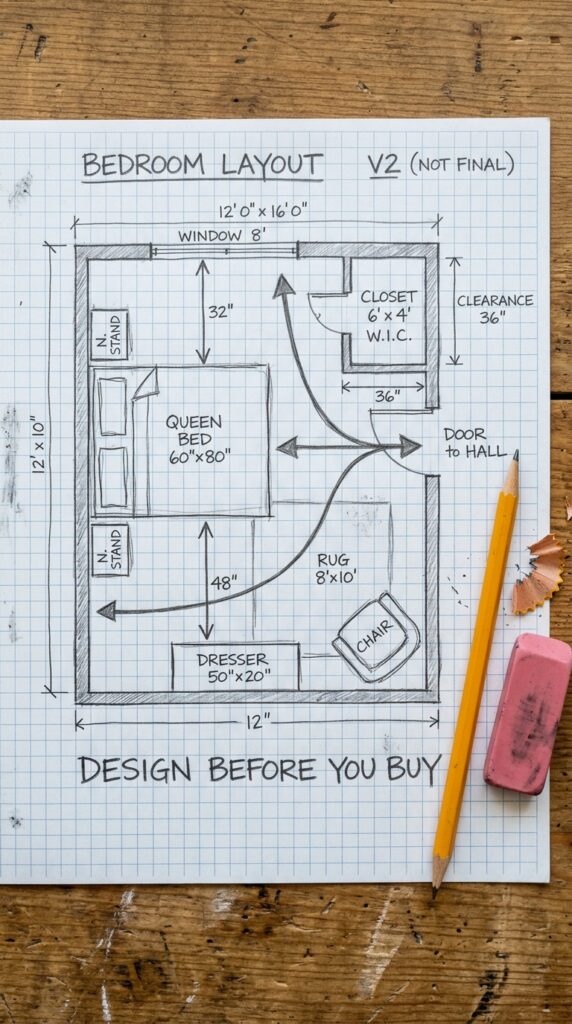
The most important layout tool is free and analog. Draw your room to scale on graph paper. Cut out paper furniture pieces. Move them around. You’ll discover that your dream dresser doesn’t fit. You’ll realize the bed looks better on a different wall. I’ve saved myself from buying the wrong size furniture dozens of times by spending 20 minutes with a pencil. The paper doesn’t lie. The tape measure doesn’t negotiate.
Do this before you buy a single piece of furniture. Do this before you move a heavy dresser. Do this before you paint. The drawing costs nothing. The mistakes it prevents cost hundreds. Cost: $5 for graph paper, $2 for a pencil.
Use 1/4 inch = 1 foot scale. Standard graph paper has 1/4-inch squares. Count the squares. That’s your room. It’s that simple.
The core decision of bedroom layout is understanding that you are designing a path, not a photograph. The room will be judged not by how it looks when you first walk in, but by how it feels on the 500th time you walk from the bed to the closet in the dark. Prioritize flow over symmetry. Prioritize clearance over aesthetics. Prioritize the emergency exit over the perfect Instagram shot.
If you do one thing from this list, start by measuring your traffic paths. Find the narrowest point between any two pieces of furniture. If it’s less than 30 inches, move something. That single change will improve your daily experience more than any paint color ever could. Then draw the floor plan. The drawing will reveal everything else.
A beautiful layout is invisible. You don’t notice it because nothing gets in your way. That’s the goal. Now go measure something.