
I painted my bedroom black once, and a well-meaning friend asked if I was “going through something.” I wasn’t. I was just tired of beige. Tired of the assumption that feminine means floral and pastel. I wanted a room that felt like the inside of a velvet clutch—dark, rich, a little dangerous, and completely mine. The first night I slept in that black room, I felt more myself than I had in years of “calming” grey walls.
Most guides to “feminine” bedrooms are stuck in 2012. They show you pale pink, fairy lights, and a lot of shabby chic. Nothing wrong with that if it’s your thing, but it misses an entire mood. Dark feminine isn’t about shrinking or softening. It’s about owning the shadows. It’s velvet and candle wax, aged brass and dried flowers, the smell of sandalwood and the weight of a good book. Conventional advice tells you to lighten and brighten. That’s the opposite of what makes this style work.
I’ve been building my own dark feminine bedroom for three apartments now. I’ve made mistakes—cheap velvet that looks like costume fabric, black paint that turned chalky, candles that smelled like a mall. This list is what survived. These 25 ideas are for anyone who wants their bedroom to feel like a secret, not a showroom. Bold, elegant, and unapologetically moody. No beige required.
1. The Burgundy Accent Wall (Not Black)
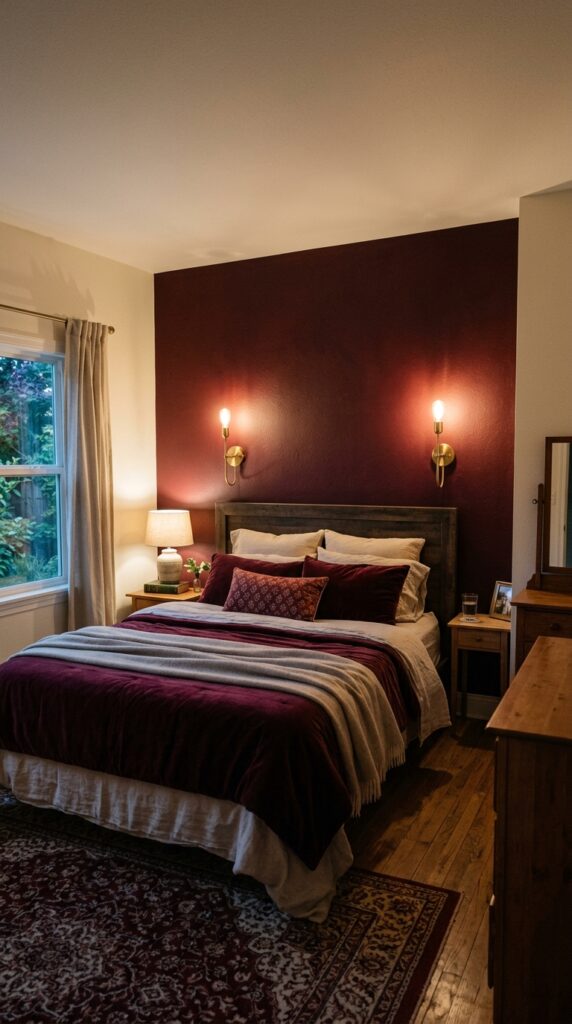
Everyone jumps to black when they think dark. Black is dramatic, but it eats light. Burgundy—specifically a deep, warm burgundy with brown undertones, not purple—gives you the same moody weight but reflects enough light to keep the room from feeling like a cave. I used Benjamin Moore’s “Burgundy” on one wall behind my bed. The color shifts from almost black at night to a rich wine in the afternoon. It’s feminine without being girlish.
The trade-off: burgundy shows every scuff and dust streak. I use a matte finish, which hides imperfections but can’t be wiped. Eggshell is more durable but shows roller marks. Also, burgundy with cool white trim looks terrible. Paint your trim a warm cream or the same burgundy. Cost: one gallon $40–$60, plus supplies $20.
Test burgundy next to your bedding before painting. It clashes with bright white sheets and cool pinks. It loves cream, ochre, and deep green.
2. Velvet That Actually Looks Expensive (Not Shiny)

Cheap velvet is shiny. It reflects light like a polyester costume. Good velvet is matte. It absorbs light and feels almost velvety—wait, that’s the word. I learned this after buying a “velvet” duvet that looked like a disco ball. The real stuff is usually cotton velvet or rayon velvet. It costs more (a pillow cover $30–$50 vs $15) but it doesn’t look like Halloween. I have a deep green velvet throw that I’ve had for four years. It’s faded slightly, but that only made it look better.
Velvet is a dust magnet. Vacuum it with the upholstery attachment monthly. And don’t put it somewhere a cat will scratch—they love the texture. Cost: velvet pillow $30–$60, velvet throw $50–$100.
Rub the velvet in both directions. Good velvet feels the same both ways. Cheap velvet goes dark in one direction and light in the other, which looks cheap.
3. Brass That Ages (Not Chrome, Not Polished)
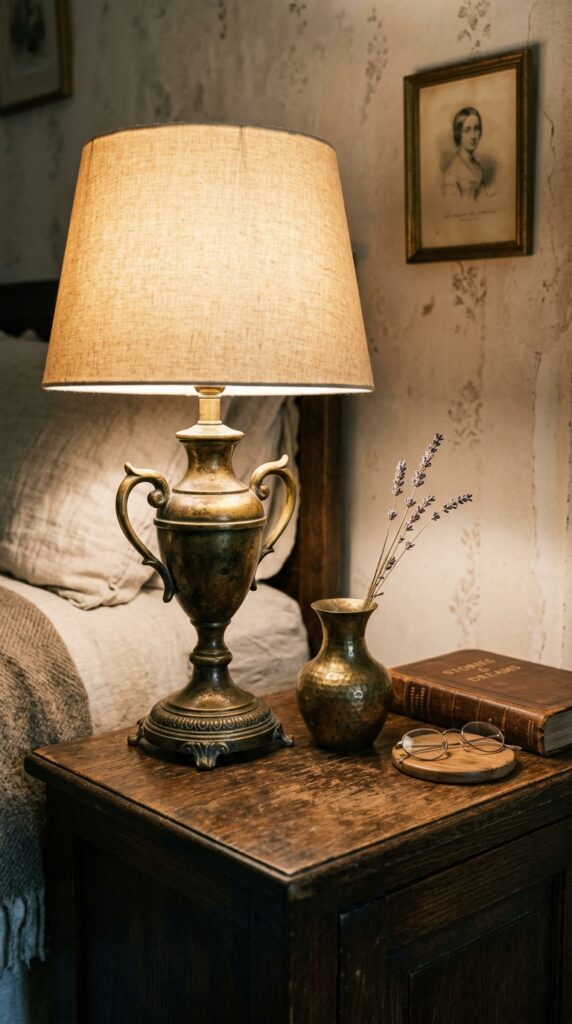
Dark feminine style hates chrome. Chrome is cold, bright, and screams 2015. You want unlacquered brass. It starts shiny and then oxidizes into a warm, muted gold with dark spots. It ages like a good leather bag. I replaced all my silver lamp bases and drawer pulls with unlacquered brass. The difference is staggering. The room went from “contemporary condo” to “Victorian study.”
The catch: unlacquered brass requires maintenance if you want it to stay shiny. But you don’t want it shiny. You want the patina. Just let it happen. If you hate the green spots that can form (verdigris), use a brass cleaner once a year. Or buy lacquered brass that stays shiny forever—but then it’s not aging. Cost: brass lamp $60–$150, brass drawer pulls $2–$8 each.
Mix brass with black iron for contrast. Too much brass feels like a steampunk convention. A black iron bed frame with brass accents is perfect.
4. The Chaise Longue In A Corner (Not The Center)
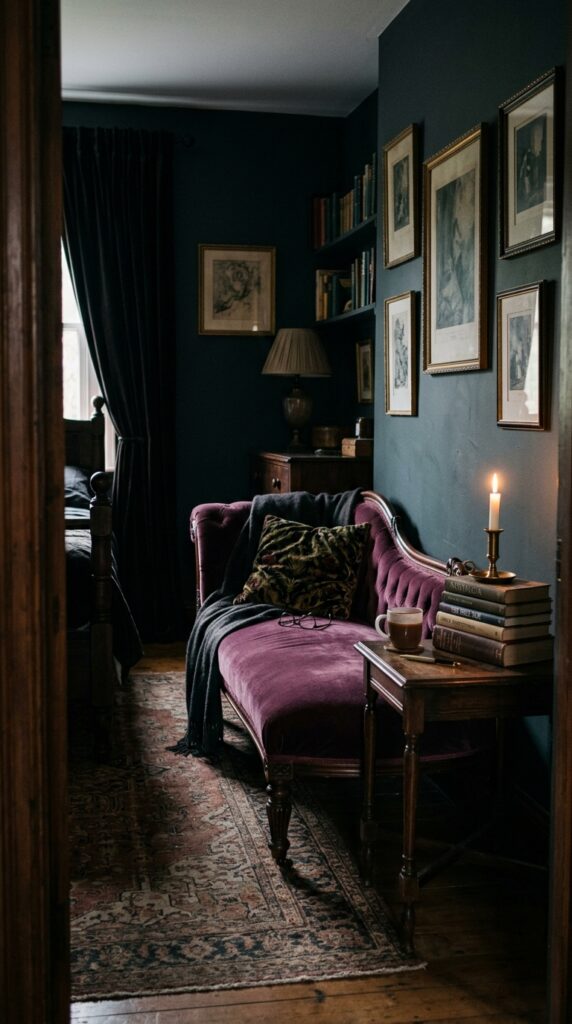
A chaise longue is the most dramatic piece of furniture you can add to a bedroom. But don’t put it in the center like a throne. Tuck it into a corner, angled 45 degrees. It becomes a secret reading nook. I found a vintage velvet chaise on Facebook Marketplace for $150. It’s deep burgundy, slightly faded, with tufted buttons. It looks like it belongs in a dimly lit hotel bar. I put it in the corner by the window. Now it’s where I drink my morning coffee and feel like a character in a novel.
The trade-off: a chaise takes up serious floor space. In a small room, skip it. Also, velvet chaises are heavy and hard to move. I’ve left mine behind in two moves because it wouldn’t fit up the stairs. Cost: used $100–$300, new $400–$1000.
If a full chaise is too much, get a tufted velvet bench. Same vibe, half the footprint. Put it at the foot of the bed.
5. Candles That Smell Like Something Real (Not “Fresh Linen”)
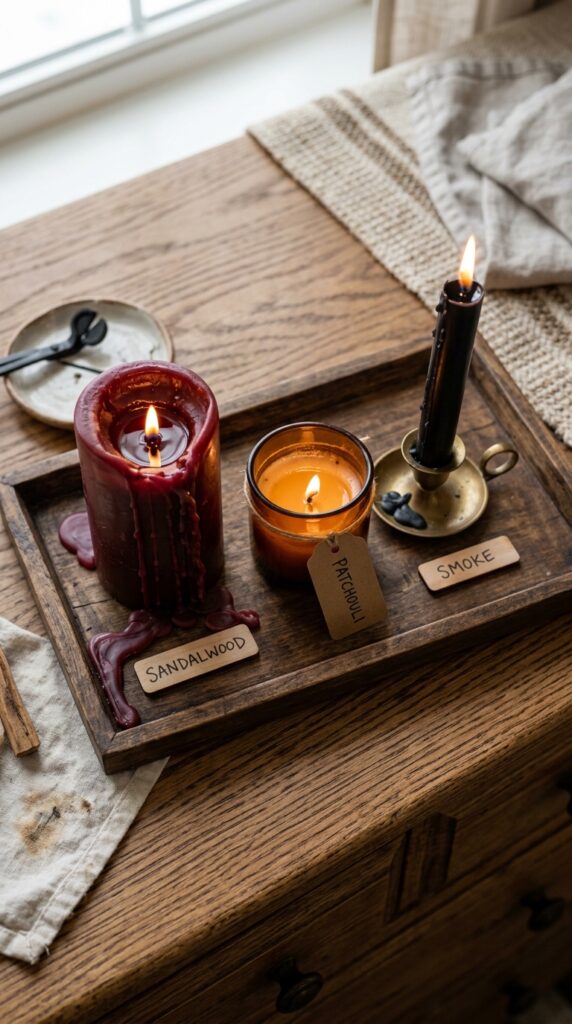
The smell of a dark feminine bedroom is not “spring breeze” or “clean cotton.” It’s sandalwood, rose, patchouli, tobacco, smoke, or leather. I keep a sandalwood candle burning for an hour each evening. The scent is grounding and slightly androgynous. Avoid anything with the word “dream” or “fresh” in the name. Those are for laundry rooms.
Real fragrance candles are expensive ($25–$50). Cheap ones smell synthetic. I buy soy wax candles from small makers on Etsy. They burn cleaner and the scent lingers after blowing them out. The downside: natural wax candles have a shorter shelf life (about a year) before the scent fades. Store them in a drawer in summer. Cost: $20–$60 per candle.
Light a candle 30 minutes before you enter the bedroom. The scent will have time to fill the room. Blow it out before sleep—never leave a candle burning unattended.
6. The Mirror With An Ornate Black Frame (Not Gold)
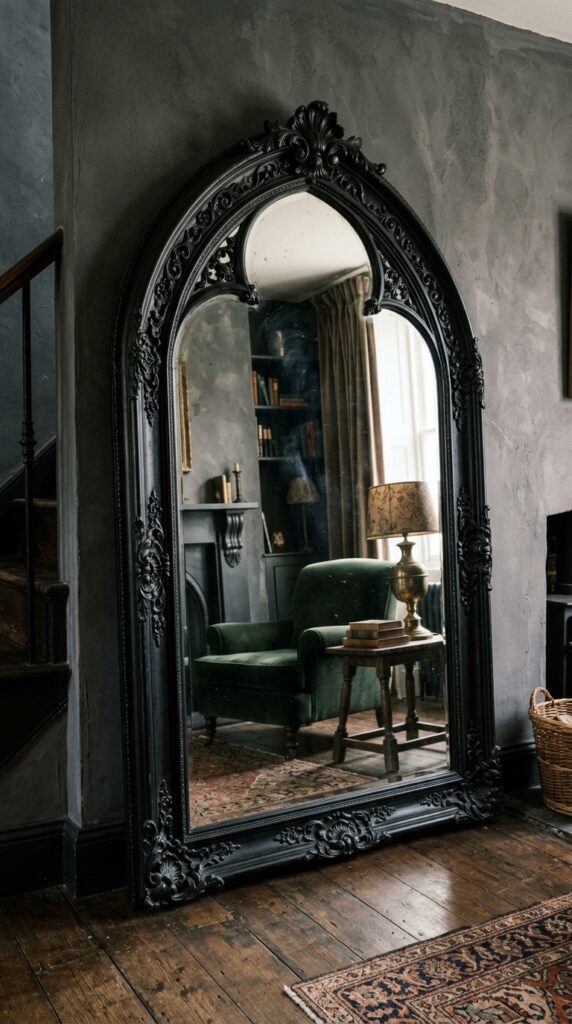
Gold frames are lovely but they read as traditional or glam. Black frames—especially ornate, carved ones—read as dark feminine. I found a massive arched mirror at a flea market for $40. The frame was chipped black paint over gesso. I left the chips. It looks like it came from a haunted mansion. The mirror doubles the light and the mood. It’s the most commented-on piece in my room.
The problem: ornate mirrors are heavy. This one is 50 pounds. I had to drill into a stud and use a French cleat. Also, the carving collects dust. I use a soft paintbrush to clean it. Cost: used $30–$100, new $150–$400.
If you can’t find an ornate frame, buy a plain black mirror and add stick-on resin appliques. Paint them black. It’s a $20 hack that looks real from three feet away.
7. The Dried Flower Arrangement (Not Fresh)
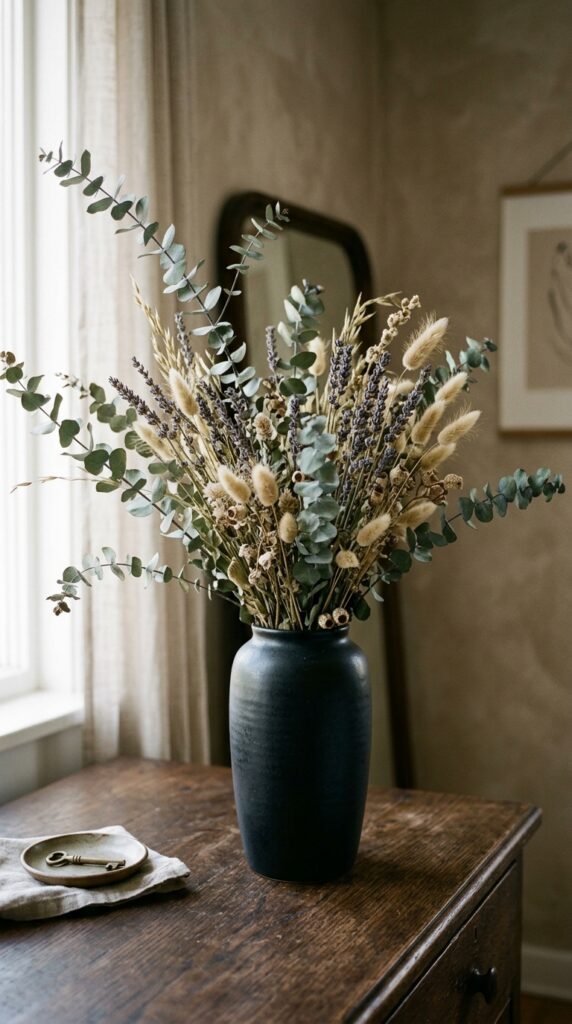
Fresh flowers are too cheerful for a dark feminine room. They die quickly and look sad. Dried flowers last for years and have a muted, melancholic beauty. I have a bunch of dried eucalyptus and lavender in a black ceramic vase. They smell faintly herbal and they don’t need water. Every few months I shake them outside to remove dust. That’s it.
Don’t use dyed dried flowers—the bright pink and blue ones from craft stores look fake. Stick to natural dried: lavender, eucalyptus, bunny tails, pampas grass (though pampas sheds like crazy), or dried hydrangeas. Cost: dried bouquet $15–$40, vase $20–$60.
Make your own by hanging fresh flowers upside down in a dark, dry closet for two weeks. It’s free and the flowers will be uniquely yours.
8. The Canopy With Sheer Black Curtains (Not White)
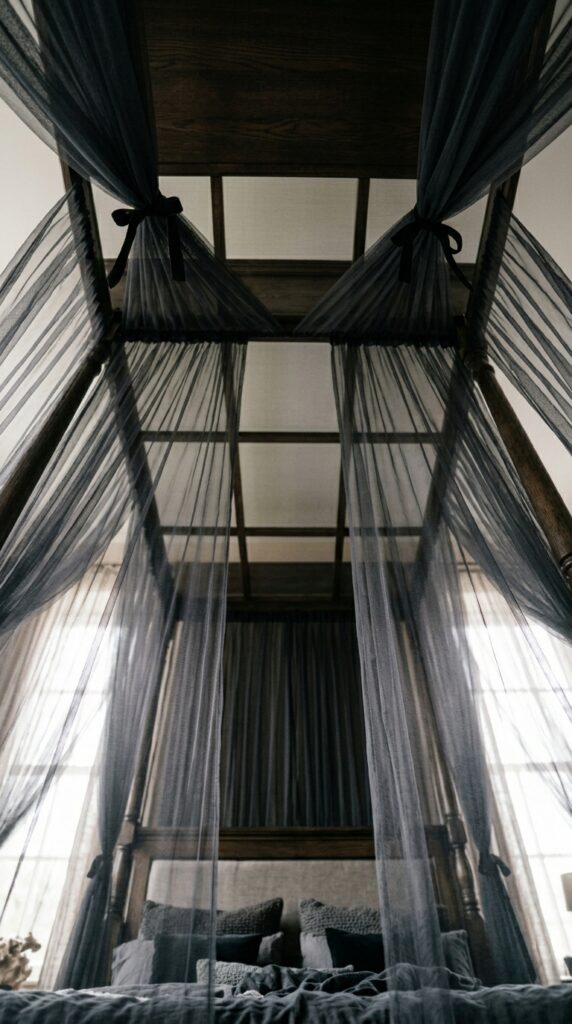
A canopy bed is the ultimate dark feminine statement. But white sheers are too bridal. I use sheer black curtains—they’re surprisingly translucent. In daylight, they filter the room into a soft, dim glow. At night, with a lamp inside the canopy, it feels like a tent of shadows. I built my canopy by attaching a simple curtain rod to the ceiling and draping two panels of black sheer fabric. Total cost $60. You don’t need a four-poster bed.
The challenge: sheer black fabric shows every dust particle. Wash it every few months. Also, the canopy traps heat. In summer, I take it down. In winter, it keeps warmth in. Cost: black sheer curtains $20–$40 per panel, ceiling rod $20.
Use a circular embroidery hoop attached to the ceiling as a canopy ring. Thread the sheer through it. It makes a perfect draped circle for $5.
9. The Black Silk Sheets (Not Satin)

Black sheets are notorious for showing every speck of lint and every body oil. But black silk? It’s worth the trouble. Real silk (not polyester satin) has a subtle, matte sheen that hides lint better than cotton. It’s also temperature-regulating—cool in summer, warm in winter. I bought a set of black mulberry silk sheets for $200. They feel like a second skin. The dark color makes the bed look like a pool of ink.
The maintenance is high. Hand wash or delicate cycle in a mesh bag. Air dry. No bleach. No fabric softener. They last about two years with proper care. If that sounds like too much, get black linen instead. Linen has a similar dark, earthy look and is much easier to wash. Cost: silk $150–$300, linen $80–$150.
Buy a second set of pillowcases and change them every three days. Black silk shows facial oils fast. The cases are easier to wash than the whole set.
10. The Portrait In Dark Tones (Not A Landscape)
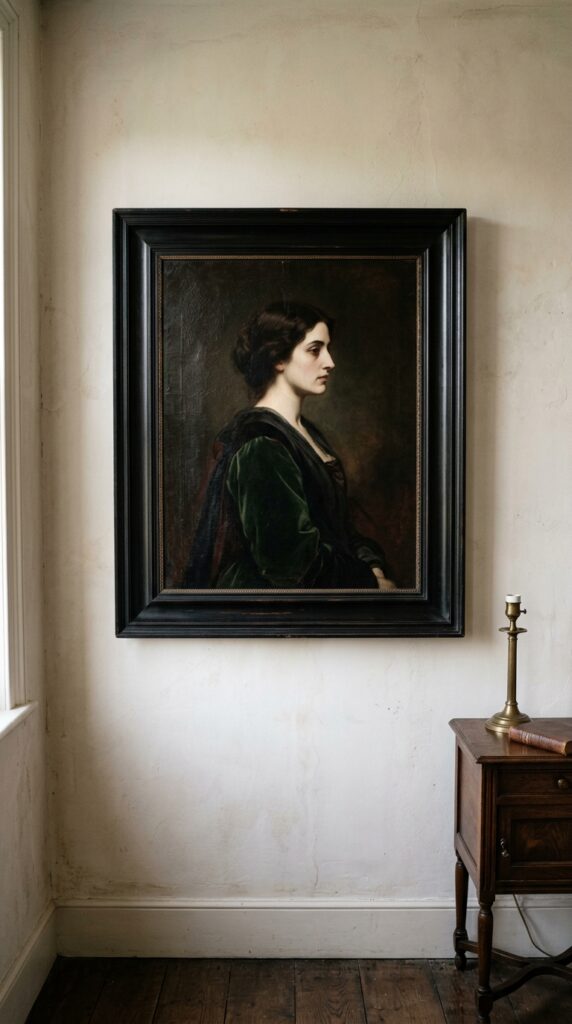
Dark feminine art is not a print of a field of flowers. It’s portraits, still lifes of wilting flowers, anatomical drawings, or abstract shapes in deep colors. I have a large canvas print of a woman’s face in charcoal and burgundy. It’s anonymous and slightly unsettling. People ask who painted it. I say “I don’t remember” because I bought it on Etsy for $40.
You can also frame vintage black-and-white photographs. Thrift store portrait paintings are perfect if you paint the background black and leave the face. The key is mood over prettiness. Cost: Etsy digital download $5–$15, printing and framing $40–$100.
Search for “dark art print” or “gothic portrait” on Etsy. Filter by physical prints only. You’ll find thousands of options for under $30.
11. The Vanity With A Black Skirt (Hide The Mess)
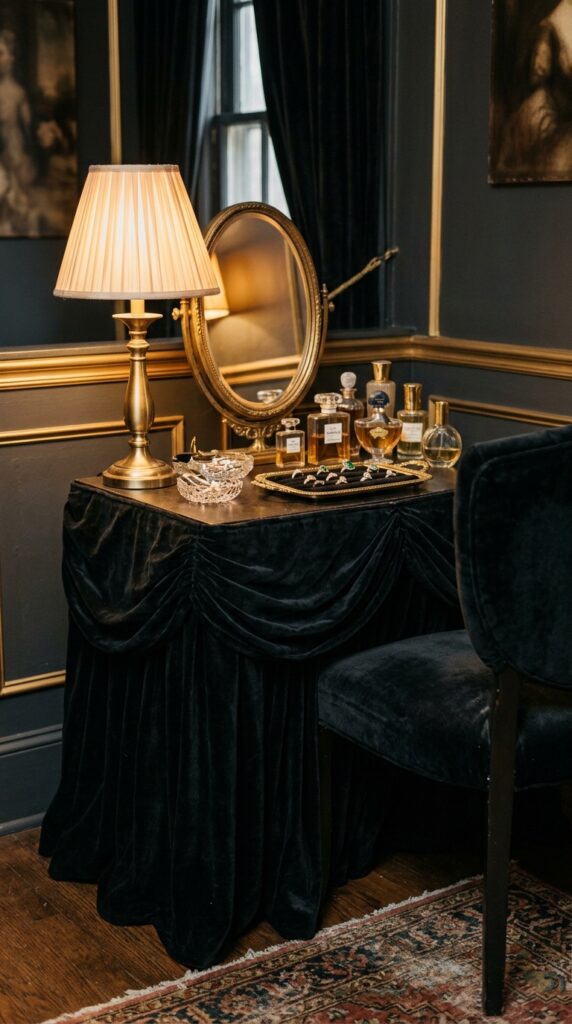
A vanity is a beautiful idea but in practice it collects clutter. The dark feminine solution: a floor-length black velvet skirt that wraps around the vanity table. It hides the hair dryer, the cords, the stack of lotions. The top stays clear except for a few beautiful objects. I made my skirt from two yards of black velvet and a tension rod under the tabletop. It cost $30 and takes ten minutes to install. No sewing—just fabric clips.
The skirt collects dust at the hem. I vacuum it monthly. Also, cats love to hide under it. My cat has claimed it as her cave. If you have a cat, accept that the skirt will have claw marks. Cost: velvet fabric $20–$40, tension rod $10, clips $5.
Use black felt instead of velvet. It’s cheaper, doesn’t show dust, and still has a soft texture. Plus, cat claws don’t leave visible marks as easily.
12. The Dark Wood Floor (Stained, Not Painted)
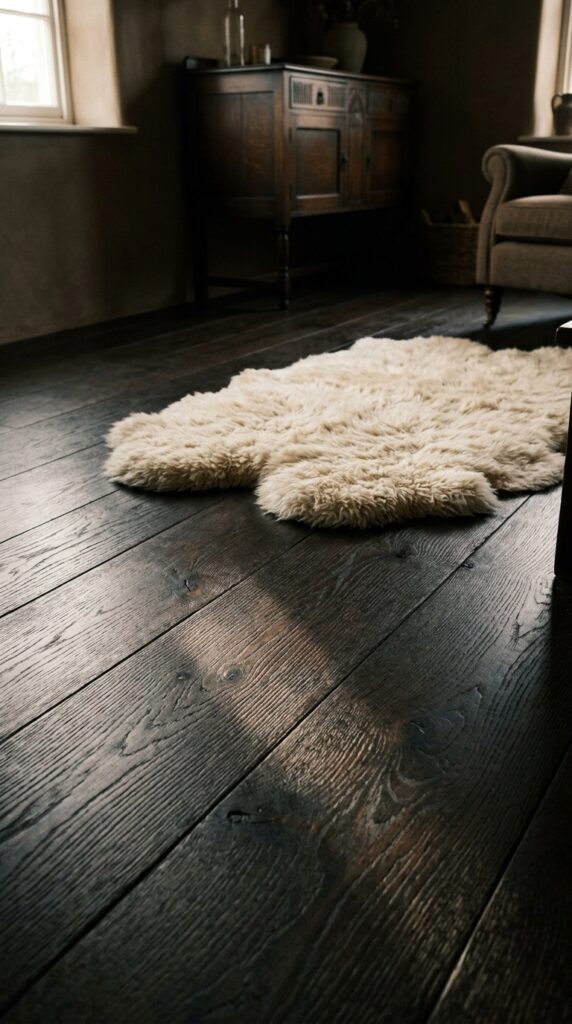
If you have light wood floors, consider staining them dark. Not black—espresso or dark walnut. The dark floor anchors the room and makes the walls feel richer. I refinished my floors myself (a terrible weekend of sanding and staining) and it was worth it. The dark floor hides dust better than light wood. But it shows scratches. Every time I move a piece of furniture, I add a new mark. I’ve learned to love the scratches. They’re texture.
If you can’t stain, use a large dark rug to cover the floor. A 9×12 dark wool rug does the same visual job. Cost: staining DIY $100–$200, professional $500–$1000, large rug $200–$500.
Test the stain on a closet floor first. “Espresso” can look purple on some woods. “Dark walnut” is safer for most.
13. The Taper Candles In Black Holders (Drippy And Real)
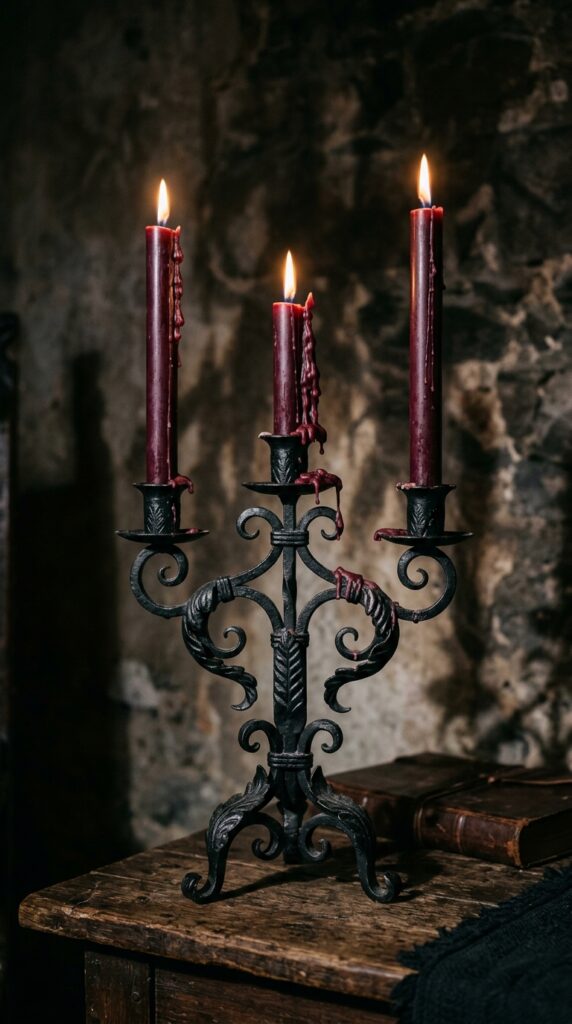
Electric candles have no soul. Real taper candles—the kind that drip wax and need a lighter—create the exact atmosphere of a dark feminine bedroom. I have a pair of black iron candlesticks on my dresser. I burn the candles for an hour each night. The wax drips onto the holders, which I let build up like a sculpture. The flickering light is impossible to replicate with LEDs.
The safety rules: never leave them unattended, keep them away from curtains, and trim the wicks to 1/4 inch to prevent smoking. Also, taper candles are expensive to burn daily. I buy unscented beeswax tapers in bulk (12 for $20) and use my scented candles on weekends. Cost: candlestick holder $15–$40 each, taper candles $2–$5 each.
Put a small glass plate under the candlestick to catch runaway wax. A cheap saucer from a thrift store works. It saves your furniture.
14. The Vintage Rug With A Dark Patina (Not New)
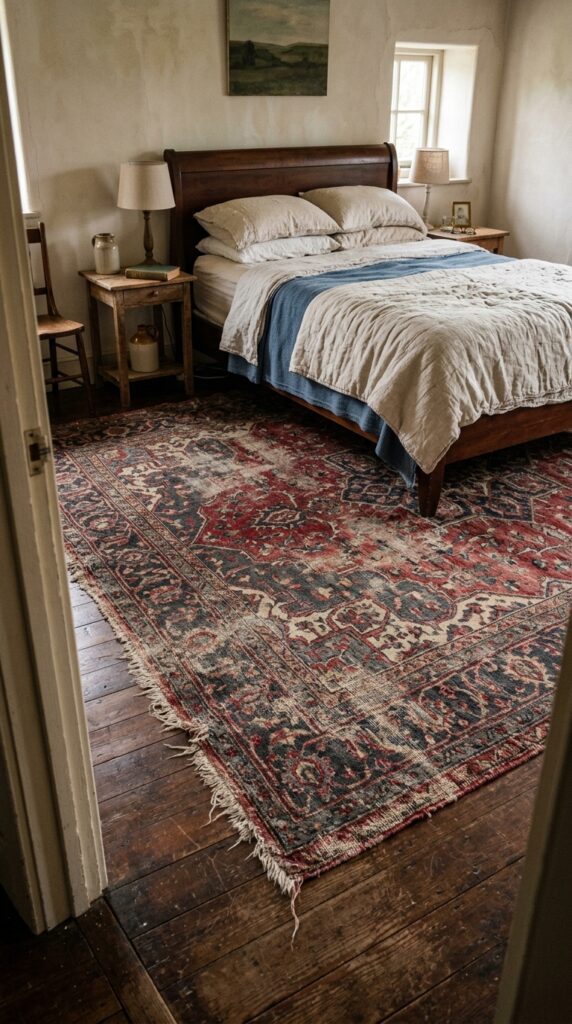
A new rug is too perfect for a dark feminine room. You want a vintage rug with patina—faded colors, worn spots, slightly uneven. I bought a 100-year-old Persian runner on Etsy for $150. It’s not perfect. It has a small burn mark and the fringe is uneven. That’s the point. The rug has history. It grounds the room in a way that a machine-made rug never could.
Vintage rugs can be expensive, but you can fake the look by buying a new rug in faded colors and distressing it yourself (sandpaper on the edges, leave it in the sun for a few weeks). Or search “distressed oriental rug” on Amazon. They make new rugs that look old. Cost: authentic vintage $100–$500, distressed new $80–$250.
Look for “overdyed” vintage rugs. They take an old rug and dye it a solid dark color (often charcoal or burgundy). The original pattern shows through faintly. Incredible look for under $200.
15. The Black Painted Ceiling (Only In Tall Rooms)
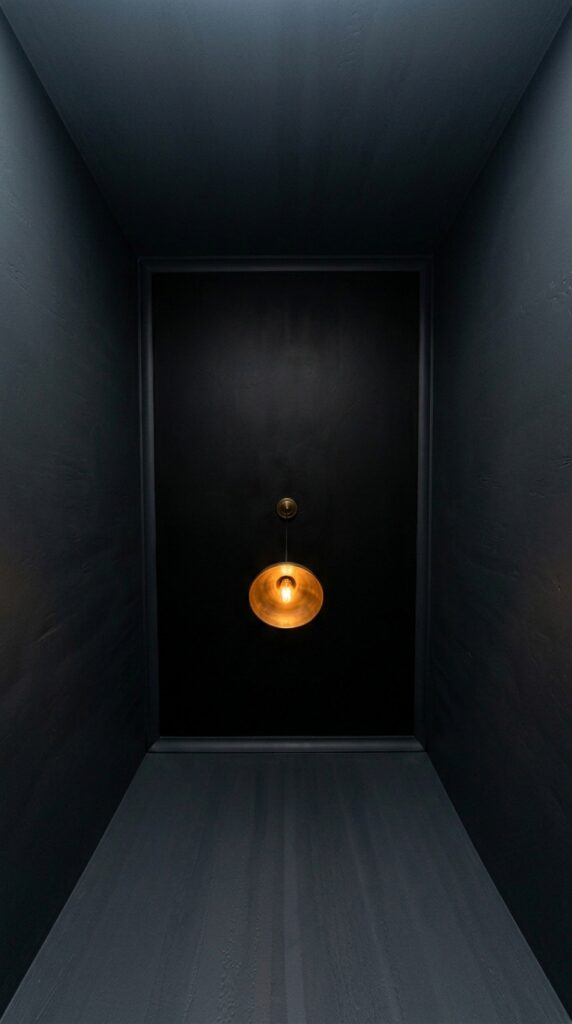
This is not for every room. A black ceiling only works if your ceiling is at least 8 feet tall and the room gets some natural light. In a low-ceilinged room, it will feel like a coffin. But in a tall, narrow room, a black ceiling recedes. The eye stops trying to find the top. I painted my 9-foot ceiling flat black. The room feels like a jewel box now. The walls in charcoal and the ceiling in black create a continuous dark envelope.
The mistake is using glossy black. It reflects light in a weird way and shows every roller mark. Use flat black (sometimes called “ceiling black”). It absorbs light completely. Cost: one gallon $30–$50, plus a lot of neck strain.
Paint the ceiling before the walls. The drips will land on the floor (cover it) rather than on your new wall color. Learn from my mistake.
16. The Lace That Isn’t White (Black Or Charcoal)
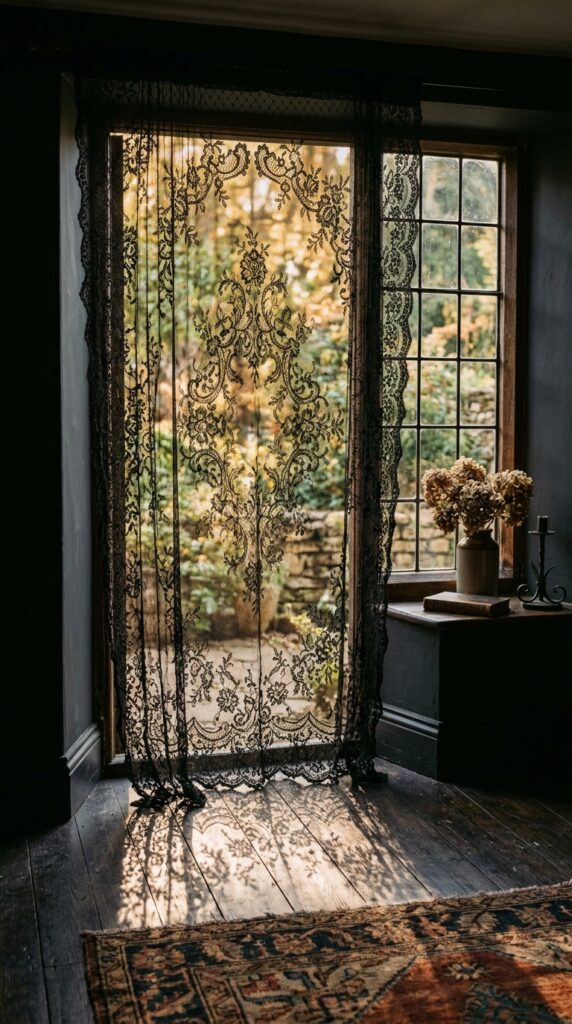
White lace is cottagecore. Black lace is dark feminine. I found a pair of black lace curtains on Amazon for $25. They’re polyester, not cotton, but the pattern is intricate. During the day, they filter the light into something soft and shadowy. At night, with a light behind them, they project lace patterns on the walls. It’s the most romantic thing in my room.
The downside: black lace shows every pull and snag. My cat has destroyed one panel already. Also, they attract dust like crazy. I wash them in a mesh bag on delicate every two months. Cost: $20–$40 per panel.
Layer black lace over a solid black curtain. The lace pattern pops against the dark background. It looks expensive even though the lace was cheap.
17. The Antique Cloche With Preserved Flowers
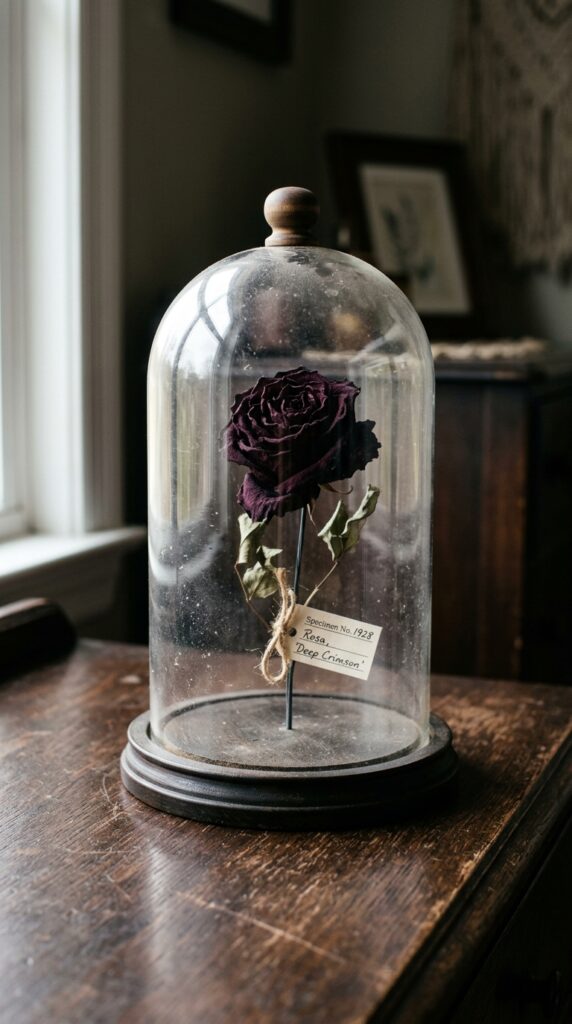
A cloche with a preserved flower inside is the most Victorian piece you can add. It’s also weirdly affordable. I bought a glass dome and a preserved black rose for $35 total on Amazon. The rose looks dead but perfect. It never needs water. It never drops petals. I keep it on my dresser and it draws comments from every guest. It’s a conversation starter and a mood setter.
Don’t use fake flowers—they look plastic. Preserved flowers are real flowers that have been treated with glycerin. They feel real and have a natural texture. They last for years if kept out of direct sunlight. Cost: cloche $15–$30, preserved rose $10–$20.
You can also use a glass bell jar from a kitchen supply store. They’re cheaper than “cloches” sold for decor. Same thing, half the price.
18. The Dramatic Floor Lamp With A Black Shade
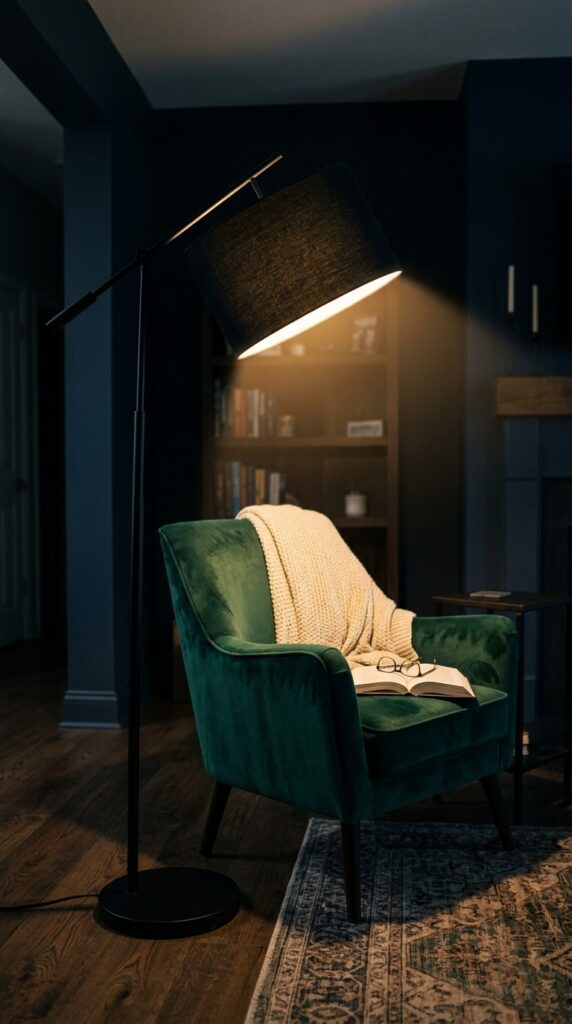
A floor lamp with a black shade is the opposite of a “torchiere” (those uplight things from the 90s). You want the shade to direct light downward, creating a pool of light on a specific surface. I have a brass floor lamp with a large black conical shade. It points at my reading chair. The rest of the room stays dark. This is how you light a dark feminine room—with pools of light, not an even glow.
Make sure the shade is dark enough that the bulb isn’t visible. A visible bulb ruins the mood. Use a low-wattage warm LED (40w equivalent, 2700K). Cost: floor lamp with black shade $60–$150.
Swap out the shade on an existing lamp. You can buy a black drum shade for $20 and put it on any lamp base. Instant dark feminine upgrade.
19. The Wallpaper With Dark Florals (One Wall Only)
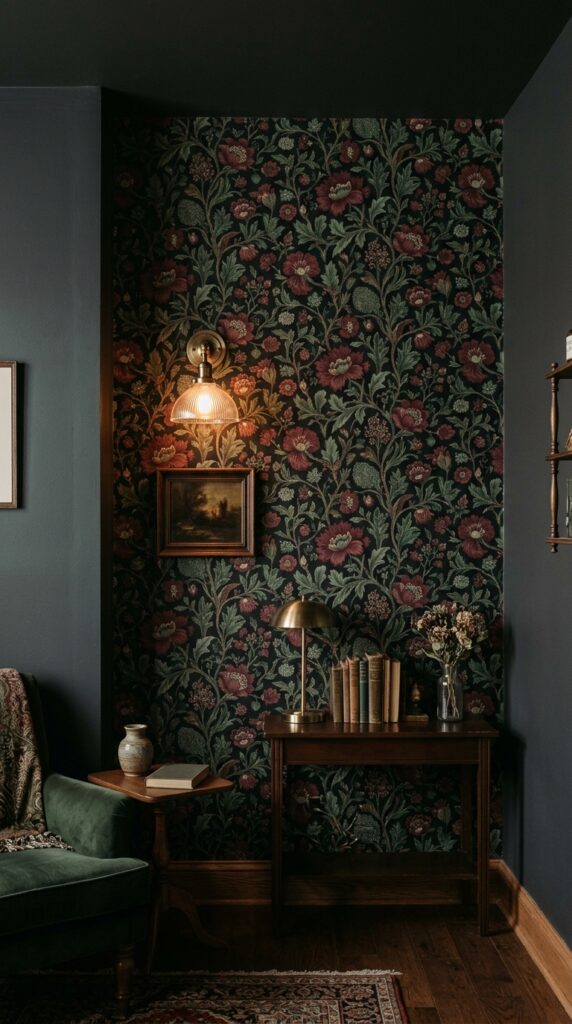
Dark floral wallpaper is having a moment, and for good reason. It adds pattern without brightness. I papered one wall behind my bed with a black background and burgundy roses. The paper was $80 for a double roll. It took me an entire Saturday to hang it, and I messed up the pattern match twice. But now the wall looks like a 19th-century novel cover. It’s the focal point of the room.
The mistake is wallpapering all four walls. That’s a sensory overload. One dark floral accent wall is dramatic; four is a panic attack. Also, cheap wallpaper peels at the seams. Spend extra for peel-and-stick or high-quality paste. Cost: one roll $40–$100, paste $10, tools $15.
Try removable peel-and-stick wallpaper first. It’s $30 a roll and comes off without residue. If you hate it, you’re out $30 instead of a weekend of scraping.
20. The Leather-Bound Books As Decor (Real Or Fake)

A stack of leather-bound books instantly adds dark academic energy. I bought a set of old encyclopedia volumes from a library sale for $5. They’re falling apart. The leather is cracked. They’re perfect. I stack them on my nightstand with a candle on top. You don’t need to read them—they’re props. But they smell like old paper and knowledge, which is the right vibe.
If you can’t find real ones, Amazon sells “vintage leather book stacks” that are actually new books made to look old. They’re fine from a distance but feel fake up close. I prefer real thrifted books. Cost: thrifted $1–$5 each, fake stack $20–$40.
Look for books by color. A stack of all burgundy or all dark green reads as intentional. Mismatched colors look like a garage sale.
21. The Mood Board Of Darkness (Personal And Weird)
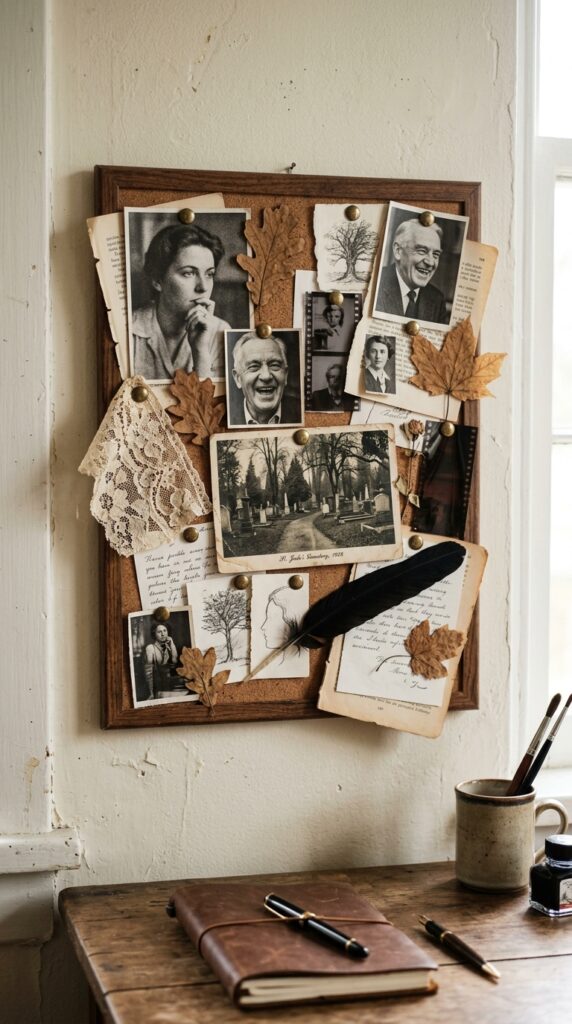
Dark feminine style should feel personal, not like a catalog. I have a cork board above my desk covered with images that feel right to me: Victorian mourning photos, pressed fern leaves, a ripped page from a botanical textbook. I add to it when I find something. It’s not perfect. It’s me. This is the opposite of “mood board” as a design tool—it’s a mood board as a living artifact.
Keep it contained. A small board (12×12 inches) is a focal point. A whole wall of collage is visual noise. Cost: cork board $10–$20, pins $5, images free (from old books).
Use a black frame around the cork board. It elevates the chaos and makes it look intentional rather than dorm-room.
22. The Velvet Headboard In Deep Plum (Not Tufted)
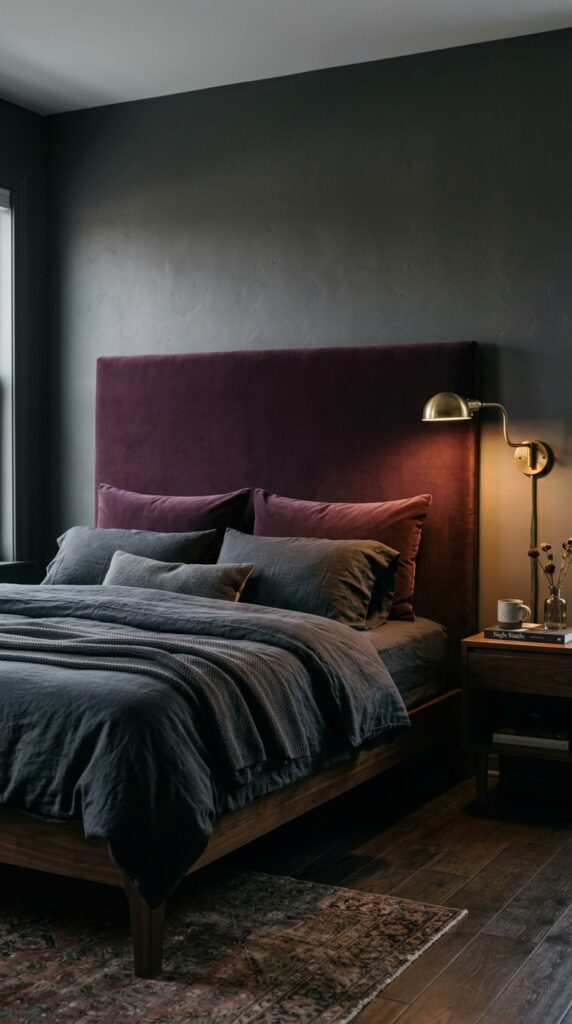
Tufted headboards (with buttons) are traditional. A smooth velvet headboard is more unexpected. I have a deep plum velvet headboard that I made by wrapping a plywood panel in velvet and stapling it to the back. It cost $70 in materials. The smooth surface doesn’t trap dust the way tufted does, and it feels more modern. The deep plum reads as almost black in low light and reveals its color when the sun hits it.
The DIY version: buy a piece of plywood cut to size, get 2 inches of foam, and a yard of velvet. Spray adhesive, staple gun. Two hours of work. If you buy one ready-made, expect to pay $300–$600. Cost: DIY $70–$100, pre-made $300+.
Use velvet upholstery fabric, not garment velvet. Garment velvet is thinner and stretches. Upholstery velvet has a backing and holds its shape.
23. The Single Black Feather In A Frame
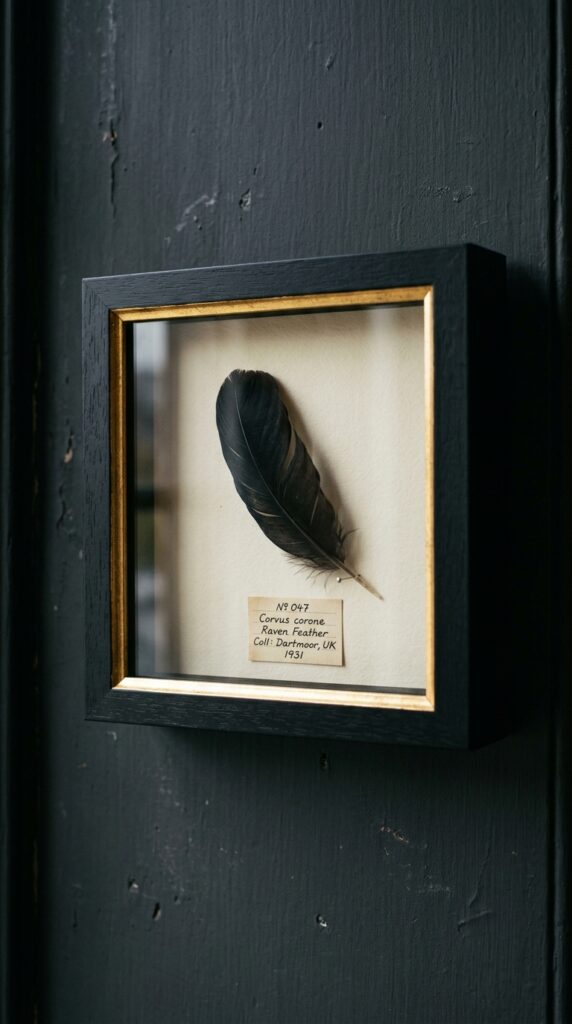
This is the smallest and most specific idea. A single black feather in a shadow box. I found a crow feather on a walk, pressed it in a book for a week, and put it in a $5 frame. It hangs next to my bed. People ask what it means. I say “nothing, I just liked it.” That’s dark feminine. You don’t have to explain everything. The feather is mysterious because it has no obvious meaning.
If you can’t find a real feather, buy a black craft feather. But a real one has irregular edges and a natural sheen that fake feathers lack. Cost: frame $5–$15, feather free or $2.
Press the feather between two heavy books for a week before framing. It will flatten and stay in place. Otherwise it will curl inside the frame.
24. The Scent Of Palo Santo (Not Incense)
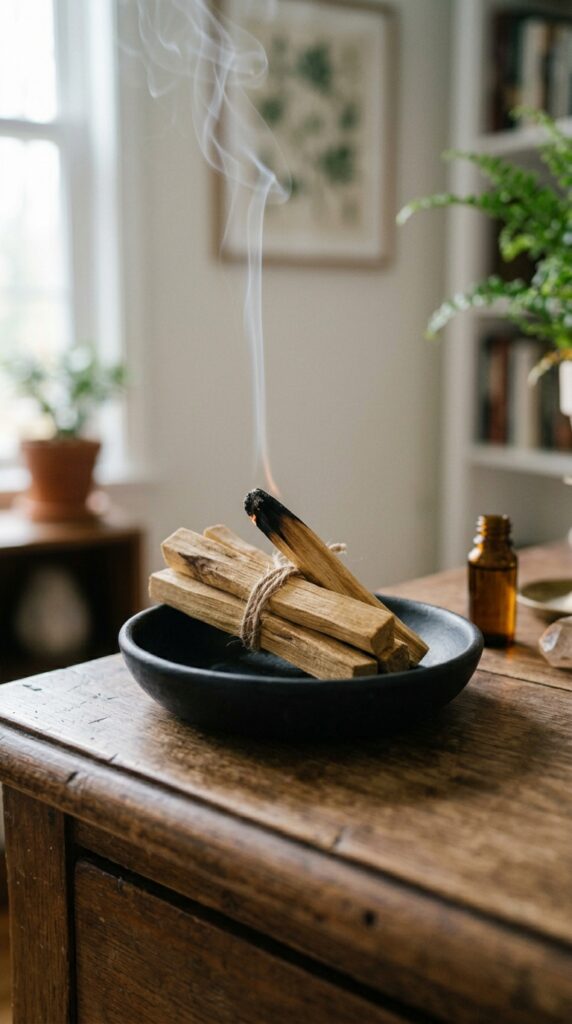
Incense is too strong and leaves a smell that lingers for days. Palo santo is a soft wood that you light for 30 seconds, blow out, and let smoke. The scent is subtle—woody with a hint of mint. It lasts about an hour. I burn a stick every evening while I read. The ritual of lighting it signals that the day is over. The smoke cleanses the air (or so they say). At the very least, it smells like a magic spell.
Buy sustainable palo santo. The wood is overharvested. Look for “ethically sourced” or “sustainable.” A bundle of 20 sticks costs $12 and lasts me six months. Cost: $10–$20.
Burn palo santo in a well-ventilated room. Open the window a crack. The smoke is mild but still particulate matter. And never leave it unattended.
25. The One Bright Thing As Contrast (Gold Or White)
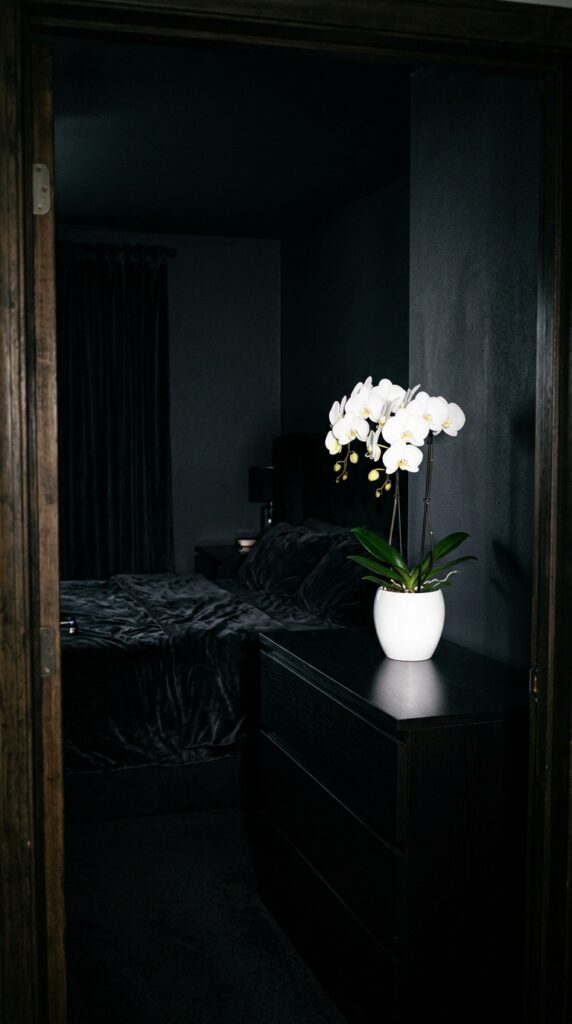
A completely dark room can feel one-note. The trick is one bright thing—a white orchid, a large gold-framed mirror, a single cream-colored pillow. Just one. The contrast creates tension. My one bright thing is a white orchid on my black dresser. Against the dark velvet and dark walls, the flower looks almost radioactive. It’s the punctuation mark on the sentence.
Don’t add two bright things. Then it’s a pattern. One bright object reads as intentional. Two reads as indecisive. Cost: white orchid $20–$40, gold mirror $50–$150.
If you don’t have a bright object, move something from another room for a week. A white vase, a stack of cream books, a piece of art with a white mat. Test the contrast before you buy.
The core decision of a dark feminine bedroom is choosing atmosphere over brightness. You are not trying to make the room look larger or more cheerful. You are trying to make it feel like a secret. That requires accepting shadows, embracing texture, and understanding that elegance often comes from restraint. You don’t need every surface covered. You need the right few things in the right dark light.
If you do one thing from this list, start with the lighting. Put every lamp on a dimmer and add a single candle. Turn off the overhead light forever. That one change will shift the room’s mood more than any piece of furniture. Then add one velvet item—a pillow, a throw, a headboard. Feel the texture. That’s the heart of dark feminine: not the color black, but the feeling of being held in soft darkness.
Your bedroom should feel like a room you want to keep a secret. Not because it’s shameful, but because it’s yours. Now go light a candle.