Last spring I papered a small reading nook in a deep olive mural with giant painted ferns. My neighbor asked if I was “bringing the outdoors in” — that phrase I hate. But she wasn’t wrong. What she didn’t see was how the green shifted from nearly black in the morning to a bright, almost electric tone at golden hour. That’s the thing about green wallpaper. It’s never just one color. And most advice about it is wrong.
The internet will tell you to pick “a soft sage” or “a moody emerald” and call it done. But green is the trickiest color in the decor spectrum. Too yellow and it reads as baby poop. Too blue and it feels like a hospital. Too dark in a small room and you’ve made a cave. Too light in a large room and it looks washed out. Most guides ignore how green behaves in different lights, on different walls, and next to different woods. They also never tell you which greens fade fastest or which patterns make a room feel smaller in a bad way.
These 25 wallpaper ideas come from hanging them, living with them, and in three cases, tearing them down after six months because they just didn’t work. I’ve made the mistakes so you don’t have to. This isn’t a list of “pretty greens I found on Pinterest.” It’s a field guide to what actually holds up — visually, physically, and emotionally — when you commit a whole wall to green.
1. Moody Botanical With Matte Ferns On Charcoal Green
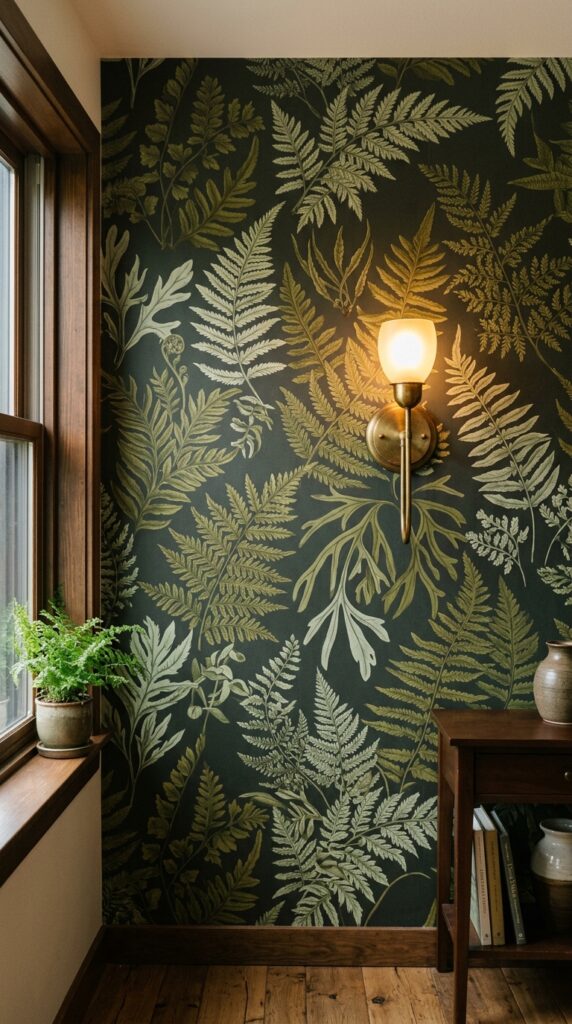
Most botanical wallpapers go for high contrast — bright leaves on a white or cream background. That reads as cheerful but also a little country-catalogue. The Neo-traditional move is to reverse it: put pale or mid-tone botanicals on a very dark green ground. I used a paper from a small British brand (around $120 a roll) in a den. The matte finish is crucial — gloss would make the dark background feel like a nightclub.
The honest truth: this paper eats light. In a room with only one small window, the walls recede to near-black by 4 PM. That’s dramatic if you want cozy. It’s oppressive if you need to work in there. Trade-off: the room feels intimate and cave-like, which is perfect for a media room or a library. Cost per 100-square-foot room: roughly $400 to $600 for good matte paper. Cheap versions use shiny inks that reflect light unevenly and show every roller mark. Also, dark paper shows dust more than you’d think.
Pro tip: Hang dark green wallpaper on the wall opposite your main light source. If you put it on the sunniest wall, the fading will be uneven within two years.
2. Vertical Stripe In Sage And Cream (But Narrow, 2 Inches Max)
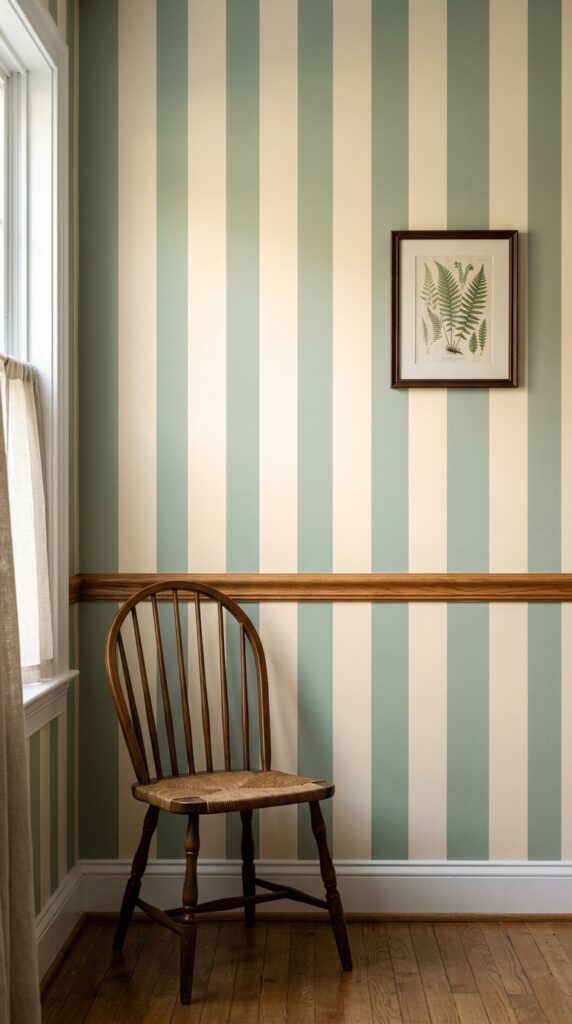
Wide stripes (6 inches or more) make a room feel like a circus tent. But narrow stripes — think pinstripe width — read as texture rather than pattern. I installed a sage-and-cream stripe (1.5-inch repeat) in a narrow hallway that previously felt like a tunnel. The vertical lines trick the eye into seeing more height. The cream keeps the green from feeling medicinal.
The catch: narrow stripes must be hung perfectly plumb. A 1/4-inch drift over ten feet becomes obvious because the stripes break at corners. Hire a pro unless you have a laser level and patience. Cost for good quality stripe paper: $70 to $100 per roll. Under $50, the pattern often doesn’t match at the seams because of cheap printing. Also, cream stripes show dirt near light switches. In a hallway, that’s a problem. In a bedroom, fine.
Run the stripes vertically even on ceilings. Horizontal stripes in a small room feel like a low-rider.
3. Faux Marbled Green Paper That Actually Looks Like Stone
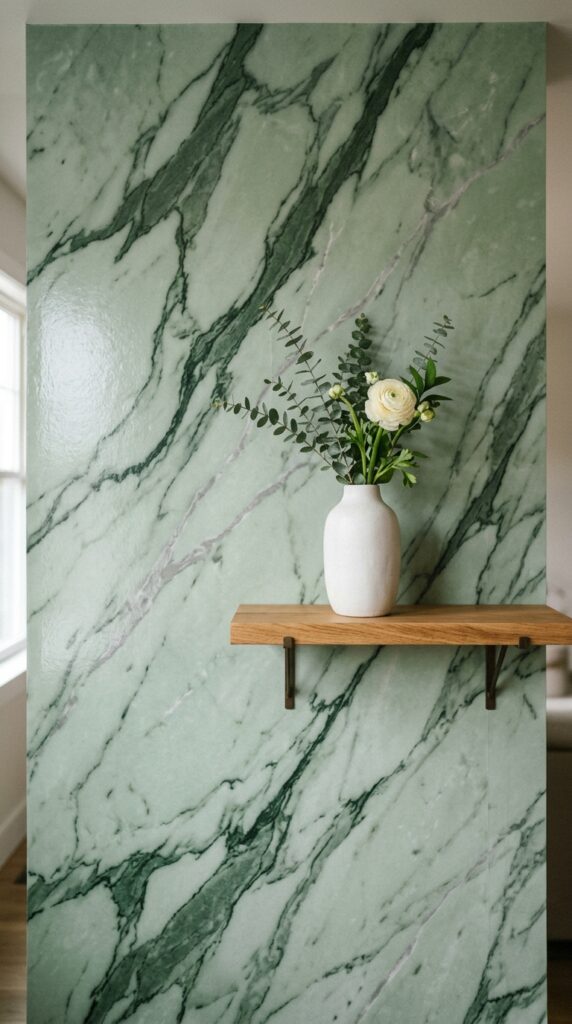
Faux marble wallpaper usually looks like a screensaver from 1998. But some newer digital prints are shockingly convincing — until you touch them. I used a green-marbled paper in a powder room where real marble would have been too heavy and too expensive. The paper cost $150 per roll (needed two). From five feet away, guests swear it’s stone. Up close, the lack of coldness gives it away, but that’s fine — it’s not trying to fool anyone, just evoke the pattern.
The trade-off: this paper has a semi-gloss finish that shows every imperfection in your wall. You must skim-coat and sand perfectly before hanging. Also, the veins are printed, so they don’t have the depth of real stone. In a small room, that’s fine. In a large expanse, it looks flat. Cost for a 50-square-foot roll: $120 to $200. Avoid the $40 rolls — the resolution is terrible and the repeats are laughably obvious.
Order a sample and tape it to the wall for a week. Look at it in morning, noon, and evening light. Some green marbles read as teal under warm bulbs.
4. Watercolor Sage With Abstract Blotches (No Discernible Motif)
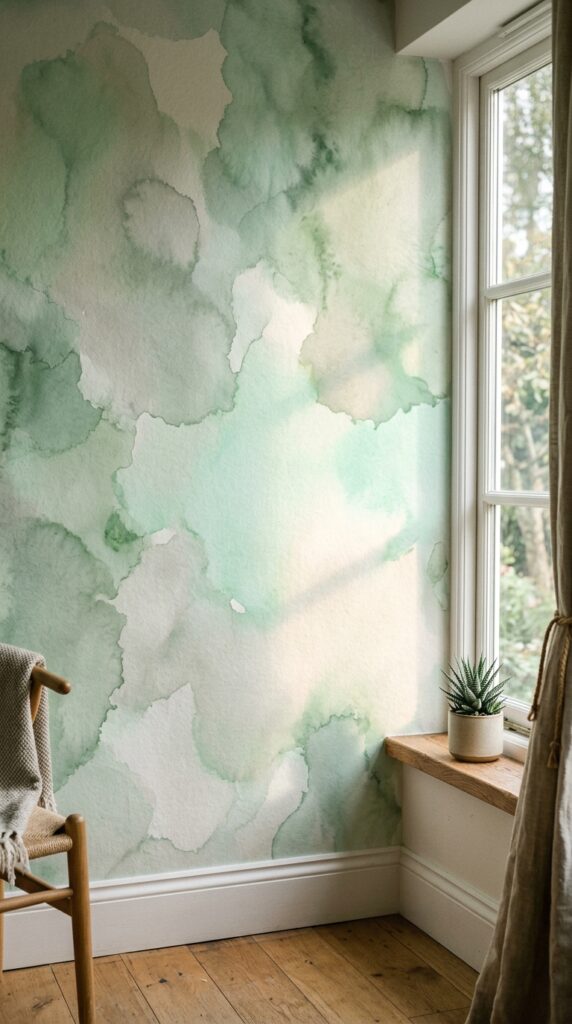
Most green wallpapers try to represent something — leaves, stripes, diamonds. Abstract watercolor is different. It’s pure atmosphere. I hung this in a bedroom where I wanted calm but not boring. The irregular blotches shift depending on where you stand. From the doorway, it reads as a unified soft green. From the pillow, you see the individual brush-like marks. It cost $110 per roll and I used three rolls for an accent wall.
Here is the friction point: this style has no repeat, so installers love it (no pattern matching). But that also means you can’t hide mistakes. A crooked seam is obvious because the organic shapes don’t line up. Also, the watercolor effect is printed, not real paint — cheap versions look pixelated. Spend on high-resolution digital printing. Under $80 a roll, the edges of the “brushstrokes” look like tiny dots. One more thing: this paper shows every nail hole if you ever hang art over it.
Use a non-woven paper for watercolor prints. It’s more forgiving of wall imperfections and easier to remove later.
5. Geometric With Terrazzo-Style Green Speckles On White
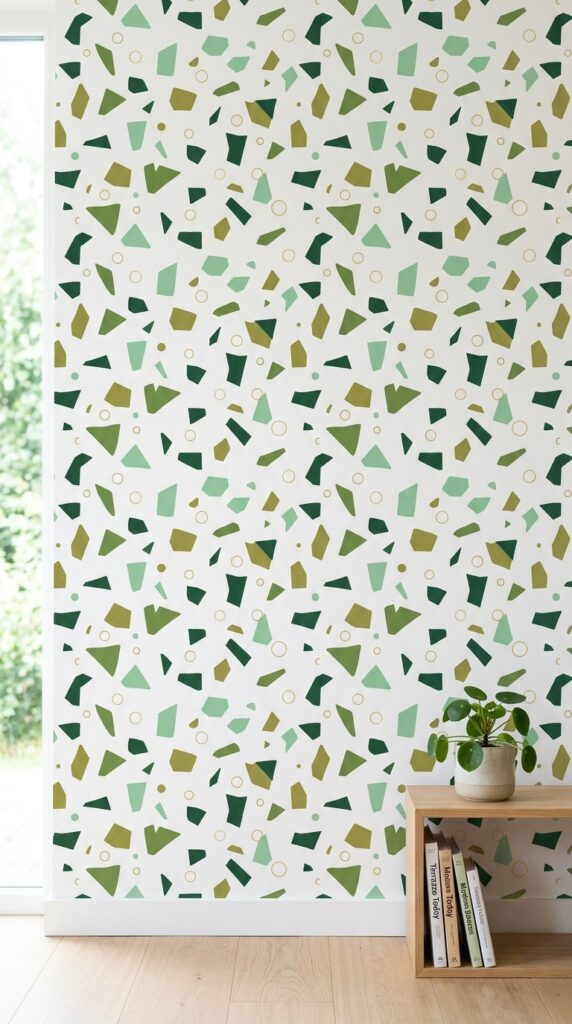
Terrazzo has been everywhere in tile and surfaces. But as a wallpaper pattern? It works because it reads as tiny abstract confetti, not as a literal floor. I put this in a home office alcove that needed energy without chaos. The white background keeps it light; the green speckles tie into plants and a green desk chair. Cost was $95 per roll.
The catch: this pattern looks terrible with other patterns. It’s already busy. Pair it with solid curtains and solid upholstery. Also, the speckles make it hard to hang straight because you don’t have vertical lines to guide you. Use a plumb line for the first drop. Under bright light, the white background reads as slightly blue if the paper is cheap. Look for “warm white” or “cream” base. One more trade-off: this pattern screams 2020s. It will date faster than a botanical or stripe. If you’re okay with that, enjoy it now.
Use this only on one wall. A full room of terrazzo wallpaper feels like a kindergarten art room.
6. Metallic Gold Ferns On Midnight Green (One Wall Only)
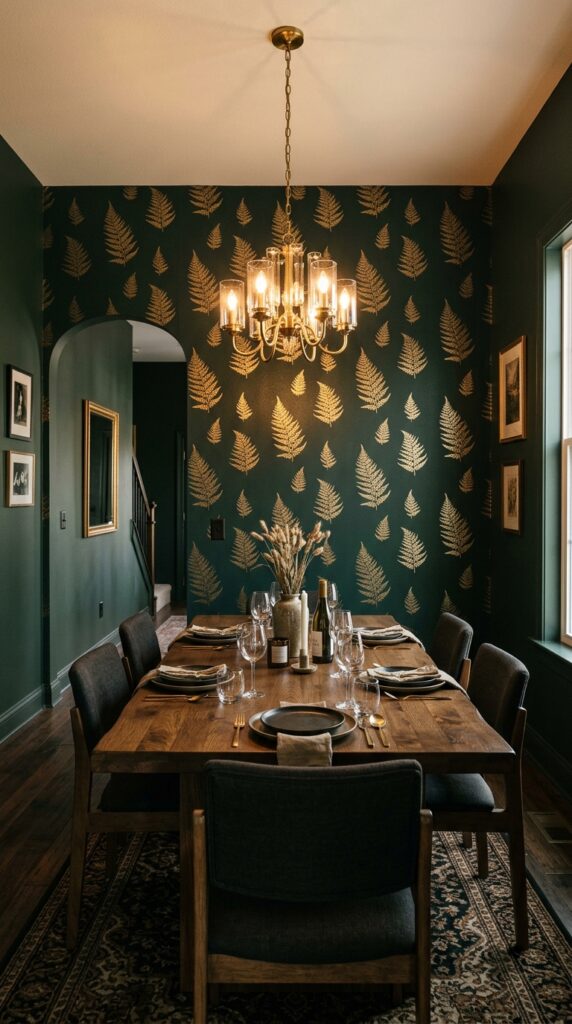
Metallic wallpaper is dangerous. Too much and you’re in a Vegas lounge. But restrained — one wall, mid-scale pattern, a green so dark it’s almost black — it becomes jewelry for the room. I put this behind a brass console table in a living room. The gold ferns only flash when you walk past. Most of the time, the wall reads as textured dark green. Cost: $180 per roll (metallic inks are expensive). I used 1.5 rolls.
The honest truth: metallic paper is a beast to hang. The foil layer stretches differently than the paper backing. Seam allowance is nearly impossible. Hire a pro who has done metallics before. Also, the gold will tarnish over time — not really, but the metallic finish can oxidize and dull. In a humid bathroom, skip it entirely. In a dry living room, expect 5-7 years of good shine before it starts looking tired. Under $100 a roll, the “gold” is usually yellow plastic that flakes.
Use a non-metallic paint on the adjacent walls — same color family but flat finish. The contrast in sheen is what makes the wallpaper work.
7. Hand-Blocked Woodblock In Teal And Natural Linen
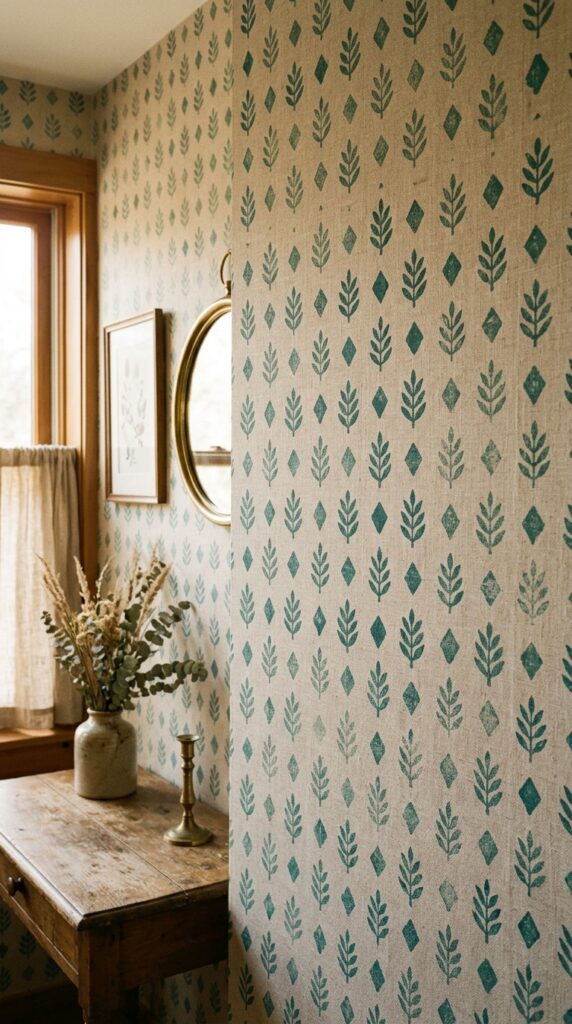
Mass-produced wallpaper is perfect. Sometimes that’s the problem. Hand-blocked paper has tiny variations — a smudge here, a lighter print there — that make it feel alive. I found a small studio in India that ships direct ($220 for a 10-meter roll, which is expensive but worth it). The teal pattern on raw linen has a warmth that digital printing can’t replicate. The linen ground is slightly rough to the touch.
The constraint: hand-blocked paper is usually made with water-based dyes that fade faster than synthetic inks. In direct sun, expect noticeable fading within three years. Use it in a north-facing room or on a wall without windows. Also, the pattern repeat can be inconsistent — order extra because you might waste more during matching. And the price. This is a $200-plus commitment for a single wall. But if you want something that looks like it has history on day one, this is it.
Ask for a “strike-off” — a sample from the actual batch you’ll receive. Dye lots vary wildly with hand-blocking.
8. Oversized Palm Leaf On Cream (Scale Is The Trick)
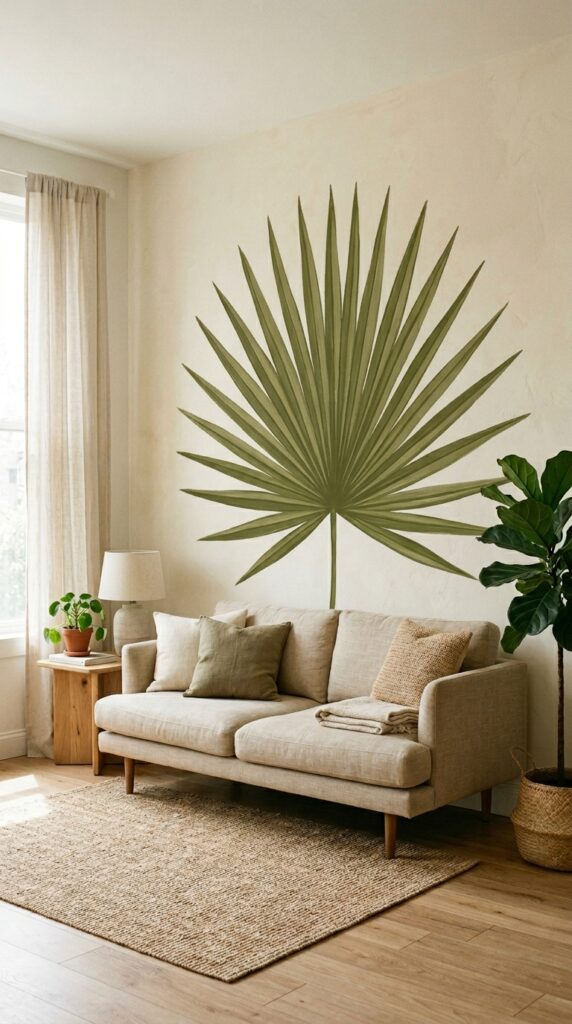
Tiny palm leaves look like a tourist shop. Giant palm leaves — the kind where one leaf spans half the wall — feel dramatic and architectural. I used a mural-style paper (single image repeated across several panels) in a sunroom. The scale tricks your brain into thinking the room is bigger because the pattern doesn’t overwhelm the space. Cost was $280 for a custom-sized mural (8×10 feet).
Here’s what nobody says: oversized patterns only work on walls with few interruptions. Doors, windows, and outlets break the leaf across awkward gaps. Measure carefully and be prepared for the leaves to be chopped in odd places. Also, matching the panels on a mural is a two-person job minimum. The seams must be invisible. If you DIY, expect frustration. Cost for non-custom oversized palm wallpaper: $90 to $150 per roll. But the repeats are shorter, so you lose the giant-leaf effect.
Position the largest, most complete leaf at eye level from your main seating area. That’s where the magic happens.
9. Chinoiserie In Teal And Off-White (But Only A Single Panel)
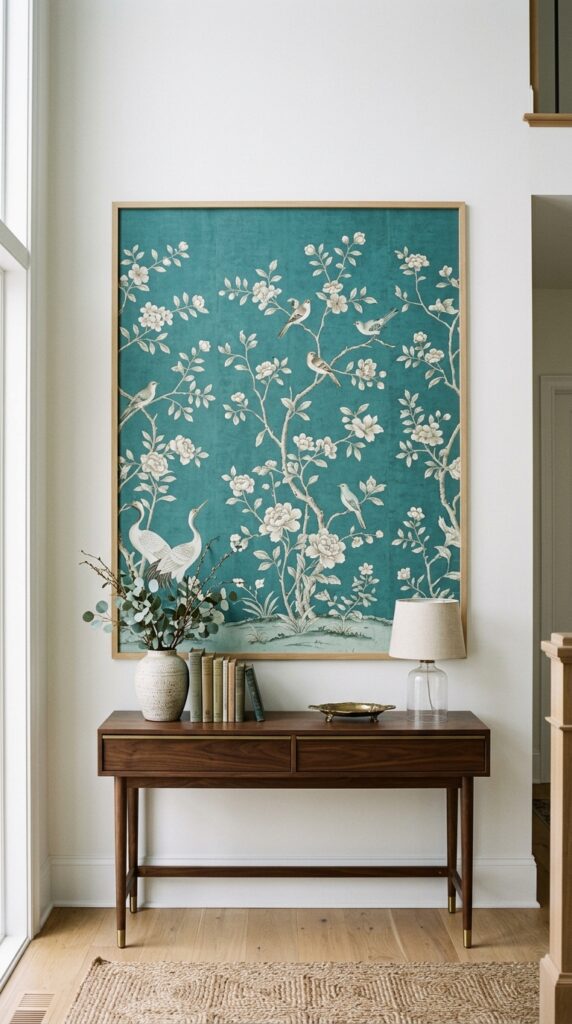
Full chinoiserie rooms are gorgeous in mansions. In a normal apartment, they can feel like a themed restaurant. The fix is to cut a single panel and frame it with battens, like a giant piece of art. I bought a single drop of chinoiserie wallpaper (sold as a “panel” rather than a roll) for $150, mounted it on foam board, and framed it with painted wood trim. It hangs above a sofa and reads as a painting from across the room.
The trade-off: you lose the immersive effect of wallpaper, which is the whole point for some people. But if you love the pattern and don’t want to commit to a full wall, this is the compromise. Also, the edges of the panel need to be perfectly straight — cut with a long ruler and a sharp blade. Cost for a full roll of chinoiserie: $100 to $300, but you’ll have leftovers. Buying a pre-cut panel from specialty sellers runs $80 to $200.
Use double-sided tape designed for wallpaper to attach the panel to the wall before adding the frame. That way you can reposition.
10. Grasscloth In A Natural Green (With Visible Weave Variation)
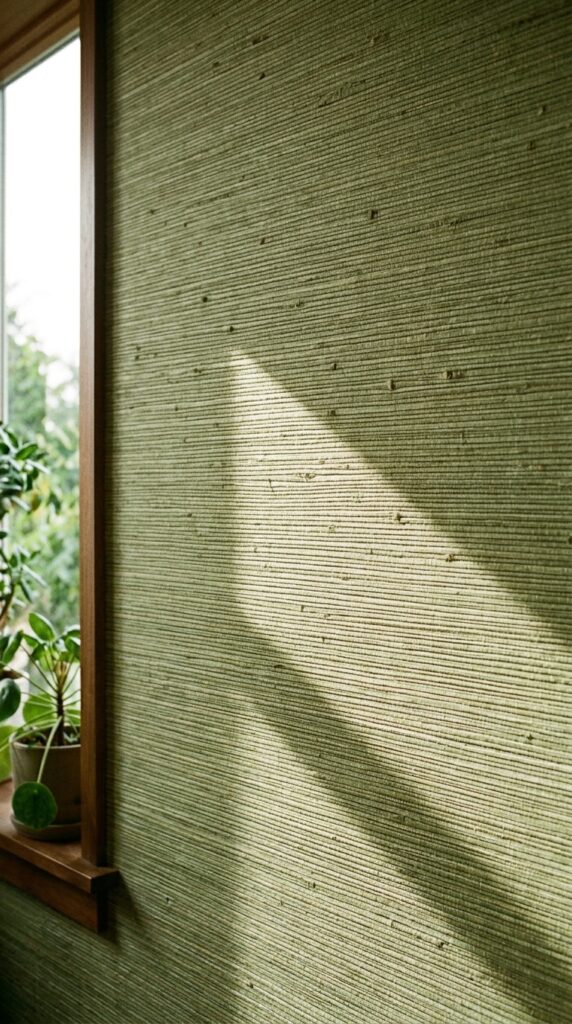
Grasscloth is the original green wallpaper — literally, it’s made from plants. A good grasscloth in a muted olive or sage has a depth that printed paper can’t touch. I put this in a home library. The fibers catch light differently throughout the day. The color isn’t uniform, which is the point. It looks like a natural material because it is. Cost: $90 to $200 per roll.
Here is the brutal reality: grasscloth is a nightmare to hang. The fibers fray at the edges. The seams show unless you overlap and trim with a straightedge (and even then, they show). The material stretches when you apply paste. Most professional paperhangers charge double for grasscloth. Also, you cannot wipe it. At all. A greasy fingerprint is permanent. In a kitchen or a kid’s room, skip it entirely. In a formal living room or adult bedroom, it’s glorious. One more thing: grasscloth fades dramatically in sunlight. Within two years, the exposed areas will be two shades lighter than behind a picture frame. Embrace it as patina or keep it out of direct sun.
Order 20 percent more than you calculate. Seam matching and trimming waste is brutal with grasscloth.
11. Art Deco Fan Motif In Mint And Black (Unexpected Combo)
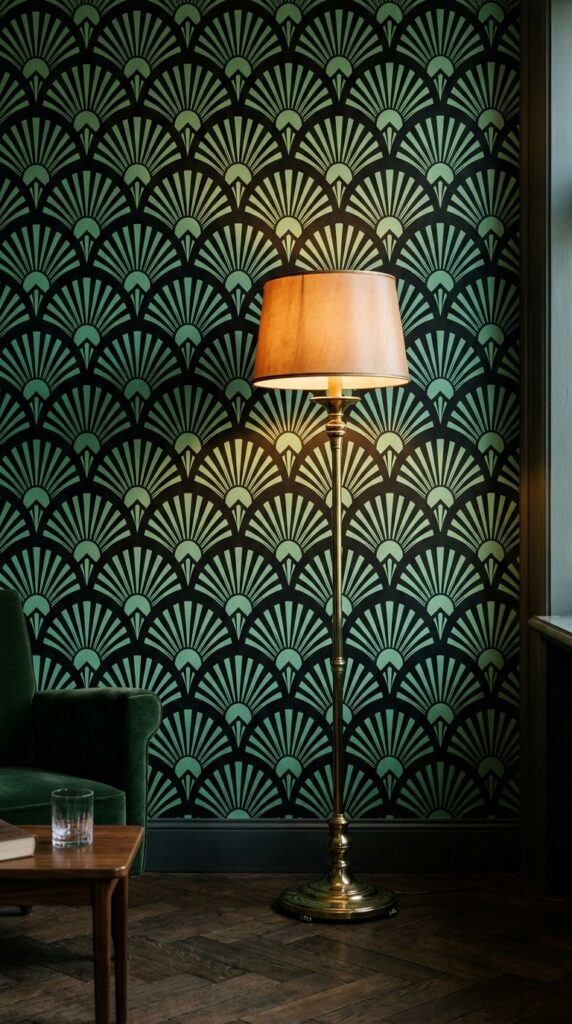
Most Deco wallpaper uses gold and black, which is dramatic but also a little on the nose. Mint green instead of gold changes everything. It’s still bold but less aggressive. I used this in a small dressing room (8×8 feet) and the black background made the room feel surprisingly cozy, not cramped. The mint fans are about 6 inches across. Cost: $85 per roll.
The challenge: mint green on black means every seam needs to be perfectly butted. Any gap shows the white wall underneath. Any overlap casts a shadow. This is not a DIY paper unless you’ve hung a few rooms before. Also, the black background shows dust within days. In a high-traffic area, you’ll see every bit of lint. Under $60, the mint is usually dull and the black is more of a dark gray. Spend a little more for deep, true black.
Paint the wall black before hanging. Then if there’s a tiny gap at the seam, it won’t scream white stripe.
12. Toile De Jouy In Emerald And Cream (But Reimagined)
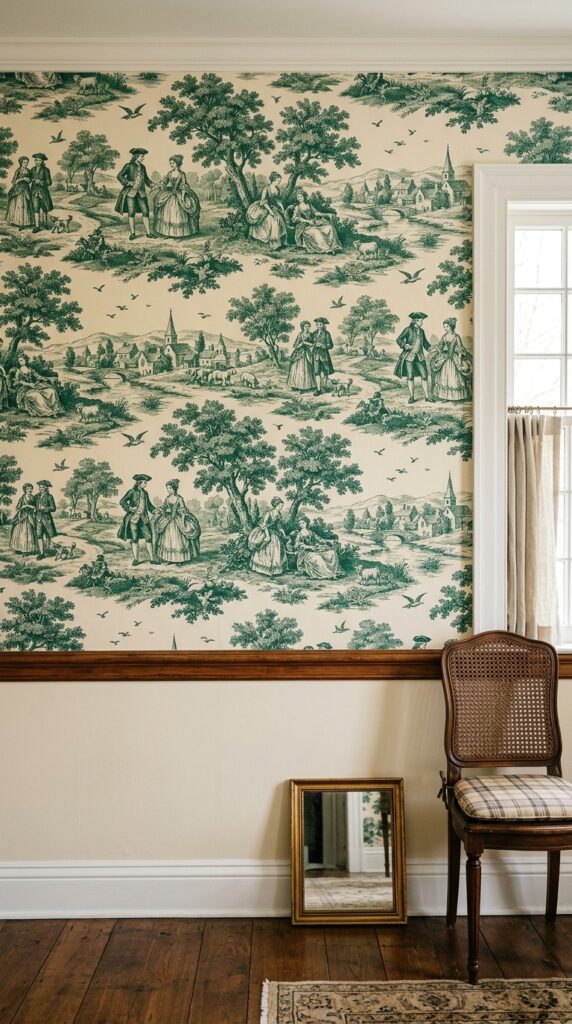
Classic toile is almost always blue or red. Green toile feels fresh and slightly subversive. I found a French reproduction in emerald on cream ($120 a roll) and used it above a chair rail in a dining room. The cream background keeps it from being too much. Below the rail, I painted the wall the same cream. The green figures read almost as illustrations on a manuscript.
The friction: toile is inherently busy. If your room already has patterned curtains or a patterned rug, skip this. It needs solid companions. Also, the scale matters. Traditional toile has tiny figures (1-2 inches). That works in large rooms. In a small powder room, use a “grande toile” with larger figures (4-6 inches) so the pattern breathes. Cost for good toile: $90 to $180 per roll. Cheap toile has blurry printing; the figures look like blobs.
Use toile only on the upper half of a wall, with a solid wainscoting below. Full-height toile in a small room is claustrophobic.
13. Fretwork / Moroccan Lattice In Olive On Warm White
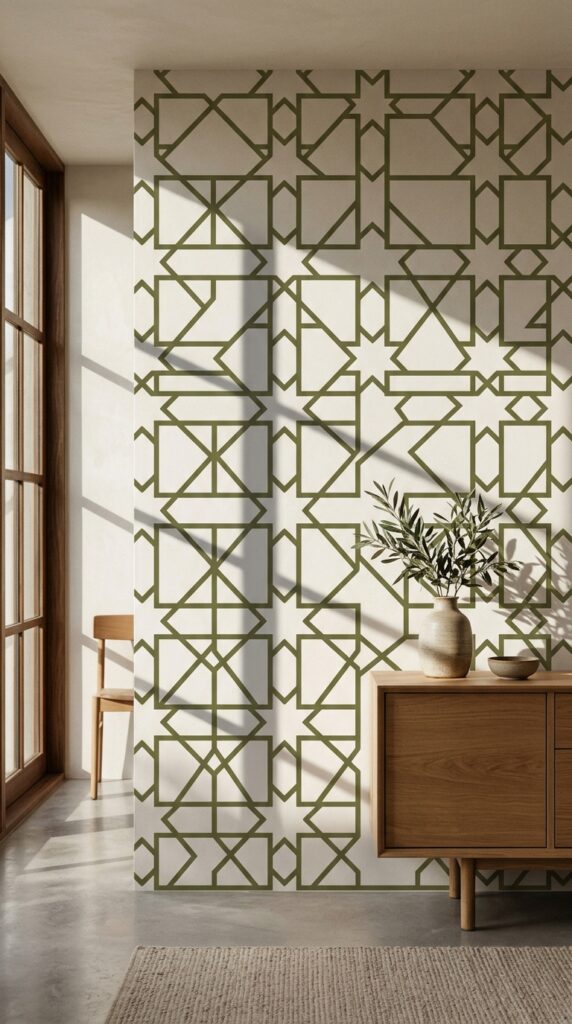
Moroccan patterns often come in loud colors — orange, bright blue, fuchsia. But olive on warm white is restrained and almost architectural. I used this in a hallway that connects a living room to a bedroom. The pattern gives visual interest without demanding attention. Cost: $70 per roll from a big-box store, surprisingly decent quality.
The trick is finding a pattern where the green isn’t too dark. If the olive approaches forest green, the contrast is too high and the pattern vibrates. Look for a muted, grayed-out olive. Also, fretwork wallpaper with a large repeat (24 inches or more) is harder to match but looks less busy. Small repeats (6 inches) feel like a screen door. Cost for designer fretwork: $120 to $200 per roll. But affordable versions are fine if the registration is sharp.
Hang fretwork wallpaper so the pattern is centered on the most visible wall first, then work outward. It looks intentional that way.
14. Peel-And-Stick In Pale Sage (For Renters Or The Indecisive)
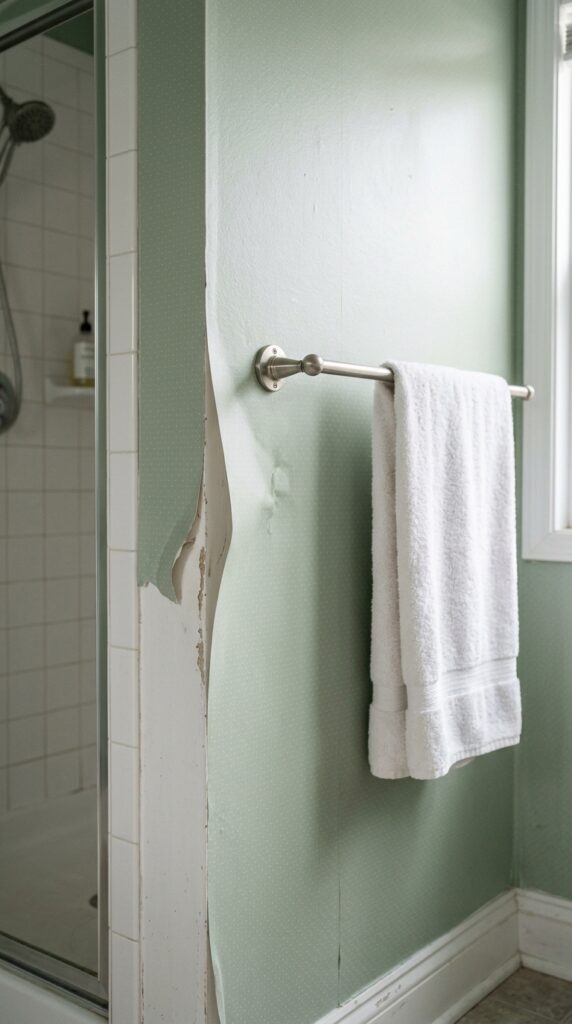
I have complicated feelings about peel-and-stick. It’s great for renters and people who change their minds every 18 months. But the material is thin, the adhesion fails in humidity, and the colors are often more pastel than the online photos suggest. That said, I used a pale sage peel-and-stick in a rental bathroom and it worked for two years before the edges started curling. Cost was $45 for a double roll.
The honest advice: use peel-and-stick only on smooth, clean walls. Any texture — orange peel, knockdown — and the paper won’t adhere. Also, keep it out of steamy bathrooms. The moisture loosens the adhesive. In a powder room with a fan, fine. In a bathroom where people shower daily, no. Cost range $30 to $80 per roll. Under $30, the adhesive is terrible and the pattern misalignment is common. Above $80, you might as well buy real wallpaper. One more thing: peel-and-stick is repositionable, but each time you peel it, the adhesive weakens. Get it right on the first or second try.
Test a small piece in an inconspicuous corner for two weeks. Some peel-and-stick leaves a residue that damages paint when removed.
15. Ikat With A Dip-Dye Effect In Seafoam And White
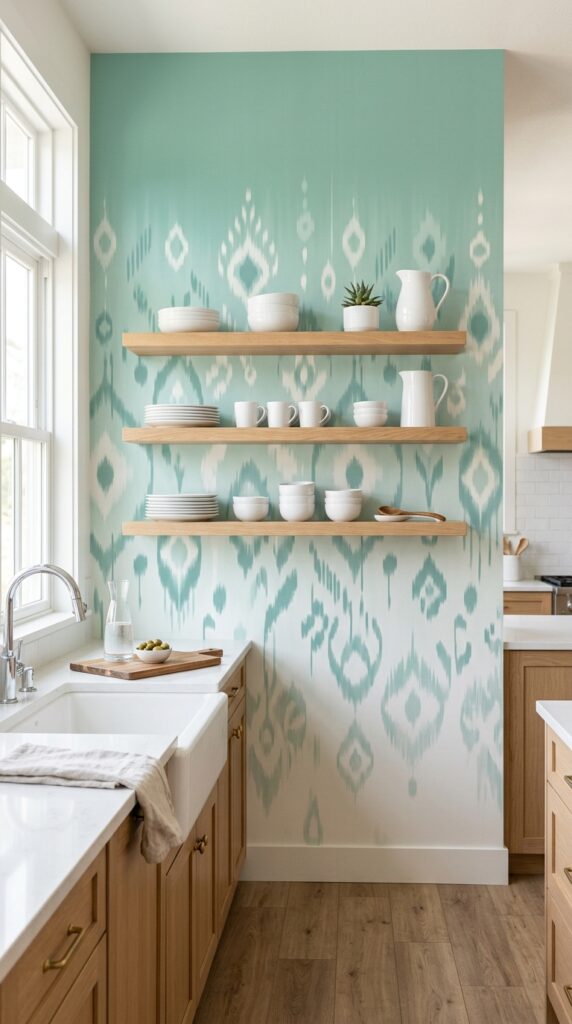
Traditional ikat wallpaper has sharp, clear patterns. The dip-dye effect — where the color graduates — is a newer twist. I found a vinyl-coated paper (good for kitchens) with a seafoam-to-white ombre behind the pattern. It hides kitchen splatters better than a solid color. Cost was $95 per roll, and I used two rolls for a backsplash-height accent.
The catch: the ombre effect means you have to hang all the panels in order, from top to bottom, with the gradient continuous across the wall. If you mix up the order, the color jumps. Also, vinyl wallpaper is less breathable than paper — in a kitchen with humidity from cooking, it’s fine. In a bathroom, it can trap moisture and peel. Cost for non-vinyl ombre ikat: $80 to $150. But the paper version stains easily in a kitchen. For kitchens, pay extra for washable vinyl (around $120 per roll).
Order all rolls from the same dye lot. Ombre papers vary significantly between batches.
16. Pine Forest Mural On One Wall (Not All Four)
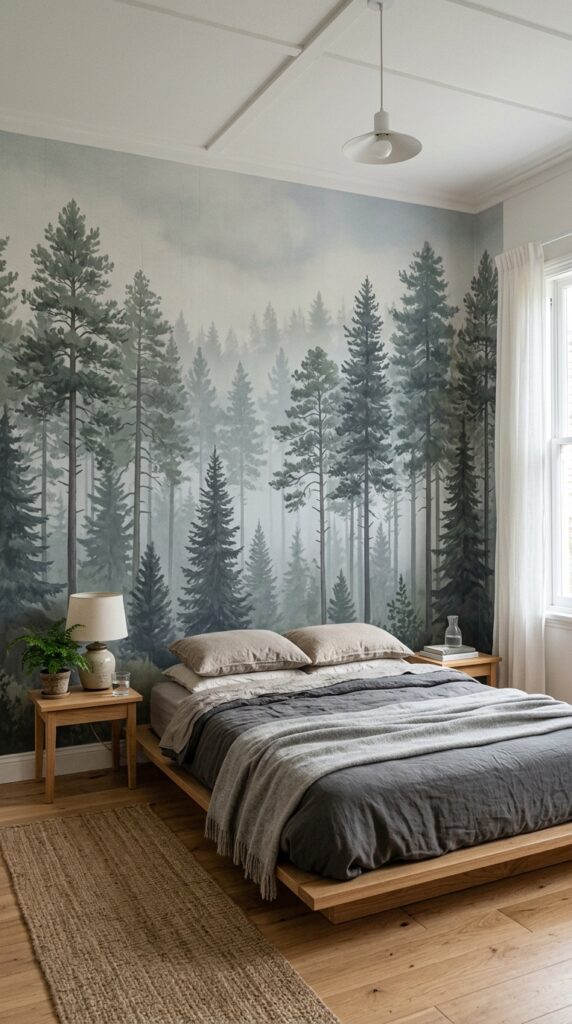
Forest murals can veer into cabin-in-the-woods kitsch. But a well-done one — painterly, slightly abstract, with a narrow color palette of greens and grays — feels like an escape. I put a pine forest mural (three panels, 12 feet wide total) in a guest bedroom for $320. The misty background makes the room feel larger, like the wall is actually a window.
The trade-off: a mural is a strong commitment. You can’t wallpaper around it later. If you change your mind, you’re stripping the whole wall. Also, murals have visible seams between panels. A good installer can minimize them, but they’re there. In direct light, you’ll see the lines. For best results, choose a mural with a random or repeating pattern across panels, not a continuous scene that gets cut awkwardly at the seams. Cost for pre-made murals: $200 to $600. Custom murals start at $800.
Install the mural panels in reverse order if the pattern allows — sometimes the factory cuts them slightly off, and reversing improves seam match.
17. Japonism Bamboo In Sepia-Toned Green On Rice Paper
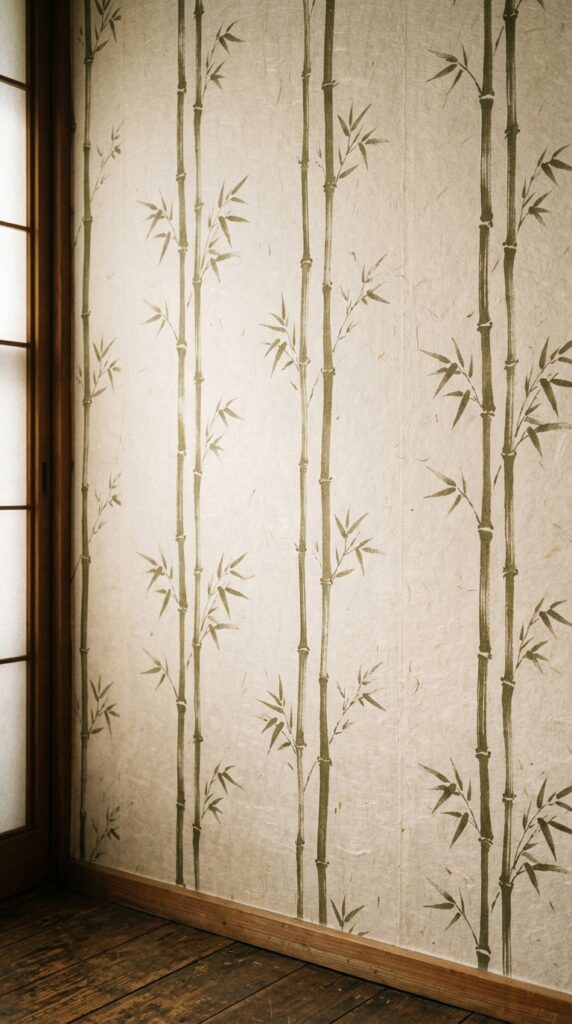
Japonism wallpaper can be precious — too many cranes and cherry blossoms. A simple bamboo pattern, printed in a muted, almost brown-green, is more restrained. I used a rice-paper-backed bamboo wallpaper ($140 per roll) in a home office. The texture of the rice paper is rough and warm. The bamboo reads as vertical lines from a distance, not as a literal plant.
The constraint: rice paper is delicate. It tears easily during hanging. You cannot wipe it clean — a stray pen mark is permanent. Also, it absorbs moisture, so keep it out of bathrooms and kitchens. In a dry office or bedroom, it’s beautiful but high-maintenance. Cost for good quality: $120 to $200 per roll. Cheap versions use printed paper that mimics rice texture — those don’t have the same depth. One more thing: bamboo patterns with large repeats (30+ inches) are harder to match but look more like art than fabric.
Use a sharp new blade for every two cuts. Rice paper dulls blades instantly and will tear instead of cut.
18. Lichen Close-Up (Microscopic Texture Scaled Up)
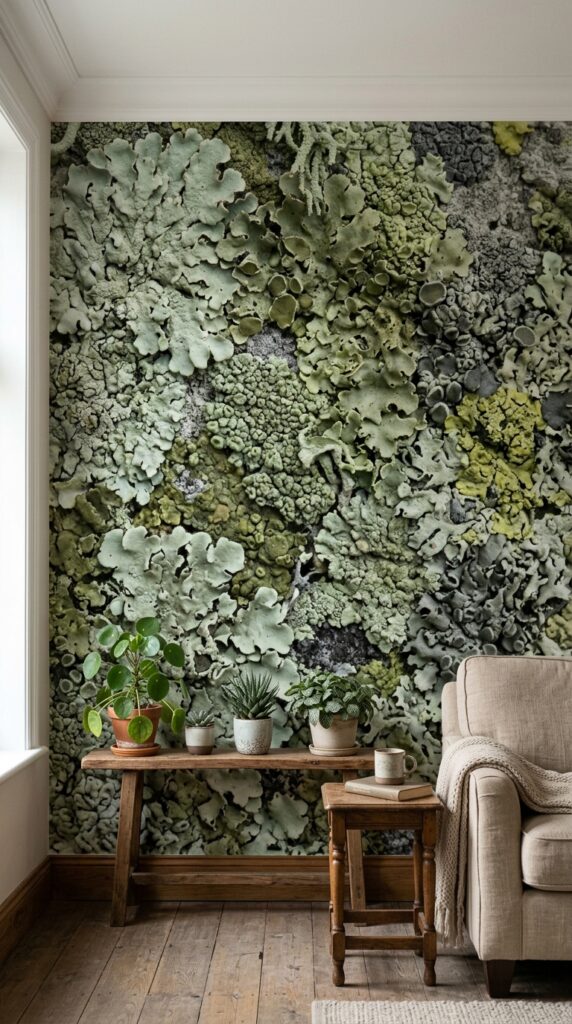
This is weird. I’ll admit it. But lichen wallpaper — scaled-up macro photos of the stuff that grows on trees and rocks — is one of the most interesting greens I’ve ever lived with. It’s not obviously anything at first glance. Just a complex, irregular texture in several greens. I found a print-on-demand company that will turn any high-res image into wallpaper. I used a public domain lichen photo, paid $250 for a 10-foot wall, and got something that looks like abstract art but also like nature.
The friction: because there’s no repeat, you have to cover the entire wall with one continuous print. That means a custom-sized mural, which costs more. Also, the high resolution required means the file size is enormous — make sure your printer can handle it. Under $200, the print quality drops and the lichen becomes a blurry mess. But if you want a green that no one else has, this is it. Just be prepared for guests to say “what am I looking at?”
Ask for a small sample print on the actual wallpaper material before committing to a full wall. Colors shift dramatically between screen and print.
19. A Green Border Only (Yes, At The Ceiling Line)
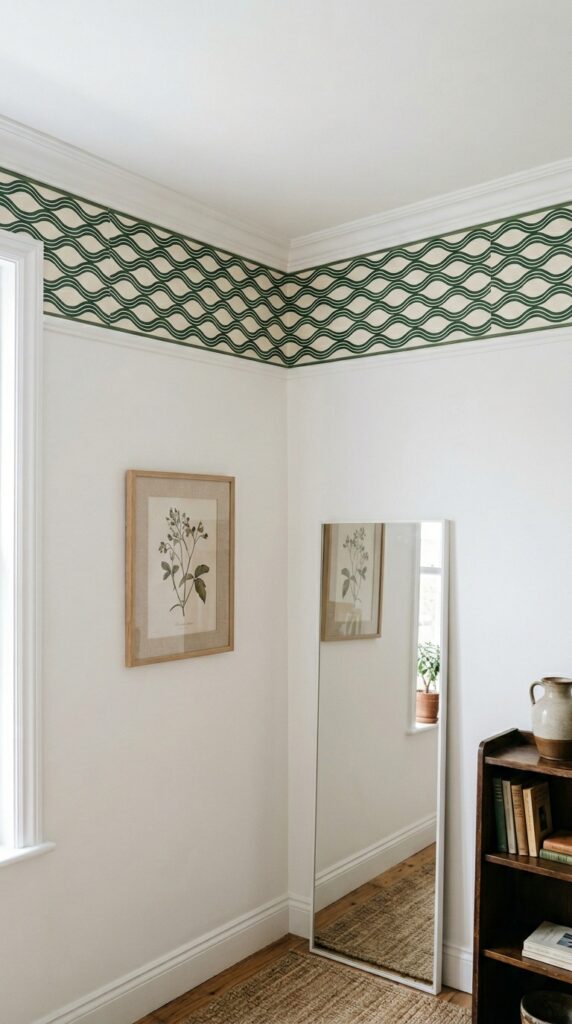
Borders were overused in the 1990s and then completely abandoned. But a single border at the ceiling line (not the middle of the wall) can add a subtle Deco or Victorian touch without overwhelming. I installed a 6-inch-wide Greek key border in dark green on cream ($25 per roll, needed two rolls) in a dining room. It acts like a hat for the wall, finishing the edge where wall meets ceiling.
The catch: borders only work if your ceiling is perfectly level. A wavy ceiling will make the border look drunk. Also, the paper is narrow and easy to mess up — it’s harder to keep straight than a full roll. Use a laser level. Cost for good borders: $20 to $40 per roll. Many are self-adhesive now, which is convenient but less durable. The adhesive version lasts about 3-4 years before edges curl. Traditional paste-applied borders last longer but are harder to find.
Paint the wall and ceiling first, then apply the border over both. That way it bridges the corner seamlessly.
20. Cork Wallpaper Dyed Soft Moss Green (Texture Over Pattern)
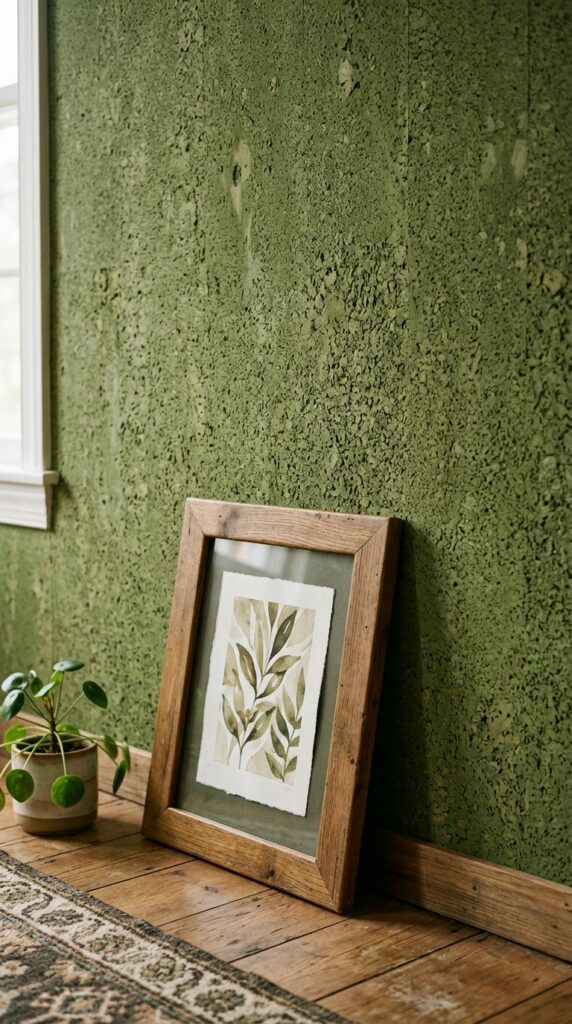
Pattern is not the only way to use green wallpaper. Cork in a soft moss green gives you color, texture, and acoustic damping all at once. I used this in a media room where I wanted to reduce echo. The cork absorbs sound surprisingly well — better than smooth paper. Cost was $90 per roll, and it’s thicker than standard wallpaper, about 1/8 inch.
The friction: cork wallpaper is hard to cut. The material crumbles at the edges if your blade isn’t extremely sharp. Also, you cannot match patterns because there is none, so seams are visible and must be butted perfectly. Any gap shows the wall. Any overlap casts a shadow. And cork stains — a greasy fingerprint is there forever. In a low-touch area, it’s great. In a hallway where people lean, no. Cost range $80 to $150 per roll. Under $60, the cork is thin and the dye is uneven.
Seal cork wallpaper with a clear matte acrylic spray after hanging. It protects against stains without changing the texture much.
21. Tropical Monstera In High-Gloss On Flat Matte Ground
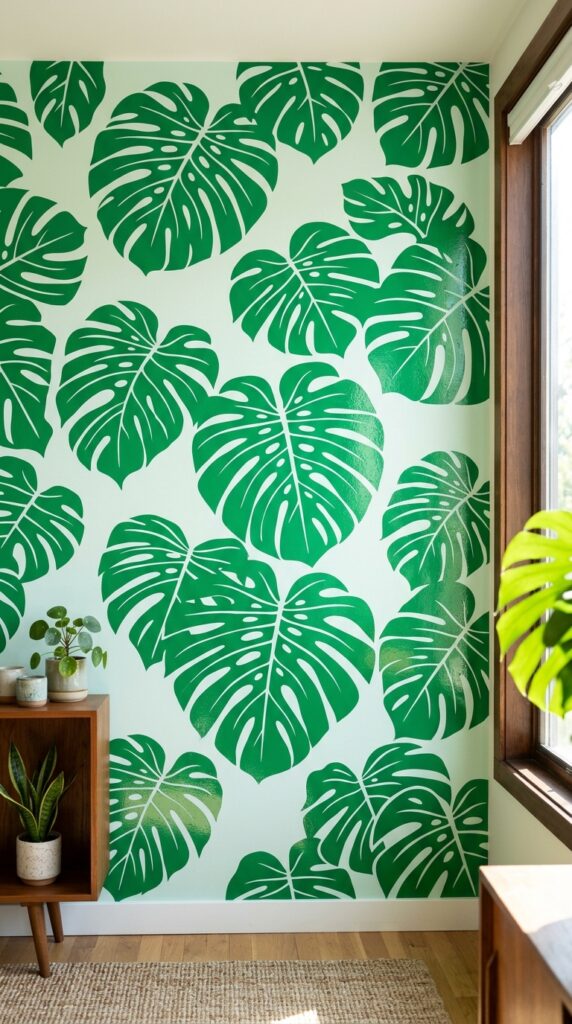
Most tropical wallpapers are all matte, which makes them feel flat. A high-gloss leaf on a matte ground creates depth without texture. I used a paper from a Dutch brand ($110 per roll) in a small sunroom. The glossy leaves catch light from different angles, so the pattern shifts as you walk by. It’s bold but not busy because the background is so quiet.
The trade-off: high-gloss inks are more expensive and harder to print evenly. Cheap versions have streaky gloss that looks like a bad laminate. Also, the glossy leaves reflect light, which means they show every seam where the pattern repeats. In a room with strong directional light, those seams are obvious. Hang this on a wall without direct raking light. Cost for good quality: $100 to $160 per roll. Under $70, the gloss is usually just a clear varnish that yellows over time.
Use a low-tack painter’s tape on the glossy areas if you need to mark something. Regular tape can pull the gloss off.
22. Patchwork Of Vintage Green Wallpaper Scraps (Frame It)
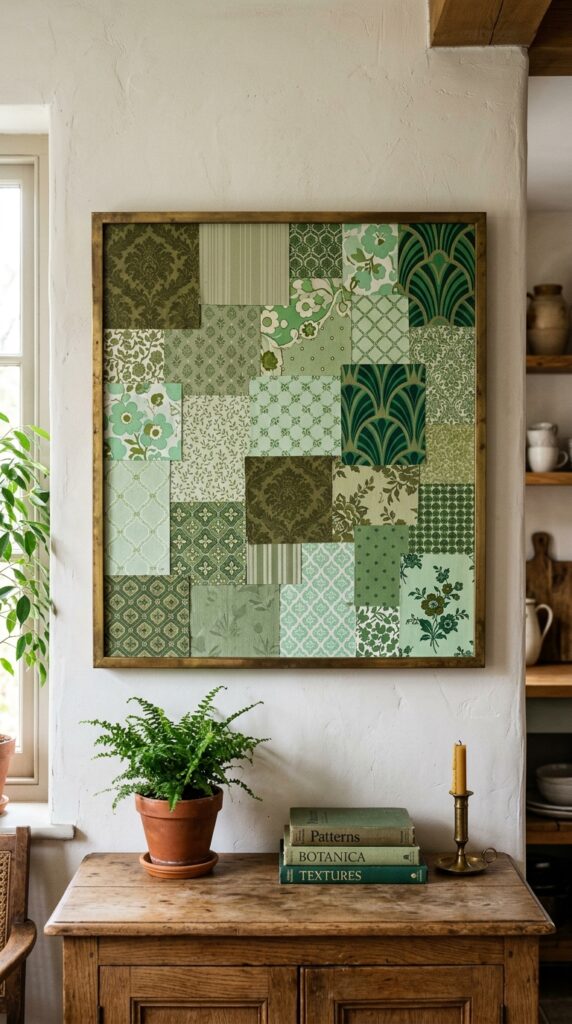
This is not a full wall of wallpaper. It’s a framed assemblage, like a textile art piece. I collected leftover wallpaper samples from hardware stores, Etsy sellers, and friends’ projects — all in different greens. I arranged them on foam board in a grid, then framed it. Total cost under $60. The effect is a conversation piece that reads as intentional art, not a failed wallpaper job.
The constraint: this takes patience. You need enough scraps to fill your frame (say, 20 to 30 pieces). Also, the different paper thicknesses make the surface uneven under glass. Use a deep-set frame (at least 1 inch deep) to accommodate the lumps. Or skip the glass entirely, but then dust collects. This idea works best as a small piece (16×20 inches) rather than a large one. It’s quirky, not grand.
Arrange the pieces on the floor first and live with the layout for a day. You’ll see color imbalances you missed at first glance.
23. Moss Effect With 3D Velvet Flocking (Tactile And Weird)
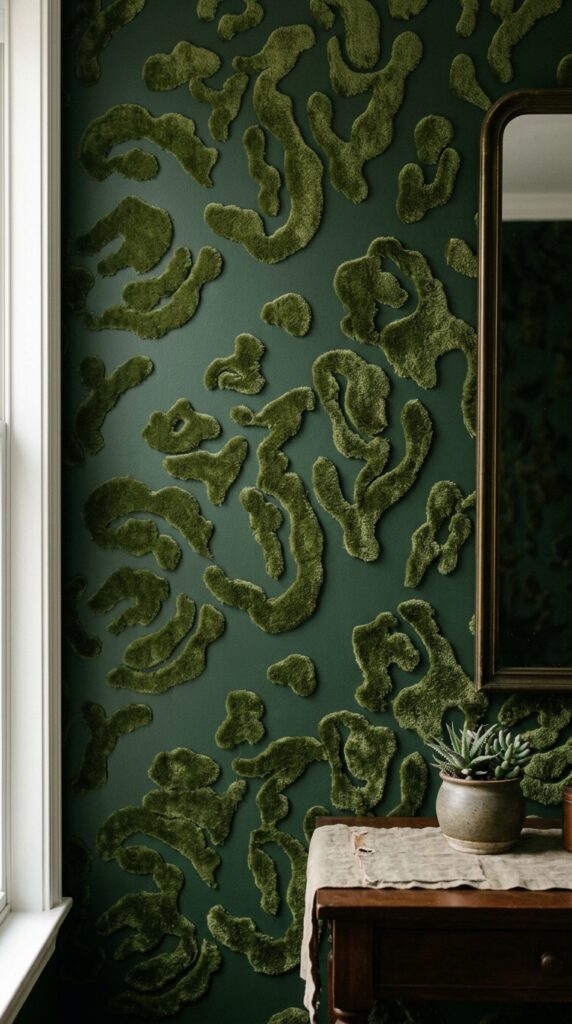
Flocked wallpaper (raised velvet patterns) is usually associated with Victorian excess. But a moss-green flocking on a dark green ground, with irregular, organic shapes, feels almost futuristic. I found a small-run flocked paper from a British manufacturer ($180 per roll). The texture is the point — you can’t stop touching it. It’s like a fidget toy for a wall.
The friction: flocking collects dust like a shag carpet. You’ll need a vacuum with a soft brush attachment monthly. Also, the velvet can crush. If you rub against it repeatedly, the flocking mats down and doesn’t spring back. Place it on a wall that doesn’t get traffic. Cost is high — $150 to $250 per roll — because the flocking process is labor-intensive. Cheap flocked paper uses glued-on fibers that fall off within a year. Also, this is not removable. Once it’s up, it’s up.
Order a sample and rub it vigorously with your hand. If fibers come off, skip it. Quality flocking shouldn’t shed.
24. Abstract Ocean Wave In Aqua And Deep Teal (Irregular Repeat)
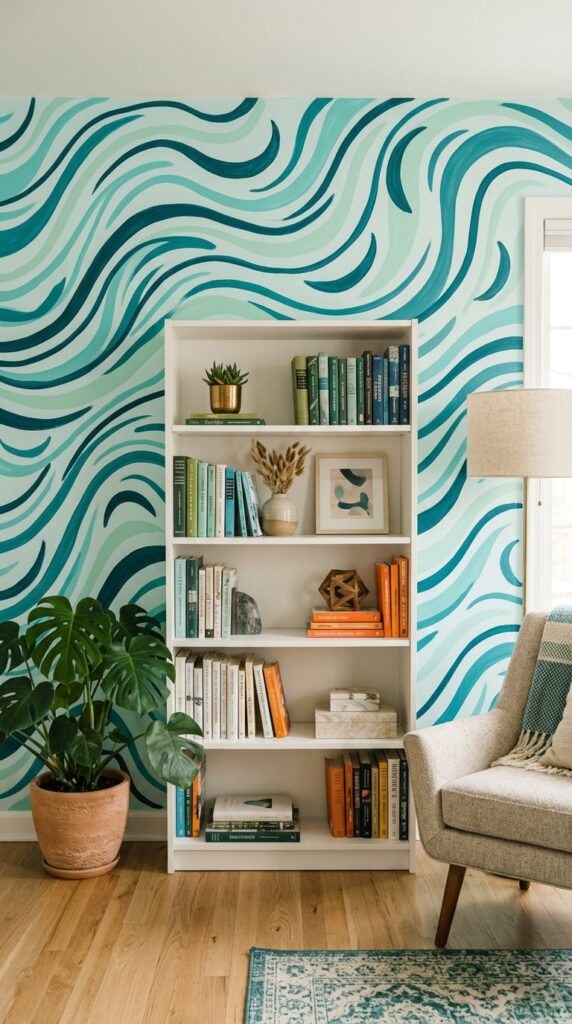
Not all green wallpapers need to be botanical or geometric. Abstract wave patterns in the blue-green family feel like a compromise between green and blue — they work with both. I used a paper with a 48-inch irregular repeat (so the pattern doesn’t obviously repeat) in a beach house living room. Cost was $130 per roll. The aqua notes read as green in some lights, blue in others.
The challenge: irregular repeats are harder to match because the pattern doesn’t line up neatly at the seams. You’ll waste more paper. Also, the abstract pattern means you can’t hide a crooked seam — the eye has no vertical line to follow, so any drift is obvious. Hire a pro. Cost for quality abstract wave: $100 to $160 per roll. Under $70, the colors are usually too saturated and the pattern reads as childish. This is a “less is more” pattern; look for muted, grayed-down tones.
Use this wallpaper on a wall that gets morning light. The blue tones come forward; in afternoon light, the green dominates.
25. Negative Space Leaves On Dark Green (Reverse Botanical)
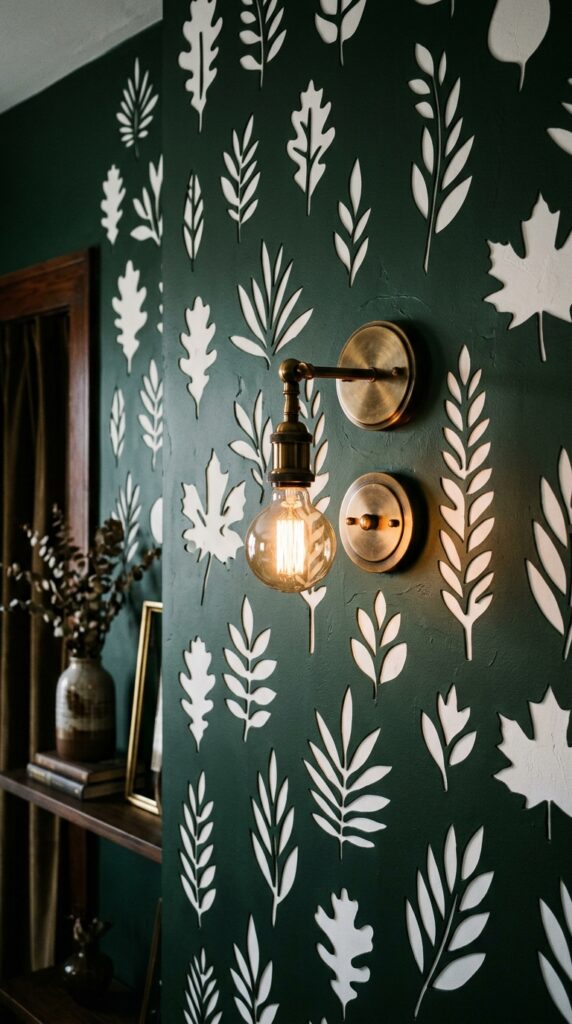
Instead of printing green leaves on a white background, this wallpaper is a dark green sheet with white leaf shapes. The “white” is actually the wall showing through — the paper has the leaves cut out, or more commonly, printed as white on the green but designed to look like cutouts. I found a version that’s actually printed (not cut) for $100 per roll. The optical illusion makes you look twice.
The constraint: if the background is very dark green, the “white” leaves must be bright white to read as negative space. Off-white reads as dirty. Also, the pattern should be sparse — too many leaves and it becomes a confusing mess. Look for a design with large, simple leaf shapes spaced widely. Cost for good negative-space designs: $90 to $150 per roll. Cheap versions have muddy greens and grayish whites. One more thing: this pattern demands perfect wall preparation because any imperfection in the “white” area shows through as texture.
Paint the wall pure brilliant white before hanging. Any off-white or cream will make the negative space look dingy.
The One Thing You Need To Know Before Buying Green Wallpaper
Green is the hardest color to get right in wallpaper because it’s never the same twice. The same roll will look different on a north wall versus a south wall, in morning versus evening, next to oak versus walnut. The core decision you need to make isn’t which pattern you love — it’s how much color shift you can tolerate. If you need a consistent green, stick to neutral grays or beiges. If you’re willing to let the room change with the light, green will reward you.
My opinionated recommendation: start with a single roll of a matte botanical or a narrow stripe in a muted sage or olive. Put it on one wall — not the whole room. Live with it for a month. See how it behaves. Then decide if you want to commit to more. Most people overestimate their tolerance for bold color. It’s better to underdo it and add than to overdo it and tear down. That said, if you’re renting or nervous, the peel-and-stick options have improved dramatically. Just keep it out of the bathroom.
Green wallpaper isn’t a trend. It’s been around for centuries because green is the color of living things, and we want that energy indoors. But the wrong green — too yellow, too blue, too bright — will make you hate a room you used to love. Take your time. Order samples. Tape them to the wall. Look at them at 7 AM and 7 PM. And when you find the one that shifts in a way that delights rather than annoys you, buy an extra roll and put it in the back of a closet. You’ll thank yourself in five years.