You know that moment when you pull out a dining chair and the rug edge flips up, catching the leg, and suddenly your perfectly arranged table setting lurches sideways? Or when a glass of red wine hits the carpet and you realize your pale, plush wool rug has the absorbency of a sponge and the stain resistance of a white t-shirt? I have lived through both. And I have learned the hard way that dining room carpet is not a decorative afterthought — it is a structural negotiation between beauty, practicality, and the reality of gravy.
Most lists will tell you to “go neutral” or “choose low pile.” That is like telling someone to buy a beige car because it hides dirt. Technically true, but deeply uninspired. What they miss is the fact that a dining room rug has to survive chair legs, food drops, morning coffee, and the occasional pet catastrophe — all while looking deliberate, not desperate. So I spent years rotating rugs through my own dining rooms (and those of friends who let me experiment) to find what actually works, what feels good underfoot, and what becomes a regret within six months.
Below are fifteen ideas I have tested, broken, cleaned, and eventually loved. Some are obvious in hindsight but never written about. Some are against conventional wisdom. All of them come with honest trade-offs. No fluff. No generic inspiration. Just the real stuff.
1. Layered Kilim Over Wall-to-Wall Carpet
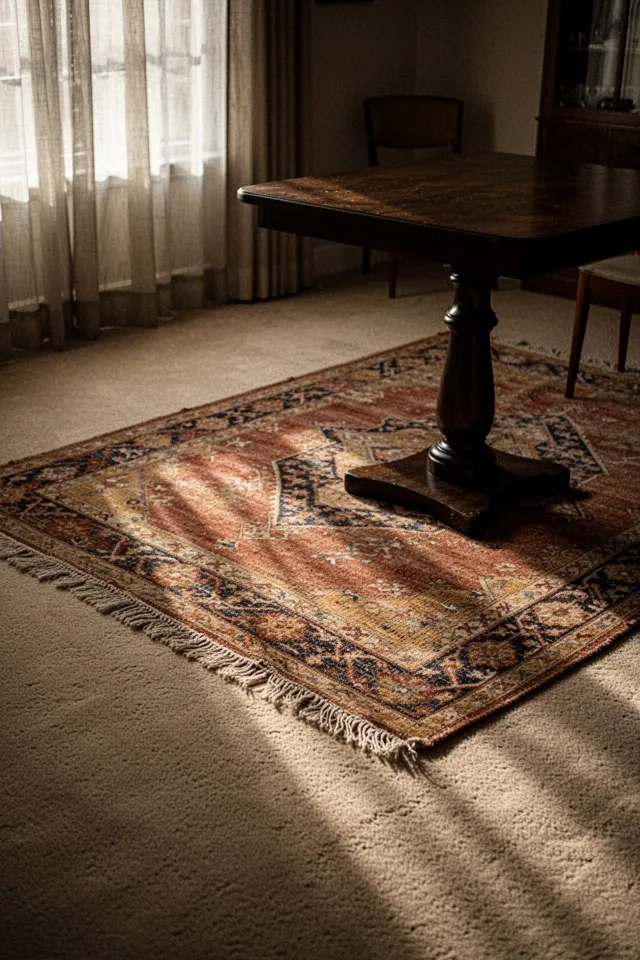
If you live in a house with decent wall-to-wall carpet that you cannot rip out (rental, budget constraints, or a spouse who loves the cushion), layering a flatwoven kilim on top is a revelation. It gives you pattern, color, and a clear dining zone without the commitment of replacing the entire floor. The key is choosing a kilim with a tight weave — no low-quality polyester blends that slide. I have a Turkish one in my own dining room that has survived three years of chair shuffling and one spilled borscht with only a quick spot clean.
The trade-off is that the kilim will not stay perfectly flat on a plush carpet. Expect a slight ripple effect, especially if the wall-to-wall is thick and cushy. You can minimize this with a non-slip pad designed for carpet-on-carpet layering, but it will never be as taut as on hard flooring. Also, the fringe can catch on vacuum cleaners. I vacuum around it with a hose attachment. Costs: a good wool kilim runs $200–$600 for a 6×9, but you can find used vintage ones for less if you hunt estate sales.
Layering a kilim over wall-to-wall is the smartest compromise when you cannot replace the floor. Go vintage wool — new synthetic kilims slide like crazy.
2. Round Jute Rug Under a Pedestal Table
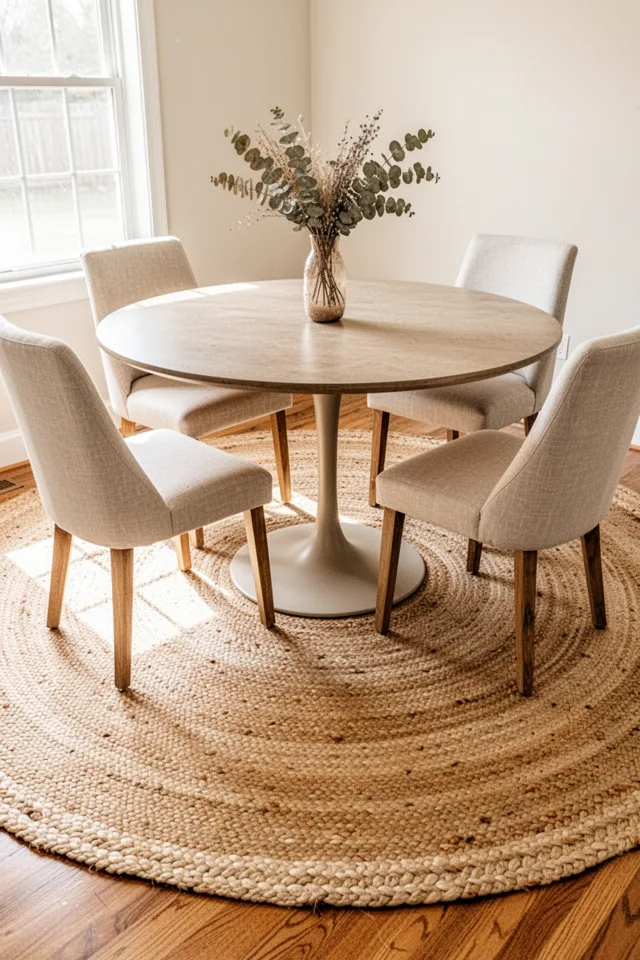
A round rug solves a geometry problem that rectangular rugs cannot: chairs on a pedestal table rotate and shift in a circular motion, and a square rug creates awkward corners where legs catch. With a round jute, every chair gets equal footprint. I installed this in a friend’s small breakfast nook and it made the space feel twice as large. The natural tone of jute blends with most wood floors without competing.
Here is the honest truth: jute is not indestructible. It stains easily, and it sheds. Fine for dry crumbs, terrible for wet spills. You must blot immediately, and even then, red wine will leave a ghost. I would never put jute under a dining table used daily by children or clumsy adults. But for a formal or occasional dining area, the soft warm texture and low cost (around $80–$150 for a 6-foot round) make it a solid choice. Also, jute gets softer with vacuuming — the loose fibers fall out over time, leaving a denser surface.
Round jute rugs are perfect under pedestal tables, but only if you are willing to treat spills like emergencies. Otherwise, go for a polypropylene flatweave in a round shape instead.
3. Faded Vintage Oushak Floral
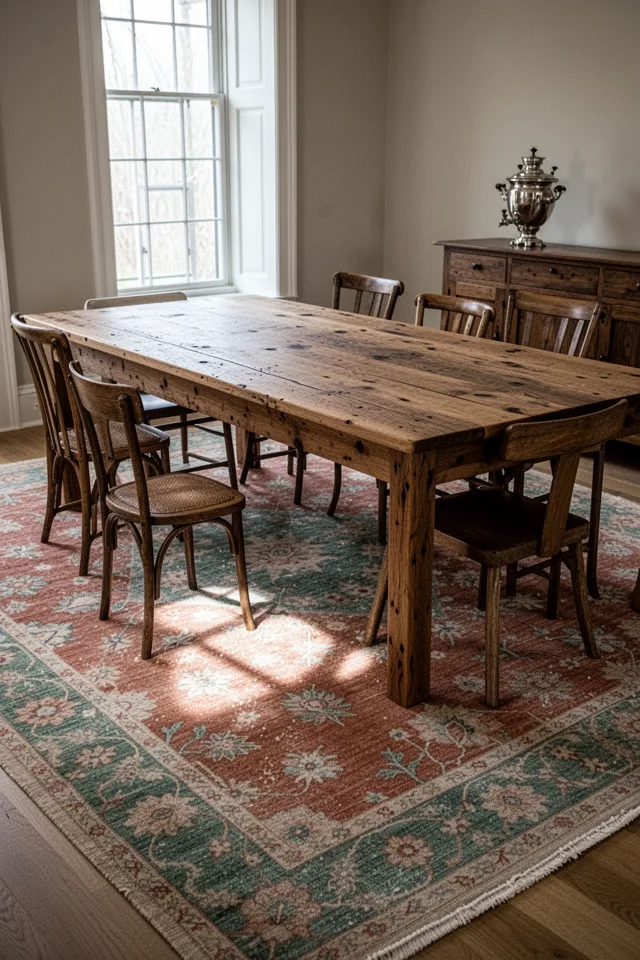
I bought a faded Oushak from a dealer in Istanbul seven years ago, and it has been the single most forgiving dining rug I have ever owned. The reason is simple: the pattern is already soft and slightly distressed, so every new stain, fade, or wear spot just blends into the existing patina. You cannot see spills until they dry, and by then they look like part of the rug’s history. The wool is thick enough to cushion chair legs, and the low pile does not trap crumbs.
The downside is cost. A genuine vintage Oushak, even a small one, starts around $500 and goes up fast. And they are fragile in direct sunlight — the fading that makes them beautiful also accelerates if you have south-facing windows. I rotate mine twice a year to even out sun exposure. Also, the fringe on old Oushaks is often delicate; I have replaced the edges on two corners. But if you can afford the investment, a faded floral wool rug will outlast any synthetic and look better with every year of use.
An authentic faded Oushak is the only dining rug that gets better with spills. Treat it like living furniture, not a decor accessory.
4. Bold Geometric Flatweave in High-Contrast
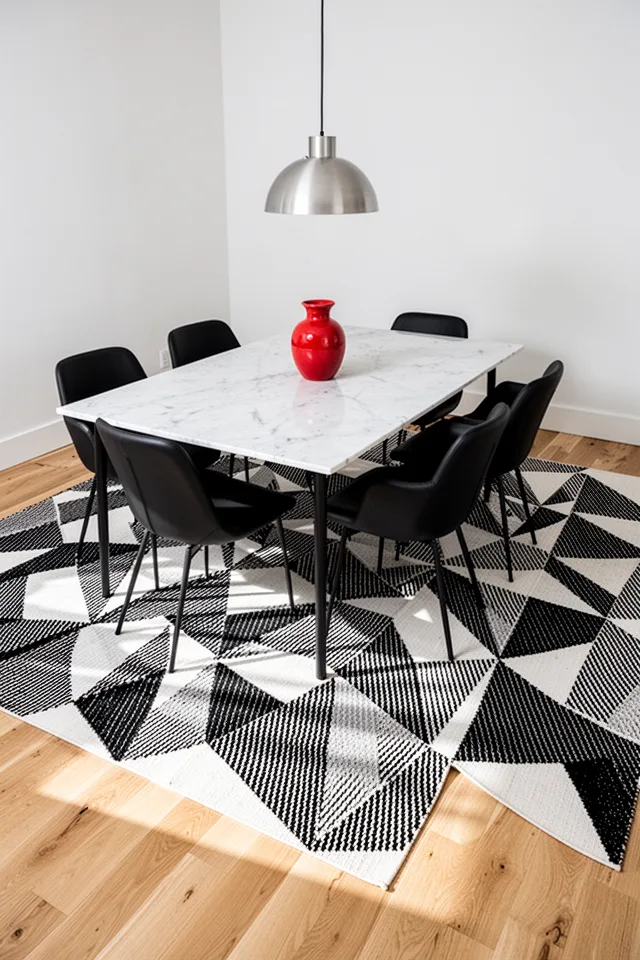
If your dining room is in an open-plan space that needs definition, a bold geometric flatweave can anchor the zone without overwhelming it. I used one in a loft that had no visual separation between living and dining — the rug became the floor of the “dining room,” and it worked. Black and white is the most durable color scheme for a dining rug because both extremes hide a lot. Crumbs disappear on white sections; dark spots vanish on black. And flatweave construction means no pile to trap debris.
But beware: direct sunlight will fade the black areas to a muddy gray in about two years if the rug is not UV-resistant. Polypropylene flatweaves handle sunlight better than wool, but they feel less luxurious underfoot. And high-contrast patterns show every piece of lint or pet hair — you will vacuum more often. A 9×12 flatweave in polypropylene costs $150–$300. I prefer the wool version for feel, but it costs double and fades faster. Trade-off is real.
Bold geometrics work best when the rug is the only pattern in the room. Keep everything else minimalist or the space will feel chaotic.
5. Long Runner Beside a Rectangular Table
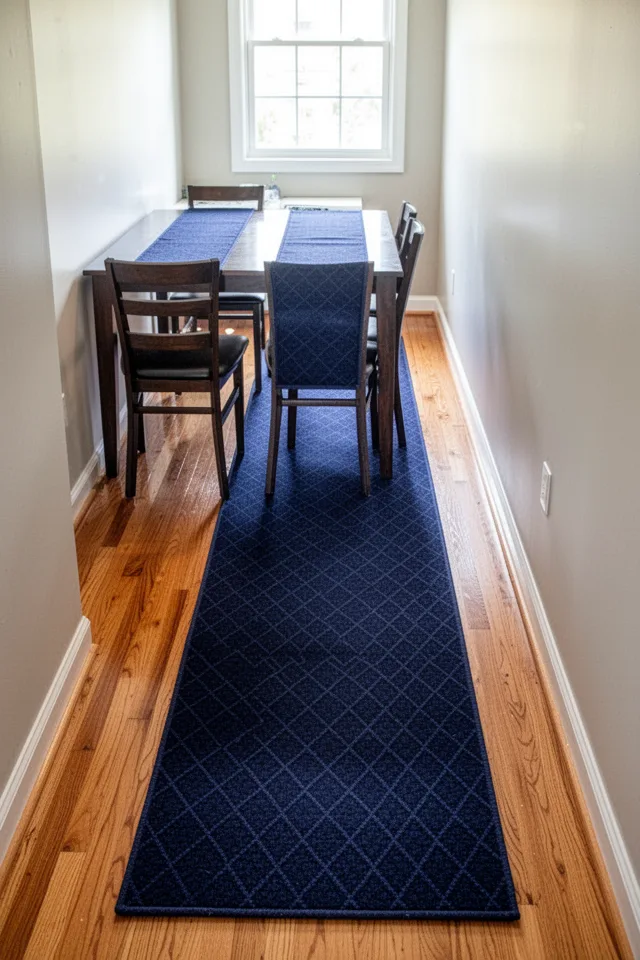
I discovered this approach when I was styling a long, narrow dining room where a standard rug under the table always looked too small or too large. By placing a runner beside the table, you avoid the chair-leg flip issue entirely (since chairs are not dragging over a rug edge), and you create a deliberate visual corridor. It works especially well if the table is against a wall, as in many apartment dining nooks.
The catch is that the runner does not protect the floor under the table itself — so you need a durable finish on the wood or tile. And the runner will take more direct foot traffic than a typical dining rug, so choose a low-pile, dense weave that can handle repeated walking. A 3×10 wool runner runs $150–$400. I have one from a Moroccan souk that has lasted eight years. It is not for everyone, but if your room is unusually shaped, this might be the only smart solution.
The runner-beside-the-table trick is the best-kept secret for narrow dining rooms. Measure carefully — the runner should be at least as long as the table itself.
6. Shaggy High-Pile Carpet (Formal Dining Only)
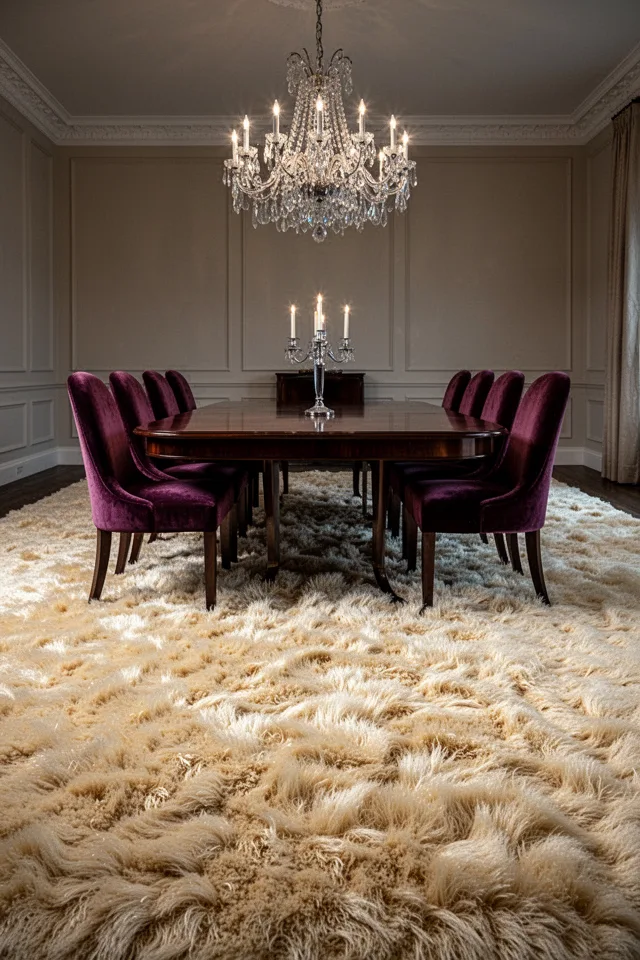
I know, I know — shag in a dining room sounds insane. But consider this: if you have a formal dining room that sees use maybe twice a month, and you are willing to vacuum before every use, a high-pile shag adds a tactile decadence that no flatweave can match. I installed a cream shag in a client’s dining room that was used only for holiday dinners, and it received nothing but compliments. The depth of the pile muffles sound, softens the room, and makes you want to walk barefoot.
The reality check: this is a maintenance nightmare for daily use. Any crumb, hair, or drop of liquid disappears into the pile and is a pain to extract. Spilled red wine? You might as well buy a new rug. Shag also traps dust and allergens, and the pile flattens permanently under heavy furniture. I would only recommend this for dining rooms that are truly formal — as in, you do not eat breakfast there. Expect to pay $400–$900 for a decent synthetic shag that is stain-resistant, but even then, do not test it.
Shag is for dining rooms that host dinner parties, not family breakfasts. If you eat there daily, choose something shorter.
7. Sisal Rug with a Dark Border
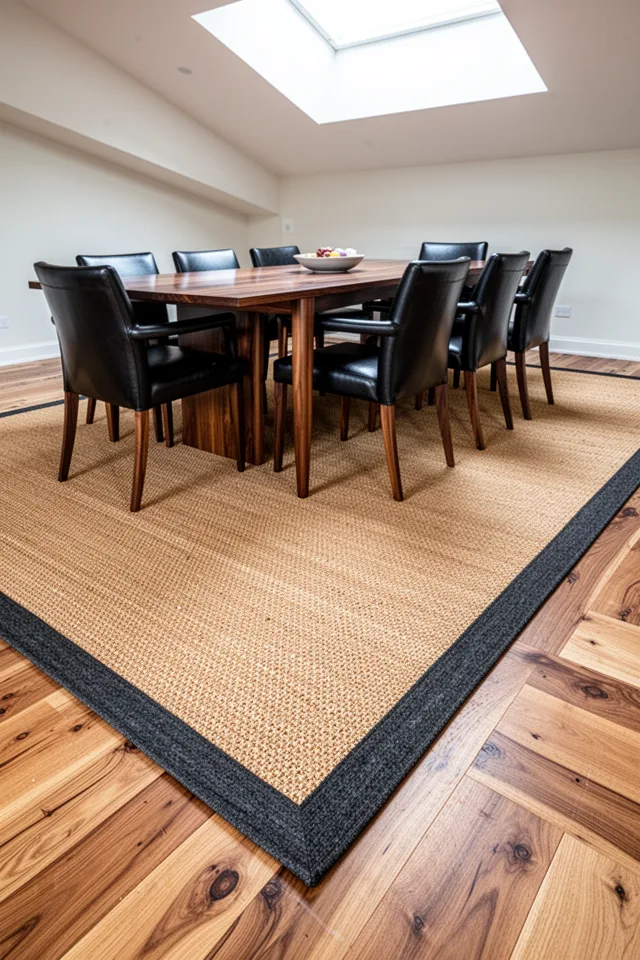
Plain sisal can feel like a burlap sack under a dining table — utilitarian, cheap-looking. But add a dark border, and suddenly it becomes architectural. I had a 10×14 sisal with a black border custom-made for a lake house dining room, and it transformed the space. The dark edge echoes the table legs and chair frames, creating cohesion. Sisal is also incredibly durable; it can handle daily chair movement without wearing through for years.
However, sisal is not soft underfoot, and it is terrible for spills — any liquid penetrates and stains immediately. You have to blot and treat within seconds. Also, sisal sheds over time, leaving little fibers on the floor. Vacuuming helps, but you will be sweeping more. A sisal rug with a border is a $200–$500 investment (custom sizes cost more). I recommend getting one with a latex backing to reduce sliding, but check that it does not damage hardwood floors — some backings can react with certain finishes.
A dark border on sisal makes the rug look like it was built for the room. Cheap trick, big impact. Just keep a stain spray handy at all times.
8. Cowhide Under a Glass Dining Table
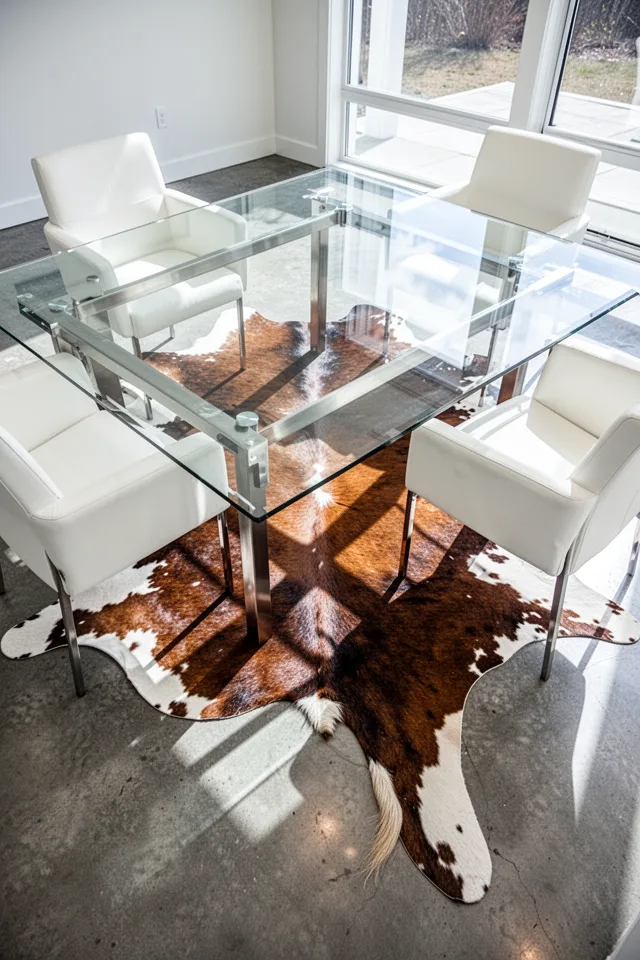
This is a bold choice that most lists are too timid to suggest. But if your dining table is transparent, a cowhide underneath becomes a sculpture in its own right. The irregular shape breaks the rigidity of a rectangle, and the natural hide brings warmth to cold materials like glass and metal. I used this in a loft for a photographer friend, and the cowhide has lasted over a decade with minimal care — just occasional vacuuming and a wipe for spills.
The trade-off is that cowhide is not soft underfoot, and it can be slippery on bare floors. You need a rug pad. Also, the hide will fade in direct sun, and the edges can curl if not kept flat. The smell of a real hide fades after a few weeks but can be strong initially. And if you are vegan or prefer synthetic, faux cowhide is available but lacks the same texture. A genuine cowhide runs $200–$800 depending on size and pattern. It is a conversation piece, but also a practical one — spilled wine wipes off easily because the hair is naturally stain-resistant.
Glass table plus cowhide is a power move. The transparency of the table makes the hide the real focal point — choose a pattern with strong contrast.
9. Custom Irregular Shape (Organic Blob)
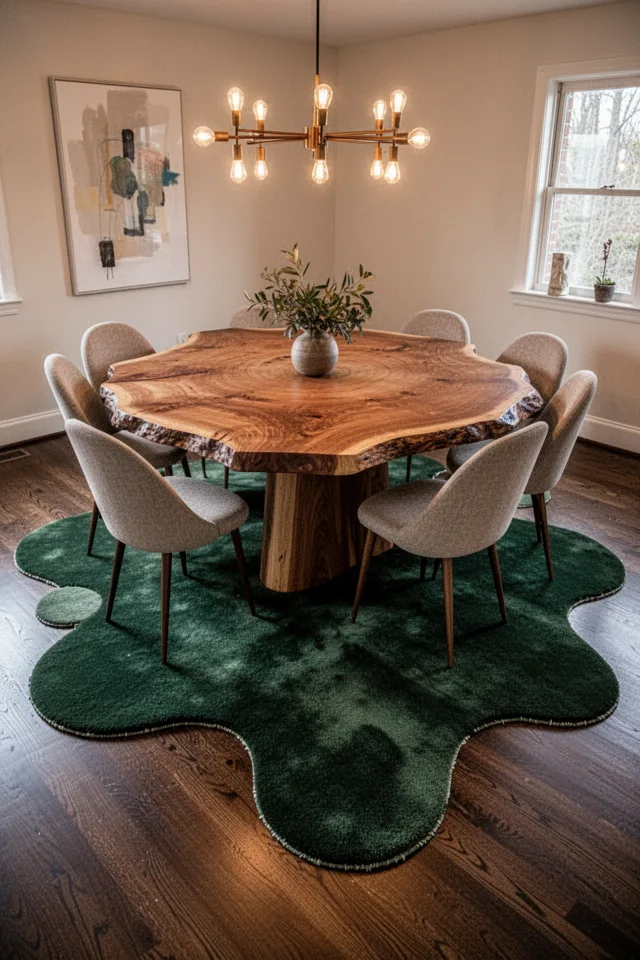
If you are tired of the tyranny of rectangles, a custom-shaped rug can redefine how a dining space feels. I had one made for a client with a round table in a square room — a rectangular rug left awkward corners, but an irregular oval with scooped edges matched the table’s shape and softened the geometry. The process is surprisingly accessible: many online rug makers allow you to upload a shape or choose from templates. The price is higher (you are paying for custom cutting), but the effect is unique.
Be aware that custom shapes can be tricky to place — you cannot easily rotate or move to another room. And if you ever change the table, the rug may no longer fit. The manufacturing tolerances are not perfect; I have had one rug arrive with a kink in the curve because the cutting machine misaligned. Also, edges that are not bound can fray over time, especially with vacuuming. A custom cut-pile wool rug in an irregular shape will set you back $600–$1,200. But if you want a dining room that no one else has, this is it.
Custom shapes work best with round or oval tables. If your table is rectangular, stick with a rectangle — irregular shapes clash with straight lines.
10. Patchwork of Vintage Dhurrie Squares
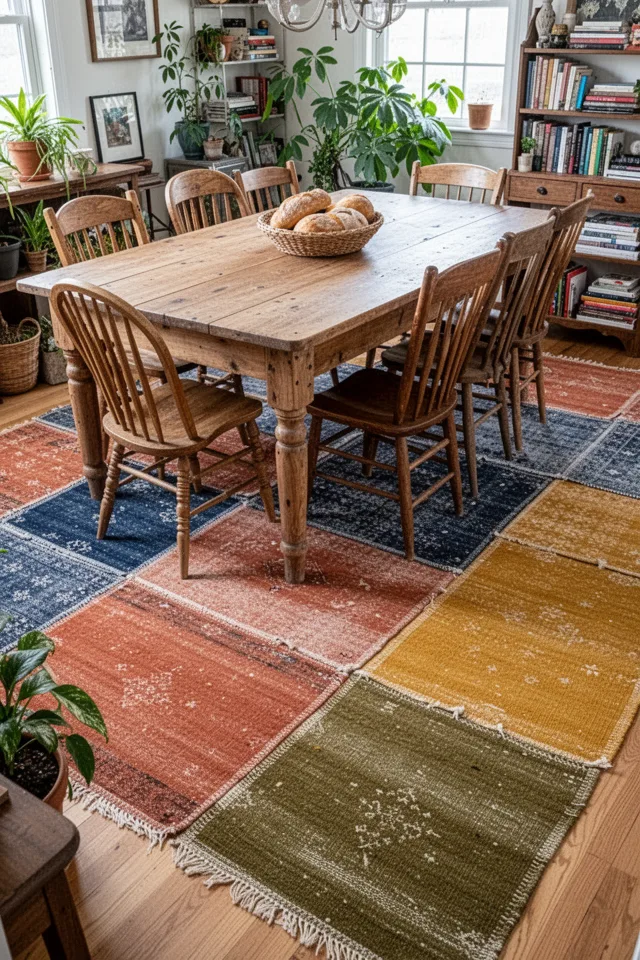
Instead of one large rug, try assembling a patchwork of vintage dhurrie squares. I started this in my own home when I could not afford a single 9×12 but had three old dhurries from travel. The effect is more interesting than any single rug. Each square brings its own history, and if one gets stained, you can replace just that one. The thin weave is ideal for dining because crumbs fall through, and spills are easy to spot clean.
The downside is that the squares will shift and slide unless you stitch them together or use a large rug pad underneath. Overlapping edges can become tripping hazards. And the visual result is intentionally messy — if you prefer a minimalist look, this will drive you crazy. I use a heavy non-slip pad cut to the overall footprint, and I tuck the edges under each square. Cost: individually, vintage dhurrie squares range from $30–$80 each. For a 12-square patchwork, total could be under $500 — cheaper than a comparable new wool rug.
Patchwork dhurries are the most forgiving dining rug solution. One gets ruined? Swap it out. The overall look only gets better with age.
11. Dark Navy Wool with Subtle Diamond Pattern
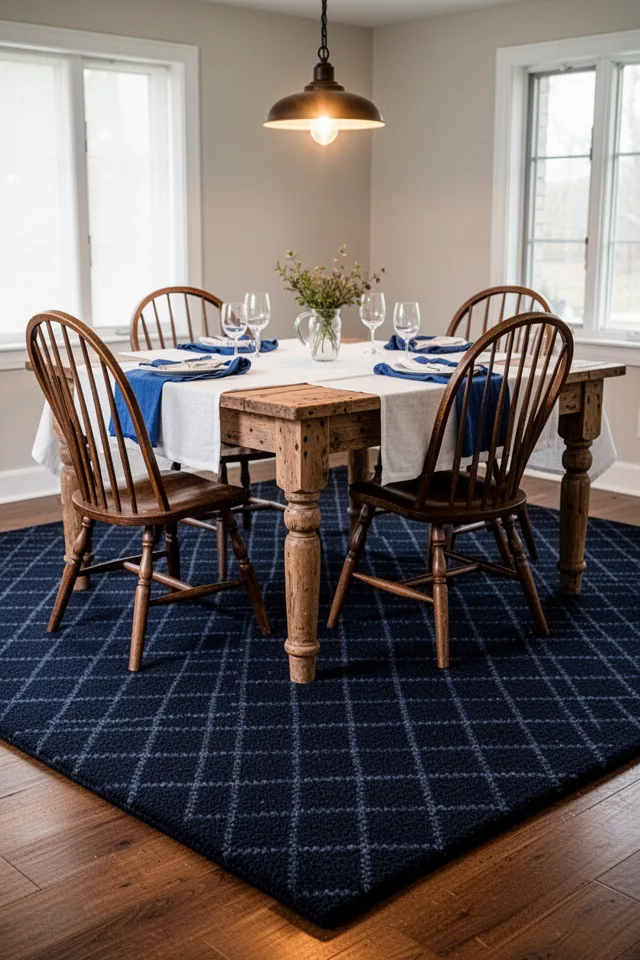
I have a dark navy wool rug with an almost-invisible diamond pattern in my own dining room. It is the best decision I ever made for hiding every imaginable stain and crumb. Dark colors mask drips, and the subtle pattern breaks up the surface so that dust and crumbs vanish. Wool naturally repels liquid if treated, and the pile is short enough that a quick vacuum picks up everything. I have had mine for four years and it still looks new.
One thing most guides skip: dark rugs show every piece of lint and pet hair in bright sunlight. Navy is notorious for revealing light-colored debris. You will need to vacuum before every dinner party. Also, wool absorbs odors — if you cook strong-smelling food (think fish curry), the rug may retain it for a day. I air out my dining room weekly. Cost: a good quality 8×10 navy wool rug runs $400–$800. I found mine on sale at a rug warehouse for $350 — hunt for deals.
Dark navy wool is the underrated workhorse of dining rugs. It looks formal, hides most crimes, and wears like iron. Just don’t let the sun hit it directly every day.
12. Berber Loop Pile in Cream with Dark Specks
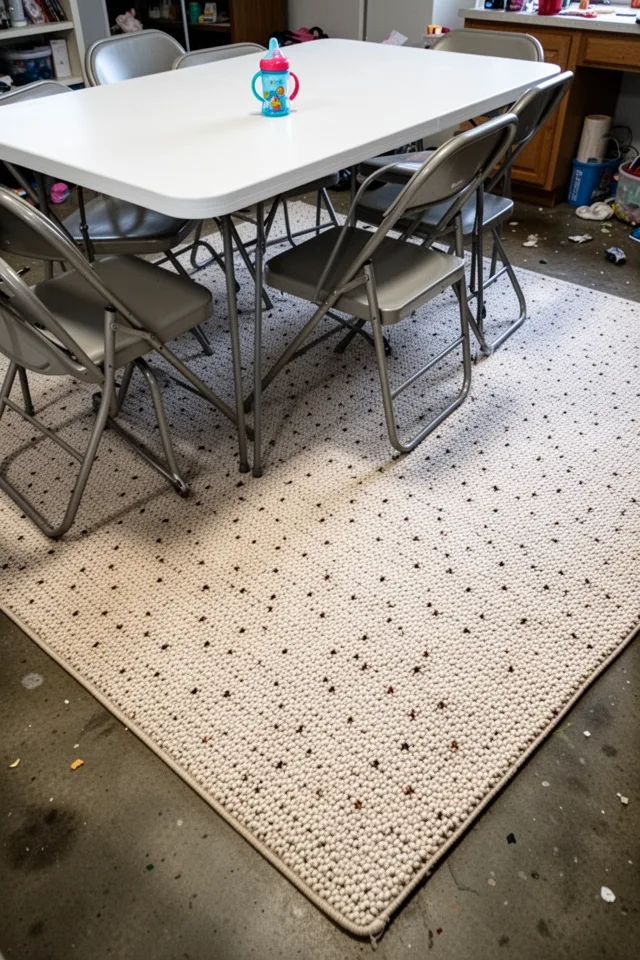
Berber loop pile is the unsung hero of dining rugs for families. The loop construction means no cut fibers to unravel, and the tight weave resists crushing from chair legs. The cream base with dark specks is a genius camouflage — the specks hide individual crumbs, while the light overall color keeps the room feeling airy. I installed this in a friend’s home with three young kids, and after two years of daily use, it still looks presentable.
However, loop pile can snag easily. If you have pets with claws, or if a chair leg has a screw sticking out, you might pull a loop and create a run. And Berber is not as soft underfoot as cut pile; it has a stiffer, more industrial feel. Also, spills can wick between the loops, making cleaning harder than on a flatweave. Cost: a 9×12 Berber rug in polypropylene runs $150–$350. Wool Berber is more expensive but naturally stain-resistant. If you can afford wool, do it.
Berber loop pile is the ultimate family dining rug — durable, cheap, and the speckles hide practically everything. Just keep sharp objects away from the loops.
13. Washable Flatweave (Ruggable Type)
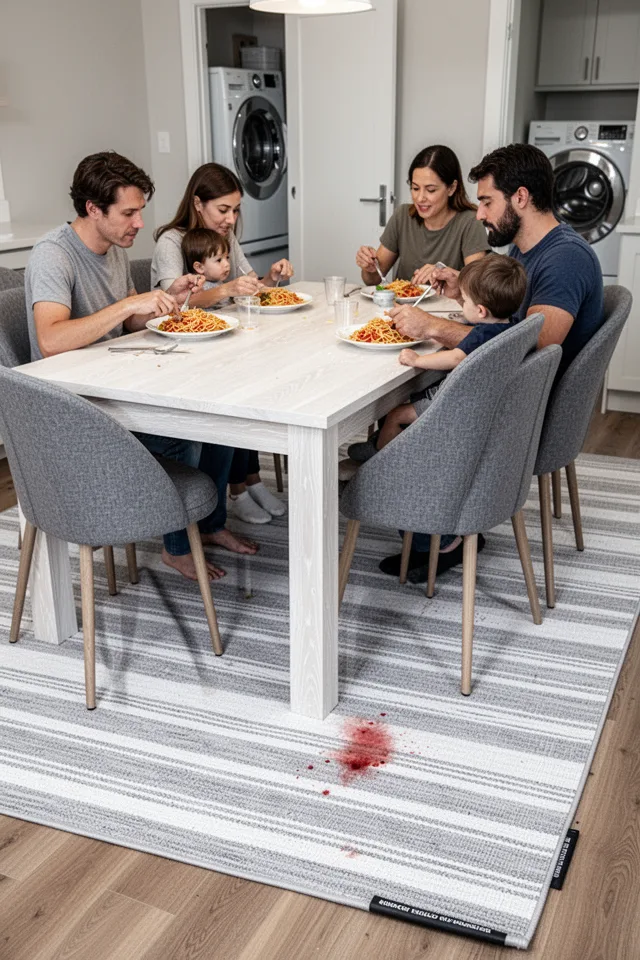
Washable rugs have become mainstream for a reason: they solve the single biggest problem of dining room carpets — the inability to clean them thoroughly. I was skeptical of the Ruggable-type system until I used one in a rental dining room, where I could not afford to replace a stained rug. After a year of use, I threw it in the washer and it came out looking new. The flatweave construction is thin enough to dry quickly, and the rubber gripper pad keeps it from shifting.
The trade-off is that washable rugs feel cheap underfoot. They are essentially fabric mats on a pad, with no pile depth. The colors can fade after many washes, and the edges may fray with time. Also, the rubber pad can trap moisture underneath if the rug is not completely dry after washing — I had a mold issue once. But for high-traffic, high-spill dining rooms, this is the most practical option. Prices range from $100–$300 for a 6×9. I recommend buying the thicker premium version for a less plasticky feel.
Washable rugs are the pragmatic choice for anyone with kids or pets. Accept the slight sacrifice in texture, and you will never panic over a spill again.
14. Silk or Viscose Accent Runner on Sideboard
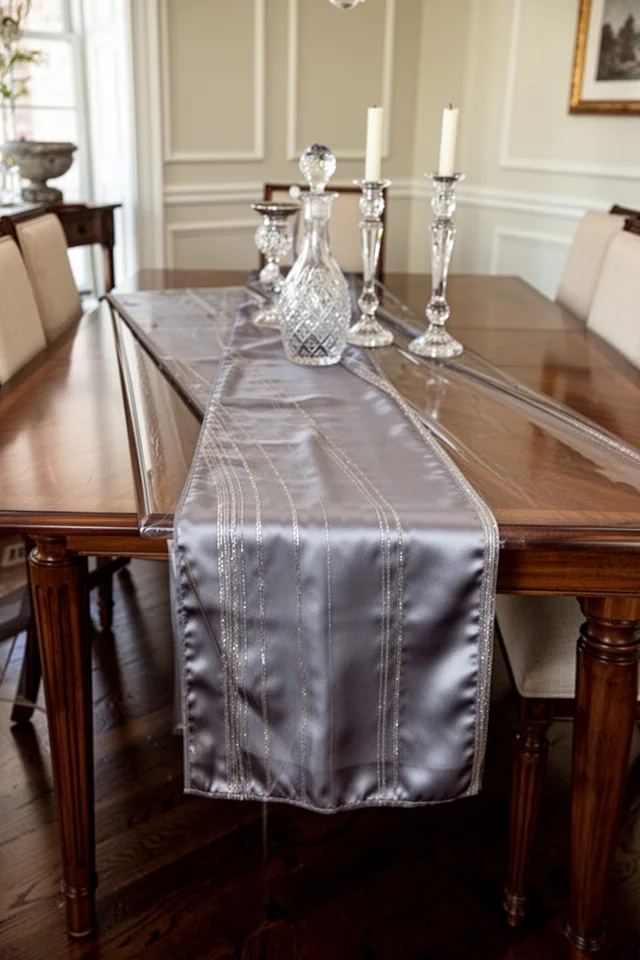
Most dining room carpet advice focuses on the floor, but a luxurious runner on a sideboard can change the entire mood of the room without any floor maintenance. I have a viscose runner on a mahogany sideboard that I swap for different seasons. It adds color and texture at eye level, and it never gets stepped on. Viscose has a silky sheen that wool cannot match, and it is much more affordable than real silk.
But viscose is delicate — it will stain permanently if you spill anything on it, and it can be damaged by sunlight. Keep it away from windows and never eat over it. Also, viscose shedding is real; I have to lint-roll mine weekly. A silk runner can cost $100–$400, viscose $40–$150. This is an accent, not a workhorse. But if you want to add sophistication without committing to a floor rug, this is the move.
A sideboard runner is the low-commitment way to bring luxury to a dining room. Just don’t let anyone put a hot dish on it — viscose and silk melt.
15. Checkerboard Black-and-White Tile-Pattern Carpet
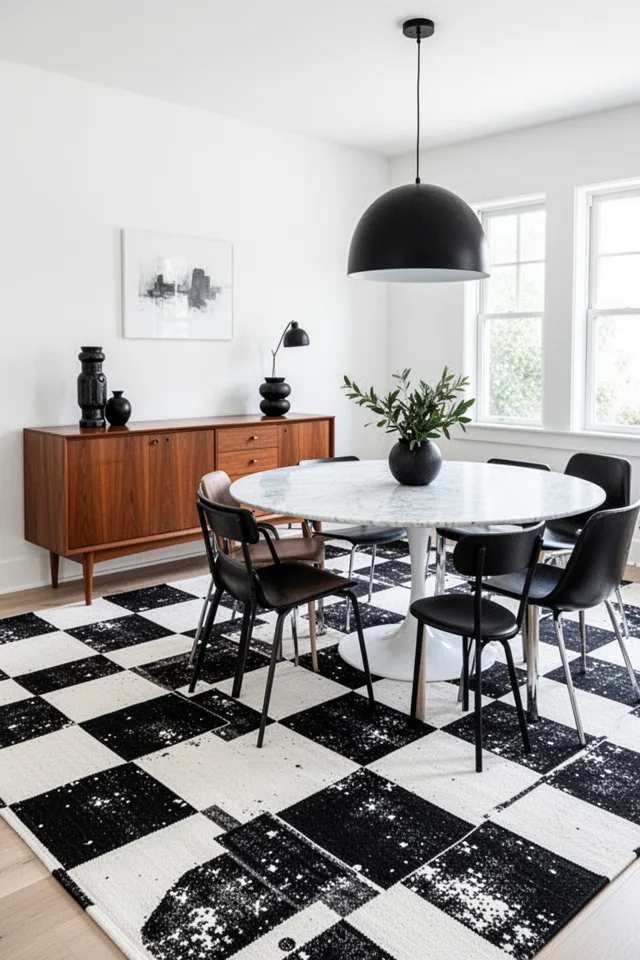
Checkerboard is having a moment, but most people think of it as tile, not carpet. A flatweave wool checkerboard rug gives you the same graphic punch without the permanence or coldness of tile. I love the way it makes a dining area feel like a Parisian bistro. The black squares hide dirt, the white squares brighten the room, and the overall pattern makes the room feel larger. I installed one in a small dining nook and it tricked the eye into seeing more space.
The challenge is that checkerboard rugs require precise centering under the table. If the pattern is off, it looks sloppy. Also, the high contrast will show every piece of lint, so vacuuming is essential. Spills on white squares are visible instantly; I keep a white towel handy for blotting. These rugs are not cheap: a 8×10 wool checkerboard runs $400–$900. Polypropylene versions are cheaper ($150–$300) but look flat and have a plastic sheen. Wool has a natural matte finish that reads as timeless.
Checkerboard carpet is a statement, not a background. Commit to the pattern, center it perfectly, and be prepared to vacuum often. It is worth the effort.
Conclusion
At the end of the day, the right dining room carpet comes down to one honest question: how much real life happens on this floor? If you eat dinner there every night with kids, choose a washable flatweave, a Berber with speckles, or a dark wool with a subtle pattern. If you host elaborate dinner parties twice a year, go ahead and indulge in a shag or a vintage Oushak. The worst mistake is buying a rug that looks beautiful in the showroom but cannot survive a Tuesday pasta dinner.
My personal recommendation for most people: start with a dark navy wool rug with a subtle pattern. It is the perfect middle ground — formal enough for guests, forgiving enough for daily spills, and durable enough to last a decade. Pair it with a good quality rug pad, and you are set. I have had mine for four years and it still makes me smile every time I walk into the room.
Remember: a dining room carpet is not a decoration. It is a stage for the meals, conversations, and messes that make life worth living. Choose something that can hold its own in the story of your home. Everything else is just fabric.