There is a particular kind of front yard that feels completely of its moment — not trendy in a way that will date badly, but genuinely contemporary in its restraint, its precision, and its confidence. Modern flower beds achieve this through a different set of rules than traditional garden design. Where cottage borders celebrate abundance and happy chaos, modern beds work through editing, repetition, and a very deliberate relationship between the plants and the hard materials surrounding them. The mulch matters as much as the flowers. The edging is as important as what grows inside it. The negative space — the mulched ground between plants — is not emptiness waiting to be filled but an active design element doing real work. If you’ve ever looked at a front yard and thought it looked expensive without being able to explain exactly why, this is almost always what was happening. These twelve ideas translate that quality into practical, achievable terms for real front yards of every size and style.
1. The Monochromatic White and Steel Bed
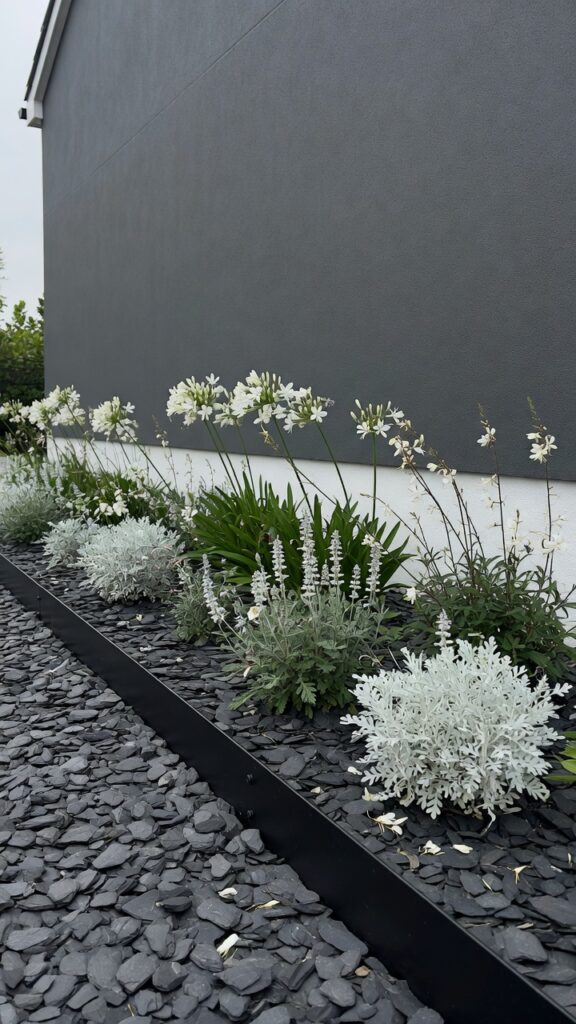
White planting against a dark or charcoal home exterior is one of the cleanest, most contemporary combinations in residential landscaping. The contrast is bold without being aggressive, and the result reads as genuinely sophisticated from the street. The key to making this work at a modern level rather than a traditional one is the supporting cast — the mulch, the edging, and the plant spacing. Dark graphite slate mulch instead of bark, slim black steel edging instead of brick or timber, and plants spaced with breathing room rather than packed tightly together. Choose white-flowering plants with different forms: the upright spike of white salvia, the airy dancing habit of white gaura, the bold rounded heads of white agapanthus, and the soft silver-grey of artemisia weaving through as foliage. No single plant dominates. The bed reads as a composition rather than a collection. One honest watch-out: white flowers need deadheading to stay pristine. If low maintenance is your priority, lean more heavily on the silver foliage and use white flowers as accents rather than the primary planting.
2. The Ornamental Grass Drift Bed
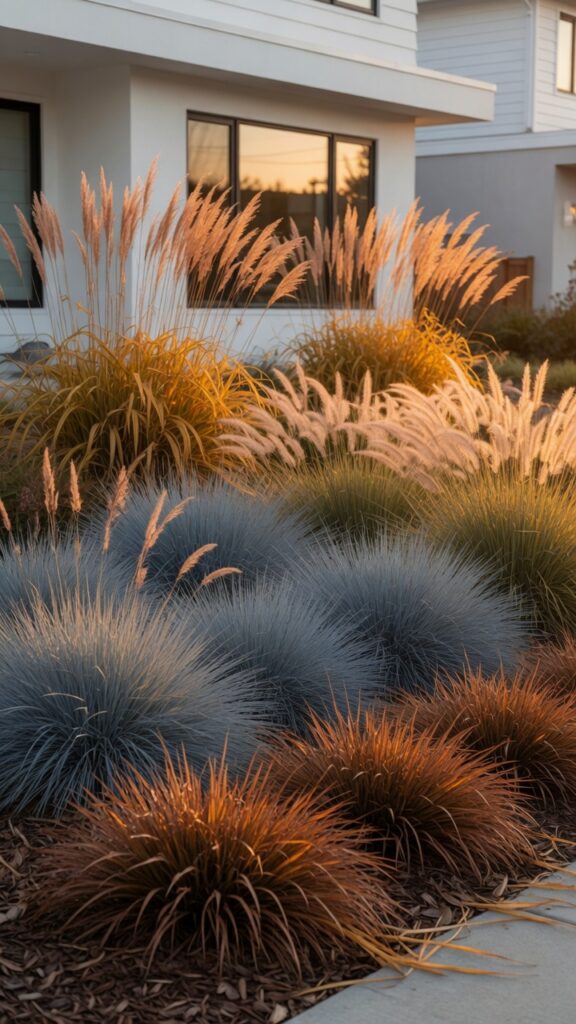
Ornamental grasses are the definitive modern garden plant, and a bed designed around them as the primary element rather than a supporting one makes an extraordinarily beautiful statement at the front of a contemporary home. The movement is the point — grasses respond to every breath of wind, and a bed that is constantly in gentle motion has a quality that no static flowering plant can replicate. Design the bed in horizontal drifts from tall at the back to low at the front: miscanthus or pennisetum at the rear, mid-height blue oat grass or feather reed grass in the middle, and fine blue fescue or bronze carex at the front edge. The tonal variation between blue-grey, gold, and bronze gives the bed genuine depth even without flowers. That said, grasses do most of their work from midsummer through winter — in early spring before they get going, a grass-only bed can look sparse. Solve this by threading in some early bulbs — alliums or tulips — that perform while the grasses are still establishing their seasonal momentum.
3. The Architectural Succulent and Gravel Bed
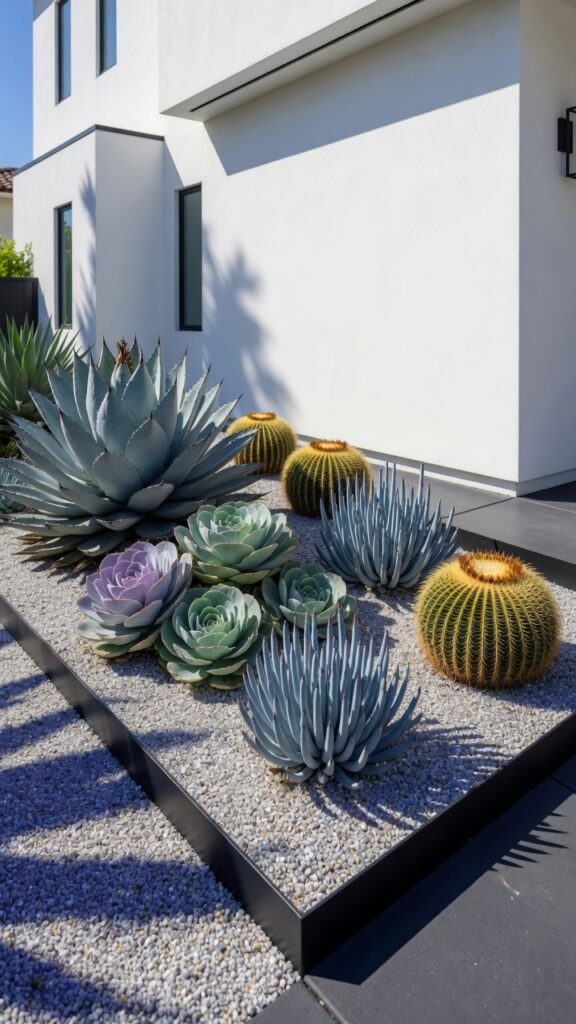
There is a graphic quality to a succulent bed that no other planting style achieves — each plant is essentially a living sculpture, and when you arrange them with space and intention in a bed of pale gravel, the result looks more like contemporary landscape art than conventional gardening. This works best in climates that don’t experience hard frosts, but even in cooler zones many succulents can be overwintered in pots and brought out for the warmer months. The design principle is contrast of form: pair the sharp, pointed rosette of an agave with the soft, rounded dome of echeveria, and add an upright element like blue chalk sticks or aloe to give vertical punctuation. Pale silver or white gravel mulch is essential — bark mulch completely kills the look. Space the plants generously, because the gravel between them is doing active visual work. One practical note: this planting needs excellent drainage above all else. If your bed has heavy clay soil, raise it slightly or excavate and replace with a sharp-draining mix before planting.
4. The Repeated Block Planting Bed
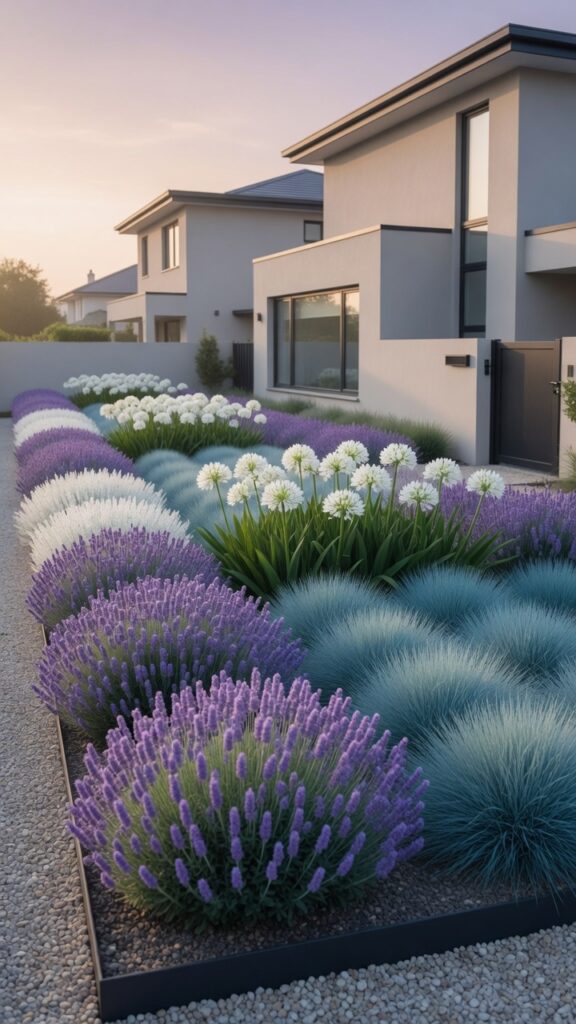
Block planting — arranging plants in large single-variety drifts rather than mixing everything together — is the technique that most clearly separates contemporary garden design from traditional approaches. Where a cottage border mixes freely and celebrates variety, a modern block-planted bed uses repetition and scale to create something that reads almost like abstract art from the street. Choose three plants maximum. Plant each one in a generous rectangular or organic drift that runs across the full depth of the bed. Then repeat the sequence along the length. The larger each block, the more powerful the effect — a drift of fifteen lavender plants reads completely differently from a drift of three. This approach is also supremely practical: monoculture blocks are easy to maintain, easy to replace if something fails, and easy to understand visually. For a long front bed along a contemporary home, lavender, agapanthus, and blue fescue in repeating sequence is a combination that has been used by professional landscape designers for good reason. It works at every scale and in almost every climate.
5. The Dark Mulch Minimalist Bed
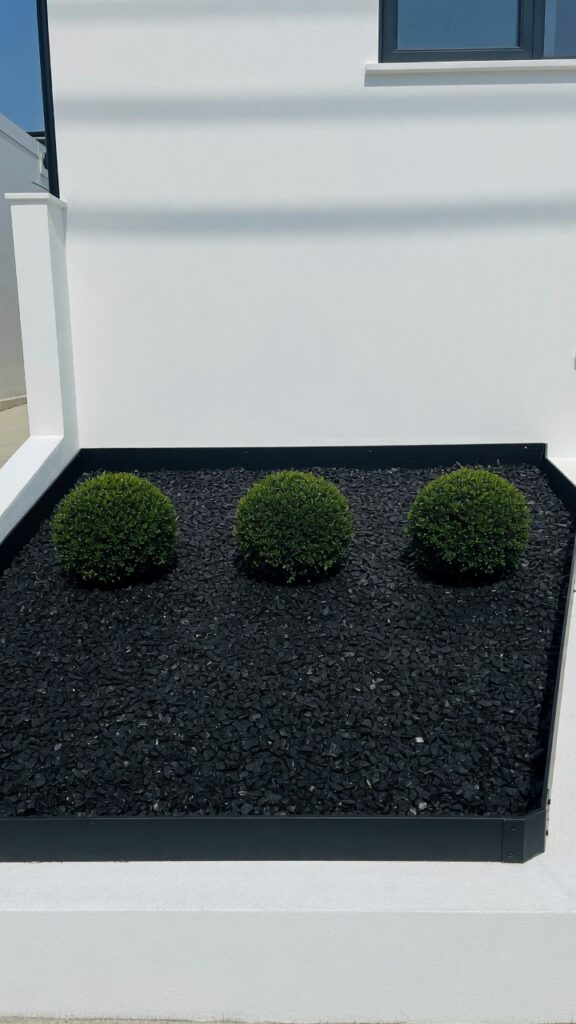
Restraint is a design skill, and nowhere is it more visibly rewarded than in a minimalist front bed where almost nothing is happening — and it looks completely intentional. Three evenly spaced clipped buxus spheres in jet black basalt chip mulch, edged in black steel, against a white rendered home is a composition of such confident simplicity that it reads as expensive immediately. The lesson here is that the quality of the negative space — the mulch, the soil, the air between plants — matters as much as the plants themselves. Black basalt chip is the mulch choice that elevates this look: it is heavier and more architectural than bark, reflects light differently, and holds its color far longer without fading. The plants must be immaculate — perfect spheres, not approximations. If clipping buxus doesn’t appeal, substitute with pittosporum balls or clipped photinia, both of which maintain their shape with minimal intervention. One watch-out: buxus is currently vulnerable to box blight and box moth caterpillar in many regions. Check local advice before committing to a large buxus planting and have a contingency variety in mind.
6. The Linear Perennial Border With Metal Edge
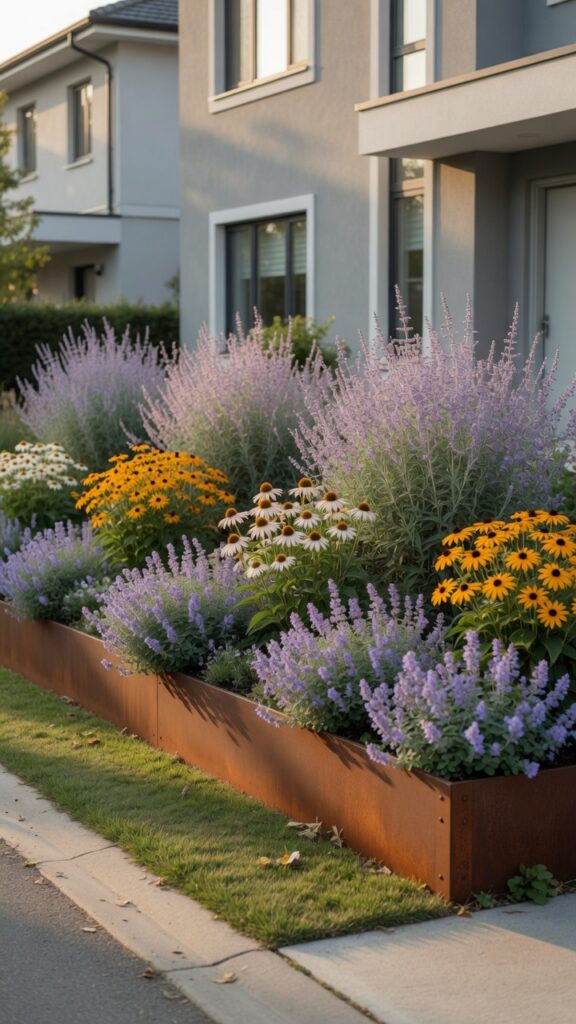
Corten steel edging — the kind that develops a rich, warm rust patina over time — is one of the most beautiful hard landscaping materials available for a modern front garden, and it does something that no other edging achieves: it improves with age. A linear perennial border held within a Corten steel frame has a precision and a material warmth that feels genuinely designed rather than simply planted. The warm rust tone of the steel works particularly well against cool grey or white rendered homes, providing the kind of contrast that makes both elements look better. Inside the bed, choose perennials that have a loose, naturalistic quality rather than a stiff formal one — Russian sage, catmint, echinacea, and rudbeckia all work beautifully and provide a long season of interest from early summer to late autumn. The combination of the precise industrial edge and the soft naturalistic planting inside it is the tension that makes this design work. Keep the mulch dark — dark bark or dark grit — to maintain the contrast with the silver-green and gold foliage.
7. The Tropical Modern Statement Bed
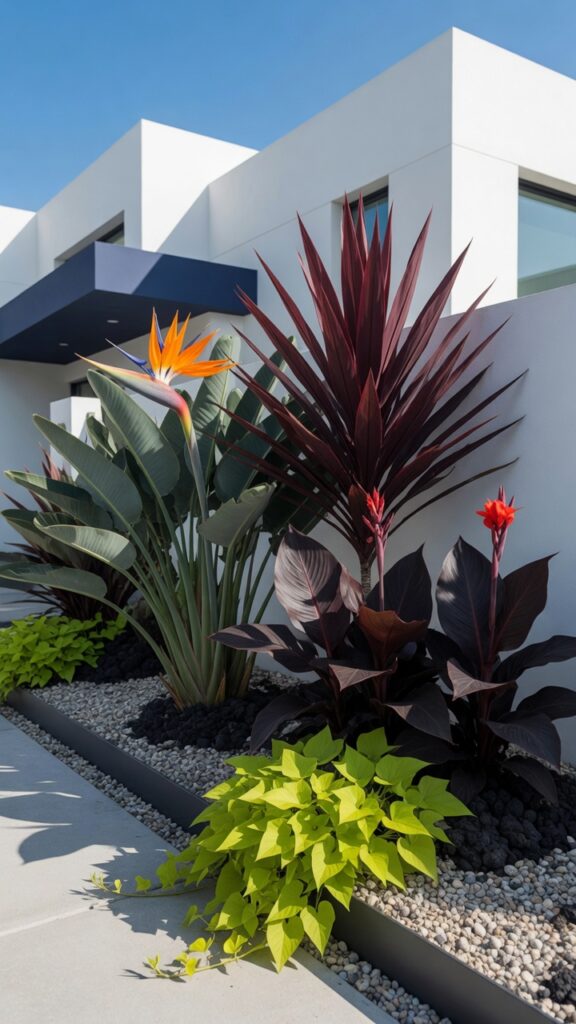
Contemporary architecture and tropical planting are natural partners — both share a love of bold form, strong silhouette, and visual confidence. A tropical-inspired front bed for a modern home differs from a traditional tropical border in its editing: fewer varieties, stronger individual plants, more space between them, and a hard landscaping frame that is as considered as the planting. Choose plants for their architectural form first and their flowering second: bird of paradise for its enormous paddle leaves and orange blooms, Phormium or New Zealand flax for its sword-like upright presence, dark-leafed canna lily for height and drama, and a trailing chartreuse element like sweet potato vine to soften the base. The color palette almost designs itself — deep burgundy, bright orange, near-black, and electric lime green against a white or pale grey rendered home is a combination of extraordinary visual power. This look demands a warm climate to perform at its best year-round, though in cooler zones the dramatic plants can be treated as seasonal performers, replaced each spring.
8. The Japanese-Influenced Zen Bed
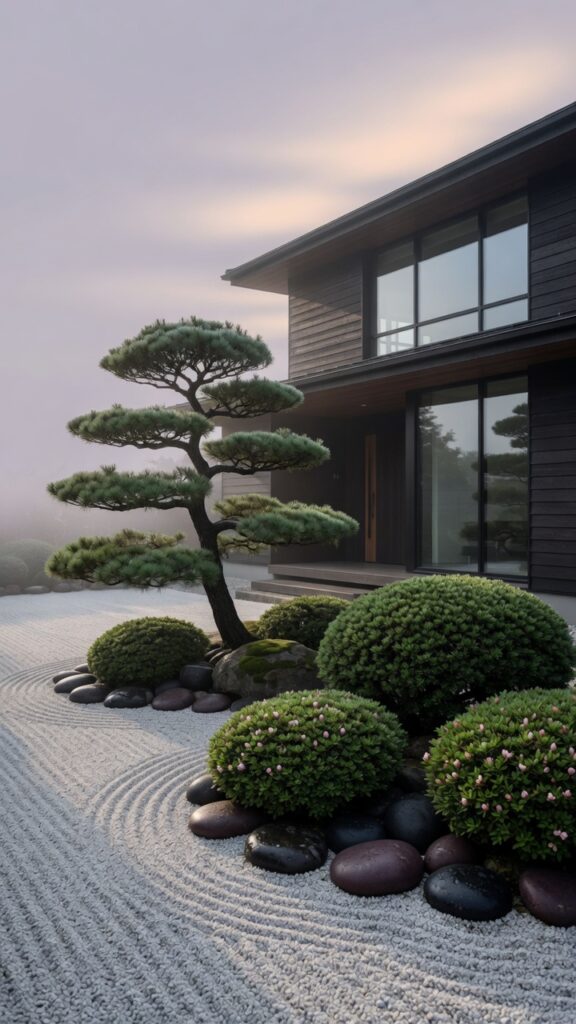
Japanese garden principles translate beautifully into a modern front bed because they share the same fundamental values: restraint, precision, the considered use of negative space, and an appreciation for the beauty of materials as much as plants. A Japanese-influenced front bed doesn’t require a complete Japanese garden — it requires the adoption of a few key principles applied confidently. Fine white or pale grey gravel as the ground plane, raked if you’re committed to the maintenance. One significant plant with strong sculptural presence — a cloud-pruned pine, a carefully shaped azalea mound, or a Japanese maple with beautiful branch structure. Dark smooth river stones placed with intention at the base of the plant. Nothing else. The discipline of this approach is the point. Every element is visible and every element has been chosen deliberately, which creates a quality of attention that visitors register even if they can’t articulate why. One practical note: the raked gravel requires regular maintenance to keep its lines. If that doesn’t appeal, an unraked gravel surface with a few statement stones still achieves the essential quality of the look with much less upkeep.
9. The Pollinator Modern Meadow Bed
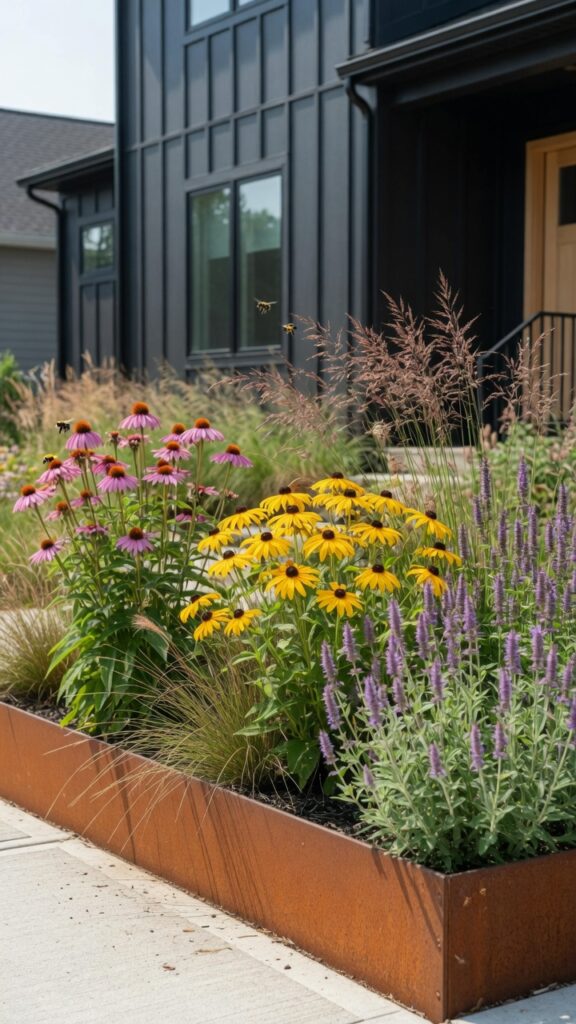
The modern meadow bed is the design that bridges the gap between ecological responsibility and genuine visual sophistication. It looks wild but isn’t — it’s carefully curated to appear natural while being entirely intentional in its plant selection and arrangement. The distinction between a modern meadow bed and an overgrown neglected border is almost entirely down to the hard landscaping frame: a crisp Corten steel or black steel edging that says clearly this was a choice. Inside that frame, plant in naturalistic drifts using a limited palette of prairie-style perennials and grasses — echinacea, rudbeckia, agastache, penstemon, and feather reed grass are a strong foundation. Let them grow to their natural height and form. Let some self-seeding happen. The casual interior and the precise edge work in deliberate tension with each other, and that tension is what gives the modern meadow bed its character. Ecologically this planting supports pollinators, requires no irrigation once established, and almost no maintenance beyond one cut-back in late winter. It is simultaneously the most responsible and one of the most visually compelling choices available for a modern front garden.
10. The Raised Corten Steel Planter Bed
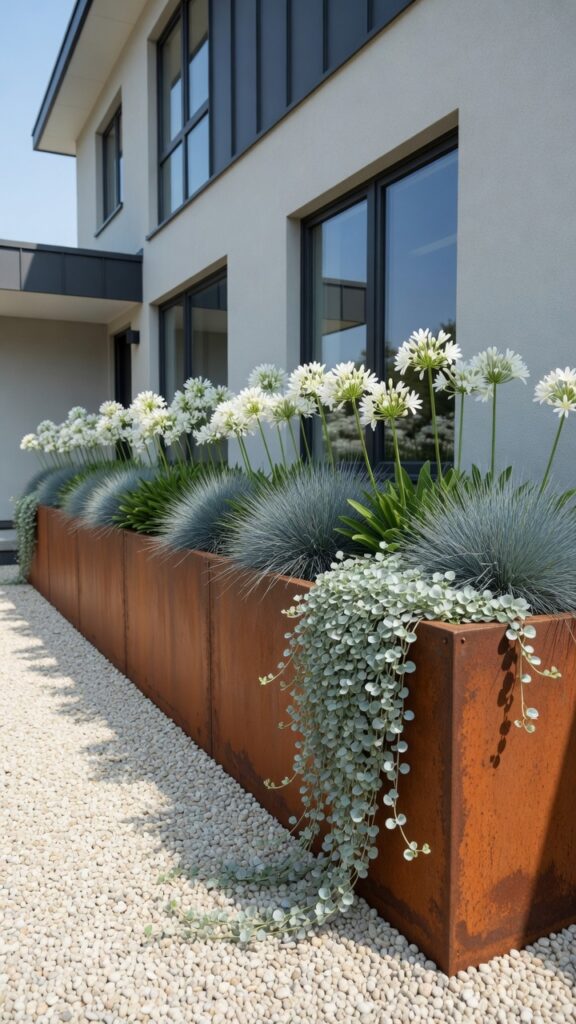
A raised bed in Corten steel is arguably the single most impactful upgrade you can make to a modern front garden. The material itself does enormous visual work — the warm, rich rust patina of weathered Corten steel has a depth and warmth that no painted metal or timber can replicate, and it looks better every single year as the patina develops. At eighteen inches high, a Corten steel raised bed also solves the most common front garden problem: poor soil. You fill it with exactly the growing medium your plants need, which means better performance, healthier plants, and less intervention. Keep the planting inside relatively simple — the bed itself is already making a strong statement and doesn’t need to compete with complex planting. White agapanthus, blue fescue, and trailing silver dichondra is a combination that is simultaneously modern, low-maintenance, and genuinely beautiful. The trailing element softening the hard steel edge is the detail that completes the look. One note on cost: Corten steel fabrication is not cheap, but it is a permanent investment that adds genuine value to the property and never needs painting, treating, or replacing.
11. The Symmetrical Modern Entry Bed
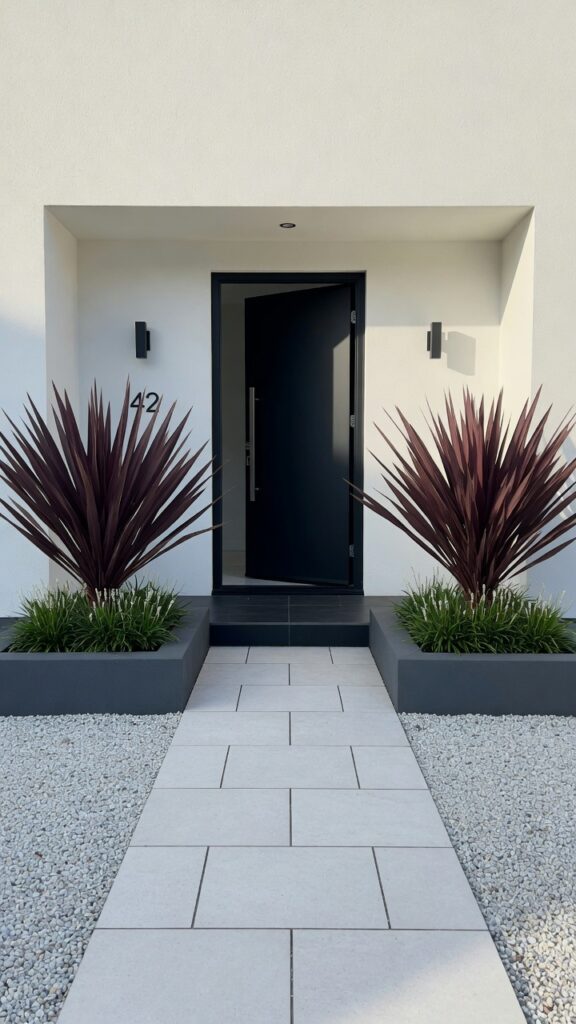
Symmetry at the front entry is a design move that works across every style, but it achieves something particularly powerful in a modern context because of how cleanly it reads from the street. Two identical rectangular beds flanking the front pathway, planted identically, create an entry sequence that feels considered and confident without a single unnecessary element. The modern version of this idea differs from a traditional symmetrical planting in the choice of plant and material: instead of clipped boxwood and brick edging, use a strong architectural plant — Phormium, agave, or a single standard olive — in a rectangular raised bed with clean steel or poured concrete edges. Underplant simply with a single low-growing variety and pale gravel mulch. The bed becomes a frame for the pathway and the front door rather than a garden feature in its own right, which is exactly the right role for an entry planting. Keep the plants identical on both sides without exception — any variation in a symmetrical scheme immediately looks like a mistake rather than a choice.
12. The Night-Lit Architectural Bed
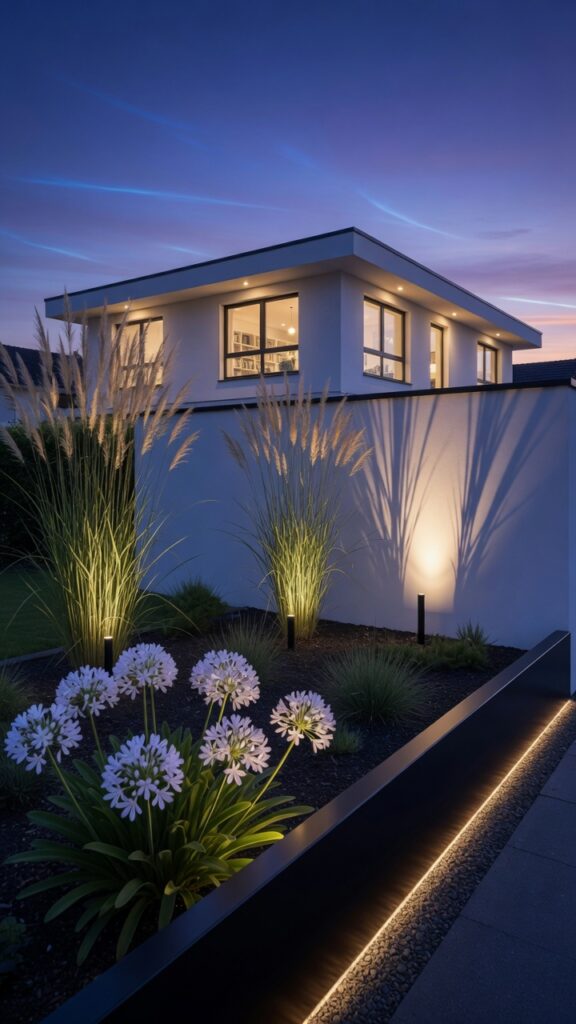
A modern front bed that has been designed for evening viewing is in a completely different category from one that only performs in daylight. Landscape lighting, done well, transforms an already beautiful bed into something genuinely cinematic — and it works every evening of the year, not just during the hours of natural light when most people are out. The lighting approach for a modern bed is directional and intentional: slim spike uplights positioned to throw dramatic shadows of ornamental grasses or architectural plants against a rendered wall, low grazing lights that skim along the steel edging and reveal its precise line, and a warm wash across the planting that makes white flowers glow and silver foliage shimmer. Warm white light only — three thousand Kelvin maximum. Cooler light temperatures make a garden feel institutional rather than considered. The shadow play on the wall behind the plants is often more beautiful than the plants themselves under good uplighting, which is a principle worth internalizing. Budget the lighting into the bed design from the beginning rather than adding it as an afterthought, because the spike positions need to work with the plant spacing rather than against it.
Modern flower beds in front of a house ask something slightly different of you than traditional ones: they ask you to trust the value of less. Every element you remove from a modern bed — every extra plant variety, every competing material, every impulse addition — usually makes it look better rather than worse. The beds in this article are united by that principle. They are confident in their editing, deliberate in their material choices, and honest about the relationship between the hard landscaping and the planting. If you take one idea away from these twelve, let it be this: the frame around your plants matters as much as the plants themselves. A beautiful steel edge, a carefully chosen mulch, a raised bed in a material that ages beautifully — these are the decisions that make a front bed look genuinely modern and genuinely expensive, regardless of what you plant inside them. Start with the frame. The plants will follow.