There’s a particular kind of pride that comes from a front yard that stops people mid-walk. Not because it’s grand or expensive — but because it’s thoughtful. Small front yards get dismissed constantly, treated like awkward transitional zones between the sidewalk and the front door. But here’s the thing: constraints are actually your friend in landscaping. A small yard forces you to edit. To choose. And when every plant and every stone earns its place, the result feels intentional in a way that sprawling estates rarely do. Whether you’re working with a narrow strip of grass, a concrete-heavy entry, or a patchy lawn that’s seen better decades, these twelve ideas are proof that scale has nothing to do with impact. These are real approaches — some budget-friendly, some a weekend project, some worth hiring out — but all of them specific enough to actually be useful.
1. The Layered Planting Bed: Tall, Medium, Low
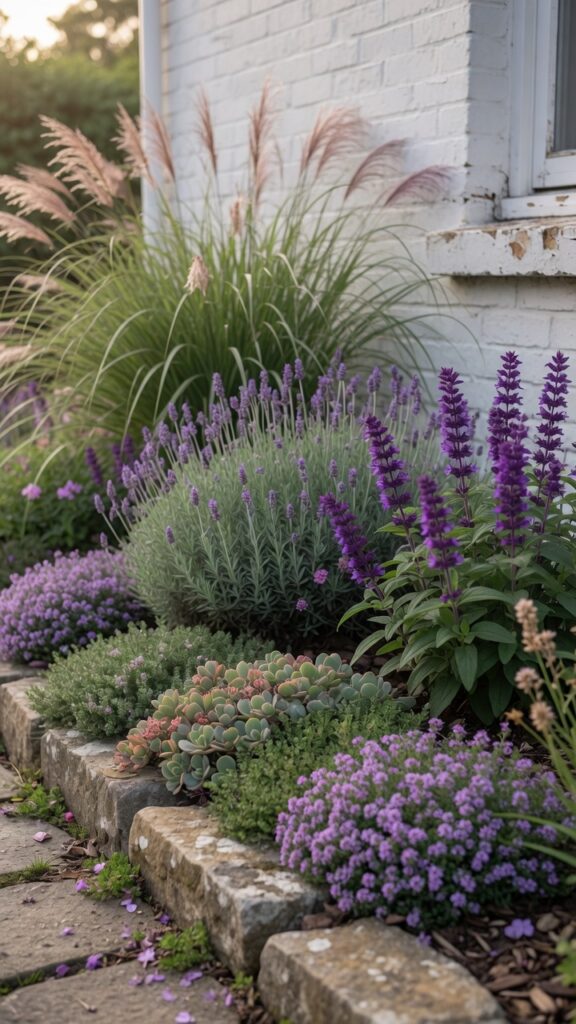
Flat planting beds are the number one missed opportunity in small front yards. If everything grows to the same height, the whole thing reads as background noise. The fix is embarrassingly simple: plant in three distinct height tiers. Tall ornamental grasses or upright shrubs like Karl Foerster feather reed grass anchor the back row against your foundation. Middle-height perennials — lavender, Russian sage, coneflower — carry the eye through. Low ground covers like creeping thyme, sedum, or ajuga finish at the front edge and visually anchor the bed to the ground.
The trick is leaving breathing room between the tiers. Don’t pack them in. Negative space inside the planting bed is just as important as what you plant. One thing to watch: this layered approach requires plants that stay in their lanes. Skip anything that spreads aggressively at the mid-tier level unless you’re committed to annual editing. For north-facing yards with less sun, swap lavender for astilbe and feather reed grass for toad lily. The layered structure holds regardless of what fills it.
2. A Curved Pathway That Earns Its Keep
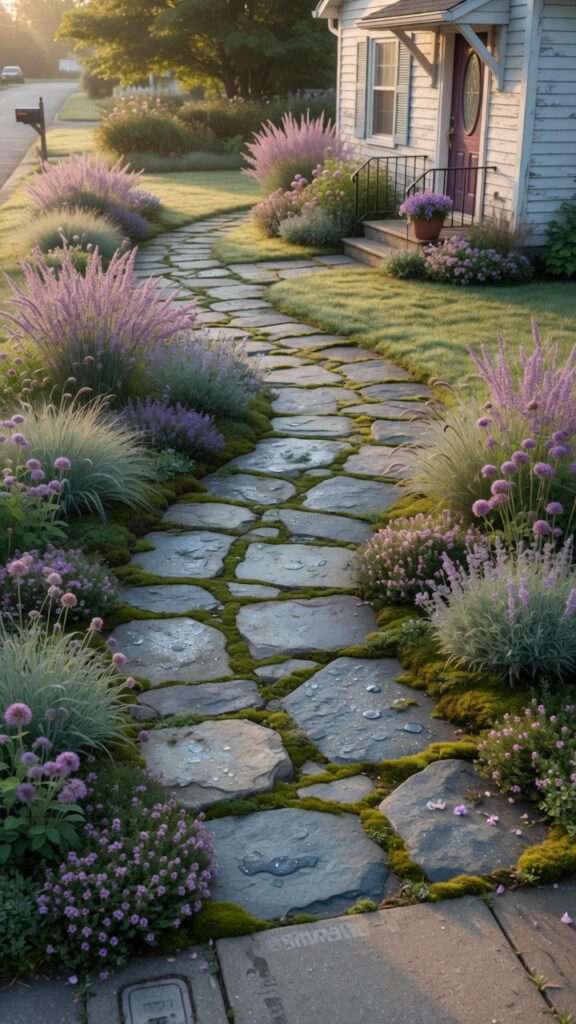
A straight concrete path from sidewalk to door is perfectly functional and almost entirely forgettable. A curved path, on the other hand, does something small yards desperately need: it creates the illusion of distance and depth. Even a gentle S-curve through a fifteen-foot front yard makes the arrival sequence feel considered. Irregular flagstone — bluestone, limestone, or even reclaimed concrete pavers — laid with deliberate gaps for creeping thyme or Irish moss adds texture at ground level that you genuinely cannot get from poured concrete.
The curve doesn’t need to be dramatic. A subtle arc of two or three feet off-center is enough. What matters more is the edging: define both sides of the path clearly with either steel landscape edging, small river rocks, or low plantings like alyssum or ajuga. Without that definition, a curved path just looks like you didn’t dig it straight. That said, this is absolutely a weekend DIY project if you have the patience to dry-lay your stones first. Lay the whole thing out before you commit to mortar. Live with the curve for a day and adjust.
3. A Statement Front Door With Framing Plantings
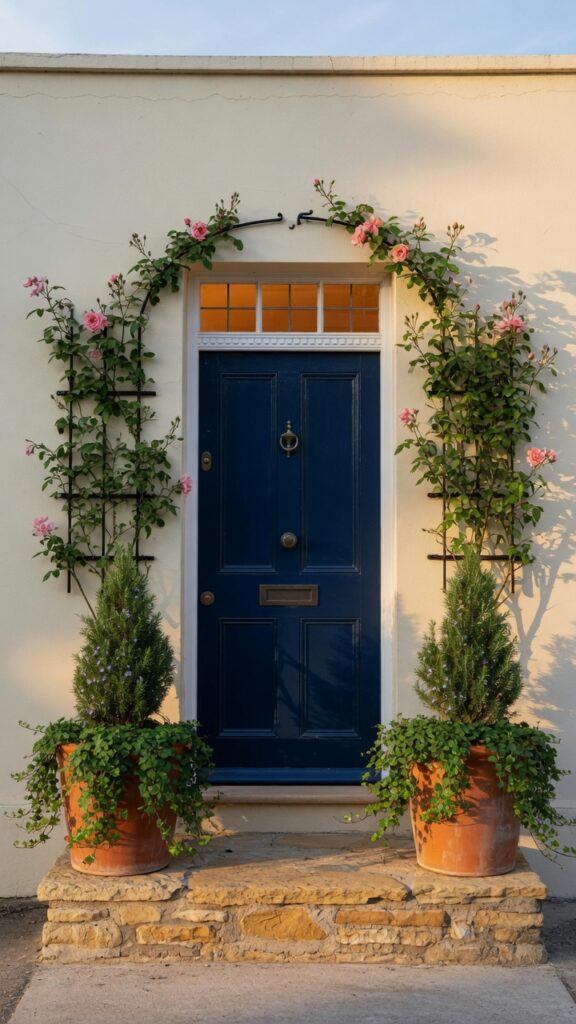
Your front door is the face of the house, and framing it with intentional plantings turns it from a functional entry into a focal point you actually look forward to coming home to. The planting doesn’t need to be elaborate — in fact, simple and symmetrical almost always wins at small scale. Two matching pots flanking the door with consistent planting — a rosemary topiary, a clipped boxwood ball, or a dwarf olive — immediately elevate even the plainest facade.
The door color matters more than most people realize. Deep navy, forest green, burgundy, and matte black all punch above their weight against neutral house colors and make surrounding greenery pop. If you’re renting and can’t repaint, focus entirely on the pots. Go for large-scale containers — at least fourteen inches in diameter — because undersized pots next to a door look apologetic. One constraint worth naming: if your entry gets less than four hours of direct sun, rosemary and olive won’t thrive. Swap to shade-tolerant ferns, heuchera, or cast iron plant, and embrace a lusher, shadier aesthetic.
4. Low Maintenance Gravel and Native Groundcover
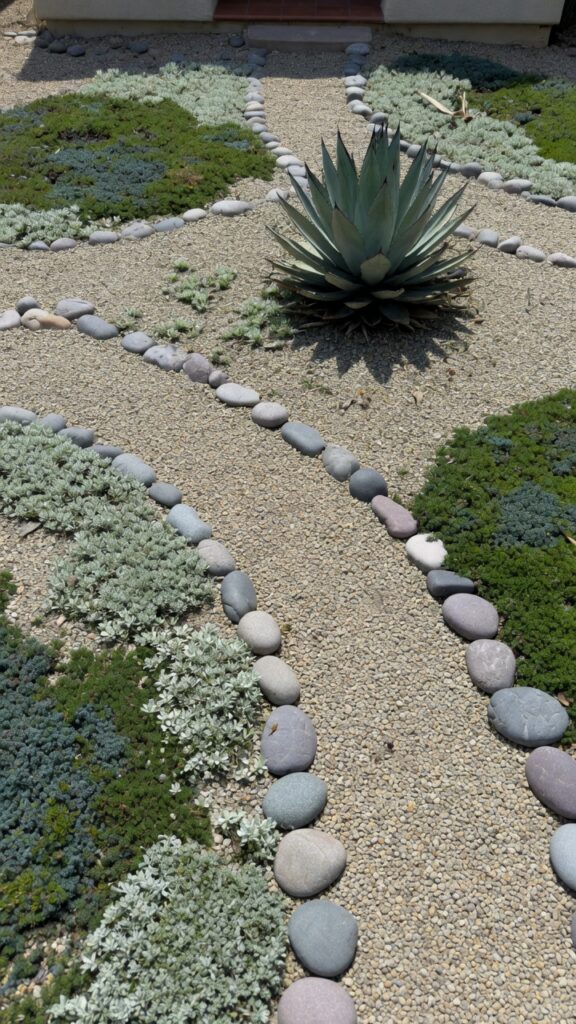
There’s a growing case for killing your front lawn entirely — and gravel-and-groundcover front yards are one of the most compelling arguments for it. Done well, they’re genuinely beautiful, require almost no maintenance once established, and survive drought without drama. The key to keeping this from looking like an abandoned lot is contrast. You need at least two distinct textures: the coarse mineral of decomposed granite or crushed limestone against the softness of prostrate rosemary, wooly thyme, or native buffalo grass plugs.
One focal point plant is essential — a sculptural agave, a dwarf Japanese maple, or a single ornamental grass clump in a strategic position. Without it, gravel yards read as flat and lazy rather than intentional. Keep the edging crisp; this is non-negotiable. Loose gravel that bleeds into the lawn or sidewalk undoes the whole clean look. Steel edging installed just below grade is worth every penny here. Skip this design if you live somewhere with heavy leaf-fall — leaves in gravel are miserable to clean up.
5. Vertical Interest: Trellises, Climbers, and Trained Shrubs
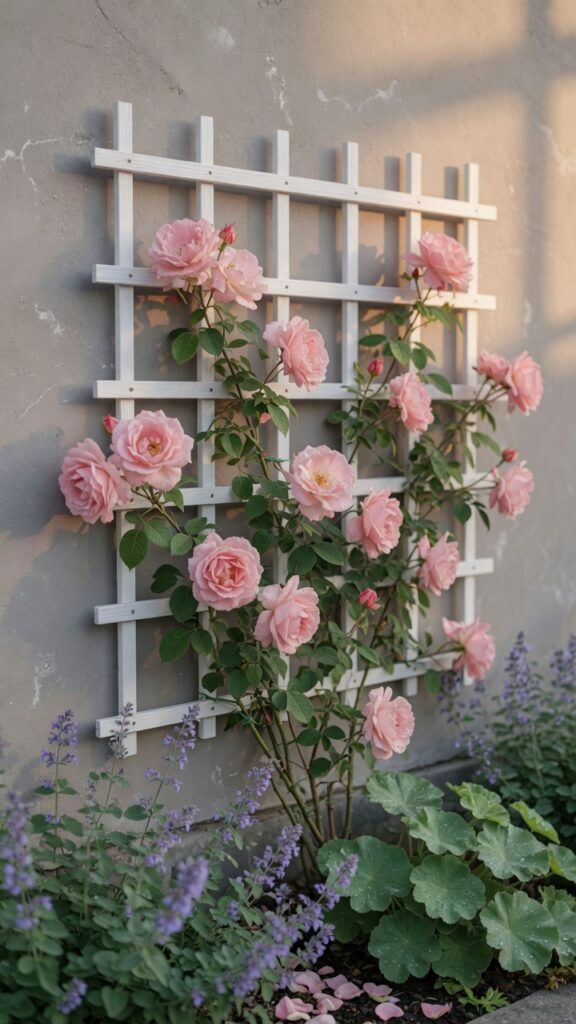
Small yards have one underused dimension: the vertical plane. When floor space is limited, growing up — not out — is how you add drama and abundance without consuming precious square footage. A flat trellis mounted against your house facade and planted with a climbing rose, clematis, or trained pyracantha creates the impression of a lush, established garden even in a twelve-inch-deep planting bed.
Climbing roses like the blush ‘New Dawn’ or the crimson ‘Don Juan’ are classic for a reason — they grow quickly, bloom prolifically, and photograph beautifully. Clematis offers a slightly more refined look, especially the deep purple ‘Jackmanii,’ which pairs perfectly with grey, white, and navy house colors. One thing to watch: trellises mounted directly against painted wood siding trap moisture. Use standoffs to hold the trellis an inch or two off the wall, or opt for a freestanding trellis anchored in the planting bed. That small gap dramatically extends the life of both your trellis and your paint.
6. The Defined Lawn Panel: Small But Immaculate
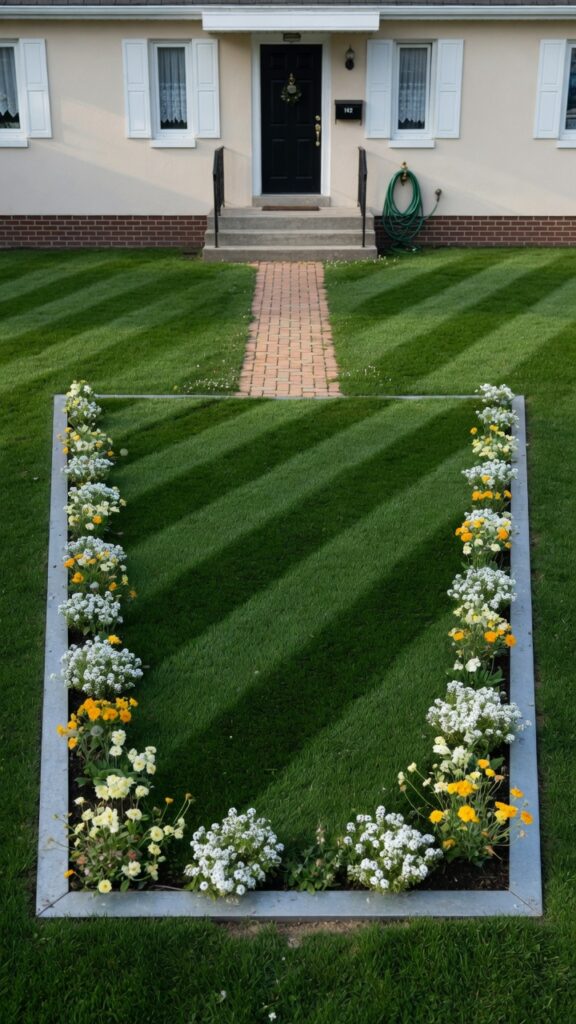
Sometimes the most striking thing you can do with a small lawn is simply make it look immaculate. Not expand it. Not replace it. Just care for it in a way that turns it into a deliberate design element rather than a default green carpet. A defined lawn panel — even one that’s only eight by fifteen feet — becomes a feature when it’s framed properly. Steel or corten edging creates a clean boundary that makes grass look intentional. A crisp mow with diagonal striping, even on a small area, adds a formality that reads from the street.
The border planting around the panel is what does the heavy lifting. Keep it low — below twelve inches — so it doesn’t visually shrink the space. White alyssum, dwarf white agapanthus, or a single row of clipped box hedge are all reliable choices that provide structure without competing. One real-life note: this approach requires consistent weekly mowing during the growing season. If that’s not realistic for your schedule, don’t choose a design that depends on lawn precision — choose one of the lower-maintenance ideas on this list instead.
7. The Woodland Edge: Shade-Tolerant Layered Planting
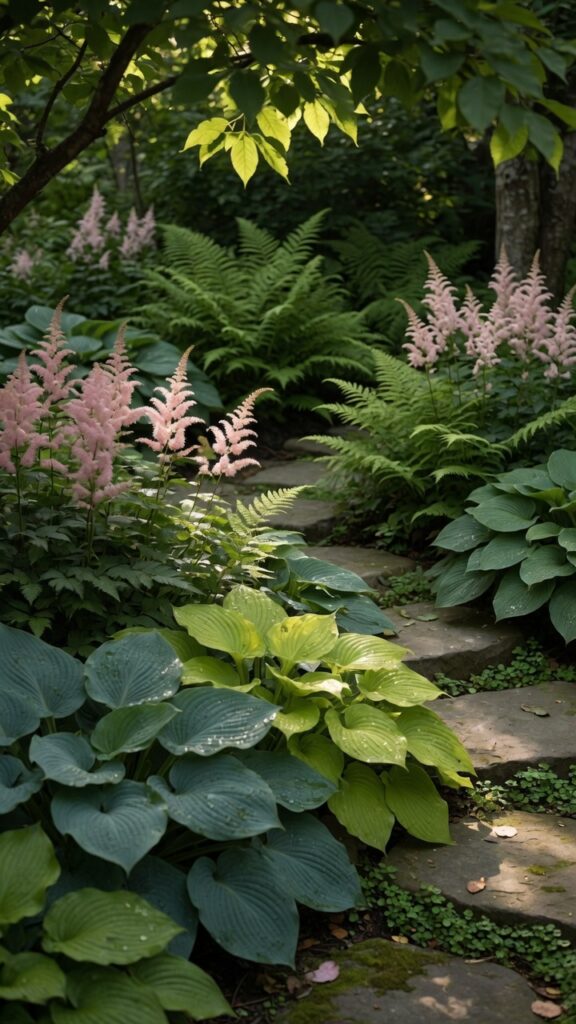
North-facing front yards and those shaded by mature street trees don’t get enough credit. Instead of fighting the lack of sun with struggling sun-lovers, lean into the shade and build a woodland garden that feels genuinely lush and intentional. Hostas are the backbone here — they’re tough, varied, and genuinely beautiful in a way that shade-garden skeptics rarely expect. Pair them with the airy fronds of Japanese painted fern, the upright texture of astilbe in soft pink or white, and the ground-hugging spread of epimedium for a layered tapestry that reads as complex even when it’s low maintenance.
The key to a woodland front garden that doesn’t look unkempt is a strong structural element — a defined edge, a stepping stone path, or a single specimen plant with bold architectural presence. Without structure, shade plantings can start to look overgrown rather than intentional. Add a large river rock or two as natural focal points, and let the moss grow between the stepping stones. In shade gardens, moss is your friend — nurture it rather than remove it.
8. Potted Plant Clusters: The Renter’s Front Yard Overhaul
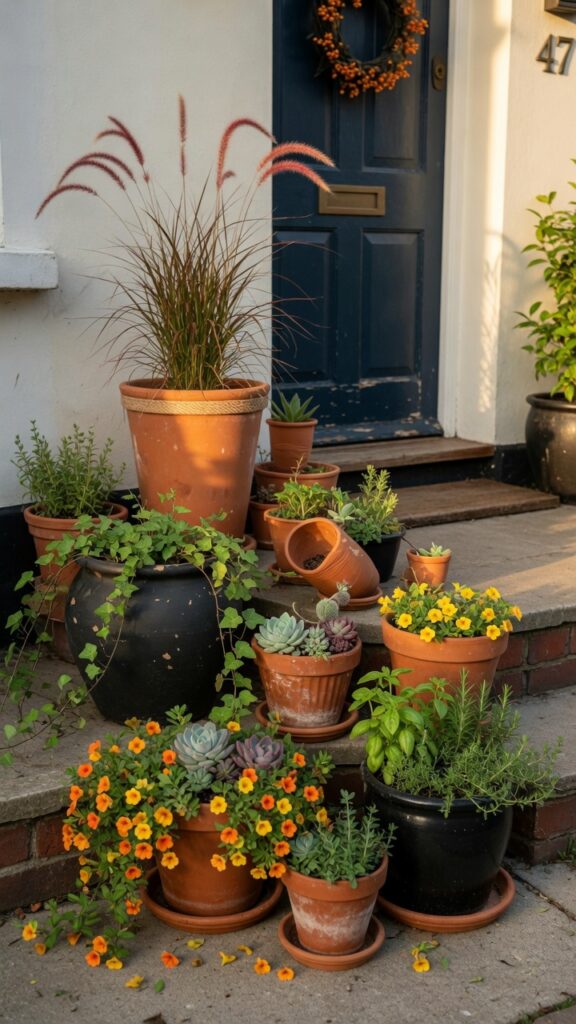
If you rent your home, or if you’re genuinely not ready to commit to in-ground planting, a well-curated cluster of containers can do everything a planted bed can do — with the bonus of being completely rearrangeable. The secret is scale and grouping. Single pots placed at random look lonely. But five to seven pots grouped in an asymmetric cluster, ranging from tall and narrow to wide and low, create the visual weight of a proper planting bed.
Mix your materials deliberately. Terracotta and matte ceramic work together. Terracotta and shiny glazed pottery usually don’t. Heights matter as much as plant selection — use actual risers or upturned pots to create elevation within the group. For plant content, think in layers even within the container cluster: something tall and upright at the back (ornamental grass, standard rosemary), something lush and rounded in the middle (flowering annuals, compact perennials), and something trailing at the edges (ivy, bacopa, calibrachoa). Swap out the seasonal annuals twice a year while leaving the structural pots in place.
9. Corten Steel or Timber Raised Beds Along the Facade
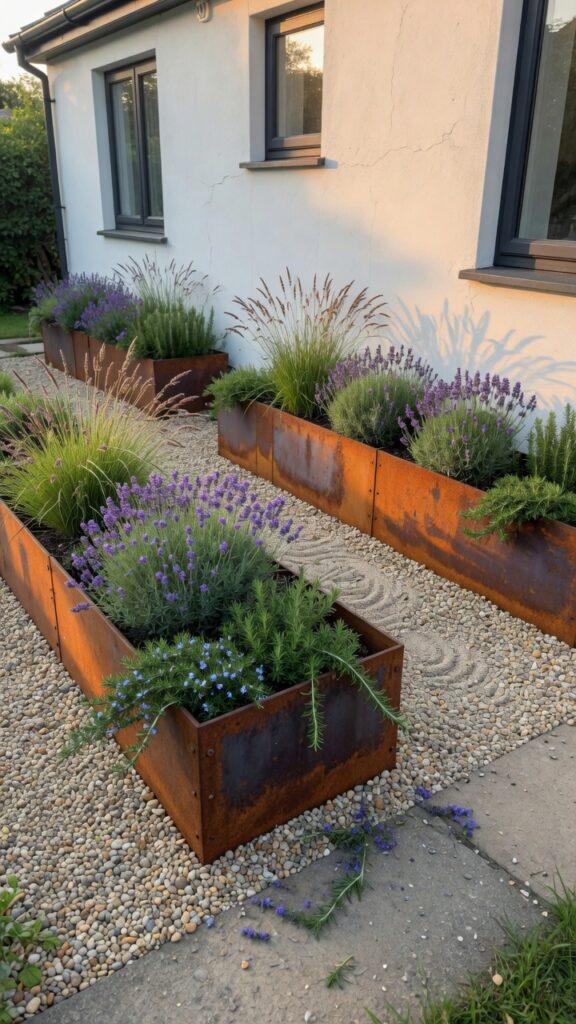
Raised beds along a house facade bring a level of architectural structure to front yard planting that in-ground beds simply can’t match. Corten steel — that warm, rust-orange weathering steel — is currently the most popular material for residential raised beds, and it earns its reputation. The color sits beautifully against both white render and dark brick, and the patina deepens over time rather than looking worse. Timber sleepers offer a softer, more organic alternative if the industrial edge of corten feels too stark for your house style.
Keep the beds low — a single course of twelve to fourteen inches is enough to provide definition without blocking light from windows or making the facade feel boxed in. Fill them with well-draining mix, not garden soil, and choose plants that work at the scale: compact lavender, upright rosemary, salvia, or native grasses rather than anything that gets large or floppy. One practical note: corten steel can bleed rust-colored staining onto concrete or pavers if placed directly on them. Install on a rubber or plastic base layer, or position on gravel, to prevent staining your path.
10. The Flowering Hedge: Privacy and Beauty at Once
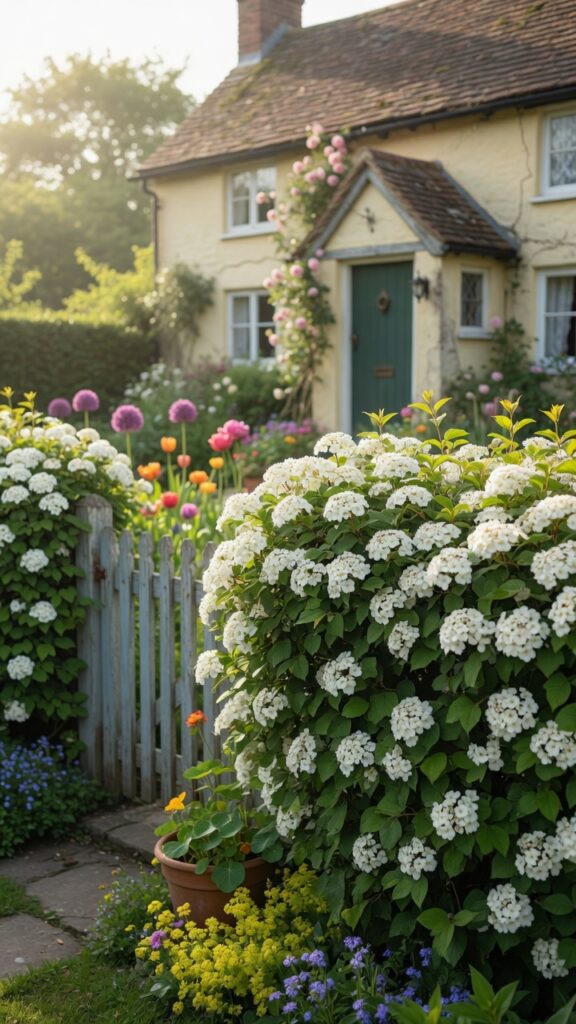
A flowering hedge along the front boundary is one of those solutions that solves three problems simultaneously: it defines your property line clearly, it provides a layer of soft privacy without the closed-off feeling of a fence, and it gives you seasonal bloom interest that’s visible from both inside and outside the home. Viburnum is an underused favourite — the white spring blooms are genuinely stunning, the structure is tidy, and it tolerates a range of conditions. For a softer, more romantic look, a clipped lavender hedge along the front path works beautifully in full sun, smells extraordinary, and attracts pollinators from spring through late summer.
The critical decision is whether you want a formal clipped hedge or an informal flowering one. Formal hedges — box, yew, lonicera — require trimming two or three times a season. Informal flowering hedges — viburnum, lavender, abelia — need less shaping but more patience as they establish. For a small house, keep the hedge height in proportion: below three feet along pathways to maintain openness, up to four feet along a boundary fence line for privacy without walling in.
11. Lighting That Does More Than Just Illuminate
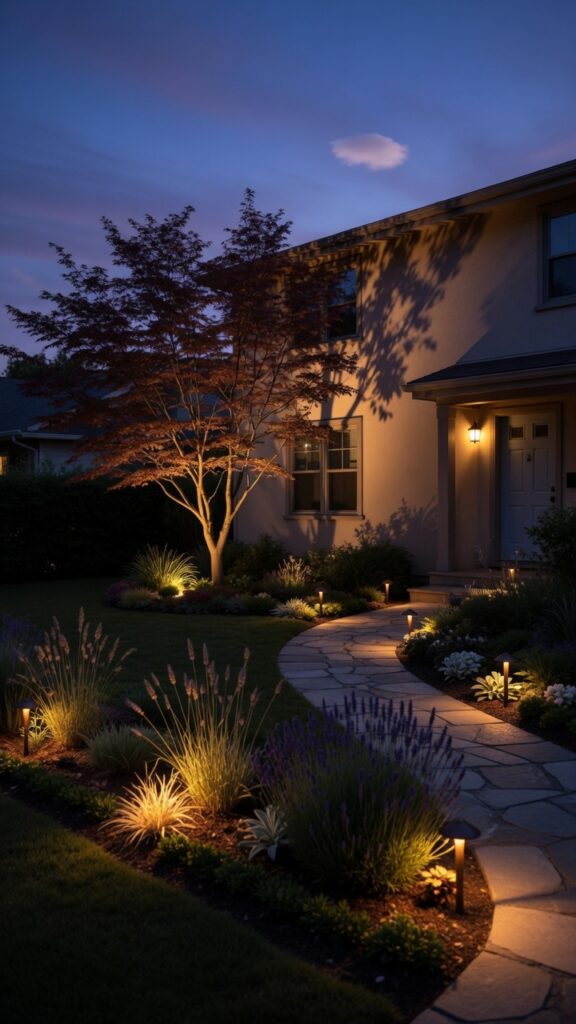
Landscape lighting is almost always an afterthought in small front yards, and that’s a shame, because it’s one of the highest-impact changes you can make for the cost. The right lighting transforms a front yard after dark into something genuinely cinematic — and the front of your house is the face it shows the neighbourhood every single evening. The mistake most people make is over-lighting. A row of identical path lights marching in formation on both sides of the path reads as an airport runway, not a garden.
Instead, layer three types of light: uplighting on a single specimen plant or small tree for drama, low path lighting for safety and definition, and ambient wash lighting across a planting bed or the facade itself. Warm white LEDs (2700K-3000K) are the only choice — cool white LEDs make a garden look clinical and drain all warmth from the plant colours. Solar is fine for path markers, but for uplighting you want a wired system with a proper transformer. One small investment that pays for itself: a dusk-to-dawn timer on a wired system. You will actually use the lighting every evening rather than remembering to switch it on.
12. The Seasonal Rotation Plan: Four Seasons of Interest
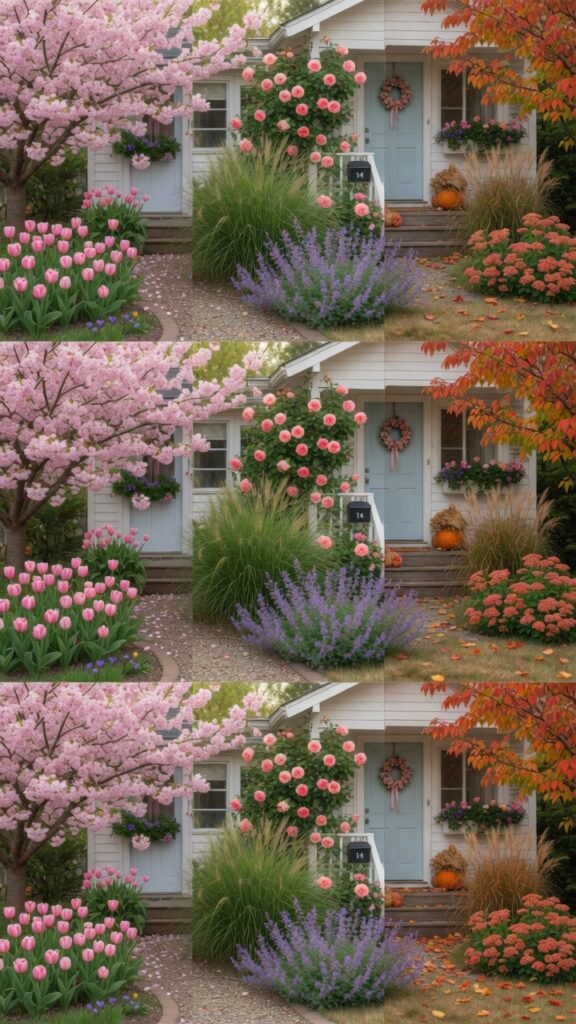
Most small front yards are designed for a single season — usually spring or summer — and look either bare or tired for the remaining months. A genuinely well-designed front garden has something to offer in every season, and achieving that is mostly a matter of planning rather than expense. Spring: tulips and alliums planted in autumn, early flowering shrubs like forsythia or viburnum. Summer: the main event — roses, lavender, ornamental grasses, perennial salvia. Autumn: sedum flowers turning deep copper, ornamental grass plumes at their best, the foliage of deciduous shrubs going gold and crimson. Winter: structural evergreens, the skeletal beauty of deciduous shrubs, and berrying plants like holly or callicarpa.
The underused layer in this four-season plan is winter structure. This is where evergreen architectural plants earn their keep — a clipped box ball, a dwarf yew cone, or a sculptural phormium holds the garden together visually when everything else dies back. One practical rule: plant at least thirty percent of your front yard with evergreen content. That thirty percent is what ensures your garden looks designed rather than dormant during the months when you and your neighbours are most likely looking out the window at it.
Small front yards reward the people who respect them. The temptation is always to do too much — to fill every inch, to plant every colour, to add every feature. The yards that genuinely stop people in their tracks are almost always edited rather than abundant. They’ve committed to a clear idea and executed it with care.
What you’ve read here isn’t a catalogue of trends. It’s a collection of approaches that work at a small scale precisely because they understand the constraints of working with limited space. Every section here has been chosen because it solves a real problem — shade, low maintenance, rental restrictions, poor soil, lack of privacy — while making the front of your home more beautiful in the process.
Come back to whichever section matched your actual yard conditions most closely. Try one idea well before adding a second. And remember: a front yard that’s consistently cared for — even a simple one — will always outshine an ambitious design that’s been neglected. The goal isn’t a magazine cover. The goal is a home that looks genuinely, quietly proud of itself every single day.