Small front yards have a reputation they don’t deserve. The assumption is that less space means less impact — that you need a sweeping lawn and a long winding driveway to make a real impression from the street. That’s simply not true, and some of the most beautiful, most talked-about front yards in any neighborhood are compact ones that have been designed with actual intention. The difference between a small front yard that looks cramped and apologetic and one that looks deliberately curated comes down to a handful of decisions: how you handle the edges, what you plant and where, whether you lean into the scale rather than fight it, and whether every element you add is earning its place visually. These twelve ideas work specifically because they respect the constraints of a small space rather than ignoring them. Each one is achievable on a realistic budget, and every single one of them punches well above its square footage.
1. The Curved Stone Pathway That Changes Everything
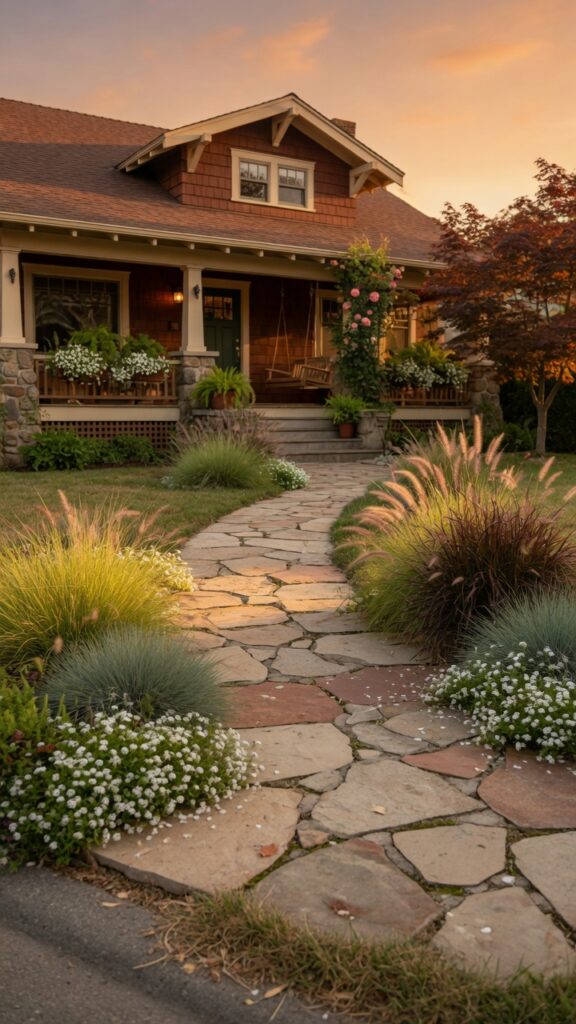
The fastest way to make a small front yard look designed rather than default is to replace or reframe the straight concrete path. Straight paths are utilitarian — they get you from A to B and communicate nothing. A gently curving flagstone or paver path does something entirely different: it slows the eye down, creates a sense of journey, and makes the yard feel larger than it actually is because the brain perceives a curve as covering more distance than a straight line. You don’t need to rip up existing concrete to achieve this effect. Lay a new curved path in natural flagstone or irregular stepping stones directly over or alongside the existing one, then plant low and soft on both sides — white alyssum, creeping thyme, or dwarf mondo grass. The planting that brushes the path edges is what completes the look. One constraint: avoid overly tight curves in very small yards, as they can feel fussy. A single gentle arc is always more elegant than an S-bend trying to fill a ten-foot space.
2. The Foundation Bed With Real Depth
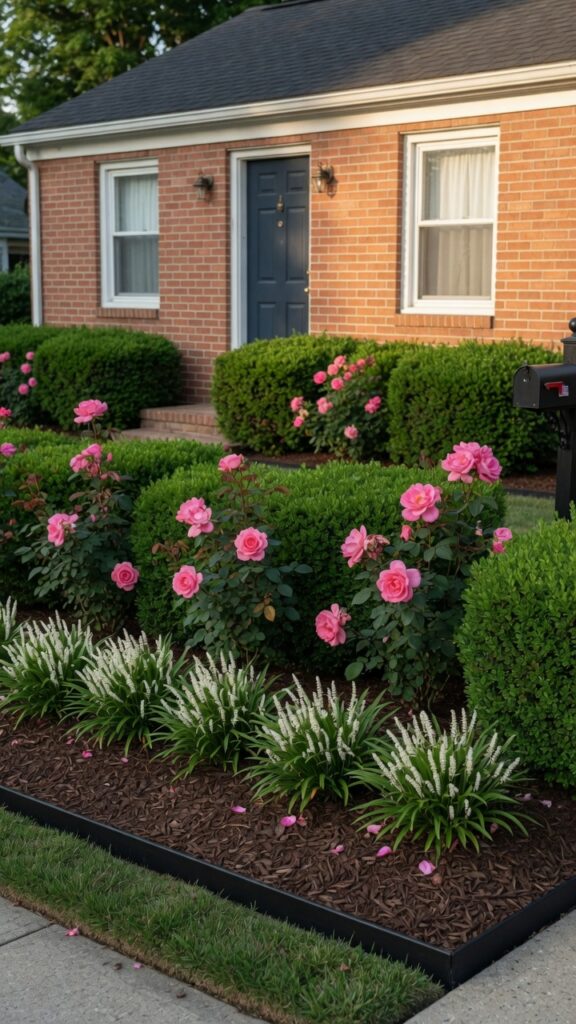
Most foundation beds fail because they’re too shallow. A single row of plants pressed against the house looks like an afterthought rather than a design decision — and in a small yard, that reads even more clearly from the street. The fix is depth: push your bed out at least three to four feet from the foundation wall, ideally more if your space allows. With genuine depth, you can layer properly — something taller and structural at the back against the house wall, a mid-height blooming plant in the middle, and something low and spreading at the front edge. That layering is what creates the impression of abundance and intention. Boxwood or clipped holly at the back provides year-round structure, knockout roses or salvia in the middle give seasonal color, and liriope or ajuga at the front softens the edge beautifully. Dark cocoa mulch and a clean black steel edging strip are the finishing details that elevate the whole thing from ordinary to expensive-looking. The steel edge is a small investment with outsized visual return.
3. The Tall Vertical Element That Draws the Eye Up
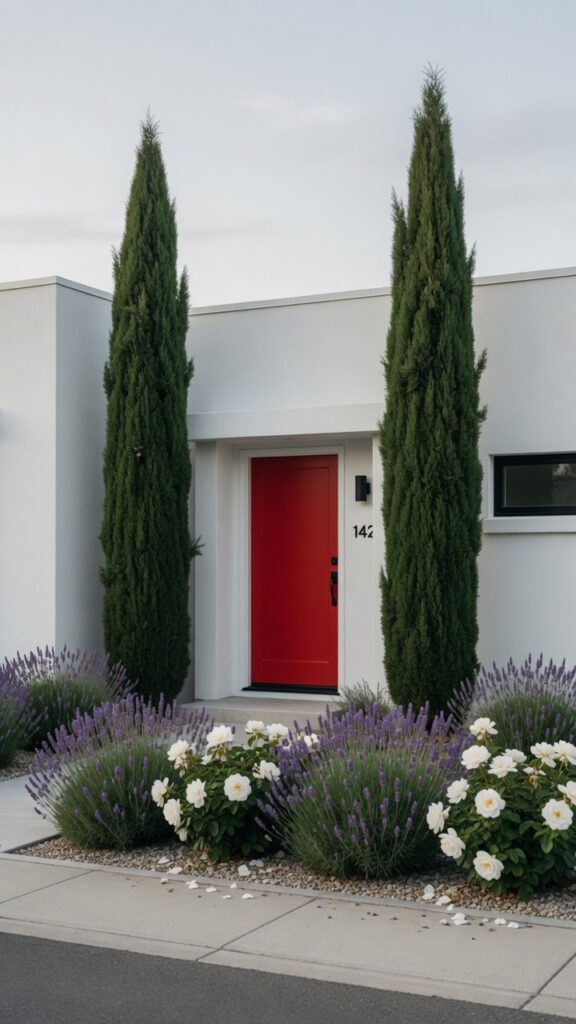
In a small front yard, verticality is your best friend. When the horizontal footprint is limited, drawing the eye upward creates a sense of scale and drama that ground-level planting alone can never achieve. A pair of slim columnar trees — Italian cypress, columnar hornbeam, or Sky Pencil holly — flanking the front door is one of the most classically elegant moves in residential landscaping, and it works on small yards precisely because the plants take up almost no ground space while making an enormous visual statement. The key is choosing a columnar variety, not a standard tree that will eventually spread and overwhelm. Plant one on each side of the entry at the same distance from the door, and underplant simply — lavender, white roses, or clipped boxwood at the base keeps things grounded without competing. This is a long-game plant: columnar evergreens look more impressive every year. If you want the look without the wait, a pair of large topiaries in matching terracotta planters flanking the door achieves the same vertical punctuation instantly.
4. The Gravel and Planting Combo That Replaces Lawn
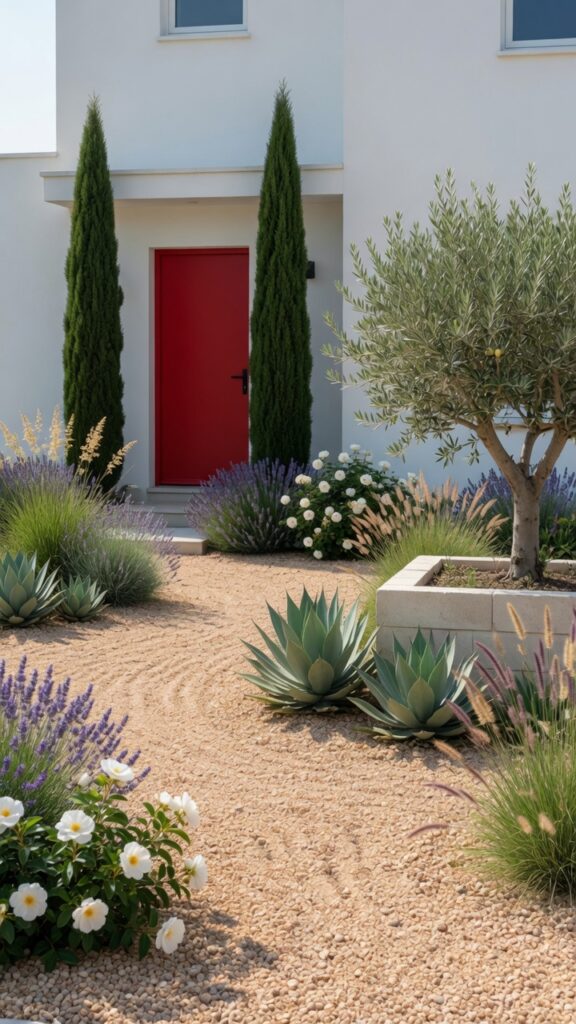
Lawns in small front yards are often more trouble than they’re worth. A postage-stamp grass strip requires mowing, edging, watering, and fertilizing — and the result is rarely impressive enough to justify the effort. Replacing it with decomposed granite or fine gravel, punctuated by deliberate planting, is a move that looks expensive, requires almost no maintenance, and actually photographs beautifully. The gravel itself needs to be warm-toned — decomposed granite, pea gravel in sandy beige, or crushed limestone — because grey gravel reads cold and industrial against most home exteriors. Into the gravel, place plants with strong architectural presence: ornamental grasses, lavender in generous drifts, a single olive tree, or a statement agave. Space them with confidence — the gravel between the plants is not empty space, it’s negative space, and negative space is a design tool. One practical note: lay a quality weed membrane beneath the gravel before you pour, otherwise you’ll be hand-weeding constantly and the look will deteriorate fast.
5. The Potted Entry That Works Like a Flower Bed
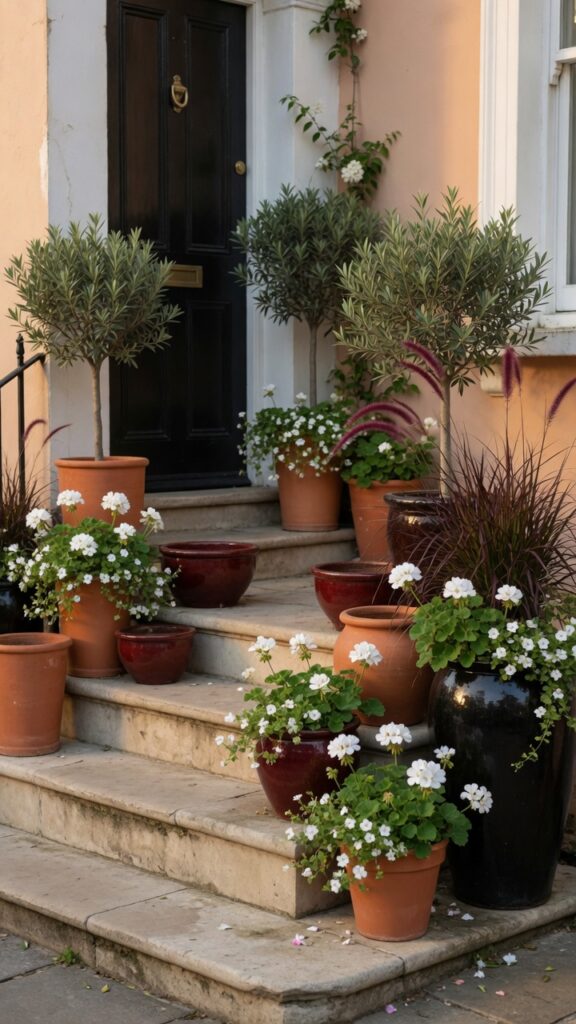
If your front yard is so small that a traditional flower bed isn’t realistic — or if you’re renting and can’t break ground — a considered arrangement of large containers achieves the same visual effect and offers complete flexibility. The rule with potted entries is scale: the pots must be larger than your instinct tells you. Most people buy pots that are too small, and the result looks timid against the architecture of a house. Go for pots that feel almost too big in the shop. Group them in odd numbers — three or five — and vary the heights deliberately. One tall standard plant like an olive or standard rose anchors the group, a mid-height thriller plant like purple fountain grass adds drama, and a trailing plant like white bacopa or silver dichondra spills over the edge to soften. Terracotta and dark glazed ceramic are the two finishes that look most expensive against stone steps. Avoid plastic, even the expensive-looking kind — it never quite convinces up close.
6. The Edged Lawn With Planting Strip Border
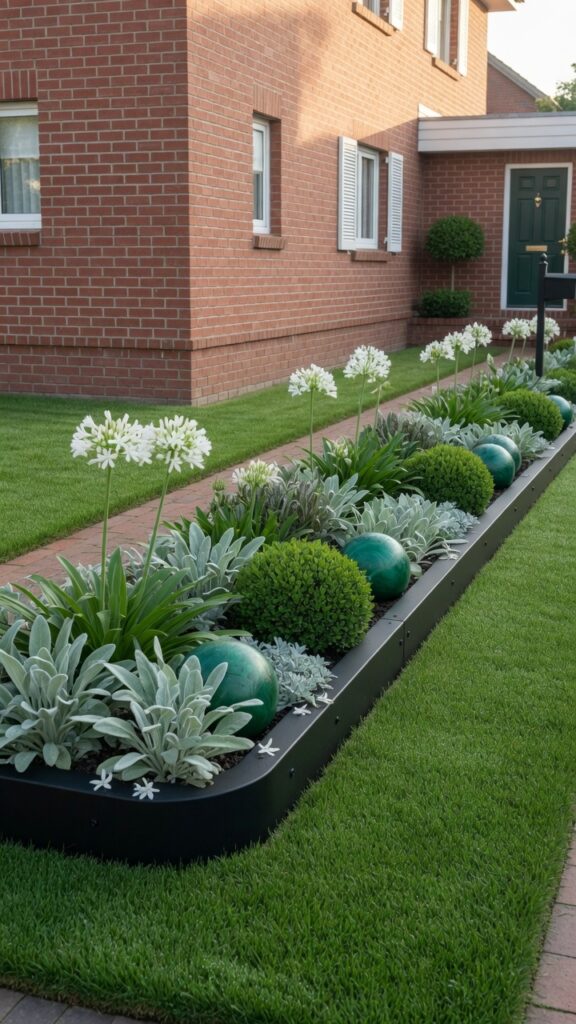
Sometimes the highest-impact thing you can do with a small front lawn is simply frame it properly. A lawn that is sharply edged and surrounded by a generous planting border looks deliberate and well-tended in a way that the same lawn without edging never does. The edging material matters enormously here — black powder-coated steel edging is the choice that will make the whole yard look expensive because it creates a clean, precise line between lawn and bed that holds its shape year-round without maintenance. The border itself can be relatively simple: a combination of clipped buxus balls for structure, one flowering perennial like agapanthus or salvia for seasonal color, and a silver or grey-foliage plant like stachys or artemisia to tie it together. This approach works on the smallest of front yards because it respects the existing lawn rather than removing it, and the visual upgrade comes almost entirely from the quality of the edging and the intentionality of the planting frame around it.
7. The Statement Tree as Focal Point
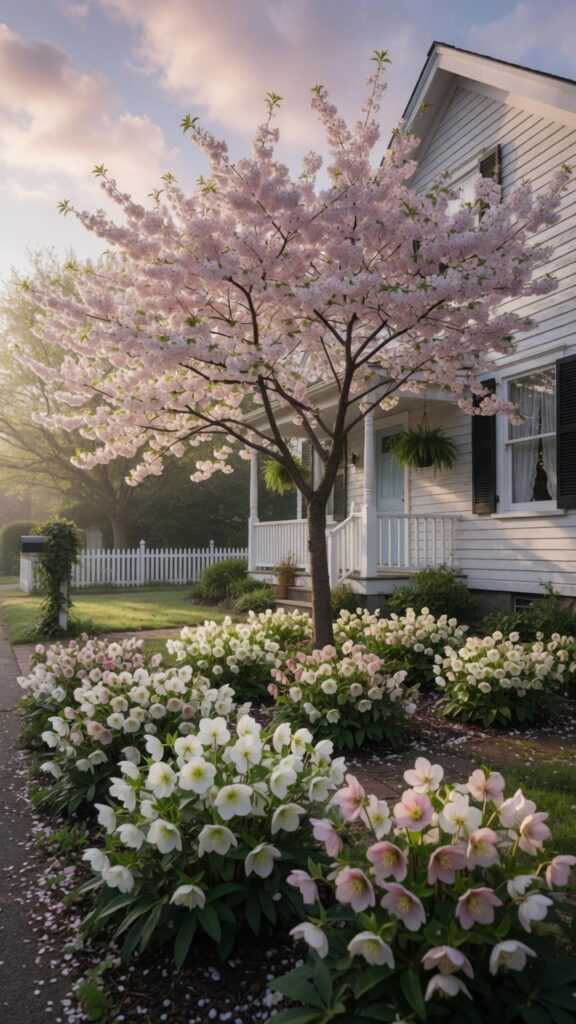
One well-chosen tree will do more for a small front yard than a dozen mismatched shrubs. The instinct in a small space is to avoid trees entirely — they’ll take over, they’ll block light, they’ll make things feel cramped. But the right tree, chosen for its scale and seasonal interest, becomes the organizing principle around which everything else makes sense. Ornamental cherries are the classic choice for good reason: they deliver spectacular spring blossom, decent summer foliage, good autumn color, and attractive winter branch structure. In a small yard, choose a weeping or vase-shaped variety rather than a spreading one to keep the canopy well above the planting below. Underplant with shade-tolerant ground-level plants — hellebores, ajuga, or white cyclamen — to complete the picture. The design principle here is editing: once you have the tree and its underplanting, resist the urge to add more. The confidence of a single focal point surrounded by clean, simple underplanting is exactly what makes a small yard look considered and expensive.
8. The Layered Shade Garden Under the Porch
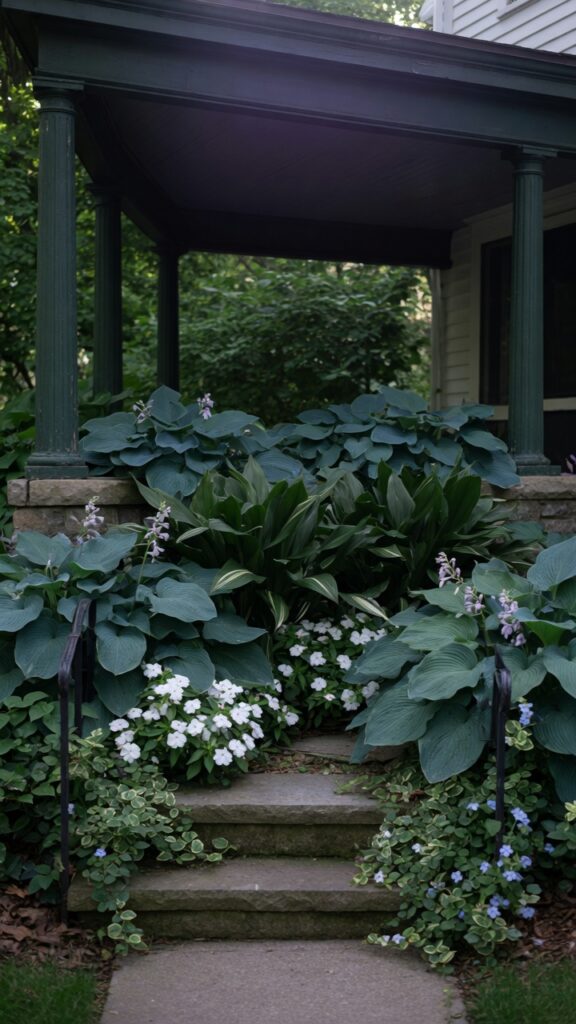
Shaded front porches present a genuine planting challenge — but solve it well and you have one of the most atmospheric small front gardens possible. The key shift is accepting that this is a foliage garden rather than a flowering one, and designing accordingly. Hostas are the essential backbone: choose at least three different varieties in varying sizes and tones — a large blue-green variety at the back, a mid-sized gold or chartreuse in the middle, a compact white-edged one at the front. Then layer in plants that offer textural contrast: the glossy, architectural leaves of cast iron plant, the fine texture of mondo grass, the soft trailing habit of vinca minor. White impatiens are the one flowering plant that performs reliably in deep shade and they provide the luminosity that keeps the composition from feeling gloomy. Dark mulch — almost black — makes the green foliage pop dramatically. This type of planting looks even more beautiful in summer heat when sun-baked neighbors are watching their front beds struggle.
9. The Monochromatic White and Green Scheme
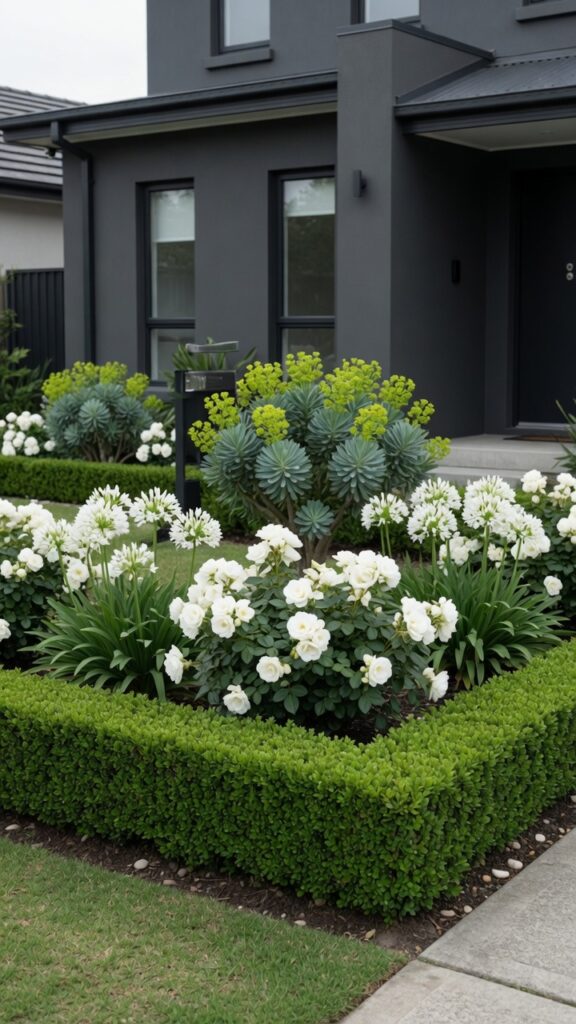
Color restraint is one of the most powerful tools in small garden design, and a white and green palette is the most sophisticated expression of that restraint. Against almost any home exterior — dark grey, warm brick, white render, navy clapboard — a planting scheme of purely white flowers and varied green foliage reads as intentional, refined, and quietly expensive. The trick is variation within the restriction: different shades of green from chartreuse to deep forest, different textures from fine grass to broad hosta leaf, different flower forms from the flat plate of white agapanthus to the cupped petals of iceberg roses. The white flowers unify everything while the foliage variation keeps it interesting. This palette also photographs extraordinarily well and looks beautiful at every time of day — it glows in the evening, sparkles in morning dew, and holds its composure in the flat midday light that makes colorful gardens look garish. If your instinct is always to add more color, try the opposite just once.
10. The Reclaimed Brick Border With Cottage Planting
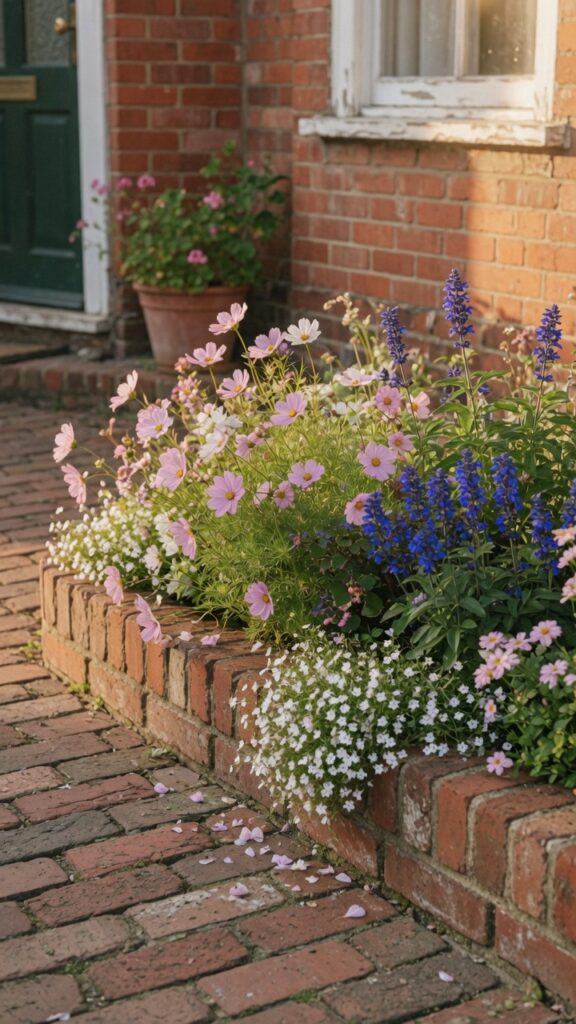
The edging material you choose for a front bed communicates something before anyone even looks at the plants. Reclaimed brick set on its end at a slight angle — the classic soldiers-course edging — gives a small front bed instant heritage, warmth, and the kind of handmade quality that modern plastic or concrete edging can never imitate. It suits cottage-style plantings perfectly because the slight irregularity of reclaimed brick mirrors the glorious imperfection of cottage flowers. Inside the border, plant generously and with a loose hand: cosmos, salvia, lobelia, sweet William, and penstemon in soft pinks, blues, and whites. Let things self-seed and sprawl slightly over the brick edge — the contrast between the structured brick surround and the overflowing planting is the whole point. This edging approach is also remarkably affordable if you source reclaimed bricks from a salvage yard or demolition site. A small front bed edged in reclaimed brick and filled with cottage flowers will genuinely stop people on the pavement.
11. The Layered Evergreen Structure Bed
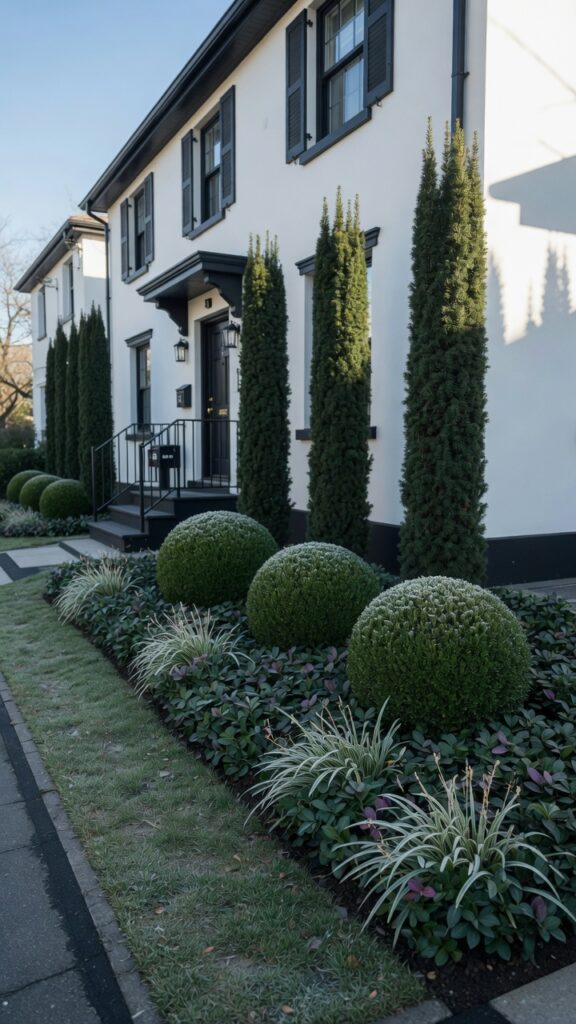
Seasonal color is wonderful, but a front garden that only looks good in summer is a front garden that looks bad for eight months of the year. An evergreen structure bed solves this problem completely. The framework is simple: one or two clipped forms — buxus globes or pyramids, columnar yews, or clipped pittosporum — anchored at key points within the bed, then filled around with low evergreen ground cover like vinca, liriope, or pachysandra. The result is a bed that looks polished and intentional in January, February, and March when everything around it is bare and brown. In a small front yard, this structural approach also has a practical advantage: evergreen plants grow slowly and maintain their proportions, so you’re not constantly cutting back or replacing overgrown plants. Add seasonal color if you want — a few tulip bulbs in spring, a potted standard rose in summer — but the evergreen bones mean the bed always has something to say. Structure first, decoration second.
12. The Lighting-Enhanced Evening Bed
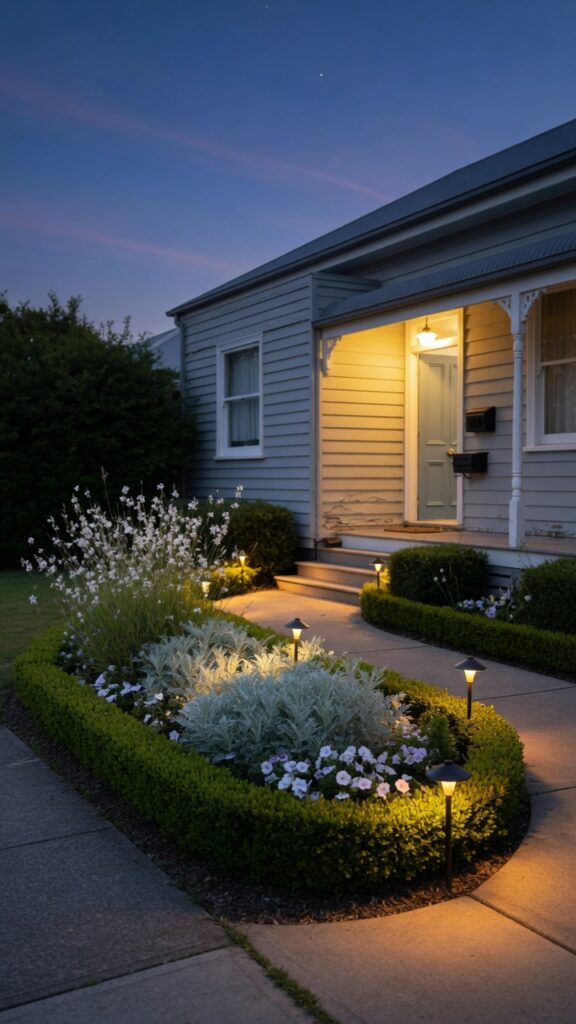
Most front yards are designed entirely for daytime viewing, which means they offer nothing after five o’clock — exactly when most people come home and when guests arrive. Adding low-voltage landscape lighting to even the simplest front bed transforms it into something that looks genuinely curated and expensive, particularly in the months when darkness falls early. The lighting approach that works best for small front yards is subtle and directional: spike spotlights aimed up into a statement plant or small tree, path lights that graze along an edging line, and a warm wash across the facade from a low-mounted wall light. Warm white bulbs only — anything cool or blue-toned makes a garden look clinical rather than welcoming. The plants that respond best to uplighting are those with interesting structure or translucency: ornamental grasses catch the light and glow, white flowers become luminous, and the branch structure of a small ornamental tree becomes genuinely sculptural. Lighting a front garden costs less than one new plant grouping and works every single evening of the year.
There’s a version of your front yard that makes people slow their cars down — and it doesn’t require a large plot, a large budget, or a landscaping degree. What it requires is the willingness to make deliberate decisions: to edge something cleanly, to choose a palette and stick to it, to pick one focal point and let it breathe, to light the space so it works at seven in the evening as well as seven in the morning. Small front yards reward intentionality more than any other garden space because every element is visible, every choice is legible from the street, and nothing hides behind scale. Take one idea from this list — just one — and execute it properly before adding anything else. That discipline, more than any specific plant or material, is what makes a small front yard look genuinely expensive.