Sweeping wide-angle shot of a charming American suburban front yard in golden late-afternoon light. A curved flagstone pathway winds through a lush mix of lavender, white alyssum, and coral coneflowers, flanked by smooth river stones and chunky granite boulders. A low stone border frames the garden beds with geometric precision. Mature ornamental grasses sway softly behind the blooms. The home’s facade — warm cream siding, dark shutters — is slightly blurred in the background. Shot with a 24mm lens, shallow depth of field on the flowers closest to camera, cinematic realism, ultra-detailed textures on the stone surfaces, warm dappled light filtering through a nearby oak.
There’s something quietly powerful about a front yard that stops people mid-walk. Not because it’s over-designed or trying too hard, but because it strikes that rare balance — natural but intentional, colorful but grounded. Flowers and stones, as a pairing, are one of the oldest tricks in the landscape design book, and yet most yards either lean too far into the flowers (a chaotic jumble with no structure) or too far into the stones (cold, clinical, almost industrial). The sweet spot is in between, and that’s exactly where these ideas live.
Whether you’re working with a narrow strip of soil between the driveway and the front walk, a sprawling lawn you’re finally ready to replace with something beautiful and low-maintenance, or a tired mulch bed that needs a complete personality transplant — there’s something in this list for you. Some of these ideas are weekend projects. Some need a little more planning. All of them will make your neighbors slow down.
1. River Stone Borders With Lavender Drifts
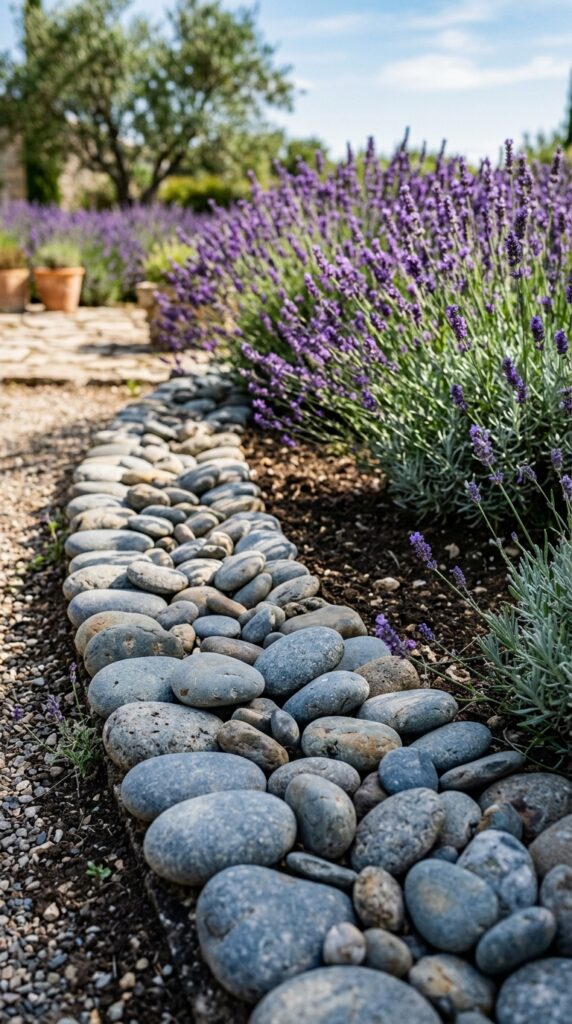
Lavender and river stones were practically made for each other. The cool, chalky grey of rounded river stones sets off those silver-green lavender stems beautifully, and the contrast between the rigid stone border and the soft, waving flower spikes gives the whole bed a kind of effortless sophistication. The practical upside: river stones suppress weeds along the edge, which is usually where they sneak in first.
When laying the stones, resist the urge to line them up perfectly. A slightly irregular edge — stones overlapping a little, varying in size between baseball and grapefruit — reads as deliberate rather than sloppy. Plant lavender in generous drifts of at least five to seven plants; single specimens look lonely and don’t create the visual weight you’re after.
One thing to watch: lavender hates wet feet. If your front yard has clay-heavy soil or poor drainage, amend the beds with grit before planting, or the roots will rot over winter regardless of how beautiful it looks in June.
River stones and lavender is one of those combinations that looks expensive and is genuinely not.
2. Flagstone Path Lined With Creeping Thyme and Pebbles
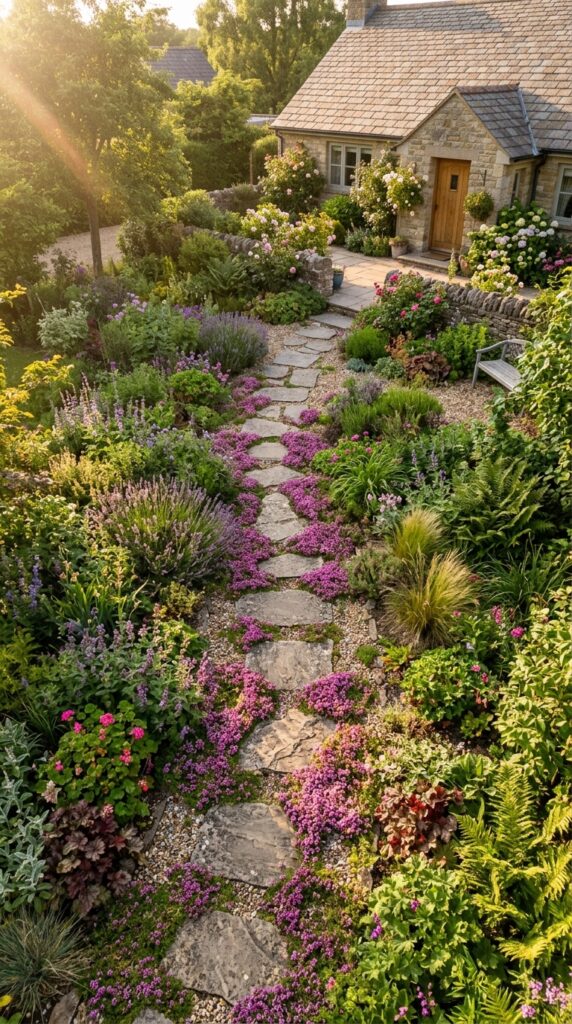
A flagstone path does double duty: it gives visitors somewhere to walk without trampling your plants, and it becomes a design feature in its own right. The secret to making it look truly designed rather than just functional is what you plant between the stones. Creeping thyme is the best answer for most climates — it tolerates foot traffic, releases a faint herbal scent when brushed, flowers in late spring in shades from white to deep magenta, and stays low enough that it never obscures the stone.
Fill the wider gaps between flags with fine pea gravel in a warm buff or pale grey tone to tie the path into the surrounding beds. Avoid white gravel here — it reads too stark against warm-toned flagstone and reflects harshly in summer sun.
Keep the path slightly irregular in its route. A perfectly straight flagstone path loses the charm that makes this material worth using in the first place. A gentle curve toward the front door adds about three extra steps and about a hundred times more character.
Skip this combination if your winters are extremely harsh — creeping thyme can thin out in zones below 4, and you’ll be replanting every spring.
3. Bold Boulders With Native Wildflowers
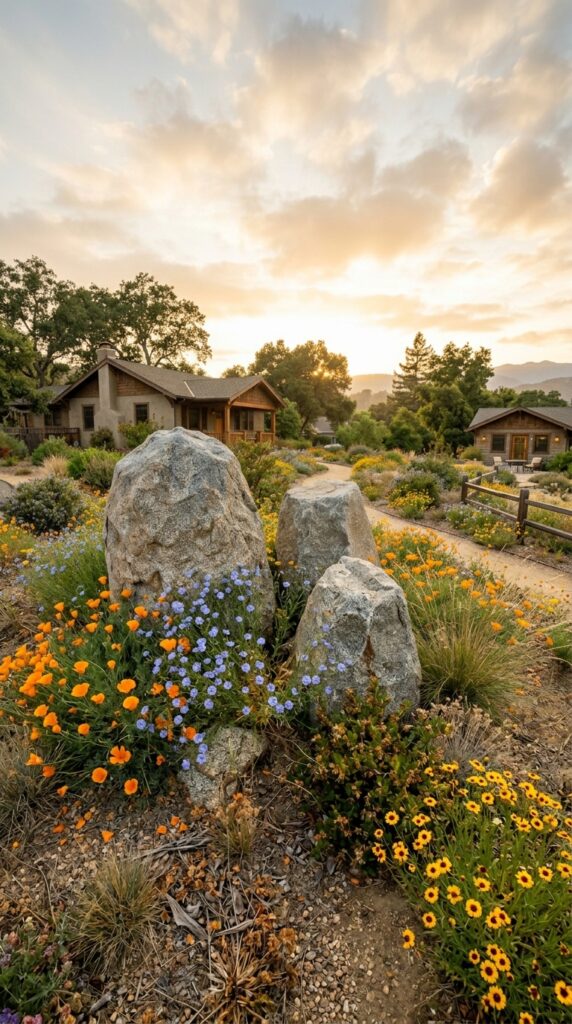
Big rocks are underused in residential landscaping, probably because most homeowners worry they’ll look like they raided a quarry. Done right, they look like the yard was always supposed to have them there. The key is using an odd number — three boulders, never two or four — and varying the sizes dramatically. One large anchor stone, one medium, one smaller. Bury the bottom third of each boulder in the soil so they look settled, not dropped.
Native wildflowers are the right planting partners because they share the same low-water, low-fuss ethos as a stone-heavy design. California poppies, black-eyed Susans, prairie coneflowers, and blue flax all work beautifully depending on your region. They self-seed gently, so the planting evolves naturally over years without becoming a maintenance burden.
This approach works especially well on slight slopes where grass is a nightmare to mow and erosion is a quiet ongoing problem. Boulders slow runoff, roots hold soil, and suddenly a problem area becomes the most interesting part of the yard.
Don’t use rounded river boulders here — you want rough, angular granite or sandstone that reads as geological rather than decorative.
4. White Gravel Beds With Red and Pink Roses
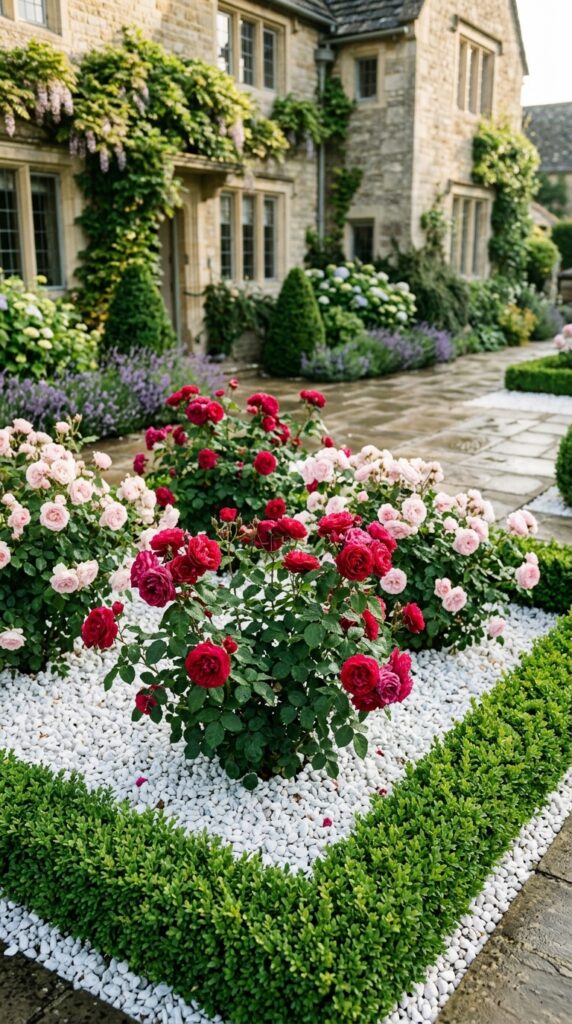
White gravel under roses is a move borrowed from formal European garden design, and it translates surprisingly well to residential front yards when you have even a modest amount of structure to work with. The gravel does several things at once: it reflects light up into the rose canopy (helping blooms develop), retains moisture in the root zone, and eliminates the muddy splash-back that ruins lower petals after rain.
Use crushed white marble or white quartz rather than the rounded pea-gravel variety — the angular pieces lock together and don’t scatter onto the path with every footstep. Lay landscape fabric underneath, but cut it generously around each rose crown to allow for mulch topdressing without the fabric riding up.
Pair crimson roses with blush or white varieties rather than mixing red and orange — the temperature clash reads as chaotic rather than lush. A low clipped hedge of boxwood or dwarf barberry around the perimeter anchors the whole composition and makes it look genuinely intentional rather than ad hoc.
One honest constraint: this is not a no-maintenance setup. Roses want feeding, deadheading, and seasonal pruning. If you hate that kind of attention, choose shrub roses at minimum — they’re far more forgiving than hybrid teas.
5. Dry Creek Bed With Daylilies and Ornamental Grasses
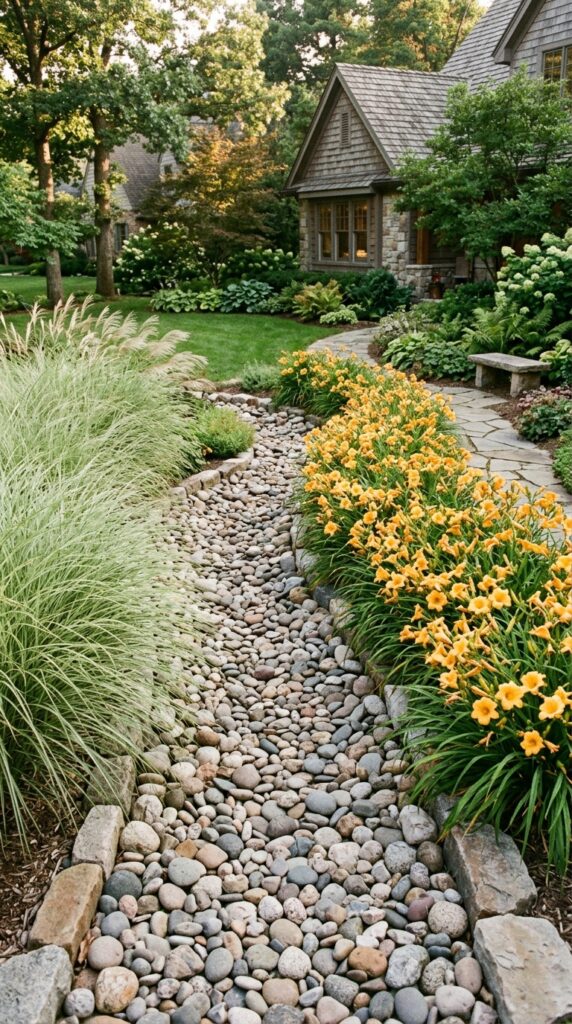
A dry creek bed is one of those landscape solutions that looks purely aesthetic but is actually doing serious functional work. It channels water away from the foundation during heavy rain, prevents erosion on sloped properties, and creates a natural-looking linear feature that gives the eye somewhere to travel through the space. Which, in a flat front yard especially, is more valuable than it sounds.
The planting on either side is where the personality comes in. Daylilies are an obvious choice because they’re tough, they bloom for months, and their strap-like foliage echoes the linear quality of the creek itself. Back them with a stand of ornamental grass — miscanthus sinensis or Karl Foerster feather reed grass — and you’ve got movement, height variation, and year-round interest even after the blooms are done.
Keep the stone selection for the creek bed cohesive. Mixing five different stone colors in one narrow channel looks jumbled. Choose two tones maximum — a dominant grey or buff cobblestone with occasional darker accent pieces — and the whole thing will read as unified.
This is also one of the more renter-friendly landscaping moves, since a dry creek bed can technically be installed without any permanent soil disturbance.
6. Terraced Stone Walls With Cascading Flowers
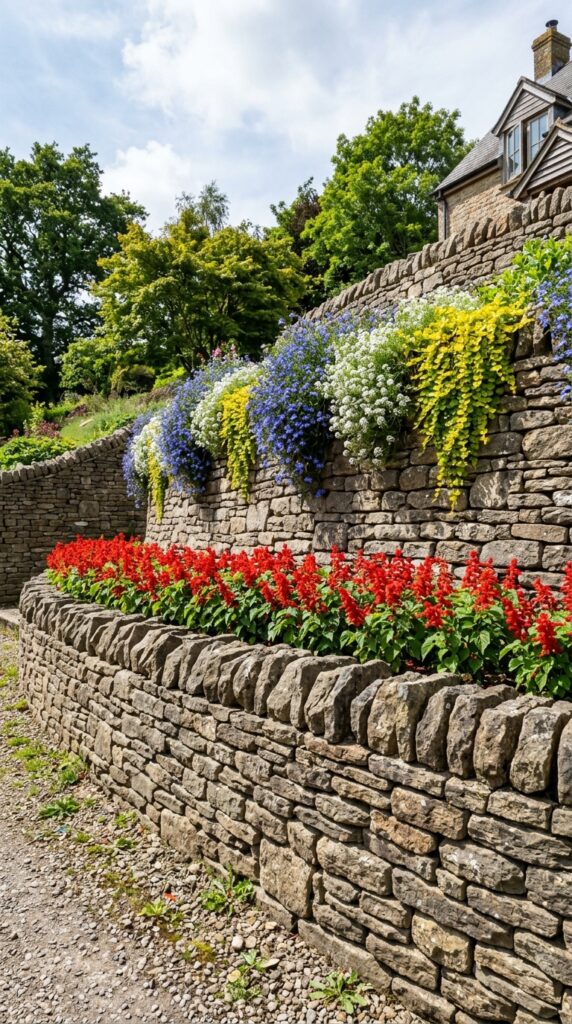
If your front yard has any kind of slope at all, terracing is almost always worth considering — both for practical erosion control and for the visual drama it creates. Dry-stacked fieldstone walls (no mortar) are the most naturalistic option and, frankly, the most forgiving for DIY builders because small imperfections just add to the charm rather than looking like mistakes.
The real design opportunity is in what you plant in and along the walls themselves. Cascading plants — trailing lobelia, alyssum, creeping jenny, aubrieta — spilling over the front face of the wall soften the stone beautifully and blur the line between hardscape and garden. Plant into the wall itself wherever there are gaps wide enough; thyme and sedum both root happily in dry stone joints with almost no soil.
On the terraced beds above, plant in layers: low edging plants at the front edge of each terrace, medium perennials in the middle, taller grasses or shrubs at the back. Each terrace becomes its own small garden, which makes the whole front yard feel far more spacious and intentional than a single flat bed ever could.
Keep the wall height reasonable — under 24 inches per course without engineering consultation. Beyond that, you’re into structural territory that needs professional assessment.
7. Japanese-Inspired Gravel Garden With Ornamental Cherry and Peonies
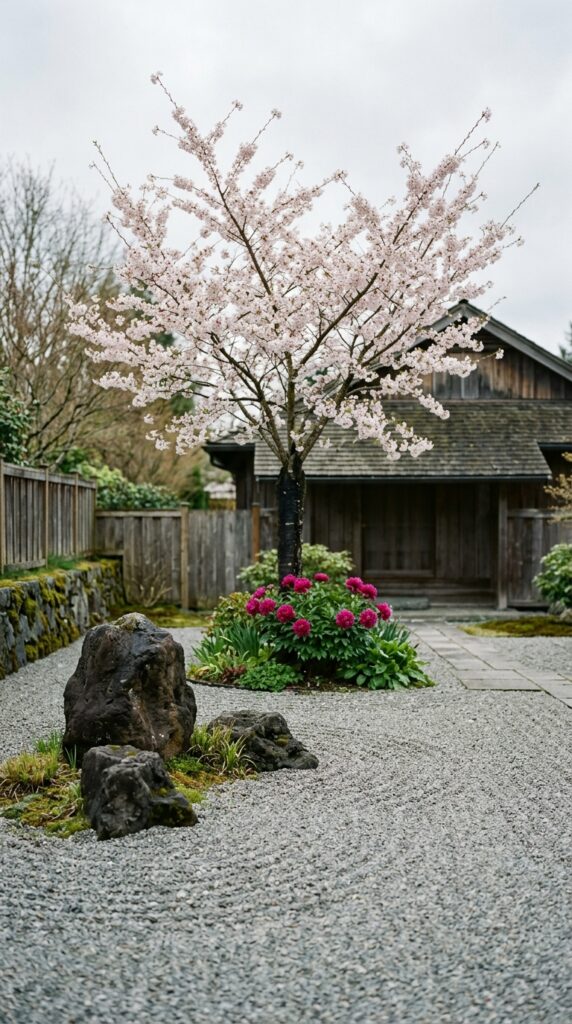
This is the one for people who want a front yard that looks genuinely different from every other house on the block. Japanese gravel garden principles translate to Western residential settings better than most people expect, as long as you’re willing to commit to restraint. The worst thing you can do is mix this aesthetic with a crowded flower border or a decorative mailbox post covered in morning glory. Edit ruthlessly.
Fine grey decomposed granite or crushed basalt is the right gravel here — not white, not tan, not multi-colored. One stone, one color, raked in parallel lines or gentle curves. The rocks you place within the gravel should feel geological and inevitable, not decorative. Dark volcanic basalt or weathered granite work far better than sandstone or river pebble.
Peonies are a surprisingly good bridge between Eastern and Western sensibilities — their blooms are extravagant, but their bare winter stems and clean summer foliage read as sculptural enough to hold their own in a minimalist setting. An ornamental cherry overhead adds that fleeting spring moment that Japanese garden design prizes above all else.
Skip this if you have young children who will inevitably redistribute the gravel into the street.
8. Cottage-Style Mixed Border With Stone Edging
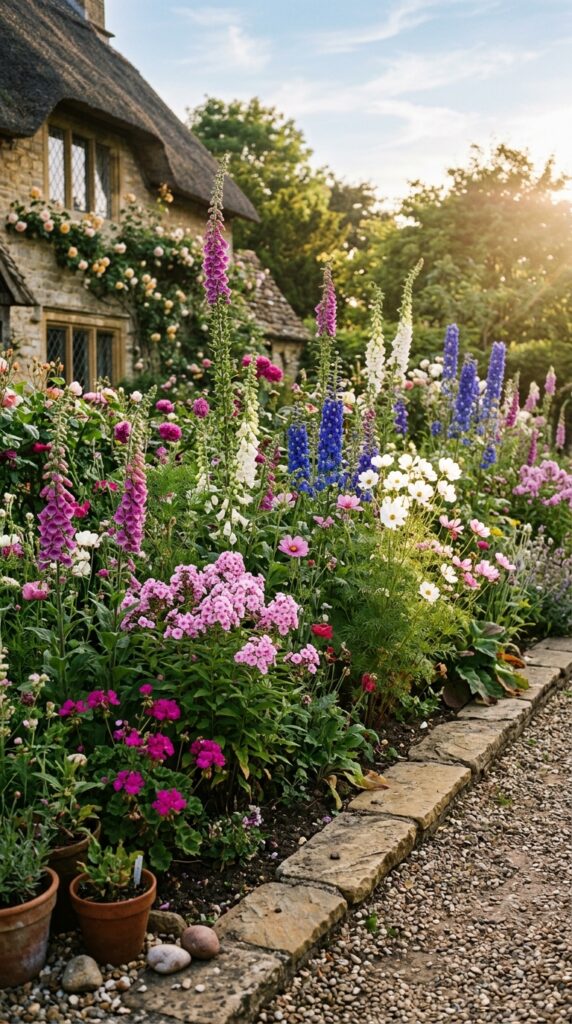
The cottage style is chaotic by design, which is both its greatest strength and its most common failure mode. The chaos needs a container — and that’s exactly what a clean stone edging provides. Even one course of flat sandstone or slate set flush with the lawn line gives the brain something to hold onto, a visual boundary that says “this wildness is intentional.”
Layer the planting by height — tall foxgloves and delphiniums at the back, medium phlox and salvias in the middle, low alyssum and viola at the front — but don’t enforce this too strictly. A foxglove occasionally leaning forward into the middle zone is charming. All foxgloves crammed uniformly at the back looks regimented and misses the whole point.
Stick to a loose color story: pastels (pink, lavender, white, soft yellow) hold together more easily than bold primary mixes. Add one darker accent — a deep burgundy hollyhock or a rich purple veronicastrum — to give the palette depth without making it feel gaudy.
Maintenance reality: cottage borders look effortless and are not. Deadheading, staking taller plants, and pulling the genuinely thuggish self-seeders every spring is the ongoing cost of this look. Worth it, but go in with eyes open.
9. Succulents and Decomposed Granite in a Xeriscape Design
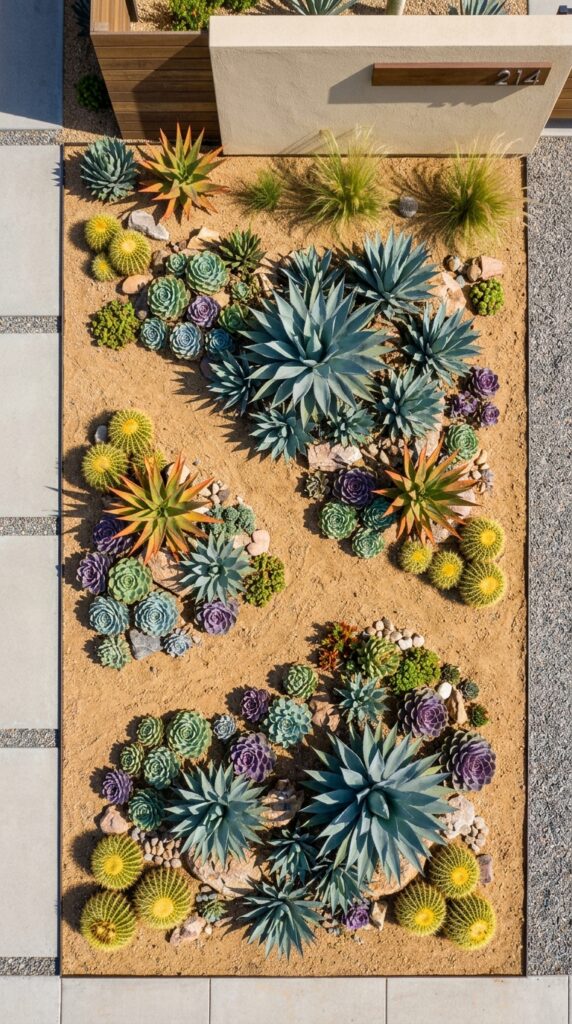
Water-wise landscaping has graduated from a reluctant compromise to a genuine aesthetic. A well-designed xeriscape front yard in decomposed granite with sculptural succulents reads as deliberately modern — almost architectural — rather than sparse or neglected. The shift in perception has happened, and it’s worth leaning into.
Decomposed granite in a warm buff or terracotta tone is the right base for most succulent designs — it echoes the earthy tones of the plants themselves and doesn’t reflect heat upward as harshly as white gravel. Top-dress with a half-inch layer after planting and refresh it every couple of years as it compacts.
Group succulents by form rather than by species — cluster the rosette types together, the columnar types together, the sprawling ground-huggers as a carpet between. Contrast of form within each grouping (a smooth agave next to a spiky aloe, a flat echeveria next to a rounded barrel cactus) creates the visual interest that keeps a gravel garden from feeling monotonous.
One thing to watch: decomposed granite needs edging on all sides or it migrates steadily toward the sidewalk. Metal edging, set just below grade, is the cleanest solution.
10. Raised Stone Planters Overflowing With Annuals
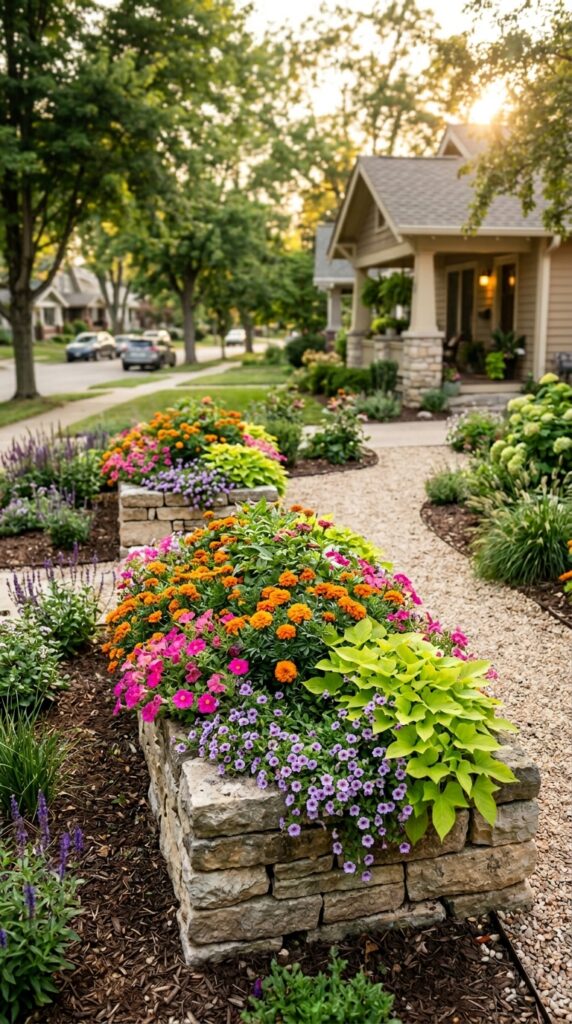
Raised planters built from natural stone are one of the most structurally elegant things you can add to a front yard, and they solve several problems simultaneously: they create immediate height and structure in a flat space, they improve drainage for plants that hate sitting in clay, and they make the whole planting feel considered rather than thrown together.
Dry-stacked limestone or sandstone is the most forgiving material to work with and ages beautifully — it takes on moss and weathering in a way that feels like the planter has always been there. Keep the height between 16 and 24 inches; taller than that starts to feel like a fortification rather than a garden feature.
The annual planting mix is where you get to have real fun with color. A warm palette — orange marigolds, red verbena, golden creeping Jenny — reads cheerful and classic. A cooler palette — white alyssum, purple bacopa, silver dichondra — feels more refined and sophisticated. The trick with any mix is adding a trailing element that spills generously over the front face of the stone; without it, the planter looks unfinished.
Change the annuals seasonally if your budget allows. Spring pansies replaced by summer petunias replaced by autumn ornamental kale keeps the display fresh and gives neighbors something to look forward to.
11. Slate Chip Mulch With Ornamental Grasses and Black-Eyed Susans
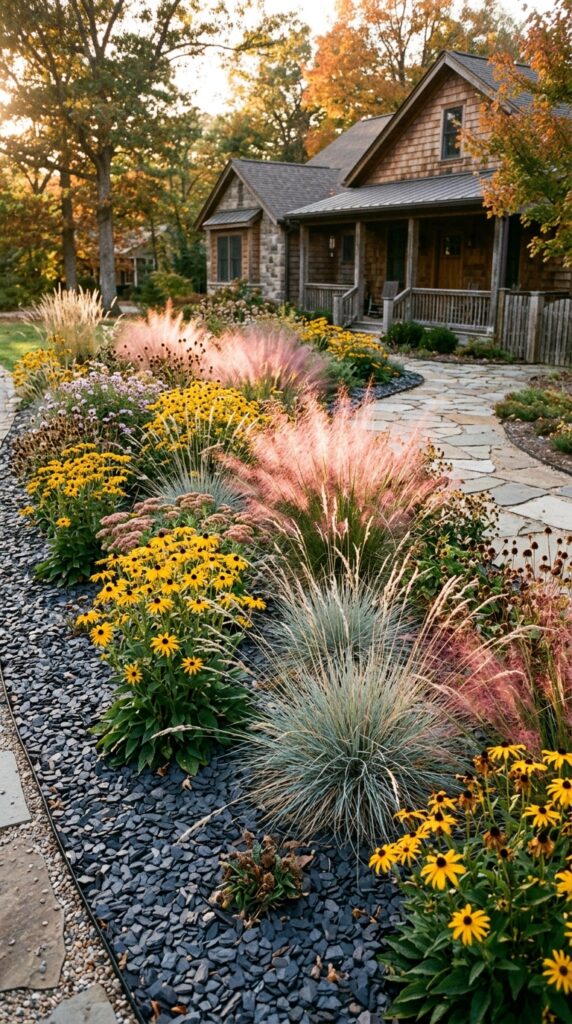
Slate chip mulch is an underrated alternative to the ubiquitous brown bark mulch that covers about seventy percent of American front yards. The deep charcoal tone of crushed slate sets off warm-colored flowers — golden rudbeckia, orange helenium, bronze sedge — with a sharpness that bark mulch simply can’t match. It doesn’t decompose, doesn’t float away in heavy rain, and doesn’t fade to grey after one summer season.
Black-eyed Susans are nearly perfect in this context. They’re drought-tolerant once established, they bloom from midsummer into October, and their golden-yellow daisy faces pop brilliantly against dark stone. Pair them with ornamental grasses that catch the low autumn light — purple muhly grass turns a spectacular magenta-pink in September, and blue oat grass adds cool contrast throughout the season.
Keep this combination loose and naturalistic in its arrangement. Formal rows of rudbeckia in slate mulch look oddly corporate. Irregular clusters, varying densities, and grasses woven between the flowering plants at different heights — that’s the approach that reads as designed but uncontrived.
Slate chips are heavier than bark mulch, which is mostly an advantage but does mean more physical effort to install. Budget accordingly.
12. Formal Symmetrical Garden With Clipped Hedges, Roses, and Limestone Paving
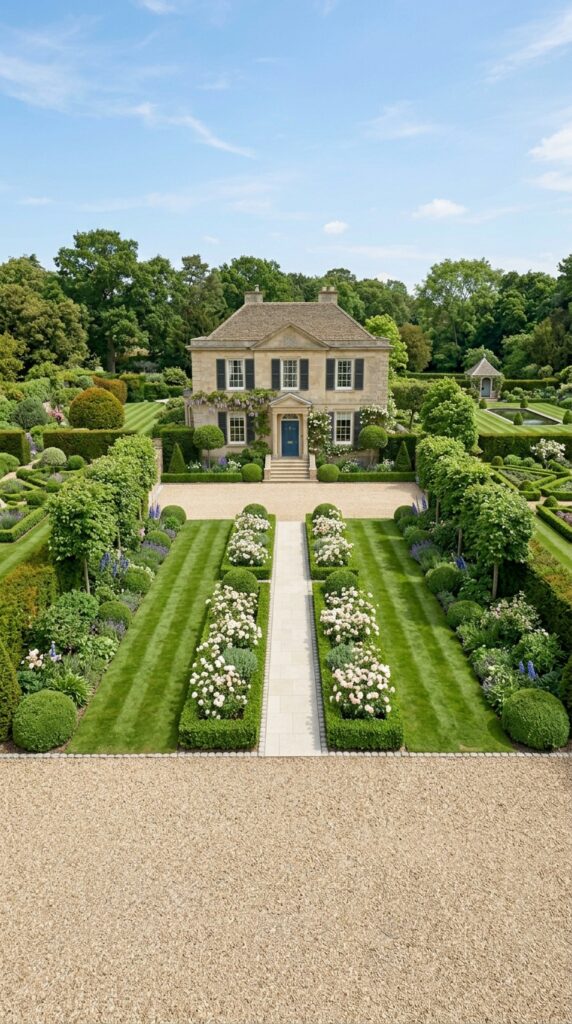
Symmetry is the most powerful tool in formal garden design, and the front yard is the one outdoor space where it almost always works — because you’re naturally looking at it straight-on from the street. A central path, mirrored beds on either side, matched plantings, balanced stone work: the whole composition reads as settled and confident in a way that asymmetrical designs simply don’t from a distance.
Limestone paving is the right material for formal designs because its pale, even tone doesn’t compete with the plantings. Grey granite setts or dark slate would pull attention downward; limestone lets the roses and hedges remain the visual stars. Keep the paving joints tight and consistent.
The hedge framework is what makes or breaks this look. Buxus (boxwood) is traditional but has serious blight issues in many regions now — consider Ilex crenata (Japanese holly) or Pittosporum as alternatives that take shearing equally well and aren’t battling disease pressure. Whatever you choose, commit to clipping it at least twice a year. A formal design with a shaggy hedge looks worse than an informal design ever could.
Roses for formal settings should be selected for repeat bloom and clean foliage — David Austin shrub roses are reliable, disease-resistant, and fragrant without requiring the obsessive attention of hybrid teas.
This is a high-commitment, high-reward approach. If you love the maintenance ritual, there’s nothing more satisfying. If you resent it, choose something else.
If you’ve made it this far, you already know your front yard is capable of being something genuinely beautiful — not just presentable. The most important thing any of these ideas illustrate is that flowers and stones work because they do opposite things for a design: stones provide structure, permanence, and calm; flowers provide color, softness, and seasonal life. You don’t need both in equal measure, but you do need both in conversation. A yard with only one or the other will always feel like it’s missing something.
Come back to this list when the seasons change. What reads as a lavender-and-river-stone project in spring might become a rudbeckia-and-slate project by late summer. Great front yards aren’t built in a single weekend — they evolve, season by season, into something that feels truly like yours.