There’s something quietly powerful about a front yard that stops people mid-walk. Not the manicured, sterile kind with two matching shrubs and a strip of sod, but a real flower bed — layered, thoughtful, slightly wild in the best way. The kind that makes neighbors slow down and ask questions. The truth is, the front of your house sets an emotional tone before anyone even reaches the door, and flower beds are one of the few landscaping moves that deliver outsized impact for relatively modest effort. Whether you’re working with a narrow strip along the foundation, a sweeping curved border along a pathway, or a small raised bed framing either side of your steps, there’s a design approach that will work for your space, your climate, and your actual maintenance bandwidth. These twelve ideas span a range of styles — from cottage-wild to architecturally clean — so you can find the one that matches how you actually want your home to feel.
1. The Layered Cottage Border
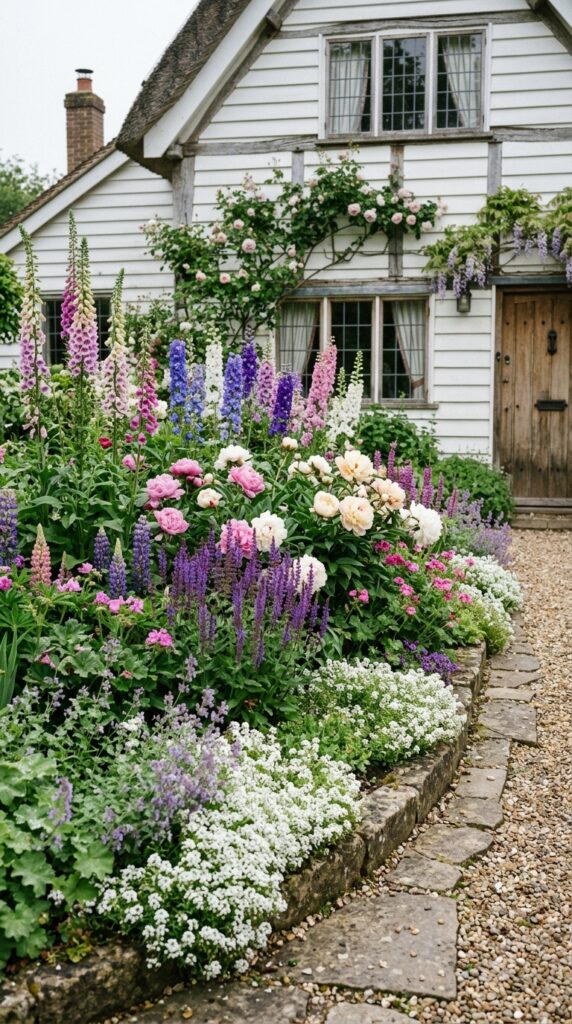
Cottage borders are the most forgiving garden design you can attempt — and that’s not a criticism, it’s genuinely their best quality. The layered rule here is simple: tall plants at the back, medium in the middle, low and trailing at the front. Think delphiniums or foxgloves anchoring the rear, then mid-height peonies or Russian sage pulling the eye through the middle, and sweet alyssum or creeping phlox spilling softly over the edging. What makes this look land rather than just look overgrown is restraint in your color palette. Stick to two or three colors maximum — blush pink, violet, and white is a classic that never feels dated. One thing to watch: cottage borders need at least six feet of depth to breathe properly. If your front bed is a shallow strip, this approach will feel crowded and chaotic rather than romantically full. Edge with irregular fieldstone or reclaimed brick to keep it grounded. The imperfection is part of the charm.
2. The Symmetrical Foundation Planting
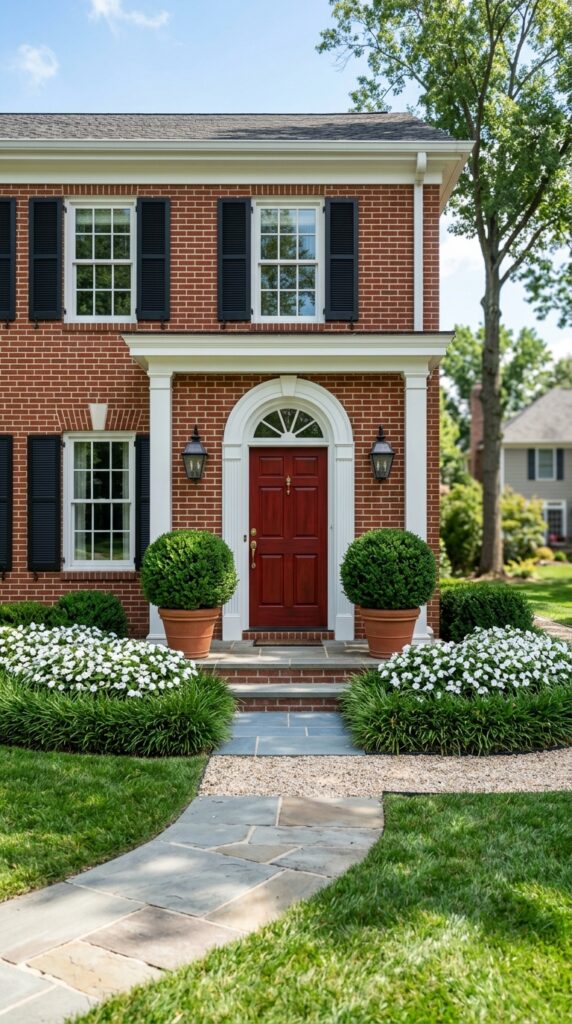
Symmetry is the cheat code of landscape design. When both sides of your front door mirror each other exactly, the whole facade reads as intentional and polished — even if the individual plants are nothing special. The key is choosing one anchor plant for each side, something with a strong shape: a clipped boxwood sphere, a columnar yew, or a compact cherry laurel. Then fill in around it with low, uniform ground-level planting. White flowers work beautifully here because they read clearly from the street. Avoid anything that grows unevenly or flops — this look only holds if both sides stay balanced. That said, pure symmetry can feel a bit cold if your home has a casual, relaxed character. If you have a craftsman bungalow or a cottage-style exterior, soften the formal bones with a slightly wilder plant choice at the edges, like a frothy catmint that blurs the line a little. Symmetry earns its keep at the entry. It’s doing structural work.
3. The All-White Moon Garden Bed
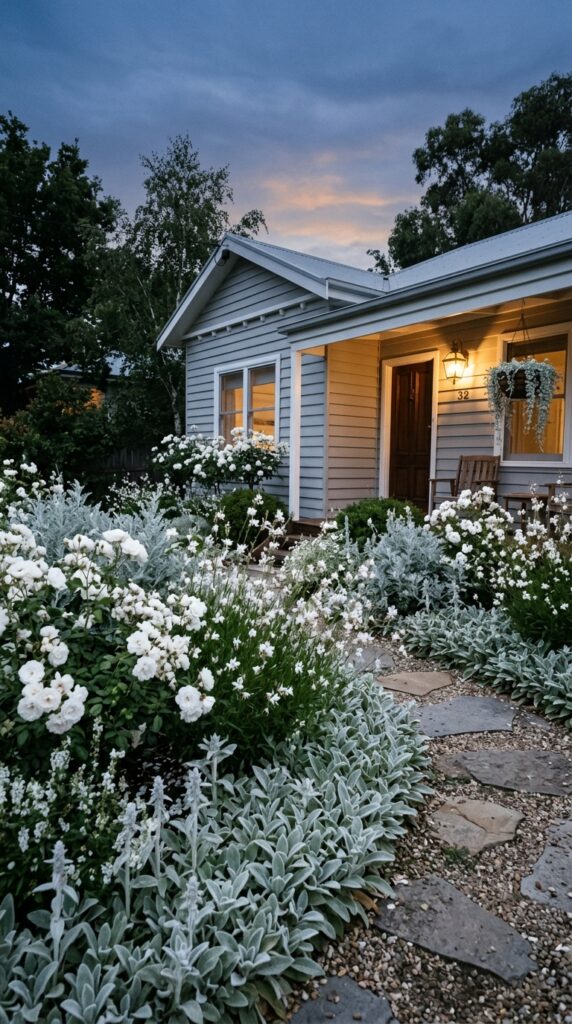
An all-white flower bed sounds minimal on paper but reads as genuinely dramatic in person, especially in the evening. White flowers catch light differently than colored ones — they glow at dusk, shimmer on cloudy days, and make the whole front of your house feel luminous. The trick is to vary texture rather than color. Combine something fluffy and soft like white gaura or cosmos with something structured like white iceberg roses, then add silvery foliage — artemisia, lamb’s ear, dusty miller — to give the bed depth without introducing color. This works particularly well if your home faces west or has a covered porch where people sit in the evenings. One honest constraint: white flowers show dirt, insect damage, and browning petals more visibly than colored ones. You’ll need to deadhead regularly to keep it looking pristine. If you’re a once-a-month gardener, a looser palette with pale yellows and blush thrown in will be more forgiving while keeping that soft, luminous quality.
4. The Curved Ribbon Bed Along the Walkway
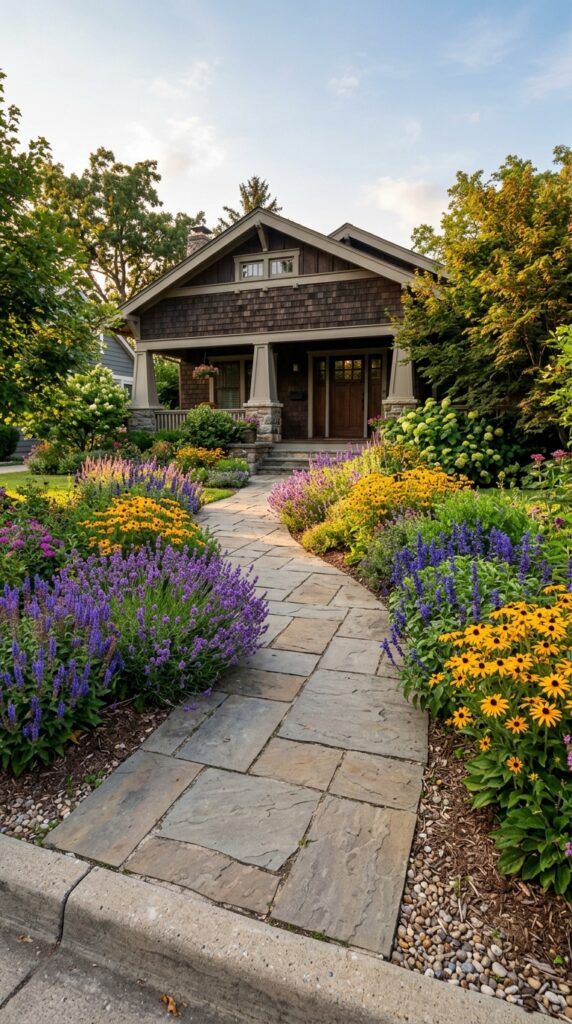
Straight lines belong in spreadsheets. A gently curved bed running along your front walkway immediately makes a yard feel more designed, more personal, and more interesting than anything a ruler could produce. The curve doesn’t need to be dramatic — even a subtle arc away from a straight path adds movement. Plant in drifts rather than rows, meaning groups of five to seven of the same plant clustered together and flowing into the next grouping. Lavender, salvia, and black-eyed Susans are a classic combination for this format because they bloom in sequence, keeping color going from early summer well into fall. Here’s the practical tip most people skip: before you dig anything, lay out your garden hose on the ground in the shape of your intended curve. Live with it for a day. Walk past it from the street. Adjust. It sounds obvious but it saves you from a curve that looked good on paper and feels awkward once it’s planted.
5. The Raised Timber Bed with Structure
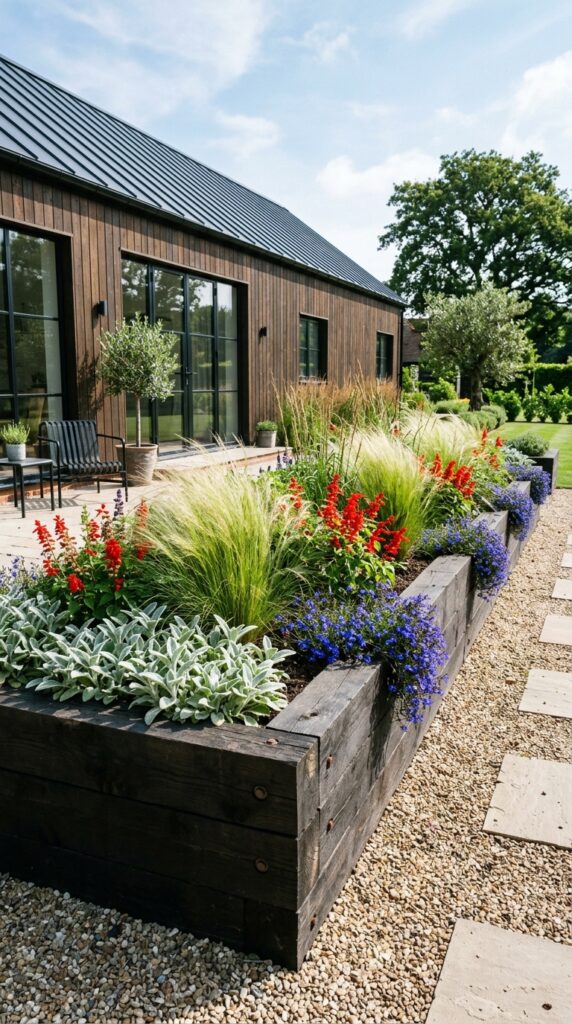
Raised beds aren’t just for vegetables. A timber-framed raised bed at the front of your house brings a level of intentionality to the space that in-ground planting rarely achieves — it signals that someone made a deliberate decision here, not just sprinkled some seeds. Use sleepers or thick structural timber at a height of about twelve to eighteen inches for the best visual proportion against a single-story facade. The raised format also solves a real problem: if your front yard has compacted clay soil or poor drainage, raising the bed means you control the growing medium entirely. Fill with a quality mix and your plants will thank you. Stick to plants that won’t overwhelm the box visually — ornamental grasses, upright salvias, and trailing lobelia at the corners work beautifully. One watch-out: dark-stained timber can look heavy against a light-colored home. If your exterior is pale or white, consider a lighter natural cedar or even painted timber to keep the bed from visually dragging down the facade.
6. The Pollinator Prairie Strip
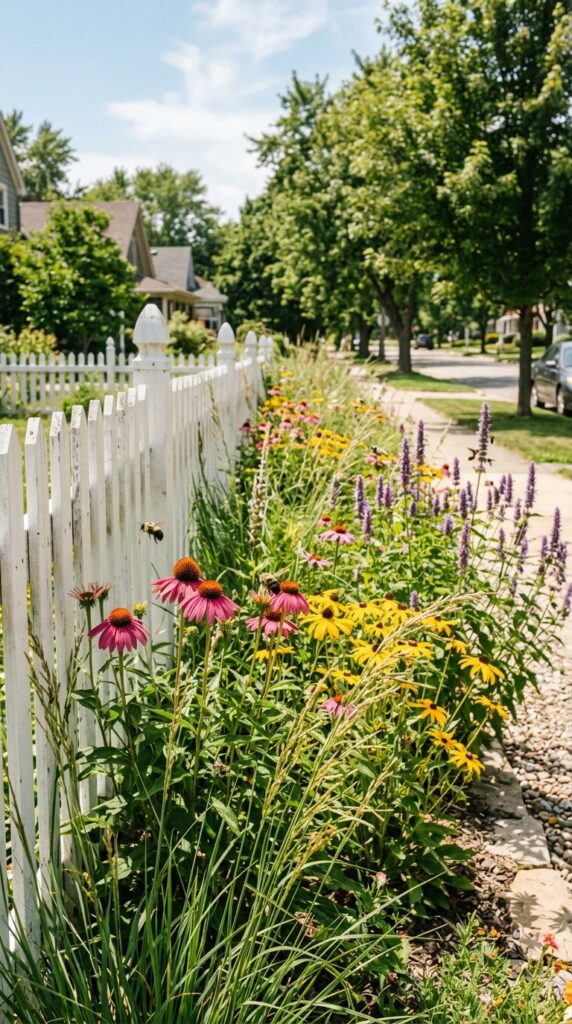
This is the idea for people who love the idea of a beautiful front yard but genuinely do not want to fuss with it after the first season. A pollinator strip planted with native or near-native perennials — coneflowers, rudbeckia, agastache, native grasses — essentially runs itself once established. The plants are adapted to your local rainfall, your local insects, and your local soil. After year one, you’re mostly watching rather than maintaining. The look is wilder than a traditional flower bed, which is precisely the point. It reads as purposeful rather than neglected if you add one clear structural element: a clean edge. A crisp metal edging strip or a sharp mow line separating the planting from the lawn tells passersby this was a choice, not an accident. Some HOAs push back on this style, so check your rules before planting. That caveat aside, a pollinator strip is one of the most ecologically generous things you can do with a front yard, and it looks genuinely beautiful at peak summer.
7. The Monochromatic Purple and Blue Bed
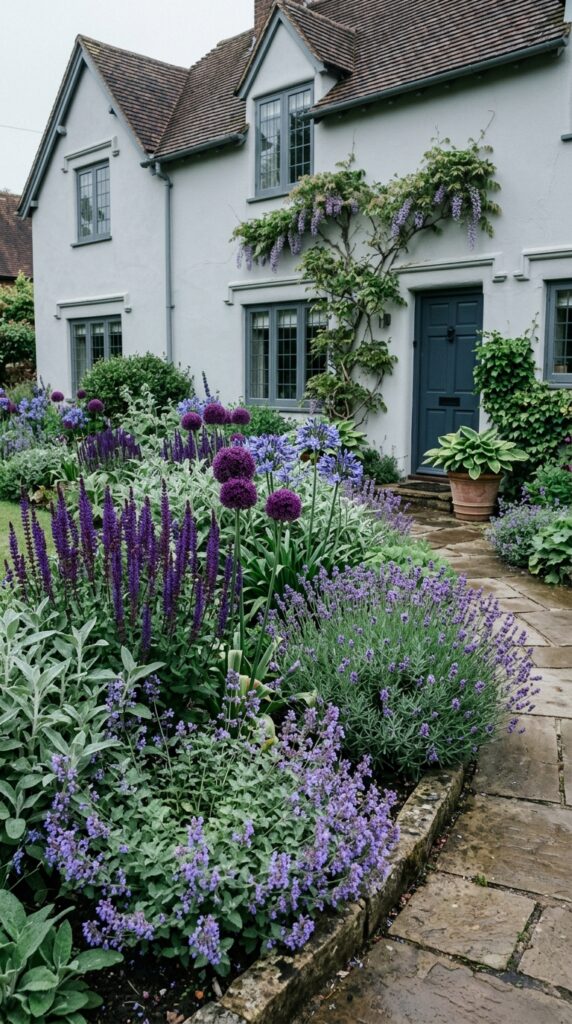
Committing to a single color family in a garden bed is a move that takes confidence but pays off enormously. A purple and blue planting — layering lavender, catmint, agapanthus, salvia, and the occasional dark violet allium — creates a bed with extraordinary depth and calm. Cool-toned plantings have a particular quality on grey or white-painted homes: they make the exterior feel more expensive and considered, like a deliberate design decision rather than a collection of whatever was on sale at the garden center. The secret to making monochromatic work is variation in form and texture. You need spiky shapes next to soft mounds next to tall vertical elements, otherwise the bed reads flat even if the colors are beautiful. Pair with silver or grey-green foliage — artemisia, eucalyptus, festuca grass — to give breathing room between blooms. One thing to know: blue flowers are notoriously tricky to photograph, so if you share your garden online, they’ll always look better in person than in photos.
8. The Tropical Statement Bed
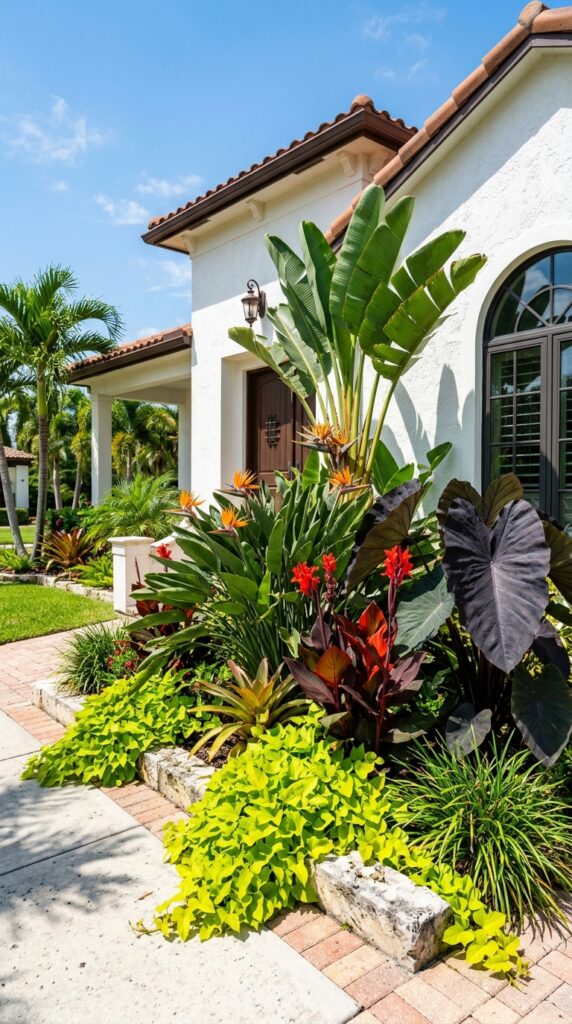
Not every front yard needs to whisper. If your home is in a warmer climate — or if you’re simply done with the idea of playing it safe — a tropical-style statement bed is the most visually arresting thing you can plant. The formula is scale plus contrast: one large architectural plant like bird of paradise or elephant ear as the anchor, then a bold colored flowering plant like red canna lily or orange heliconia, then something that spills and softens at the base — sweet potato vine in chartreuse or purple works brilliantly against both. The color combinations that work best here are ones that would seem loud indoors but feel correct outside in full sun: deep burgundy foliage next to hot coral blooms, or near-black elephant ear leaves behind electric yellow canna. One honest limitation — this look does not translate to cold climates unless you treat the dramatic plants as annuals and replant each season, which gets expensive. In zones 9 and above, this planting practically grows itself.
9. The Low-Water Mediterranean Bed
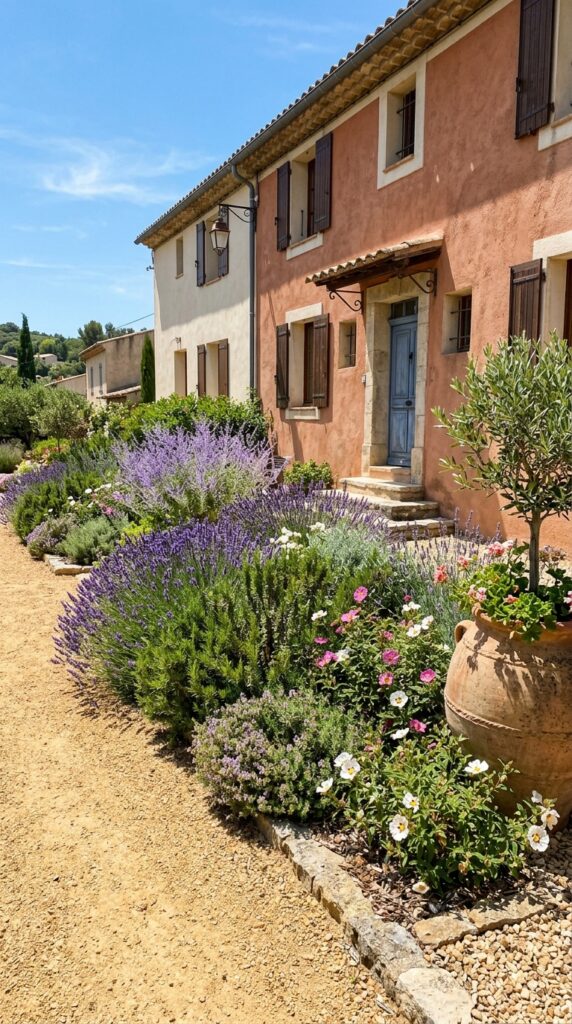
Drought-tolerant doesn’t mean dull — it means you’ve stopped fighting your climate and started working with it, which is frankly the smarter design move. A Mediterranean-style bed anchored in lavender, rosemary, salvia, and ornamental thyme is one of the most fragrant, textured, and visually rich planting schemes you can create, and it asks almost nothing of you once it’s settled in. The key design element here is the mulch: swap bark mulch for gravel or decomposed granite in a warm sandy or terracotta tone. It completes the look and reflects heat upward around the plants, which they genuinely love. This works especially well with homes that have rendered or stone exteriors in warm tones. Against a red brick home, lavender and silver foliage create a stunning contrast that has been used in garden design for centuries for good reason. One practical note: lavender needs sharp drainage above almost everything else. If your soil stays wet, mound the bed slightly or mix in grit before planting.
10. The Shaded Front Bed Under Trees
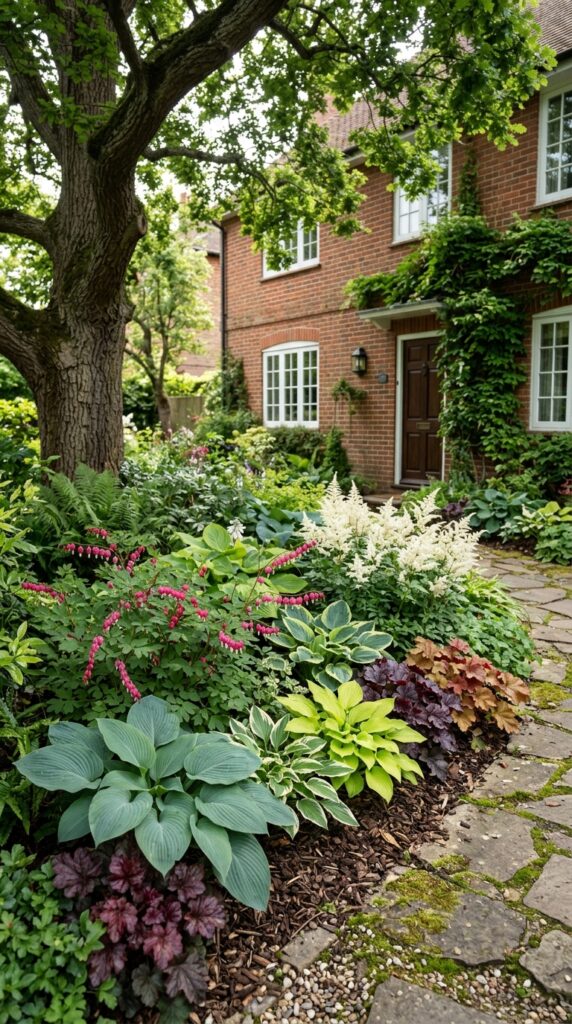
Shade is not the enemy. The front yards with mature trees often feel like the most beautiful ones — layered, cool, and naturally lush — but only if the planting under those trees is chosen deliberately. Most sun-loving bedding plants will sulk and fail beneath a dense canopy. Instead, lean into the conditions: hostas are the obvious workhorse here, and for good reason. They come in an extraordinary range of sizes and tones, from blue-green giants to tiny gold miniatures, and they genuinely thrive with little light. Layer in astilbe for vertical white or pink plumes, heuchera for color at the base, and bleeding heart for early-season drama. The palette almost designs itself — cool greens, burgundy, blush, and white feel absolutely right in dappled shade. One constraint worth naming: if your tree roots are very shallow and aggressive, like those of surface-rooting maples, you may struggle to establish anything underneath. In that case, a deep raised bed on top of root barrier fabric is your most practical workaround.
11. The Repeating Rhythm Bed
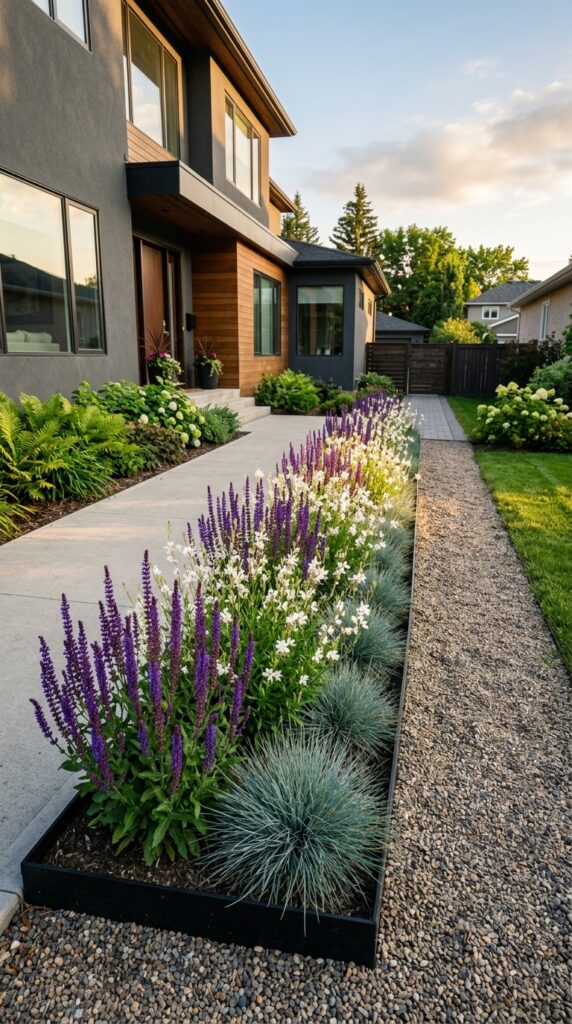
Repetition is one of the most underused tools in residential garden design. Instead of filling a long front bed with as many different plants as possible — which usually ends in visual chaos — choose three plants and repeat them in a consistent rhythm along the entire length. One upright, one mounding, one low and grassy. Plant them in groups of three to five, then start the sequence again. The result is a bed that reads as cohesive from the street, has a satisfying visual rhythm, and is actually much easier to maintain because you’re working with a small number of varieties. This approach suits long, linear beds along a ranch-style or modern home particularly well. It also scales beautifully: the longer the bed, the more satisfying the repetition becomes. Here’s the design principle to internalize — the street view of your house is essentially a composition, and compositions need rhythm to feel resolved. Three plants, repeated confidently, will always look more considered than fifteen plants planted once each.
12. The Seasonal Bulb and Perennial Layered Bed
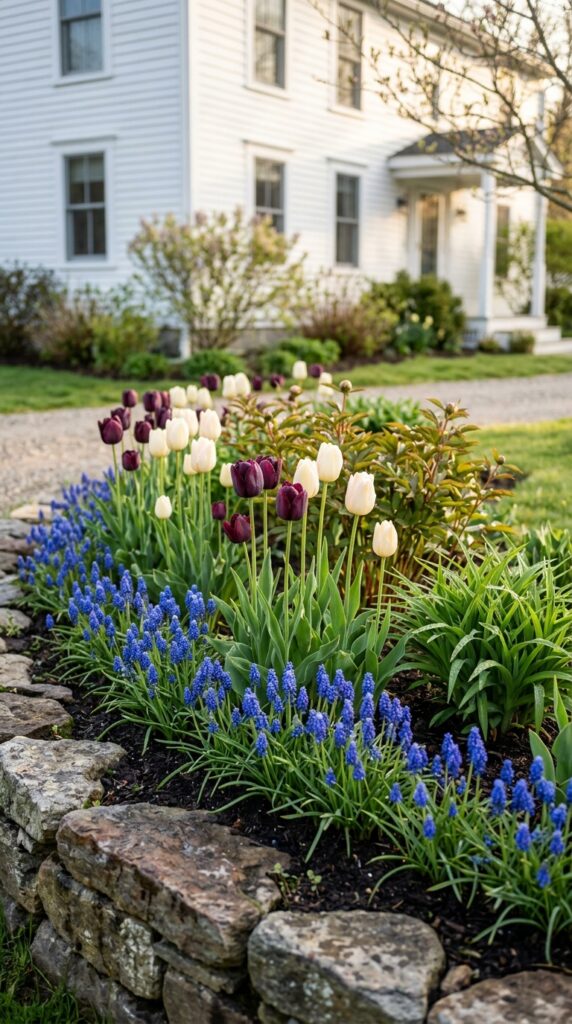
The most sophisticated front beds aren’t the most expensive or the most elaborate — they’re the ones that look beautiful in every season because someone thought ahead. Layering spring bulbs beneath summer perennials is the technique that separates garden enthusiasts from garden lovers, and it’s simpler than it sounds. In autumn, plant tulips, alliums, and muscari in drifts across the front of your bed. Then plant peonies, daylilies, and ornamental grasses in the same areas. In spring, the bulbs emerge first, putting on a generous show of color. As they fade, the perennials grow up and cover the dying bulb foliage naturally, giving you continuous coverage without any gaps. By midsummer, the perennials are in full swing and you’d never know the bulbs were ever there. The one thing to manage is your tulip depth — plant at least eight inches down in colder climates to prevent frost damage. This is a once-a-year planting effort that pays dividends for years, which makes it one of the most satisfying investments in the entire front garden toolkit.
Your front flower bed doesn’t need to be perfect to be remarkable. It needs to be intentional. The ideas in this piece share one underlying principle: every great front garden started with someone deciding what feeling they wanted a visitor to have before they even knocked on the door. Warm and wild? Calm and structured? Bold and tropical? Quiet and fragrant? Once you know the answer to that, the plants almost choose themselves. Start with one bed, one corner, one idea — and do it properly rather than doing five things halfway. A single well-planted, well-edged bed of lavender and salvia will look more impressive than a sprawling, half-committed planting that covers the whole yard. Come back here when you’re ready for the next section. There’s always more to learn, more to try, and more reasons to get your hands in the soil.