There’s a particular kind of house you notice while driving down a street — the one where the path to the front door looks intentional, where the plants seem placed rather than just planted, where the whole entrance communicates that someone gave it real thought. That house isn’t always the biggest or the most expensive. It’s the one where the landscaping does its job: welcoming, framing, softening, and guiding. Your front entrance is a sequence of impressions — starting at the curb and ending at the door — and every element along that path either adds to the experience or detracts from it. These twelve landscaping ideas are specifically focused on the entrance zone: the pathway, the planting beds, the vertical elements, the lighting, and the small finishing touches that make a front entrance feel genuinely designed rather than just maintained.
1. Define the Path With Natural Stone
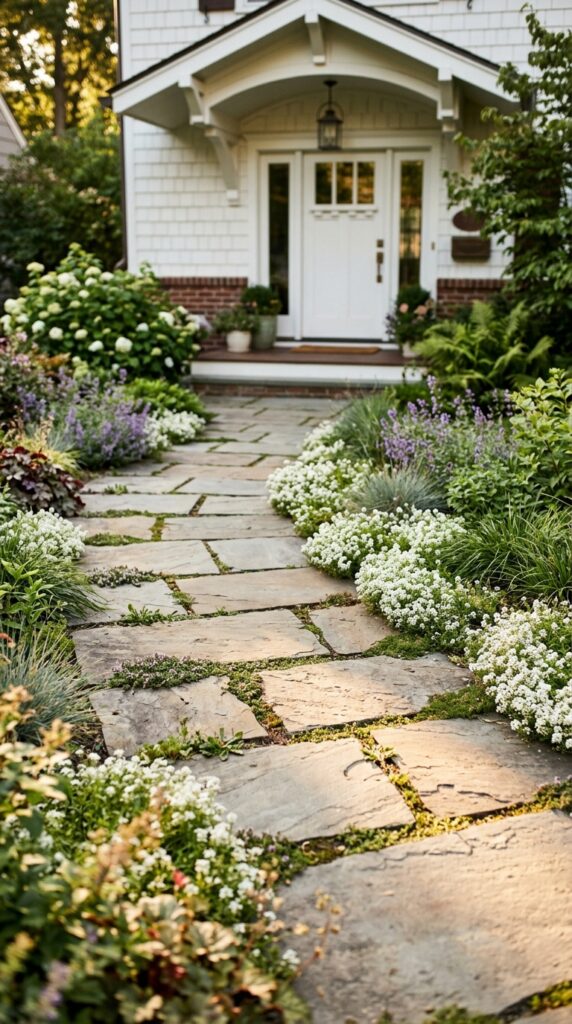
The path to your front door is the single most-used design element of your entire entrance — and most homes treat it as an afterthought. A plain concrete strip technically functions, but natural stone transforms the entire experience. Bluestone, Pennsylvania fieldstone, and tumbled travertine all work beautifully depending on your home’s architectural style. The width matters enormously: a path under three feet wide feels cramped and inhospitable. Aim for four feet minimum — wide enough for two people to walk comfortably side by side. Introduce a gentle curve even if the straight line is shorter; the curve slows the approach and creates a sense of arrival. Tuck low groundcover like creeping thyme or woolly thyme into the joints — it smells incredible underfoot and fills gaps naturally over time. One constraint: irregular stone needs a properly compacted gravel base to prevent shifting and uneven surfaces that become trip hazards.
2. Frame the Door With Symmetrical Planting
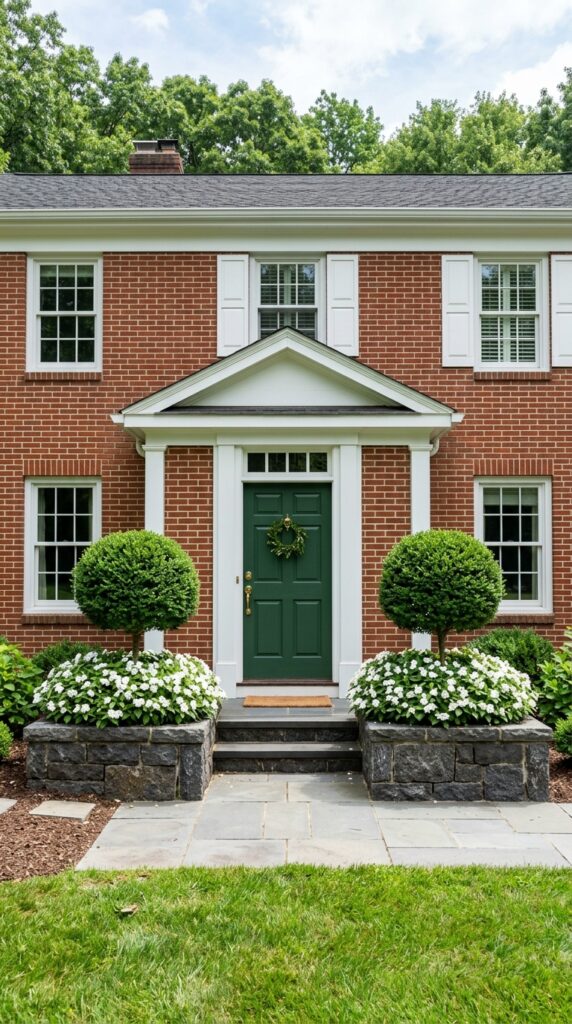
Symmetry is one of the oldest tricks in residential design, and it works because it signals intentionality. When both sides of a front door mirror each other — same shrub, same planter, same height — the entrance reads as composed and deliberate. You don’t need expensive materials to achieve this. Matching clipped boxwood balls, identical ornamental grasses, or even the same low hedging variety repeated on both sides creates the effect. The discipline is in maintaining the symmetry: one side that outgrows the other breaks the spell immediately. If your entrance isn’t architecturally centered — if windows, columns, or stairs are offset — lean into asymmetry instead and create intentional balance through contrasting heights and volumes rather than mirroring. Symmetry works best on traditional and craftsman-style homes; on contemporary architecture, it can read as stiff.
3. Layer the Foundation Planting
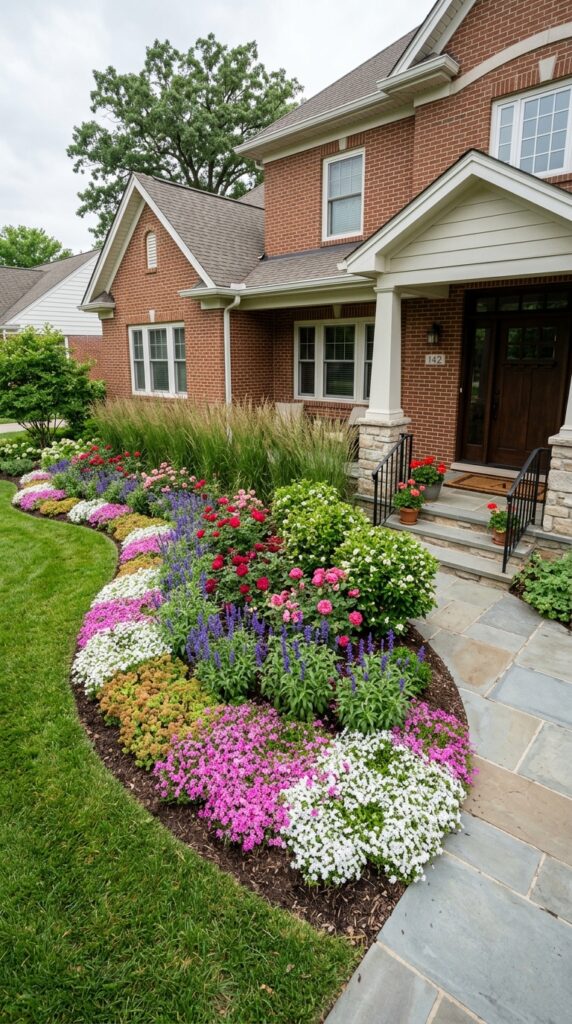
Single-row foundation planting — one species, one height, planted in a line — is the most common and most forgettable approach to entrance landscaping. Layered planting, by contrast, gives a bed depth, movement, and four-season interest. The formula is straightforward: low groundcover at the front edge to soften the bed border, mid-height flowering or textural shrubs in the center, and taller structural plants toward the back and corners. Think creeping phlox, sedum, or liriope at the front; lavender, salvia, or spirea in the middle; ornamental grasses or compact evergreen shrubs at the rear. The layered effect reads well from the street because your eye travels through the planting rather than stopping at a flat wall of green. Keep the bed a minimum of three feet deep — anything shallower collapses the layering effect entirely.
4. Install Entrance Lighting That Works
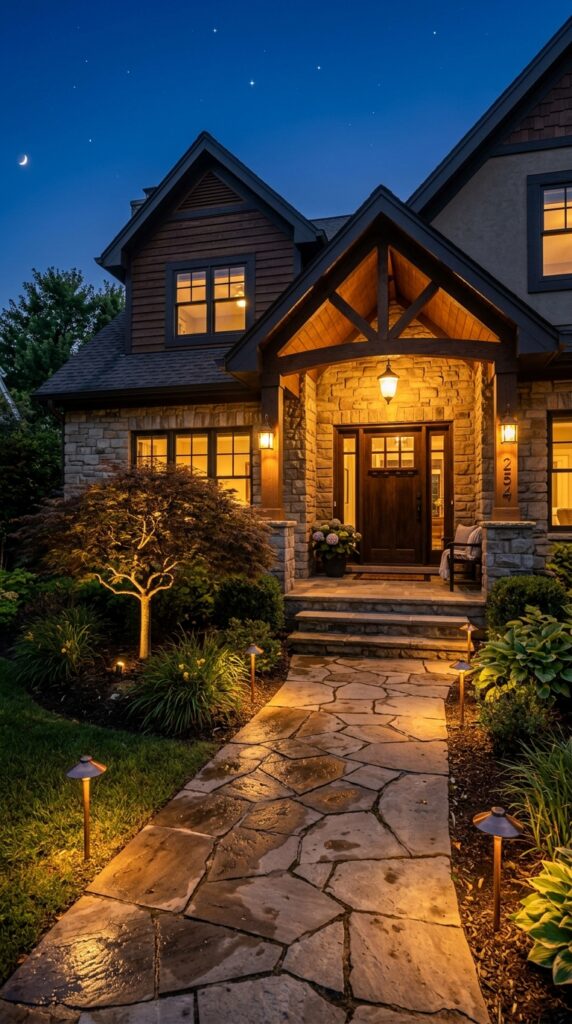
Lighting transforms an entrance after dark — and for most of the year, your home is approached in low or no light as often as it is in full daylight. A well-lit entrance communicates safety, welcome, and care. Path lights along the walkway give structure and definition; wall lanterns flanking the door provide functional illumination and vertical symmetry; a single uplight aimed at a focal tree or architectural feature adds drama and depth. Use warm white LEDs at 2700K to 3000K — cooler temperatures feel clinical against organic plant material and warm-toned stone. Avoid the trap of spacing path lights too close together; every eight to ten feet is sufficient and prevents the runway effect. One thing to watch: overlighting at uniform intensity removes all shadow and depth, leaving an entrance that looks flat and overexposed rather than welcoming.
5. Add Vertical Interest With Climbing Plants
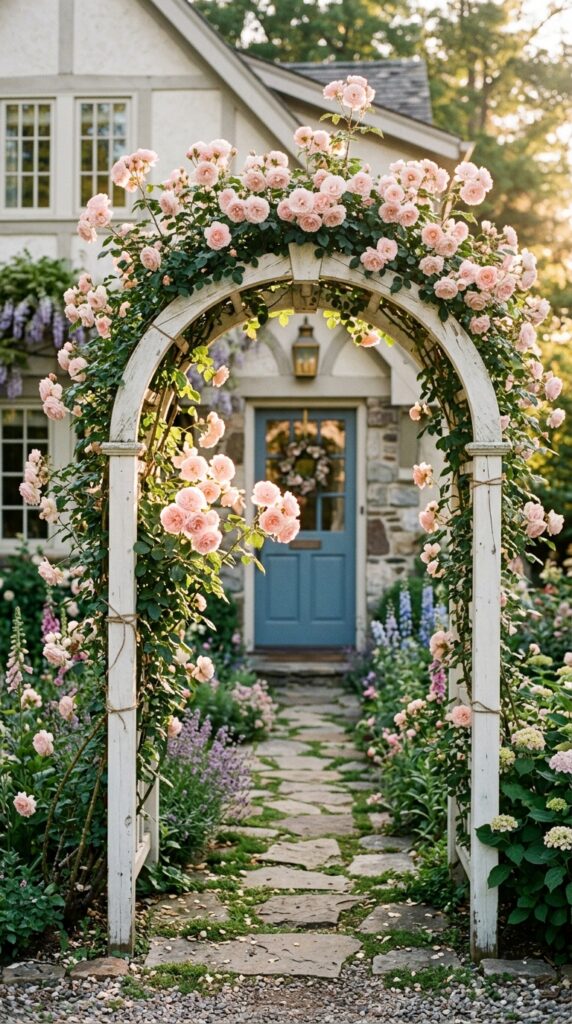
Most entrance landscaping works horizontally — beds, lawns, pathways. Adding a vertical element introduces scale and framing that no amount of ground-level planting can replicate. A simple timber or iron arbor positioned over the start of the pathway, draped with climbing roses, star jasmine, or wisteria, creates a genuine sense of passage — a threshold that marks the transition from street to home. The plant choice matters here. Climbing roses offer seasonal bloom and fragrance but need annual training and pruning discipline. Star jasmine is lower-maintenance and evergreen in mild climates. Wisteria is spectacular but genuinely aggressive — it will consume an arbor and anything adjacent to it if not managed firmly. Whatever you choose, commit to the maintenance. An untrained, sprawling climber on an arbor looks worse than no arbor at all.
6. Use Ornamental Grasses at the Entry Corners
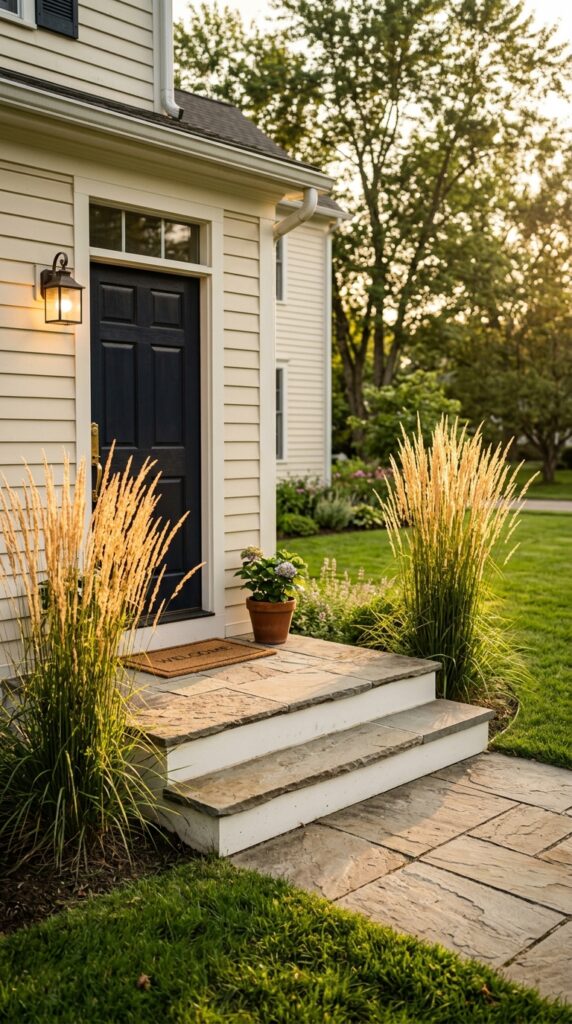
Corner planting is one of the most underused techniques in entrance landscaping. The corners of your front stoop or landing — where the steps meet the surrounding beds — are natural anchor points, and filling them with tall ornamental grasses adds height, movement, and texture that flowering perennials simply don’t provide. Karl Foerster feather reed grass is the standard for good reason: it grows upright to five or six feet, stays tidy, produces beautiful feathery plumes from midsummer, and holds its warm wheat-gold color through winter. Plant in masses of three for a full, intentional look rather than single specimens, which can read as accidental. One practical note: ornamental grasses need cutting back hard to about six inches in late winter before new growth emerges. Skip this step and the previous year’s dead growth becomes a tangled, unattractive mess that chokes the new shoots.
7. Create a Welcoming Landing Area
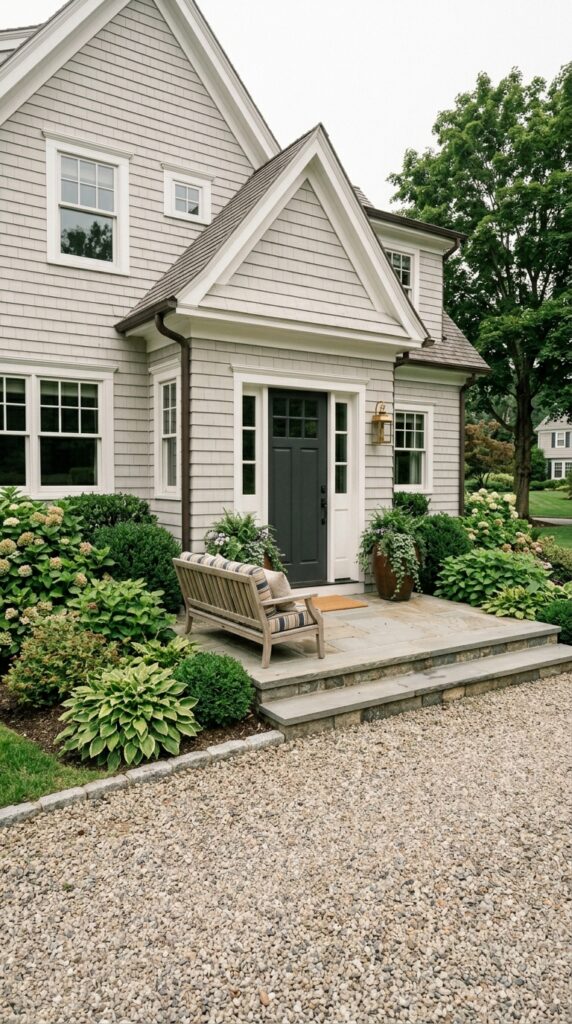
The area immediately in front of your door — the landing — is often sized to the legal minimum and designed to nothing beyond that. Enlarging or improving this zone makes an entrance feel genuinely hospitable. If your existing stoop is small, you can extend it visually by paving an adjacent area with matching material, creating a generous platform that reads as one connected space. Add a simple outdoor bench or a pair of low stools: the functional message is that you’re welcome to sit, which immediately humanizes the entrance. Two large planters here — taller than you think you need — add vertical scale. A quality doormat in natural coir or woven jute finishes the surface with texture and practicality. Skip thin, curling rubber-backed mats; they look cheap within a season and undermine everything else you’ve done well.
8. Define Edges for a Polished Look
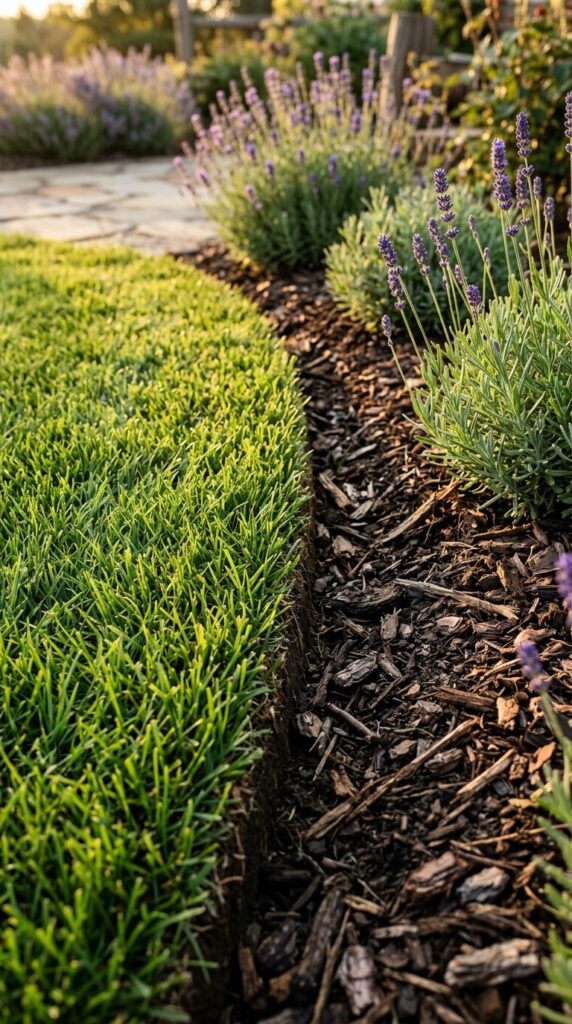
Clean edging is the detail that separates a maintained entrance from a designed one. It costs almost nothing and requires only a half-moon edger, thirty minutes, and the willingness to do it two or three times a season. The visual effect is immediate and striking: the contrast between a crisp vertical lawn edge and dark mulched bed makes both elements look sharper, cleaner, and more intentional. After cutting, top up beds with two to three inches of dark shredded hardwood mulch. The dark color creates contrast against the green lawn and makes plant foliage pop. It also suppresses weeds and retains soil moisture — it’s not just decorative. One thing to watch: never edge a shape that isn’t already defined. If your beds are irregular and shapeless, lay a garden hose in your intended curve first, walk away, look at it from the street, then cut.
9. Plant for Year-Round Interest
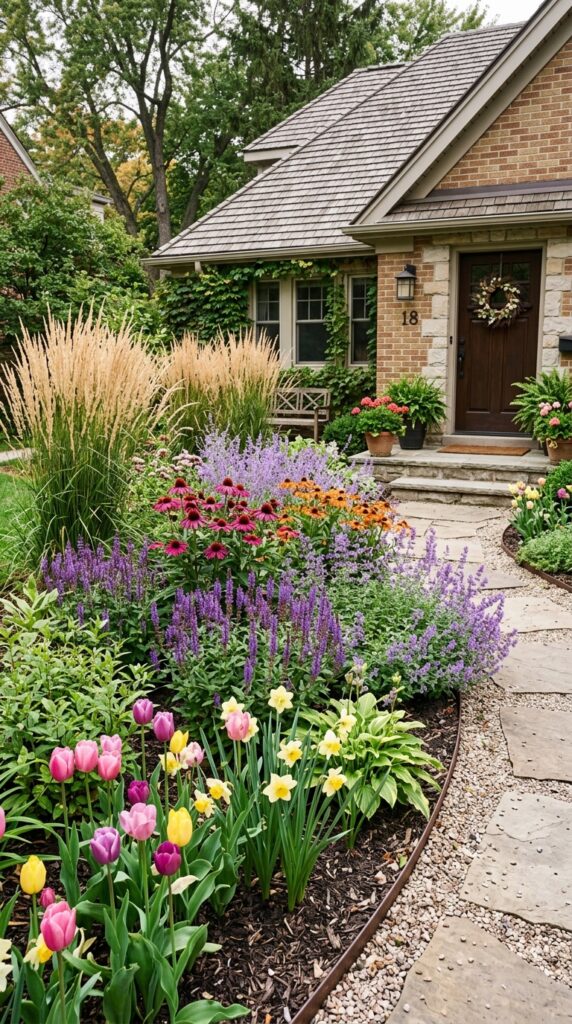
An entrance that looks beautiful in June but bare in November hasn’t been fully designed — it’s been seasonally decorated. True entrance landscaping plans for all four seasons simultaneously. Start with winter bones: evergreen structure from boxwood, holly, or compact yew ensures the entrance never looks completely empty. Add spring bulbs — tulips, alliums, and muscari — planted deep in fall for early-season color that emerges before anything else is awake. Follow with summer perennials that bloom in succession: salvia, coneflower, and rudbeckia carry color from June through September. Let ornamental grasses and asters carry the fall interest before the grasses turn their winter wheat-gold. The design principle behind all of this is simple: something should always be doing something. A thoughtfully layered entrance planting delivers on that promise in every month of the year.
10. Incorporate a Low Retaining Wall
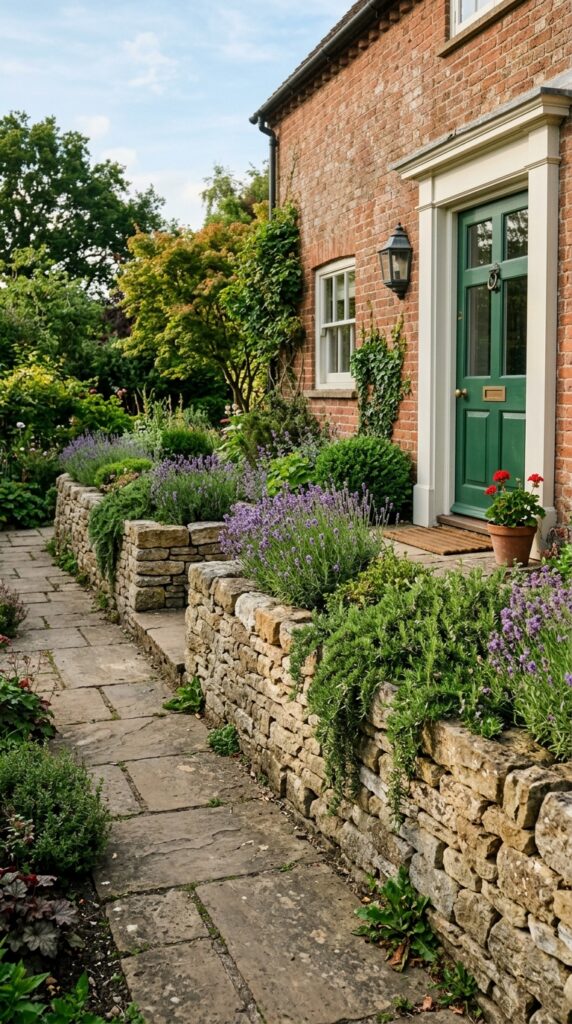
If your entrance has any grade change — even a gentle slope — a low retaining wall is one of the most elegant and functional improvements you can make. It creates a raised bed that elevates planting to a more visible and impactful height, controls erosion, and introduces a strong horizontal architectural element that anchors the entire entrance composition. Dry-stacked natural stone is the most timeless choice and suits almost every architectural style from craftsman to contemporary. Fieldstone, limestone, and bluestone all age beautifully and develop character over time as moss and weathering settle in. For walls under eighteen inches, no engineering is required in most areas — just a compacted gravel base for drainage. Beyond two feet, consult a landscape professional. One practical note: raised beds created by retaining walls drain quickly and dry out faster than ground-level beds, so factor in irrigation or choose drought-tolerant plant material accordingly.
11. Choose a Statement Front Door Color
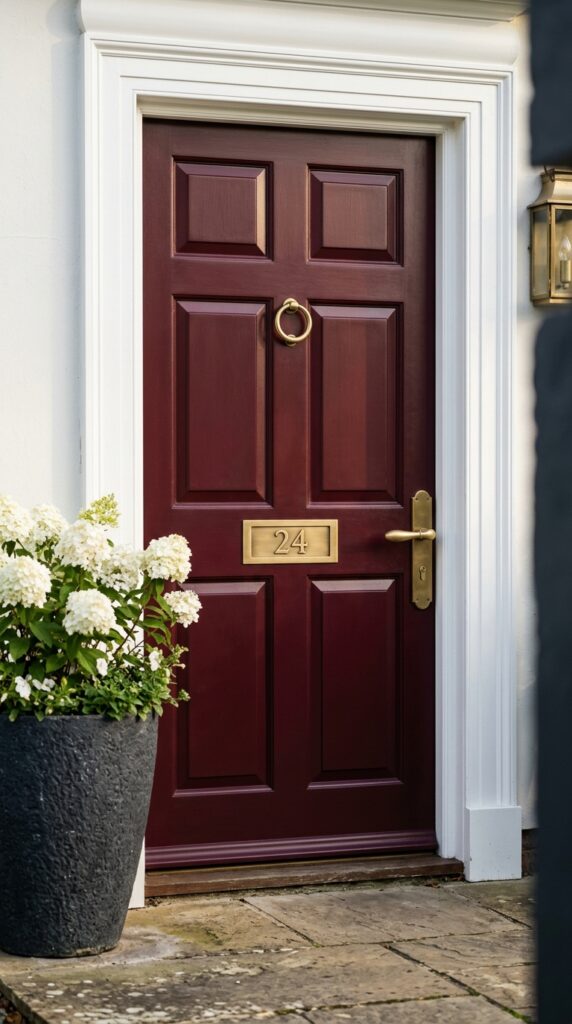
This sits at the intersection of architecture and landscaping, but it belongs in this list because nothing affects the entrance experience more immediately. Your front door is the visual destination of every pathway, every bed, every planting choice you make — it’s what all of it points toward. A deeply committed door color — burgundy, deep teal, forest green, saffron yellow, matte black — elevates the entire entrance and gives the landscaping something bold to work with rather than disappear against. The rule is to go more saturated than feels safe. Muted, hedging colors lose themselves against most siding materials and fail to create the focal point the entrance needs. Pair a bold door with crisp white or very light trim, and choose hardware in a single consistent finish — matte black or unlacquered brass, not both. Semi-gloss finish holds up to door traffic and weather far better than flat.
12. Finish With a Planted Mailbox Vignette
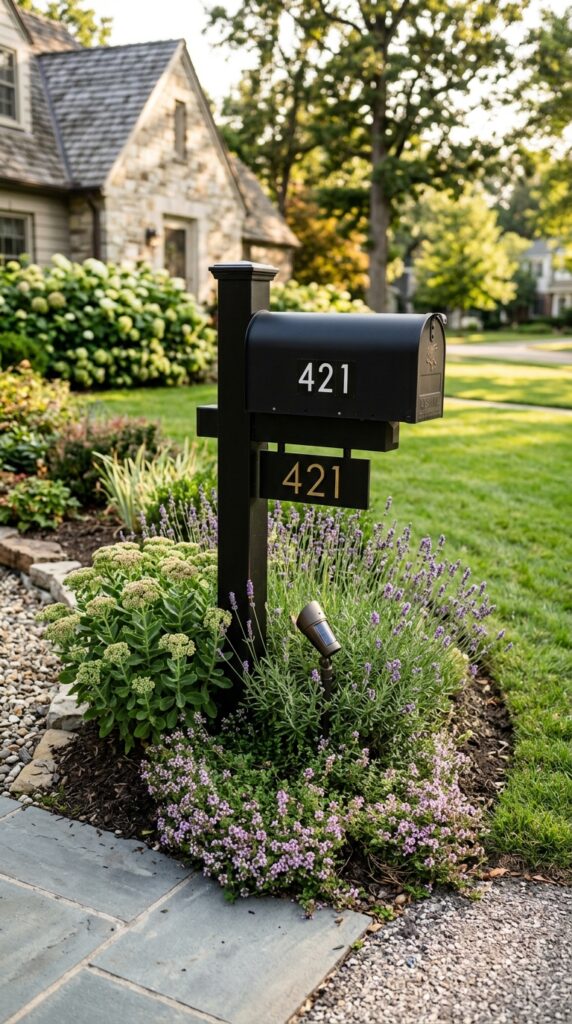
The mailbox marks the beginning of your entrance sequence — it’s the first object a visitor or passerby registers before they even reach the pathway. Treating it as a design element rather than pure utility closes the loop on your entire entrance landscaping scheme. Paint the post a color that echoes your front door or trim. Plant a generous circle — at least eighteen inches radius — of low-maintenance perennials at the base: sedum, creeping thyme, lavender, and ornamental grasses all thrive in the typically dry, lean soil around a mailbox post without demanding much attention. Add a small directional spotlight aimed at the house number for nighttime legibility. The planting here doesn’t need to be elaborate — it needs to be intentional, tidy, and consistent with the rest of your entrance design language. A well-dressed mailbox tells visitors, before they’ve reached your door, that the whole property has been considered.
A beautiful front entrance doesn’t require starting over — it requires paying attention to the right details in the right sequence. The pathway sets the structure. The planting layers add depth and life. The lighting extends the welcome into evening. The finishing touches — a bold door color, clean edges, a planted mailbox corner — tie it all together into something that reads as designed rather than just maintained. What makes entrance landscaping genuinely satisfying is that it compounds: each improvement makes the next one more visible and more rewarding. Start with the element that bothers you most, execute it well, and let the rest follow. Your front entrance is working every single day whether you’ve designed it or not — these ideas simply make sure it’s working in your favor.