River rock is one of those materials that looks deceptively simple — just stones, right? But spend ten minutes scrolling through high-end landscape design portfolios and you’ll notice something: the yards that stop you mid-scroll almost always have river rock somewhere in them. Smooth, rounded, and naturally worn by centuries of water movement, these stones carry a kind of effortless authority that gravel simply can’t replicate. They don’t scream “DIY weekend project.” When used well, they whisper “intentional design.”
The real secret isn’t the rocks themselves — it’s how you layer them, what you pair them with, and where you let them breathe. Used poorly, river rock can look like a bag of stones got dumped in a corner. Used well, it can transform a flat, forgettable yard into something that looks like a landscape architect charged five figures for it. This guide is going to show you exactly how to get there, with twelve distinct approaches that span everything from dry creek beds to container vignettes to sleek modern borders.
1. The Dry Creek Bed That Actually Moves
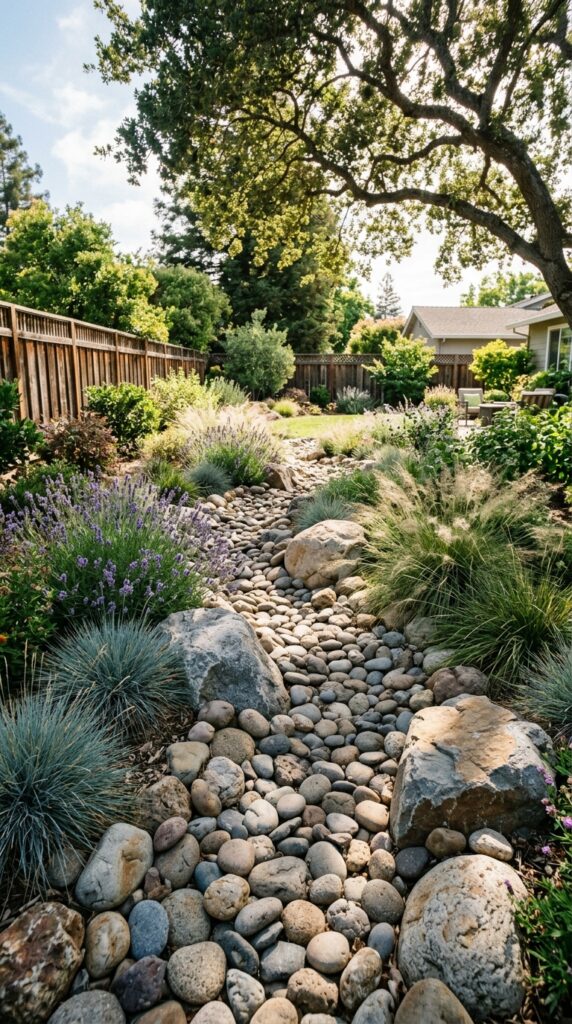
A dry creek bed is the single most impactful thing you can do with river rock, and most people botch it immediately by making it too straight. Real water doesn’t travel in straight lines — it curves, narrows, widens, and drops. If your creek bed looks like a corridor, start over.
The trick is to vary your rock sizing deliberately. Use your largest rocks (think cantaloupe-sized) on the outer curves where “water” would have slowed and deposited heavy material. Medium stones fill the main channel. Smallest pebbles and fine gravel sit at the straightest, fastest sections to mimic high-flow erosion. This single detail is what separates a designer installation from a DIY dump-and-spread job.
Plant along the edges, not in the bed. Blue fescue, society garlic, and ornamental salvias spill naturally over the banks without crowding the stone. One constraint worth noting: if your yard is completely flat, a dry creek bed can look staged rather than believable. Even a two-inch grade change makes a world of difference. Borrow a shovel and create it.
2. River Rock Mulch Around Statement Trees
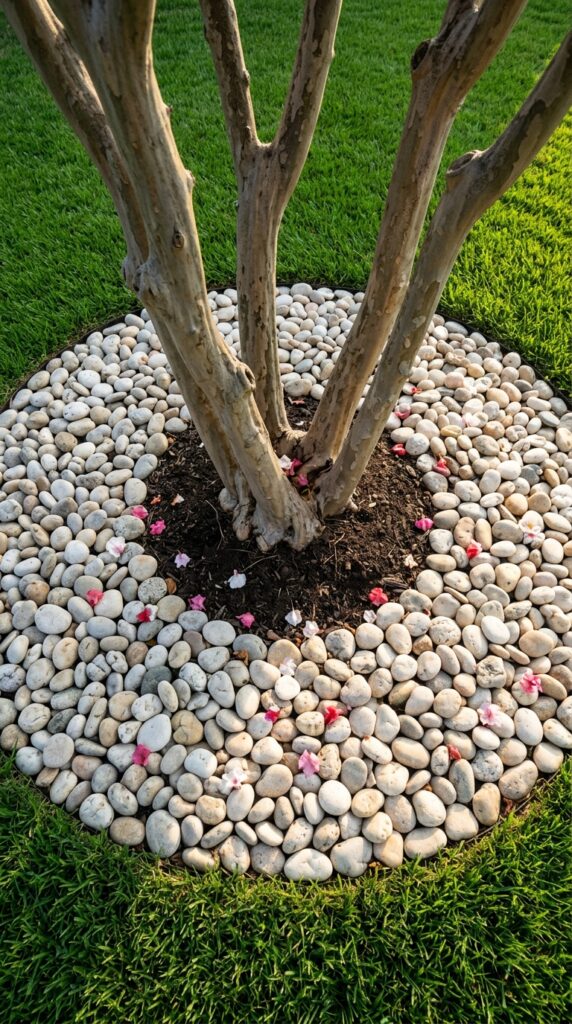
Swapping wood chip mulch for river rock around a focal tree is one of the fastest visual upgrades in landscaping — and it’s a decision you’ll never have to revisit. No re-mulching every spring, no color fade, no displacement after heavy rain.
Choose a single stone color that complements your home’s exterior rather than defaulting to whatever’s cheapest at the garden center. Cream and white river rocks look stunning against dark soil and green lawn, giving a clean, almost Japanese garden quality. Grey river rock reads more contemporary. Russet-toned stones warm up a Mediterranean or craftsman exterior beautifully.
Keep the ring generous — at least two to three feet from the trunk — and go two to three inches deep so soil doesn’t peek through. What you want to avoid is the “donut” look: a thin, stingy ring of rock that looks like an afterthought. Make it a statement. One thing to watch: river rock holds heat in summer. For newly planted or sensitive trees, check soil moisture more frequently during the first season. For established trees, it’s genuinely low-maintenance magic.
3. The Gravel-and-Rock Zen Entry Path
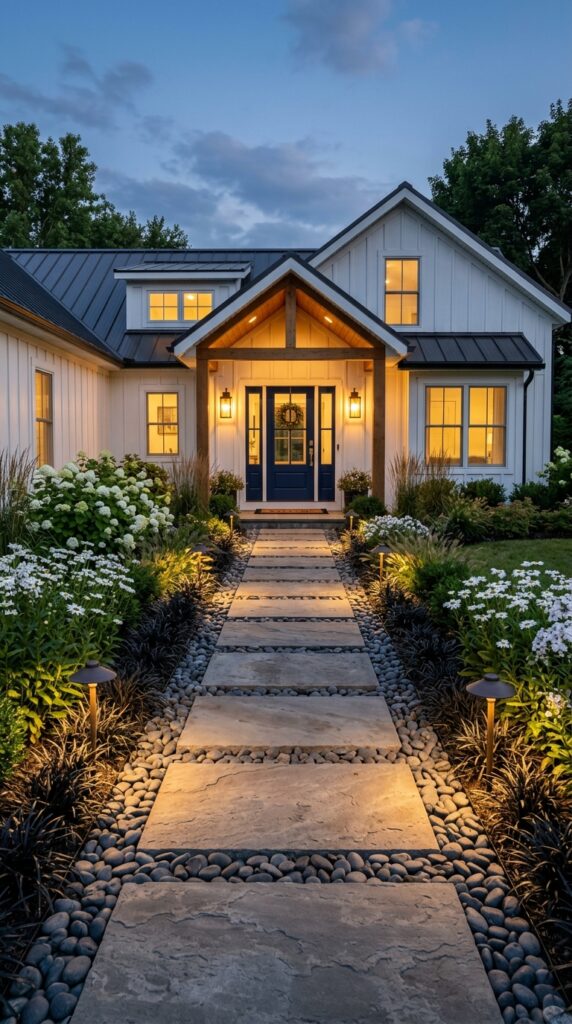
An entry path is the first sentence of your home’s design story. If it’s plain concrete or bare soil, you’re already boring your guests before they’ve knocked. Here’s the combination that works consistently: large flat stepping stones — bluestone, slate, or even thick irregular fieldstone — set directly into a river rock bed rather than a lawn or soil.
The river rock does several jobs at once. It eliminates weeds between stepping stones without chemicals, it creates beautiful drainage, and visually it frames each stepping stone like a gallery floor frames a sculpture. Space stepping stones at a natural walking stride: roughly 18 to 24 inches center-to-center. Too far apart and visitors mince awkwardly; too close and the path loses its intentional rhythm.
Border the whole path with low, clumping plants — mondo grass, liriope, or low ornamental alliums — to soften the stone-on-stone composition. Lighting here earns back its cost tenfold. Two or three low-voltage bollard lights or flush path lights transform this entry at night into something genuinely atmospheric. Don’t skip it just because it seems like extra effort.
4. Raised Planter Beds Edged in River Rock
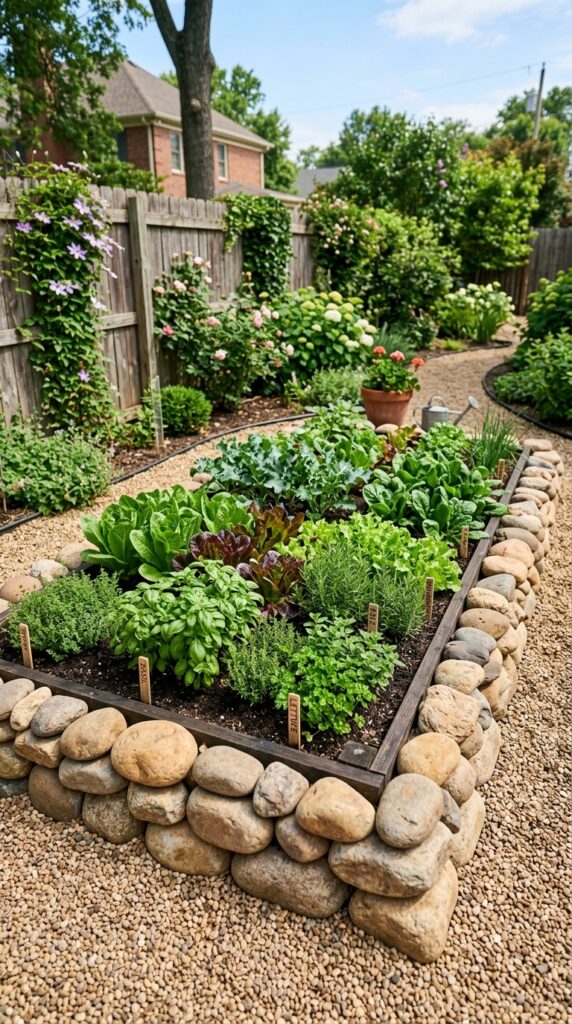
Raised beds have exploded in popularity, and for good reason — but most of them look utilitarian at best and messy at worst. A double-stacked border of smooth river rock along the base perimeter changes the entire aesthetic. It grounds the bed visually, creates a clean transition between the raised planting zone and the surrounding ground, and adds weight and permanence that no plastic edging can replicate.
Use rocks that are at least fist-sized for the border — anything smaller shifts out of alignment within a season. Stack two layers, pressing the second row slightly inward so the border has a slight batter (lean) rather than sitting perfectly vertical. This looks more intentional and holds better over time.
This approach works especially well when the surrounding ground is covered in pea gravel or decomposed granite rather than lawn, since it creates a cohesive stone-on-stone palette throughout the space. One constraint: if you have children who help in the garden, loose border rocks can become projectiles. In that case, consider mortaring the base layer or using larger, heavier stones they genuinely can’t pick up easily.
5. A River Rock Fire Pit Surround
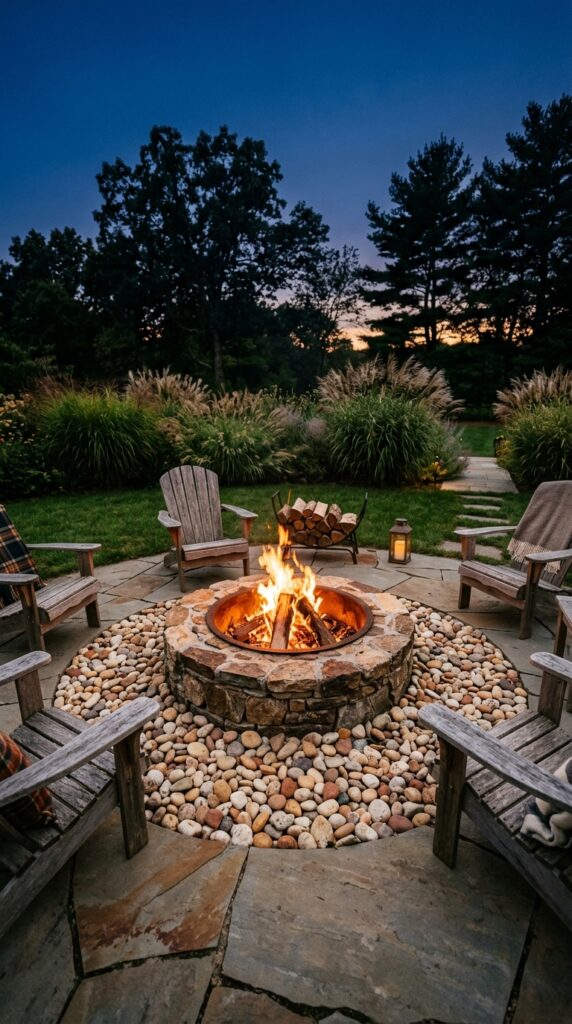
A fire pit without proper grounding looks like a hole in the ground with chairs around it. A river rock surround transforms the whole zone into an actual outdoor room — a defined gathering space with texture, warmth, and intention.
The most polished version of this involves three concentric zones: the fire pit structure itself (stone, steel, or brick), a first ring of larger river rocks six to eight inches wide packed tightly around the base, and a wider outer ring of medium-sized rocks extending another foot or two. This creates visual depth and mirrors how a real riverbed looks when the water pulls back from the bank.
Choose warm-toned stones — russet, amber, cream — for fire pit surrounds specifically. Cool grey river rock can look slightly cold and flat beside actual flame. That said, grey works beautifully in the outer zone while warm tones anchor the center. One practical note: the ring directly adjacent to the fire pit will discolor from heat and ash over time. Embrace it — the patina is attractive. Keep a light broom handy to sweep ash from the stone surface after each use, since buildup does eventually dull the color.
6. Minimalist Japanese-Inspired Rock Garden
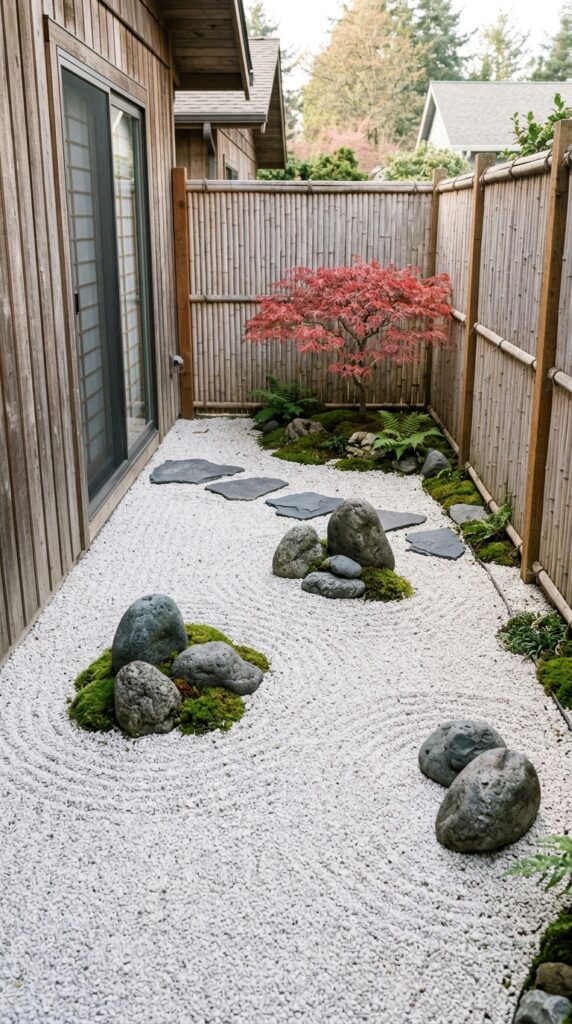
Not every garden needs to be full. This is the principle behind Japanese rock garden design, and it’s the one most Western landscaping instinctively resists. The result of that resistance is yards packed with too many plants, too many materials, and no visual breathing room.
River rocks in a Japanese-inspired composition work as focal points, not filler. You’re placing three to five significant stone clusters — not spreading rock as ground cover — and allowing negative space to do the heavy lifting. Pair smooth dark river rocks with raked fine gravel or white decomposed granite for maximum visual contrast. The color opposition between dark stone and pale ground is what creates that serene, expensive-looking tension.
This approach works brilliantly for narrow side yards that are too shaded or too dry for lawn. Drought-tolerant, zero maintenance once established, and visually interesting in every season. One honest caveat: this style demands discipline. If you’re someone who instinctively fills every gap with another plant, you’ll fight this design constantly. It only works if you trust the emptiness.
7. River Rock Waterfall Feature
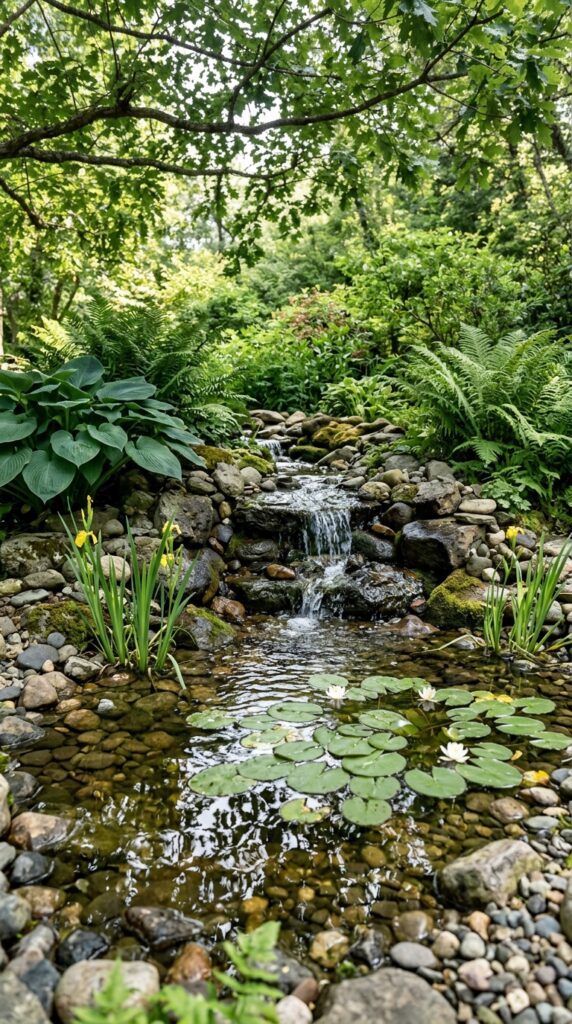
A water feature built with river rock looks like the land simply decided to do this on its own. That’s the goal — absolute naturalism. Anything that looks too engineered kills the effect immediately, so the placement of every stone matters.
Start with your largest rocks at the base and sides to create the “bank,” then work upward toward the water source with progressively smaller stones, using mid-sized rounded rocks to create the actual cascade steps. The key detail most DIY installations miss: tuck plants into the crevices between rocks, even if it means drilling a small hole in a hollow stone to hold soil. Moss, creeping Jenny, and water-tolerant sedges growing between rocks is what makes the whole thing look ancient and inevitable rather than freshly assembled.
River rock naturally handles the engineering problem of exposed liner — it conceals every edge of the pond liner that would otherwise look industrial and fake. Go at least three rocks deep at all visible edges. One thing to watch: smaller river rocks shift under pump turbulence near the waterfall head. Weight them in place with a dab of aquatic-safe mortar on the underside.
8. Modern River Rock Border Along a Fence Line
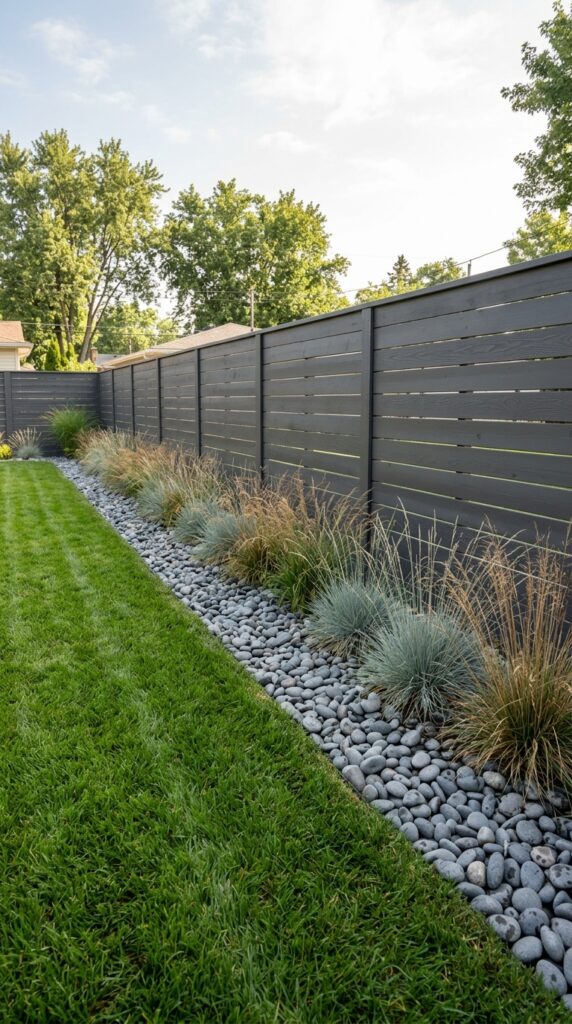
Fence lines are one of the most neglected spaces in residential landscaping. Most people default to either bare soil with some scraggly shrubs or a mowing strip of plain gravel. A river rock border is neither of those things — it reads as deliberate, finished, and architecturally considered.
The key to making this look expensive is consistency: same stone, same depth (three to four inches), and a clean edge on the lawn side. You don’t necessarily need a steel or aluminum edging strip if your stone is heavy enough — but a good straight edge cut into the turf with a spade gives the border its crisp definition. Plant ornamental grasses behind the rock rather than in front; grasses behind the stone layer create depth, while grasses in front of the rock obscure the material and muddy the composition.
This approach is also wonderfully practical. Rocks along the fence eliminate the impossible task of mowing or trimming right up against fence posts, reduce moisture against the wood, and deter the weeds that always colonize fence lines. Choose grey river rock against a dark fence and the whole composition looks like a landscape architect’s sketch brought to life.
9. River Rock Mulch in a Desert-Style Front Yard
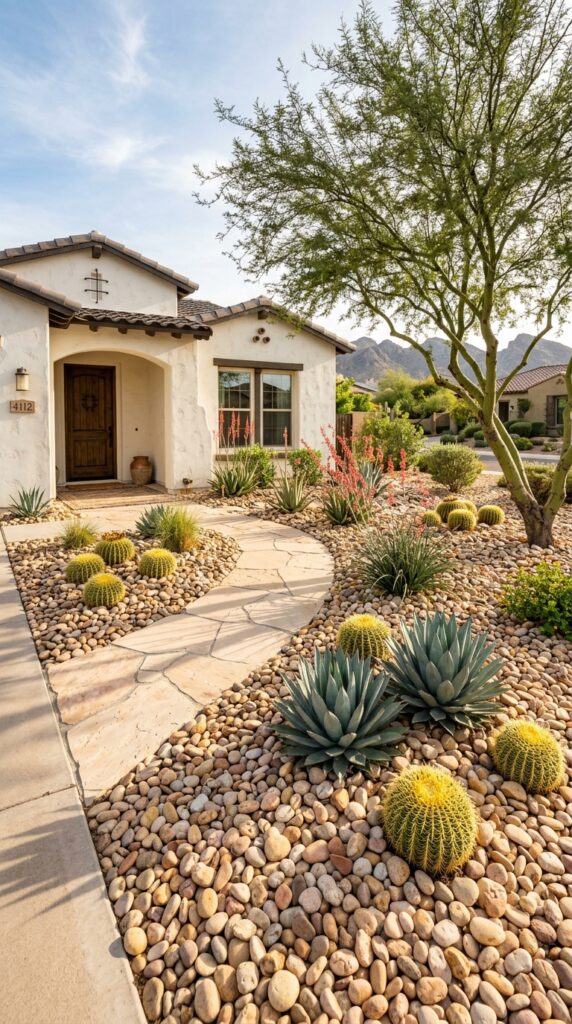
Lawn removal is no longer a fringe landscaping decision — in drought-prone regions it’s both financially and environmentally sensible. But the replacement material matters enormously. Fine gravel looks cheap. Decomposed granite looks utilitarian. River rock, layered thoughtfully as ground cover across a xeriscape front yard, looks like it belongs in an architectural magazine.
The proportions that work: roughly 70% rock ground cover, 20% statement plants, 10% hardscape (path, border, or low wall). This ratio gives the rock room to breathe and be noticed while the plants provide vertical interest and seasonal color. Use two or three complementary stone colors rather than a single tone — cream with warm grey, or tan with russet — for visual depth.
One constraint that’s worth saying plainly: this style looks extraordinary in the right climate and awkward in the wrong one. In a rainy, lush region surrounded by green lawns and established trees, a desert-style front yard can look stranded. Context matters. But in the American Southwest, Southern California, the Mediterranean coast, or arid Australia, this is genuinely the most beautiful — and lowest-maintenance — front yard decision you can make.
10. Stone Steppers Set in a River Rock River
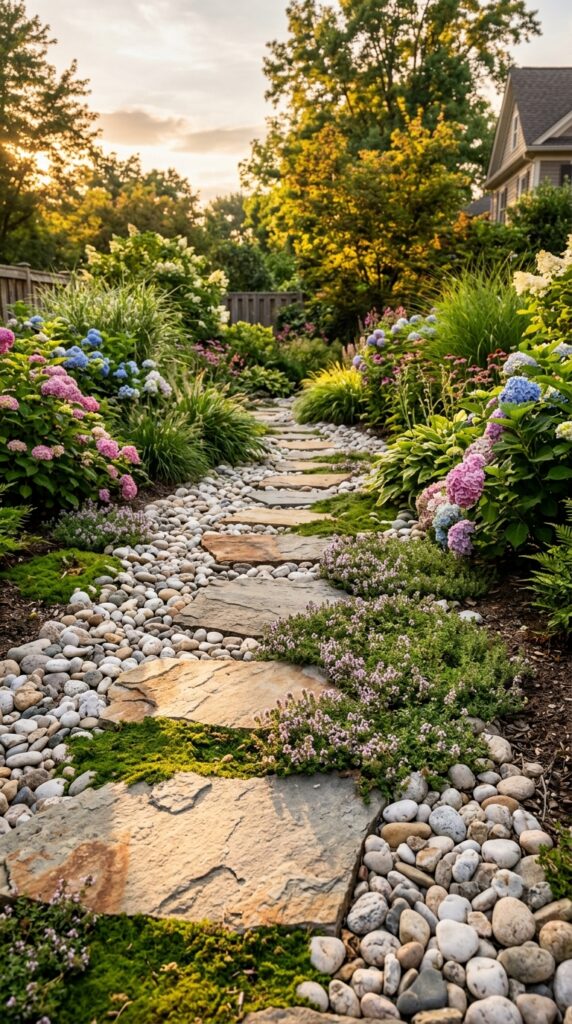
This is one of those design moves that photographs beautifully and performs even better in person. Instead of a path set into lawn or soil, the stepping stones float in a river of river rock — and the path suddenly becomes a feature rather than infrastructure.
The river of rock should be wider than the path by at least a foot on each side, so the steppers appear genuinely embedded in stone rather than simply placed on it. Vary the river’s width as it moves through the garden — let it narrow between tight plantings and open into wider pools near seating areas or focal points. This mimics the natural rhythm of water and keeps the design from feeling mechanical.
Creeping thyme, mind-your-own-business, and baby tears are all excellent for threading between river rocks along path edges, softening the composition without overgrowing it. One thing to watch: in regions with heavy rainfall, fine river rock can migrate and fill in around the stepping stones over time. A yearly reset of the stones and a quick raking takes about twenty minutes and keeps everything looking crisp.
11. River Rock Raised Berm with Layered Planting
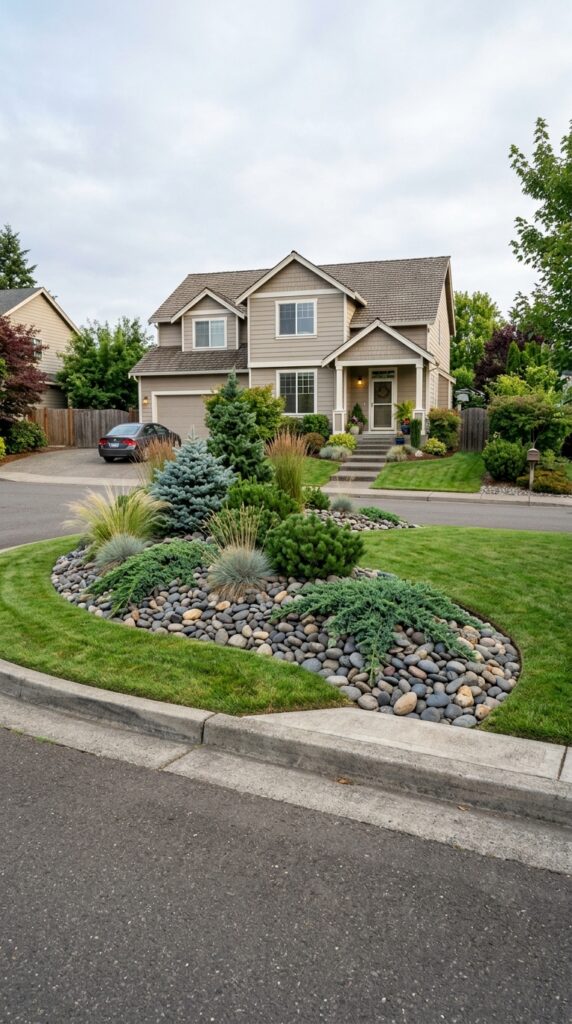
A berm solves several landscaping problems at once — it adds elevation to a flat yard, creates a natural privacy screen, improves drainage, and gives you a planting structure with genuine visual drama. Cover it in river rock and it graduates from “practical mound” to “intentional landscape feature.”
The most important rule for a rock-covered berm: let some of the rocks be large enough that they look like they belong there by geological logic. A berm covered exclusively in small river pebbles looks like someone scattered birdseed. Use a few anchor boulders (at least watermelon-sized) as the foundation, then fill in with medium and small river rocks around and between the planted specimens.
Plant dwarf conifers for year-round structure — ‘Blue Star’ juniper, ‘Montgomery’ dwarf spruce, or ‘Nana’ hinoki cypress all work beautifully with grey river rock. Ornamental grasses add movement. Spreading ground-covering junipers that drape over the rock face are the detail that makes the whole berm look mature and settled even in the first season. This is a design commitment, not a weekend whim — build the berm with proper fill and soil before you ever place a single stone.
12. The Courtyard Pool Surround in River Rock
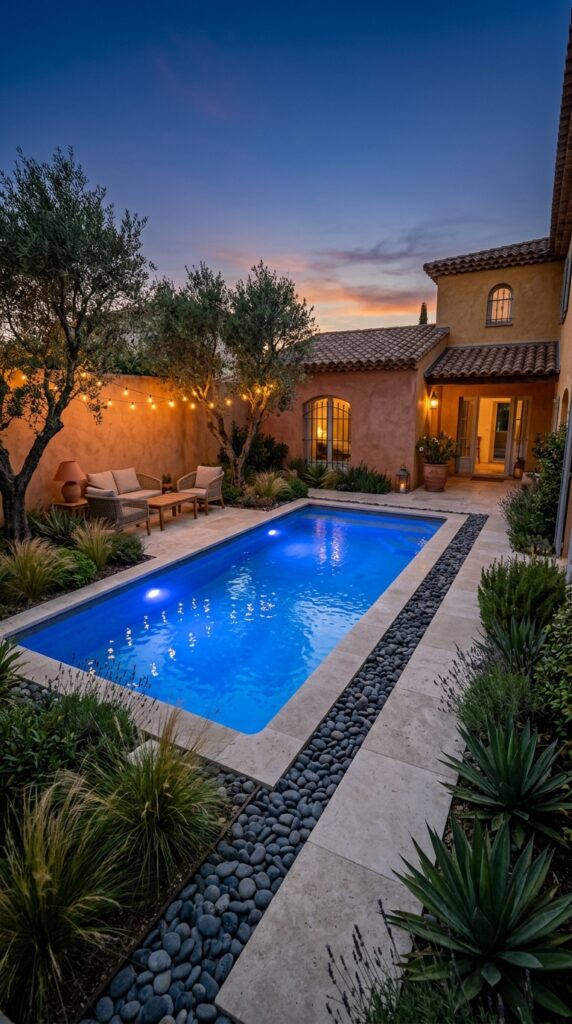
Pool surrounds are where landscaping either earns its money or wastes it completely. Standard concrete copings and plain garden beds around a pool look like a municipal facility. River rock along the planted perimeter of a pool courtyard — not on the deck itself, which is a safety hazard — creates a layered, resort-quality finish that costs a fraction of what you’d expect.
Use the darkest river rocks you can find for pool surrounds: charcoal, deep slate grey, and almost-black stones. Dark rock beside blue water creates a natural, high-contrast palette that photographs beautifully and looks even better in person. Against pale limestone or travertine pool coping, the contrast is genuinely striking.
Keep the river rock contained to the planted beds, not the walking surfaces. Use steel landscape edging to hold the boundary cleanly and prevent rocks from migrating onto the pool deck. Plant ornamental grasses, dwarf agave, and clumping bamboo among the rocks for height and movement. Evening lighting is non-negotiable in a pool courtyard — warm-toned uplighting directed through the ornamental grasses and across the river rock creates shadow-play that transforms the space after sunset.
A Few Stones Worth Taking With You
River rock earns its keep not because it’s trendy, but because it solves genuine problems with genuine beauty. It handles drainage, suppresses weeds, eliminates high-maintenance lawn areas, and does all of it while looking like the landscape was simply born this way. That combination is rare in any design material.
What separates expensive-looking river rock work from average results is almost never the budget — it’s the details. Stone size variation. Thoughtful plant pairings. Proper depth. A little restraint where restraint serves the composition. None of these cost more money. They cost more attention, and that’s a resource every one of us has.
If you take one thing from this article, let it be this: river rock is not a background material. It’s a design element that deserves the same deliberate placement as a sofa or a statement light fixture. Treat it that way, and your outdoor spaces will start looking like the yards you save to your inspiration folders. Come back whenever you’re ready for the next project — there’s always another corner of the garden waiting.