There’s something almost magical about handing a kid a stick of chalk and watching them disappear into their own world for an hour. No screens. No batteries. No instruction manual. Just a patch of pavement and a brain firing on all cylinders. As someone who has spent more weekends than I can count chalking out hopscotch grids and pretending to be impressed by my niece’s “abstract” interpretations of our golden retriever, I can say with full confidence: chalk is one of the most underrated tools in a parent’s arsenal.
The trick isn’t just buying a bucket of chalk and pointing at the driveway. The real win comes from setting up a scene that pulls kids in and keeps them busy long enough for you to actually finish your coffee while it’s still warm. These twelve ideas go beyond basic doodling. Some are quiet and meditative, others are loud and sweaty. All of them buy you time, and most of them double as something you’ll secretly want to photograph.
1. The Classic Hopscotch With a Twist
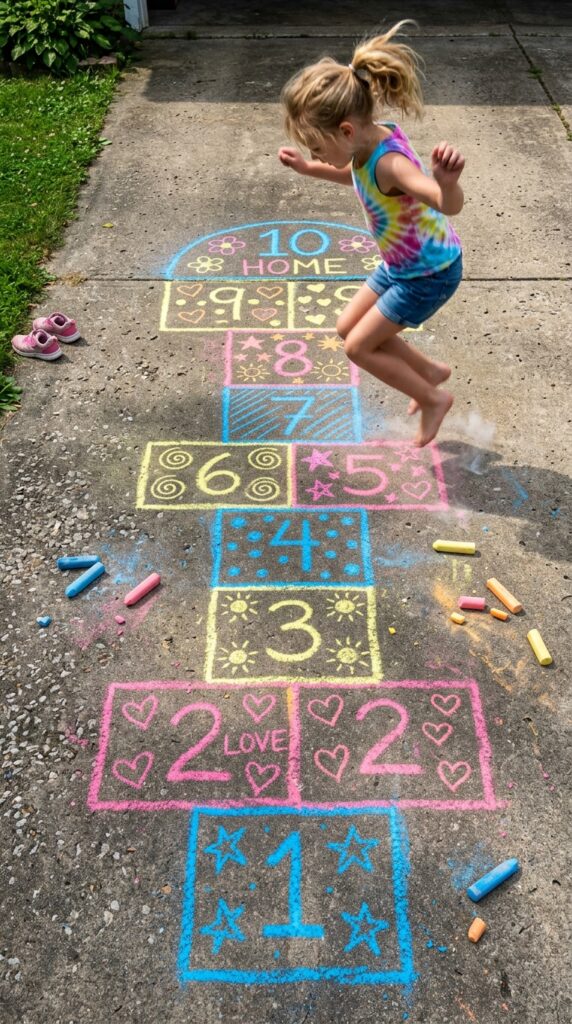
Hopscotch is the gateway drug of chalk games, and there’s a reason it’s survived since literal Roman times. But the basic 1-through-10 grid gets boring fast for kids over five. Here’s the trick: turn each square into a mini challenge. Square three becomes “spin twice.” Square seven says “make a silly face.” Square nine is “hop like a frog.” Suddenly it’s not just hopscotch, it’s a mini obstacle course with personality.
Use chunky chalk for the outlines so the lines stay crisp through several rounds. If your driveway slopes, draw the grid horizontally rather than downhill so kids aren’t fighting gravity on every jump.
One thing to watch: rough concrete eats chalk fast. Stock up on extras before you start, because nothing kills momentum like running out mid-game.
The real magic happens when kids start designing their own challenge squares. Let them.
2. Driveway Roadway for Toy Cars
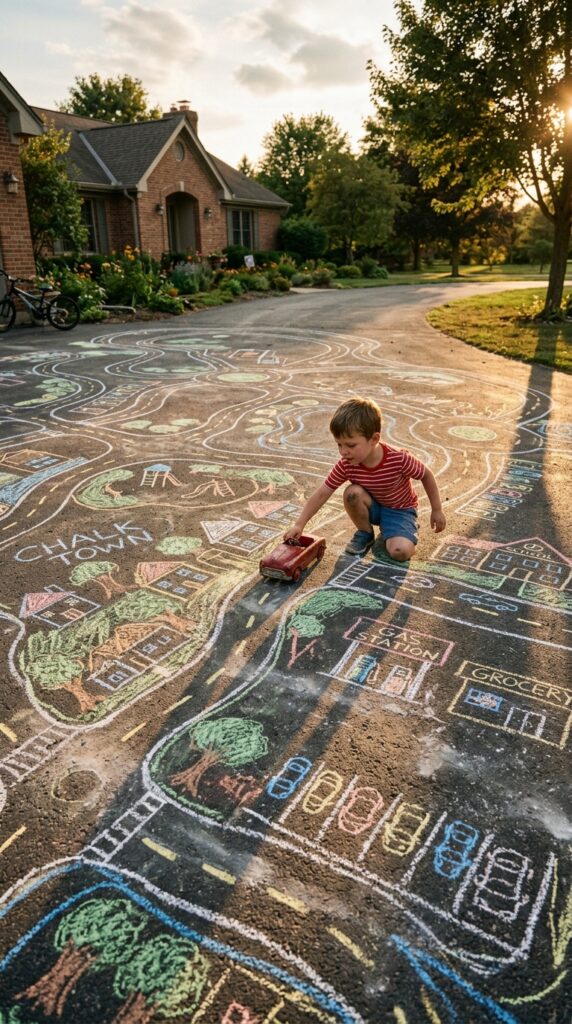
If your kid has a fleet of tiny cars sitting unused in a bin, this is your weekend saved. Draw a full road network across the driveway with lanes, crosswalks, roundabouts, and a few parking lots. The more elaborate, the longer the engagement. I’ve seen kids stay locked in on this for two hours straight, narrating traffic disputes and rerouting around imaginary construction zones.
Add a chalk gas station, a “car wash” near the garden hose, and a few destination buildings like a school or grocery store. Use white chalk for road lines and bright colors for buildings so the contrast is clear.
Skip this if your driveway is steep, the cars roll away and chaos ensues. Flat surfaces only.
A roll of blue painter’s tape can extend the road into the garage on rainy days. Bonus longevity.
3. Giant Chalk Tic-Tac-Toe and Board Games
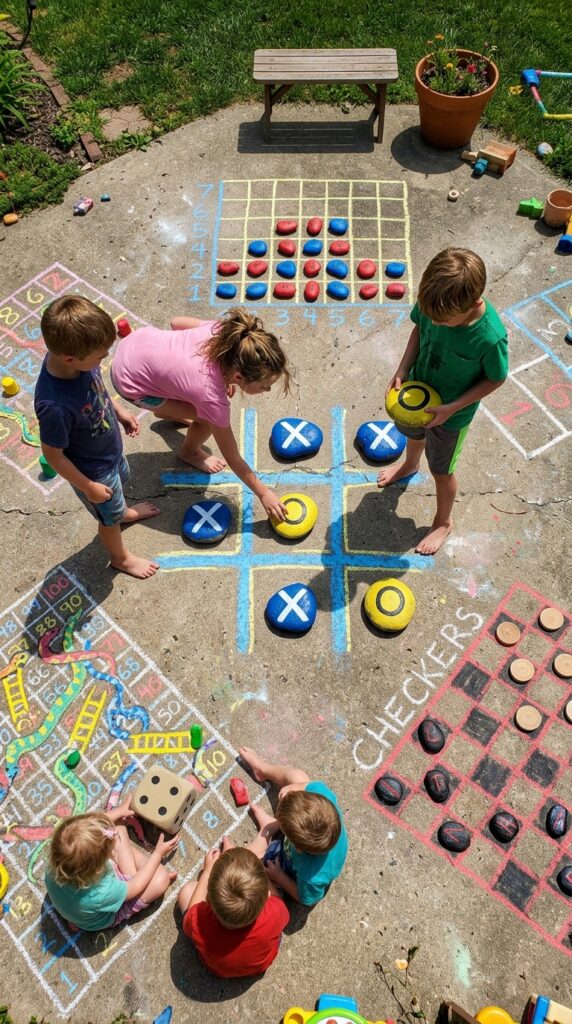
There’s something deeply satisfying about playing a normally tabletop game at human scale. Tic-tac-toe is the easy entry point, but don’t stop there. A giant checkers board with painted rocks as pieces keeps older kids engaged way longer than the screen-based version of the same game.
Use a yardstick or piece of cardboard as a straight edge for the grid lines. Sloppy lines bug kids more than you’d think. For game pieces, painted river rocks work better than chalked symbols because they don’t smudge and you can reuse them indefinitely.
Watch out for sibling competition escalating fast. Have a backup activity ready before the first crying jag begins.
If you want this to last all summer, sketch the grids with outdoor paint pens instead of chalk on a small section of patio. Permanent fun, basically free.
4. The Chalk Obstacle Course
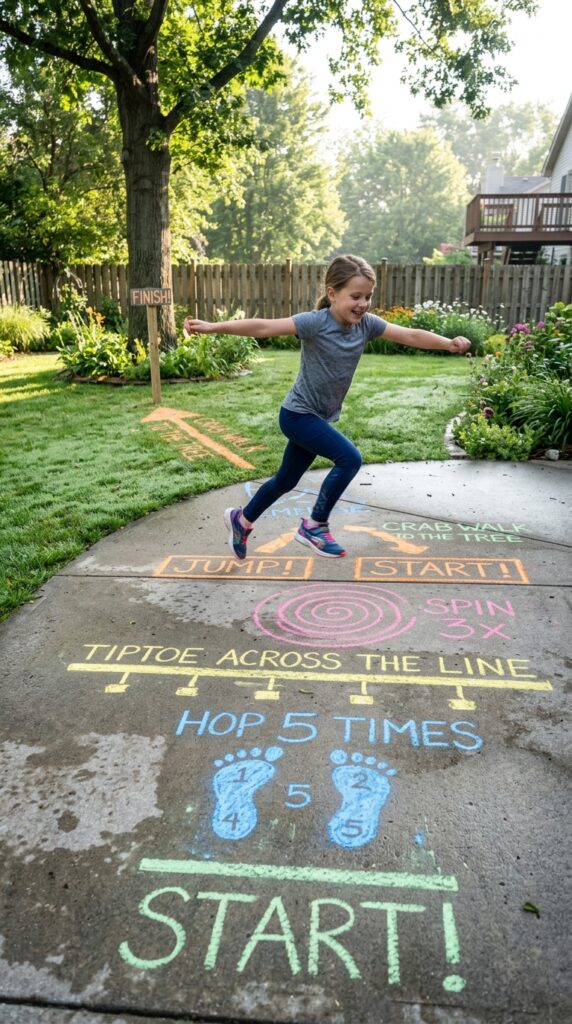
This one is gold for burning off energy on days when the weather’s too hot for the park. Map out a course with chalked stations: hop on one foot to the next mark, spin three times, do a starfish jump, crab walk to the finish line. Kids race themselves, race each other, and somehow find new ways to make it harder.
The genius move is making it loop, so once they finish, they can immediately start again without you having to redesign anything. Add a “rest zone” square so they pace themselves slightly.
One catch: don’t put obstacles too close together. Kids will collide. Ask me how I know.
End the course at a “prize” station, even if the prize is just a sticker or a high five. The finish line moment matters.
5. Chalk Paint Murals
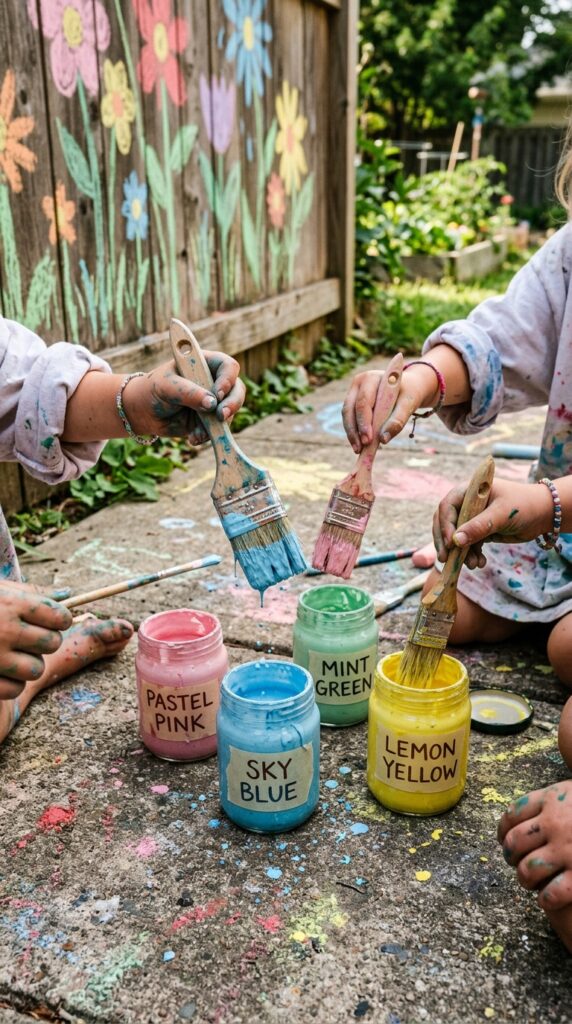
Regular chalk is fine, but chalk paint is where things get serious. Mix cornstarch and water in equal parts, then stir in food coloring or washable tempera until you get the consistency of pancake batter. The kids paint with brushes onto the driveway, fence, or patio, and the pigment goes on saturated and bright in a way regular chalk never quite manages.
It dries to a chalky finish, washes off with a hose, and feels infinitely more “art project” than basic doodling. Use small mason jars for the paint and cheap craft brushes you don’t mind retiring.
The downside: it’s messier than chalk. Wear old clothes. The food coloring version can stain light-colored fabric, so keep it away from your good outdoor cushions.
It rinses off concrete cleanly, which is the only reason I trust it on the patio.
6. Glow-in-the-Dark Chalk for Evening Play
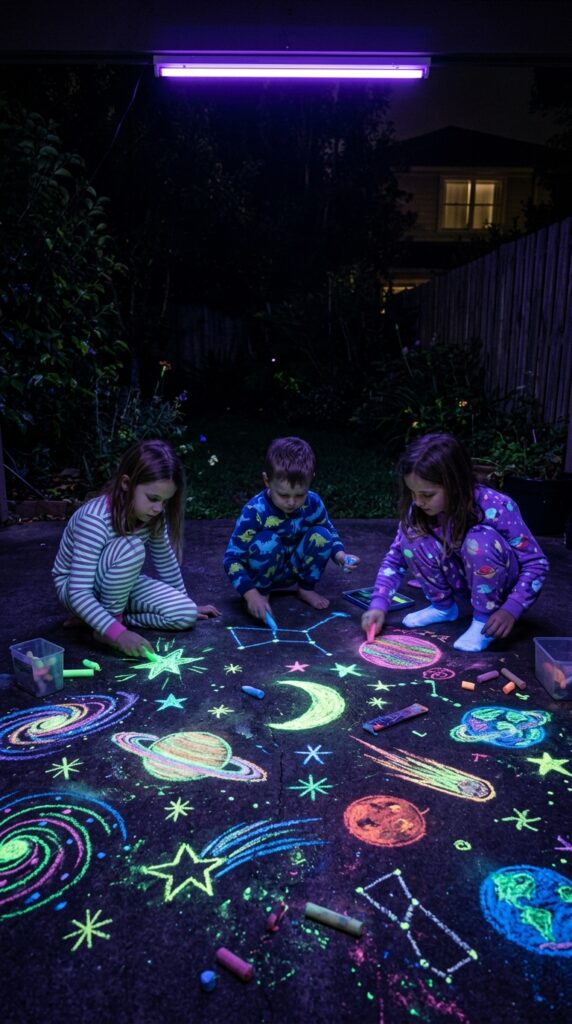
Summer nights with kids who refuse to go to bed at a reasonable hour? Glow chalk is your secret weapon. Draw a galaxy on the patio, light it up with a portable UV blacklight, and suddenly bedtime stalling becomes the best part of the day.
Look for chalk specifically labeled as glow or UV-reactive. Regular chalk with neon pigments won’t work the same way under blacklight. Set up the light at a low angle so the chalk pops without blinding everyone.
Heads up: this works on dark surfaces, not light ones. A pale concrete patio will wash out the effect. Black asphalt or dark pavers are ideal.
There’s something about glowing constellations on the driveway that makes kids quieter. Use that to your advantage.
7. Chalk Self-Portraits and Body Tracing
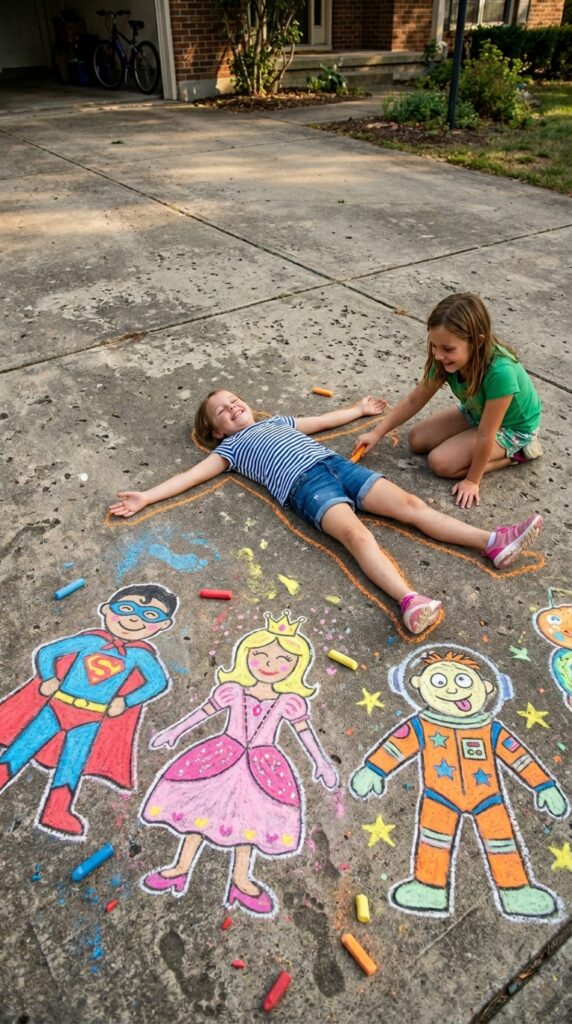
This is the activity that always surprises parents with how long it holds attention. One kid lies down, another traces their outline, and then comes the fun part: filling in the chalk body with outfits, superhero costumes, mermaid tails, whatever the imagination produces. Friends, siblings, even the dog can get traced.
Use a soft chalk for the outline so the kid being traced doesn’t feel scratched up. Stick to the smoothest section of pavement available.
The constraint here is real estate. You’ll need at least four feet of clear space per kid. Crowded driveways turn this into a Tetris problem fast.
Take a photo before the chalk fades. These are the kinds of art pieces kids actually remember years later.
8. Hopscotch’s Cooler Cousin: The Chalk Maze
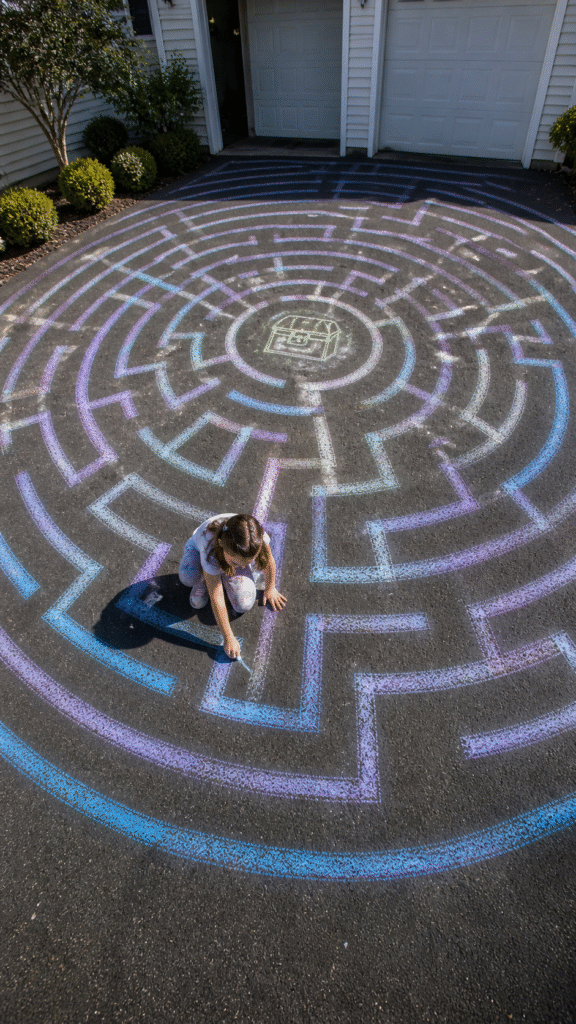
A maze takes longer to draw than to solve, which is honestly part of the charm. Spend twenty minutes designing a labyrinth with branching paths, dead ends, and a treasure spot in the middle, and you’ve bought yourself an hour of kid focus minimum. Older kids love designing their own and challenging siblings to beat them.
Make the corridors wide enough for little feet to walk through without crossing lines. Add small obstacles inside the maze, like a square where they have to hop, or a section where they have to crawl.
Watch out for making it too hard. Kids under five get frustrated with complex mazes. Keep it simple for the younger crowd.
The reward at the center can be a sticker, a snack, or a tiny toy. Whatever it is, make it visible from the start.
9. Outdoor Chalkboard Wall
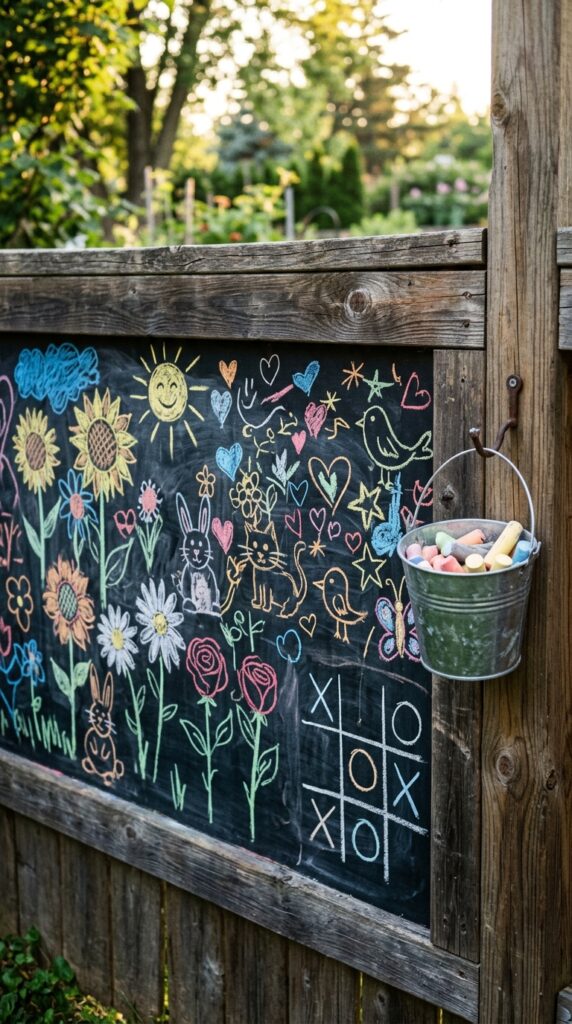
If you’re committed to chalk being a permanent feature of summer, paint a section of fence or an old piece of plywood with chalkboard paint. Mount it at kid-height in a shaded corner of the yard, and you’ve created an outdoor art station that gets used all season.
Use proper outdoor chalkboard paint, not the indoor version, or the weather will eat it within a month. Two coats minimum, and let it cure fully before the kids attack it.
The catch: chalk dust can stain siding or pavers below the board. Place a planter or a small mat underneath to catch the fallout.
This is the project that turns chalk from a weekend novelty into a permanent backyard fixture.
10. Chalk Twister or Color Stomp
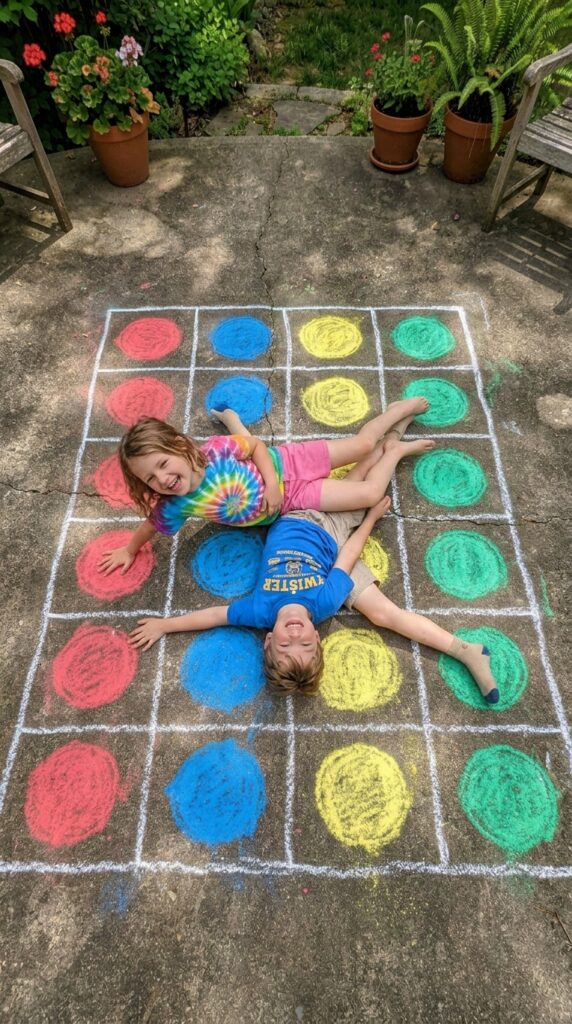
A homemade Twister grid takes about ten minutes to draw and provides about an hour of giggling chaos. Big colored circles arranged in rows of four, a homemade spinner on cardboard, and you’re set. The original game costs money and lives in a box. This version costs a chalk stick and disappears with the next rain.
For younger kids who don’t quite get Twister yet, simplify it to “Color Stomp.” Call out a color, they race to stand on it. Add an animal: “Stomp blue like a bunny.” Done. Instant game.
The drawback is concrete is not as forgiving as a Twister mat. Don’t play this with adults who have bad knees. Trust me.
It’s the kind of game that ends in a pile of laughing kids on the driveway. Nothing wrong with that.
11. Chalk Garden With Pretend Flowers
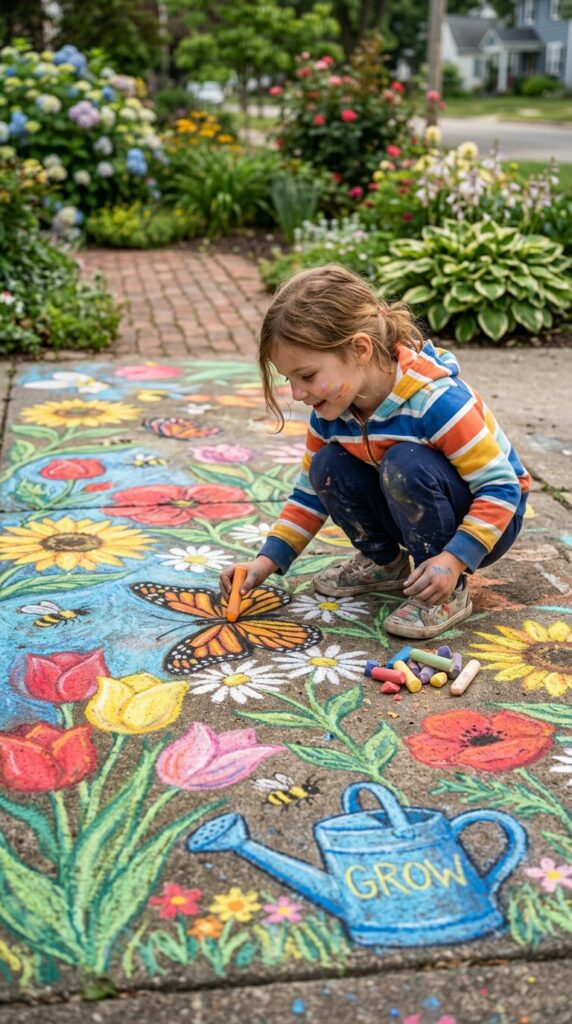
This is the quiet, meditative cousin of the obstacle course. Hand a kid chalk and ask them to draw a garden, and watch what happens. Flowers, vines, butterflies, ladybugs, a sun in the corner. It’s the kind of activity that pulls in the more introverted kid who finds racing games overwhelming.
Encourage them to use the side of the chalk for soft texture, and the tip for outlining. Show them how to blend two colors with their fingers for shading. These small techniques make a huge difference in how the final mural looks.
The catch: this works best on smooth concrete. Rough textures fight delicate detail work and frustrate kids who want their petals to look like petals.
A real flower laid beside the chalk garden makes for a sweet photo. Just saying.
12. Chalk Storytelling Path
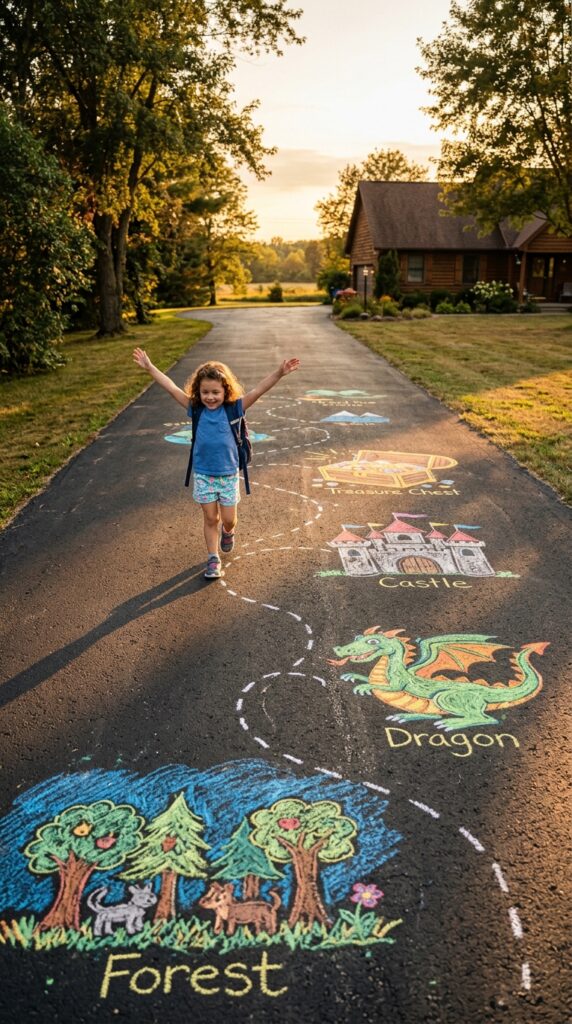
Save the best for last. The chalk storytelling path turns the driveway into a literal narrative. Draw a winding path with stops along the way: a forest, a river to jump over, a dragon to defeat, a castle at the end. The kid walks the path and acts out each scene, sometimes for thirty minutes, sometimes for two hours.
Older kids love designing the story themselves. Younger ones love being told what comes next at each station. Either way, it’s storytelling, movement, and creative play stitched together.
The constraint is space. You need a long, uninterrupted stretch of pavement. Short driveways can do this in a loop instead of a straight line.
This is the idea that turns chalk from a craft into an entire afternoon.
Wrapping It All Up
Chalk is one of those wonderfully low-stakes parenting tools. It’s cheap, washes away with the next rain, and somehow manages to keep kids more engaged than half the toys gathering dust in their rooms. The ideas on this list aren’t meant to be done all at once, that would exhaust everyone, including the dog. Pick one for a sleepy Saturday, save another for when the cousins visit, and keep a few in your back pocket for those long summer afternoons when “I’m bored” gets repeated every fifteen minutes.
What I love most about chalk play is how much it leaves room for kids to bring their own ideas to the surface. You set up the scene, and they take it somewhere you didn’t expect. That’s the part worth showing up for. If you tried something here and it became a hit at your house, or if your kid invented a chalk game I haven’t thought of, I’d genuinely love to hear about it. This site is built on real ideas that real families test in their real driveways, and you walking away with one new thing to try this weekend is exactly why I write these. See you back here for the next one.