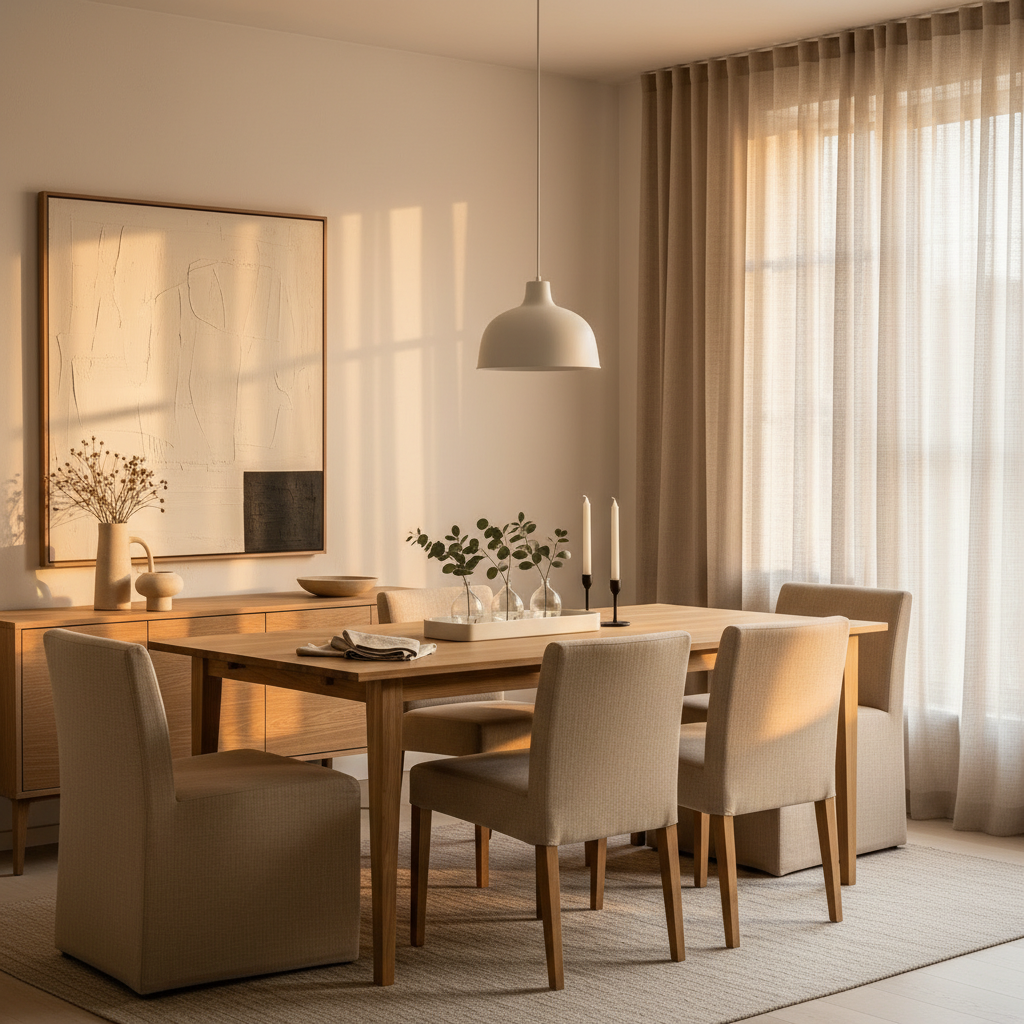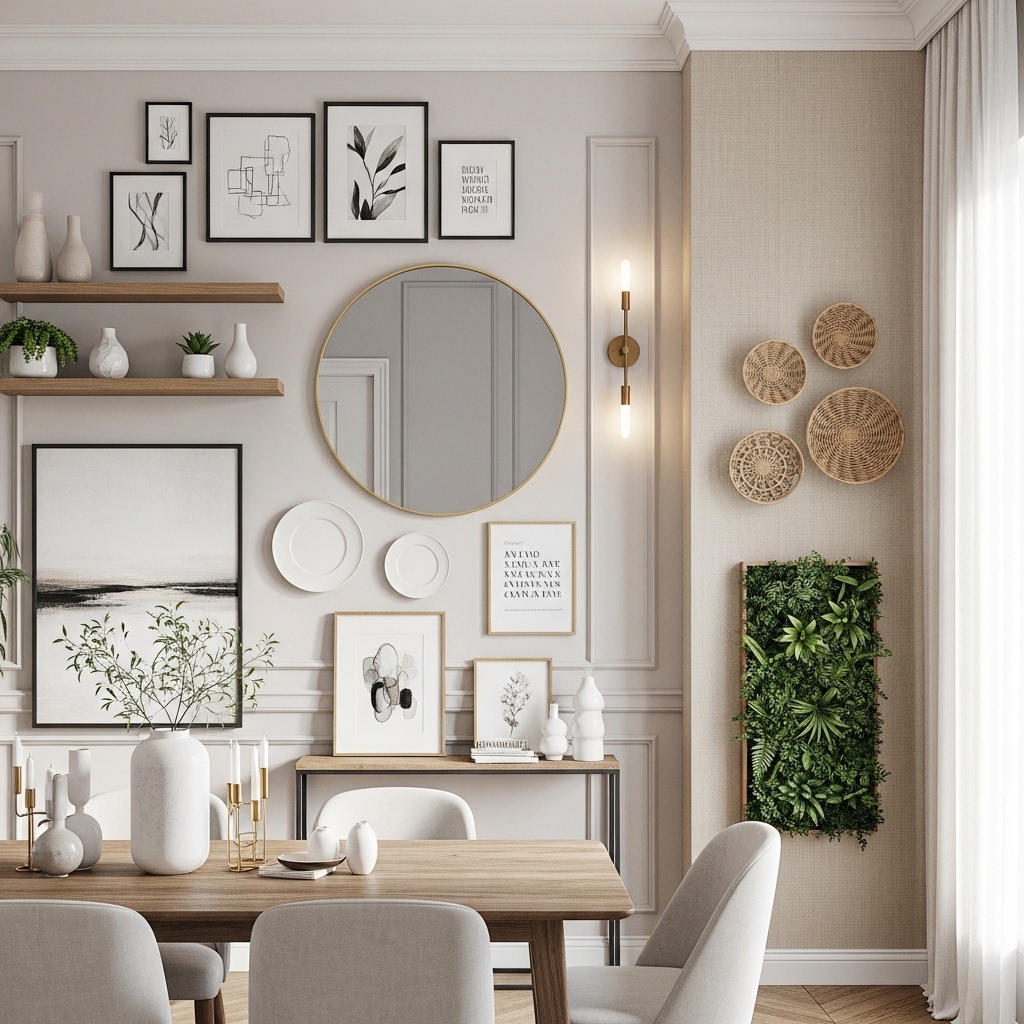
There’s a reason professional interior designers almost always include a mirror in the dining room. It’s not a trick, exactly — it’s more of a quiet amplifier. A well-placed mirror makes natural light work twice as hard, makes a room feel taller or wider without touching a single wall stud, and gives the space a kind of layered depth that furniture alone can’t achieve. But mirrors in dining rooms are also one of those things people get very wrong, very easily. The wrong size, the wrong frame, the wrong placement — and suddenly your dining room looks like a hotel corridor or a badly staged real estate listing.
This guide is for people who want to do it right. Whether you’re working with a small galley space, a narrow apartment dining nook, or a proper dedicated dining room with decent bones, there’s a mirror approach here that will work with your light, your furniture, and your taste. We’re going into detail — materials, placement logic, what to skip, and why certain combinations age better than others. Some of these ideas are bold. Some are quietly transformative. All of them are specific enough to actually use.
1. The Leaning Arch Mirror Behind the Sideboard
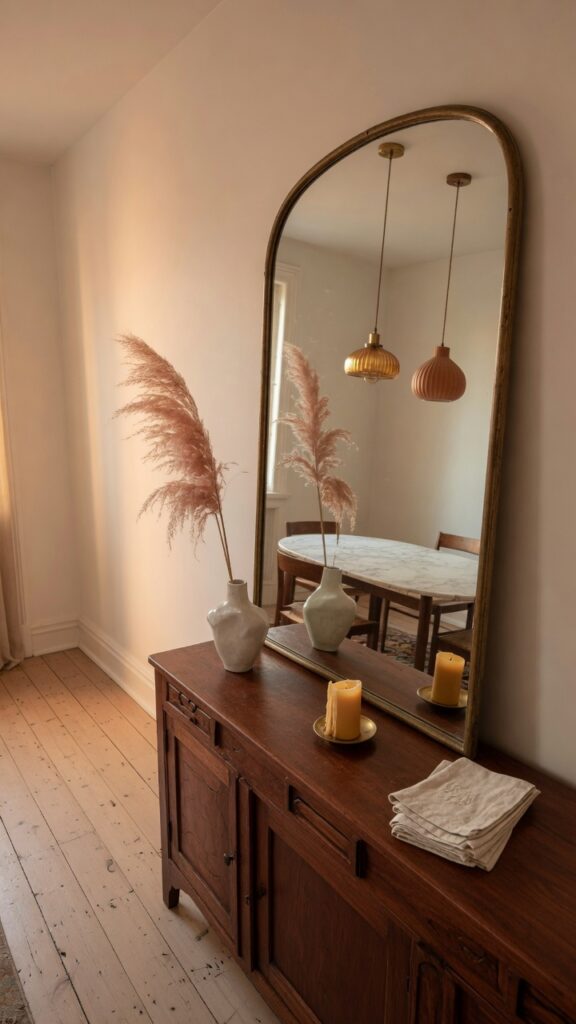
There’s something genuinely relaxed about a leaning mirror that wall-mounted options will never replicate. It signals intention without rigidity — like someone put it there and liked how it looked, rather than measuring twice and drilling four holes. Behind a sideboard, a tall arched mirror does real work: it reflects the pendant lights above the dining table, bounces afternoon light back across the room, and creates a secondary focal point that doesn’t compete with the table itself.
For this to land well, the mirror needs to be tall — at least two-thirds the height of the wall — and the arch shape specifically helps soften rooms with very boxy architecture. A thin brass or unlacquered bronze frame ages beautifully alongside walnut or dark-stained oak. Style the sideboard with restraint: one tall object, one low object, negative space. Overcrowding the surface in front of a mirror just creates visual chaos when it reflects back at you.
One thing to watch: if your dining room is small, a leaning mirror at that scale can feel oppressive rather than airy. Save this idea for rooms with at least ten feet of wall space to breathe into.
2. Antique Mirror Panels for a Moody, Layered Wall
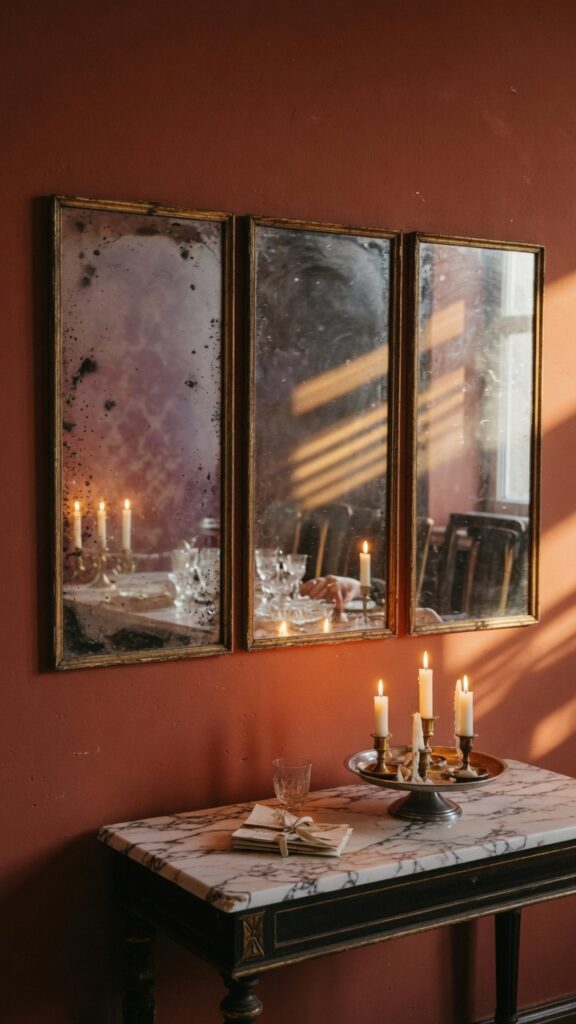
Antique mirror panels — the kind with foxed, oxidized surfaces that reflect imperfectly — are one of the most underused tools in residential dining room design. Unlike a clean contemporary mirror, they absorb light as much as they bounce it, which creates warmth rather than brightness. In a dining room that already gets good natural light, this is often exactly what you want. You’re not trying to make the space feel bigger. You’re trying to make it feel like somewhere worth lingering.
Mount three equal rectangular panels at the same height with a consistent gap between them — about two inches works. The repetition reads as intentional wall art rather than a storage-unit aesthetic. Deep wall colors behind antique mirror panels are transformative: clay, oxblood, bottle green, even a dark plaster grey. The imperfect reflection catches candlelight at dinner in a way that genuinely cannot be replicated with any other material.
Skip this idea if you hate visual complexity or if the room doubles as a workspace during daylight. Antique mirror panels are committed to atmosphere, and atmosphere isn’t always practical.
3. A Sculptural Round Mirror as a Dining Room Focal Point
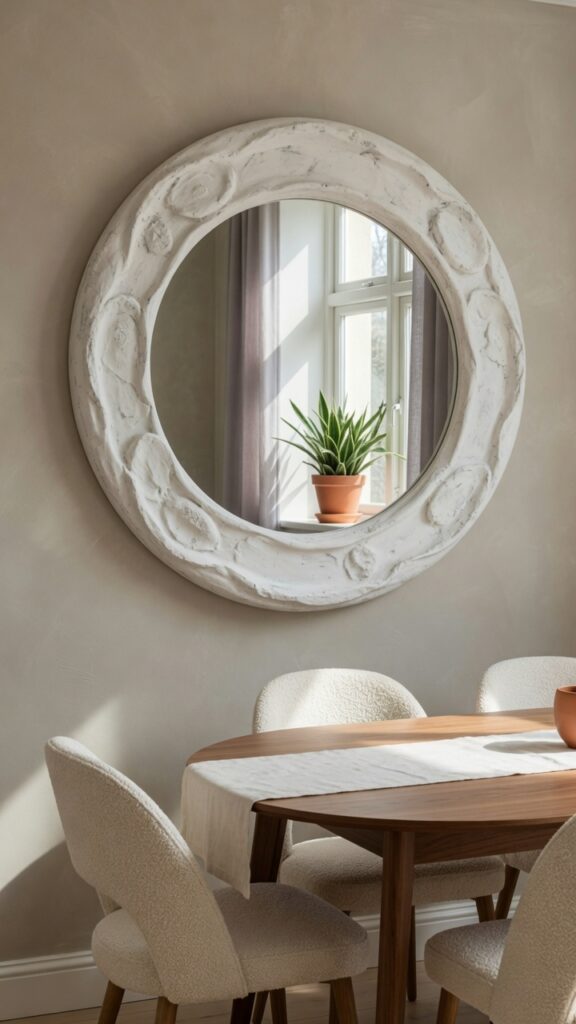
Round mirrors and oval dining tables have an almost embarrassingly good relationship. The curves echo each other without matching exactly, and the visual result is a room that feels considered but not rigid. A sculptural plaster frame takes this further — the raw, tactile quality of plaster adds warmth that metal or lacquered wood frames often lack, especially in rooms with a lot of hard surfaces like marble, stone tile, or glass.
Centered placement matters here. This mirror works as a focal point only if it’s treated like one — hung at true center above the table or the console, with deliberate breathing room on each side. Don’t crowd it with other wall art. The mirror itself is the art.
If your dining room faces north and doesn’t get much direct light, position this mirror directly opposite your main window. The reflection of the window creates a convincing illusion of a second light source, and in rooms with low natural light, that difference is significant. Use a frame in raw plaster, limewash plaster, or — if you want warmth — a rattan-wrapped style that reads similarly organic.
4. The Full-Length Mirror That Tricks the Eye on a Narrow Wall
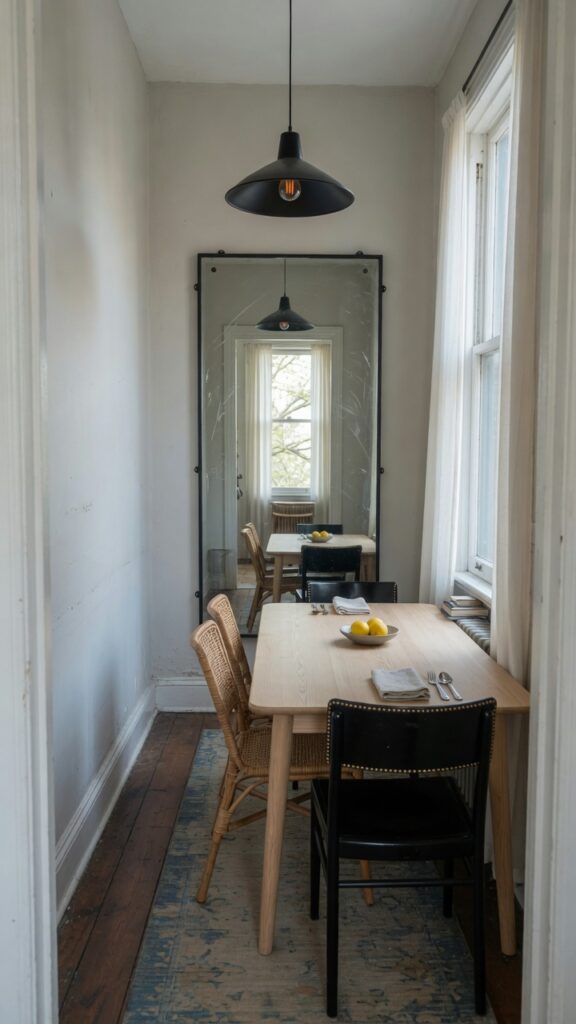
This is the renter’s best friend and the most structurally impactful mirror idea on this list. In a dining room that’s long but narrow — the kind with walls closing in on both sides of a rectangular table — placing a full-length mirror on the short end wall stops the visual squeeze entirely. The room appears to continue past the wall. It’s not subtle, and it’s not trying to be.
The frame needs to be minimal for this to work at scale. Thick decorative frames on floor-to-ceiling mirrors start to look like department store fitting rooms. Go slim: matte black steel, thin brushed nickel, or even a frameless polished edge if your aesthetic leans modern.
Here’s the trick that most people miss: what the mirror reflects matters as much as the mirror itself. Before mounting, stand where the mirror will hang and look at what it will face. If it’s reflecting a blank wall, you’ve wasted the effect. Angle it slightly, or rearrange so it captures the window, the pendant light, or the table’s length. That reflected image is what does the work.
5. Sunburst Mirror Above the Dining Table for Vertical Drama
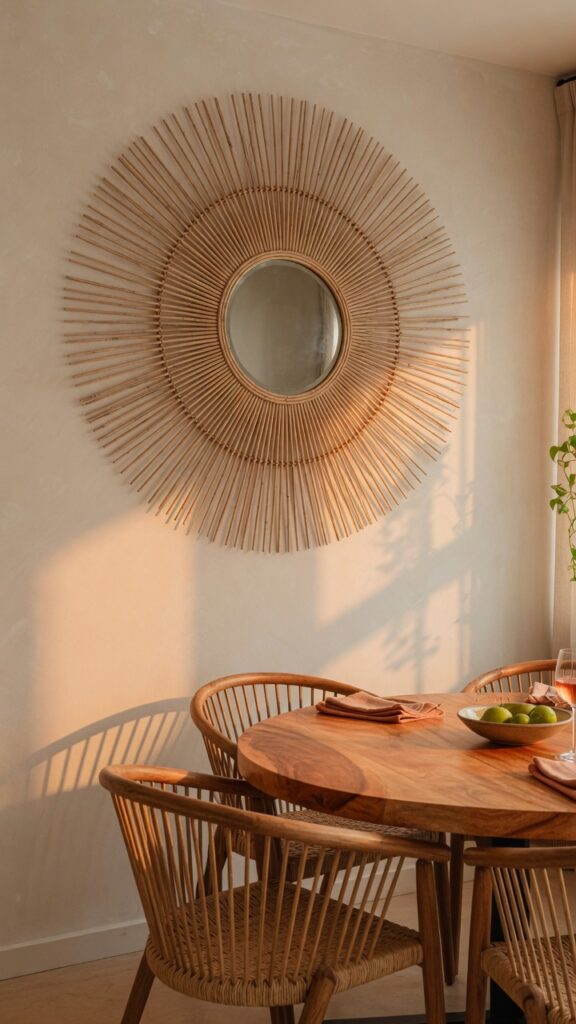
Sunburst mirrors get dismissed as trend pieces — and fair enough, there have been a lot of bad ones. But a sunburst in rattan rather than gold-painted resin is a completely different object. The natural material tones down the drama, adds texture to the wall, and references organic forms that age well alongside wood and linen. Above a round dining table, the circular core of the sunburst aligns visually with the table below, creating a vertical axis that gives the room a clear center of gravity.
Sizing is critical. The sunburst should be wider than the table — at minimum matching its diameter — or it will float weakly above like an afterthought. For a 48-inch round table, you want a mirror with a total diameter, rays included, of at least 40 inches. Go bigger if the ceiling height allows.
This works beautifully in rooms with high ceilings that feel unanchored. It’s not the right choice for rooms with very low eight-foot ceilings — the rays will crowd the space and your eye won’t have room to appreciate the form.
6. A Grid of Small Mirrors for an Eclectic, Gallery-Wall Energy
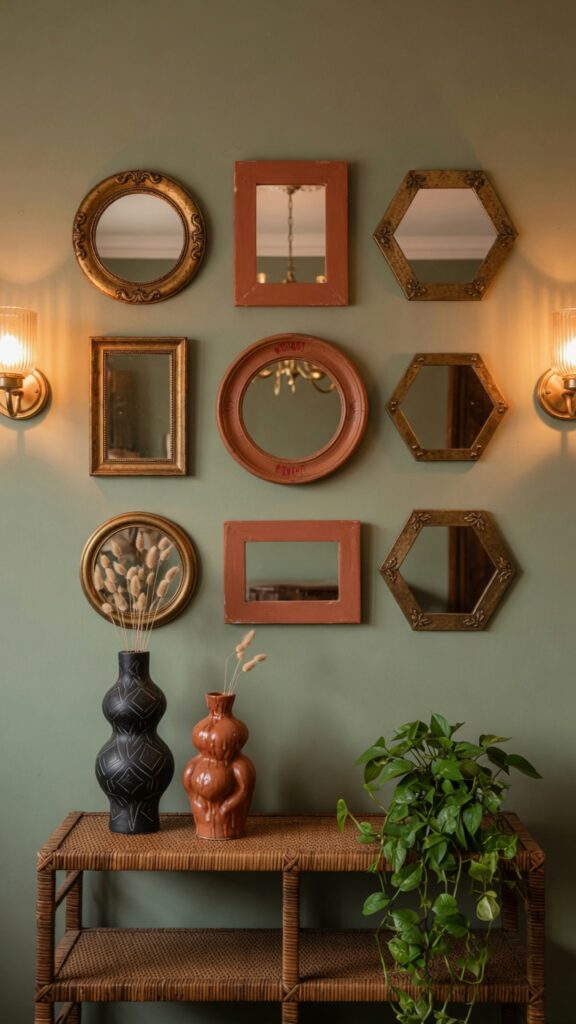
Nine small mirrors arranged in a grid read as gallery wall art while doing the optical work of one large mirror. This is a genuinely good solution for people who find large statement mirrors too committal — visually or financially. Each individual mirror can be sourced separately over time, and the arrangement can be adjusted without leaving a large hole in the wall if you change your mind.
The key to making this feel intentional rather than chaotic is consistent spacing and deliberate frame variation. Don’t mix too many finishes — pick a dominant material (say, warm metal tones) and let the shapes vary. Round, square, hexagonal. Keep the gaps uniform: three to four inches between each piece feels tight enough to read as a single composition.
A dusty sage or muted olive wall is the ideal backdrop. It’s present enough to make the mixed frames pop without competing with them. If you share the dining space with a partner who vetoes bold wall color, this arrangement also works against warm white — the mirror grouping creates enough visual interest on its own.
7. Antiqued Venetian Mirror for Formal Dining Rooms
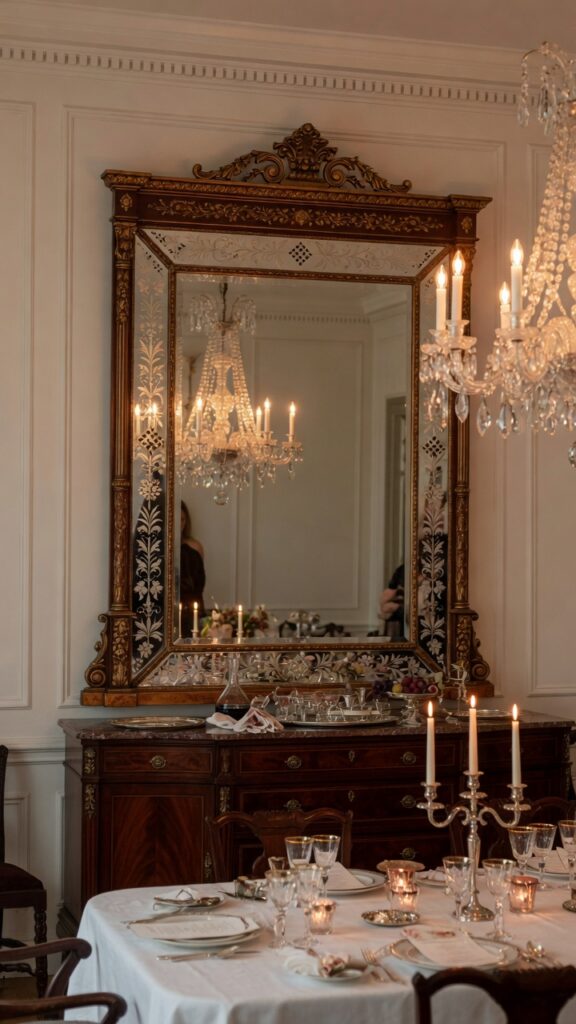
Venetian mirrors have a reputation for formality that occasionally tips into fussiness — and they can, in the wrong context. But in a dining room with genuine architectural detail — crown molding, wainscoting, ceiling medallions — a Venetian mirror is one of the few pieces that meets that architecture at its own level. Everything else tends to look slightly underdressed.
The etched or beveled glass borders of a Venetian mirror catch candlelight in a way that plain mirror glass simply doesn’t. At a dinner party, the effect is genuinely beautiful: the chandelier appears twice, the candles multiply, and the room achieves that quality of depth that photographers spend a lot of effort trying to recreate artificially.
One honest constraint: this is a committed choice. A Venetian mirror in a room that later gets updated with rattan chairs and linen curtains will look like something survived from a different era. If you’re planning to stay formal, invest in it. If your style is evolving, choose something more neutral.
8. Integrated Mirror Alcove for Architectural Interest
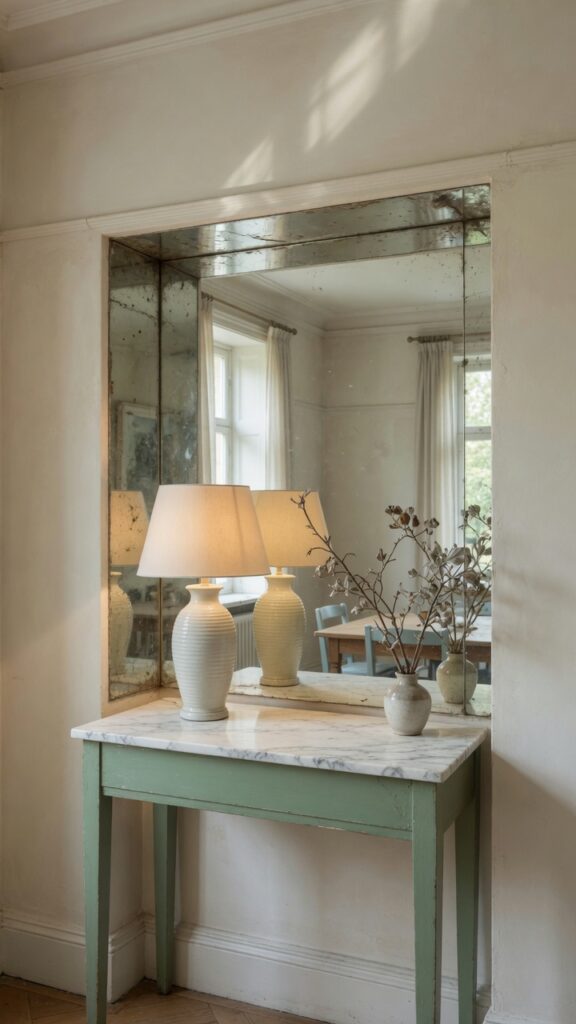
This one requires either a pre-existing architectural alcove or the willingness to create one — but the payoff is unlike any other mirror treatment on this list. Lining a recessed alcove with mirror transforms it from dead wall space into a luminous focal point. The mirror inside the recess reflects inward and outward simultaneously, creating a sense of almost infinite depth in a contained area.
If you’re building or renovating, this is worth discussing with your contractor. An alcove doesn’t need to be deep — even six inches of recess creates the effect. For renters, this isn’t an option, but homeowners willing to do one thoughtful structural move will get years of visual return on the investment.
Style the console inside with restraint. One lamp, one sculptural object, negative space. The mirror is doing the heavy lifting — don’t obscure it with clutter. Materials that work well inside a mirrored alcove: sage-painted wood, raw ceramic, aged brass, anything with texture that photographs beautifully when reflected.
9. Oversized Rectangular Mirror Horizontal Placement
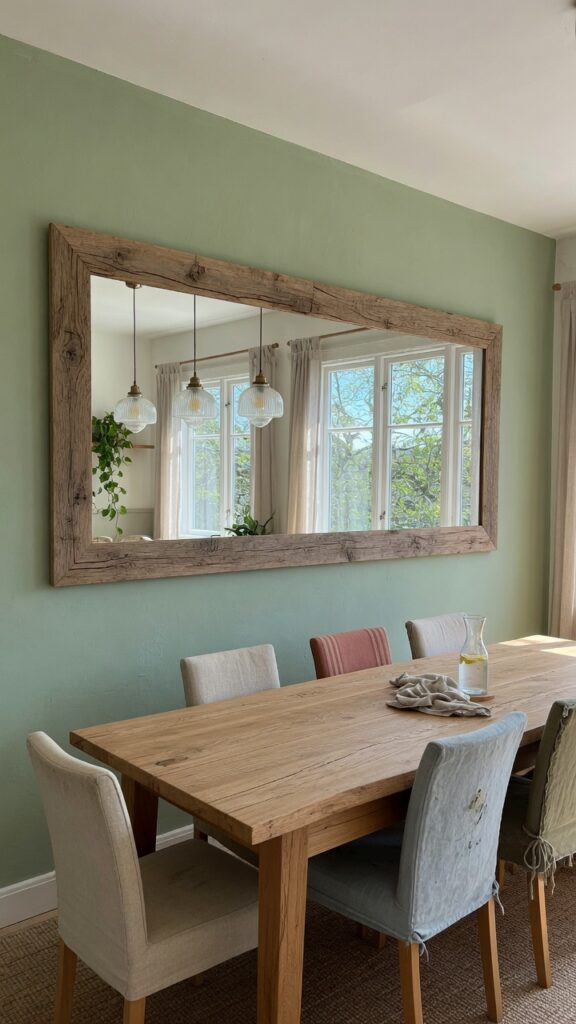
Most people hang rectangular mirrors vertically without questioning it. Rotating a large rectangular mirror to a horizontal orientation is one of those simple changes that completely shifts how a dining room reads. Horizontally, a wide mirror emphasizes width and makes low-ceilinged rooms feel broader rather than taller. It also aligns naturally at eye level when seated — which means it’s doing its reflecting work exactly where it matters most during a meal.
A thick reclaimed wood frame in natural oak keeps this from reading as corporate or sterile. The raw material quality softens the scale. If your dining furniture is already wooden, matching the mirror frame to the table wood (or going slightly lighter or darker for contrast) creates a cohesive material story without feeling matchy-matchy.
One sizing note: go wide. This idea only works when the mirror genuinely spans the wall — at minimum three-quarters of the wall’s width. A short horizontal rectangle just looks like a mirror hung sideways, which achieves nothing.
10. Tinted Mirror for a Moody, Contemporary Feel
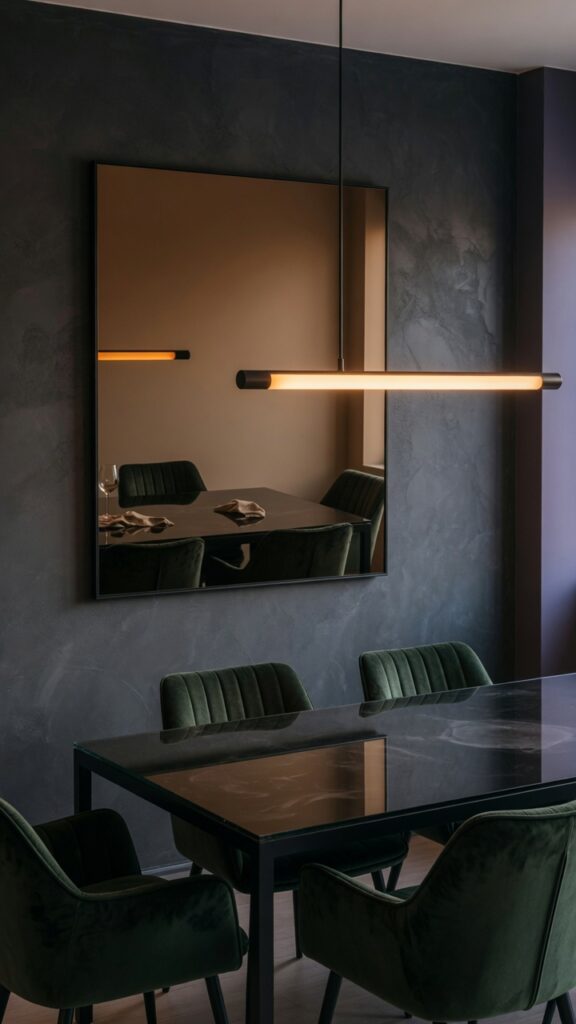
Clear mirror glass isn’t your only option, and in a dining room designed for evening ambiance, it’s often not even the best one. Bronze-tinted or smoke-tinted mirror glass reflects warmly rather than crisply — it softens the reflection, adds a golden or grey cast depending on the tint, and creates an atmosphere that feels genuinely designed rather than default.
Bronze tint pairs particularly well with dark wall colors, black steel furniture, and jewel-tone textiles like forest green or dusty plum velvet. The warm cast of the reflection complements candlelight almost magically. Smoke tint works better in cooler rooms with grey, navy, or graphite palettes — it enhances the cool tones rather than fighting them.
One practical note: tinted mirrors are harder to source than standard glass, and custom sizing typically requires ordering through a glass supplier rather than picking something off the shelf. Plan the lead time into your project if you’re renovating. It’s worth the wait.
11. Mirror and Sconce Pairing for Layered Evening Light
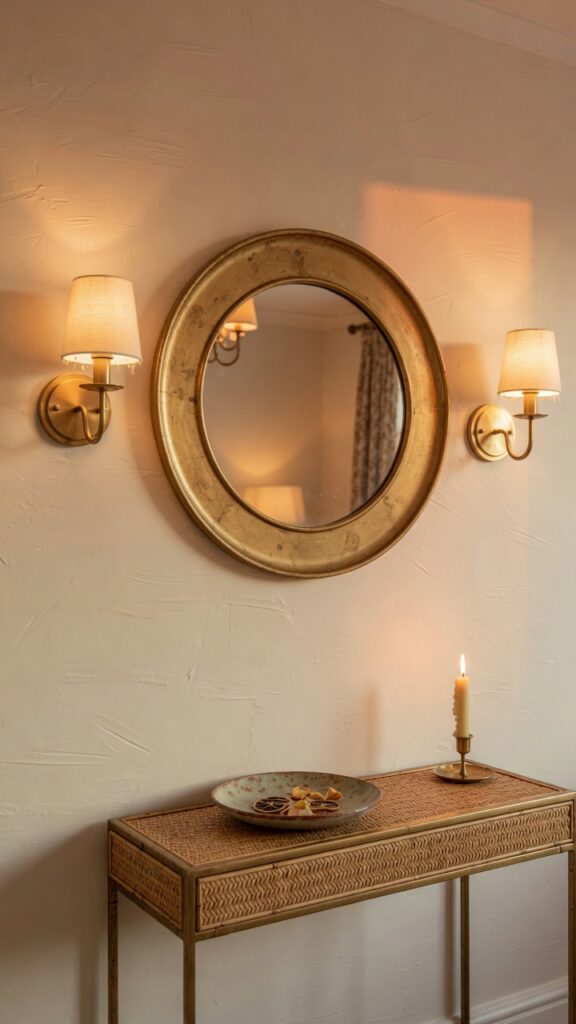
A mirror on its own is decorative. A mirror flanked by two sconces becomes a lighting installation. The pairing works because the mirror reflects the sconce light back into the room, essentially doubling the output of each fixture — and because the composition has a symmetry that reads as architecture rather than styling.
Unlacquered brass sconces with linen shades are the current gold standard for this look. The linen shade softens the light into something warm and ambient rather than task-oriented. Over time, unlacquered brass develops a natural patina that adds character without requiring any maintenance — it’s one of those materials that genuinely gets better with age. If you hate repainting or re-finishing things, brass is your material.
Keep the console or sideboard below clean and simple. A low ceramic dish, a taper candle, maybe a small sculptural object. This arrangement is already doing a lot visually — it doesn’t need props competing for attention. The mirror, the sconces, and the console should read as a single composed moment.
12. Frameless Floor Mirror Propped in the Corner
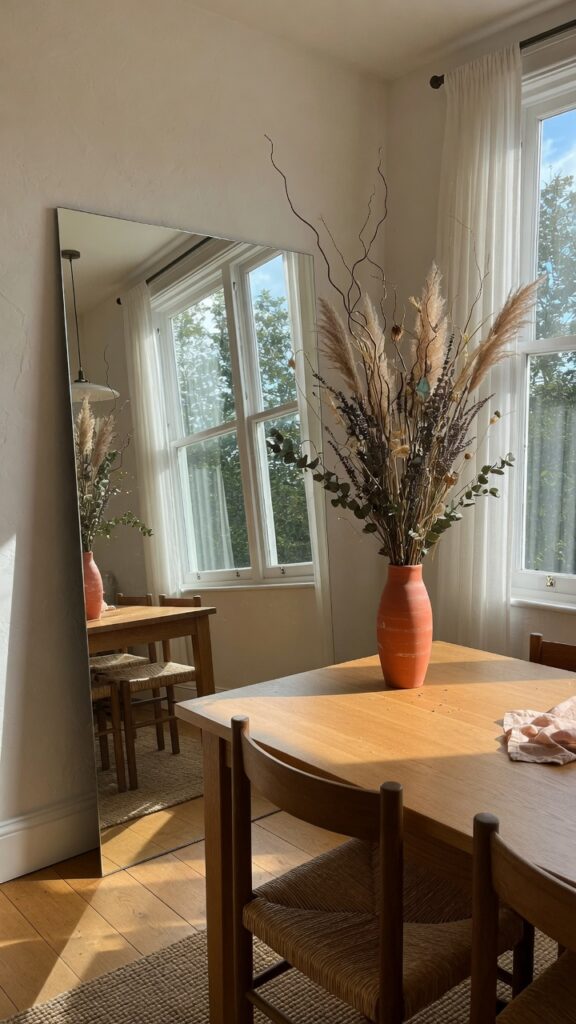
This is possibly the least expected placement on the list, and it’s one of the most effective in rooms that have an awkward dead corner. Propping a frameless floor mirror in the corner — angled slightly outward rather than flat against the wall — captures light from multiple directions simultaneously and reflects it back across the room in a way that wall-mounted mirrors can’t replicate.
Frameless mirrors have a lightness that disappears almost completely once they’re styled around. Add a tall dried botanicals arrangement in a slim vase beside the mirror — pampas, dried lunaria, bleached branches — and the corner becomes one of the most photographed spots in the room. The botanicals appear to continue in the reflection, which creates a lush, layered effect with minimal actual material.
This works particularly well for renters because nothing is mounted, nothing is drilled, and the whole arrangement can be moved or removed in minutes. If your room faces north or gets limited sun, placing this in the corner nearest your window is the single highest-impact thing you can do to redistribute what natural light you do have.
Mirrors in dining rooms are one of those investments that pay forward differently from furniture or lighting. A good sofa is a good sofa. A well-placed mirror changes how the entire room feels — at noon and at midnight, in summer and in winter, with twelve people at the table or just two. The ideas in this guide represent twelve genuinely different approaches, and the right one depends not just on your taste but on your light, your architecture, your table shape, and how you actually use the room. Start with the mirror placement before you finalize anything else in the space. Get that right, and a lot of the other decisions become easier — because you can see, literally, what the room is doing.