There’s a particular kind of morning ritual that has nothing to do with productivity hacks or five-step routines. It’s quieter than that — the sound of a kettle, the smell of fresh grounds, the satisfying weight of a ceramic mug in both hands. A well-designed coffee bar doesn’t just hold your equipment; it sets the tone for your entire day. And honestly, it doesn’t need to be expensive or elaborate to feel intentional.
Whether you’re working with a dedicated kitchen nook, a forgotten corner of your living room, or a single floating shelf above a sideboard, there’s a version of this that works for your space. The ideas in this article range from renter-friendly to fully committed renovations — from minimal Scandinavian setups to warm, layered maximalist corners that look like they belong in a slow-travel café in Lisbon. Pick what fits your life, your light, and your taste. Here’s how to make your morning corner feel like the best part of your home.
1. The Floating Shelf Setup
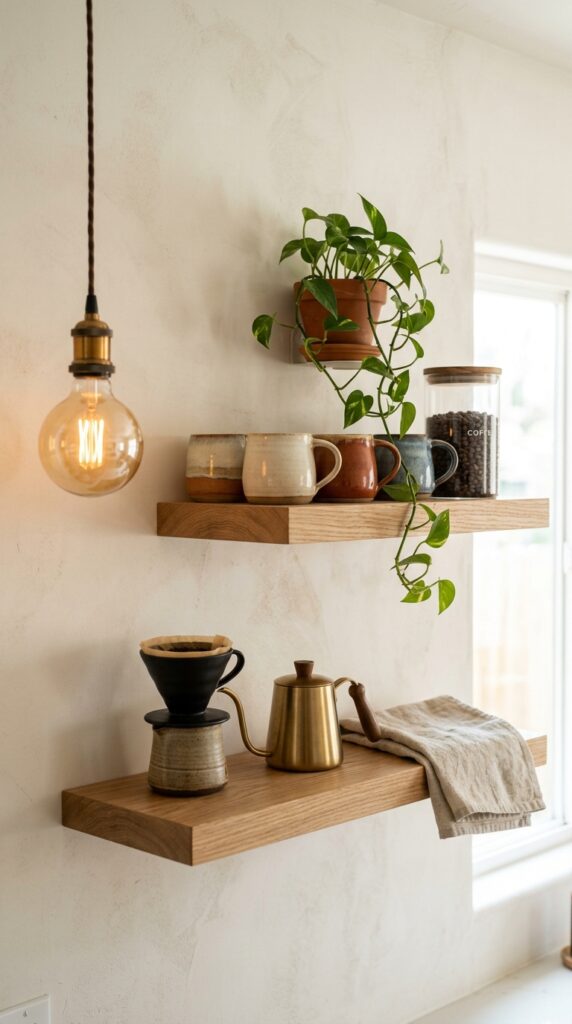
If you’re renting, or simply don’t want to commit to cabinetry, floating shelves are the single best thing you can do for a coffee corner. Two staggered shelves — one slightly deeper at counter height and a narrower display shelf above — give you function and visual interest without eating floor space.
White oak is the material to reach for if your kitchen leans warm and natural. For cooler, modern spaces, go with painted MDF in a matte finish; it photographs cleanly and ages decently. Here’s the trick: don’t line things up like soldiers. Group objects in threes — a kettle, a pour-over, a folded linen cloth. Leave deliberate gaps. Density makes a shelf look cluttered; restraint makes it look curated.
One thing to watch: shelves without a lip will have your equipment sliding around every time someone bumps the wall. Add a thin brass rail or a folded strip of leather at the front edge. Practical, and it adds a detail that feels considered.
Works best for renters and small kitchens. Skip the upper shelf if your ceilings are low — it will feel claustrophobic.
2. The Dark and Moody Corner
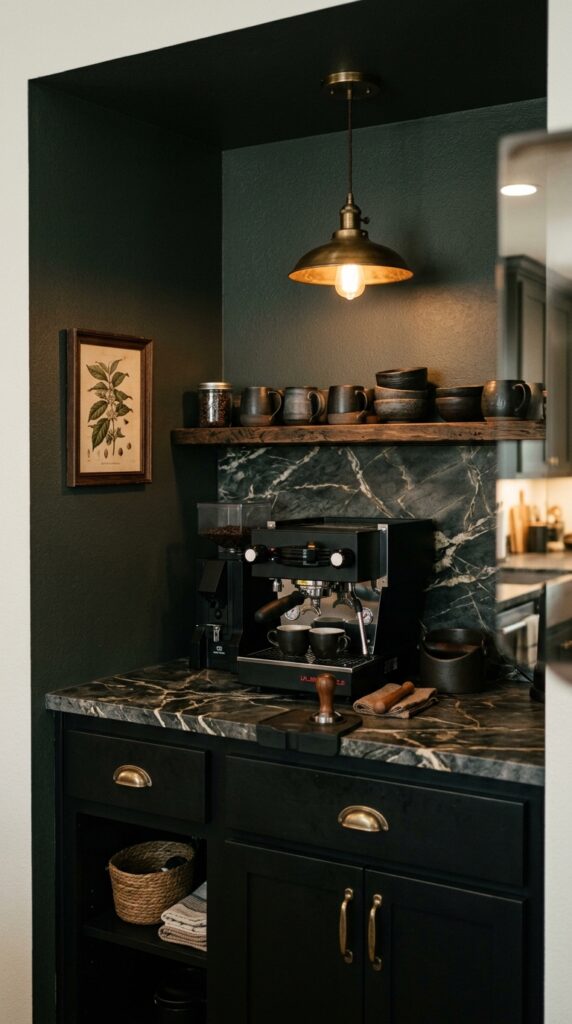
Not every coffee bar has to be bright and airy. There’s something genuinely luxurious about a dark, enclosed corner that feels like a private ritual space — removed from the rest of the kitchen’s busyness. Deep matte paint colors — forest green, charcoal, navy, warm black — absorb light in a way that makes everything placed in front of them look intentional and expensive.
The key to pulling this off without it feeling cave-like is contrast. Keep your equipment and ceramics lighter or metallically reflective. A matte black espresso machine disappears into a dark wall; a cream ceramic or aged brass kettle pops beautifully. Aged brass hardware is essential here — polished chrome would look clinical, and black-on-black reads flat.
If your alcove faces north and gets no natural light, lean into it rather than fighting it. Add a small warm-toned pendant or a clip-on brass wall sconce. It will glow beautifully and feel like evening even at 7 a.m., which, depending on your personality, might be exactly the vibe you want.
This can feel overwhelming in open-plan spaces. Confine it to a recessed nook or a single dedicated wall for maximum effect.
3. The Open Cabinet Bar
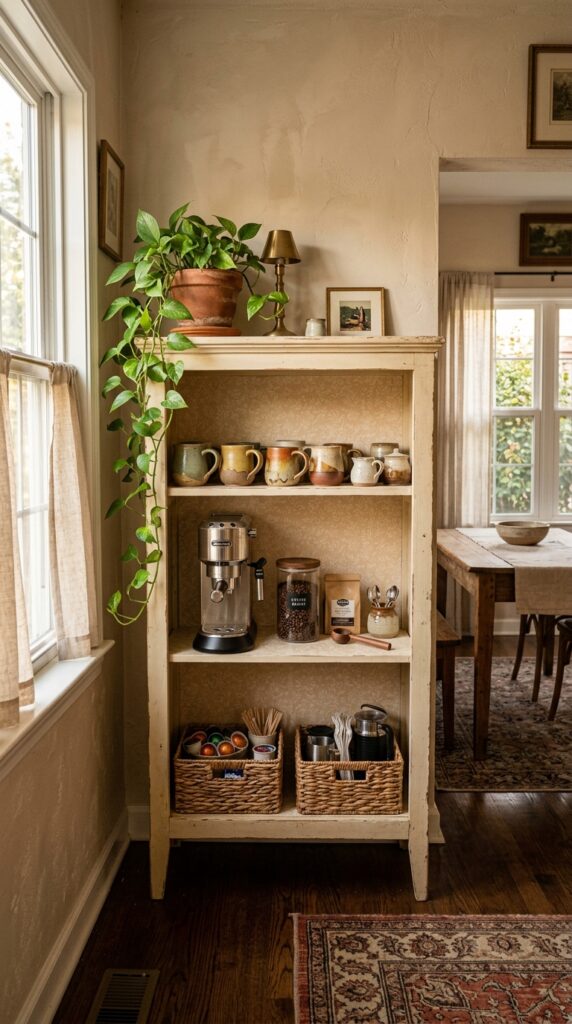
Freestanding open cabinets — the kind you can find secondhand and repaint — are criminally underused as coffee bars. They bring the station out of the kitchen entirely, which is particularly useful if your kitchen is already maxed out on counter space or if you want your coffee corner to live in a dining room or living area.
The styling approach here is different from built-in shelves. Because a freestanding cabinet is furniture, it needs to feel furnished, not just stocked. Line shelves with textured paper or a painted interior in a contrasting color. Group your mugs by color family rather than by size. Tuck wicker or rattan baskets on lower shelves to hide the less photogenic stuff — pods, stirrers, cleaning cloths.
The top of the cabinet is prime real estate. A trailing plant, a small stack of books, or a framed print with a slim brass frame all work well here. Resist the urge to stack things randomly; the top should feel like the exclamation point of the whole piece.
One constraint worth naming: open shelves collect dust and coffee residue faster than you’d expect. If you don’t want to wipe shelves every few days, add a small curtain panel across the lower shelves at minimum.
4. The Marble and Brass Moment
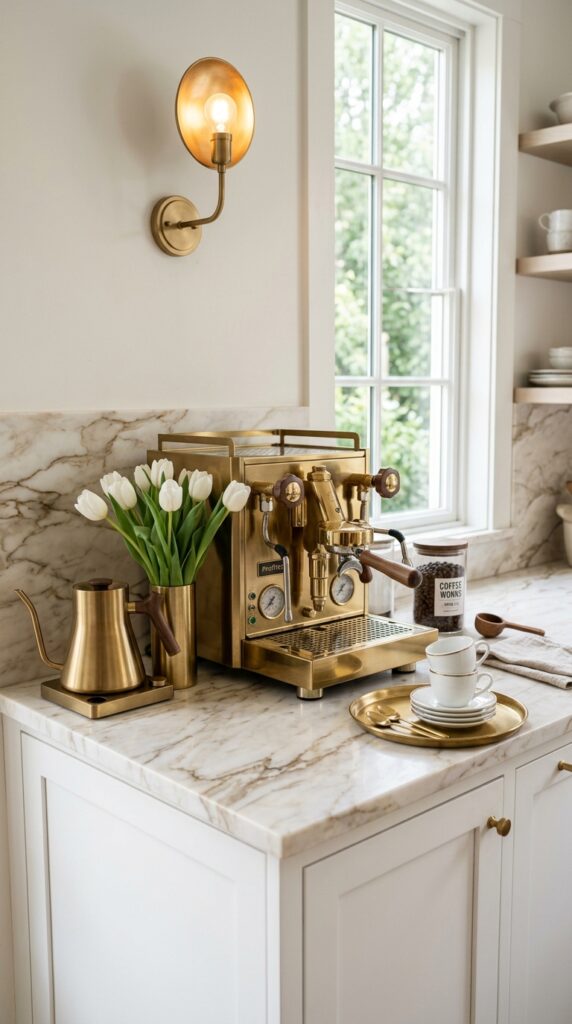
Marble and brass is the pairing that refuses to go out of style, and for good reason — the cool grey-white stone and the warm yellow metal sit in genuine tension with each other in a way that reads sophisticated rather than matchy-matchy. It’s the coffee bar equivalent of a well-tailored outfit with one unexpected accessory.
You don’t need real marble to get this look. Honed porcelain tile in a Calacatta print works beautifully at a fraction of the cost, and honed (not polished) finishes are far more forgiving of coffee rings and water marks. The matte surface also photographs better in natural light — glossy marble can look cheap in photos even when it isn’t.
For the brass, go unlacquered if you want it to age gracefully, or brushed if you want it to stay consistent. Unlacquered brass develops a warm patina over time that polished brass never achieves. One thing to watch: mixing too many metallic finishes — brass kettle, chrome machine, gold tray — will look scattered. Pick one and commit.
Keep the rest of the styling spare. Two or three white porcelain pieces, a single fresh stem, a small brass tray to corral things. The materials do the work; clutter ruins it.
5. The Renter-Friendly Cart
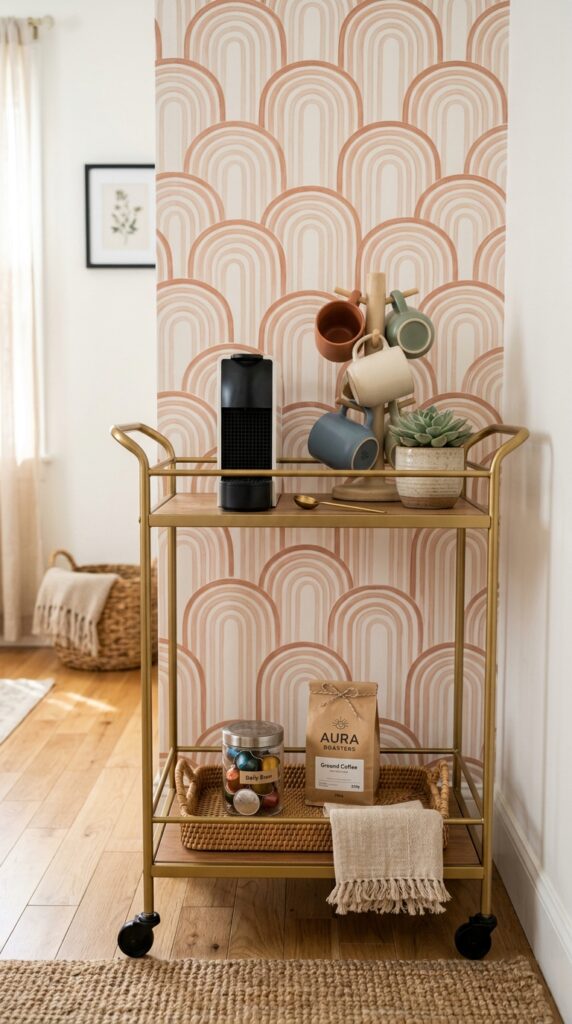
A bar cart is the most flexible coffee bar solution that exists. It moves, it doesn’t require drilling, and it costs a quarter of what a built-in does. For renters especially, a well-styled cart is the difference between a home that feels considered and one that feels temporary.
The frame matters more than people think. Thin-rail gold or aged brass frames read elegant and airy; thick black industrial frames read utilitarian. For a coffee station, you want the former. Style the cart in two clear zones: the working top tier (machine, mug tree, immediate essentials) and the storage bottom tier (beans, accessories, extras tucked into a small tray or basket).
Here’s what most people miss: the wall behind the cart is part of the composition. A blank rental-white wall makes even a beautifully styled cart look temporary. Add a removable peel-and-stick wallpaper panel behind it — a soft arch, a painterly botanical, a grid of terracotta tiles — and suddenly the cart looks intentional rather than improvised. These panels come off cleanly when you leave, and they transform the whole corner for under forty dollars.
Skip this if you have small children or pets; carts tip, and hot liquids and wobbly surfaces are a bad combination.
6. The Minimalist Japandi Bar
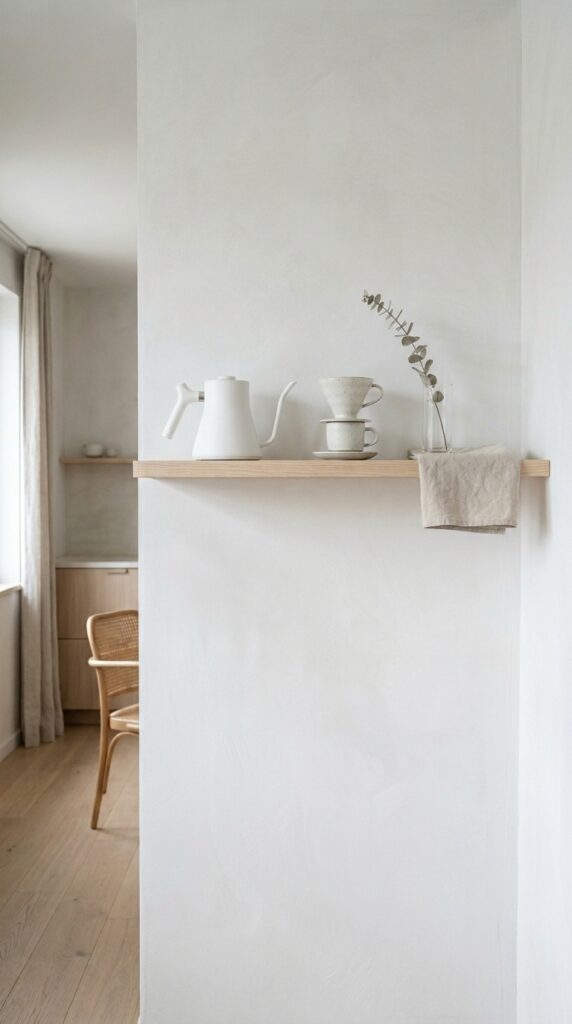
Japandi — the mashup of Japanese wabi-sabi sensibility and Scandinavian functional minimalism — produces the quietest, most serene coffee corners you can build. The philosophy isn’t just aesthetic; it’s operational. You keep only what you use daily. Everything has a place. The surface is almost always clear.
Materials are specific here: pale ash or white oak, matte ceramic in undyed tones (off-white, grey, sand), linen, and natural stone. No gloss, no shine, no color for its own sake. Even the coffee machine should be matte and ideally white or light grey — a stainless steel machine with buttons and lights would break the whole mood instantly.
The practical win of this style is that it’s incredibly easy to keep clean. There’s simply less on the counter. The psychological win is that a spare, calm space genuinely makes the morning ritual feel more intentional — more like something you do for yourself, less like fuel-loading before a commute.
One honest constraint: if you share this space with a partner who loves mugs, magnets, and general counter accumulation, the Japandi bar will be a source of low-grade domestic tension. Have that conversation before you commit to the aesthetic.
7. The Vintage-Eclectic Vignette
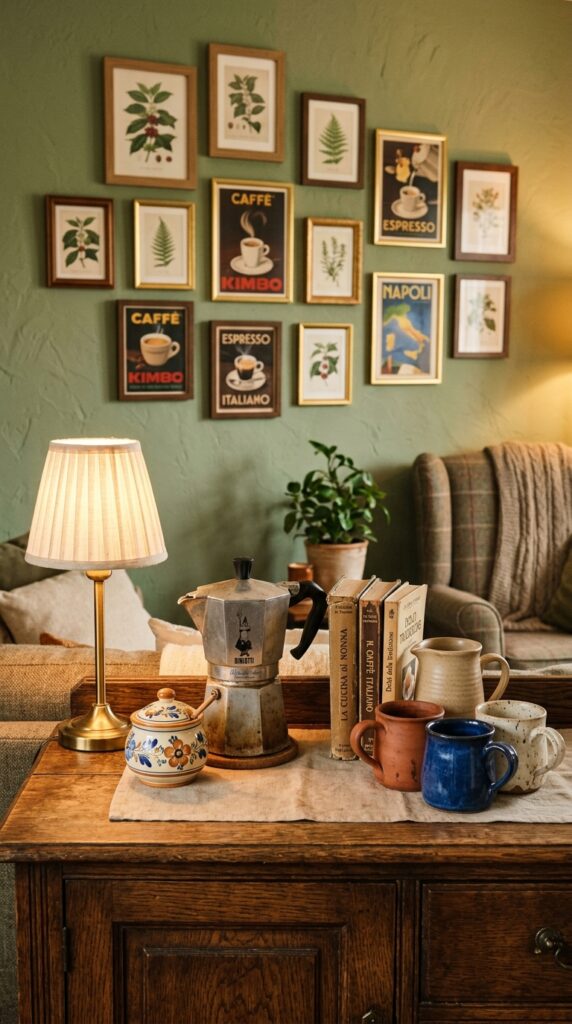
Some of the best coffee corners have nothing to do with matching sets or design systems. They’re accumulated over time — a moka pot inherited from a grandmother, mugs bought at a market in a city you loved, a chipped ceramic creamer that’s too beautiful to throw away. This kind of layered, collected quality can’t be bought in a single shopping trip, but it can be intentionally curated.
The key is edited volume. Vintage-eclectic doesn’t mean everything you own piled onto a surface — it means choosing the most characterful pieces and giving them enough breathing room to be seen. A cluster of three mismatched mugs reads charming; twelve reads chaotic.
Color is your organizing principle here. Even in an eclectic arrangement, if you’re working with terracotta, cobalt, and cream, the palette creates cohesion across disparate objects. Add a small brass lamp for task lighting — it warms the whole corner and makes it look lived-in rather than staged.
This style actually ages well. As you acquire new pieces that speak to you, you rotate old ones out. The corner evolves with your taste rather than going stale, which is something very few design styles can claim.
8. The Built-In Nook
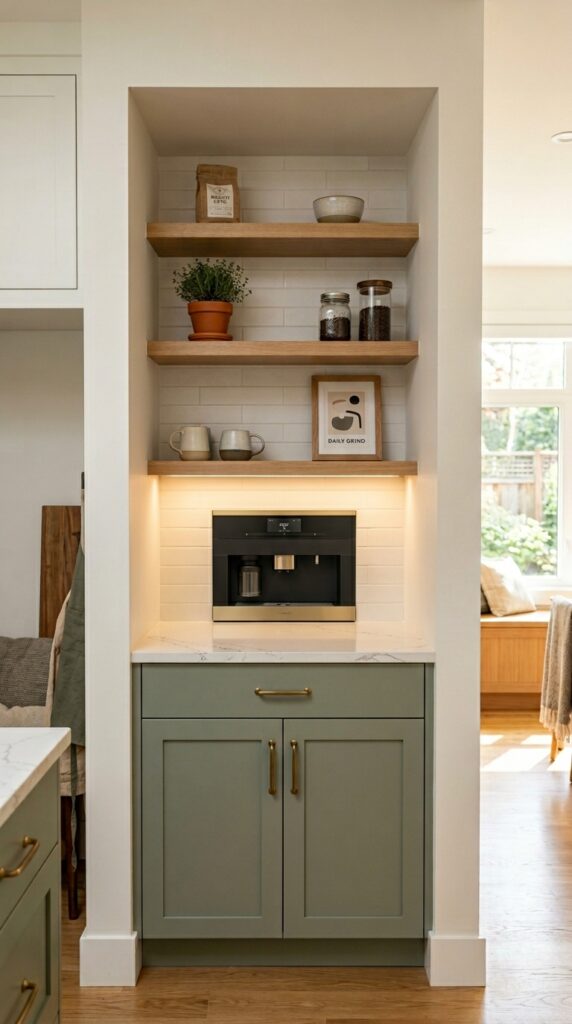
If you’re renovating or building, designating a dedicated coffee nook during the planning phase is worth every penny. A recessed built-in coffee station — with a flush-mounted machine at counter height, dedicated upper storage, and task lighting — functions radically better than any add-on solution and looks like the space was always meant to be this way.
Cabinet color is everything in a built-in nook. Painting the interior a different tone from your surrounding cabinetry — sage green interior cabinets against white kitchen cabinets, for example, or deep navy against natural oak — creates a frame effect that makes the nook feel intentional and jewel-like rather than like a random section of kitchen.
Under-cabinet LED strip lighting is non-negotiable. It makes the task surface functional in the early morning when overhead lights are too harsh, and it creates an atmospheric glow that makes the nook look warm even in photos. Go for warm white (2700K), never cool white; cool light in a coffee corner kills the mood entirely.
The main trade-off is obvious: this is the most expensive and least reversible option. Do the homework on your machine dimensions before anything gets built. Built-in espresso machines have specific ventilation and clearance requirements that your contractor needs to know about upfront.
9. The Pegboard Organizer
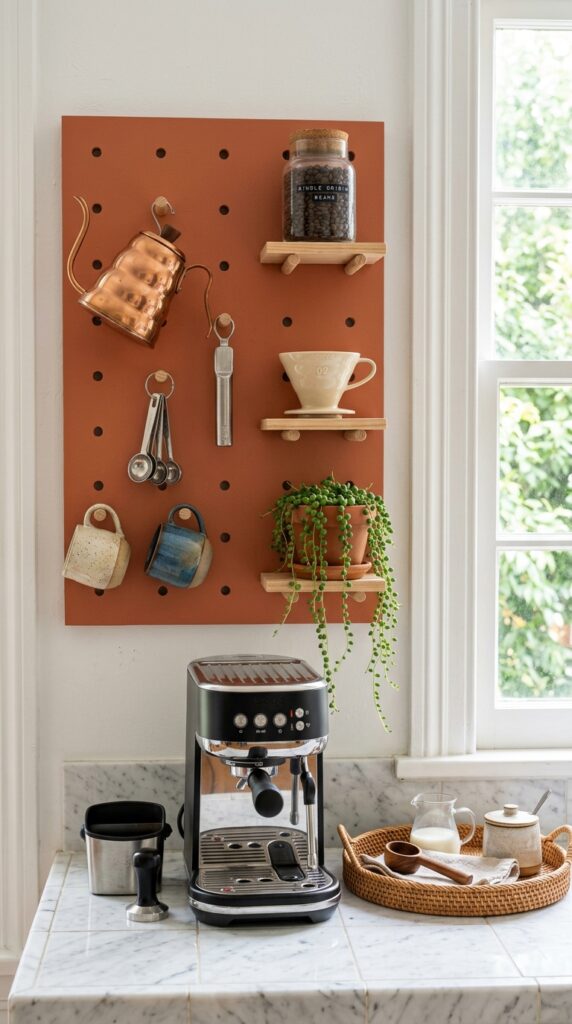
Pegboards get dismissed as a craft-room solution, but a well-executed painted pegboard is one of the most practical and visually interesting things you can mount above a coffee counter. The appeal is real: everything is visible, accessible, and off the counter surface. You’re not hunting through a drawer for a tamper or a thermometer — it’s right there, hanging at eye level.
The color of the pegboard itself is the design decision. White reads clean and modern but blends into walls. Terracotta, sage, or warm ochre reads intentional and adds a hit of color that kitchen walls rarely get. You can also paint the pegboard to match a specific accent in your kitchen — the inside of a cabinet, the grout color of a backsplash tile — for a custom, built-in feel.
Wooden shelf inserts (the kind designed specifically for pegboard systems) let you mix hanging storage with flat-shelf display. A small trailing plant in one of these inserts — string of pearls, a compact pothos — adds life without taking up counter space.
One watch-out: pegboards require studs for secure mounting, especially once you’ve got heavy equipment hanging from hooks. Don’t anchor into drywall alone; you’ll regret it the first time a kettle comes loose.
10. The Two-Toned Cabinet Refresh
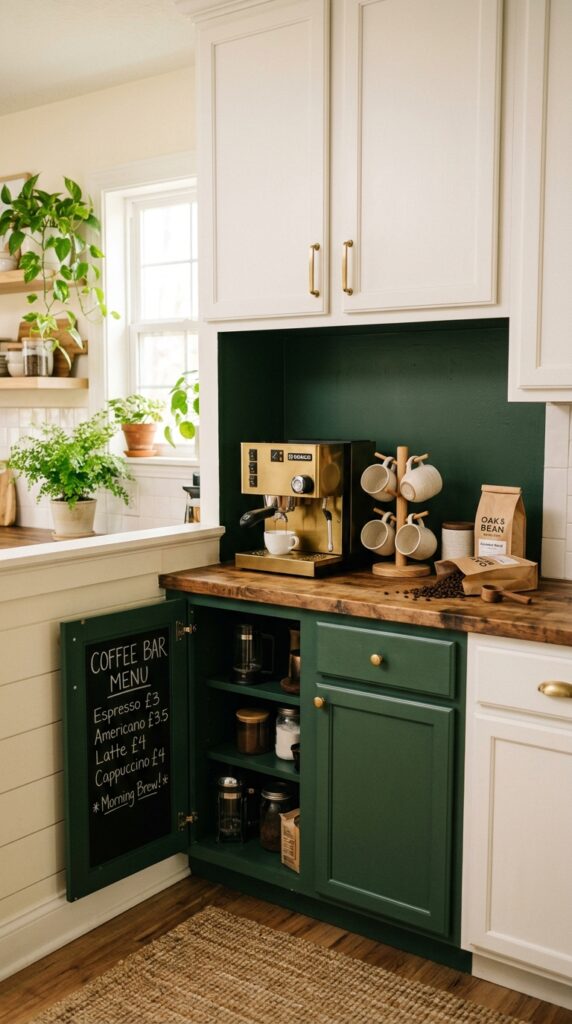
You don’t need a full kitchen renovation to create a dedicated coffee zone. Painting just two adjacent base cabinets — and their interiors — in a contrasting color is a low-cost way to visually designate a coffee section that looks designed rather than accidental. The two-toned cabinet trend has real staying power because it’s reversible (paint over it), affordable, and genuinely looks like intentional design rather than a budget compromise.
Forest green, deep navy, warm black, or terracotta all work well as accent cabinet colors, especially against white or light grey surrounding cabinetry. For the countertop specifically in this zone, butcher block is warmer and more tactile than stone — it photographs beautifully alongside dark cabinets and develops character with use.
The insider move here: paint the interior back panel of at least one open cabinet in the accent color too, and add a small chalkboard panel inside a door for writing your weekly coffee menu or your current bag’s tasting notes. It adds personality and a touch of the artisan café energy that makes home coffee bars feel elevated rather than utilitarian.
Use chalk paint for this project — it adheres to cabinet surfaces without extensive sanding, and the matte finish is exactly what you want.
11. The Warm Lighting Setup
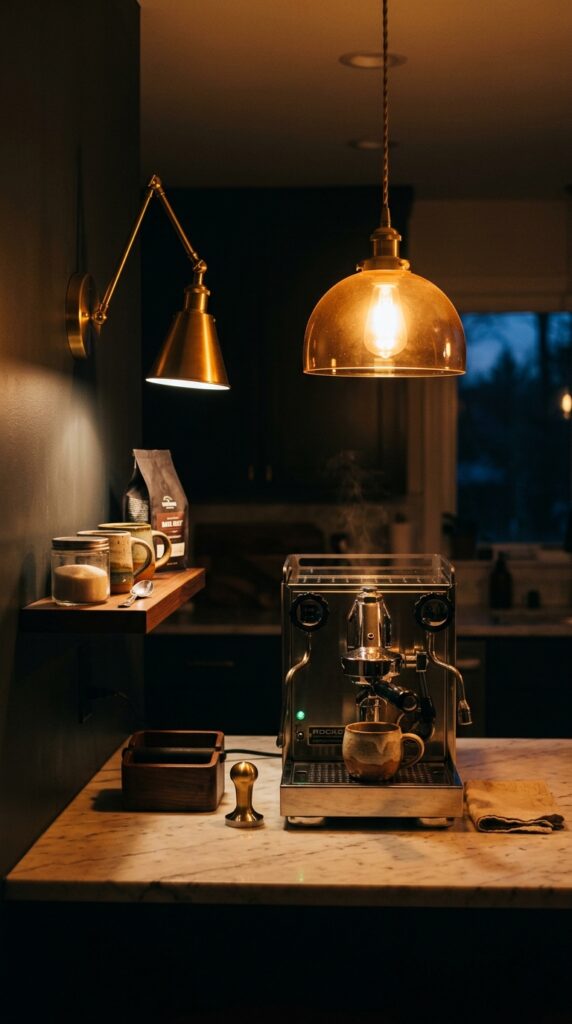
Lighting is the most underrated element of a coffee bar setup, and most people get it wrong. The default — overhead recessed LEDs blasting white light at 6 a.m. — is the opposite of what you want. Good coffee bar lighting is warm, localized, and layered. It should make the corner feel like a destination, not a workstation.
The most impactful addition is a pendant light directly above the coffee area. An amber glass dome, a rattan shade, or a simple Edison-style bulb on a fabric cord all cast the kind of warm, directional glow that makes ceramic surfaces and wooden countertops look genuinely beautiful rather than functional. Keep the bulb at 2200–2700K — anything higher is too clinical.
Layer a second source: a small swing-arm wall sconce or a plug-in table lamp on a nearby shelf. Two warm light sources create depth and dimension; a single overhead light source creates flatness. This is the same principle restaurant designers use, and it works just as effectively at home.
If your room faces north or east and gets limited morning sun, this layered warm lighting approach becomes even more critical. You’re essentially engineering the mood of the morning rather than relying on natural light to do it for you.
12. The Herb and Green Corner
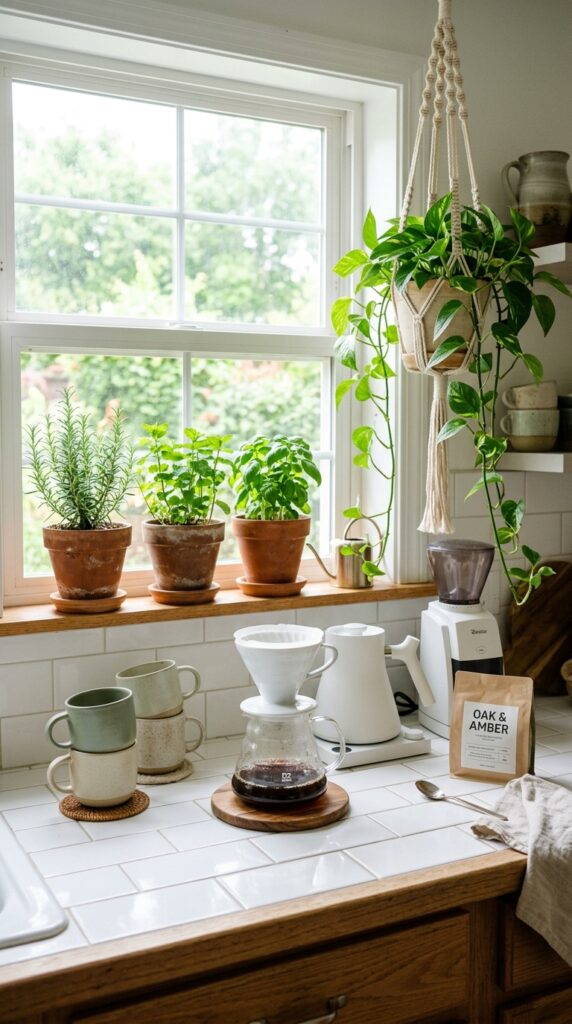
The single fastest way to make a coffee corner feel genuinely alive rather than styled is to add real growing things. Not a dried pampas arrangement (beautiful, but static), not a fake succulent — actual growing herbs in terracotta pots, placed right where the light is.
A kitchen windowsill coffee bar is the ideal setup for this: the machine lives on the counter below, and a row of small terracotta herb pots — rosemary, mint, basil — lines the windowsill directly above. It’s practical (you can actually use the herbs), it’s aromatic, and it adds a layer of living texture that no purely material arrangement can replicate.
The styling rule with plants in a coffee corner is to keep them small-scaled and contained. A single large plant in the wrong place crowds the workspace. Multiple small pots create rhythm without taking over. And terracotta — the actual unfinished clay kind, not glazed ceramic — is the right material here. It breathes, it ages beautifully, and its warm orange-red tone works with almost every counter and wall color you’ll encounter.
One honest maintenance note: if you travel frequently or tend to forget watering, herbs will punish you. Either choose very drought-tolerant options (rosemary handles neglect well; basil does not) or go with a trailing pothos — essentially unkillable, genuinely beautiful, and happy in the indirect light that most kitchen corners offer.
Conclusion
A coffee bar is one of those rare home projects where the effort-to-impact ratio is genuinely in your favor. You don’t need a renovation budget or a large kitchen to create a corner that makes you pause, notice, and enjoy your morning in a slightly more deliberate way. What you need is a clear idea of your style, a handful of considered materials, and the willingness to edit rather than accumulate.
The biggest lesson across all twelve of these ideas is that specificity is what separates a beautiful corner from a generic one. Not “shelves” but white oak floating shelves with a brass rail. Not “a plant” but a trailing pothos in a terracotta pot beside a south-facing window. Not “warm lighting” but an amber glass dome pendant at 2400K layered with a swing-arm brass sconce.
Come back to this article the next time you’re standing in your kitchen wondering why the corner doesn’t feel quite right. The answer is almost always in the details — a material swap, a lighting layer, a color decision that makes everything else cohere. Your morning ritual deserves a space that was actually thought about. Now you have twelve ways to start.