There’s a particular kind of satisfaction in a laundry room that actually works for you — not one that’s just pretty for Instagram and miserable to use at 7 a.m. on a Tuesday. Farmhouse style, done right, sits in that rare sweet spot: it’s warm without being fussy, practical without being sterile. But here’s what most decorating guides won’t tell you — farmhouse laundry rooms fail when people lean too hard into the aesthetic and forget the function. The shiplap goes up, the faux-vintage sign gets hung, and suddenly there’s nowhere to fold a fitted sheet or hang a dripping raincoat. The ideas ahead are different. Each one is genuinely livable, anchored in real materials and real habits. Whether you’re working with a narrow galley, a shared mudroom corner, or a full dedicated room, there’s something here that will change how you feel about laundry day. And that’s not a small thing.
1. The Deep Apron Sink as the Room’s Anchor
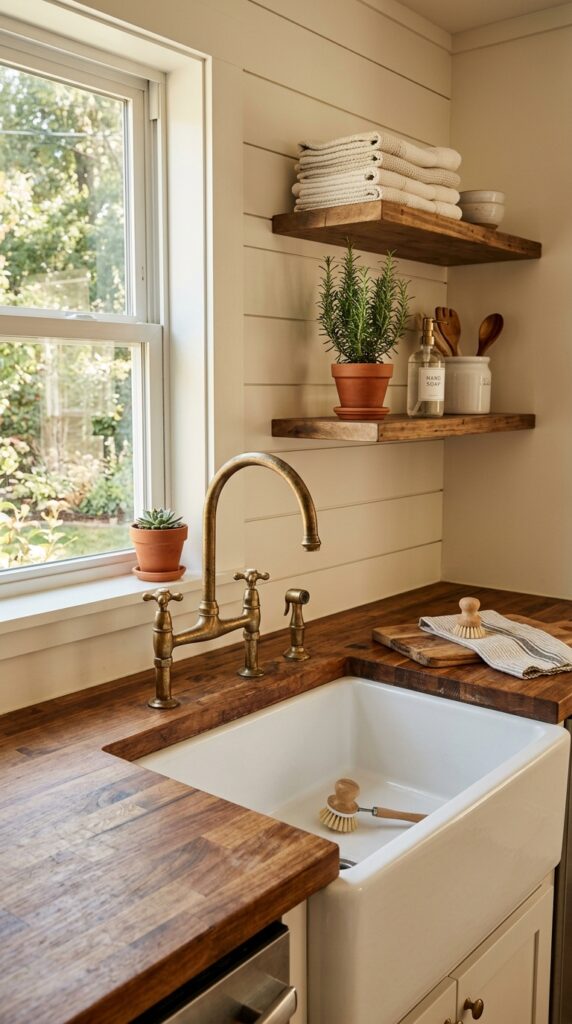
If there’s one upgrade that does the most work in a farmhouse laundry room, it’s swapping a standard drop-in sink for a deep fireclay apron-front model. The depth — usually ten inches or more — means you can hand-wash a bulky sweater, soak stained table linens, or rinse out paintbrushes without water going everywhere. It also just looks right in a way that’s hard to fake with anything else. Pair it with an unlacquered brass bridge faucet and the whole room gains ten years of character overnight. The brass will patina unevenly over time, which is either charming or maddening depending on your personality — if you’re someone who polishes fixtures, go with brushed brass instead. Keep the counter around it in thick butcher block rather than quartz; the warmth is the whole point. One thing to watch: deep sinks sit lower than standard counters feel comfortable for tall people, so confirm the height before committing.
2. Shiplap Done with Restraint
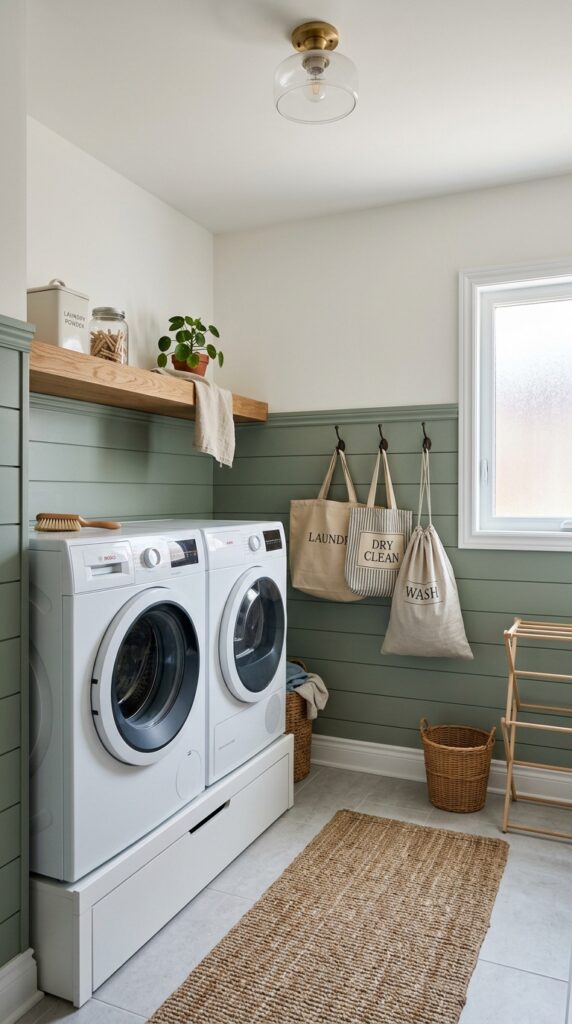
Full-room shiplap can tip from cozy to chaotic faster than you’d expect, especially in rooms under 60 square feet. The smarter move — and the one that reads more intentional — is to use it as wainscoting, running it from floor to chair-rail height and leaving the upper wall smooth. Paint the shiplap in something with some color: muted sage, dusty slate, warm taupe. Leave the top half in a creamy off-white plaster or eggshell and suddenly the room feels layered rather than theme-park farmhouse. This also gives you a visual break that makes ceilings feel taller. If you’re renting and can’t install real shiplap, peel-and-stick shiplap panels exist and they’re genuinely convincing in photos and in person, provided you don’t look at the seams too closely. Skip this approach entirely if your room already has low ceilings and heavy cabinetry — you don’t want the walls competing with everything else.
3. Open Shelving with Honest Organization
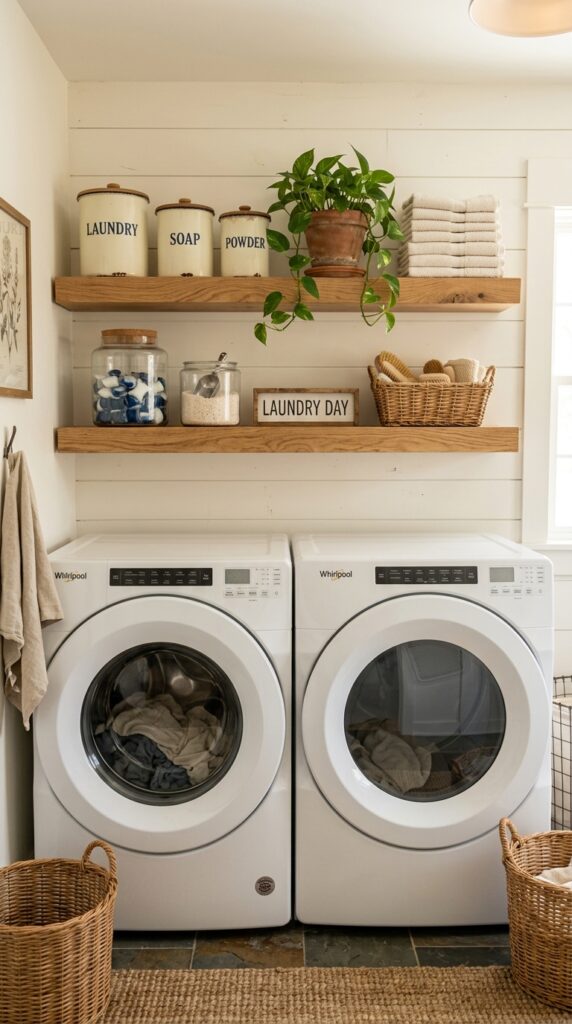
Open shelving works in laundry rooms when you commit to the containers, not just the shelves. The mistake is putting random boxes and half-empty bottles out in the open and calling it organized. What actually looks good — and stays looking good — is decanting: powder detergent into a large glass jar with a wooden scoop, dryer sheets into a linen-lined basket, stain sticks into a small ceramic dish. It takes twenty minutes to set up and it changes everything. Use solid oak or pine shelves with a natural oil finish rather than painted MDF; they hold up better in the humidity of a laundry space and the grain adds warmth. Keep one shelf purely functional and let one shelf breathe with a small plant, a candle, something alive. That mix of utility and softness is what makes a farmhouse room feel human rather than styled. Revisit the shelves every season and edit ruthlessly.
4. The Utility of a Built-In Drying Rack
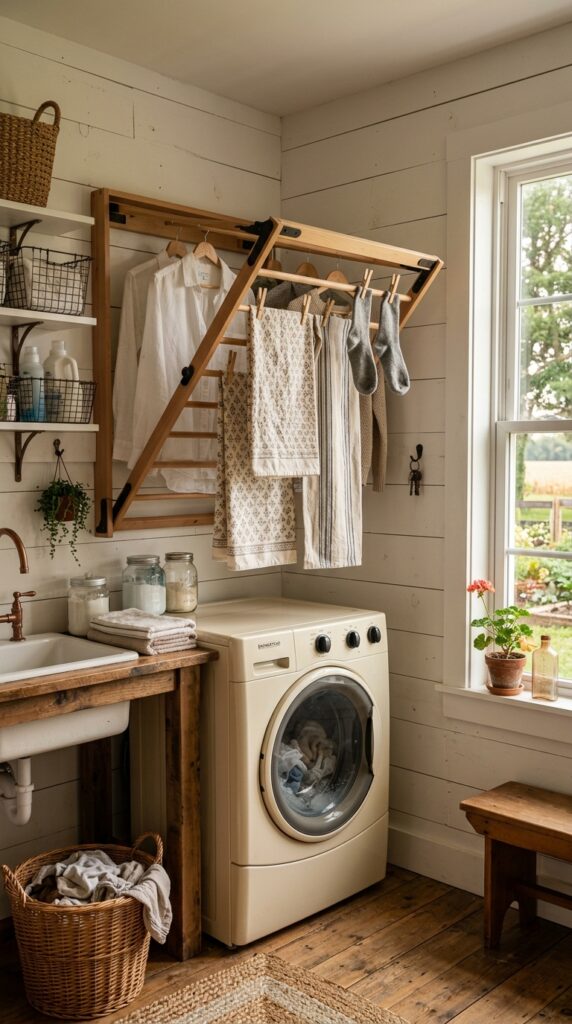
A fold-out wall-mounted drying rack is one of those additions that people wish they’d done from the start. It collapses completely flat against the wall when not in use — you’d barely notice it — and extends to hold ten or twelve garments when you need it. In a farmhouse laundry room, choose one in natural beech or oak with black iron hardware rather than chrome or plastic. The material matters here both aesthetically and practically: wood is gentler on delicate fabrics and looks intentional rather than like a gym equipment afterthought. Mount it at the right height: roughly shoulder level so hanging items clear the floor by a few inches. If you share the laundry space with a partner who’s significantly taller or shorter than you, land somewhere in the middle and neither of you will love it, but you’ll both use it. That said, it still beats the plastic freestanding rack that tips over every single time.
5. Butcher Block Countertops for Folding Space
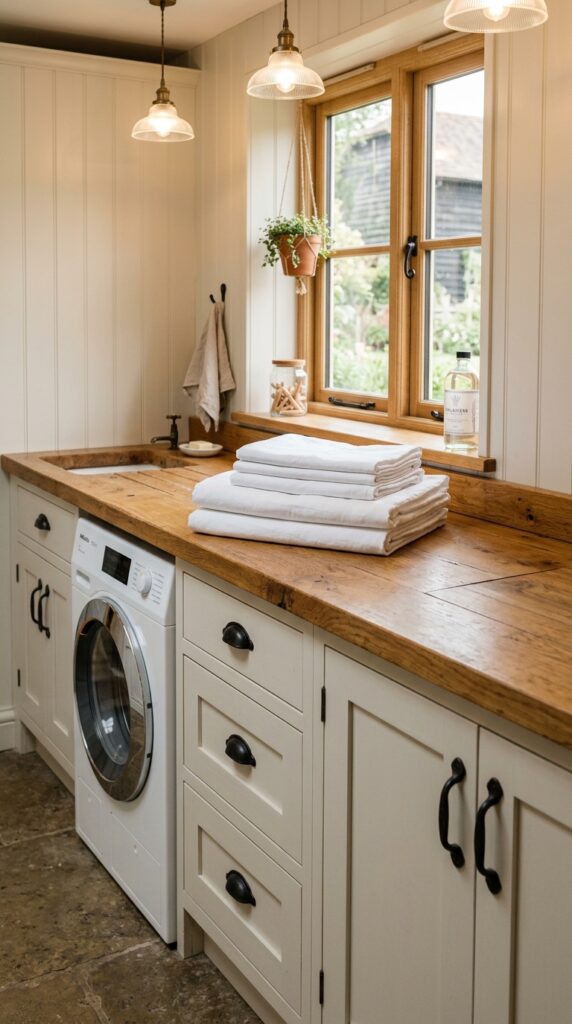
Counter space is the thing most laundry rooms are starved of, and it’s almost always the first thing people say they’d change. A continuous butcher-block counter running over the washer and dryer and extending to a full folding station is genuinely life-changing. Butcher block reads as farmhouse without trying — the warm honey tones of oak or the cooler grain of maple both work — and it costs significantly less than quartz for large runs. Seal it with a food-safe mineral oil and it’ll hold up fine against the occasional splash or damp towel. The one thing to watch: don’t let water sit on it, especially near the seams. A dedicated folding surface also means you’re more likely to fold things immediately rather than piling them in a chair — and that small behavioral shift has an outsized impact on how tidy the room stays. Sometimes design just quietly makes you better at life.
6. Black Iron Hardware as the Room’s Punctuation
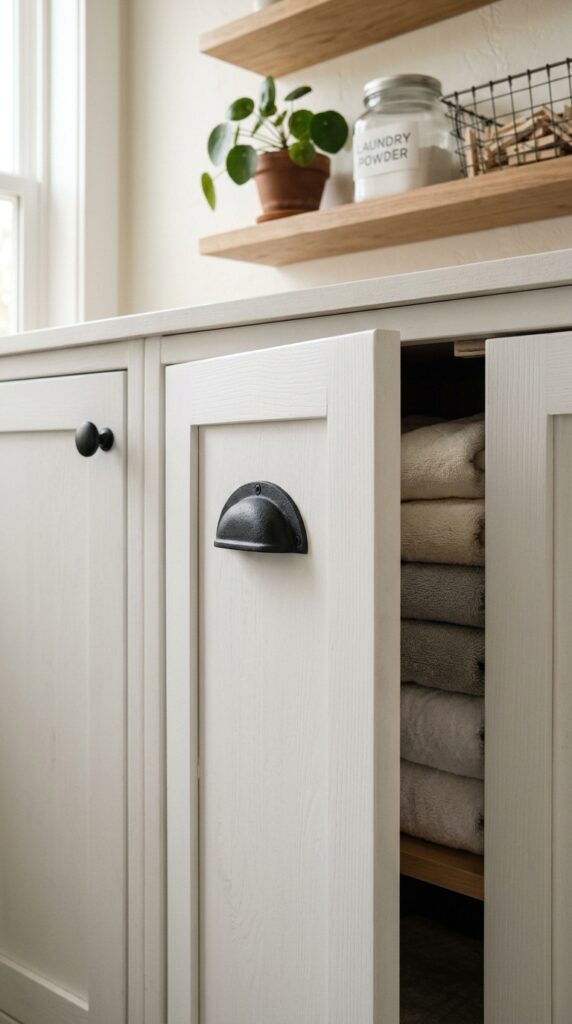
Hardware is the jewelry of a room, and in a farmhouse laundry space, matte black iron is the right call almost every time. It reads as utilitarian and old-world simultaneously, which is exactly the tension that makes farmhouse style work. Swap out stock builder-grade brushed nickel pulls for flat black bin pulls or ring pulls on your cabinets and the whole room upgrades instantly — it’s a Saturday afternoon project that costs under a hundred dollars and punches well above its weight. Pair black hardware with white Shaker cabinets for a clean contrast, or with sage or navy cabinets if you want something more layered. Avoid mixing metals in a small laundry room: if your faucet is brass, carry brass into the hardware. If it’s black, stay black. The room is too small to resolve two competing metal tones gracefully. This is one of those rules designers break on purpose and the rest of us follow for good reason.
7. A Statement Tile Floor That Does the Heavy Lifting
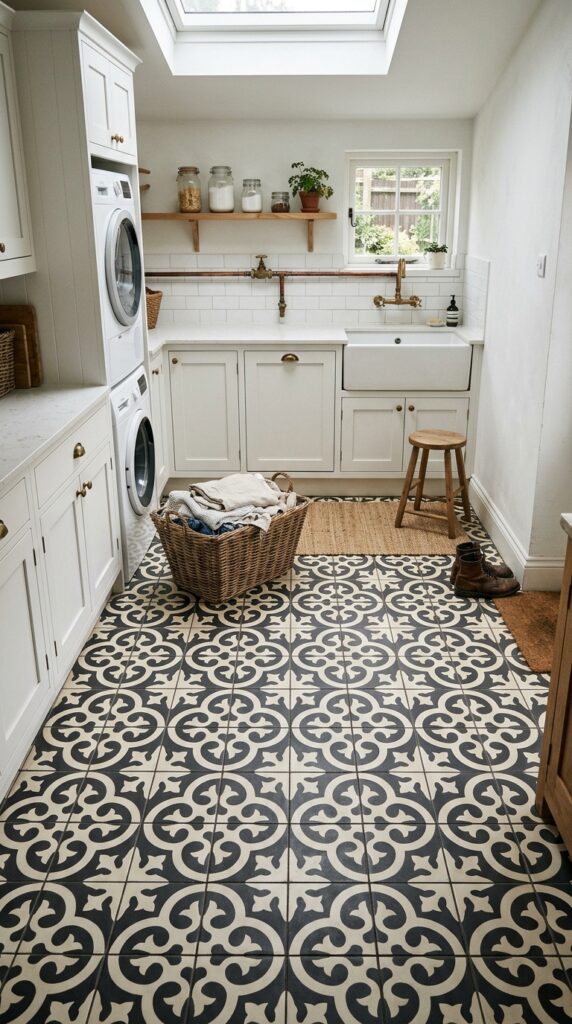
When the walls and cabinets are all white or near-white — which is most farmhouse laundry rooms — the floor is where the personality lives. A large-format encaustic-style cement tile in a geometric pattern, or even a classic black-and-white hex, gives the room something to stand on visually. The scale matters: smaller tiles in a small room create visual noise and make the space feel busier than it is. Go bigger than feels comfortable — twelve-by-twelve at minimum, ideally larger for rooms over fifty square feet. Cement tiles are porous and need sealing, which some people find annoying. If that’s you, porcelain tiles with a matte encaustic-style print give you the look with zero maintenance. One real constraint: dark patterned floors show lint and dust more than light ones. If your dryer is a heavy lint-producer and you’re not vacuuming weekly, a lighter tile pattern will cause you less frustration.
8. Woven Baskets as the Sorting System
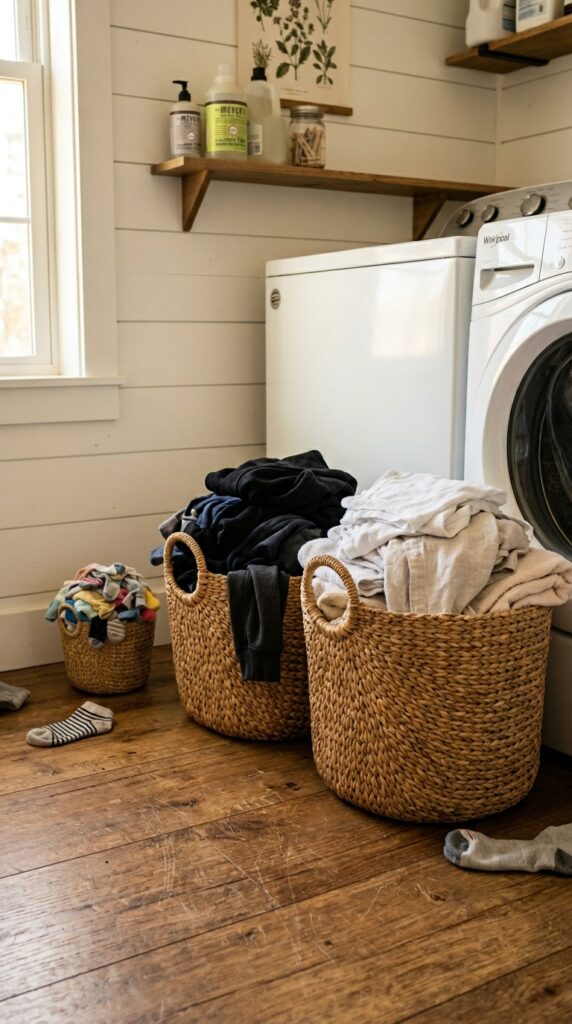
Plastic laundry bins are fine. Woven seagrass or water hyacinth baskets are better — not because they’re more precious, but because they don’t look like a storage unit and they age beautifully. In a farmhouse laundry room, three baskets of graduated sizes work as a sorting system: one for lights, one for darks, one for delicates or hand-wash items. Line them in a row against the wall or tuck them beneath an open counter. The natural texture contrasts nicely against shiplap or smooth plaster and adds that handmade, earthy quality that makes farmhouse rooms feel warm rather than manufactured. If you have kids, label the baskets with simple stamped linen tags — it actually gets used. One practical note: woven baskets don’t hold structural shape over time the way plastic bins do, and very heavy loads can distort them. Size up and don’t pack them past two-thirds full. They last years if you treat them reasonably.
9. Beadboard Ceiling for an Unexpected Detail
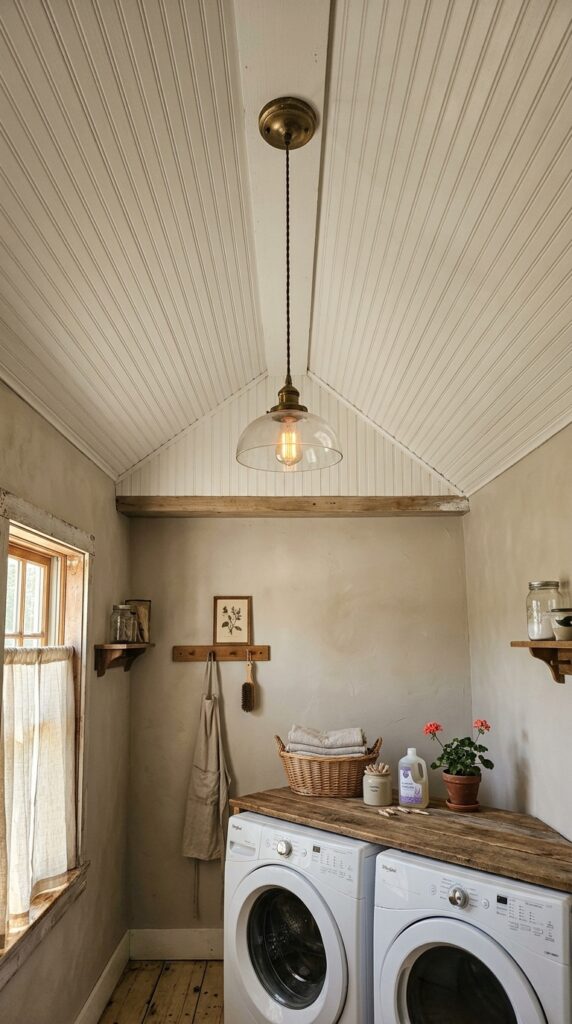
Most laundry room ceilings are completely ignored, which is a missed opportunity. Beadboard ceiling panels — the narrow tongue-and-groove planks typically associated with porches and old Southern kitchens — bring a quiet warmth to a room that you feel before you consciously notice it. Paint them the same off-white as the walls and it reads as architectural texture rather than a bold statement. Paint them a slightly darker tone — warm cream against bright white walls — and the ceiling feels purposeful and considered. Installation is a weekend project and the panels are inexpensive. The real payoff is in how the room photographs and how it feels in daily use: there’s something genuinely pleasant about looking up in a room and seeing something other than a flat, featureless expanse of white. One thing to watch in humid climates: ensure your dryer is properly vented before installing any ceiling treatment, otherwise moisture damage becomes a real problem within a year or two.
10. A Chalkboard Wall for the Actual Logistics
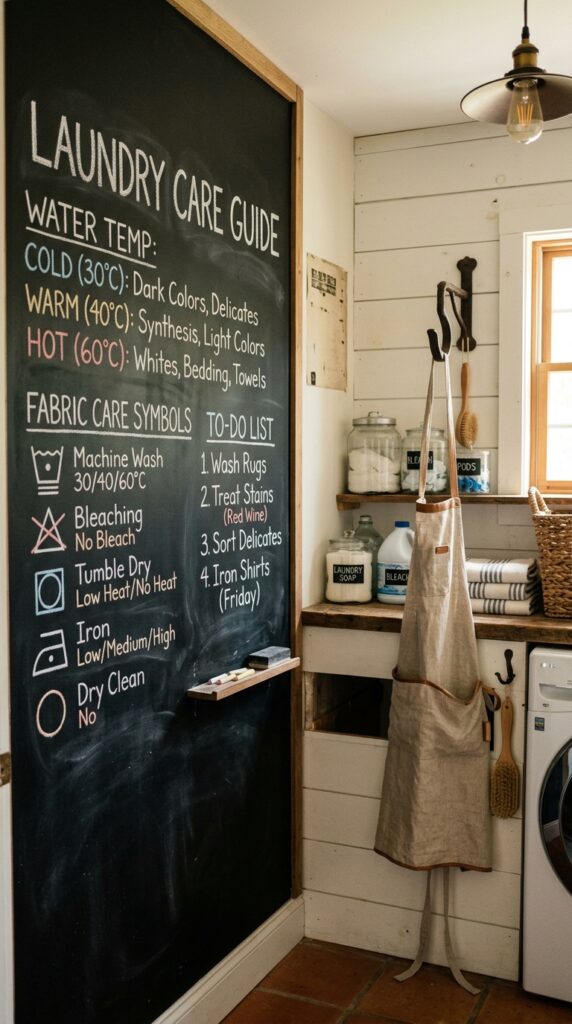
A chalkboard wall panel in a laundry room sounds like a Pinterest cliché, but in practice it earns its place in a way a lot of other decorative ideas don’t. Use it for actual information: fabric care shorthand, cold-wash reminders, a running list of items that need mending or dry cleaning. In a household where multiple people share laundry duties, it becomes genuinely useful communication. Keep the chalkboard section small — a two-by-three-foot panel between two hooks is plenty — rather than doing an entire accent wall, which can feel heavy. Chalkboard paint in matte black works, but dark forest green or deep navy chalkboard paint reads as more intentional in a farmhouse space. Write in chalk markers rather than traditional chalk for cleaner lettering that doesn’t smear every time someone brushes past. Rewrite the board every season when habits change. It should look used, not curated.
11. Vintage-Inspired Pendant Lighting Over the Sink
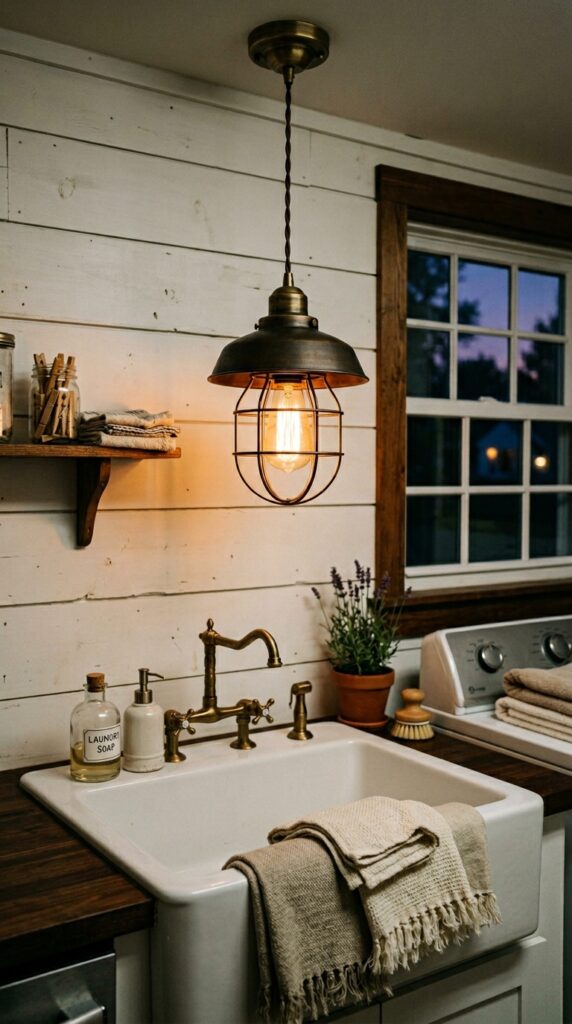
Overhead recessed lighting is the safe, forgettable choice. A single pendant over the sink is the decision that makes the room. In a farmhouse laundry room, reach for an aged brass cage pendant or an enamel factory-style shade — something with visual weight and a slightly industrial-meets-old-world quality. Position it low enough to feel intimate but high enough that you won’t hit your head: roughly 66 to 70 inches from the floor to the bottom of the fixture is a safe range. Use a warm-toned Edison-style filament bulb, not a cool white LED — the color temperature is part of what makes the room feel cozy rather than clinical. If your laundry room is small and has no natural light source, add a second pendant or a small sconce on an adjacent wall rather than relying on a single overhead fixture. Working in a dim laundry room is nobody’s idea of a good time regardless of how well-designed it looks.
12. A Mudroom-Laundry Hybrid with Thoughtful Transition Zones
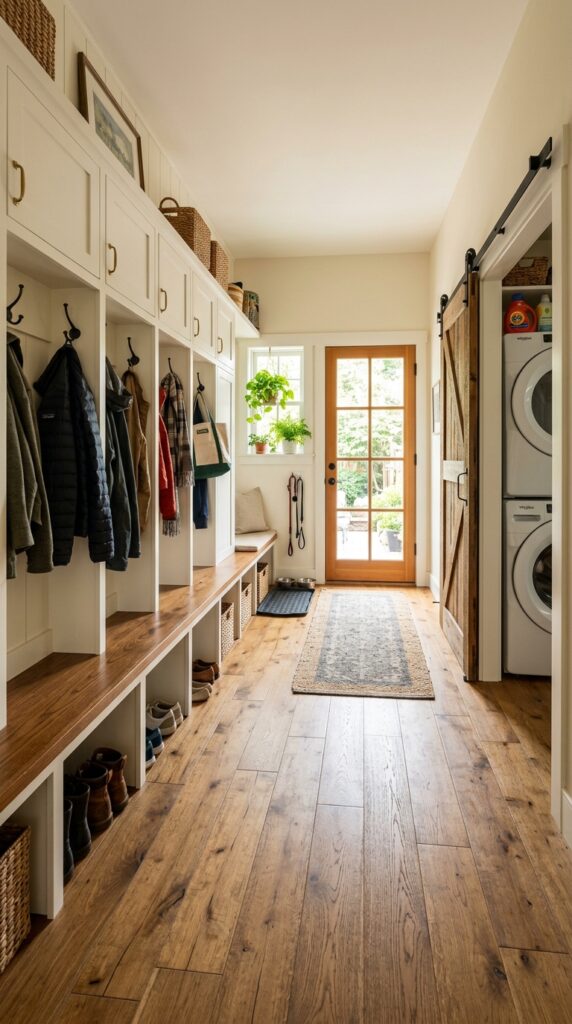
When a laundry room shares space with a mudroom — which is increasingly common in modern farmhouse homes — the design challenge is making two sets of needs coexist without the room feeling schizophrenic. The key is creating distinct transition zones: lockers or built-in cubbies for outdoor gear on one side, laundry function on the other, with a visual anchor like a barn door or a half-wall separating the zones. Wide-plank hardwood or durable LVP flooring that runs continuously from the exterior entry through the laundry area unifies the space without treating it as two separate rooms. Keep the palette consistent — the same shiplap, the same hardware, the same paint — so both zones feel like they belong to the same home. A bench with woven baskets underneath pulls double duty: seating for taking off boots and concealed laundry storage. In a family home, this is arguably the most hardworking room you’ll ever design.
Final Thoughts
A farmhouse laundry room done well is one of those spaces that quietly earns its keep every single day. It doesn’t ask for attention. It just makes your mornings feel a little less chaotic, your evenings a little more organized, and the whole routine of washing and folding somehow less like a chore you’re enduring. The ideas in this article aren’t about perfection — they’re about building a room that has personality and actually functions. Spend your money on the sink and the counter space. Spend your weekends on the ceiling and the hardware. Decant your detergent, hang your drying rack, choose a tile that makes you smile when you walk in. A room you enjoy being in is a room you’ll actually keep tidy. That’s not a design theory — it’s just true. Come back to this list when you’re in the middle of a renovation and second-guessing everything. You’ll find something useful here, and that’s exactly the point.