Let’s be honest: laundry rooms are usually the last space anyone thinks about decorating. They’re the dumping ground for half-empty detergent bottles, mismatched socks, and that one basket of clothes you keep meaning to fold. But here’s the thing — a well-organized laundry room can genuinely change how you feel about doing laundry in the first place. I’m not promising you’ll start loving it, but you might stop dreading it.
The best laundry rooms I’ve worked on share a few stubborn rules: every item has a home, surfaces stay mostly clear, and there’s at least one thing in the room that’s genuinely nice to look at. Whether you’re working with a closet-sized nook or a proper utility room, the same principles apply. Below are twelve ideas I keep coming back to — some are quick weekend projects, others are full rethinks. Pick what fits your space, your budget, and how much you actually care about color-coordinated detergent bottles.
1. Floor-to-Ceiling Cabinetry That Hides Everything
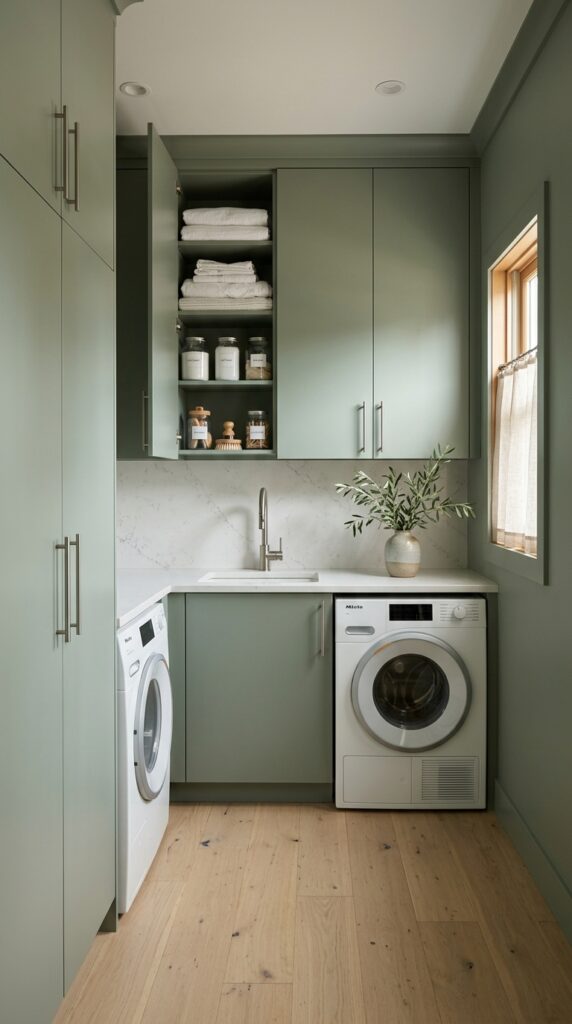
If you’re going to invest in one thing, make it cabinetry that goes all the way up. The space above standard cabinets is wasted real estate, and it’s exactly where laundry rooms accumulate visual noise — random boxes, dusty bottles, that ironing board you forgot you owned. Floor-to-ceiling cabinets force everything behind closed doors, which is the whole point.
A few things I’d push for: matte finishes over glossy (they hide fingerprints and feel more grown-up), soft-close hinges, and pulls in a finish that contrasts the cabinet color. Sage, mushroom, and warm off-white all age beautifully. Skip pure white if you have kids or pets — it shows everything.
One watch-out: full-height cabinetry can feel oppressive in tight rooms. If your ceiling is under eight feet, leave a small gap at the top or break the run with open shelving. The takeaway? Hide the ugly stuff, and the room basically organizes itself.
2. A Counter Over the Washer and Dryer
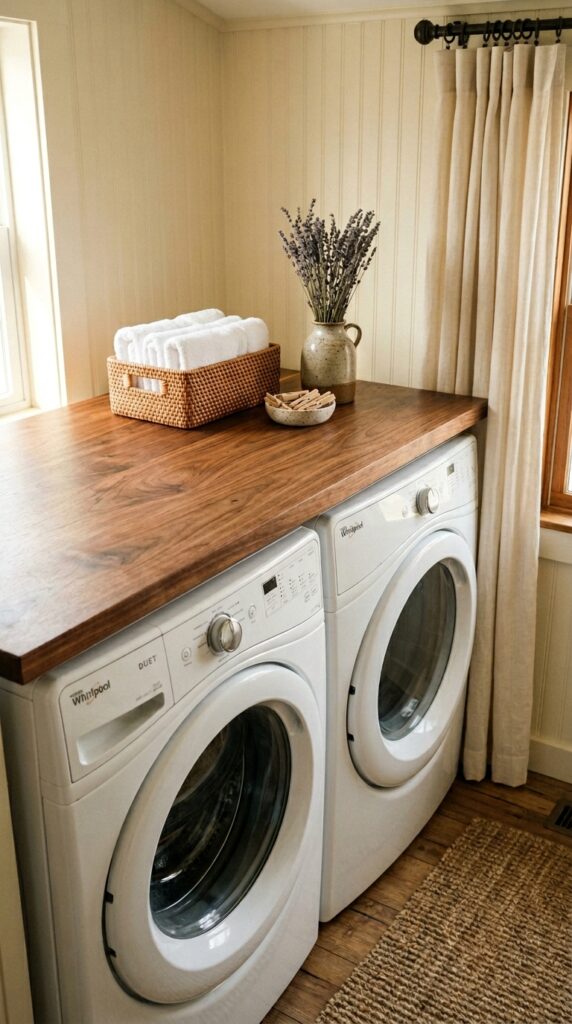
This is the single best upgrade for front-loading machines, and most people sleep on it. A continuous countertop across both appliances gives you a folding station, a sorting surface, and somewhere to set your coffee while you wait for the cycle. It instantly makes the room feel intentional instead of utilitarian.
Butcher block is my go-to here — walnut or white oak, sealed properly, costs a fraction of stone and feels infinitely warmer. Quartz works too if you’re worried about water rings. Make sure the counter overhangs slightly at the front so you can stand close without bumping your knees, and leave clearance at the back for vibration.
The trade-off: top-loaders won’t work with this idea. If that’s what you have, skip ahead. For everyone else, this is the kind of small change that quietly transforms how the space functions every single day.
3. Three Matching Baskets for Sorting
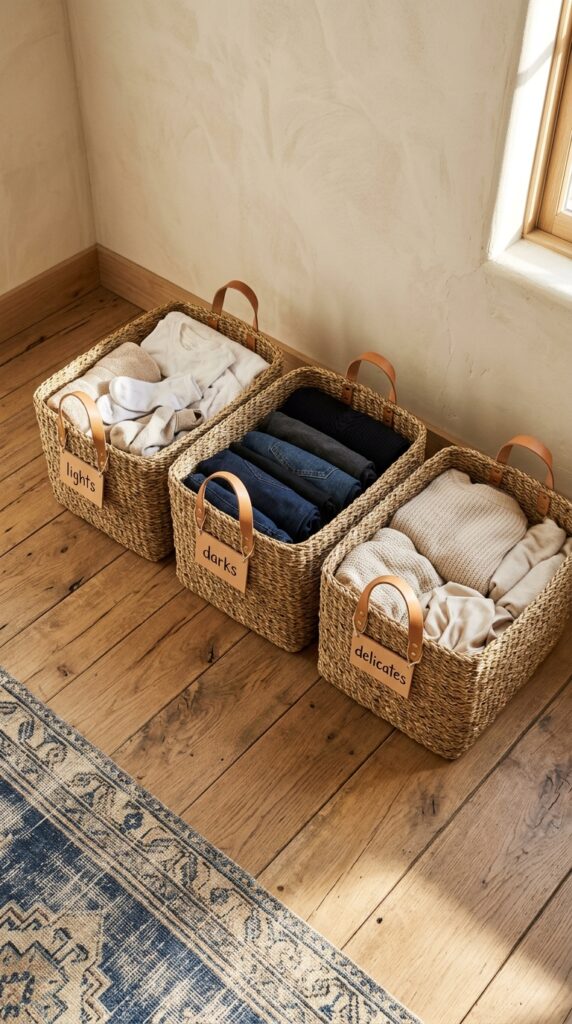
The matching basket trick is almost too simple, but it works because it removes the visual chaos of mismatched plastic hampers. Three baskets, same material, same size — labeled or not — and suddenly the floor doesn’t look like a yard sale. Seagrass, water hyacinth, or rattan all have that earthy texture that softens hard appliance lines.
Pick a size that’s deep enough to hold a full load but light enough to carry up stairs. Leather handles last longer than rope ones, especially if you’ve got teenagers who drag them around. Small leather or canvas tags add a personal touch without feeling precious.
Watch out for cheap baskets that shed fibers — they look great for a month, then start unraveling at the rim. Spend a little more here. The takeaway: three good baskets do more for visual calm than any storage system you could buy in a box.
4. Pegboard Wall for Tools and Supplies
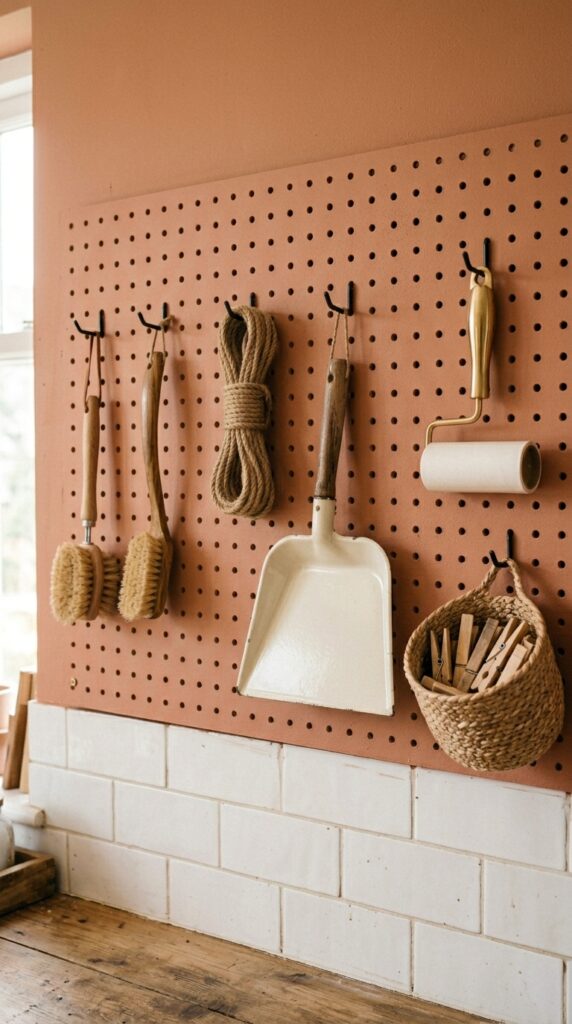
Pegboard isn’t just for garages anymore, and a painted pegboard wall in a laundry room is one of those underrated moves that makes the space feel custom. Everything you reach for daily — brushes, lint rollers, scissors, drying clips — hangs in plain sight, which means you actually use them instead of digging through a drawer.
Paint the board in a warm, saturated color (clay, olive, dusty blue) so it reads as a feature, not just functional. Black or brass pegs look more refined than the standard metal ones. Group items by use, leave breathing room between them, and resist the urge to fill every hole.
The constraint here: pegboard works best on a full wall or a clearly defined section. A tiny square of it just looks lonely. If you’ve got the space, this might be the most useful five square feet in your house.
5. Glass Jars for Detergents and Powders
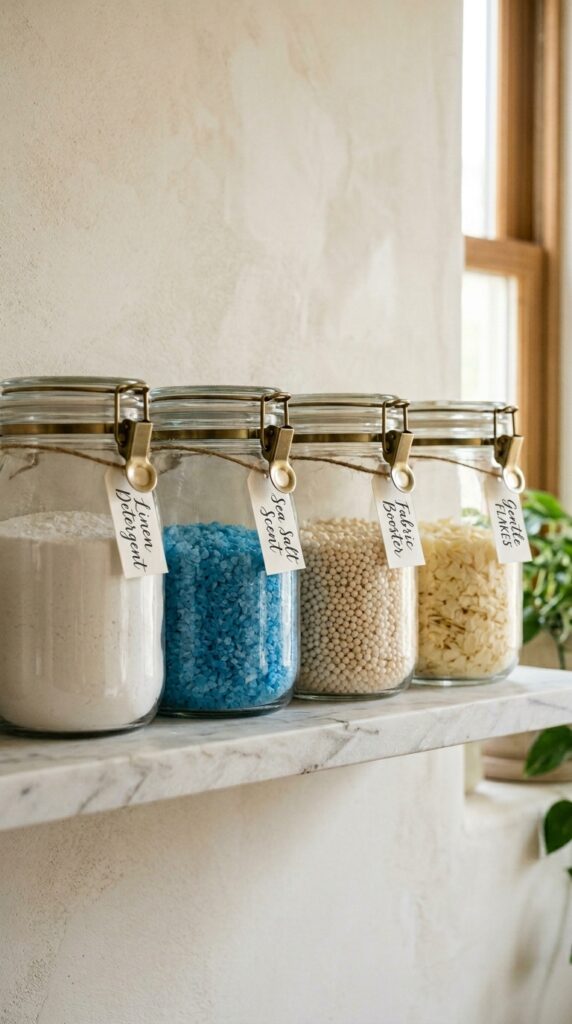
Decanting detergents into glass jars is the kind of move that splits people. Some find it genuinely calming; others think it’s peak Pinterest energy. I land somewhere in the middle — it’s worth doing, but only if you’ll actually maintain it. Half-decanted jars are worse than the original bottles.
Stick to one jar shape and one lid material across the whole room. Brass clamps, wood lids, or simple cork all work. Use them for powders, pods, oxygen boosters, and wool dryer balls — anything dry. Liquids are trickier; a dispenser pump on a glass bottle is easier than pouring from a jar every time.
The catch: write what’s inside on the bottom or back, not the front. Fancy front labels get sticky and look dated fast. Keep the takeaway simple — uniform jars equal instant calm, but only if you commit.
6. Open Shelving Above the Machines
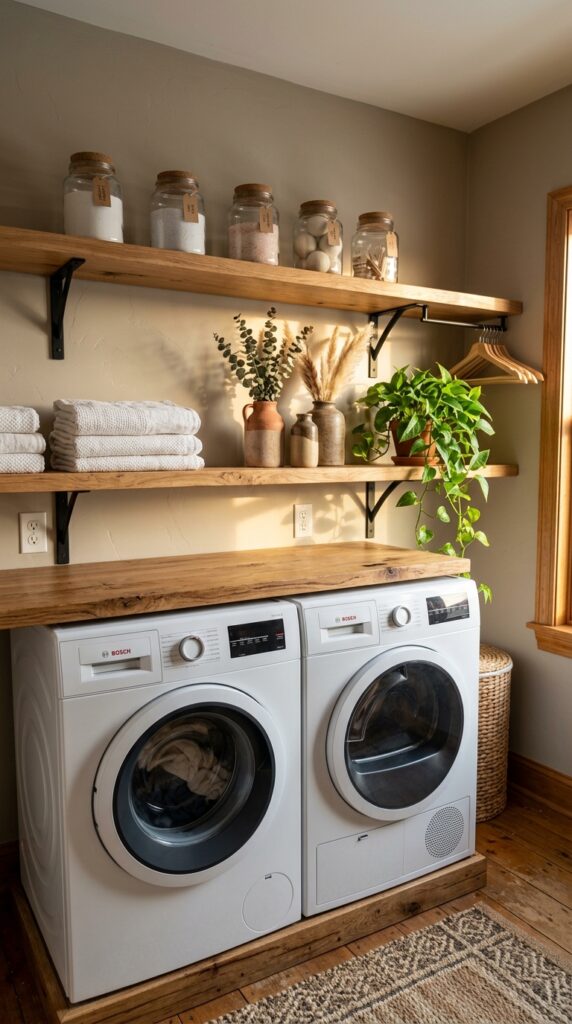
Open shelving above the machines is a controversial pick because it requires real discipline. If you can’t commit to keeping it tidy, install cabinets instead. But when it’s done right — two thick wooden shelves, a few well-chosen objects, no dead weight — it makes the room feel like a real part of the home, not an afterthought.
Use the shelves for things you genuinely use weekly: folded towels, jars of detergent, a basket for stray socks. Mix in one or two non-functional items (a small plant, a ceramic piece) so it doesn’t read as pure storage. Thicker shelves (1.5–2 inches) always look more architectural than thin ones.
One real watch-out: dust collects fast above appliances because of vibration and lint. Wipe weekly. The takeaway? Open shelves reward people who edit ruthlessly and punish those who don’t.
7. A Hanging Rod for Air-Drying
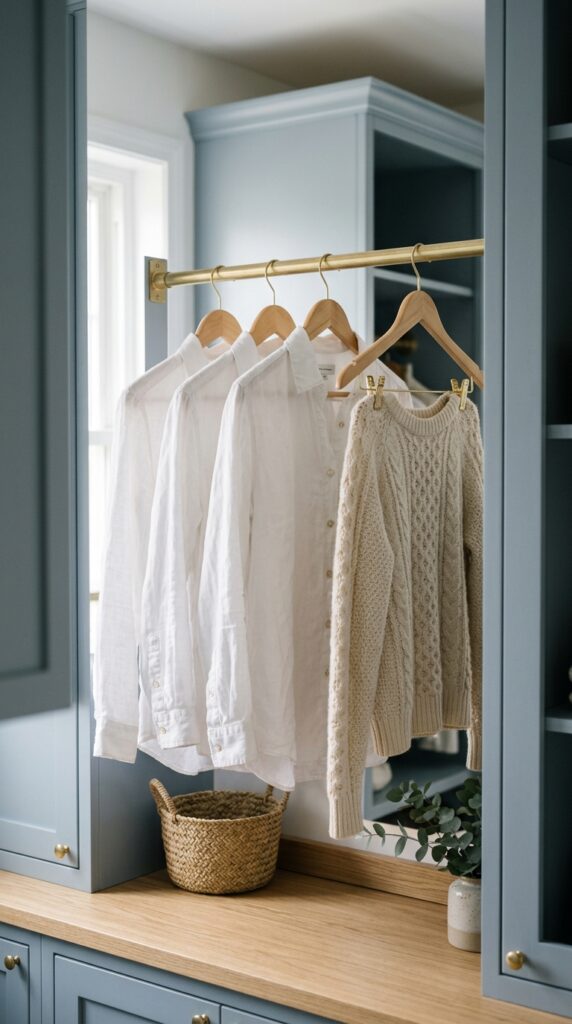
A built-in hanging rod is non-negotiable in my book. Half the things you wash shouldn’t go in the dryer anyway — knits, linen, anything delicate — and draping them over chairs is how you end up with permanent crease lines. A proper rod fixes that in about an hour of installation time.
Tuck it between cabinets so it disappears when not in use, or mount it under a shelf so it doubles as architectural detail. Brass and matte black both look better than chrome. Make sure you’ve got drip clearance below — either tile, a sink, or a small drainage pan.
The constraint is ceiling height. If your room is short, a pull-down or retractable rod is smarter than a fixed one. Either way, this is the kind of small built-in that quietly makes line-drying feel less annoying and more like a reasonable thing to do.
8. A Statement Floor That Hides Everything
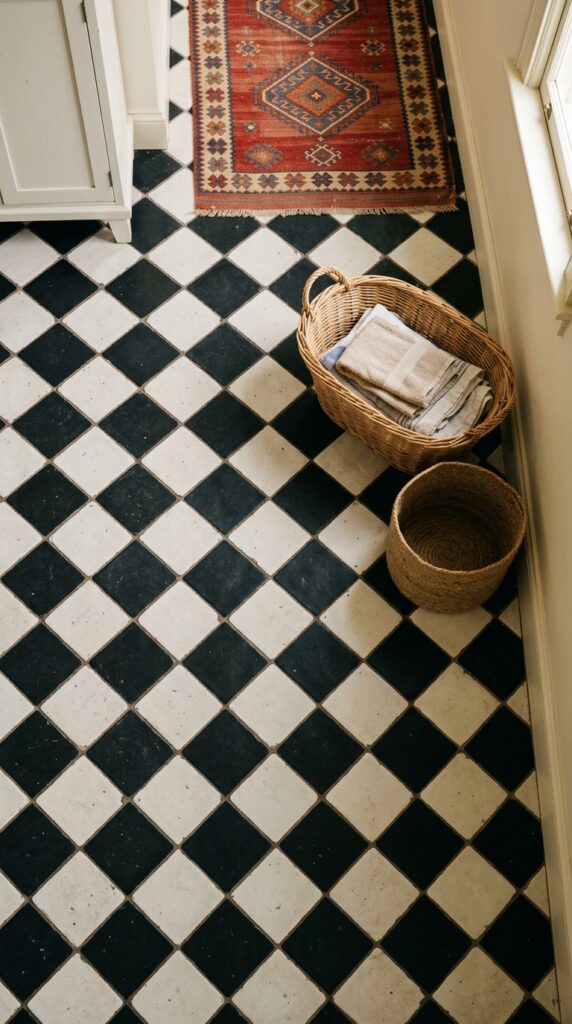
The laundry room is the perfect place to be brave with flooring because the room is small enough that bold patterns don’t overwhelm — and weirdly, busy floors hide lint, hair, and water spots better than plain ones. Checkerboard, terrazzo, encaustic patterns, even a deep saturated solid color all work.
Matte porcelain or ceramic is your best bet for durability and water resistance. Skip glossy finishes here; they get slippery when wet and show every drip. If you’re renting, peel-and-stick vinyl tiles have come a long way and look surprisingly convincing in photos and in person.
The trade-off: a strong patterned floor means everything else in the room — cabinets, walls, textiles — should stay calm. Fight that urge to layer more pattern on top. The takeaway is simple: pick one thing to be loud, and let the floor be it.
9. Drawers Instead of Lower Cabinets
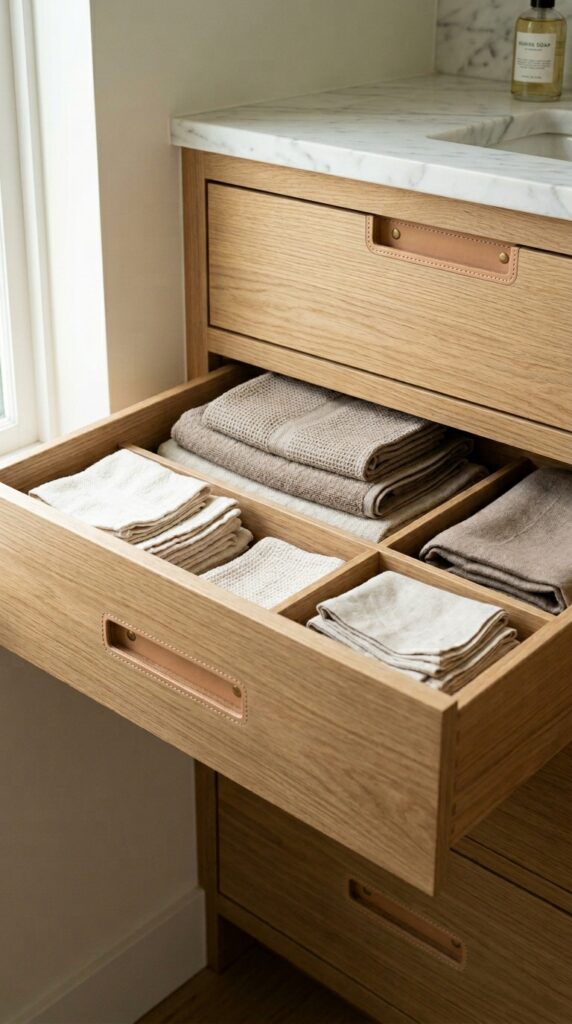
Lower cabinets are where laundry room organization goes to die. You shove things in, can’t see what’s at the back, and three months later you’re buying detergent you already own. Drawers fix this completely. Everything is visible the second you pull them open.
Deep drawers (around 10–12 inches) work best for laundry tasks — they hold detergent jugs upright, fit folded linens, and accommodate cleaning supplies without awkward stacking. Add simple wooden dividers to keep zones distinct. Soft-close runners are worth the extra cost; nothing kills the vibe faster than a slammed drawer.
Watch out for the price difference, though. Drawers run noticeably more than standard cabinets, especially with quality runners. If budget’s tight, do drawers in the most-used base unit and keep regular cabinets elsewhere. The takeaway: pull-out beats reach-in every single time.
10. A Proper Utility Sink, Made Beautiful
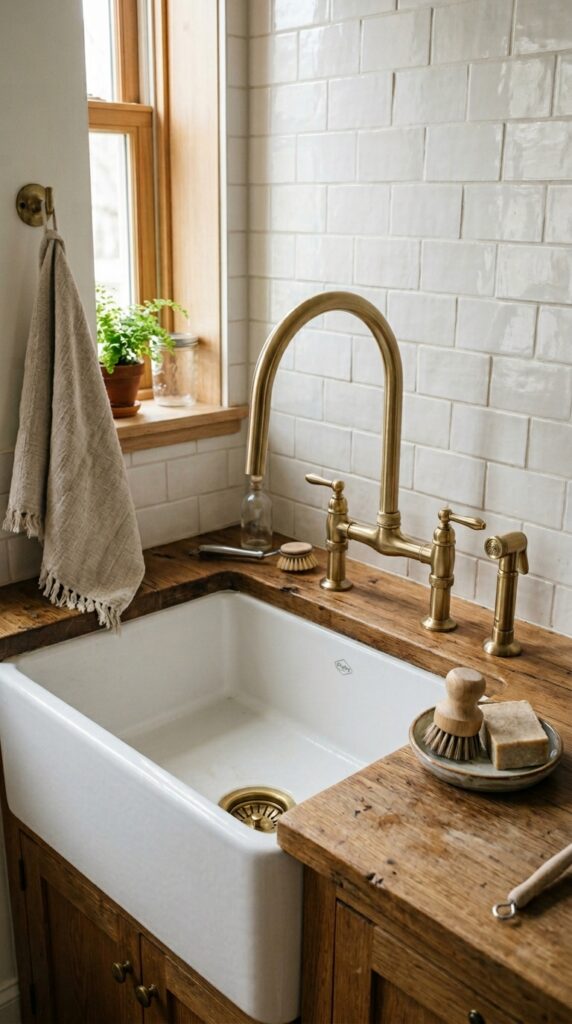
Utility sinks have a reputation for being ugly — that flimsy plastic basin with the chrome legs is a crime against design. But a proper deep sink in fireclay or stainless can be genuinely beautiful, and it’s one of the most useful additions to any laundry room. Pre-soaking, hand-washing, watering plants, washing the dog. It earns its keep.
Go deeper than you think you need. A 9-inch basin feels useless once you’re rinsing something bulky. Pair it with a tall arched faucet, ideally one with a pull-down sprayer. Brass, matte black, and brushed nickel all hold up well in a wet environment.
The constraint: plumbing might dictate where it goes, and adding a sink to a room that doesn’t have one is a real expense. If you’ve already got the rough-in, this is a no-brainer. If not, weigh it carefully.
11. Tucked-Away Hampers in Pull-Out Bins
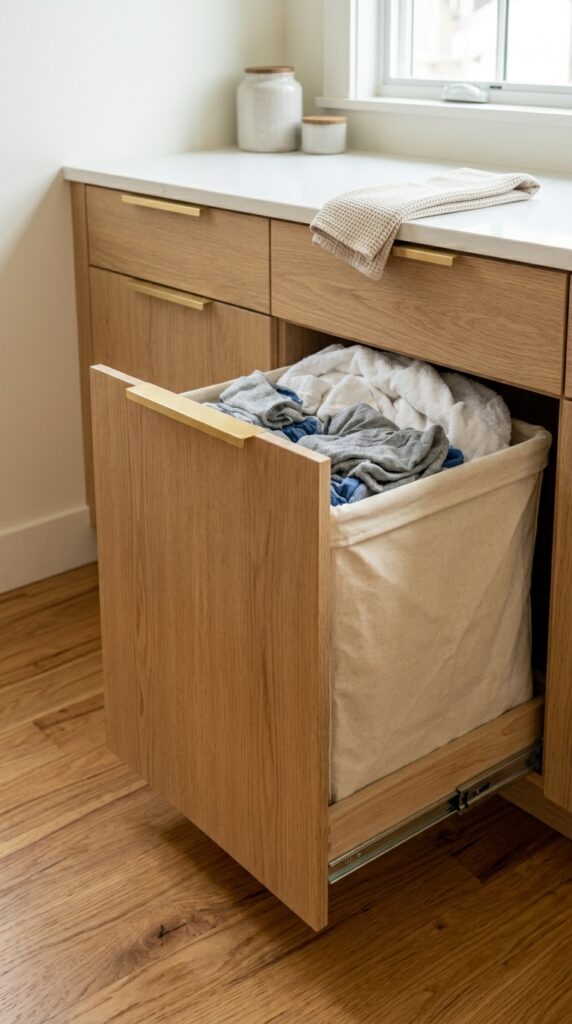
Visible hampers, no matter how nice, always read as clutter. Pull-out hampers built into the cabinetry solve this entirely — you get the function of a basket with none of the visual weight. They look like just another drawer until you open them.
Most cabinet companies offer a pull-out hamper insert, or a good carpenter can retrofit existing cabinets. Use removable canvas or linen liners so you can dump and wash them. Two side-by-side bins (one for lights, one for darks) is the move; three is overkill unless you have a big family.
The trade-off: pull-out hampers take up base cabinet space you could use for something else. Make sure you’ve got room for both storage and sorting. Quick takeaway — out of sight really does mean out of mind here, in the best possible way.
12. Wallpaper That Makes the Room Worth Looking At
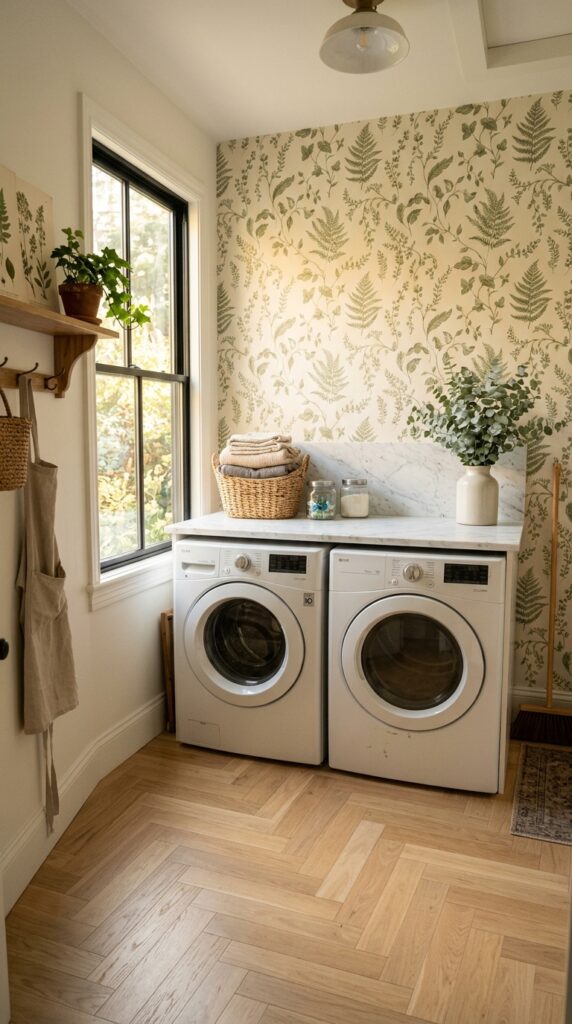
Wallpaper in a laundry room sounds extravagant until you do it — and then you wonder why every laundry room doesn’t have it. Because the space is small, you can splurge on a single roll of something genuinely beautiful and the cost stays reasonable. It’s the highest design impact per dollar in the whole house.
Stick to one accent wall, ideally the one you face when using the machines. Botanical prints, small geometrics, and traditional florals all age better than trendy bold patterns. Peel-and-stick versions have gotten genuinely good for renters or anyone commitment-shy. Pair the paper with calm, neutral cabinetry so it doesn’t fight for attention.
One real watch-out: humidity. Make sure the wallpaper you choose is rated for damp environments, or use it on a wall away from direct steam. Quick takeaway? Treat the laundry room like a small jewel box, and it’ll surprise you every time you walk in.
Final Thoughts
A laundry room won’t ever be the room you show off when guests come over — and that’s actually its strength. Because it’s hidden, it’s the one space where you can experiment without overthinking. Try the bold floor. Use the wallpaper you were too scared to commit to in the living room. Decant the detergent into glass jars, even if your friends roll their eyes.
The real shift happens when you stop treating the laundry room as purely functional and start treating it like a small, intentional space that deserves the same care as any other room in the house. Hide what’s ugly, double down on what’s beautiful, and make sure every item has somewhere to live. That’s the whole game.
If you took even one idea from this list — the matching baskets, the counter over the machines, a single roll of wallpaper — you’re already ahead of most people. Bookmark this page, come back when you’re ready to tackle the next project, and remember where you learned it. We’ll be here with more ideas to make the spaces you actually live in feel a little more like yours.