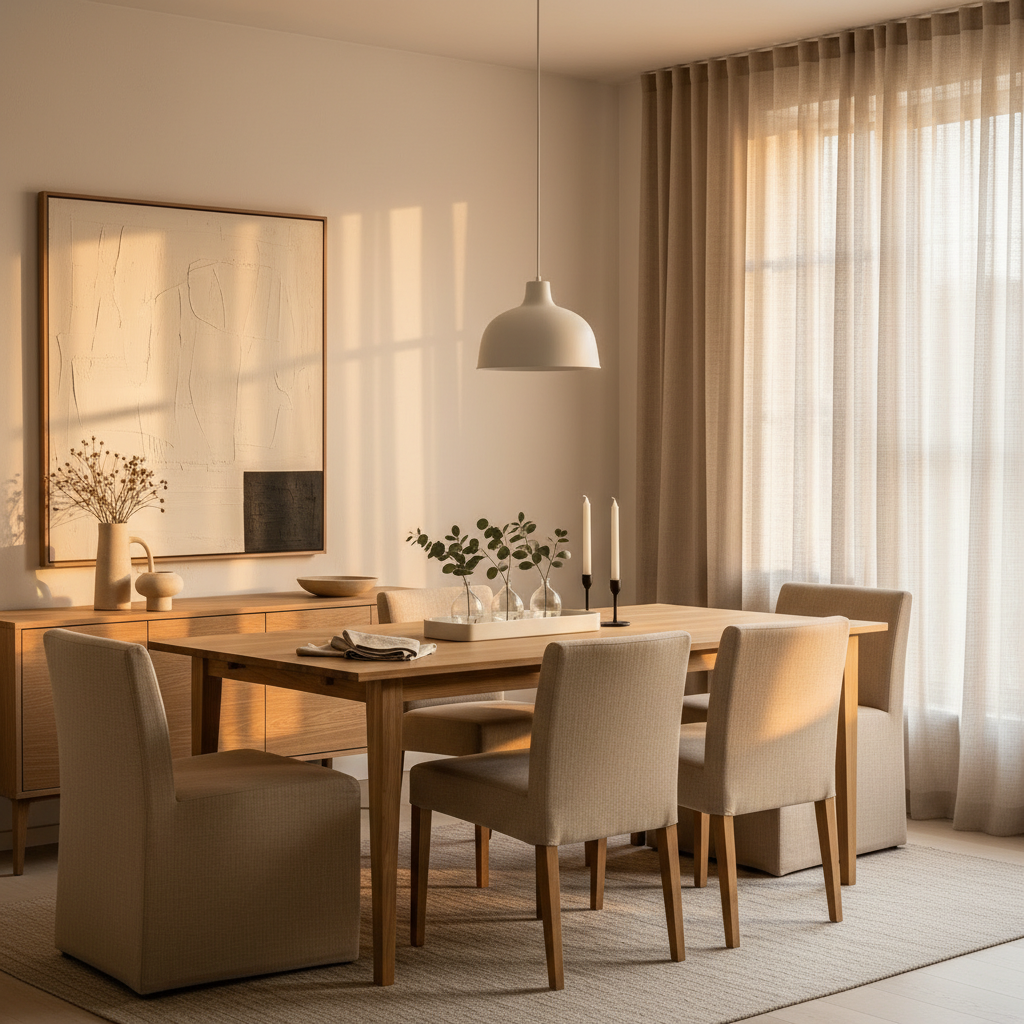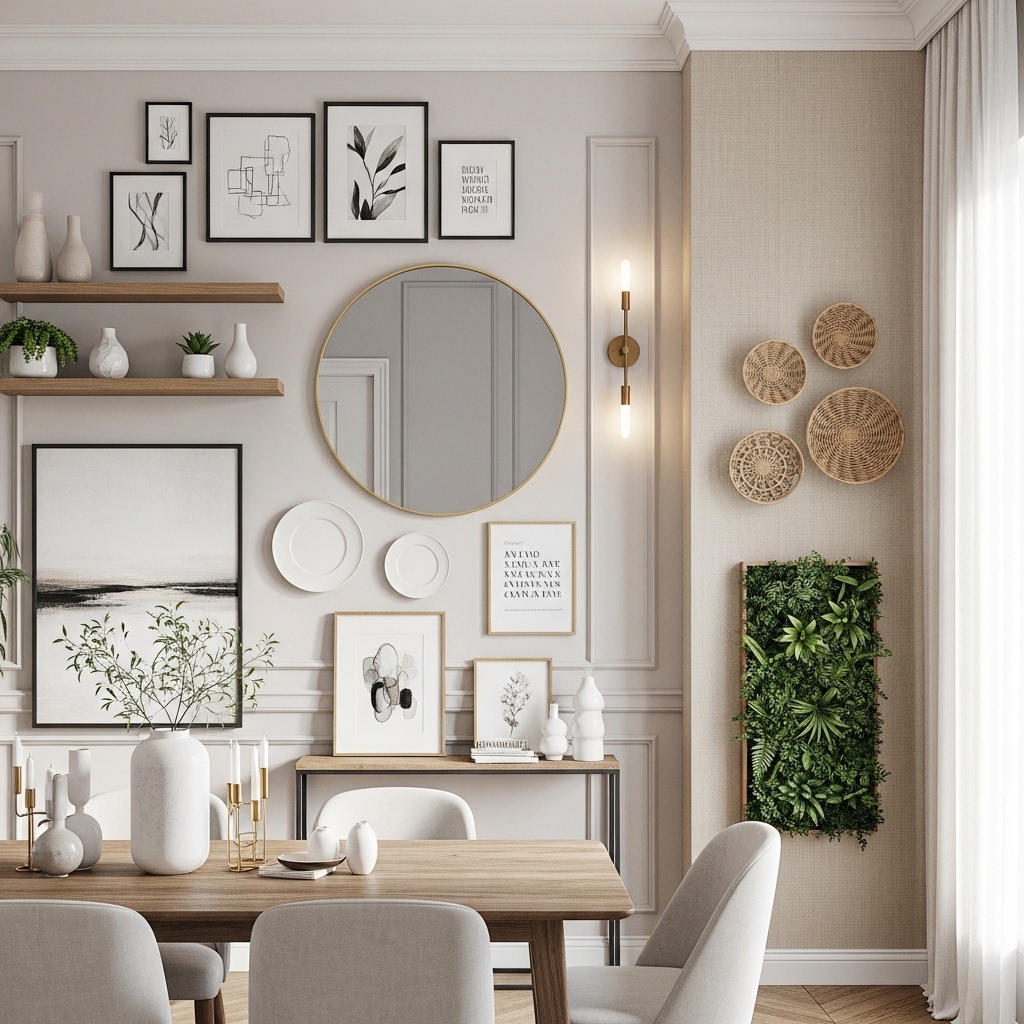
There’s a specific kind of dining room that makes you want to linger long after the plates are cleared — the kind where the light is soft, the chairs are slightly mismatched in the best possible way, and everything feels like it arrived slowly over years rather than in a single shopping cart. That’s the French country dining room. It’s not a style you manufacture in an afternoon. It’s a mood you build — one linen napkin, one chipped ceramic, one slightly imperfect wall at a time.
What makes this aesthetic enduring isn’t nostalgia. It’s intelligence. French country interiors are layered, practical, and deeply human. They tolerate imperfection. They prioritize comfort. They mix old and new without apology. And because the palette tends to stay within the warm neutrals and muted naturals of the actual French countryside — think lavender fields, stone farmhouses, sun-faded shutters — it ages beautifully instead of dating quickly. Whether you’re working with a formal dining room or a cramped eat-in kitchen, these twelve ideas will give you something genuinely usable.
1. The Limewash Plaster Wall
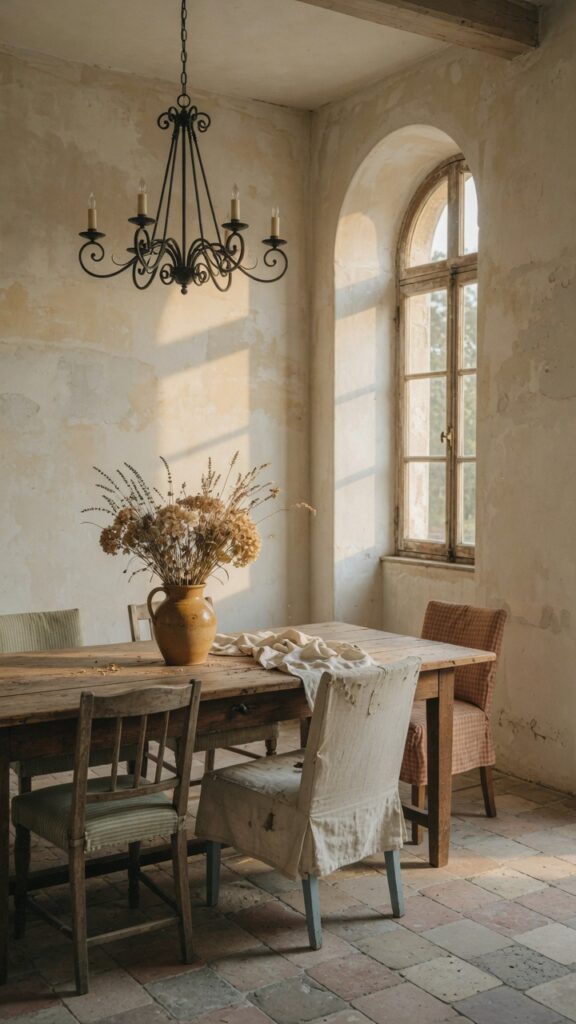
Limewash paint is having its moment, and for good reason — it does in one afternoon what regular paint simply cannot. The layered, slightly translucent finish gives walls a depth that reads as old plaster, old farmhouse, old Provence. In a dining room, this matters because walls are always visible. You’re sitting at the table looking at them for the entire meal.
The best colors for this treatment in a French country context are warm whites, aged linen, pale terracotta, and very soft sage. Go lighter than you think. Limewash reads richer on the wall than on the sample card.
Apply it yourself — it’s genuinely forgiving. Unlike venetian plaster, limewash doesn’t require a smooth substrate. Imperfections read as character. That said, in very bright rooms with direct southern sun, the finish can look washed out by midday. If your dining room faces south, go a shade warmer.
One thing to watch: it marks. Not badly, but it does. This is not the finish for a dining room with young children unless you’re emotionally prepared.
2. The Mismatched Chair Collection
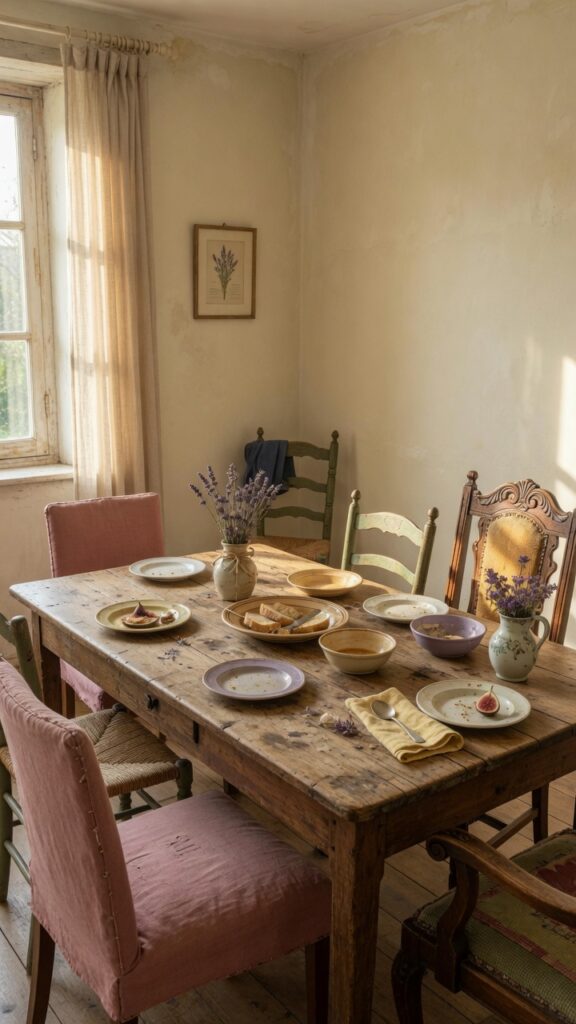
The matched dining set is a very recent invention, and honestly, not a particularly interesting one. French country rooms have always mixed chairs because historically, that’s just what happened — chairs came from different rooms, different generations, different markets. The result is a table that feels lived in rather than staged.
The trick to making it work is to pick one unifying element. It could be color — paint all the chairs the same chalky white or dusty sage. It could be material — ensure every chair has a natural fiber seat, whether rush, rattan, or linen. Or it could be scale — keep all chairs at a similar height and visual weight so the mix reads as curated rather than chaotic.
Armchairs at the head positions immediately elevate the look. They don’t need to match each other, but they should feel slightly grander than the side chairs. Upholstered seats in slubby linen or cotton velvet add softness without formality.
Avoid mixing too many wood tones if you’re not confident. Two, maybe three tones maximum. More than that and you lose the cohesion.
3. A Stone or Terracotta Tile Floor
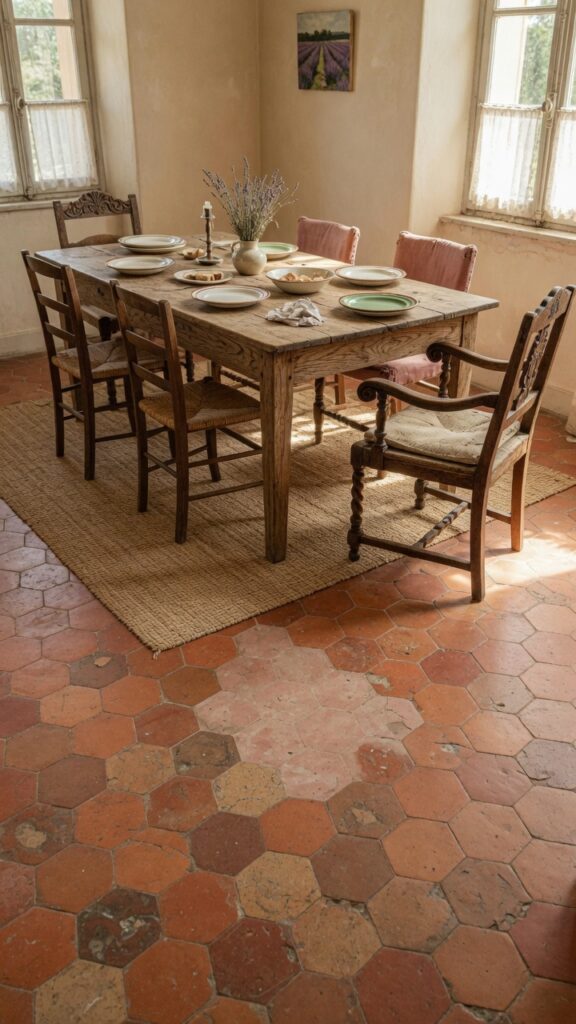
If there is one thing that separates a truly convincing French country dining room from one that just looks like it — it’s the floor. Terracotta tiles, stone pavers, or aged hexagonal cement tiles have a warmth and weight that no wood laminate can replicate. The slight unevenness, the variation in color across tiles, the way they hold and reflect candlelight — all of it reads as authentically old.
For most people, replacing a floor is a renovation, not a weekend project. But if you’re already planning one, prioritize this. Reclaimed terracotta tiles are widely available and less expensive than you’d expect. Unsealed, they’ll darken with age and use. Sealed with a matte finish, they’re practical and easy.
If you rent or can’t touch the floor, a large jute or flat-weave wool rug in warm oatmeal or faded stripe does meaningful work. Layer it under the table so at least two chair legs sit on it — this anchors the furniture and adds the texture you’re missing underfoot. A rug also absorbs sound, which matters in hard-surfaced rooms where conversation gets echoey.
4. The Wrought-Iron Chandelier
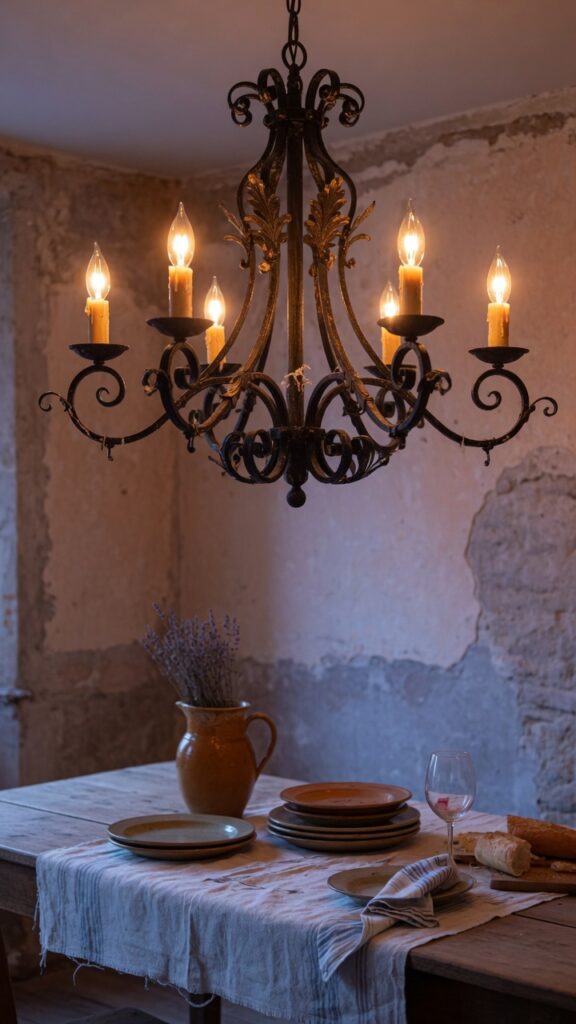
Lighting defines dining room atmosphere more than almost any other single element, and the French country chandelier is one of the most quietly powerful tools in the room. Wrought iron, forged bronze, aged brass — the material matters less than the silhouette. You want branches. You want candle-style bulbs. You want something that looks like it belongs in a farmhouse in the Loire Valley rather than a hotel lobby.
Hang it lower than you think necessary. Standard guidance says 30 to 36 inches above the tabletop, but in French country rooms where ceilings are often lower and the atmosphere is intimate, erring toward 30 inches adds enormously to the mood. You want to feel like you’re dining under it, not beneath it.
Bulb choice is critical. Warm filament bulbs — 2200K to 2700K — are non-negotiable. Cool white bulbs kill the atmosphere entirely. If you’re using a dimmer, check bulb compatibility before buying.
One practical note: iron chandeliers collect dust quickly on horizontal surfaces. If you host often and care about that sort of thing, factor in cleaning access before committing to a very large piece.
5. Botanical and Toile Wallpaper as an Accent
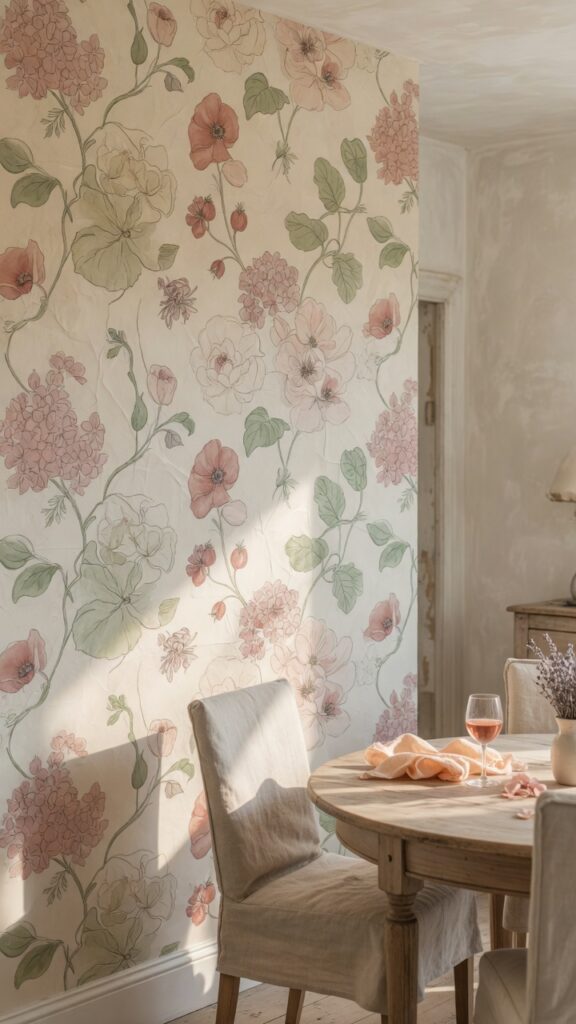
One accent wall of wallpaper in a French country dining room is one of those moves that reads as confident and considered rather than trendy, provided the pattern is right. Botanical prints — oversized herbs, garden florals, trailing vines — work beautifully. So does classic toile de Jouy, the pastoral illustrated print that is essentially the mascot of this entire aesthetic.
The rule is: pattern on one wall, texture on the others. Don’t wallpaper a whole dining room unless you have genuinely high ceilings and a large room. In standard proportions, four papered walls will feel overwhelming and close.
For renters, peel-and-stick wallpaper has improved dramatically in the last few years. Several makers now offer botanicals and toile in genuinely good colorways that go up cleanly and come off without damage.
Color palette guidance: the most successful versions of this stay within a soft range — muted sage, dusty rose, faded terracotta, antique cream, soft navy. The moment the colors get too saturated, the print stops reading as French country and starts reading as maximalist. There’s a difference, and it’s a fine line.
6. The Farmhouse Table with Visible Grain
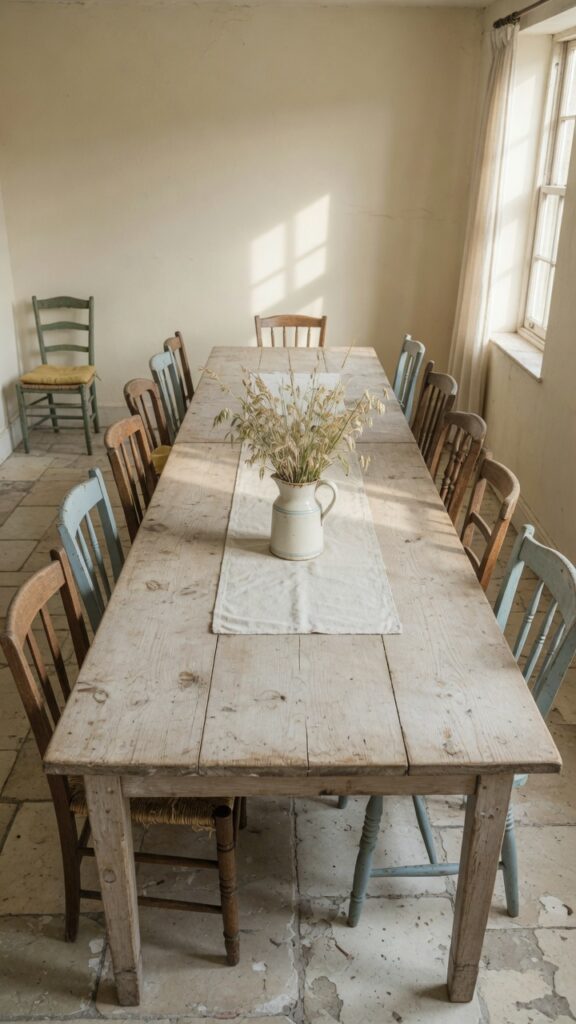
The table is the room. Everything else — the art, the chairs, the chandelier — exists in relationship to the table. In a French country dining room, the table should be farmhouse in spirit: long, solid, slightly worn, and made of real wood with visible grain and imperfection.
Whitewashed or limed oak is the most versatile option. It reads light without being stark, and it coordinates with almost any upholstered chair color. If you prefer more warmth, a natural walnut or chestnut with a matte oil finish is deeply beautiful, though it will show every water ring, which some people find charming and others find maddening.
Buy the biggest table your room can realistically support. French country dining is about gathering — a table that seats eight but lives in a room that comfortably fits ten is almost always the right call. Leave at least 36 inches between the table edge and the nearest wall for chair pull-out. Less than that and the room starts to feel like a puzzle.
Skip glass tops entirely. They’re maintenance nightmares and they kill the warmth.
7. Open Shelving with Earthenware Display
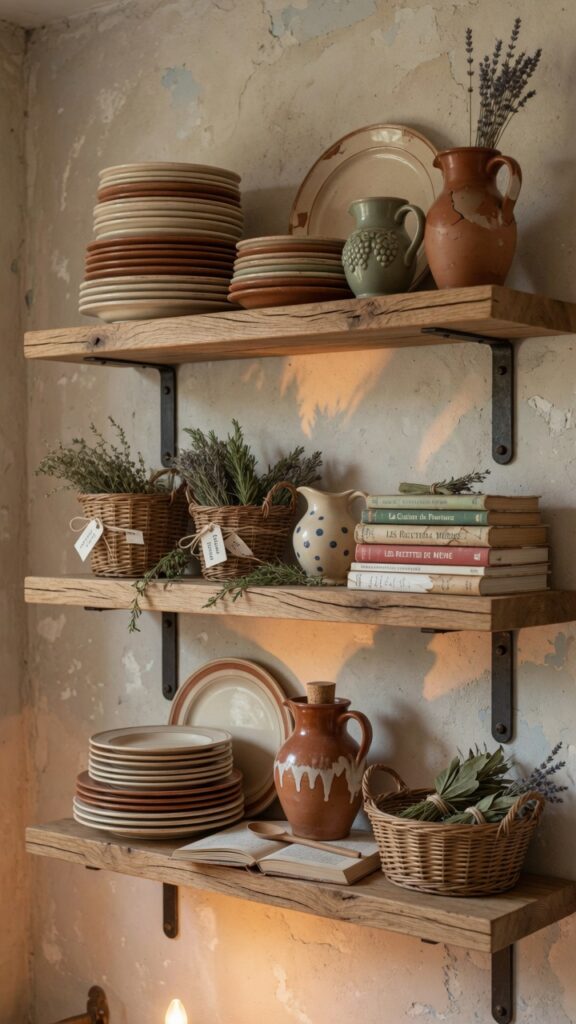
Open shelving in a dining room does two things simultaneously: it provides practical storage and it acts as a permanent installation of curated objects. In French country rooms, the shelves themselves should be simple — thick-cut oak, rough-hewn pine, or painted wood in an off-white. The objects do the decorating.
The palette for what you display should stay tight: cream, terracotta, sage, natural wood, soft copper. Mix textures — smooth glazed ceramics next to rough stoneware next to woven baskets. Vary heights constantly. A stack of four plates next to a tall pitcher next to a low bowl — that rhythm is what separates good shelf styling from items that simply sit on a shelf.
Dried botanicals are your best friend here. A bundle of dried lavender, some wheat stalks, a few dried orange slices — these add color and organic texture without the maintenance of fresh flowers.
One honest constraint: open shelves collect grease and dust, especially near a dining area. If you cook adjacent to this room or host frequently, factor in a wipe-down every few weeks. It’s not onerous but it’s not nothing either.
8. Linen Drapes in Natural Tones
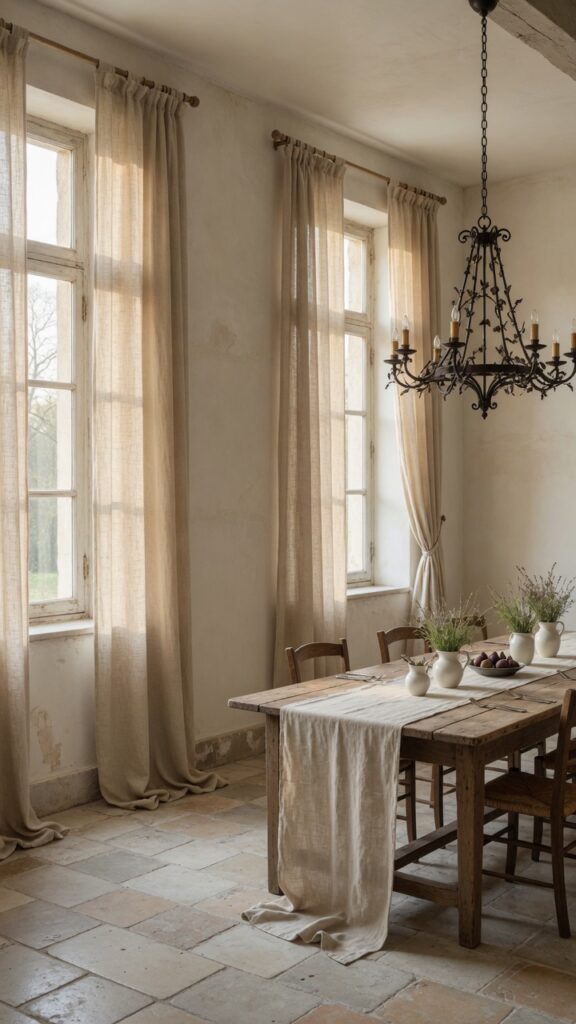
Curtains in a dining room are often treated as an afterthought. They shouldn’t be. In a French country space, the right drapes add height, softness, and — crucially — that slightly rumpled, lived-in quality that defines the whole aesthetic.
The fabric is non-negotiable: linen. Not linen-look polyester, not cotton-linen blend — actual linen, or as close to it as your budget allows. Real linen wrinkles. That’s the point. It drapes differently from synthetic fabrics. It catches light differently. It breathes differently. The imperfection of it is part of the beauty.
Hang the rod as close to the ceiling as possible, regardless of where the window actually sits. This creates the illusion of height and makes average-sized windows look generous. Let the drapes puddle at the floor by one to three inches — not yards of fabric, just a gentle break.
Natural linen, undyed flax, soft oatmeal, and warm ivory are the best colors here. Avoid bright white — it reads as clinical in this context. If you want subtle pattern, a very fine stripe in a tone-on-tone works well without competing with other elements.
9. A Vintage or Antique Mirror Above the Sideboard
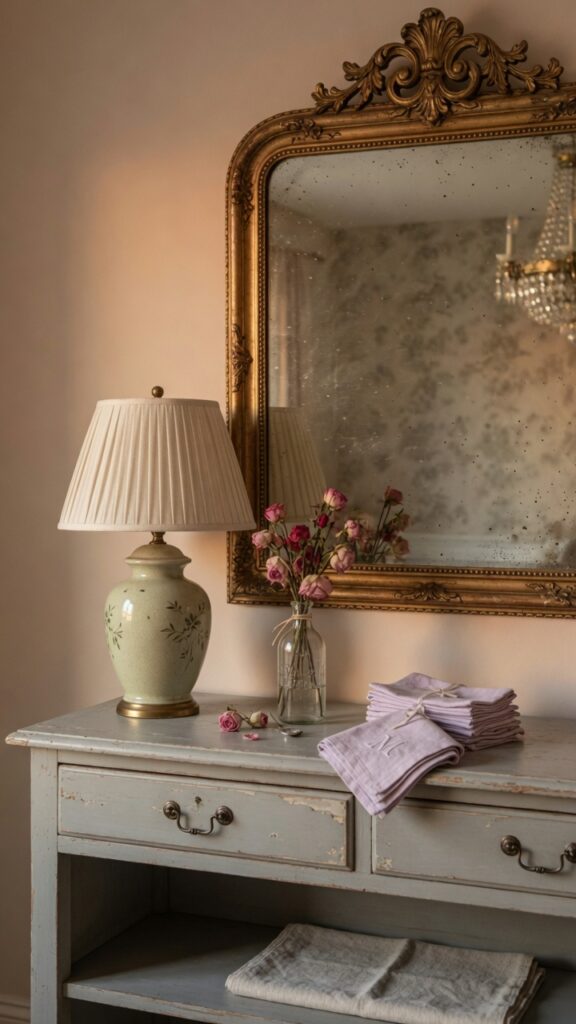
Mirrors in dining rooms earn their place by multiplying light and making the space feel larger. In French country rooms, the right mirror goes further — it adds age, character, and a focal point above the sideboard or buffet that anchors that entire wall.
The frame is everything. You want ornate but worn — gilded wood with the gold rubbing off in places, or a distressed plaster frame, or a simple arched frame with visible age marks. Avoid anything that looks too polished or contemporary. The mirror itself should ideally have some foxing — those small dark spots that appear in antique glass over time. They signal age without demanding an explanation.
Size matters more than people think. Go larger than feels comfortable. A mirror that’s too small reads as timid above a sideboard. As a rough guide, the mirror should be at least two-thirds the width of the furniture beneath it.
Source these at estate sales, antique markets, or online vintage marketplaces rather than mass retailers. The price difference is often not as dramatic as people assume, and the character difference is enormous.
10. Soft Candlelight and Layered Lighting
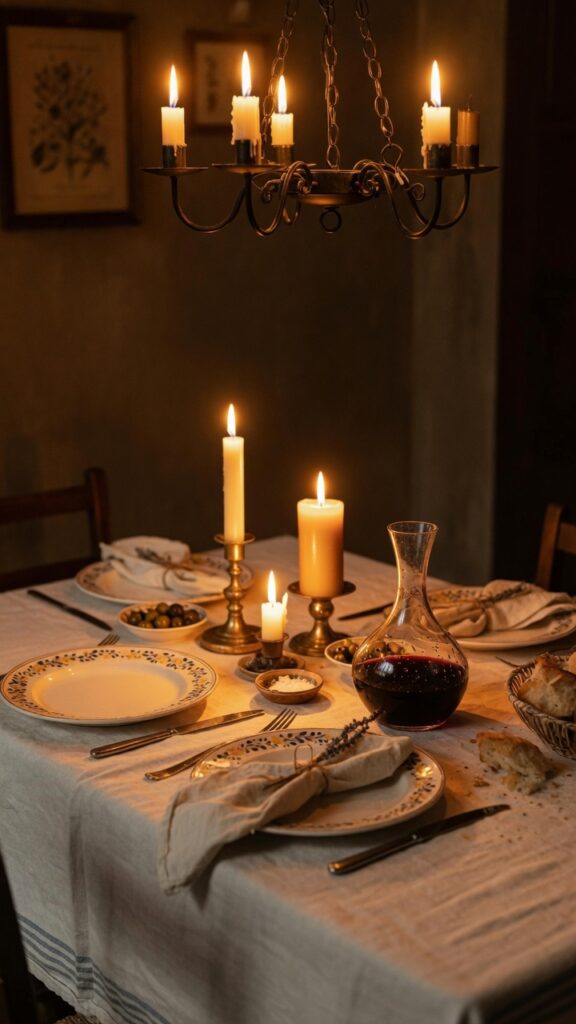
This is the thing most people get wrong: one overhead light source. A chandelier, even a beautiful one, is not enough on its own. French country dining rooms work because the light feels layered — some from above, some from the table, some from a corner. The eye has multiple points to rest on, and the room never feels like it’s lit for a supermarket.
Build your lighting in three layers. Overhead is the chandelier, always on a dimmer. Table level is candles — real candles where possible, high-quality flameless where necessary. If you host dinners, get into the habit of lighting pillar candles thirty minutes before guests arrive. The room transforms. Finally, consider a wall sconce or a lamp on the sideboard for a third warm point of light.
The color temperature across all sources should match: warm, warm, warm. 2200K to 2700K for bulbs. Candles are naturally in this range. If your chandelier uses cool-white bulbs, replace them immediately — it is the single most impactful change you can make for under twenty dollars.
This layered approach works in any size room and requires no renovation. Start with a dimmer and a set of pillar candles. Everything else can follow.
11. A Gallery Wall of Vintage Botanicals and Maps
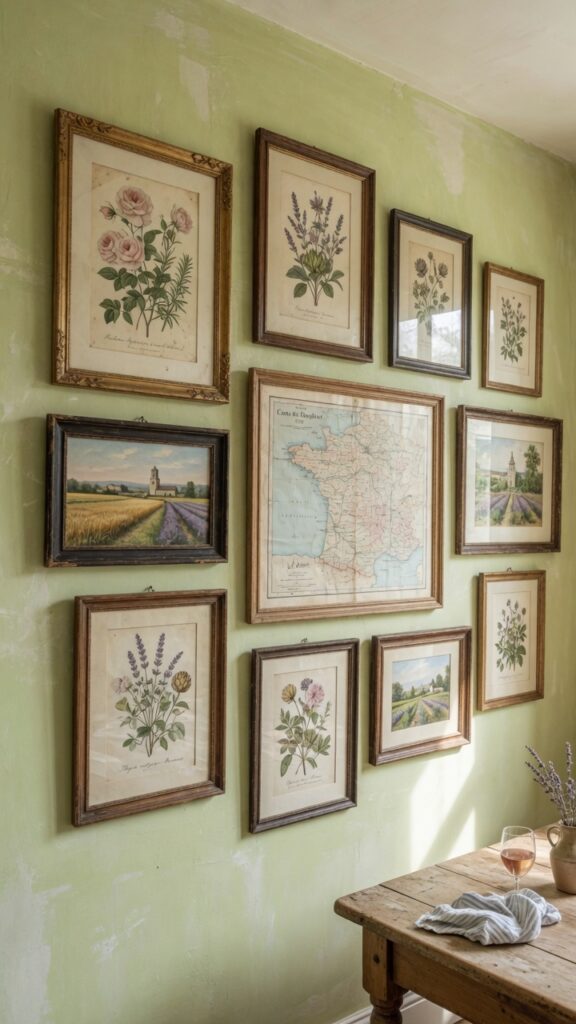
A gallery wall in a dining room should feel like it accumulated over time — not like it was planned in an afternoon using a template. The French country version leans on vintage prints: hand-illustrated botanicals from old encyclopedias, regional maps of French provinces, small landscape sketches, pressed plant illustrations. The content has a through-line (natural world, old France, pastoral life) even when the frames don’t match.
Frames should be a mix of thin gilded wood, simple dark wood, and perhaps one or two in painted white. Keep the variation modest — too many different frame styles reads as chaotic rather than curated. The sizes should vary significantly: mix large anchor prints with small accent pieces.
Arrangement tip: lay everything on the floor first. The organic salon-style grouping works best when you establish the outer boundary first, then fill in. Avoid grids — they look corporate in this context. Center the grouping at eye level, which for a dining room means slightly lower than you’d hang art in a hallway, since people are often seated.
For sourcing, old botanical encyclopedias and atlases can often be disassembled at antique markets for very little money. The prints inside, once framed, look completely professional.
12. The Provençal Centerpiece: Dried Botanicals and Ceramics
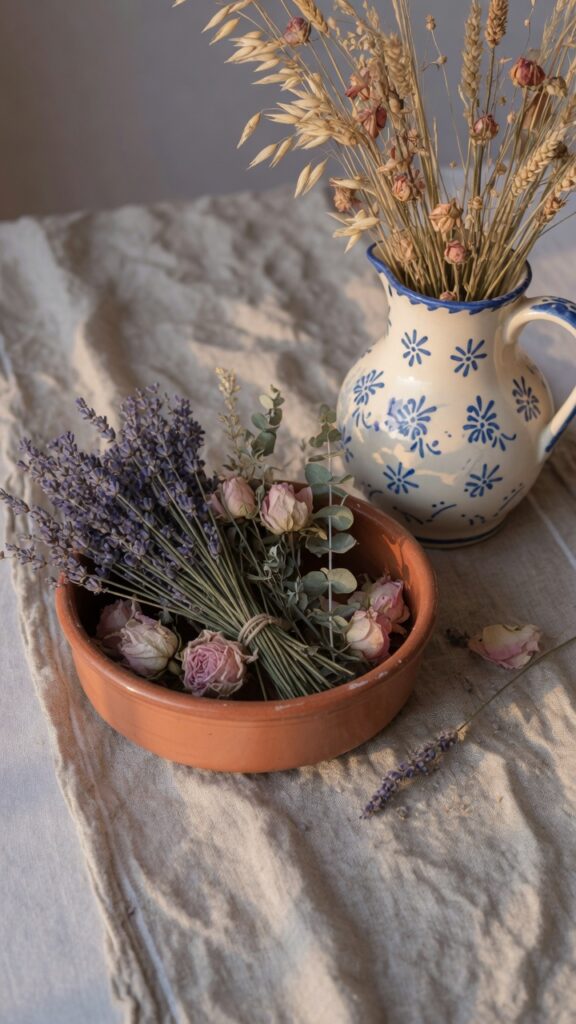
The centerpiece is the smallest thing and the most personal. In French country dining, it should never look purchased — it should look gathered. Dried lavender from the garden. A ceramic pitcher from a market. A few stems of something foraged. The goal is abundance without fussiness.
Dried botanicals are the smartest choice for dining rooms because they require no water, no maintenance, and they only improve with age as the colors soften and fade. Lavender, pampas grass, dried roses, wheat stalks, dried eucalyptus, cotton stems — any of these, alone or combined, immediately read as French countryside.
The vessels matter enormously. Terracotta pots, hand-thrown ceramic pitchers, stoneware bowls, glass bottles — anything with an imperfect, handmade quality. Avoid anything too polished or symmetrical.
Keep height varied and the arrangement low enough that people can see across the table. A tall centerpiece that blocks conversation is a design failure regardless of how beautiful it is. Two or three vessels of different heights, grouped loosely, always outperforms one elaborate arrangement.
Change it seasonally. Spring calls for dried tulip heads and pale grasses. Summer leans into lavender and sunflower stems. Autumn invites in wheat and dried seed pods. Winter is dried orange slices and pine. The room evolves without a single piece of furniture moving.
The French country dining room is one of those rare interiors that rewards restraint and patience in equal measure. You don’t need all twelve of these ideas — you need the right four or five for your specific room, your light, your life. Start with what’s immovable: the floor, the wall finish, the lighting. Then layer in the things that are easier to swap — the textiles, the ceramics, the art.
What tends to get overlooked is that this style is genuinely forgiving. Mismatches are intentional. Imperfections are the point. A chipped ceramic is more interesting than a perfect one. A wrinkled linen drape is more beautiful than a pressed polyester one. That philosophy, more than any specific product or color, is what makes French country dining rooms so enduringly livable — and why so many people return to this aesthetic again and again, even decades after they first discovered it.