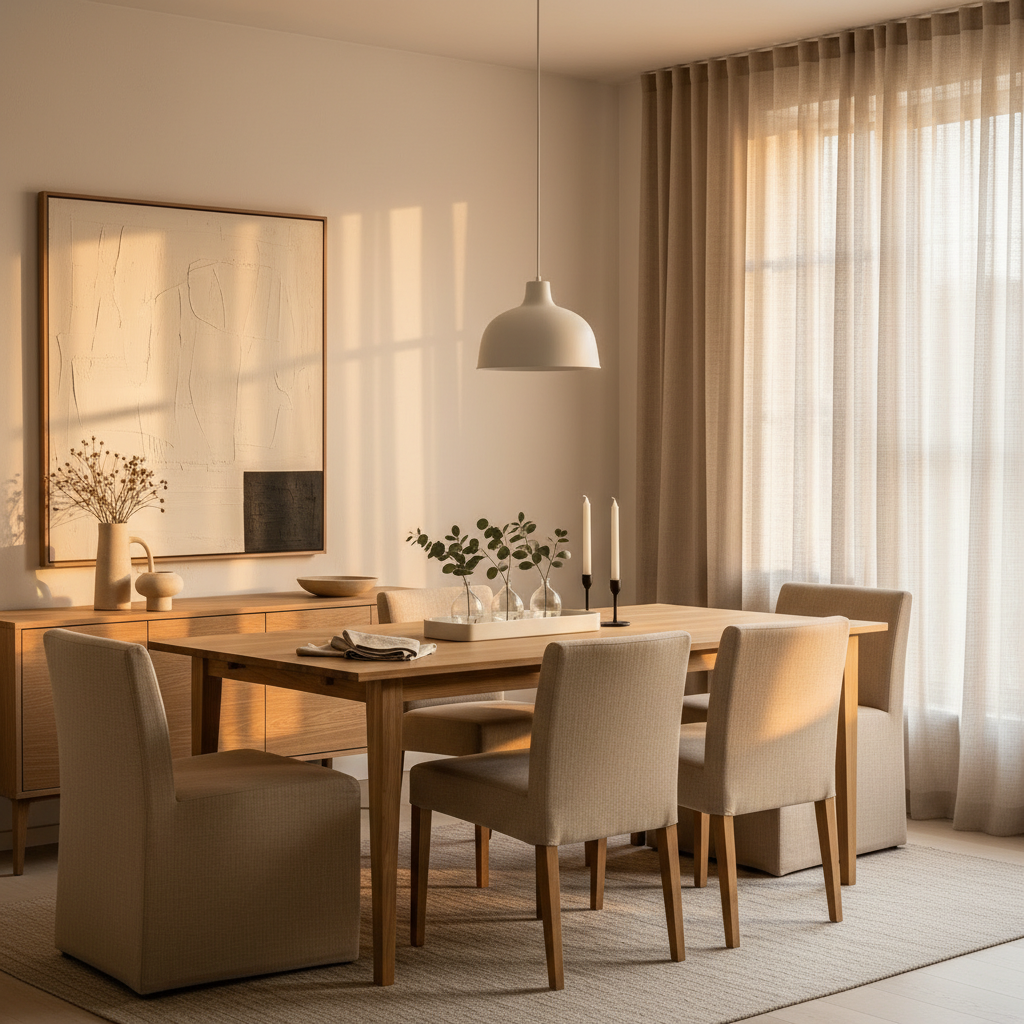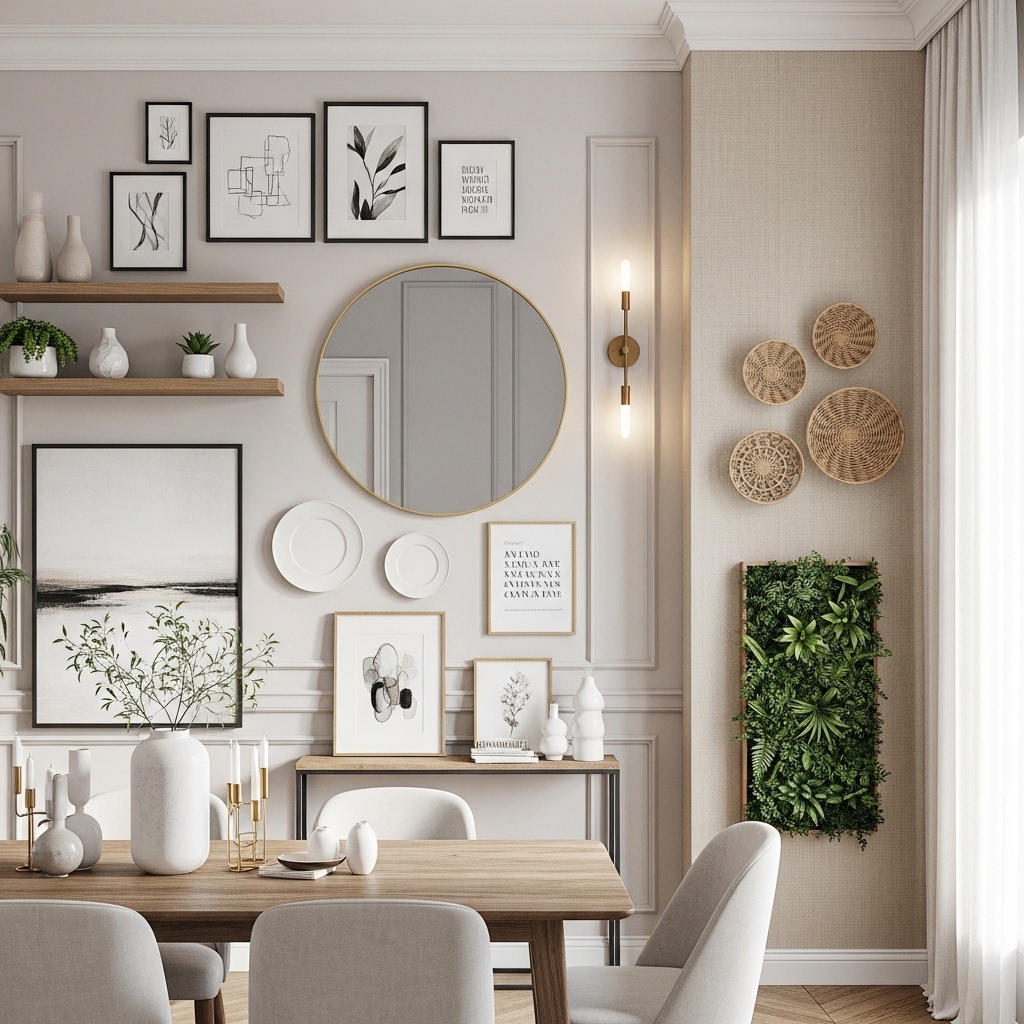
There’s a reason the farmhouse aesthetic has refused to go out of style. It isn’t trend-chasing — it’s actually rooted in something more honest than that. Farmhouse dining rooms feel like they’ve been lived in, argued over, laughed around, and set for a hundred meals before you ever pulled up a chair. They’re the opposite of precious. And right now, with so many interiors swinging toward either cold minimalism or maximalist chaos, that warm middle ground feels genuinely refreshing.
The tricky part? Getting it right without tipping into cliché. Shiplap everywhere, a mason jar on every surface, a chalkboard that nobody writes on — that version of farmhouse is tired. What works today is more selective, more layered, and honestly more personal. It borrows from the traditional farmhouse vocabulary — raw wood, linen, iron, ceramics — but filters it through a modern eye that knows when to stop.
These twelve ideas cover everything from statement lighting to renter-friendly wall treatments, from color palettes that actually hold up in low-light rooms to textile layering that makes a dining space feel genuinely warm rather than staged. Whether you’re starting from scratch or just trying to refresh a room that’s lost its character, there’s something here worth stealing.
1. The Reclaimed Wood Dining Table as the Room’s Anchor
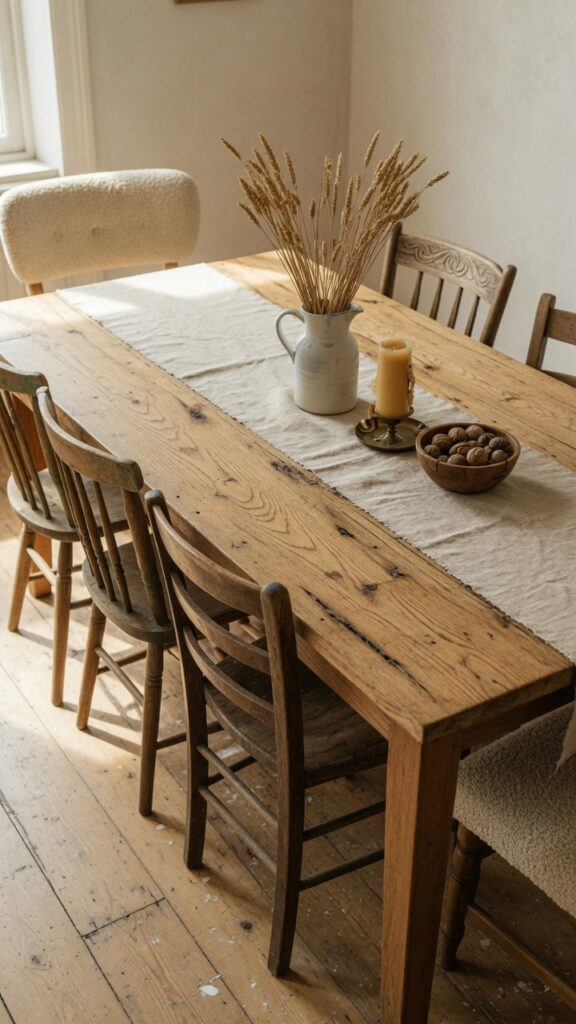
The table is doing most of the work in a farmhouse dining room, so it’s worth being deliberate about it. A reclaimed wood table — one with actual history in the grain, actual knots and color variation — immediately sets the tone in a way that no amount of decorative accessories can replicate. This isn’t a piece you decorate around. It’s a piece you decorate with.
Look for tables with a thick, substantial top — at least two inches of depth — because that heft reads as genuinely farmhouse rather than farmhouse-adjacent. The finish matters too. An oiled or lightly waxed surface that shows the wood’s natural texture will age beautifully and wipe clean easily, which matters when you’re actually using the table for meals. Avoid heavily lacquered finishes; they reflect light in a way that reads more contemporary than rustic.
One constraint worth flagging: very dark reclaimed wood can make a small dining room feel heavy, especially if your walls are already a deeper tone. In rooms under 12 feet wide, consider a lighter oak or ash option over walnut. Pair with mismatched seating — it’s one of the easiest ways to make a curated space look genuinely collected rather than bought as a set.
2. Shiplap Walls Done Right (And When to Skip Them)
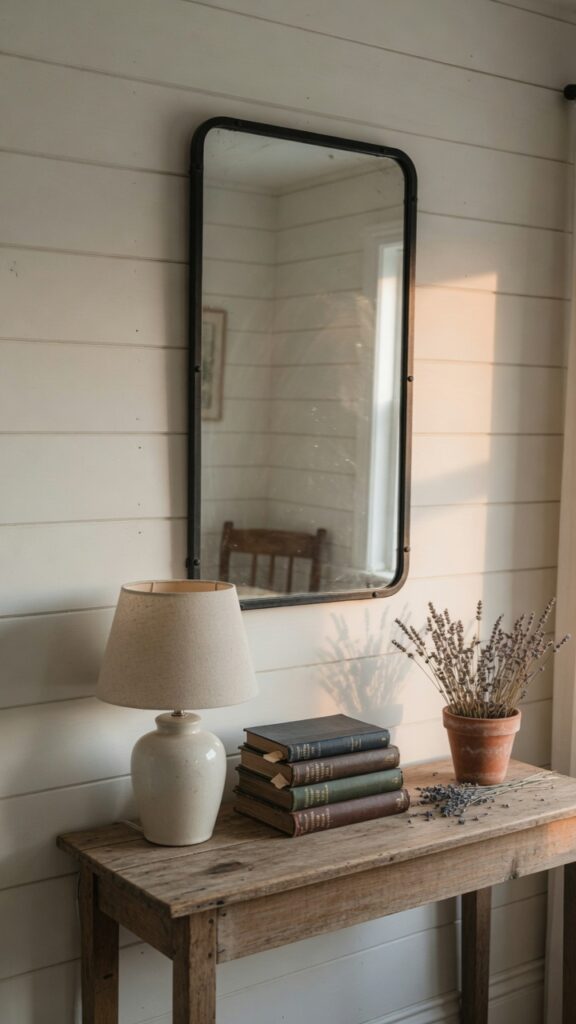
Shiplap has become so synonymous with farmhouse style that it’s easy to either lean on it too hard or dismiss it entirely as overdone. Neither reaction is quite right. When installed and painted thoughtfully, horizontal shiplap still does something genuinely useful in a dining room: it adds texture and architectural interest to what are often very flat, featureless walls, without demanding much visual attention.
The key is restraint in how you finish it. A warm white — something with a cream or linen undertone rather than a stark cool white — reads as farmhouse without feeling like a TV set. Matte or eggshell paint rather than satin is essential; shiplap in a semi-gloss finish loses all its character and starts looking like a bathroom wall.
Here’s the trick most people miss: shiplap works best on a single accent wall, not all four. Running it around the entire room turns a texture detail into a statement that quickly becomes exhausting. Choose the wall that gets the most natural light — the shiplap shadows will shift throughout the day, adding quiet life to the room. If you’re renting and can’t install real shiplap, peel-and-stick shiplap panels have improved considerably, though they work better over smooth walls than textured ones.
3. Wrought Iron and Edison Bulb Chandeliers
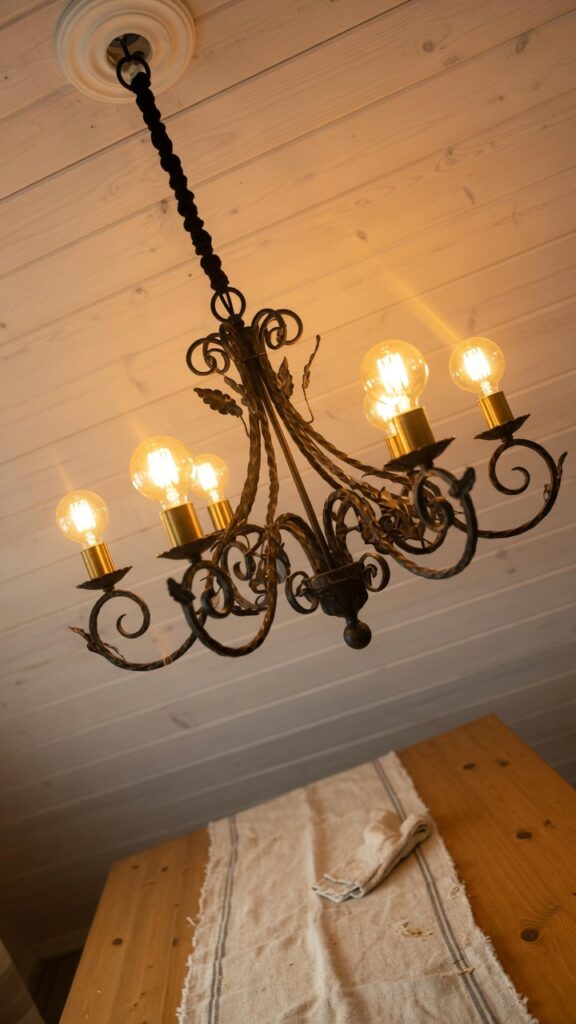
Lighting in a farmhouse dining room isn’t background detail — it’s the atmosphere. And nothing delivers that warm, gathered-around-the-fire feeling quite like a wrought-iron chandelier with Edison bulbs hung low over the dining table. Low is the operative word. Most people hang their pendant fixtures too high, which scatters the light and loses the intimacy entirely. The general rule is to hang the bottom of the fixture somewhere between 30 and 36 inches above the tabletop. If your ceilings are higher than nine feet, add three inches per additional foot.
The fixture itself should feel slightly industrial and handmade — look for irregular welds, rough-forged arms, and a matte black finish rather than a polished one. Polished wrought iron reads as more contemporary and loses the farmhouse warmth. Pair with medium-wattage Edison bulbs in a warm color temperature, around 2200K. That amber filament glow is doing more for your dining room’s atmosphere than any candle arrangement.
One thing to watch: in very small dining rooms, a large multi-arm chandelier can feel oppressive rather than cozy. In rooms under 10 feet wide, consider a single large pendant or two smaller pendants hung in a line over a rectangular table instead. The drama stays; the overwhelm doesn’t.
4. A Neutral-First Color Palette With Deliberate Warm Accents
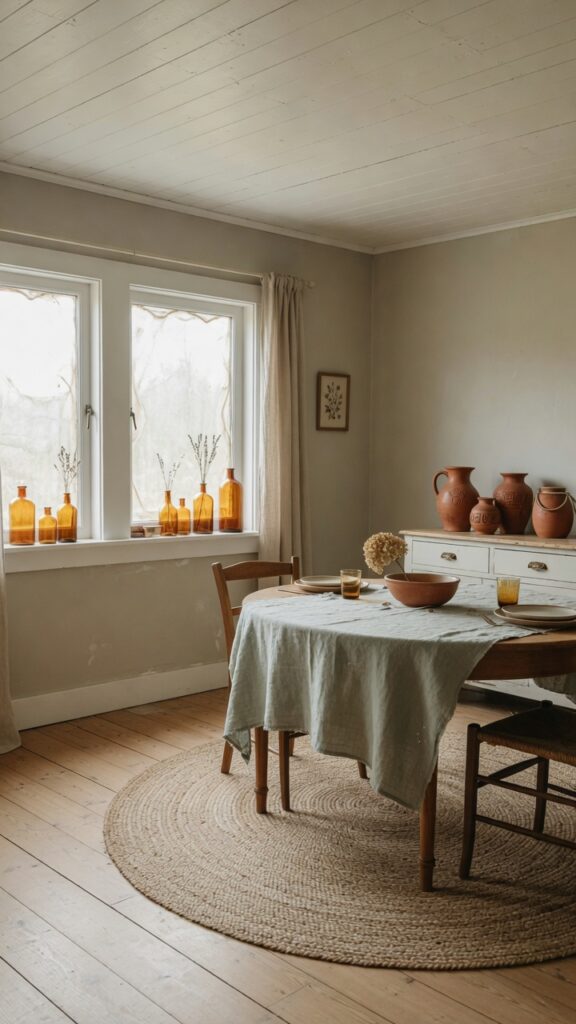
Farmhouse color palettes get misread constantly. The instinct is to go all-white — white walls, white trim, white furniture — and call it done. But a fully white dining room almost always reads as cold by evening, when natural light drops out and artificial lighting takes over. The smarter move is to start with a warm neutral — think greige, warm linen, pale clay, or even a muted sage — and build from there.
The walls are your biggest decision. A tone like Farrow & Ball’s String or Benjamin Moore’s Pale Oak reads as neutral in bright light but reveals its warmth as the day progresses, which is exactly what you want in a dining room that sees the most use in the evenings. Pair with white trim — not bright white, but a soft white with a hint of yellow — and the room will feel wrapped rather than washed out.
Warm accents should be deliberate, not scattered. Choose one or two accent tones — terracotta and amber work beautifully together — and repeat them in small doses: a ceramic jug, a few amber bottles catching window light, a runner in dusty sage. Too many accent colors competing for attention is what makes a room feel messy rather than layered. Stick to three tones maximum and let the neutrals breathe.
5. Layered Textiles: Linen, Jute, and Cotton Done Right
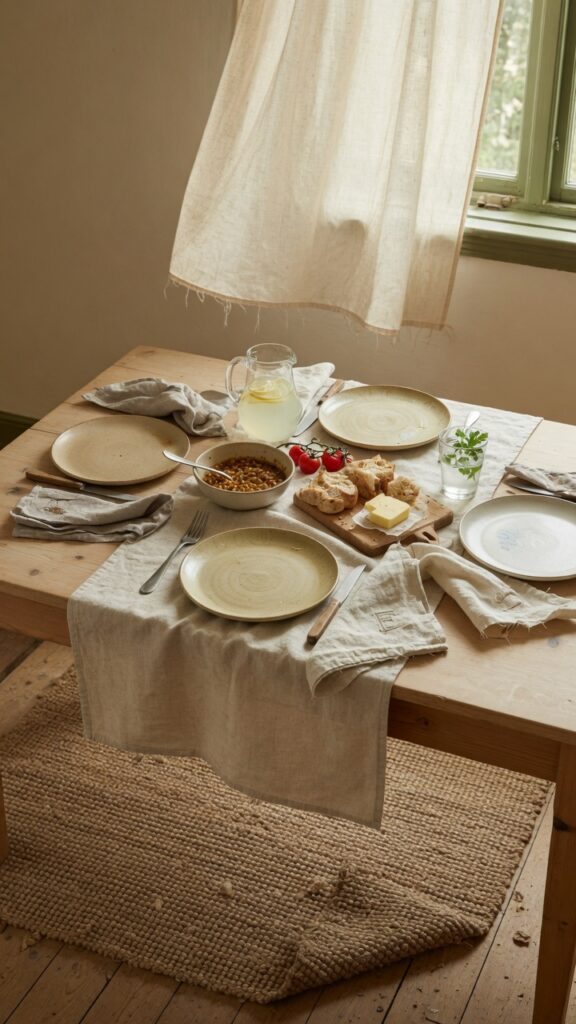
Textiles are where a farmhouse dining room either earns its warmth or falls flat. And the most common mistake isn’t using the wrong fabric — it’s using too few of them. A dining room with bare floors, bare windows, and a bare table is going to feel sparse no matter how good the furniture is. Layering is what closes the gap between a room that looks designed and one that actually feels lived in.
The layering formula is simple: start at the floor with a jute or sisal rug, which adds both texture and a grounding visual element under the dining table. Jute especially has that honest, undone quality that reads as genuinely farmhouse. Layer up to the table with a linen runner — never a full tablecloth for everyday use, which tends to feel stiff — and then add linen or cotton napkins in tones that sit close to each other on the color wheel rather than matching exactly.
For windows, sheer cotton or linen curtains in warm white are almost always the right call. They diffuse light beautifully without blocking it, which matters enormously in rooms where the natural light quality shifts throughout the day. One practical note: linen wrinkles and that’s fine. In fact, pressed-flat linen looks wrong in a farmhouse setting. Let it be slightly rumpled. That’s the point.
6. Open Shelving as Functional Decor
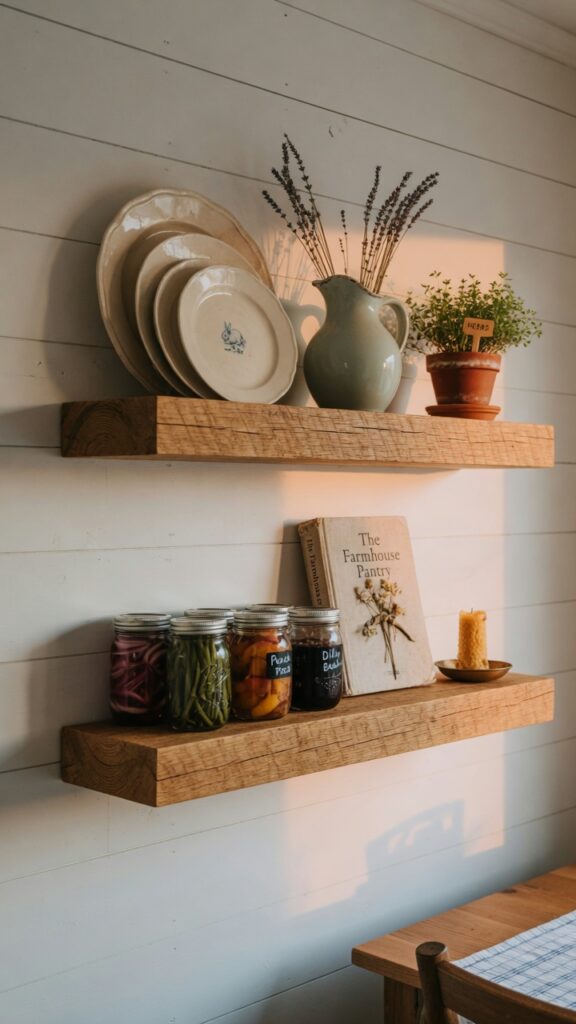
Open shelving in a dining room is genuinely useful — but only if you’re willing to style it with real intention and keep it that way. The Instagram version of open shelving is pristine and artfully arranged. Real life is a little more complicated. Before committing, honestly assess whether you’ll curate the shelf consistently or whether it’ll become a dumping ground for random ceramics and takeout menus within a month.
If you’re in it for real, open shelving in a farmhouse dining room does two things beautifully: it breaks up a long wall that might otherwise feel flat, and it gives you a place to display functional objects — ceramics, glassware, cookbooks — in a way that reads as intentional rather than just storage. The key is grouping objects by material and height rather than matching them by color. A stack of cream plates next to a wooden cutting board next to a glass jar of dried pasta reads as collected and real. Three identical ceramic jars in a row reads as a display from a home goods shop.
Stick to a maximum of three or four object groups per shelf. Leave actual empty space — it gives the eye somewhere to rest and keeps the whole arrangement from feeling claustrophobic. Floating shelves in solid oak or walnut, at least two inches thick, look far better than thin MDF versions regardless of how you style them.
7. Vintage and Antique Mirrors to Amplify Light
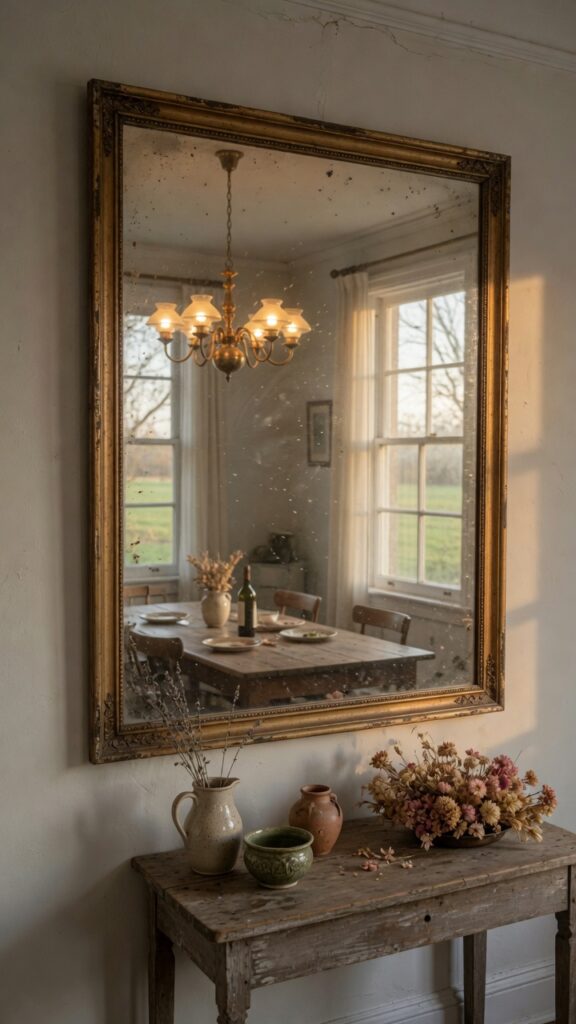
A well-placed mirror in a dining room does something nothing else in your decor toolkit can replicate: it reflects light back into the space, making the room feel both larger and warmer simultaneously. In farmhouse dining rooms — which often trend toward heavier materials like dark wood and matte ceramics — a mirror provides a necessary counterbalance, lightening the visual weight without sacrificing warmth.
The vintage or antique version is the right call here. A mirror with slightly foxed or aged glass, with a thin brass or distressed wood frame, contributes texture and history that a clean contemporary mirror simply can’t match. It doesn’t need to be an actual antique — well-made reproductions with antiqued glass are widely available and considerably more affordable — but the effect should feel like it belonged to someone else first.
Placement matters enormously. Mount it on the wall that faces the room’s primary light source — typically opposite or adjacent to your main window — so it bounces natural light across the table during the day and reflects the chandelier’s warm glow at night. Avoid placing mirrors directly opposite each other; two facing mirrors create an unsettling infinity effect that works in dressing rooms but not at dinner.
8. A Warm-Toned Gallery Wall With Botanical and Landscape Prints
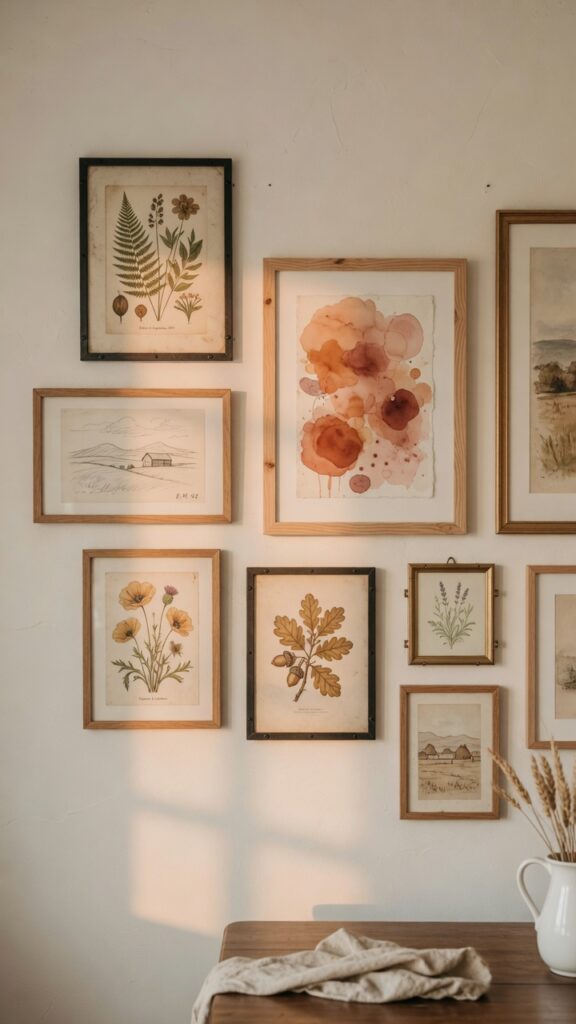
A gallery wall, done with restraint and a clear visual theme, is one of the most effective ways to bring personality into a farmhouse dining room without committing to a single large piece of art that has to be perfect. The operative word is restraint. A gallery wall that mixes too many styles, too many frame finishes, or too many color palettes quickly reads as chaotic rather than curated.
For farmhouse specifically, the sweet spot is botanical and landscape prints in muted, earthy tones — warm greens, ochre, raw umber, dusty terracotta — with frames in no more than two finishes. Thin black iron and natural wood work well together. Thin black iron and brass also work. Mixing all three rarely does.
The arrangement itself should feel slightly imperfect. A precise grid looks better in a modern or Scandinavian interior. For farmhouse, a looser arrangement with varied spacing and a mix of portrait and landscape orientations reads as more authentic. Start by laying the arrangement out on the floor before committing to wall holes — it saves an enormous amount of patching and repainting. If your walls are already a warmer tone, opt for frames with a little visual weight; thin frames disappear against anything darker than a light neutral.
9. A Farmhouse Sideboard for Storage and Styling
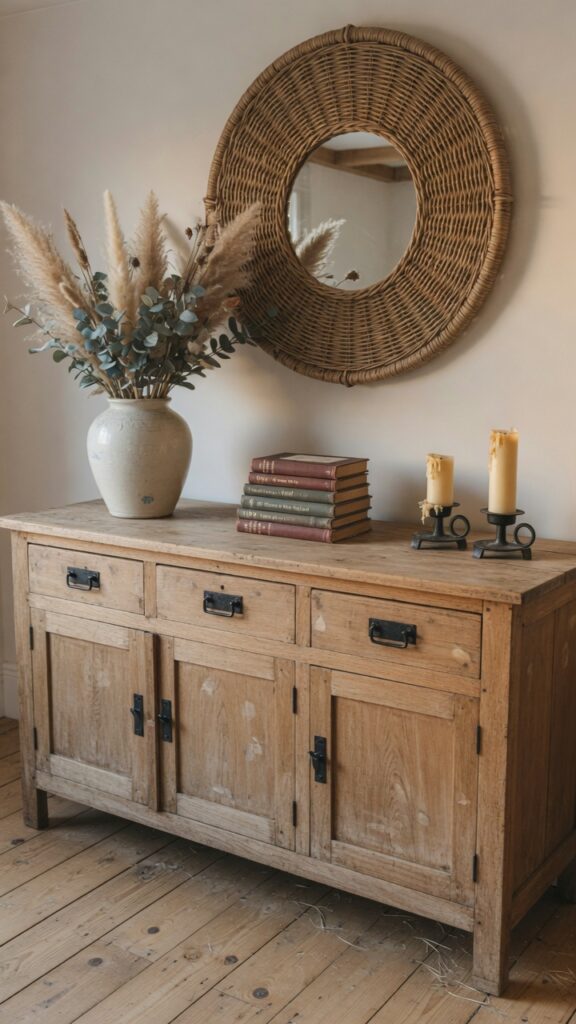
A sideboard is arguably the most hardworking piece of furniture in a dining room and yet somehow it’s often treated as an afterthought. In a farmhouse dining room, the sideboard is where the room’s personality really has a chance to show up — it’s a surface for layering, a storage solution for linens and serving pieces, and a visual anchor for the wall it sits against.
For farmhouse style, look for a sideboard in solid oak, pine, or reclaimed wood with black iron hardware. The silhouette should be simple — a long, low rectangle with either drawers or cabinet doors, ideally both. Avoid ornate carved details; they pull toward French country or cottage rather than farmhouse. A slightly distressed finish, whether natural aging or intentional, will read more authentically than something straight out of a showroom.
The styling on top follows the same rule as open shelving: group by material and height, leave breathing room, and resist the urge to fill every inch. A large ceramic vase with dried stems on one end, a small vignette of books and candles in the center, and open space on the other end is almost always more compelling than a fully loaded surface. Change out the dried flowers with the seasons — pampas in autumn, branches and berries in winter, something green and fresh in spring — and the room stays feeling alive without requiring a full redesign.
10. Mixing Chair Styles Around One Unified Table
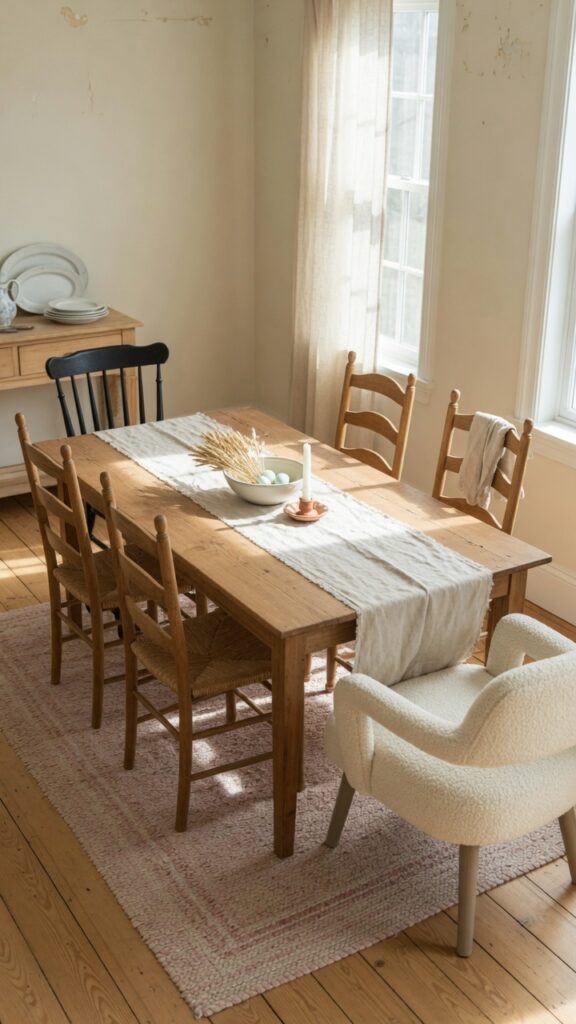
Matching chair sets — six identical chairs around a table — used to be the only acceptable approach to dining room seating. That era is over, and honestly, good riddance. Mixing chair styles is not only more interesting to look at but also far more practical: you can add a chair from a different source when you need extra seating, replace a damaged chair without hunting for an exact match, and build a seating arrangement that actually reflects real life rather than a furniture showroom.
The trick is giving your mismatched chairs something to unify them. That unifying element can be color — painting chairs from different eras the same matte color pulls them together instantly. Or it can be material — keeping all chairs in natural wood tones, regardless of their individual shapes, creates cohesion without matching. Scale matters too; chairs that vary too dramatically in height or visual weight will look accidental rather than intentional.
A practical formula that works consistently: two identical chairs at the long sides, and two different armchairs or upholstered chairs at the heads of the table. The upholstered heads read as a slight elevation — host and guest-of-honor seating — which adds a layer of intention to what might otherwise feel random. Boucle and linen upholstery both hold up well at the dining table if treated with a fabric protector, which is worth doing immediately rather than waiting for the first spill.
11. Bringing the Outdoors In With Dried and Living Botanicals
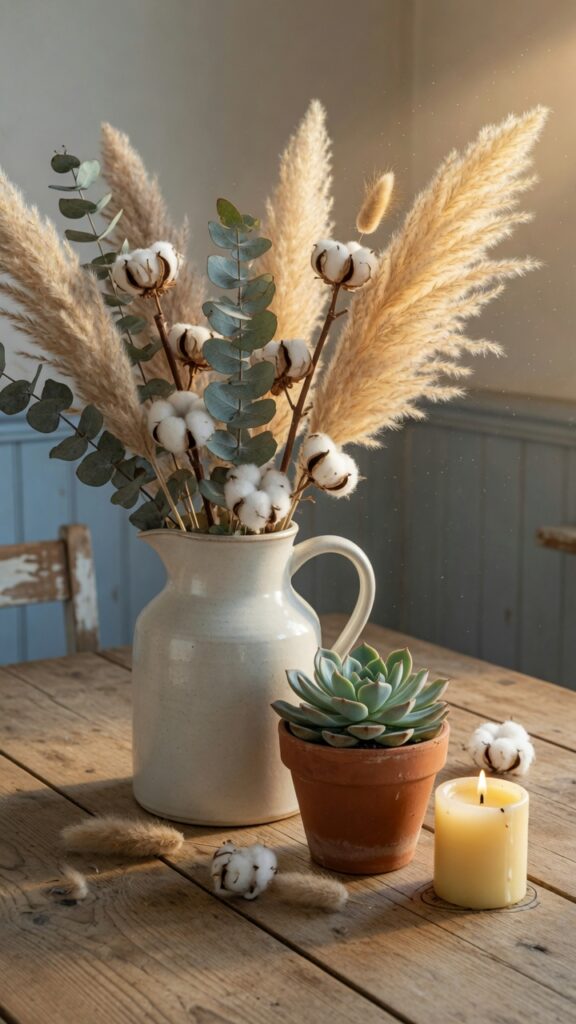
Plants and botanicals in a dining room do something that no other decorative element quite manages: they make the space feel genuinely inhabited rather than decorated. The difference is subtle but real. A room with living or dried botanicals has a quality of presence — something that changes slightly over time, catches the light differently depending on the hour, and signals that someone with actual taste lives here.
Dried botanicals have become the dominant choice in farmhouse dining rooms, and for good reason. Pampas grass, dried cotton stems, wheat stalks, preserved eucalyptus, and dried seed pods all hold their shape and color for months without any maintenance. They read as organic and unhurried — deeply farmhouse in character — and they photograph beautifully, which matters if you’re building a Pinterest-worthy space.
That said, a fully dried room can start to feel slightly dusty and melancholic if nothing living is present. Balance dried arrangements with at least one living plant or fresh-cut stems. A simple potted herb on the sideboard — rosemary, thyme, or a small olive tree if your room gets enough light — bridges the gap between decoration and reality. One constraint worth noting: pampas grass sheds. If you have light-colored upholstered chairs nearby, position pampas arrangements on the sideboard rather than the center of the table, where chairs bump the table and dislodge fibers constantly.
12. Renter-Friendly Farmhouse Updates That Actually Work
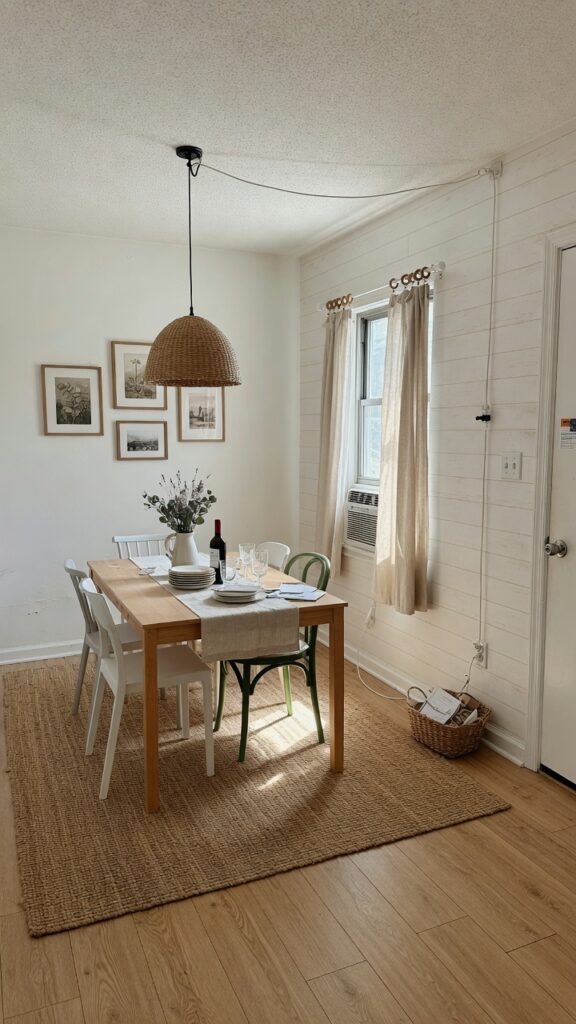
Renting does not have to mean surrendering the dining room you actually want. The farmhouse aesthetic — more than almost any other interior style — translates well to renter-friendly approaches because it’s built on textiles, layering, and furniture rather than architectural features. You’re not dependent on exposed brick or original hardwood floors. You work with what you have and layer warmth on top.
Start at the floor. Peel-and-stick luxury vinyl planks in a wide-plank light oak finish have become genuinely convincing, and in most rental agreements, they’re permissible as long as you remove them when you leave. A large jute or sisal rug over existing flooring is even simpler — no installation required, just placement.
Walls are trickier, but removable wallpaper has improved dramatically. Shiplap-look removable wallpaper on a single accent wall reads surprisingly well in photographs and in person, provided the underlying wall is smooth. On textured walls, the seams and bubbles will show. For lighting, swap pendant fixtures — most landlords permit it as long as you reinstall the original when you leave — and use plug-in pendants on walls where rewiring isn’t possible. Curtains hung on tension rods work in most standard window frames without drilling. Put these elements together and a generic rental dining room can read as genuinely designed in a weekend.
Finding Your Own Version of Farmhouse
What makes a farmhouse dining room feel real — as opposed to merely themed — is the sense that it was assembled over time by someone with a point of view. Not purchased as a complete look, not executed perfectly on the first try, but adjusted and layered and refined through actual living.
The ideas in this article aren’t a checklist to complete. They’re a vocabulary to borrow from selectively. Maybe you love the idea of a reclaimed wood table but your room is too small for shiplap walls. Maybe you’ll do the gallery wall and the layered textiles but keep the chairs matching because you genuinely prefer the order of it. That’s exactly right. The rooms that hold up over time — the ones that feel warm and personal years after they’re put together — are the ones where someone made real decisions based on their actual life, not a mood board.
The farmhouse dining room at its best isn’t a style. It’s a feeling: a table worth gathering around, light that flatters everyone at it, and enough texture and warmth that the room does the work of hospitality before a single plate hits the table. Start there and the rest follows naturally.