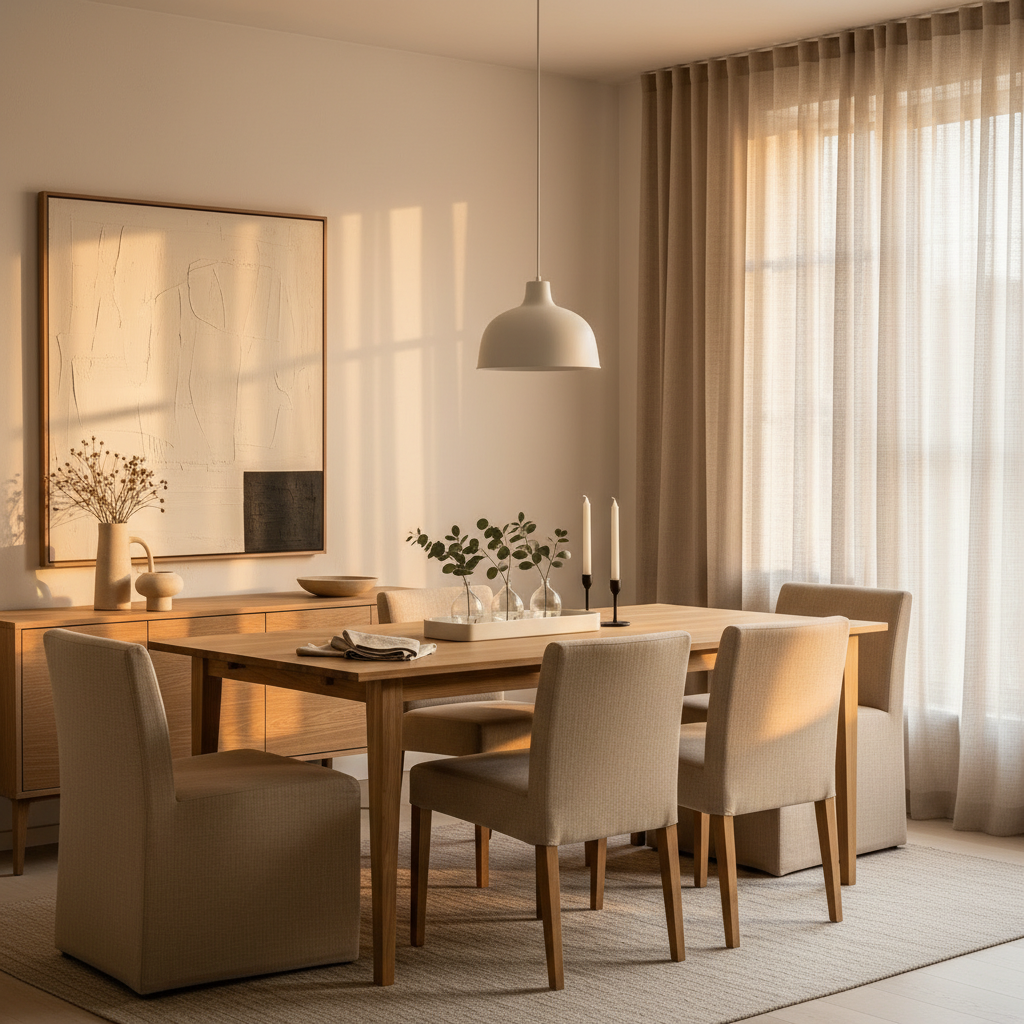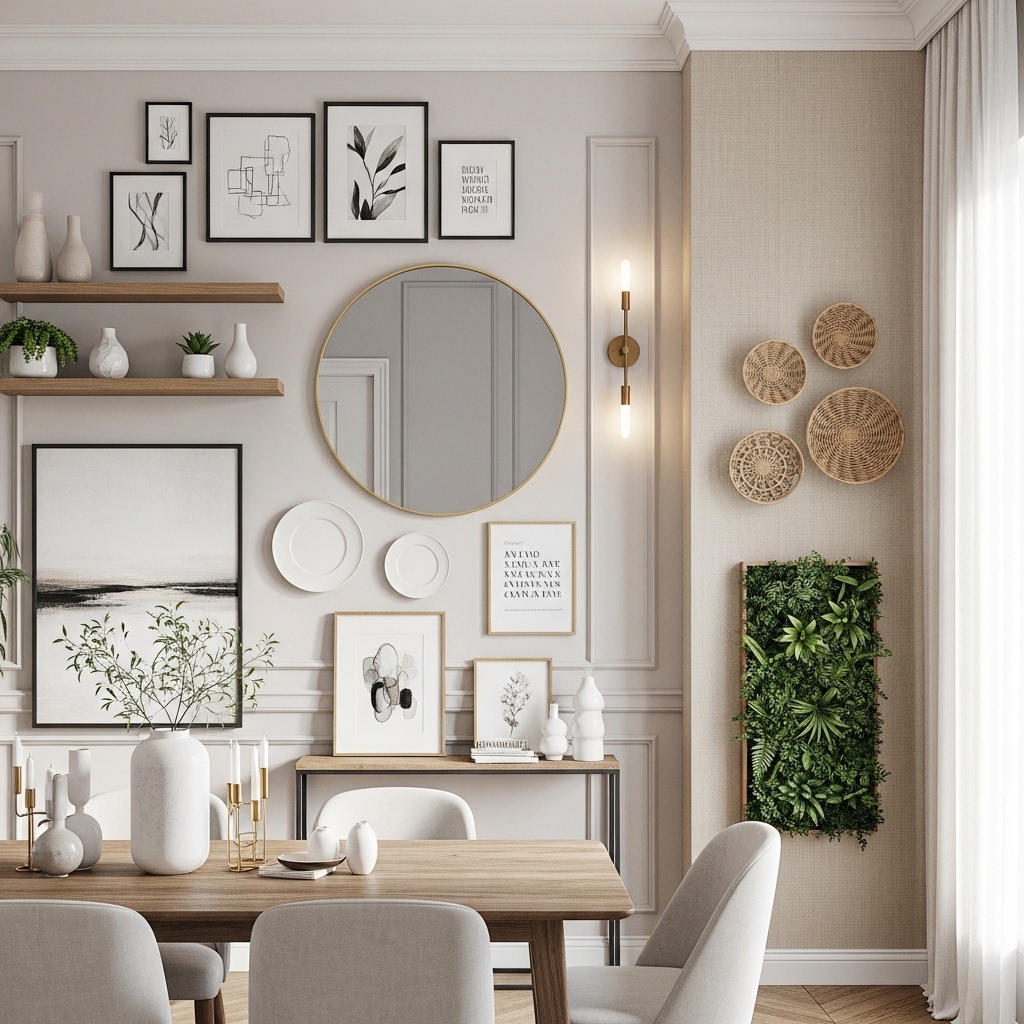
There’s something about a farmhouse dining room that makes people slow down. Not in the way a formal dining room does — stiff-backed and a little intimidating — but in the way a great meal with good people does. You pull out a chair, the wood creaks a little, candles flicker, and suddenly no one’s looking at their phone. That’s the real goal of this aesthetic: a room that feels like it was built for living, not just for looking at.
The rustic farmhouse style has evolved well past the shiplap-and-Mason-jar cliché. Today it’s about layering genuine materials — raw wood, aged iron, washed linen, hand-thrown ceramics — with an intentional looseness that keeps the space from feeling like a catalog shoot. This is decor that earns its warmth. Whether you’re starting from scratch or trying to breathe new life into a dining room that feels a little flat, these twelve ideas will give you real, specific direction — no vague advice about “adding texture” without telling you exactly how.
1. The Reclaimed Wood Dining Table as a Foundation
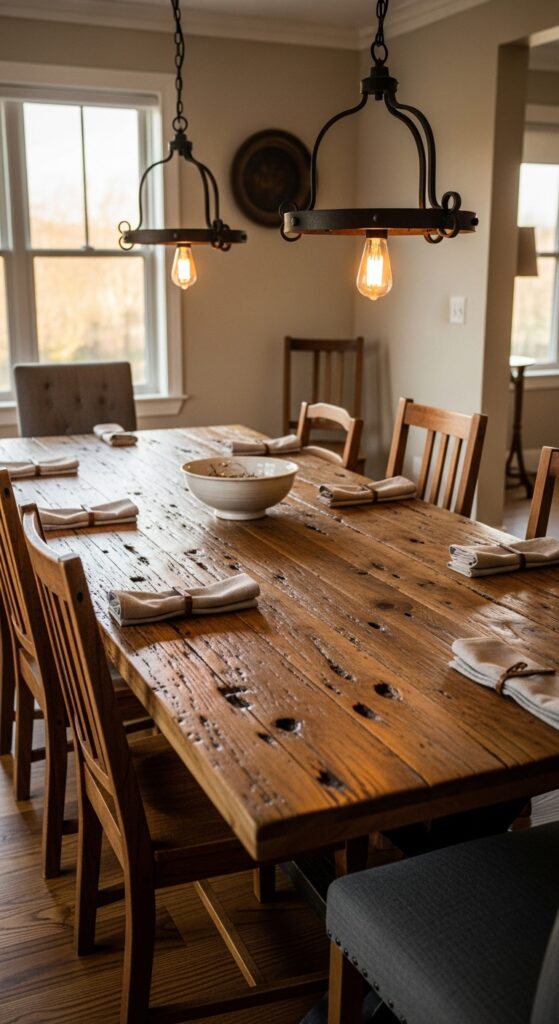
Let’s start with the most important piece of furniture in the room, because getting this wrong makes everything else harder to fix. A reclaimed wood dining table is not just a style choice — it’s a structural decision that sets the entire emotional register of the space. The knots, the color variation, the slight unevenness of the surface: these are not flaws. They’re the whole point.
When shopping for reclaimed wood tables, look specifically for pieces made from old-growth timber — pine, elm, and oak are the most common. Old-growth wood has tighter grain rings, which means it’s denser and more durable than newer-growth alternatives. It also patinas more beautifully over time.
One constraint worth naming: reclaimed wood tables are heavy. If you’re renting or know you’ll be moving in the next two years, factor in that a solid reclaimed oak table can easily top 200 pounds. It’s not impossible to move, but it’s not casual either.
Pair it with chairs that offer visual contrast — don’t match the wood tone exactly. A table in warm walnut reads best with chairs in a slightly cooler or lighter finish, or with upholstered seats in natural linen or oatmeal boucle.
The table is your room’s foundation — invest here before anywhere else.
2. Shiplap Walls Done With Restraint
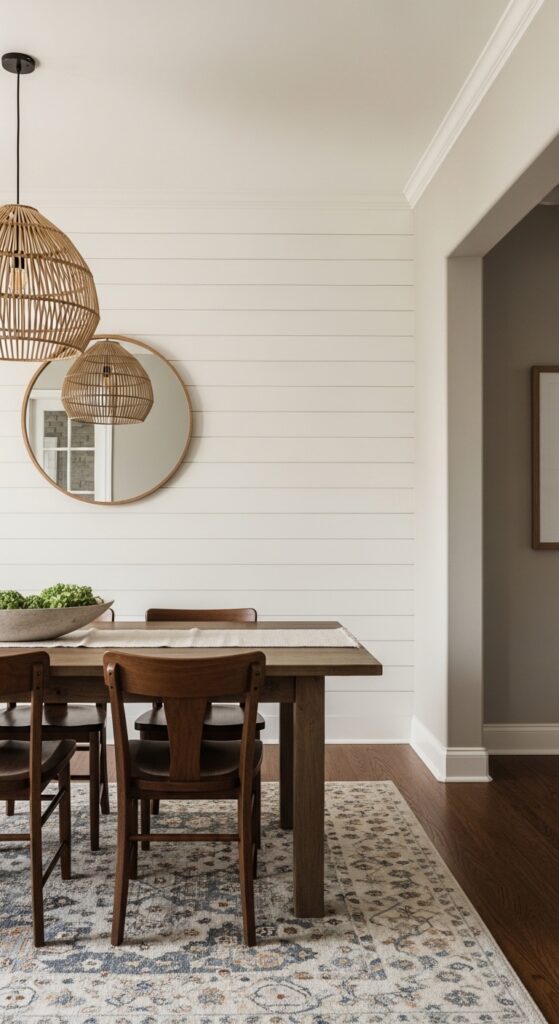
Shiplap has a reputation problem. It became so ubiquitous during the peak of the renovation-TV era that using it now can feel like a tired shortcut. But here’s the distinction: shiplap used as a single accent wall, rather than covering every surface in a room, still works beautifully — and actually looks more considered than the all-walls approach.
The key is restraint. Choose one wall — ideally the one your dining table sits against, or the wall most visible from the room’s entry point — and apply shiplap there only. Paint it the same color as your ceiling for a seamless, architectural feel, or go a half-shade warmer to add subtle definition.
Matte paint is non-negotiable here. Shiplap in eggshell or semi-gloss reads cheap and overly casual. A quality matte or flat finish gives the horizontal lines shadow and depth that make the whole treatment feel intentional.
One thing to watch: shiplap can feel loud in smaller dining rooms where the horizontal lines visually compress the ceiling height. If your dining room is under 250 square feet, consider just a wainscoting-height application — four feet up from the floor — instead of full-height planks.
Used wisely, this is one of the most renter-friendly accent wall options, since peel-and-stick shiplap panels have genuinely improved in quality.
3. Wrought-Iron Chandeliers With Warm Bulbs
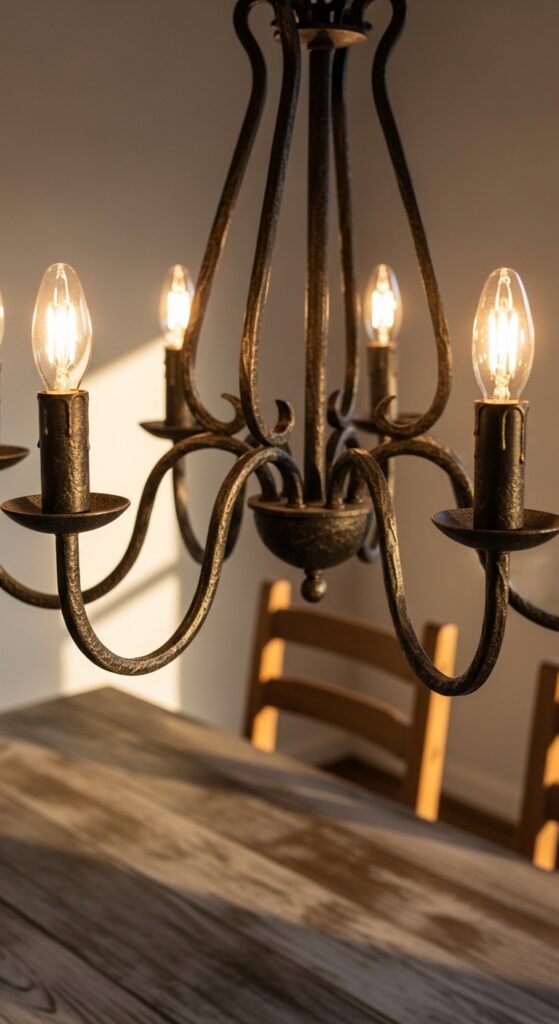
Lighting in a farmhouse dining room is doing more work than people realize. A wrought-iron chandelier — specifically one with visible, warm-toned filament or Edison-style bulbs — transforms the atmosphere of a room from functional to genuinely beautiful the moment the sun goes down.
The most common mistake is hanging the chandelier too high. Over a dining table, the bottom of the fixture should sit roughly 30 to 34 inches above the tabletop. If you’re working in a room with especially high ceilings — nine feet and above — you can push to 36 inches, but no higher. The fixture should feel intimate, not like it’s floating in the stratosphere.
For the fixture itself, an oxidized or matte black finish ages the best and reads most authentically rustic. Avoid anything with a polished or lacquered finish — it looks too refined for this aesthetic.
That said, don’t default to the most elaborate option. Some of the best farmhouse chandeliers are structurally simple: a few candelabra arms, minimal ornamentation, honest ironwork. Complexity for its own sake muddies the room’s visual calm.
Pair with a dimmer switch. This is not optional. A farmhouse dining room without dimming capability is a missed opportunity every single evening.
4. Mixed-Chair Seating for Effortless Character
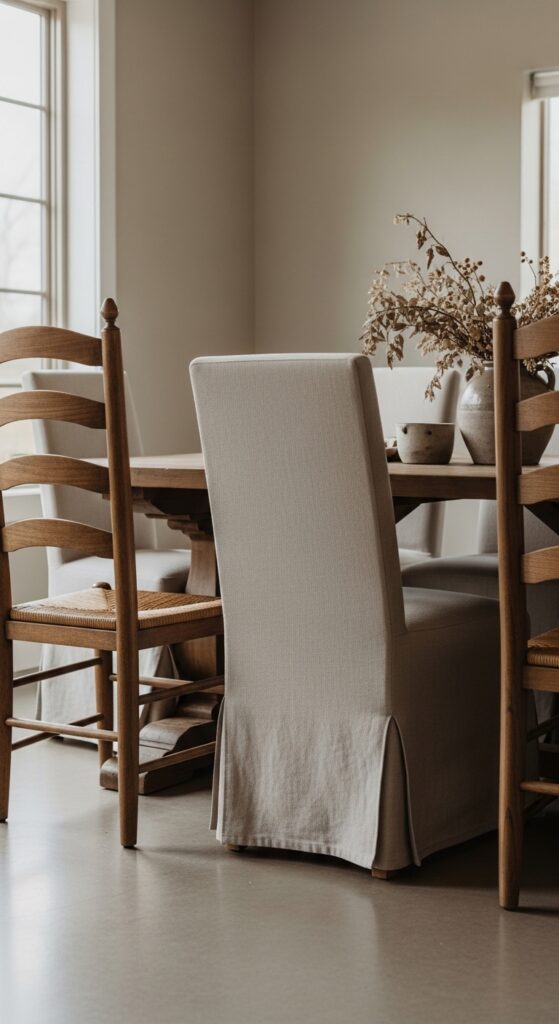
Matching dining chair sets are fine, but they tend to make a room feel like it was furnished in a single afternoon. Farmhouse style thrives on the sense that a space was assembled over time — a chair inherited from someone, a bench found at a market, a set of side chairs added later. Mixing seating achieves this instantly.
The trick is to mix within a consistent framework. Choose one common thread — wood tone, finish color, or seat height — and then vary everything else. For example: two painted black ladder-back chairs at the table ends, four natural oak Windsor chairs along the sides. Different forms, same visual weight.
Upholstered chairs are worth including in the mix for comfort, but choose fabrics in natural, muted tones. Linen, cotton canvas, and oatmeal boucle all work well. Avoid patterns unless they’re very subtle — a small woven stripe, a tonal check. Bold prints will compete with the warmth you’re building elsewhere.
One constraint: if you’re sharing the space with kids, upholstered chairs in pale linen are a beautiful headache. Either treat the fabric with a quality textile protector or reserve upholstered seating for the end chairs that see the least splatter.
Mismatched seating done right feels like a story, not an accident.
5. A Long Wooden Bench on One Side
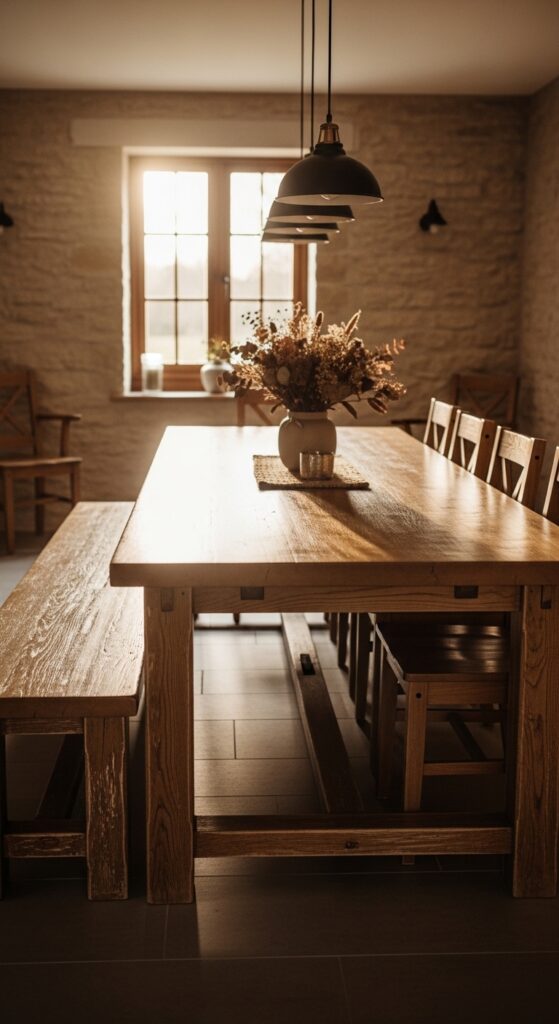
Benches are one of the most practical, underused pieces in the farmhouse dining toolkit. They flex for large gatherings in a way chairs simply can’t — you can always squeeze in one more person on a bench — and they read as beautifully rustic without requiring much styling effort.
Position the bench along the side of the table that faces the room’s main view or window, so that seated guests have something pleasant to look at. Opposite the bench, use individual chairs — this gives the seating arrangement visual rhythm and makes the bench feel intentional rather than like you ran out of chairs.
For the bench itself: raw or lightly oiled wood beats painted wood almost every time in a farmhouse setting. You want to see the grain, the texture, the honest materiality of the piece. A simple through-tenon or trestle construction looks far more authentic than a bench with ornate legs or turned spindles.
Add a linen cushion or a folded wool blanket for comfort — benches without any softness can feel punishing during long dinners. Secure the cushion with ties rather than relying on it to stay put, especially if you have younger diners who tend to slide around.
One bench, one decision, immediate character.
6. Exposed Wooden Ceiling Beams
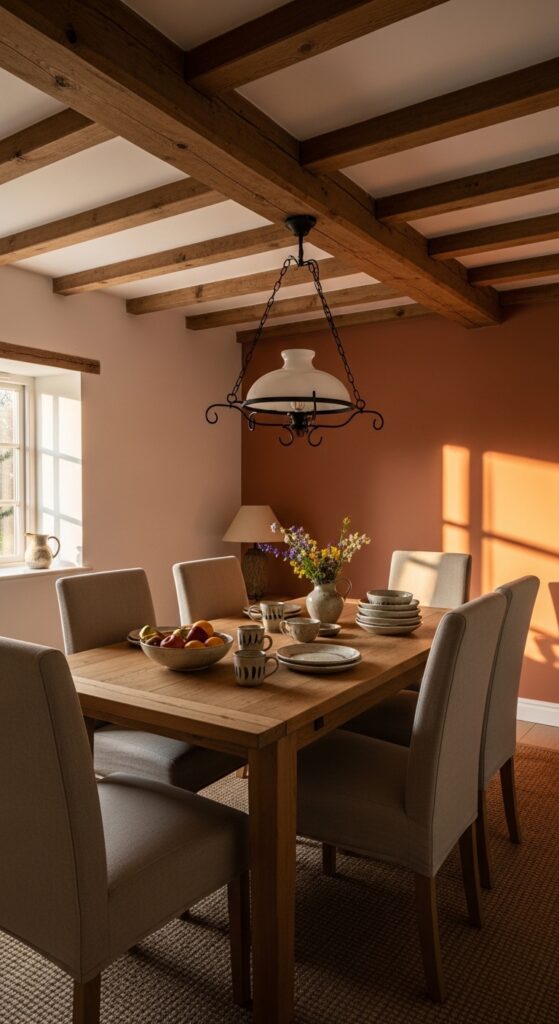
Exposed ceiling beams are the architectural equivalent of good bone structure — the room just looks better with them, and they make everything you put underneath feel more grounded. If your home already has them, consider yourself lucky. If it doesn’t, faux beams made from polyurethane or wrapped real wood have come a long way and are now a legitimate option for homeowners who want the look without structural renovation.
The sizing matters more than most people think. Beams that are too thin look tacked-on and decorative in a precious way. Beams that are too thick can make a normal-height ceiling feel oppressive. In a room with eight-foot ceilings, aim for beams that are roughly six to eight inches wide. In rooms with nine or ten-foot ceilings, you can go up to ten or twelve inches.
Finish is everything here. Raw, unfinished wood with a light clear oil is the most rustic option. A darker stain — walnut or dark oak — gives the beams more weight and contrast against a white ceiling. Avoid paint unless you’re going for a coastal-adjacent aesthetic, which reads differently than classic farmhouse.
One thing to watch: north-facing rooms with low ceilings and dark beams can feel cave-like. Balance with plenty of warm artificial light.
7. A Vintage Sideboard or Hutch
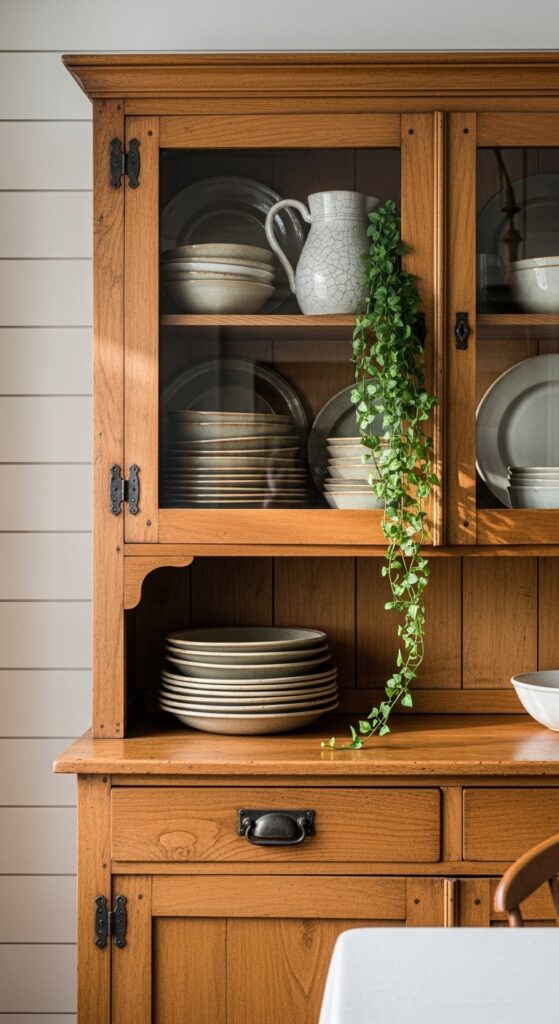
Every farmhouse dining room needs a place for stuff — the good serving pieces, the extra napkins, the candles you’re about to light. A vintage sideboard or hutch solves this practically and adds enormous character in the process.
The hutch style — with open or glass-fronted upper shelves — is particularly useful because it lets you display your best ceramics and serve ware without committing to open shelving on your walls. Think stacked stoneware plates, ironstone pitchers, hand-thrown mugs. These objects become part of the room’s decor when they’re visible, and the hutch frames them beautifully.
When hunting for vintage sideboards, prioritize construction quality over cosmetics. A piece with solid wood dovetail joints and original hardware is worth refinishing or even painting; one with particleboard sides is not worth the effort regardless of how good it looks in the listing photos.
That said, don’t feel obligated to restore everything. A slightly worn finish on a sideboard reads as authentically rustic — the dents, the faded paint, the small scratches all contribute to that sense of accumulated history that’s very difficult to fake.
Avoid overcrowding the surface. Style it like a still life: a few deliberate objects, some negative space, one small plant or vase of greenery. Less, always less.
8. Woven Rattan or Seagrass Pendant Lights
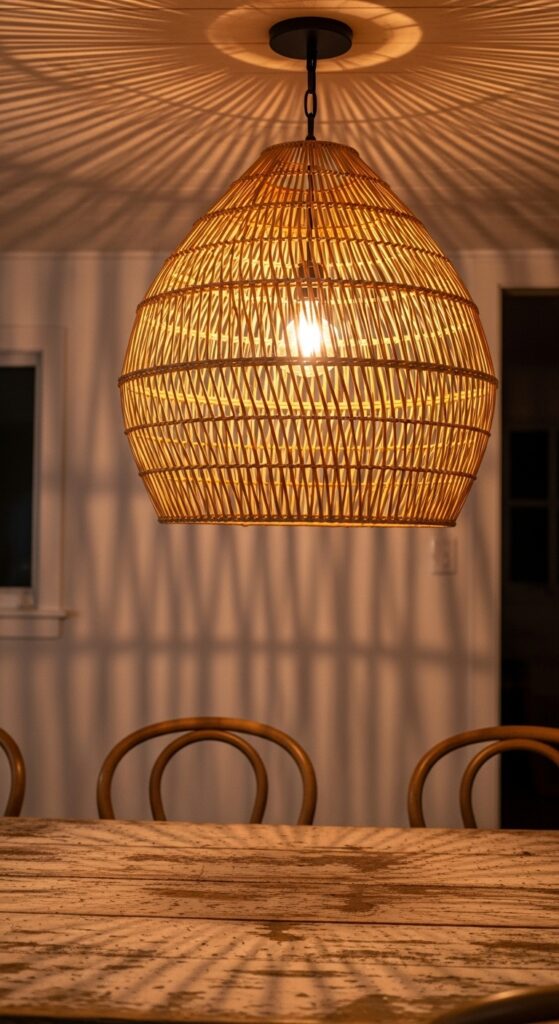
There’s a moment in any well-designed farmhouse dining room where the light becomes the mood, and rattan or seagrass pendants are one of the most reliable ways to create it. The natural weave of the material casts a remarkable dappled light pattern across the ceiling and table when backlit — something a solid shade simply can’t do.
Size up more than you think you need to. A rattan pendant that looks dramatically large in a store will often read as just right — or even a bit small — once it’s hanging in an actual dining room. For a table that seats six, a pendant between 20 and 28 inches in diameter is appropriate. For a table that seats eight or more, consider two smaller pendants hung in a line rather than a single oversized one.
Natural, undyed rattan reads most authentically farmhouse. Bleached or whitewashed versions work well in rooms that skew more coastal. Black-lacquered rattan is a hybrid that works in modern-rustic rooms where the palette is mostly neutral with dark accents.
One constraint: woven natural fiber pendants are not ideal for rooms near open kitchen ranges or fireplaces. The fibers can absorb cooking smoke over time and are difficult to clean. Keep them in the dining room proper, away from direct heat or steam.
Rattan overhead changes the whole feel of an evening.
9. Layered Table Linens in Natural Fibers
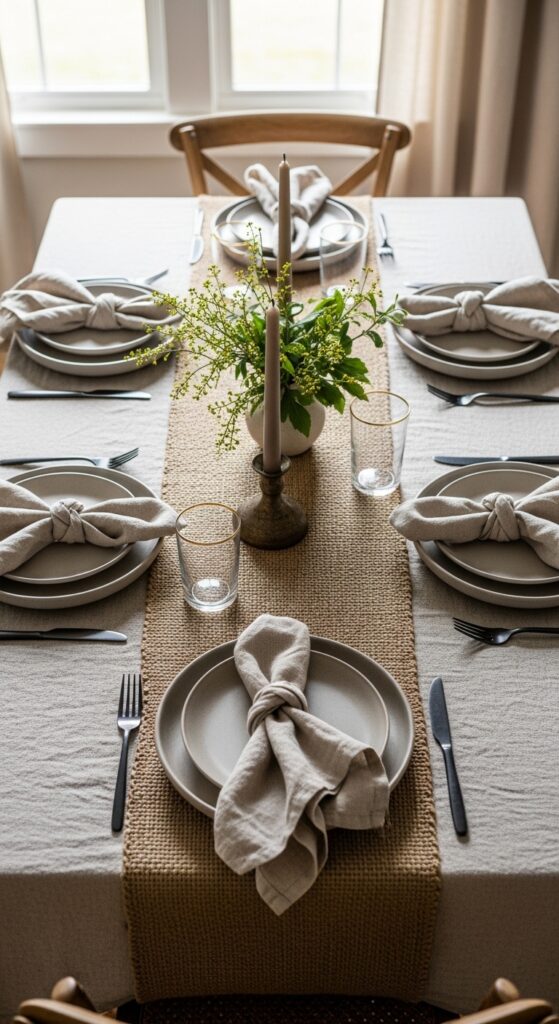
The table itself is a decorating surface, and one that most people underuse. Layering natural fiber linens — linen tablecloths, cotton or linen napkins, a jute or cotton runner — immediately brings warmth, texture, and that lived-in quality that defines the farmhouse aesthetic at its best.
The key is intentional casualness. Don’t iron your linen tablecloth flat; let it have a slight rumple and drape. Don’t fold napkins into precise shapes — a simple fold or a casual scrunch tied with a sprig of rosemary or a piece of twine is more authentic and takes about twelve seconds.
Texturally, vary the weave weights across your layers. A heavier, slubby linen tablecloth underneath a lighter cotton runner gives the table visual depth without visual noise. Stick to a two or three-color palette across your linens — natural white, warm oatmeal, and one muted earthy tone like sage, rust, or dusty blue work beautifully together.
Skip the matching linen sets sold as complete packages. They tend to feel too coordinated, which undercuts the collected, over-time feeling. Instead, buy pieces separately, in complementary but not identical tones.
Table linens are the easiest thing to change seasonally — swap colors to refresh the room without touching a single piece of furniture.
10. A Gallery Wall of Botanical or Farm Prints
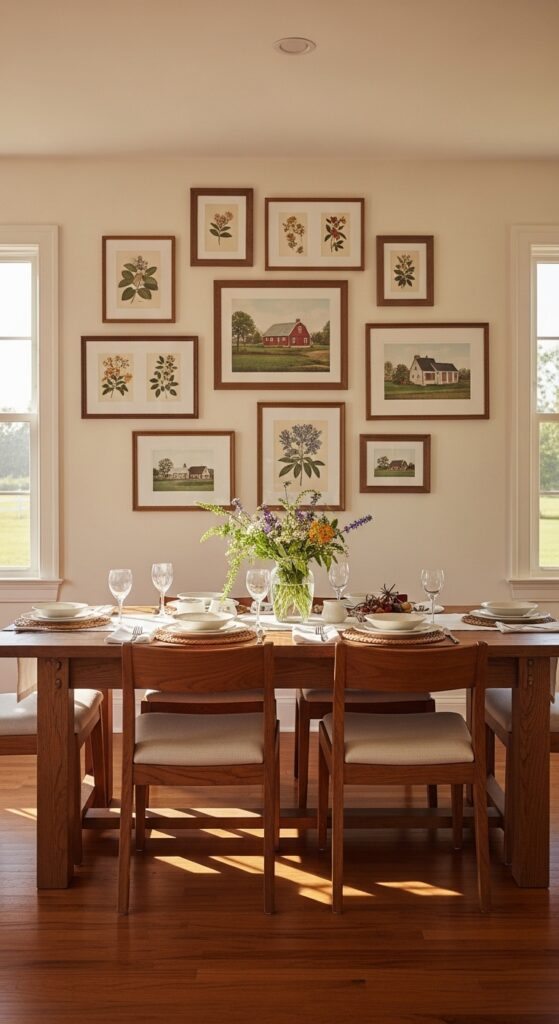
A well-curated gallery wall in a farmhouse dining room does something clever — it adds visual interest without requiring another piece of furniture, and it allows for a level of personal expression that generic decor can’t replicate. The subject matter matters enormously here. Botanical illustrations, vintage seed packet reproductions, simple farm landscape sketches, and hand-drawn herb studies all feel native to the farmhouse vernacular.
Go asymmetrical rather than grid-based. A rigid grid of uniformly sized frames reads more contemporary gallery than rustic farmhouse. Instead, anchor the arrangement with one or two larger pieces and build outward with smaller frames in varying sizes. The arrangement should feel slightly organic — like it grew over time.
Frame selection is where most people make the mistake of over-coordinating. Natural wood frames in oak, walnut, or maple work best, and mixing wood tones slightly adds to the warmth. Keep mat boards consistent — natural white or warm cream — for visual coherence without rigidity.
If you hate the idea of committing to a permanent wall arrangement, lean larger framed pieces against the wall on a sideboard or shelf instead. It’s a small change that reads as intentional and is completely renter-friendly.
Print the gallery wall before you commit. Tape paper cutouts to the wall first and live with the layout for a day.
11. Terracotta and Earthy Accent Colors
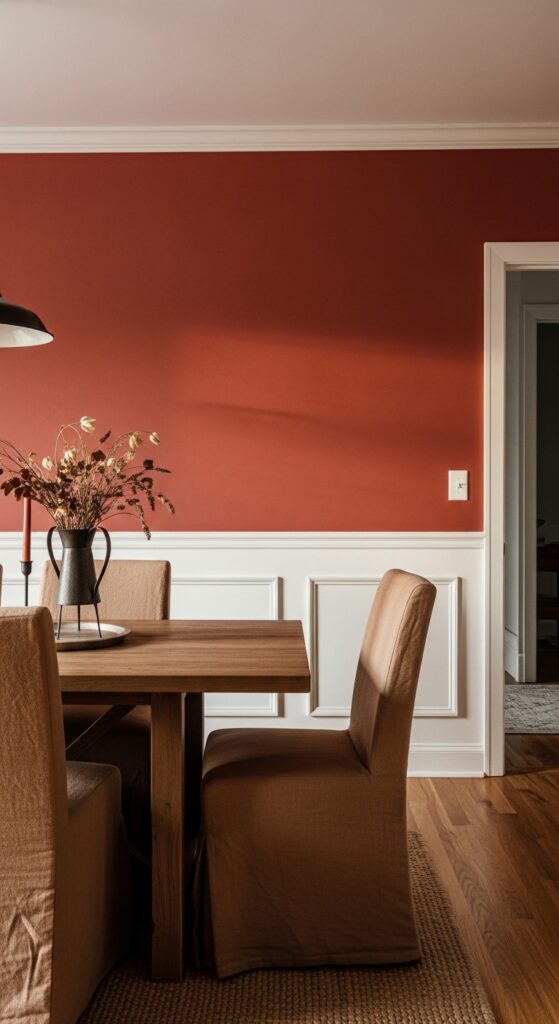
Color is where the farmhouse dining room most often plays it too safe. Endless white walls with wood accents is a legitimate look, but it can also feel timid — like a room that wasn’t willing to commit. One terracotta wall changes everything.
Terracotta reads as earthy, warm, and deeply rooted — exactly the emotional register that farmhouse style is reaching for. A single accent wall in a muted, clay-based terracotta (not the bright, orange-saturated version) pairs naturally with natural wood, warm white, aged iron, and the kinds of stoneware and pottery that tend to collect on farmhouse shelves.
The finish should be matte or flat. Terracotta in any sheen above eggshell looks synthetic and loses the soft, almost plaster-like quality that makes the color work in this context. If you’re willing to go further, consider a genuine limewash or plaster finish — the color variation in these applications gives the wall organic texture that paint simply cannot replicate.
This can feel bold in very small rooms. If your dining room is compact, consider applying the terracotta to just the lower half of the wall — used as a paint-based dado rail alternative — with warm white above. It gives you the warmth without the enclosure.
Commit to color. Rooms with genuine personality always do.
12. Dried Botanicals, Stoneware, and Organic Centerpieces
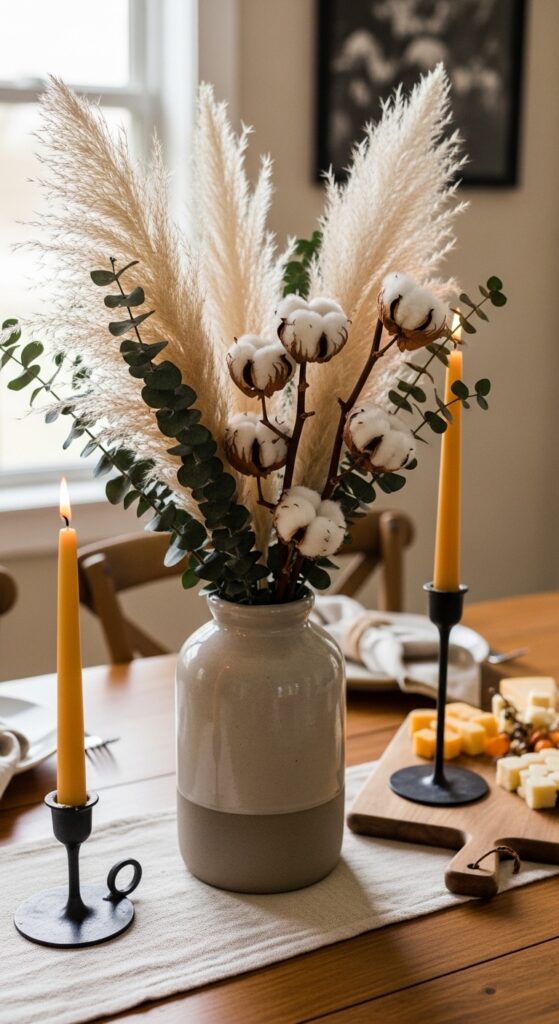
The centerpiece is the punctuation mark on everything else you’ve done in the room, and in a farmhouse dining room, it should feel gathered rather than arranged. This is the difference between floristry and foraging — between something that took an hour and something that looks like it took ten minutes and happened to be perfect.
Dried botanicals are the farmhouse centerpiece material of the moment because they’re beautiful, long-lasting, and require zero maintenance. Pampas grass, dried cotton stems, preserved eucalyptus, bunched wheat, and lunaria (the papery silver-dollar plant) all hold their structure for months or even years. They don’t wilt, they don’t drop petals, and they age gracefully into slightly softer, more muted versions of themselves.
The vessel matters as much as the stems. A matte, hand-thrown stoneware vase in an earthy tone — ochre, slate grey, warm brown — will always beat a shiny or overly smooth ceramic in this context. The slight irregularity of a hand-thrown piece is what makes it feel real rather than purchased.
Layer the centerpiece with a few supporting objects: a pair of beeswax taper candles in simple iron holders, a wooden board with a few seasonal items, a small stack of books with interesting spines. The goal is a vignette, not a single focal object. Make it feel like the table was set for a meal that everyone is still recovering from.
This is the detail guests comment on, even when they can’t articulate why.
A Room Worth Coming Back To
What makes a farmhouse dining room work — really work — isn’t any single element. It’s the accumulated sense that every piece in the room belongs there: that the table has history, the chairs were chosen with care, the light is always warm, and the centerpiece looks like it came from a garden rather than a store. That quality is harder to reverse-engineer than it sounds, but these twelve ideas give you the building blocks.
Start with your anchor pieces — the table, the lighting, the wall treatment — and layer inward from there. Resist the temptation to finish everything at once. The most beautiful farmhouse dining rooms almost always look like they’ve been slowly collected over years. Give yours time to breathe.
The real takeaway from this guide is simpler than any of the individual ideas: choose honest materials, keep the palette grounded in earthy neutrals, and prioritize warmth over perfection. A room that’s genuinely comfortable — where people linger after the meal, where the candles burn low without anyone noticing — is always more successful than one that’s simply well-styled. That’s the farmhouse philosophy in a sentence. Now go build a room worth coming back to.