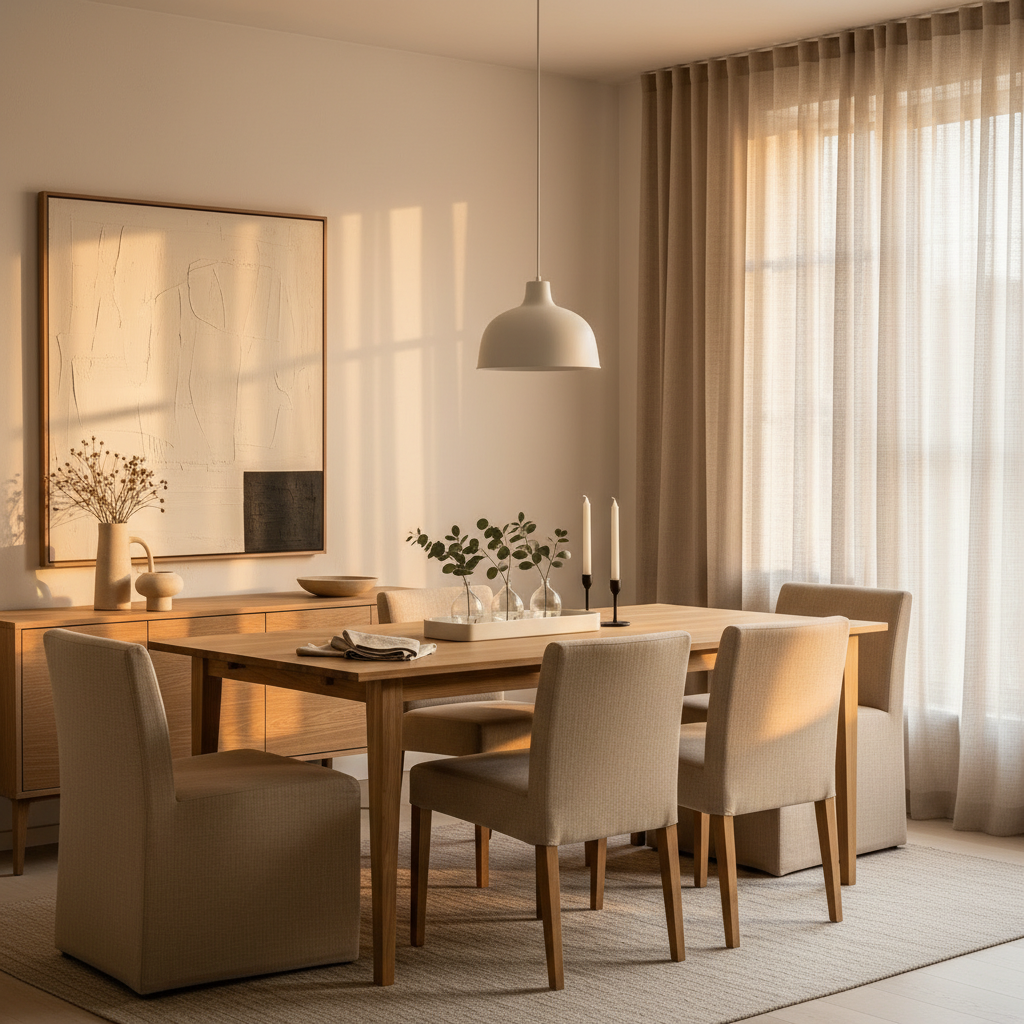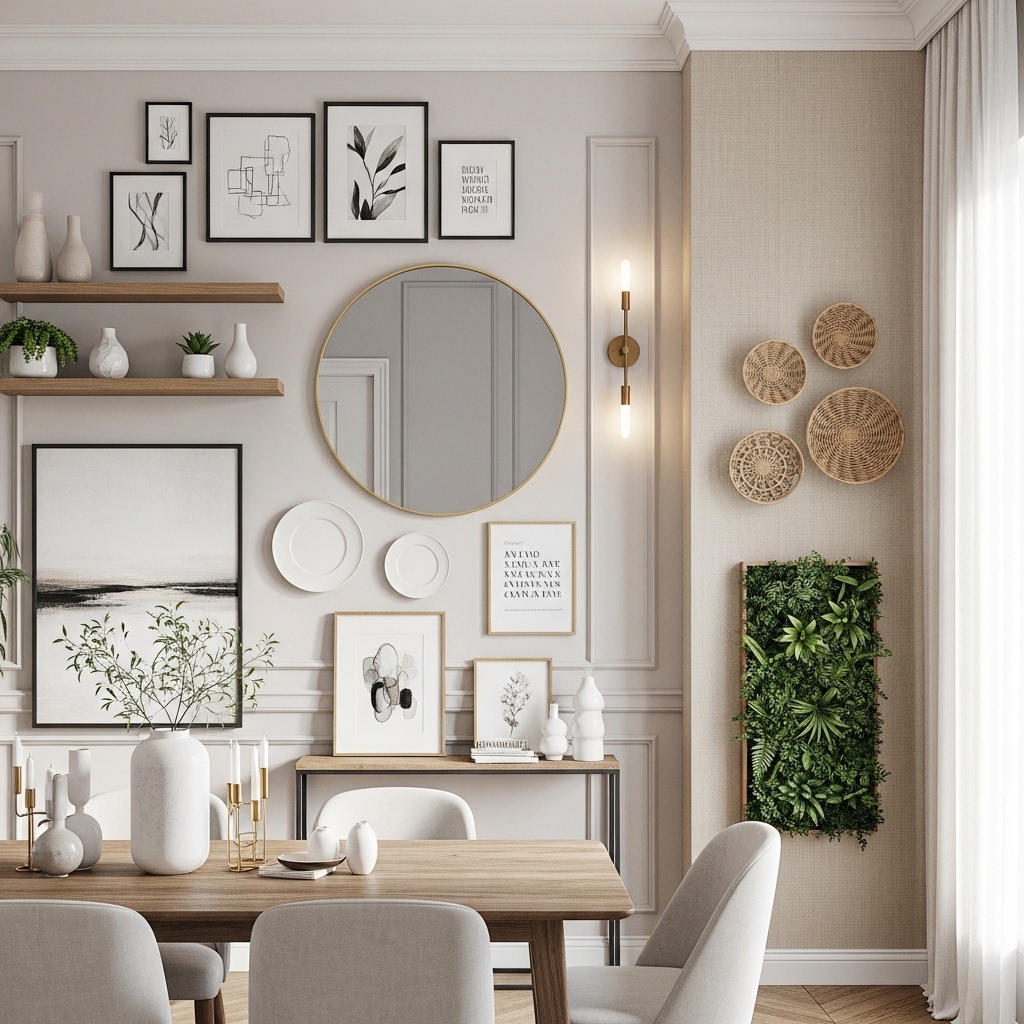
Apartment dining rooms have a special kind of pressure on them. They’re rarely a perfect square, they’re often doing double-duty as a home office or homework station, and somehow they’re always visible from the couch. The good news: modern style actually loves constraints. Clean lines, intentional choices, and fewer (better) pieces are basically the whole point.
This article is for the people who want their dining area to feel designed, not decorated-to-death. We’ll talk about the small swaps that actually move the needle—lighting that changes the mood, rugs that fix awkward proportions, paint and wall treatments that add depth without chaos, and styling that feels like you live there (because you do). Some of these ideas are renter-friendly, some are worth a weekend project, and a few are “only if you’re ready.” Pick what fits your space and your tolerance for visual clutter. You’ll end up with a dining room that feels modern, warm, and genuinely yours.
1. Make the Pendant Light Do the Heavy Lifting
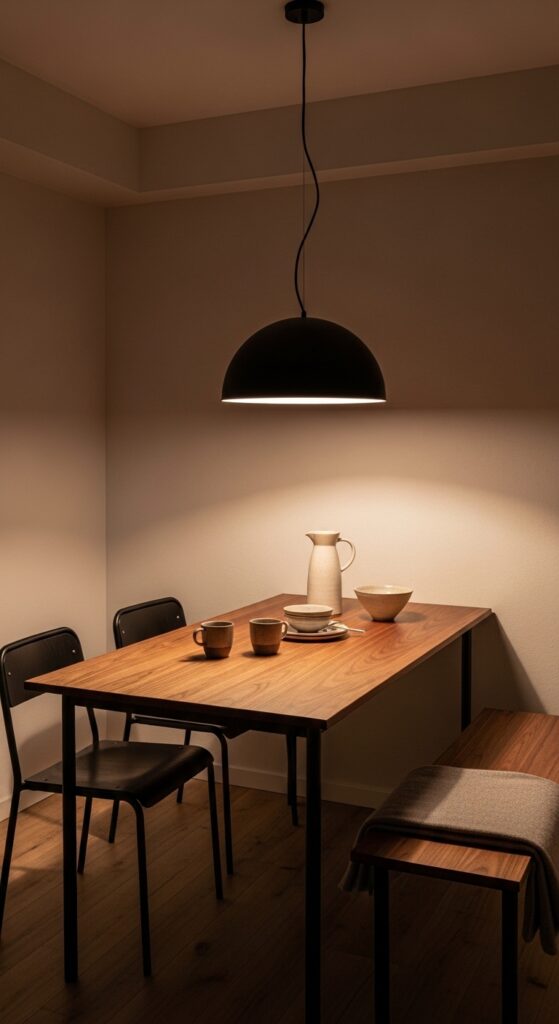
Modern dining rooms live and die by lighting. If your dining space is part of an open-plan room, a good pendant acts like a visual “pin” that says: this is the dining zone, right here. Go a little bigger than you think—apartments can handle it, and small lights often look stingy.
Try this:
- Hang the pendant lower than feels “normal” (about 28–34 inches above the tabletop) for intimacy and better light.
- Choose a matte or plastery finish if you want softness, or metal if you want crisp contrast.
- If your ceilings are low, pick a wide, shallow shade rather than a tall lantern shape.
Watch out: clear glass pendants can feel harsh at night and show every bulb and speck of dust.
The takeaway: one strong light fixture can make a rental dining area look intentionally designed.
2. Choose a Rug That Fixes Proportions (Not Just One You Like)
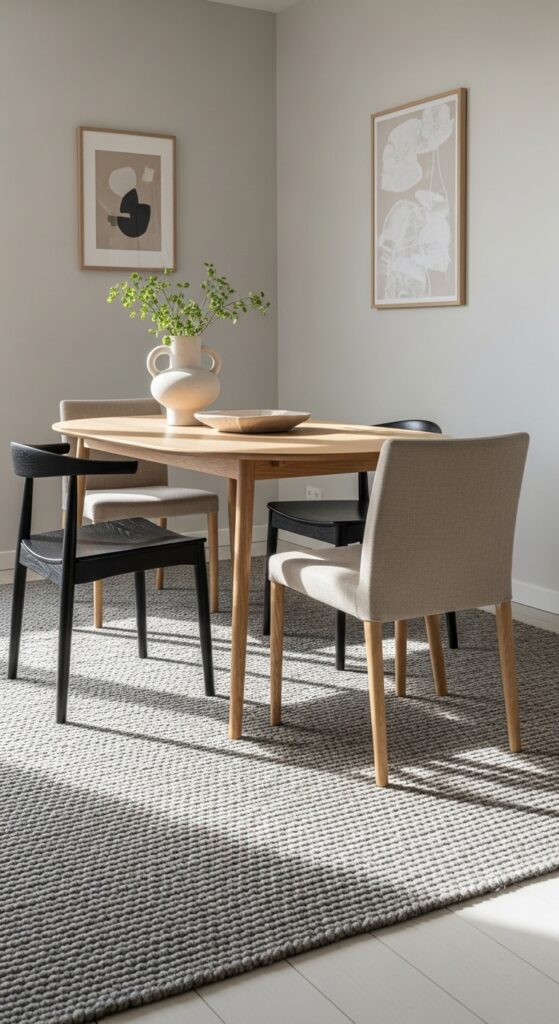
A dining rug isn’t a “maybe” in an apartment—it’s a layout tool. It’s how you stop the dining set from looking like it’s floating in the middle of nowhere. Modern style looks best when the scale is confident, and rugs are where people undershoot.
Try this:
- Size up so chairs stay on the rug even when pulled out (aim for at least 24 inches of rug beyond the table edges).
- Flatweaves and low-pile rugs are your best friend under chairs—less snagging, less stress.
- If your space is narrow, an oval or subtly patterned rug can soften the corridor feel.
Watch out: shag and chunky weaves collect crumbs and fight chair legs. Save the plush stuff for the living room.
The takeaway: the right rug quietly makes your dining area feel anchored, larger, and more “finished.”
3. Mix Chairs on Purpose (So It Looks Modern, Not Random)
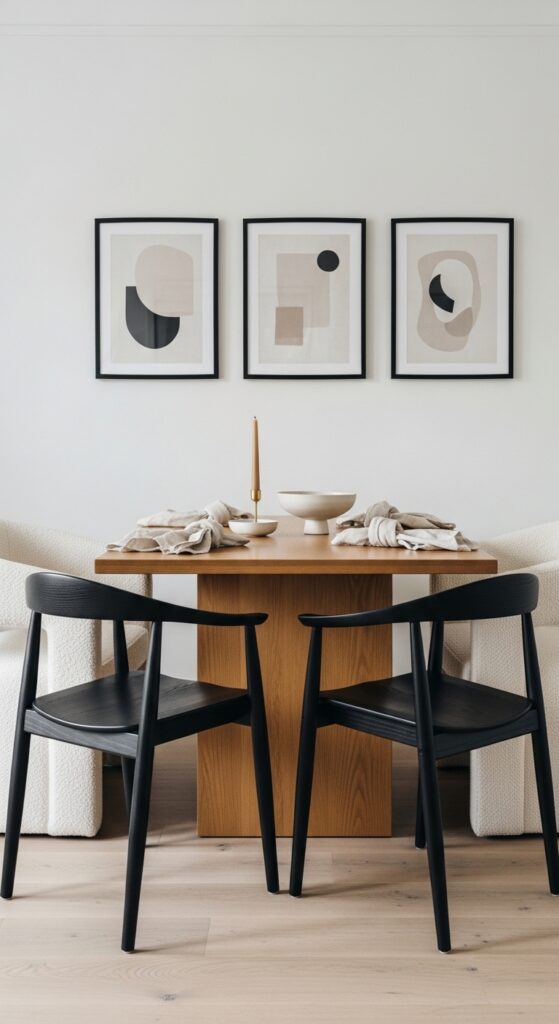
Matching chair sets can look a little showroom-ish—fine, but not always modern-cool. Mixing chairs is one of the easiest ways to add personality without adding clutter. The trick is to repeat one element so it reads intentional.
Try this:
- Keep one unifying detail: all chairs in the same wood tone, or all with black legs, or all with curved backs.
- Put the “statement” chairs at the ends (they read like punctuation marks).
- If you share the space, choose side chairs with some softness—upholstery in linen or performance fabric makes sitting linger-worthy.
Watch out: mixing too many shapes in a tiny room can feel busy fast. Two styles is usually enough.
The takeaway: a little chair contrast adds modern edge while keeping the room calm.
4. Go Round to Stop the “Hallway Dining Room” Problem
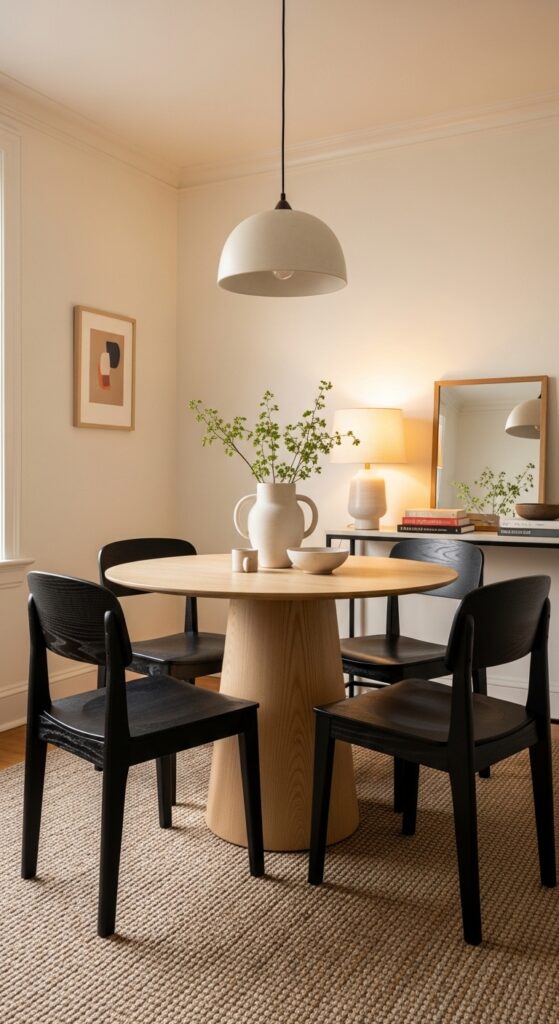
If your dining area feels like it’s wedged between the kitchen and the living room, a round table can be a genuine fix—not just a style choice. Curves create breathing room visually, and pedestal bases are a gift in tight spaces (no corner legs to dodge).
Try this:
- Choose a pedestal or tulip-style base for easier chair placement.
- Add a round rug underneath to reinforce the shape and make it feel deliberate.
- If you often host, consider a round table with a leaf—modern doesn’t have to mean impractical.
Watch out: tiny round tables can feel like café furniture if the scale is too small. Make sure it has presence.
The takeaway: when space is awkward, round shapes smooth the traffic flow and make modern style feel effortless.
5. Create a “One Wall Moment” With Paint (Even as a Renter)
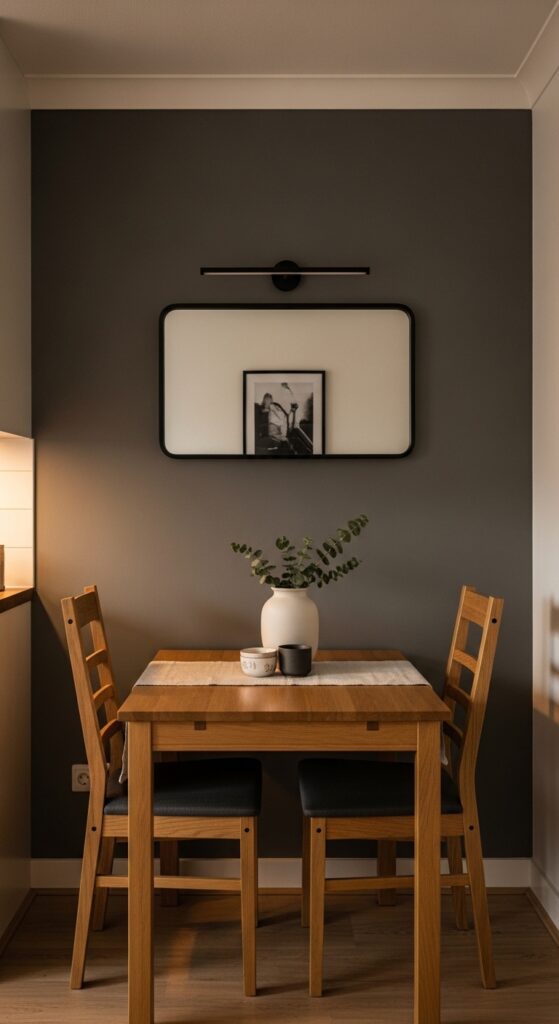
Modern dining rooms don’t need a lot of stuff—they need one strong decision. Paint is the cheapest “decision” available. Even if you’re renting, you can do a removable wallpaper panel, a peel-and-stick mural, or a temporary limewash-look finish (test it first).
Try this:
- Pick a color that plays well at night—clay, olive, smoky blue, or warm charcoal are modern and forgiving.
- Paint just the dining wall to “frame” the area in open concept spaces.
- If your room faces north and feels cool, lean warm (terracotta, mushroom, sand).
Watch out: super bright whites can look sterile next to warm wood and brass—choose a soft white instead.
The takeaway: one intentional wall gives your dining area identity without needing more furniture.
6. Add a Mirror Where You’d Normally Hang Art

A mirror in the dining room is one of those “quiet designer” moves. It bounces light, makes small apartments feel deeper, and adds a sense of polish without introducing more colors. Plus, if your dining area doesn’t get much daylight, this is a sneaky fix.
Try this:
- Go larger than a typical art piece—mirrors need scale to work.
- Choose a thin frame (black metal or warm brass) to keep it modern.
- Hang it so it reflects something pleasant: a window, a plant, or a beautiful light fixture.
Watch out: mirrors that reflect clutter (kitchen mess, laundry pile) will make the whole room feel chaotic. Placement matters.
The takeaway: mirrors add depth and light—two things apartments are always short on.
7. Upgrade the “Invisible Storage” With a Slim Sideboard

If your dining table constantly becomes a mail drop, a slim sideboard is basically therapy. Modern style looks best when surfaces aren’t fighting for attention. Give the clutter a home, and the room instantly feels calmer.
Try this:
- Choose a sideboard that’s shallow (14–18 inches deep) so it doesn’t eat the walkway.
- Use the top as a controlled landing zone: one tray for keys/mail, one bowl, one lamp.
- Inside, store linens, candles, and the “we only use this sometimes” serving pieces.
Watch out: open shelving can look messy fast unless you love styling and maintaining it. Closed storage is kinder.
The takeaway: a slim sideboard makes your dining area feel intentional—and keeps the table clear for actual dining.
8. Do the Modern Thing: Texture Over Pattern
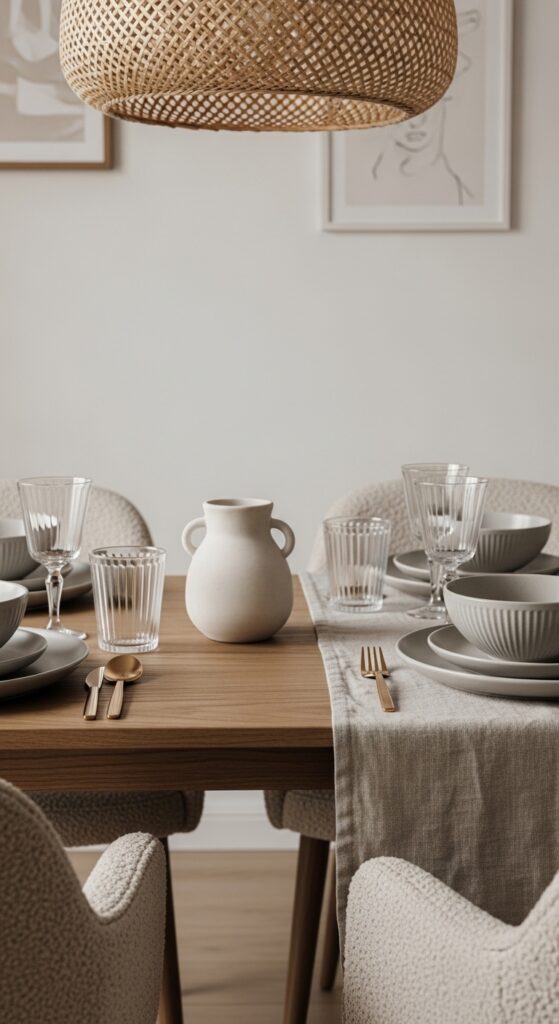
If you want modern style that doesn’t feel cold, stop chasing bold patterns and start collecting textures. Linen, boucle, oak grain, matte ceramics, ribbed glass—those details read expensive and lived-in without shouting.
Try this:
- Swap cotton for linen napkins (they look better slightly rumpled, which is a win).
- Add one tactile element: boucle seat cushions, a chunky woven runner, or a plaster centerpiece.
- Keep the palette tight—warm whites, soft taupes, black accents—then let texture do the visual work.
Watch out: too many competing textures can feel fussy. Pick two “stars” (like linen + wood) and keep the rest supporting.
The takeaway: modern dining rooms feel warm when you layer materials, not prints.
9. Replace One “Basic” Piece With Something Sculptural

A lot of apartment dining rooms look “fine” and also…forgettable. One sculptural element fixes that. Not ten. One. Modern style loves a focal point with shape—especially when everything else is clean-lined.
Try this:
- Choose a sculptural pendant, a curved mirror, or a chunky ceramic bowl with an imperfect rim.
- Keep surrounding items simple so the statement reads crisp, not chaotic.
- If you hate committing, make the sculptural piece something movable (a centerpiece or lamp) instead of a permanent install.
Watch out: sculptural doesn’t mean delicate. If you’re in a small space, avoid pieces that stick out at head level or feel sharp.
The takeaway: one bold shape gives the whole dining area a “designer” energy without adding clutter.
10. Add a Soft Glow Layer (Modern Doesn’t Mean Bright)
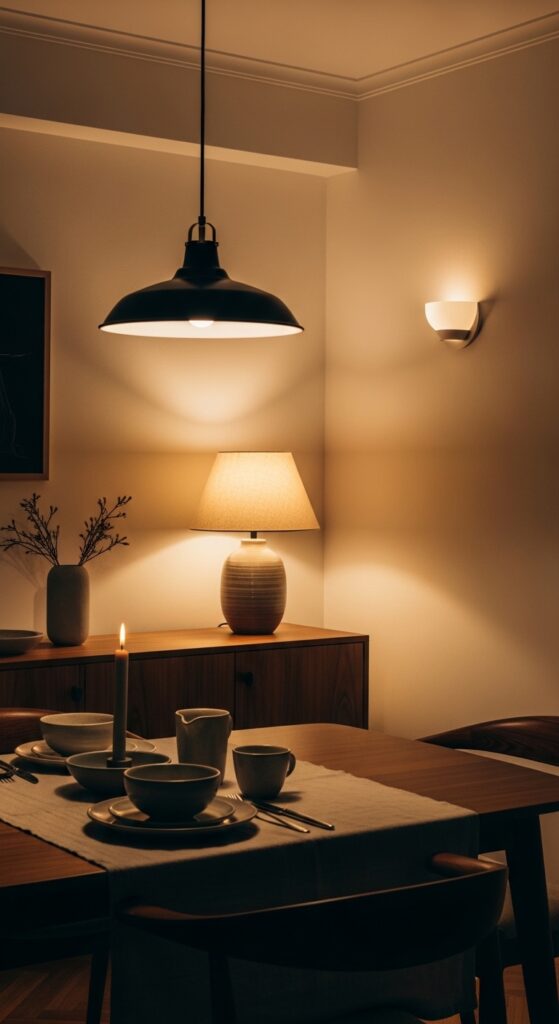
Overhead-only lighting is the fastest way to make a modern dining room feel like a waiting room. You want layers: overhead for function, lamps for mood, maybe a sconce for polish. The goal is a soft glow that makes dinner feel like an event—even if it’s just leftovers.
Try this:
- Add a small lamp to a sideboard or console (yes, lamps in dining rooms are allowed and look great).
- Use warm bulbs (around 2700K) for a flattering, cozy feel.
- Put everything on dimmers or smart plugs so you actually use the mood lighting.
Watch out: cool-white bulbs will make your walls look gray and your food look sad. Don’t do it.
The takeaway: modern spaces feel inviting when the lighting is warm, layered, and controllable.
11. Style a Centerpiece That Doesn’t Steal Table Space
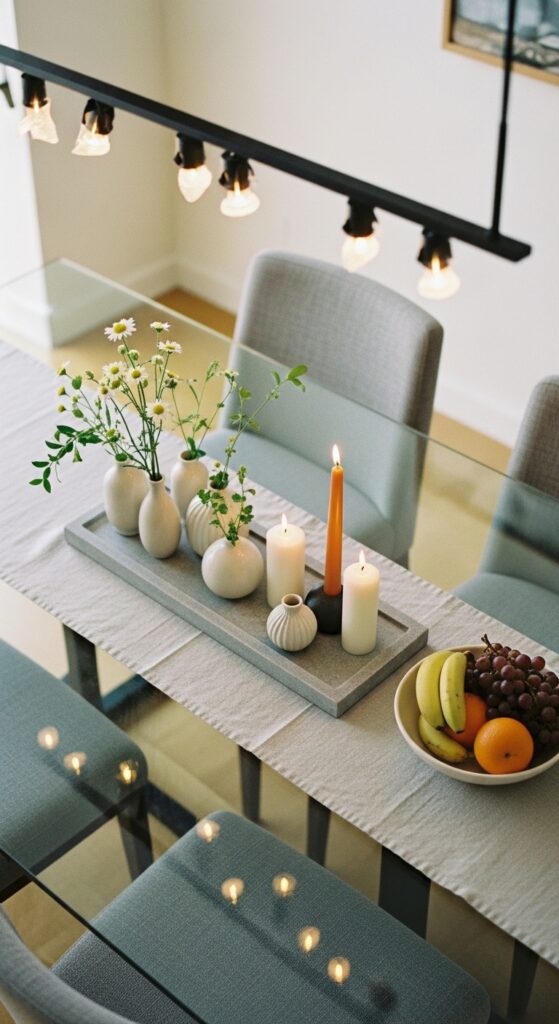
Centerpieces are tricky in apartments because the table is often your everything-surface. The best modern centerpiece is low, movable, and useful. Think of it as a “landing strip” that makes the table look styled even when you’re not hosting.
Try this:
- Use a long, shallow tray so the styling feels contained and easy to move.
- Keep height low—bud vases, small candles, a fruit bowl—so you can still talk across the table.
- Stick to one material family: ceramic + linen + brass, or wood + glass + stone.
Watch out: tall arrangements look dramatic but become annoying fast in daily life. Save those for actual parties.
The takeaway: a low, contained centerpiece gives you style without sacrificing function.
12. Treat the Corners Like Real Design (Not Afterthoughts)

Corners are where modern rooms either look polished or look unfinished. If your dining area feels a bit bare, it’s often because the corners are empty in a sad way, not a minimalist way. Give them one job: height, warmth, or light.
Try this:
- Add a tall plant (olive, ficus, rubber tree) in a textured pot to bring vertical balance.
- Use a floor lamp with a linen shade to soften the edge of the room.
- If you’re short on wall space, a narrow picture ledge can hold art without committing to a big gallery wall.
Watch out: tiny plants on the floor look accidental. If you’re going to do a plant, go taller and more architectural.
The takeaway: finishing the corners makes the whole dining area feel considered—like you meant it.
Conclusion
Modern apartment dining rooms aren’t about having the “right” furniture set—they’re about making a few smart choices that solve real problems: weird layouts, limited storage, and spaces that multitask. If you take anything from today, let it be this: modern style works best when there’s one clear focal point (usually lighting), one anchoring move (often a properly sized rug), and one layer of warmth (texture, a lamp, or a moody wall).
You don’t need to redo everything at once. Start with the piece that annoys you daily—harsh lighting, cluttered surfaces, chairs that feel flimsy—and fix that first. Small upgrades compound fast in an apartment. The goal is a dining space that feels calm, intentional, and good to live in… not just good to look at for five minutes.