There’s something quietly satisfying about a front yard that actually looks intentional. Not the kind that screams “I hired someone expensive” — but the kind where you pull up to a house and think, someone actually thought about this. That’s exactly the energy that shrubs and mulch bring to front yard landscaping. It sounds simple, maybe even boring on paper. But in practice, it’s one of the most effective, low-maintenance combinations in residential landscaping. Shrubs give you structure and year-round presence. Mulch gives you that clean, finished look that makes everything else pop. Together, they create curb appeal that holds up in July heat and February dreariness alike. Whether your front yard is a wide suburban canvas or a narrow city strip, these twelve ideas will show you how to use shrubs and mulch in ways that feel considered, personal, and genuinely beautiful — without requiring a landscape architect or a limitless budget.
1. The Layered Foundation Bed
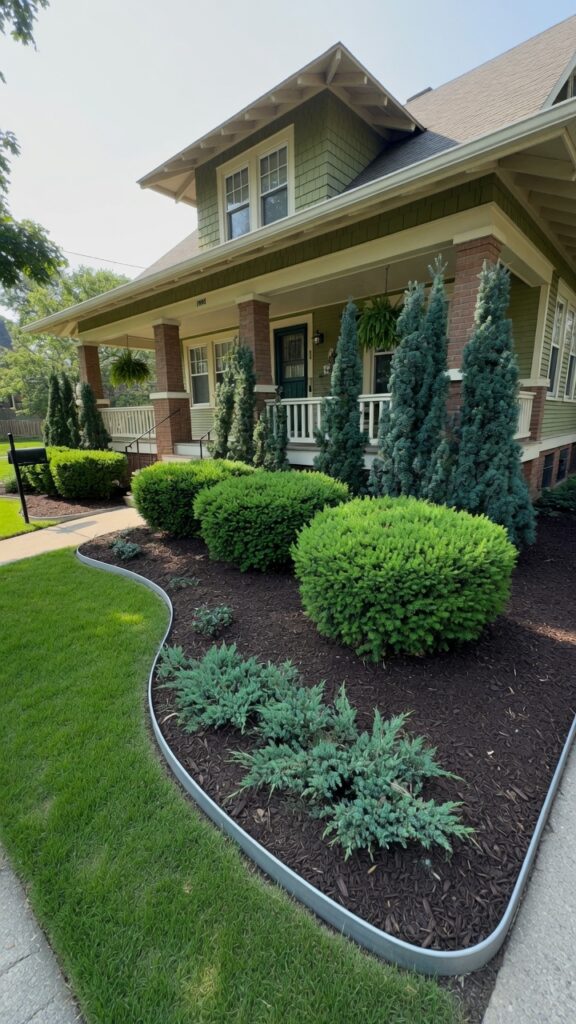
Foundation planting is the backbone of front yard design, and layering is what separates a thoughtful yard from a forgettable one. The idea is simple: tall shrubs hug the house, mid-height shrubs fill the middle ground, and low creeping varieties spill toward the lawn edge. This tiered approach creates visual depth that a flat row of identical bushes will never achieve.
Go for a back row of something substantial — arborvitae, upright yews, or inkberry holly. Mid-tier options like compact spirea or knockout roses give seasonal interest. Front-edge picks like creeping juniper or dwarf mugo pine keep things grounded without blocking windows.
Use a deep, dark mulch — dyed hardwood or natural cedar — to make the greens read more intensely. It’s the contrast that does the heavy lifting.
One thing to watch: don’t plant too close to the house. Shrubs need air circulation, and crowded foundation beds invite moisture issues against siding. Leave at least eighteen inches of clearance.
Layering takes patience — some of these shrubs grow slowly — but three years in, you’ll understand why designers call it the single best investment in curb appeal.
2. The Symmetrical Entry Flanking
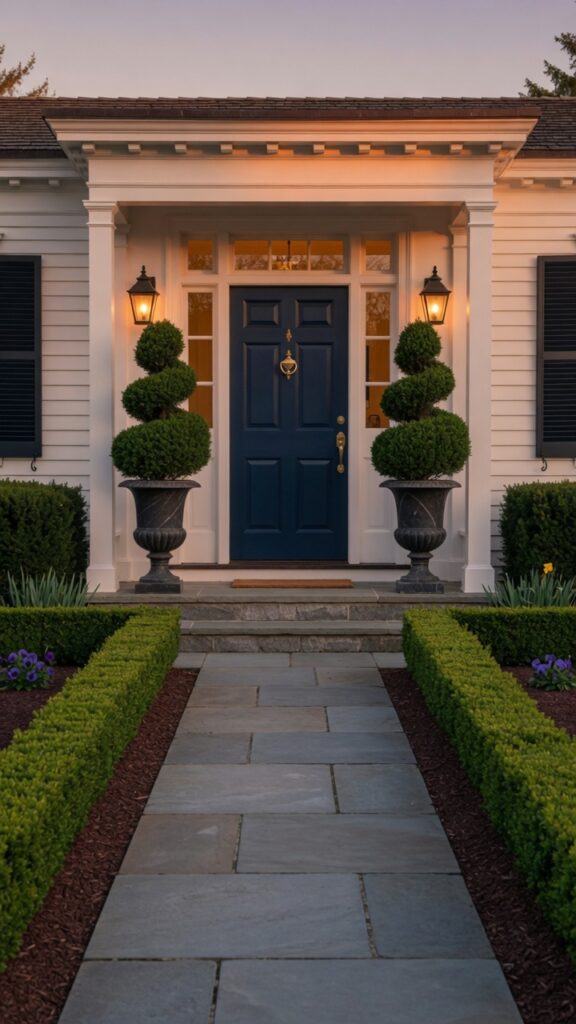
Symmetry is one of those design principles that works almost universally. Flanking your front door with matching shrubs — whether clipped into formal shapes or left naturally rounded — creates an instant sense of arrival that asymmetrical planting rarely achieves.
For a classic look, boxwood globes or columnar euonymus on either side of the entry path are unbeatable. For something softer, try matching clumps of ‘Incrediball’ hydrangea — the big white blooms feel generous and welcoming from spring through fall.
Here’s the trick with symmetrical planting: the mulch needs to be immaculate. Because the eye is already looking for perfect balance, any raggedy mulch edge or mismatched bed shape reads as sloppy. Use a half-moon edger along the lawn border every spring and refresh mulch in early May before it fades.
This approach can feel a little formal or stiff on cottage-style homes. If your house has that relaxed, imperfect character, skip the paired topiaries and go with matching but more loosely structured shrubs — something like ‘Little Lime’ hydrangeas or dwarf fothergilla.
Done right, a symmetrical entry reads as confident. It says someone lives here who cares — without looking like a theme park.
3. Curved Mulch Beds With Naturalistic Shrubs
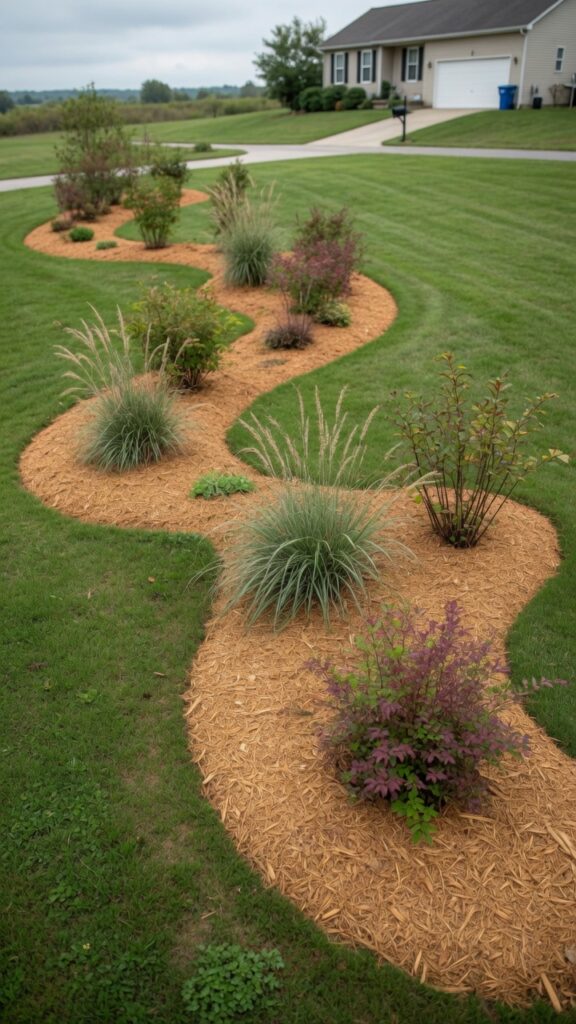
If the symmetrical entry feels too buttoned-up for your taste, this is your answer. Curved beds with naturalistic shrub groupings create a yard that looks like it grew that way — intentionally wild, effortlessly relaxed. The secret is that the curves themselves are doing the design work.
When you lay out curved beds, use a garden hose to test shapes before you cut anything. Wide, sweeping arcs read better than tight, nervous wiggles. Think of the curve as a slow river bend, not a zigzag.
Plant shrubs in odd-numbered groupings — threes and fives — rather than evenly spaced rows. Native shrubs shine here: spicebush, sweetspire, native viburnums, and blueberry shrubs all work beautifully in naturalistic arrangements and reward you with seasonal color without demanding much care.
Shredded cedar mulch in a warm amber tone complements this relaxed style better than dyed black mulch, which can feel harsh against the organic planting.
One constraint worth naming: curved beds need consistent maintenance at the edges. The organic shapes only look intentional when the edge is crisp. A steel or aluminum edging strip installed beneath the surface keeps things honest all season with minimal upkeep.
The result feels personal and alive in a way that rigid, squared-off beds never quite manage.
4. Evergreen Shrubs For Year-Round Structure
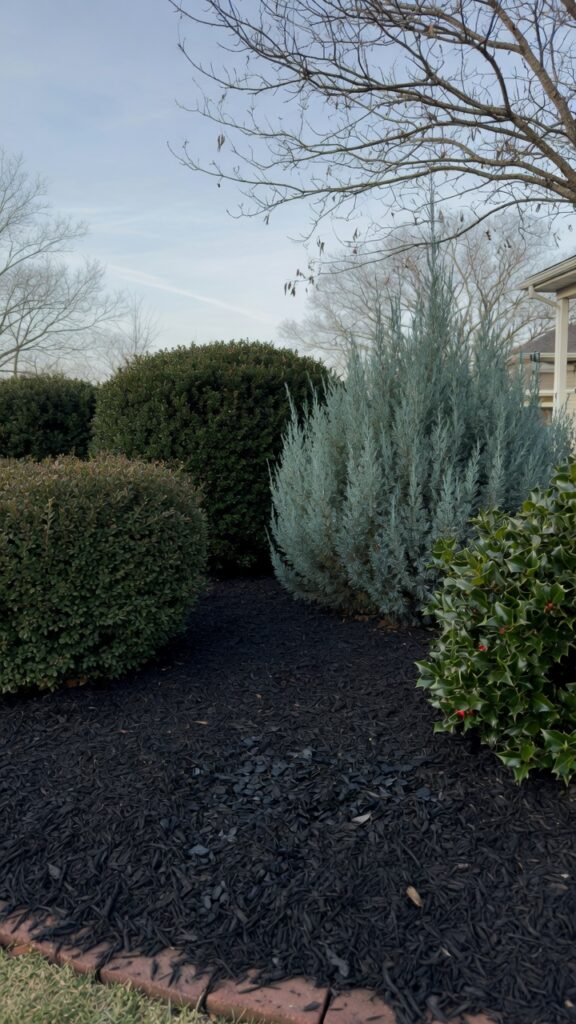
Here’s an honest truth about front yard landscaping: most people only think about how it looks in June. Evergreens are the solution to the rest of the year. A yard anchored by well-chosen evergreen shrubs has structure and presence in February that a flower-heavy yard simply cannot offer.
The best evergreen shrubs for front yards combine interesting foliage texture with manageable size. ‘Sky Pencil’ holly gives you vertical drama in tight spaces. ‘Blue Star’ juniper offers a cool blue-gray color that photographs beautifully against warm mulch tones. Dwarf Alberta spruce brings a tidy conical silhouette that looks almost architectural.
Dark mulch — black or deep espresso — makes evergreen foliage look richer and more saturated. It’s a contrast game, and the mulch is your background.
That said, an all-evergreen yard can skew flat and monotonous by midsummer when everything is uniformly green. Break it up with at least one or two shrubs that offer seasonal interest — berry production, fall color, or late-summer bloom. ‘Winterberry’ holly is exceptional for this: fully deciduous but covered in red berries from October through February.
Evergreens don’t ask for much. Water them through their first two seasons, mulch well, and they’ll carry the yard through decades with almost no intervention.
5. Black Mulch With Variegated Shrubs
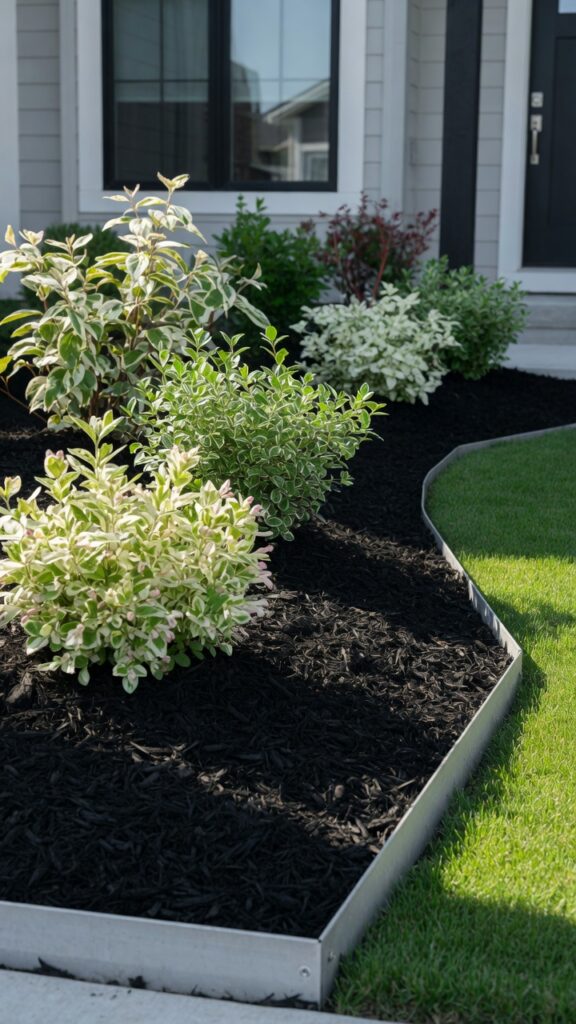
Black mulch is divisive. Some designers love the bold graphic contrast it creates; others think it looks harsh or unnatural. Here’s where it genuinely excels: paired with variegated shrubs, it creates a high-contrast combination that reads as intentional and contemporary rather than stark.
Variegated foliage — shrubs with leaves edged or splashed in cream, white, or gold — practically glows against a dark background. ‘Variegata’ weigela, ‘Emerald Gaiety’ euonymus, and golden-tipped false cypress are all reliable performers that give you this effect without requiring perfect conditions.
The visual logic is simple: dark ground, light foliage, clean line between the two. It works especially well on homes with modern or transitional architecture — think board-and-batten siding, dark trim colors, or minimalist landscaping elsewhere on the property.
One thing to watch: black dyed mulch fades faster than natural cedar or hardwood. By midsummer, it often shifts to a washed-out gray that undermines the whole effect. Budget for a refresh in late July if the look matters to you, or switch to a naturally dark mulch like composted wood chips that age more gracefully.
Skip this combination if your house is painted a pale neutral — the contrast can overwhelm a soft color palette rather than complement it.
6. Native Shrubs For A Pollinator-Friendly Front Yard
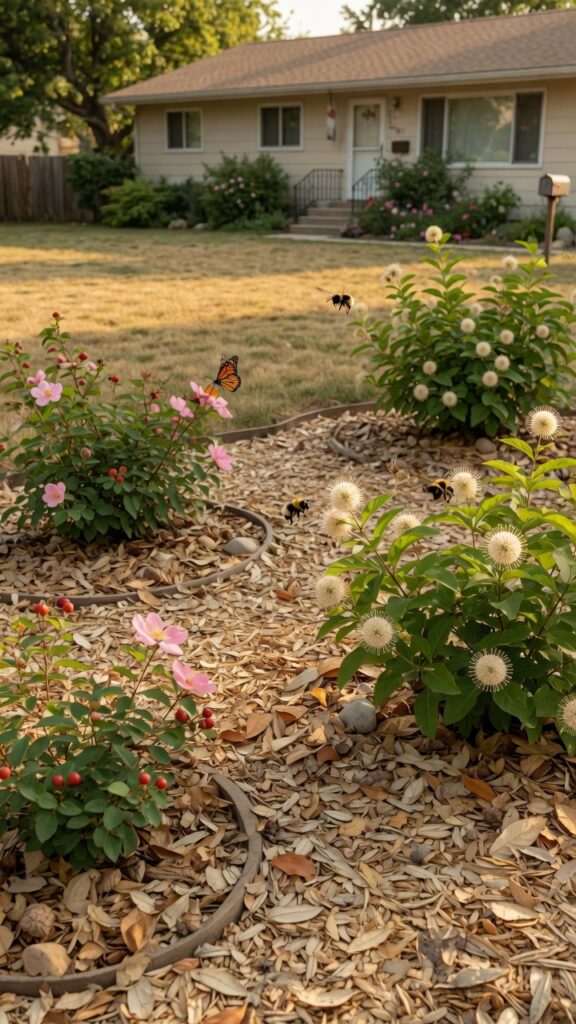
There’s a real movement happening in residential landscaping right now, and it’s less about aesthetics than ethics — though the results are often beautiful. Native shrubs paired with natural mulch create front yards that support local ecosystems while dramatically reducing maintenance. It’s not the “let it go wild” look people sometimes assume. Done well, it’s deeply considered.
Native shrubs earn their place not just because they’re low-maintenance (they evolved here, after all) but because they feed something. Buttonbush draws pollinators ferociously. Native viburnums feed birds through winter. Spicebush is a host plant for the spicebush swallowtail butterfly. These aren’t just plants; they’re participants.
Use shredded leaf mulch or untreated wood chips rather than dyed products. The natural color reads warmer and supports soil biology more actively than synthetic dyes allow.
The constraint here is patience with neighbors and HOAs. Native front yards can look “unfinished” to eyes trained on conventional landscaping. Define the beds clearly with crisp edges, include a small sign if your neighborhood allows it, and the perception usually shifts quickly.
This approach rewards observation. Sit on your porch in July and watch what visits your buttonbush. It changes how you think about your yard entirely.
7. Ornamental Grasses Mixed With Flowering Shrubs
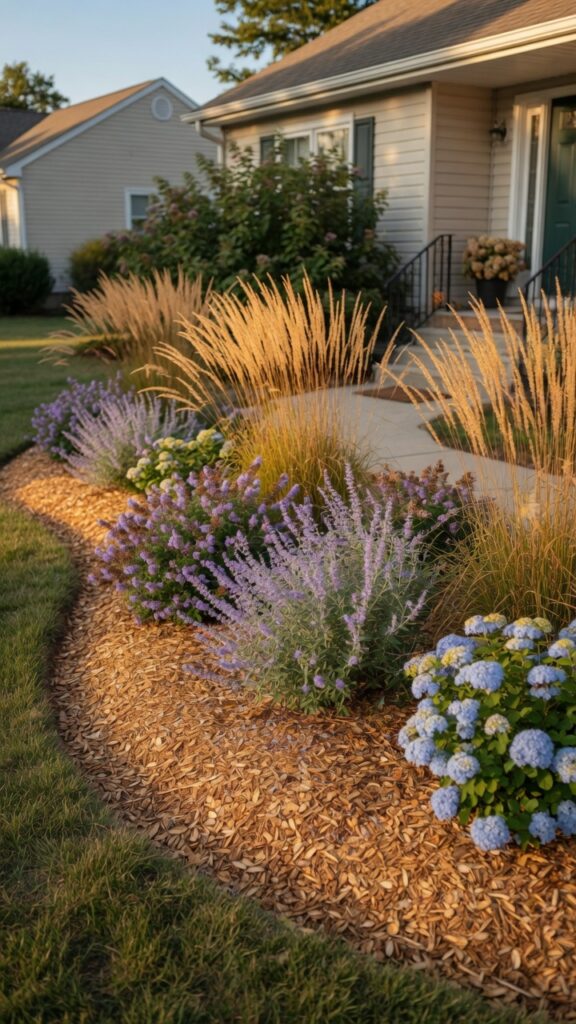
Mixing ornamental grasses into shrub beds is one of those tricks that separates a good landscape from a genuinely interesting one. Grasses bring movement. On a still day, they add texture. On a breezy afternoon, they catch light and sway in a way that no shrub can replicate.
The combination that works especially well: mid-height fountain grass or Karl Foerster feather reed grass interspersed between flowering shrubs like blue mist spirea, Russian sage, or dwarf butterfly bush. All of these bloom in the blue-purple range, which creates a cohesive palette without feeling matchy.
Use a warm natural mulch — shredded hardwood in a brown or amber tone — to keep the bed grounded while letting the grasses read as the stars.
Here’s the practical trade-off: ornamental grasses need to be cut back hard every late winter (to about four inches) before new growth emerges. This is easy work, but it’s non-negotiable. Skipping a year leaves you with a dead bird’s nest of old growth that’s genuinely difficult to deal with.
This combination handles heat and drought far better than hydrangea-heavy beds. If you’re in a climate with dry summers, it’s worth serious consideration over the more popular but thirstier alternatives.
8. Formal Clipped Hedges As Front Yard Walls
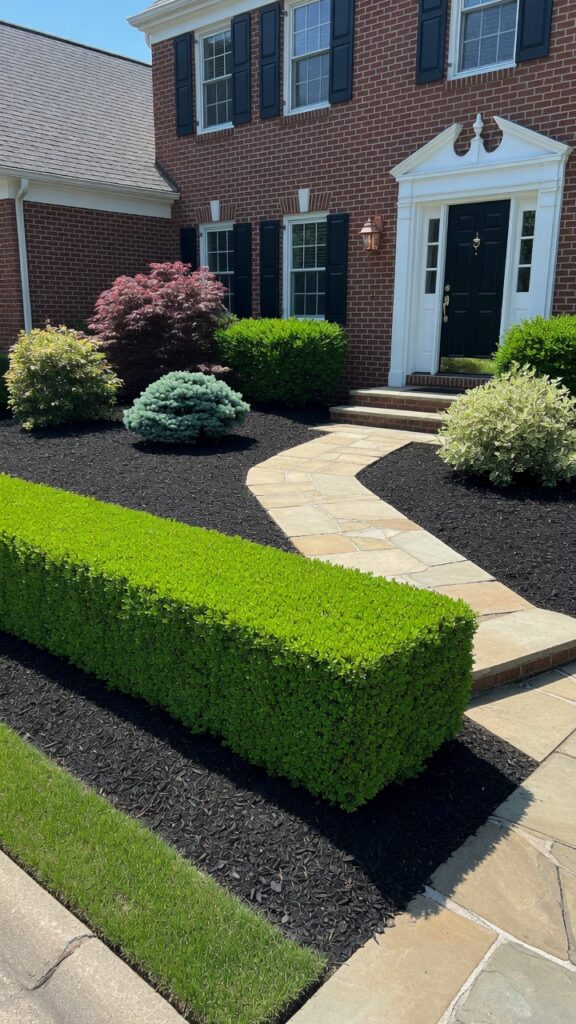
A clipped hedge running along the front property line is one of those old-fashioned ideas that keeps coming back because it simply works. It defines the boundary between public and private space without a fence, creates a frame for everything behind it, and gives the whole property a composed, finished quality.
Boxwood is the classic choice, but it’s been hit hard by boxwood blight in many regions. ‘Sprinter’ boxwood and ‘NewGen’ varieties show better disease resistance. Alternatively, dwarf inkberry holly is an underused native option that clips beautifully and tolerates wet feet — useful if your front yard dips toward the street.
Keep the interior of the hedge border mulched consistently. The contrast between the tightly clipped green wall and the dark, soft mulch behind it is what makes this look so clean.
The time commitment is real. A formal hedge needs two or three clips per season to maintain its shape. Use a battery-powered hedge trimmer with an extending reach and it becomes a thirty-minute task rather than an afternoon.
One constraint: this look reads as traditional and structured. It’s not the right match for a contemporary or bohemian-style home. Read your architecture first and let it lead.
9. Sloped Front Yard With Tiered Shrub Plantings
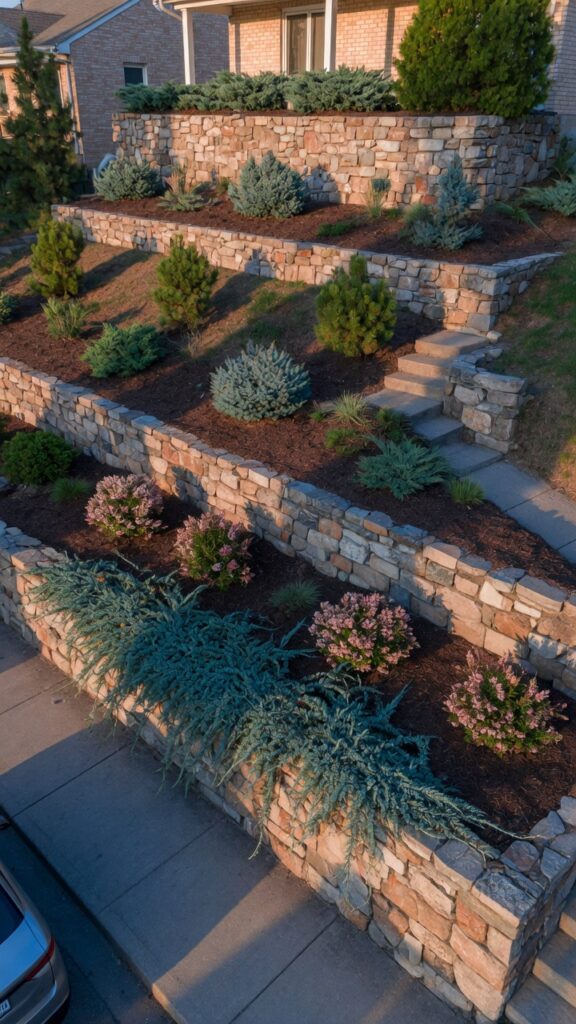
A sloped front yard frustrates most homeowners. Mowing it is awkward, erosion is a constant concern, and flat-ground landscaping ideas simply don’t translate. But slopes are genuinely one of the best canvases for shrub and mulch landscaping — because elevation change creates natural drama without any additional design effort.
The key is working with the slope in tiers rather than fighting it. Even simple two-level terracing — one low retaining wall of natural stone or timber — doubles your planting area and controls erosion while creating visual interest. Each tier gets its own mulch bed and shrub plantings.
Choose shrubs with strong root systems for the upper tiers — arrowwood viburnum, native sumac, or rugosa roses are all excellent slope stabilizers. Cascading varieties like creeping juniper or ‘Gro-Low’ fragrant sumac spill attractively over wall edges and help knit the slope together.
A thick layer of mulch — three full inches — is essential on slopes to slow water runoff and protect soil between plants. Use a coarser shred than you’d use on flat ground; fine mulch migrates downhill in heavy rain.
This is higher effort upfront but almost no-maintenance after year two. And the dimensional quality of a well-terraced front yard is something flat lots simply cannot achieve.
10. Mulch Paths That Connect Planting Islands
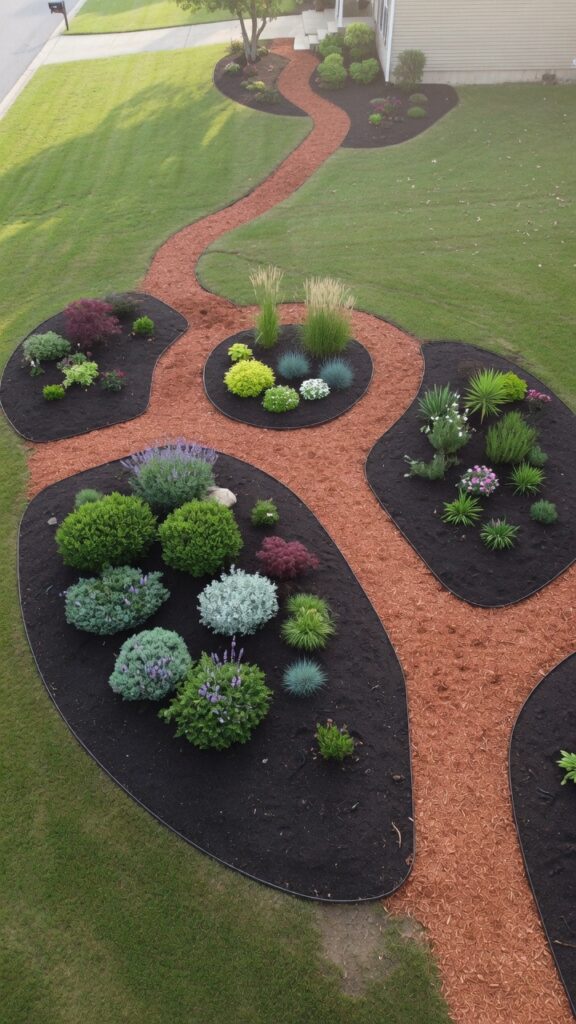
Most front yard landscaping is designed to be looked at from the street. This idea invites people in. Mulch pathways that meander between planting islands create a front yard you actually move through — which changes how it feels to arrive home and how guests experience your property entirely.
The design logic: replace a portion of lawn with mulch paths (the same material as the beds) and arrange shrub plantings as islands that the path navigates between. The effect is immersive and personal in a way that a single continuous bed never achieves.
Shredded hardwood mulch works well for paths, but install a two-inch layer of coarse material beneath to improve drainage and reduce compaction underfoot. Edge the pathways with a simple steel or stone border to keep the mulch from migrating onto the lawn.
Plant islands should be varied in height and interest — a taller specimen shrub at the center of each island, lower plants radiating outward. Keep the tallest plantings toward the house and scale down as you approach the street.
One watch-out: mulch paths require edging maintenance just like beds do. If you let the edges blur, the whole system reads as neglected rather than designed. A seasonal edge refresh keeps everything looking intentional.
11. Four-Season Interest With A Curated Shrub Palette
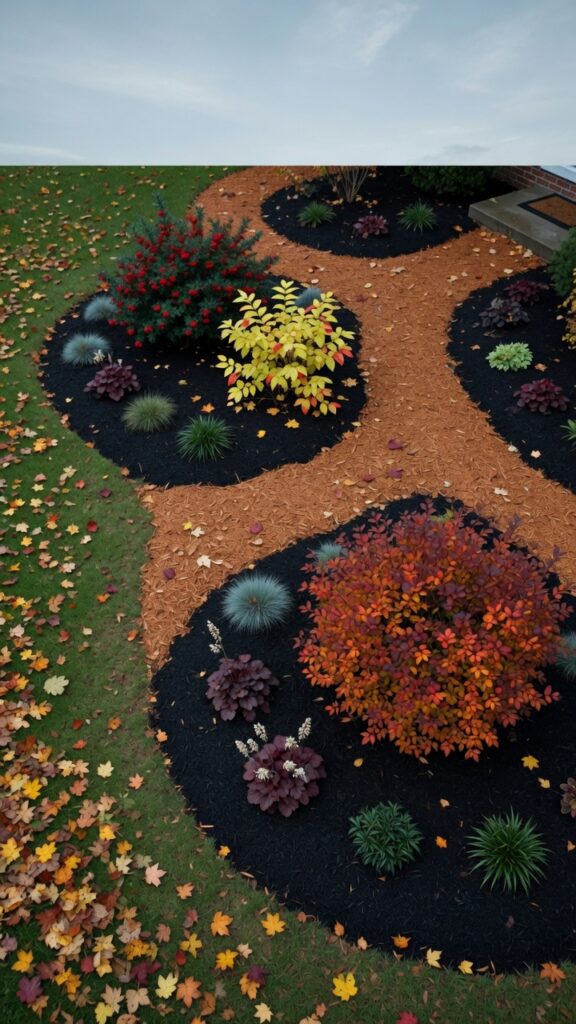
Most front yards look great for about eight weeks in late spring. The rest of the year is an afterthought. Designing specifically for four-season interest changes how you think about shrub selection — and the result is a yard that earns admiring looks in November just as confidently as it does in May.
The framework: assign each shrub in your design a seasonal role. Spring interest comes from blooming shrubs — spirea, lilac, fothergilla. Summer is handled by roses, hydrangeas, and butterfly bush. Fall is where native viburnums and fothergilla earn their keep with exceptional foliage color. Winter belongs to hollies with berries, red-twig dogwood, and the structural silhouettes of evergreens.
Mulch becomes even more important in the off-season because it’s what you’re looking at when the shrubs have dropped their leaves. Dark, fresh mulch in November keeps beds looking tended rather than abandoned.
The practical tip: map your selections on paper before you plant, noting each shrub’s primary season of interest. If two-thirds of your picks peak in June, you haven’t solved the problem. Aim for at least two strong performers in each season.
It takes more thought upfront. But a yard that’s interesting in February — really interesting, with red berries against snow and graphic branching patterns — is genuinely rare. And people notice.
12. Low-Maintenance Minimalist Front Yard
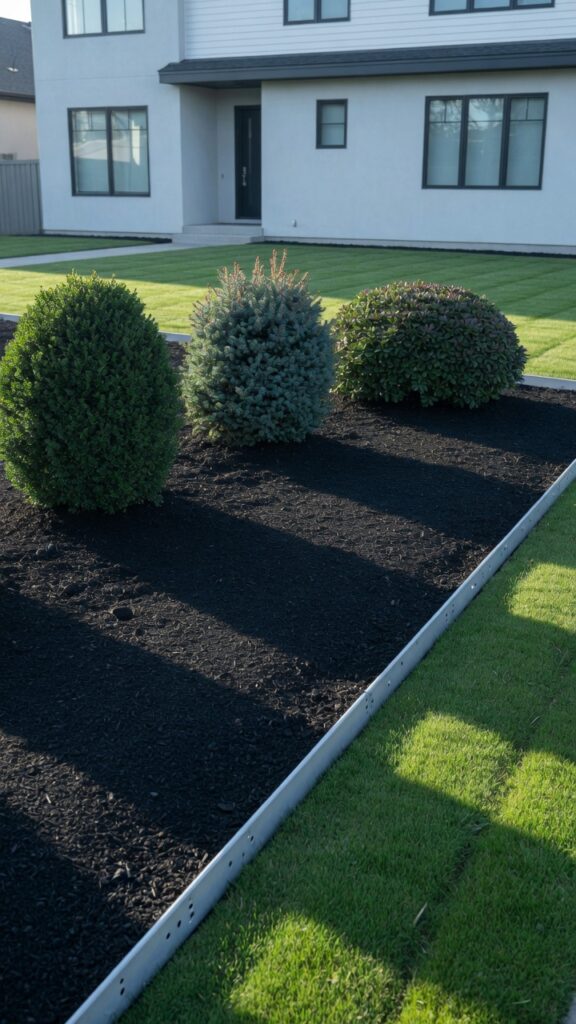
There’s a version of front yard landscaping that asks very little of you — and still looks genuinely intentional. The minimalist approach leans on a few strong specimen shrubs, widely spaced, in a generous mulch bed with a perfect edge. No fussiness, no overcrowding, no seasonal replanting. Just structure and restraint.
The key is choosing shrubs that are interesting enough to stand alone. ‘Limelight’ hydrangea in tree form. A weeping blue atlas cedar. A large specimen ‘Winter King’ hawthorn. These aren’t background plants — they’re the entire statement.
Space them generously: what looks sparse when you plant it fills in beautifully within three years, and you avoid the chronic problem of shrubs outgrowing their space and requiring constant cutting back.
Black or very dark mulch suits this aesthetic best — it reads as a ground plane, a stage for the specimen plants above it. Keep it fresh; faded mulch undermines the whole effect more here than in a busier planting scheme.
This is the right choice if you travel frequently, hate gardening maintenance, or simply prefer a yard that doesn’t demand your attention. There’s a quiet confidence to a minimalist front yard that more elaborate designs sometimes lack. Less, done properly, is genuinely more.
If you’ve made it this far, you’ve absorbed something that most homeowners never quite articulate: the reason some front yards look so good isn’t money or luck — it’s intention. Shrubs and mulch work because they combine permanence with flexibility. The shrubs give you bones; the mulch gives you polish. Together, they let you make design choices that hold up across seasons and years, not just on the afternoon after a planting session.
What you’ve seen across these twelve ideas is that the same two ingredients — shrubs, mulch — can produce wildly different results depending on how you use them. Formal or naturalistic. Bold or restrained. High-maintenance drama or quiet, effortless structure. The deciding factor is almost always understanding your own home, your climate, and honestly, how much time you’re willing to give your yard each season.
Take one idea from this article and try it. Just one bed, one design move, one season’s experiment. Front yard landscaping rewards incrementalism — you don’t have to transform everything at once. Start with a clean mulch edge and one well-chosen shrub in the right spot. You’ll be surprised how much that single decision changes the way your home reads from the street. Come back next season ready to add the next layer.