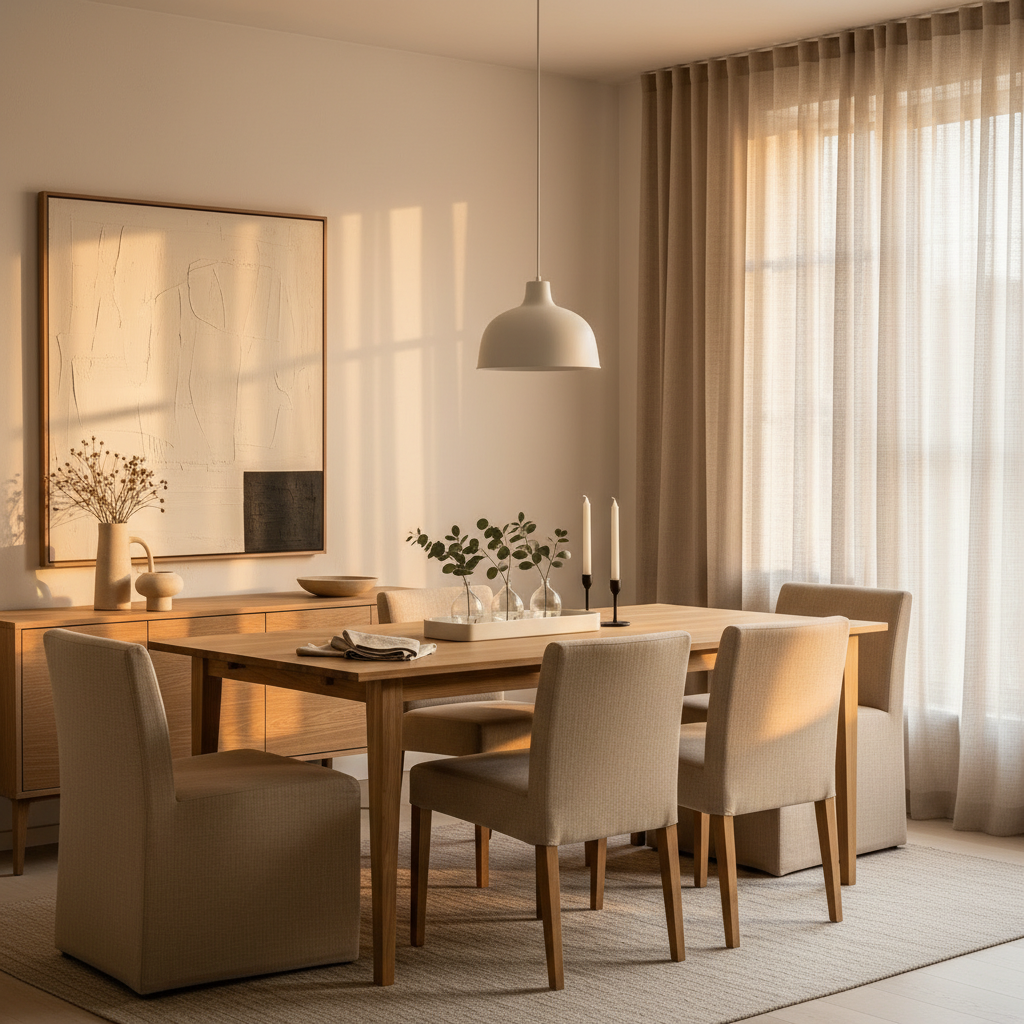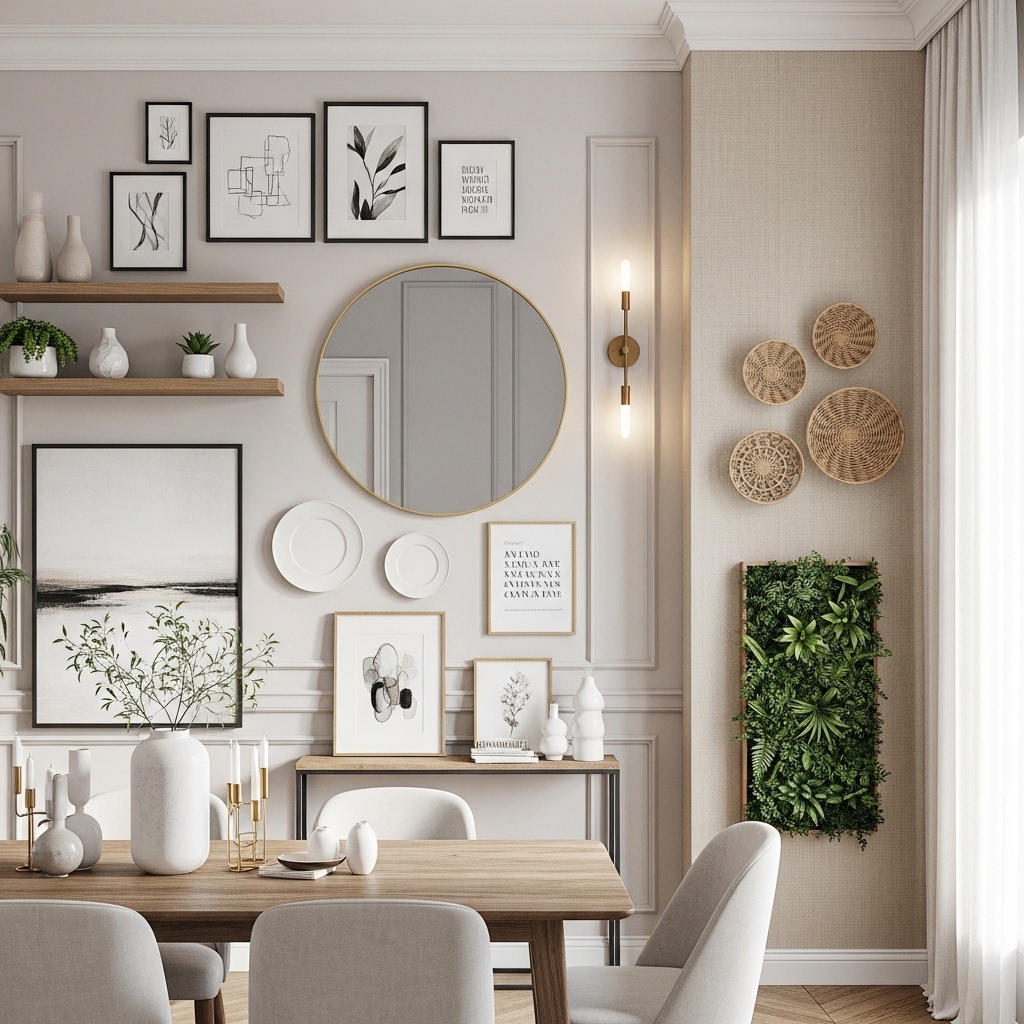
Walls are the most underestimated design element in any dining room. People spend weeks choosing the right table, agonize over chair upholstery, and then hang a single small print above the sideboard and call it done. The result is a room that functions perfectly and feels almost completely flat.
The dining room wall has a unique opportunity that walls in other rooms don’t always get — it becomes the backdrop to every meal, every gathering, every conversation that happens around that table. Done well, it sets a mood before anyone even sits down. Done carelessly, it makes even beautiful furniture feel like it’s floating in a void.
These twelve ideas are not about following trends. They are about understanding what actually works in dining rooms specifically — the scale, the light, the textures, the materials — and making choices that age well and feel genuinely personal rather than assembled from a mood board.
1. Oversized Abstract Art as the Room’s Anchor
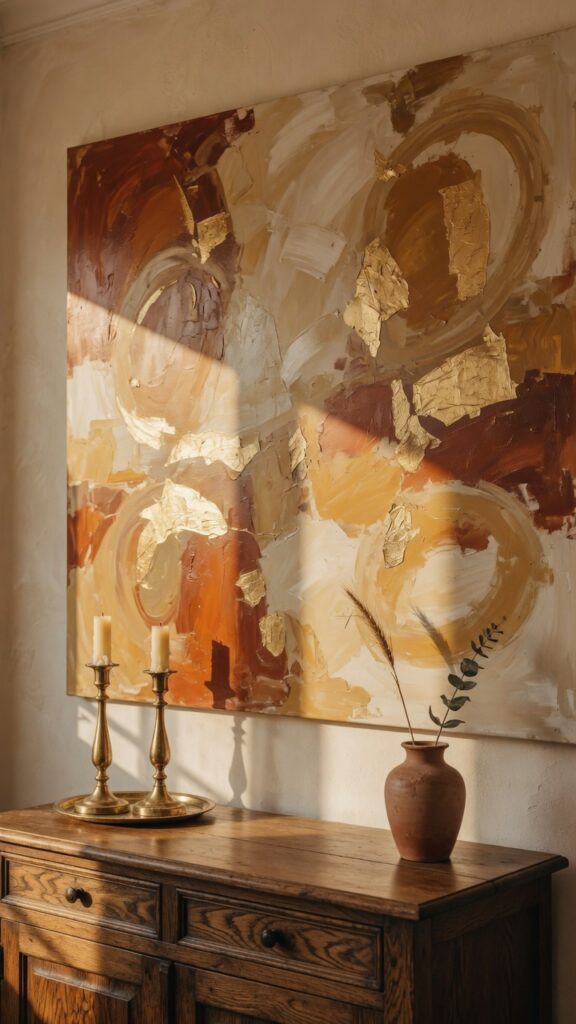
One strong piece of art does more for a dining room than an entire gallery wall done halfheartedly. If you are going to invest in anything for your dining room walls, make it one oversized canvas and make it count.
The scale here is non-negotiable. The artwork should span at least sixty to seventy percent of the wall’s width — anything smaller reads as an afterthought rather than a statement. Abstract works in warm earth tones age particularly well in dining rooms because they photograph beautifully in any light and never clash with seasonal table settings.
Hang it lower than instinct suggests. The bottom edge of the frame should sit roughly eight inches above whatever is beneath it — sideboard, console, or even just the baseboard — so the art and the furniture read as one composed arrangement rather than two separate decisions.
One watch-out: in very small dining rooms, an oversized canvas on a short wall can feel oppressive rather than grand. If your room is tight, choose a horizontal composition that emphasizes width rather than a square or vertical format that draws the eye upward.
The right piece of art tells every guest something about who lives there before a single word is spoken.
2. Wall Sconces for Layered, Atmospheric Light
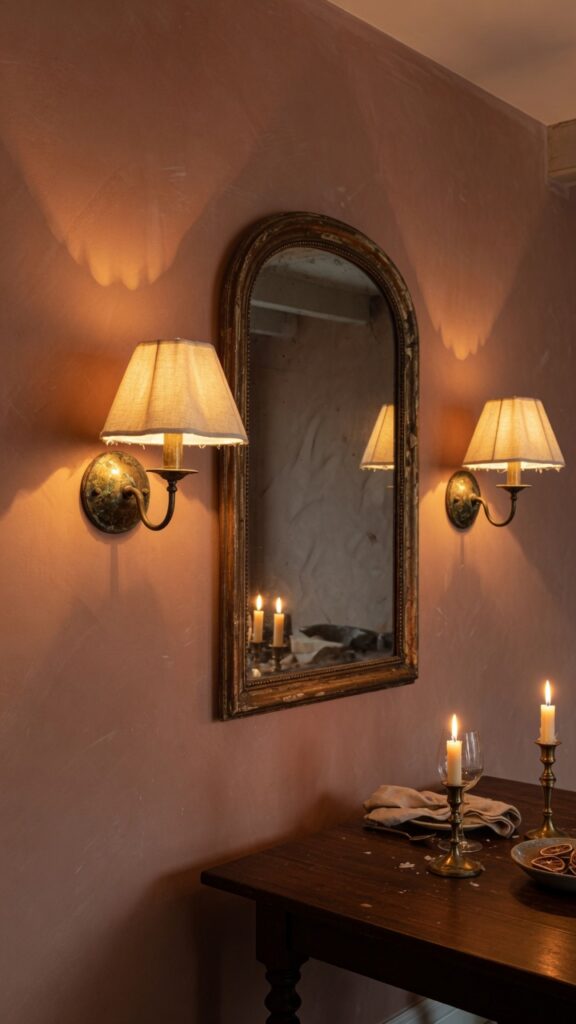
Overhead lighting alone makes dining rooms feel like offices. Wall sconces change that completely — they add a secondary layer of warm, human-scale light that makes everyone at the table look better and makes every meal feel more considered.
Mounted on either side of a mirror or artwork, a matching pair of sconces frames the wall composition and doubles as both functional lighting and decorative detail. Aged brass is the most forgiving finish — it picks up warmth from candlelight and doesn’t show fingerprints or tarnish the way polished finishes do. Matte black works beautifully in more contemporary or industrial dining rooms.
For renters or anyone avoiding electrical work, plug-in wall sconces with fabric-wrapped cords are genuinely stylish now and require nothing more than a hook and an outlet. The cord can run along the wall or be partially hidden behind furniture.
One thing to watch: mount sconces at eye level when seated — roughly 60 to 66 inches from the floor — rather than at standing height. Too high, and they illuminate the ceiling instead of the people beneath them.
Sconces are one of those changes that make a room feel inexplicably better even when guests can’t pinpoint exactly why.
3. Limewash or Plaster Paint for Textured Walls
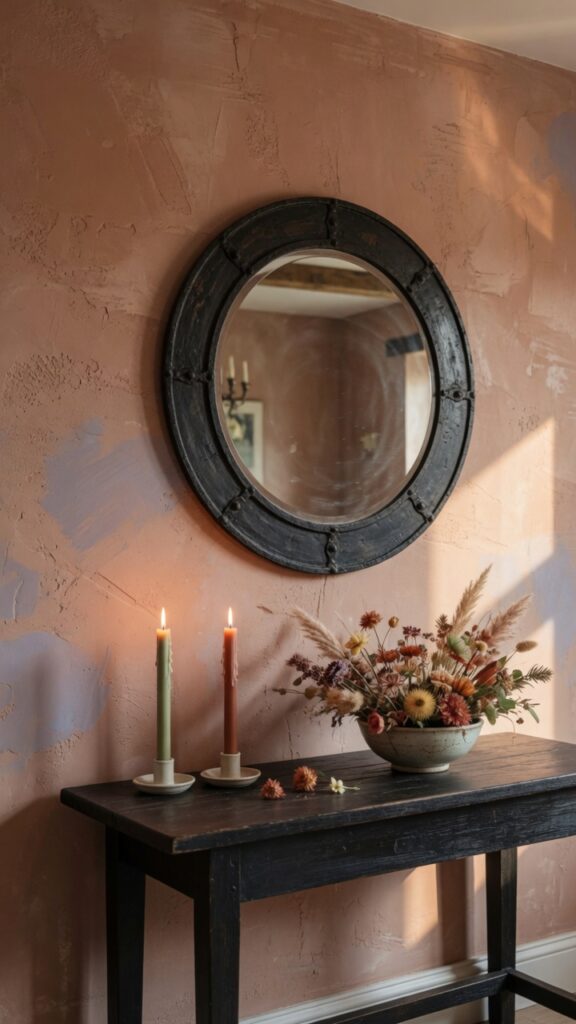
Paint color gets all the attention. Paint texture gets almost none — and that is backwards. A flat emulsion wall in even the most beautiful shade of clay or sage reads as one-dimensional in a dining room. Limewash paint, on the other hand, has a layered, chalky, almost ancient quality that shifts with the light throughout the day and gives a wall genuine depth and character.
The technique involves applying thin, diluted layers of lime-based paint with a brush in slightly irregular strokes. The variation is intentional — it creates that soft, organic, slightly weathered surface that photographs beautifully and ages even better. Warm terracotta, dusty rose, aged ochre, and deep sage all work brilliantly in dining rooms.
Venetian plaster takes this further — it is more labor-intensive and usually requires a professional applicator, but the result is a wall that genuinely looks like polished stone and adds a quiet luxury that no wallpaper can quite match.
One constraint: limewash and plaster finishes are more difficult to touch up than standard paint. If your household has children or the walls take regular contact, this may not be the most practical choice for every wall. Use it on the feature wall your dining room genuinely deserves.
Texture on a wall does what color alone never can — it makes the room feel three-dimensional.
4. A Gallery Wall Done With Restraint
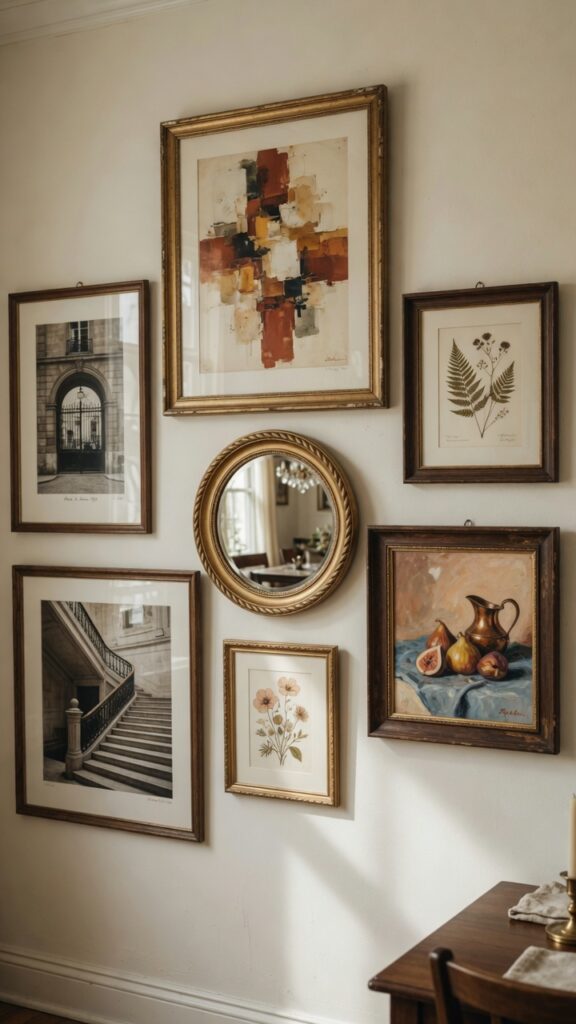
Gallery walls have a reputation for going wrong — and honestly, most do. The problem is almost always either too many pieces competing at the same scale, or frames so mismatched they look like they were collected randomly rather than curated deliberately. Done with restraint, though, a gallery wall is one of the most personal and visually rich things you can create in a dining room.
The key is treating the wall as a single composition rather than a collection of individual items. Lay everything out on the floor first and live with the arrangement before committing a single nail. Aim for a mix of scales — one large anchor piece, two or three medium frames, and two smaller elements — rather than an even grid of same-sized prints.
Mix frame materials within a limited palette: aged gold, dark walnut, and matte black all coexist beautifully. Introduce one non-frame element — a small convex mirror, a ceramic wall hanging, or a single sculptural piece — to prevent the arrangement from feeling flat.
One firm rule: the gallery wall should not extend beyond the furniture beneath it. Keep the arrangement roughly contained to the width of whatever anchors it below — a sideboard, a console, or a bench — or the wall composition floats disconnectedly.
A restrained gallery wall is one of the few places in a home where personality and elegance genuinely coexist.
5. Architectural Molding and Panel Details
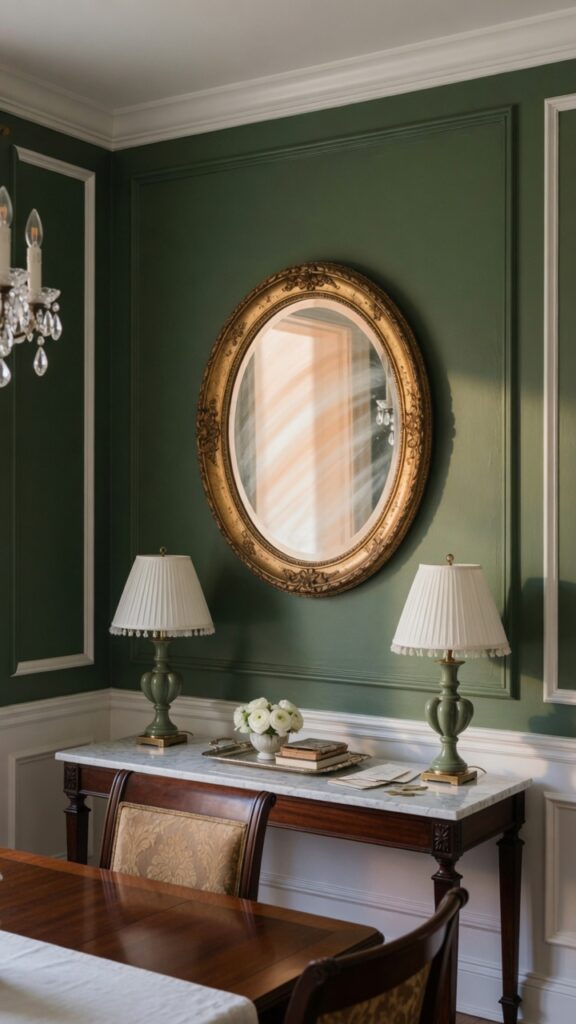
You do not need to live in a period home to have beautiful wall architecture. Adding panels, dados, or picture rails to a flat dining room wall is one of the highest-impact decorative changes available — and far more accessible than most people assume.
Simple flat-panel molding applied to drywall and painted in the same tone as the wall creates a quiet, tonal texture that reads as understated elegance rather than ostentatious decoration. Painted in a contrasting color — deep green, navy, or charcoal against white trim — it becomes a dramatic feature that transforms the entire room.
Pre-made MDF molding strips from a hardware store, adhesive and a miter saw, and one weekend of work can genuinely produce results that look like original architectural details. The key is proportions: panels should be roughly equal in width and height, with consistent margins from floor to ceiling rail.
One watch-out: very low ceilings make vertical panel divisions feel cramped. In rooms under nine feet, run panels horizontally to the dado height only, and keep the wall above clear or lightly decorated.
Architectural detail is the one wall treatment that adds genuine resale value alongside visual elegance.
6. A Single Statement Mirror
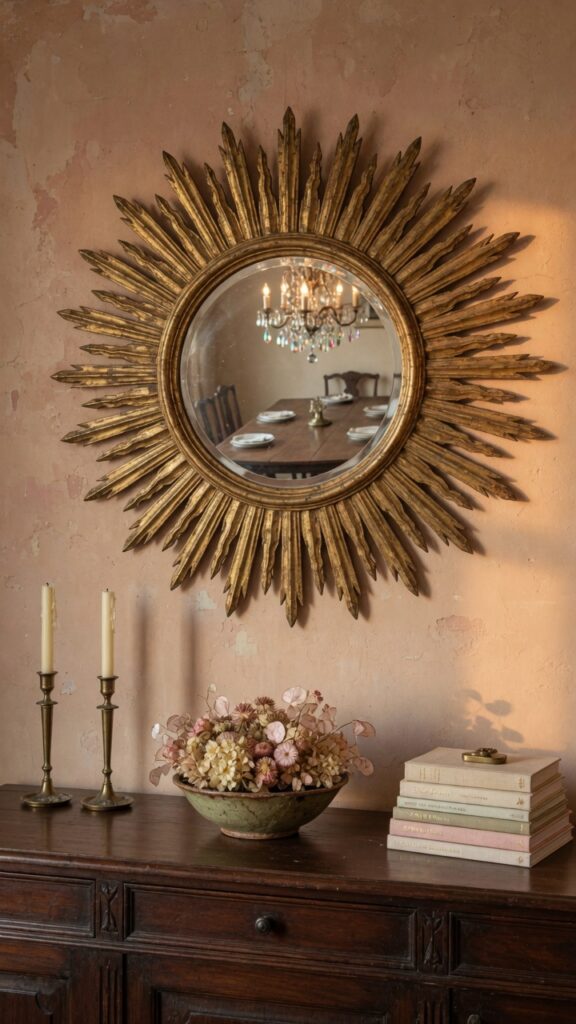
A single well-chosen mirror does more for a dining room wall than almost any other object. It reflects light, expands the perceived space, echoes whatever beautiful elements already exist in the room, and adds a focal point without the commitment of permanent artwork.
The shape matters enormously. Sunburst mirrors in aged gold bring warmth and a slightly retro-glamour quality that works across traditional, eclectic, and contemporary dining rooms. Arched mirrors with simple brass or iron frames are cleaner and more architectural. Round mirrors in oversized proportions create a bold, modern statement that photographs brilliantly.
Whatever the shape, err larger than feels comfortable. A mirror that is too small on a dining room wall looks timid. The piece should be substantial enough to hold the wall on its own without relying on surrounding objects to fill the space.
One practical note: position the mirror so it reflects something genuinely worth doubling — a window, a chandelier, the table set for dinner — rather than a blank wall or a cluttered corner.
The right mirror makes a dining room feel like a room someone thought carefully about.
7. Wallpaper on a Single Feature Wall
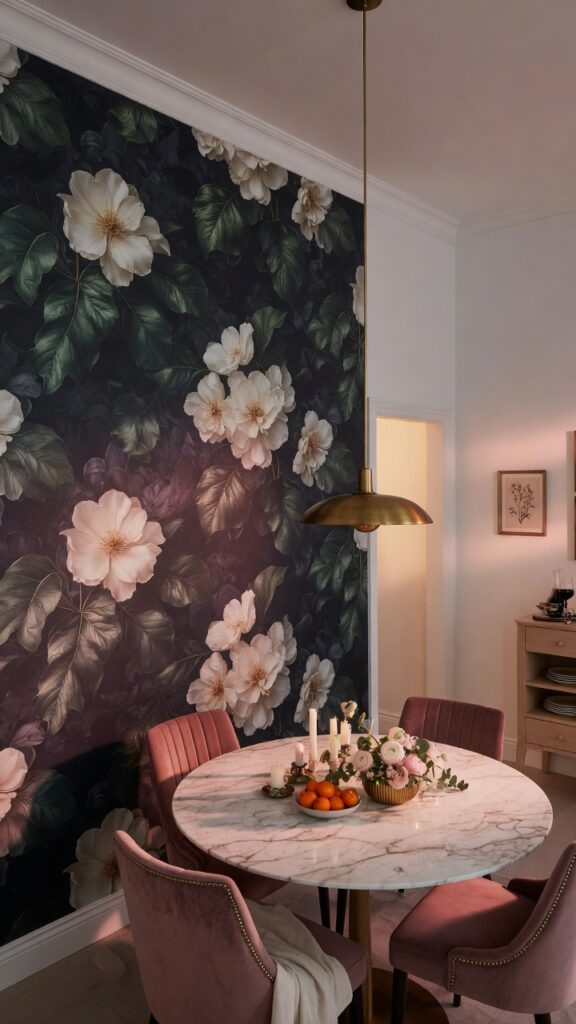
Full-room wallpaper is a commitment many people avoid entirely. A single feature wall, on the other hand, gives you all the drama and personality of a bold print without overwhelming a space — and it is significantly easier to live with long-term.
Choose the wall your dining table naturally faces or the wall most visible from the room’s entry point. That is your feature wall. A large-scale botanical print, a geometric in warm tones, a textured grasscloth, or an abstract watercolor design all work beautifully in dining rooms — each creates a completely different mood.
Dark wallpaper — deep navy botanicals, charcoal geometrics, forest green foliage — works in dining rooms better than almost any other room in the house because dining rooms are often used in the evening under warm artificial light, when deep tones feel atmospheric rather than oppressive.
One honest constraint: if you rent, quality peel-and-stick wallpaper has genuinely improved. However, large-scale prints still require careful pattern matching on application — budget more time than the instructions suggest.
A single wallpapered wall is the fastest route from plain dining room to a space that feels designed.
8. Floating Shelves Styled as Wall Decor
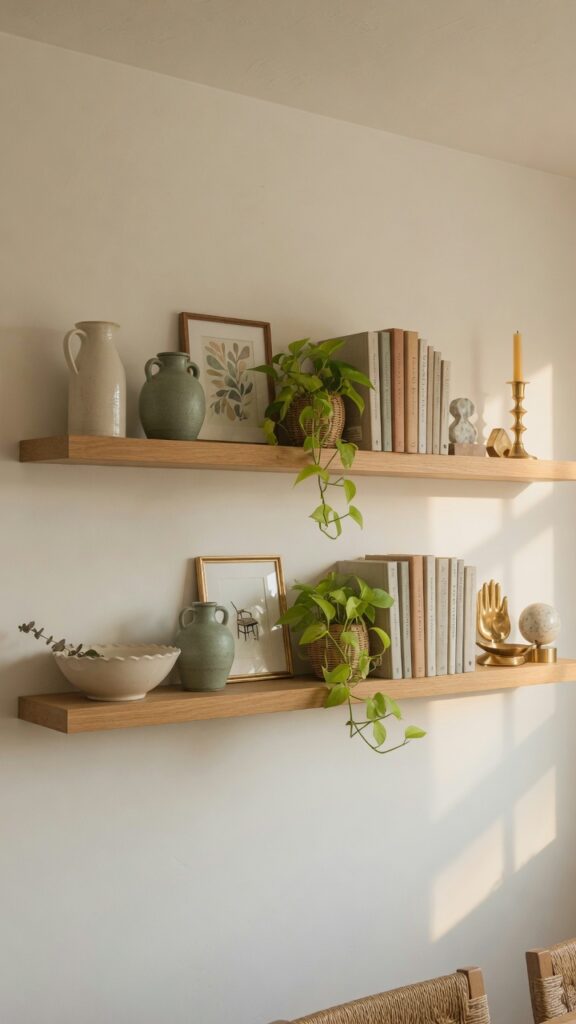
Floating shelves in a dining room tend to get dismissed as a kitchen or home office idea, but a pair of well-styled shelves on a dining room wall is genuinely beautiful — especially in rooms that lack a sideboard or console for surface styling.
The styling rules differ from kitchen shelving. In a dining room, the arrangement should lean decorative rather than functional. Ceramics in a considered color palette — creams, sages, terracottas — look elegant and cohesive. Lean a small framed print or artwork against the wall on the shelf for added depth. Introduce one trailing plant per shelf for movement and life.
Keep the color palette tightly edited across both shelves so the arrangement reads as intentional rather than accumulated. Two or three tones maximum — a warm neutral, one deeper accent, and natural wood or rattan — creates harmony without monotony.
One watch-out: shelves loaded with mismatched items can make even a beautiful dining room feel like a storage overflow. The rule is fewer, better objects with deliberate breathing space between groupings.
Floating shelves do the dual work of wall decoration and gentle display — without a single nail going into the artwork you actually love.
9. Woven and Textile Wall Hangings
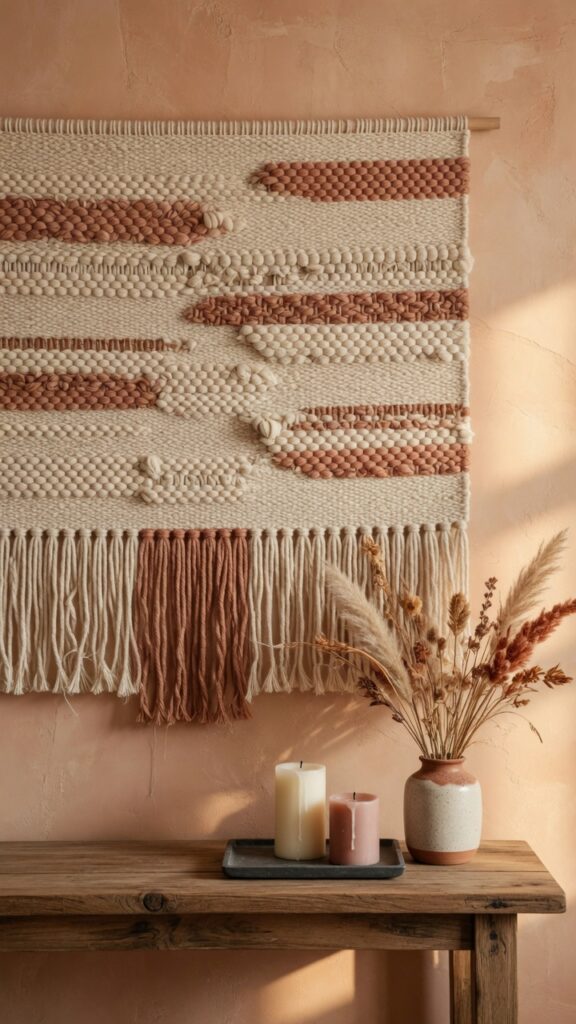
Textile wall art is having a well-earned resurgence, and dining rooms are genuinely one of the best spaces for it. Woven hangings add acoustic softness to rooms that tend to be echoey — hard floors, hard furniture, hard surfaces everywhere — and introduce a warmth and handmade quality that no framed print can replicate.
A large handwoven piece in natural fibers — undyed wool, cotton, linen — reads as quiet luxury rather than craft-fair kitsch when the proportions are right and the mounting is clean. Mounted on a simple brass or wooden dowel, centered above a console or sideboard, it becomes a natural focal point with genuine texture and depth.
In dining rooms with an earthy, organic, or bohemian aesthetic, a woven wall hanging ties together rattan chairs, wooden furniture, and linen textiles into one coherent material story. In more contemporary rooms, a single large neutral weave against a clean wall creates beautiful textural contrast.
One constraint: very large hangings in small rooms can feel heavy. If your dining room is compact, choose a piece that spans no more than half the wall’s width and keep the surrounding wall clear.
Textile art brings a dimension of warmth to dining rooms that visual art alone rarely achieves.
10. Dark Moody Paint for Drama and Intimacy
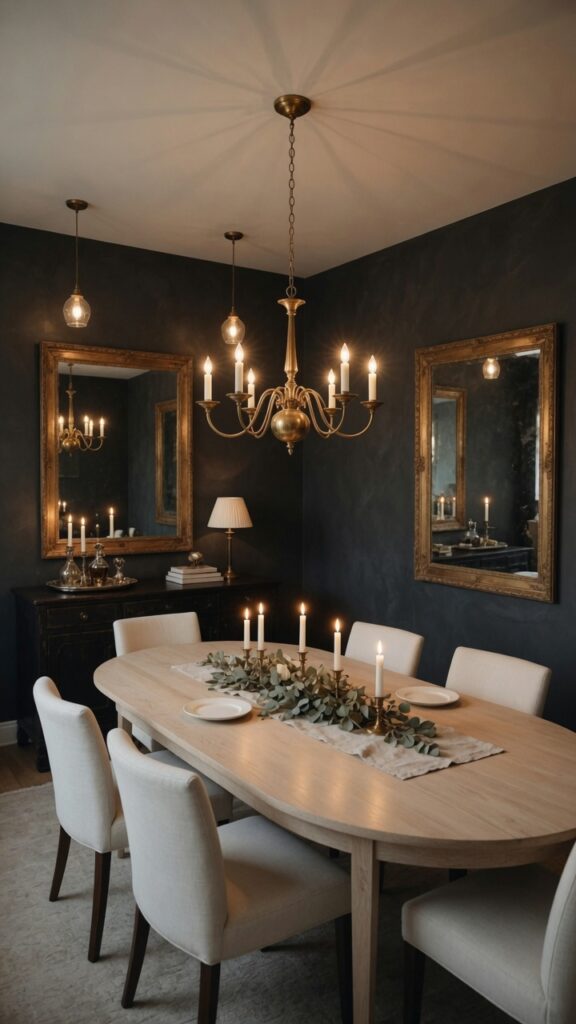
Dark walls in a dining room are one of those choices that sounds bold on paper and feels completely right in person. Charcoal, deep navy, forest green, plum — any of these on dining room walls creates an intimate, enveloping atmosphere that lighter walls simply cannot achieve, particularly in the evenings when most dining happens.
The key is contrast. Dark walls need something light to work against — pale oak furniture, cream linen upholstery, ivory ceramics, warm brass fixtures. Without that contrast, the room disappears into itself. With it, every object in the room pops with unexpected clarity.
Finish matters as much as color. Matte or flat sheens absorb light and create a velvety, almost atmospheric quality. Eggshell adds a faint glow that works well in rooms with lower ceilings. Avoid satin or semi-gloss on feature walls — the reflective surface cheapens the effect.
One honest note: dark paint in a room with very little natural light can feel genuinely depressing during daytime use. If your dining room doubles as a breakfast space or is used regularly in daylight, test the color at multiple times of day before committing entirely.
Done confidently, dark walls transform a dining room from a functional space into something people remember.
11. Vertical Shiplap or Cladding for Texture
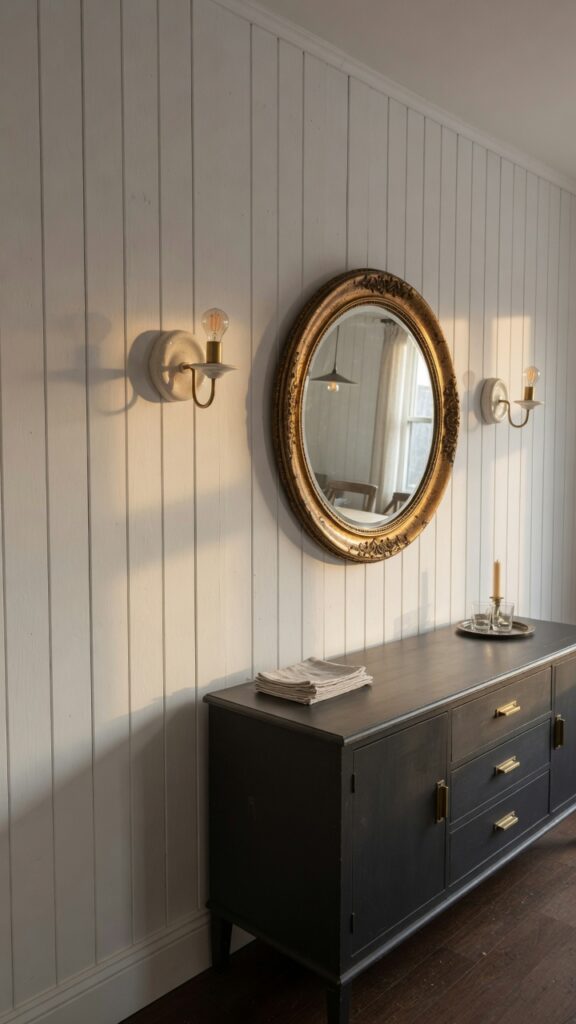
Wall cladding is underused in dining rooms and almost always looks better in person than in photos. Vertical shiplap — narrow planks with slight shadow gaps between them — adds architectural rhythm and subtle texture to a flat wall without the color commitment of paint or the permanence of wallpaper.
Painted white, it reads as fresh, coastal, and slightly Scandinavian. Painted in a deeper tone — charcoal, navy, warm sage — it becomes dramatically elegant. Left in a natural wood finish, it adds warmth and an organic, cabin-like quality that works beautifully in homes with lots of natural materials.
The vertical orientation specifically is worth choosing over horizontal for most dining rooms. Vertical lines draw the eye upward, making ceilings feel higher and rooms feel taller — a genuine advantage in standard-height spaces.
One practical consideration: real timber cladding adds cost and installation complexity. MDF tongue-and-groove paneling is a far more accessible alternative that paints beautifully and is significantly lighter and easier to work with.
Wall texture through cladding gives a dining room a quality that paint alone can never deliver — the sense that the walls themselves were designed rather than just finished.
12. A Curated Mix of Wall Elements as a Composition
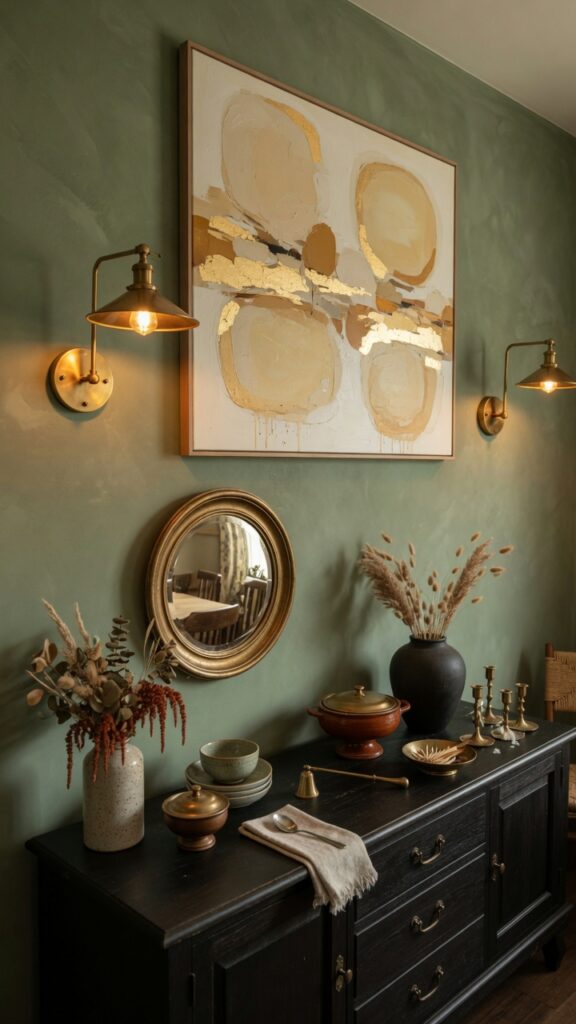
The most beautiful dining rooms are rarely the ones that picked one wall idea and ran with it. They are the ones that layered several elements into a composition that feels like it evolved naturally rather than being assembled all at once.
The trick is hierarchy. Start with one dominant element — a large artwork, a dramatic mirror, a statement wallpaper — and build around it rather than competing with it. A large canvas paired with flanking sconces and a composed sideboard below becomes a full wall vignette where every element reinforces the others.
Material layering matters here too. Combine smooth surfaces (glazed ceramic, polished brass, glass) with rough ones (linen, rattan, raw plaster, dried botanicals) so the eye has texture variation to travel across rather than a single flat surface. The contrast is what creates visual richness without visual noise.
One rule to keep: limit the number of competing focal points to one per wall. A gallery wall, a statement mirror, and a bold wallpaper on the same surface creates chaos rather than composition. One hero, supporting cast only.
A thoughtfully composed dining room wall is the difference between a room that looks finished and one that feels genuinely alive.
Conclusion
Dining room walls hold more power over the mood of a space than most people give them credit for. They are the backdrop to every meal shared, every conversation had, every occasion celebrated around that table. Treating them as an afterthought is genuinely leaving one of your best design tools unused.
What this guide hopefully made clear is that elegant wall decor is not about expensive art or elaborate renovations. It is about understanding scale, committing to texture, layering materials with intention, and making choices that reflect genuine taste rather than generic trend-chasing.
Start with one idea that resonates most honestly with your space and your lifestyle. Build from there. The dining room wall you create over time — with real consideration and real personality — will be far more memorable than anything assembled in one hurried afternoon.
Come back to this guide whenever you are ready for the next layer. There is always something worth adding, refining, or reconsidering — and that is exactly what makes a home feel alive.