Fall is the season that makes dining rooms matter again. After months of casual outdoor meals and quick kitchen suppers, something shifts in October — the light gets golden and low, the air carries that particular coolness that makes you want to light every candle you own, and suddenly the dining table becomes the most important piece of furniture in the house. People linger. Meals stretch. Someone always refills the wine.
The challenge with fall table decor is avoiding the obvious. The plastic pumpkins, the generic orange-and-black palette, the stuff that looks festive for exactly three weeks and then just looks tired. Real fall decorating borrows from the season’s actual palette — the deep burgundies, the warm ochres, the muted forest greens, the almost-brown golds — and uses materials that carry genuine texture and weight. This guide gives you twelve distinct, specific ideas for transforming your dining table into the kind of setup that makes guests feel genuinely welcomed the moment they sit down.
1. The Layered Linen Runner in Rust and Warm Cream
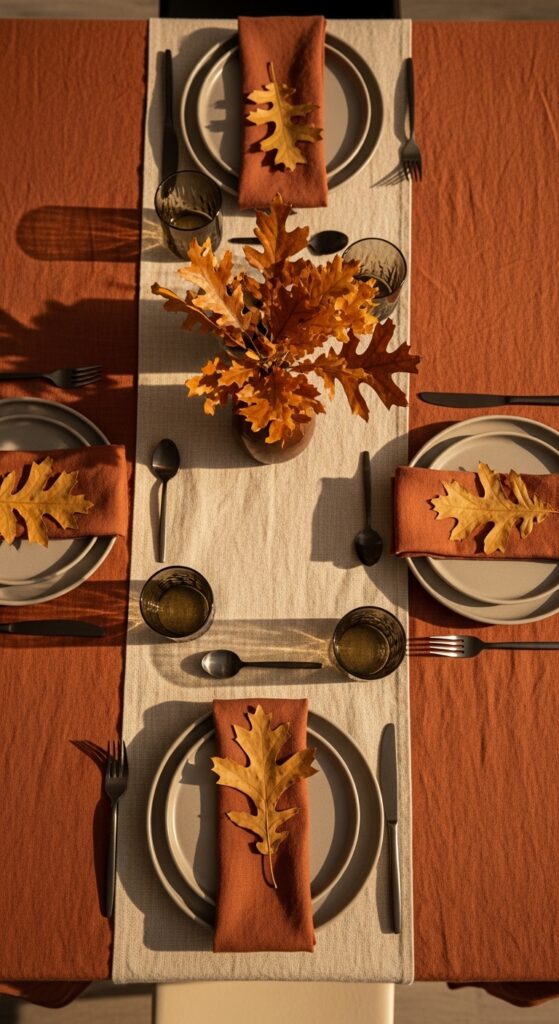
Most people treat the table runner as an afterthought — something to protect the surface rather than something that actively builds the room’s mood. For a fall table, the runner is the first decision, and layering two of them is one of the easiest ways to add immediate depth.
Start with a wide, heavier linen cloth in rust, burnt sienna, or deep terracotta as your base. Over it, run a narrower piece in natural undyed cream or warm oatmeal. The color contrast between the two layers is subtle but creates a quiet richness that a single runner never achieves.
Material matters enormously here. Both pieces should be in natural fiber — linen or cotton. Polyester table runners photograph fine but feel thin and synthetic in person, and guests notice. A well-washed linen runner with a slight rumple to it communicates warmth in a way a perfectly pressed fabric simply doesn’t.
One practical note: if you’re styling this for an actual dinner rather than just a display, make sure the runner layers don’t slide against each other mid-meal. A small piece of non-slip shelf liner underneath the bottom layer fixes this instantly.
Layered linens are the lowest-effort, highest-impact fall table investment you’ll make.
2. Pumpkin Stacking as a Sculptural Centerpiece
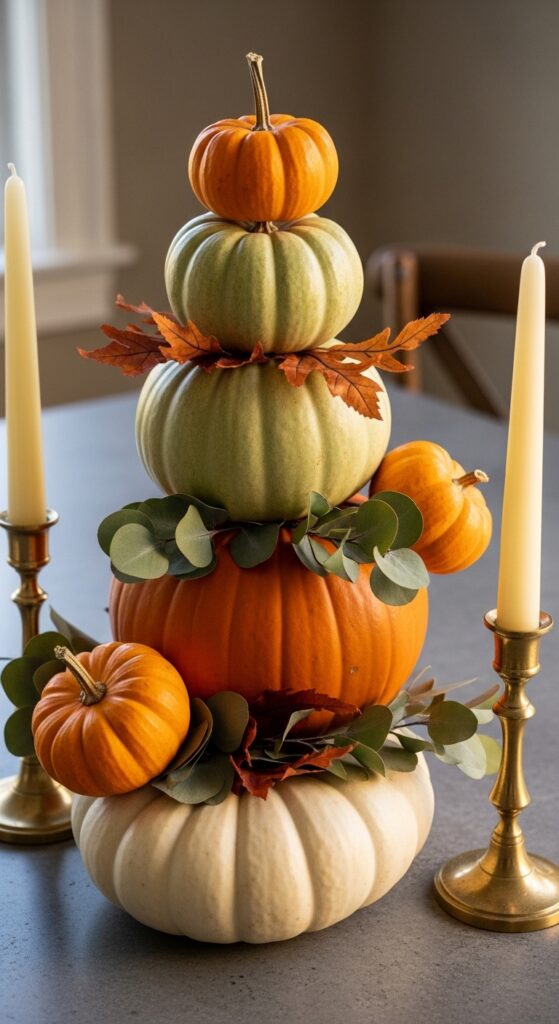
Here’s an opinion worth defending: real pumpkins beat every faux pumpkin alternative on the market. The color variation in heirloom varieties — the dusty blue-greens, the deep cinnabar oranges, the pale blush whites — is something no artificial version has managed to replicate convincingly. And when you stack and group them at different heights, they become genuinely sculptural.
The trick to making a pumpkin grouping feel designed rather than just dumped on the table is variation in three things: size, color, and variety. Mix a flat white Cinderella pumpkin at the base with a medium orange heirloom and a small sugar pumpkin on top. Add two or three tiny ornamental gourds in unexpected colors — pale yellow, forest green, deep maroon — tucked around the base.
Fill the gaps with dried botanicals: preserved oak leaves, eucalyptus stems, a handful of dried berries. This softens the hard edges of the pumpkins and makes the arrangement feel more organic.
One constraint: tall stacked arrangements can block conversation across the table. Keep the highest point of your grouping under twelve inches so guests can actually see each other.
A well-built pumpkin centerpiece lasts three to four weeks before it needs replacing — start with the ones you love most.
3. Brass and Copper Candlestick Clusters
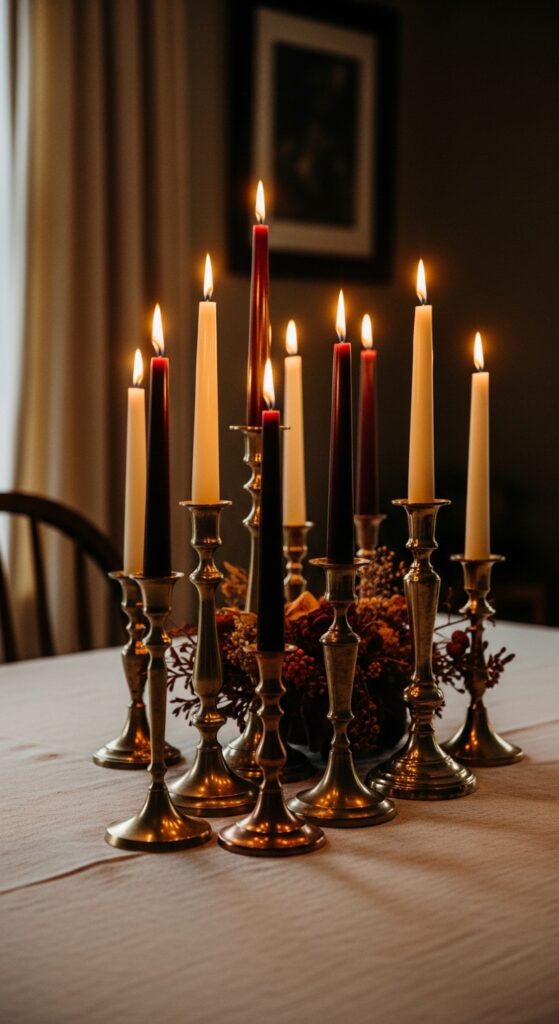
Candlelight is the single most powerful atmospheric tool in a dining room, and fall is the season to use it without restraint. A cluster of mismatched brass and copper candlestick holders in varying heights does something that a matching candleholder set never achieves — it looks assembled over time, like each piece came from a different place and ended up on the table together by happy accident.
Vary the heights deliberately. A cluster of five candlesticks works beautifully: one tall, two medium, two short. The height variation catches light at different angles and creates genuine visual movement as the candles burn.
Choose taper candles in colors that deepen the fall palette. Ivory and warm cream are always safe. Burnt orange adds a seasonal note without becoming costume-y. Deep burgundy or oxblood is my personal favorite — it reads incredibly rich against brass and aged copper finishes without screaming Halloween.
Brass with a slightly antique or unlacquered finish ages most beautifully. Shiny lacquered brass looks a little too polished for this aesthetic. If you already own lacquered pieces, steel wool applied very lightly will knock back the shine to something warmer.
One watch-out: a candle cluster as the only centerpiece can feel sparse on larger tables. Flank it with a few dried stems or a small stoneware vessel to complete the vignette.
4. A Deep Jewel-Tone Table Setting
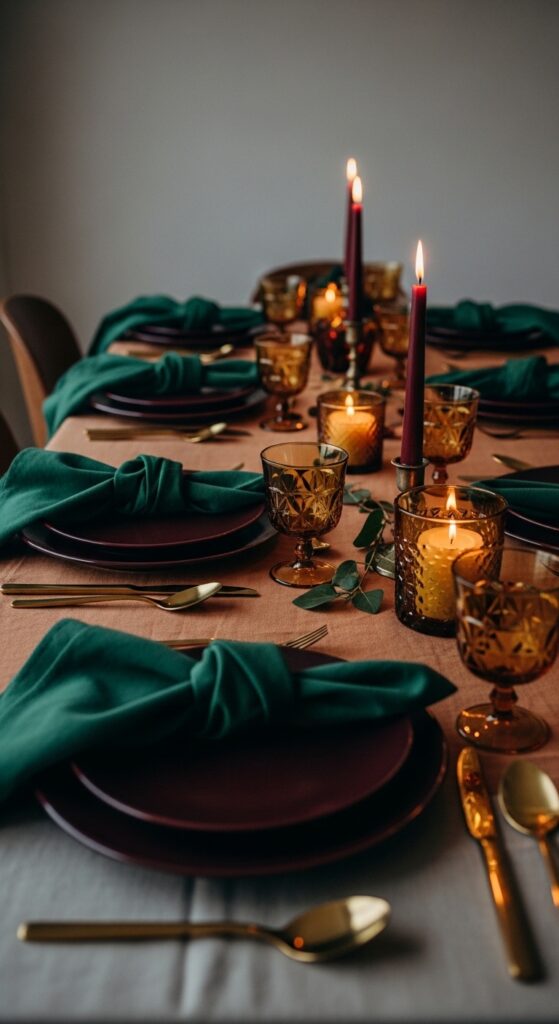
The fall color conversation in home decor always starts with orange and somehow stops there. But the season’s most sophisticated palette lives in the jewel tones — the deep forest greens, the rich burgundies, the warm ambers, the plum-adjacent purples that show up in late-autumn foliage right before the leaves drop. A table setting built around these colors is quietly stunning in a way the standard orange-and-brown approach simply isn’t.
Start with your linens: an oatmeal or warm flax linen tablecloth as the base, neutral enough to let the colored elements read clearly. Then bring in the jewel tones through ceramics, glassware, and napkins. Deep forest green napkins in cotton velvet or heavy linen are the most versatile starting point — they work for October, November, and well into December.
Amber or smoked glassware — the kind that turns a deep honey color when the candlelight hits it — adds warmth and color without requiring any extra styling. These are worth owning year-round, not just for fall.
Don’t match all your jewel tones to the same intensity. One deep burgundy element, one muted forest green, one warm amber creates richer visual layering than three elements at the same saturation level.
This palette is genuinely adult and cozy. Skip it if you feel obligated to do something that screams “fall” — this is for people who want the season without the performance.
5. Dried Wheat and Grain Bundle Centerpieces
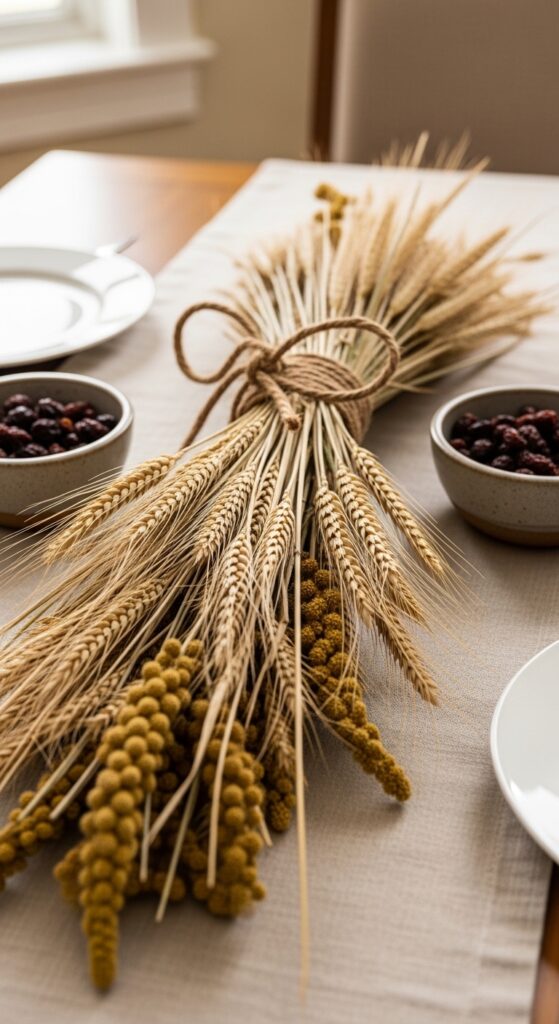
Dried wheat bundles are one of those centerpiece ideas that sound almost too simple — and then you put them on the table and realize they’re exactly right. There’s something genuinely harvest-y about dried grain that no ceramic pumpkin or faux leaf garland ever achieves. It carries actual seasonal meaning, and it costs almost nothing.
Lay a bundle horizontally across your table runner rather than standing it upright in a vase. A horizontal arrangement on a dining table creates a more casual, generous feeling — like an offering rather than a display. Tie it with rough jute twine or a simple strip of torn linen. The binding material is a detail, but it matters.
Mix wheat with other dried grains for texture variety: millet branches have a feathery quality that contrasts beautifully with the stiff structure of wheat. Dried lavender, added sparingly, brings a faint scent that’s pleasant without being overpowering at a dining table.
One thing to watch: loose dried grain sheds. Put a table runner underneath the arrangement to catch the debris, and accept that you’ll be doing a light cleanup after every meal. The payoff is worth it, but it’s not a zero-maintenance choice.
For a renter-friendly fall table that requires zero permanent changes and costs under twenty dollars, this is the answer.
6. Velvet Napkins in Autumnal Hues
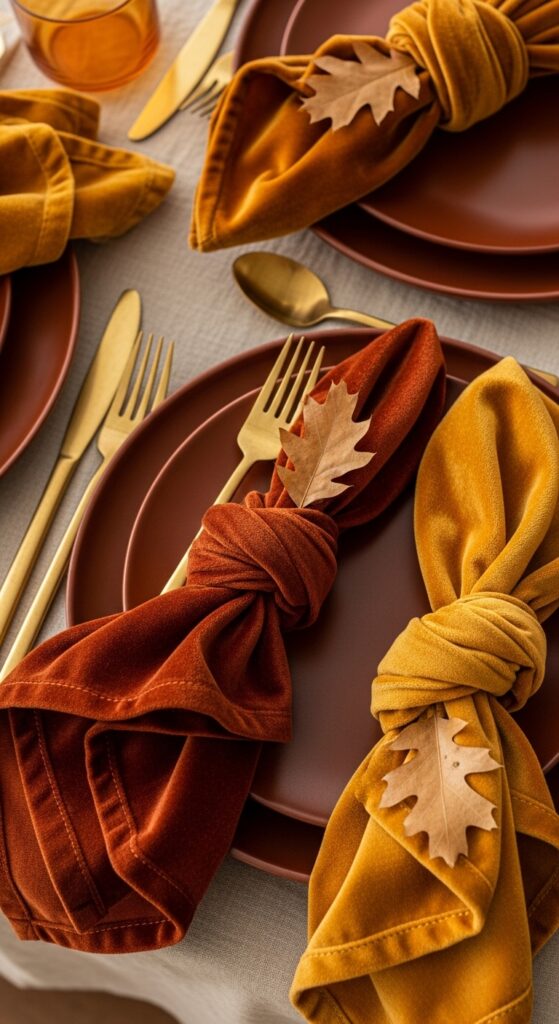
Napkins are an underrated decor element precisely because they’re so close to the guest — literally placed in their hands — and yet most tables treat them as purely functional. Cotton velvet napkins in fall tones are one of the fastest ways to make a table feel genuinely luxurious, and they’re far more affordable than the impact they deliver.
The texture of velvet at a dining table is genuinely pleasurable in a tactile way. It has a softness and a slight weight that linen doesn’t — and in fall, when you’re already trying to create warmth and coziness, tactile pleasure is part of the atmosphere.
Burnt orange, deep ochre, warm brick red, and forest green are the most useful fall velvet tones to own. Buy two colors and alternate them around the table for a setting that feels layered without being overthought.
The simplest fold — a loose rectangle or a casual roll — suits velvet better than elaborate origami shapes. The fabric has enough presence on its own; it doesn’t need to be folded into a swan.
One practical constraint: velvet napkins show every crease and food mark. They’re beautiful for dinner party setups, but if you’re using them for a long Thanksgiving meal with children at the table, have a backup plan.
Tuck a single dried leaf or a small sprig of rosemary into each fold for a detail that takes thirty seconds and genuinely impresses.
7. Mini Gourd and Taper Candle Alternating Runners
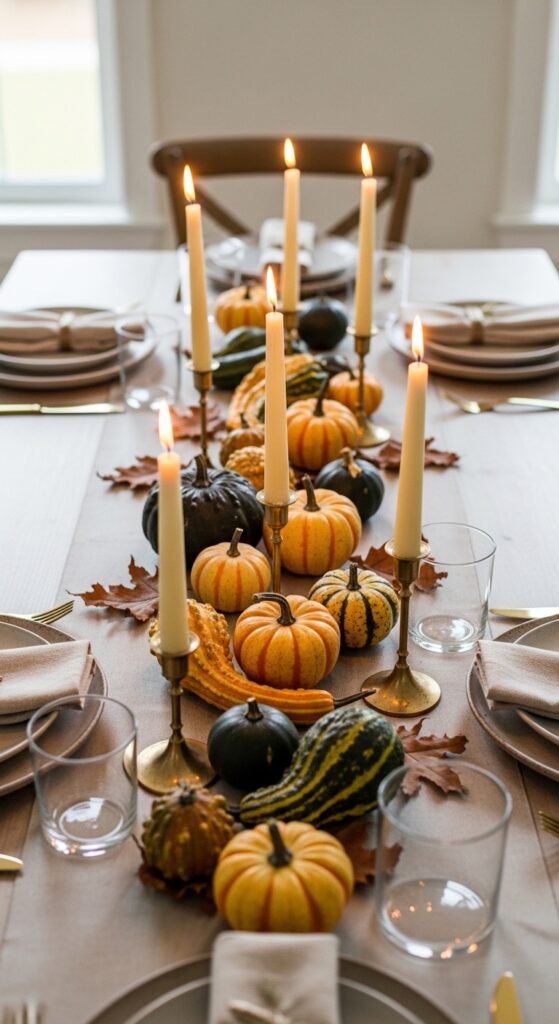
Linear arrangements down the center of a dining table are one of the great tools of tablescaping — they work with the natural length of the table rather than fighting it, and they scale to any table size without requiring you to rethink the proportions. An alternating sequence of mini gourds and taper candles is the fall-specific version of this approach, and it’s more versatile than it sounds.
The pattern is simple: one taper candle in a low holder, two or three mini gourds clustered close, one taper candle, repeat. Vary the gourd colors — white, orange, deep green, pale yellow — so the sequence has visual rhythm without becoming monotonous. Scatter dried leaves loosely in the spaces between for organic connective tissue.
Use low taper holders rather than tall candlesticks here, so the arrangement stays under twelve inches in height and doesn’t impede the conversation across the table. Simple iron ring holders are inexpensive and look beautiful against the organic shapes of the gourds.
One detail that elevates this from good to great: use taper candles in two different but related colors — ivory and warm amber, for instance — rather than all the same tone. The slight variation catches the eye in a way that’s pleasing without being distracting.
This arrangement works equally well as an everyday fall tablescape and as a dinner party centerpiece.
8. Ceramic and Stoneware Place Settings in Earthy Tones
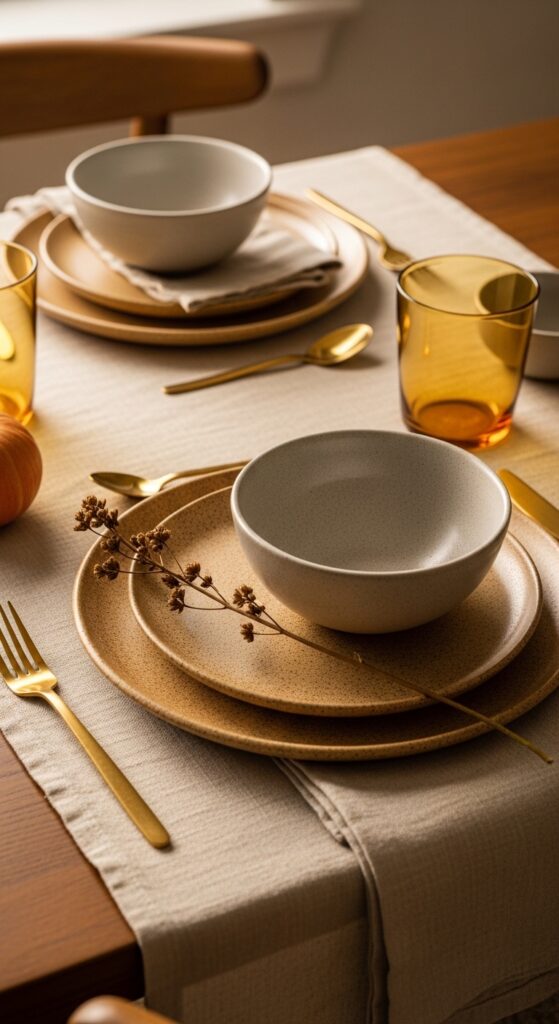
The plates and bowls you set the table with are doing decorative work whether you think of them that way or not. Mass-produced, uniformly white dinner plates are a perfectly serviceable choice eleven months of the year — but in fall, swapping to handmade or artisan-style stoneware in earthy, speckled tones transforms the entire table with no additional styling required.
The quality to look for: a matte or satin glaze finish, slight color variation from piece to piece (a natural consequence of hand-making), and earthy tones — warm clay, slate grey, deep ochre, muted forest green. These colors pull from the same autumnal palette as everything else on the table and create natural cohesion.
You don’t need a matching set. In fact, a slightly mismatched collection of stoneware pieces in the same color family — similar tones but different from piece to piece — looks more considered and interesting than eight identical plates.
Pair them with brass or matte black flatware rather than chrome. Chrome reads too modern and clean for this aesthetic; the warmer metals tie the whole setting together.
One watch-out: genuinely handmade stoneware is rarely dishwasher-safe at high heat. Check before you run the first load.
Good ceramics are worth owning year-round, but they earn their keep most in fall.
9. A Fall Foliage Wreath Laid Flat as a Centerpiece
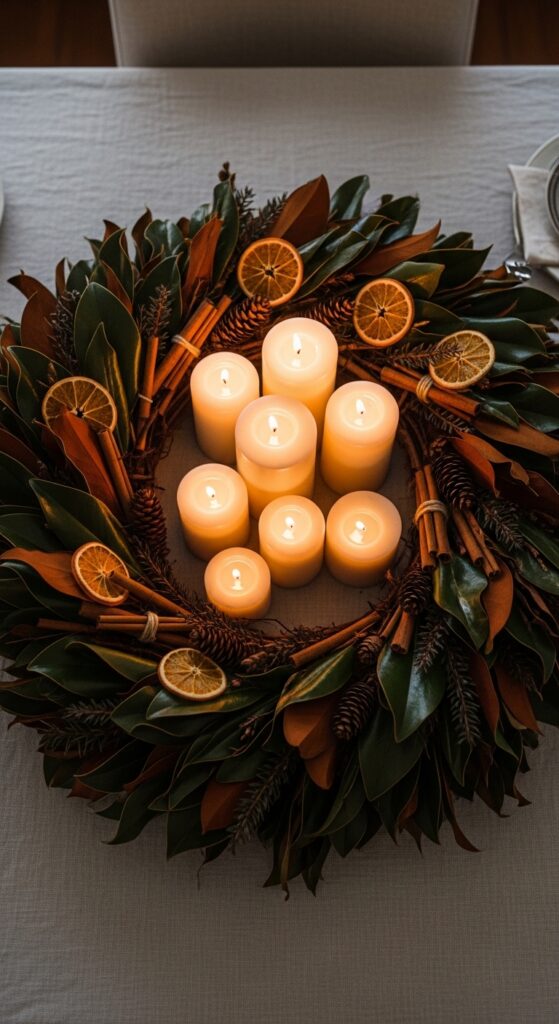
This is one of those ideas that sounds unconventional until you try it, and then you wonder why you ever put a wreath anywhere else. Laying a foliage wreath flat on the dining table as a centerpiece — with candles or a small vase arrangement in the opening — is an unexpected move that creates an incredible amount of warmth and seasonal presence.
Choose a wreath with real botanical substance: preserved magnolia leaves in their warm brown-green tones, dried orange slices (which smell faintly wonderful and last for months), small pine cones, cinnamon sticks bundled together. The more layered the materials, the more interesting it looks from above, where your guests will often glance at it.
Place three or four pillar candles of varying heights in the center opening, or a single low arrangement of dried stems in a short ceramic vase. The candle option creates the more dramatic effect at dinner.
One practical constraint: a flat wreath is a large footprint. Measure your table first — you need at least eighteen inches of clear space on each side of the wreath for actual place settings. On tables shorter than six feet, this can get tight.
This approach also doubles as a wall wreath before the dinner — hang it through October and lay it flat when you need the full table effect.
10. Warm Amber and Smoked Glass Tablescape
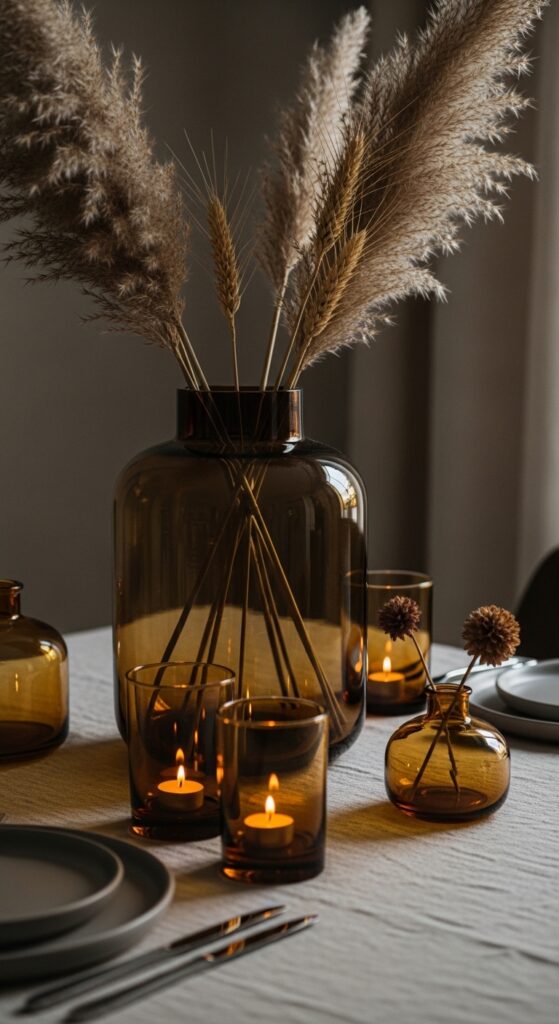
There’s a version of fall table decorating that doesn’t use a single pumpkin, leaf, or gourd — and it’s arguably the most sophisticated interpretation of the season. Amber and smoked glass, used as the primary material across vessels, glassware, and accents, captures the light quality of autumn without any of the literal seasonal iconography.
Amber glass at a candlelit table does something almost magical: it filters and deepens the warmth of the light in a way that makes everything glow. A collection of amber vessels in varying sizes — a large vase, a few small bud vases, the drinking glasses themselves — creates a cohesive, rich tablescape without requiring any additional styling.
Smoked glass adds depth and a slightly moody quality that amber alone doesn’t have. The combination of the two, in an otherwise neutral table setting, is one of those quietly impressive choices that people notice without being able to name exactly why.
Fill the larger amber vessel with dried pampas grass, dried wheat, or preserved autumn branches. The dried material photographed through amber glass has a particular warmth that fresh flowers in the same vessel would never achieve.
Skip this if you prefer a more literal seasonal look. This one is for people who want autumn’s feeling without its costume.
11. A Charcuterie-Style Harvest Table Spread
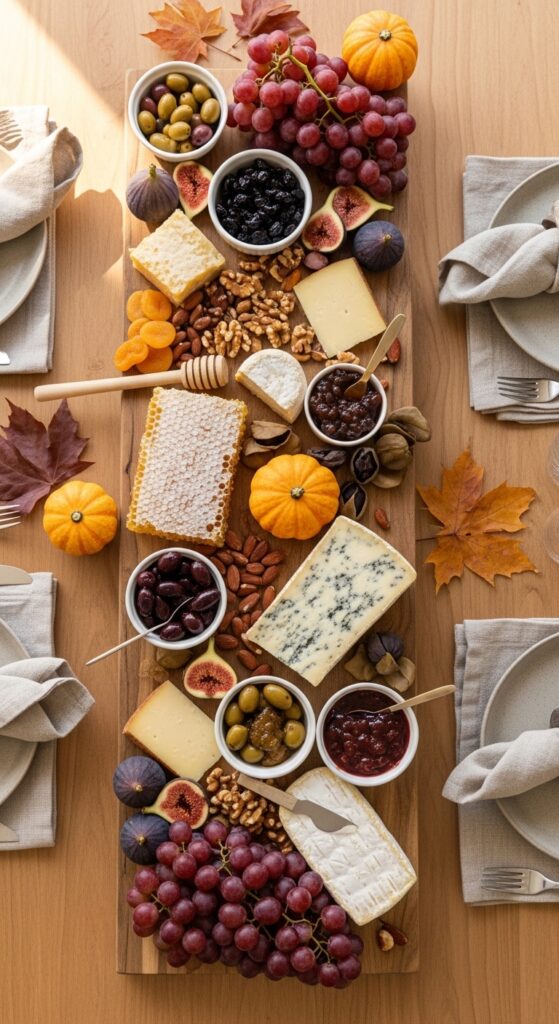
Decor and food are not separate categories at a fall dining table — the most beautiful fall table setups I’ve seen use the actual food as part of the visual arrangement. A harvest-style spread down the center of the table, built like an extended charcuterie board, is both the centerpiece and the meal, and it creates an atmosphere of abundance that no amount of decorative pumpkins can replicate.
The key to making this feel designed rather than chaotic is the use of a long wooden board or a series of smaller boards as the organizing spine. Everything sits on or around the boards, which gives the spread structure and prevents it from looking like the table just ran out of counter space.
Layer in seasonal elements: clusters of deep red or black grapes, fresh figs halved to show their interior color, dried apricots, walnuts and chestnuts in their shells, a honeycomb piece, a wedge of aged gouda or manchego. Tuck small decorative gourds and a few preserved autumn leaves between the food elements to bridge the gap between edible and decorative.
One constraint: this style requires committing to the table as a serving surface for the meal. It doesn’t work as a display-only centerpiece — guests need to actually eat from it, which is the whole point and also requires comfortable access from all sides.
Build the spread thirty minutes before guests arrive, not hours ahead, so the food stays at its best.
12. Candlelit Lanterns and Moody Ambient Lighting
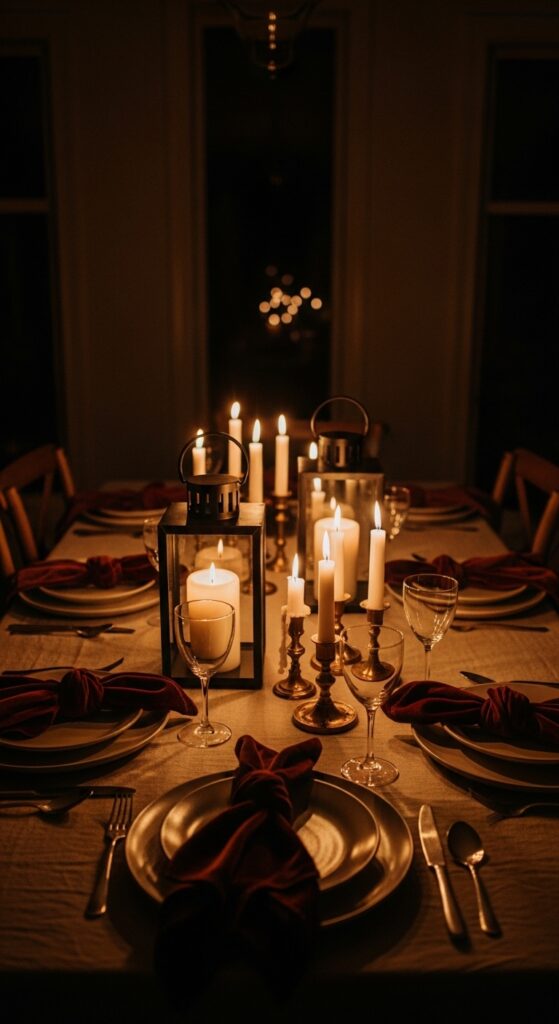
Everything else on this list is about objects on the table. This last idea is about light itself — specifically about what happens to a fall dining room when you eliminate overhead lighting entirely and rely only on candles. The answer is: the room becomes something else altogether.
Iron lanterns with pillar candles are the most practical approach to achieving this. Unlike taper candles, which require holders and create some anxiety about dripping, lanterns contain the flame, protect it from drafts, and look intentional rather than improvised. A cluster of three lanterns in varying heights at one end or the center of the table creates generous ambient light without requiring dozens of individual candles.
Combine the lanterns with a few taper candles in brass holders for visual variety — the different flame heights and points of light create movement and warmth that a single light source doesn’t.
The key to making candle-only dining work practically: use long-burn pillar candles rather than the standard short varieties. You want five to six hours of burn time minimum for a dinner that might stretch into the evening. Test the candles before the night itself so you know the burn rate.
One honest constraint: some guests are uncomfortable with candle-only lighting, particularly older guests or those with vision sensitivities. Have a simple table lamp nearby that you can switch on if needed, so the mood is never achieved at anyone’s discomfort.
Candlelight is fall’s best styling tool. Use it generously and intentionally.
The Warmest Room in the House
A fall dining table that’s done well does something beyond looking beautiful — it changes the pace of the room. People slow down. They notice the light. They pick up a dried leaf from the arrangement and turn it over in their hands. That’s what good seasonal decor achieves at its best: it makes the atmosphere physical.
The ideas in this guide work because they’re grounded in real materials, honest textures, and a genuine understanding of what makes fall feel like fall — the warmth, the harvest abundance, the slight moodiness of shorter days, the impulse to gather. None of them require significant investment or a complete table overhaul. Most can be assembled in an afternoon.
Take one idea and commit to it fully before layering in a second. A table with one beautifully executed centerpiece and well-chosen linens will always outperform a table that tried to do all twelve things at once. Start there, and let the season do the rest.