Vintage dining room design is not about recreating the past — it’s about honoring the best of it. There’s a meaningful difference between a room that looks like a costume and a room that feels genuinely collected, layered, and lived in across time. The first is achieved by buying everything from a single “vintage-style” collection at a furniture chain. The second happens when someone makes thoughtful, patient choices about patina, proportion, and the particular beauty of things that have been used and loved before they arrived in your home.
The appeal of vintage in a dining room specifically is that it suits the function so well. Dining is about gathering, about the pleasures of a table set with care, about objects that have their own history joining the histories being made around them. A perfectly matching modern dining set has its place, but a vintage-influenced room has something the new room rarely achieves: the feeling that the space itself has witnessed many good dinners before yours. These twelve ideas will help you build that feeling.
1. A Dark Wood Dining Table With Turned Legs
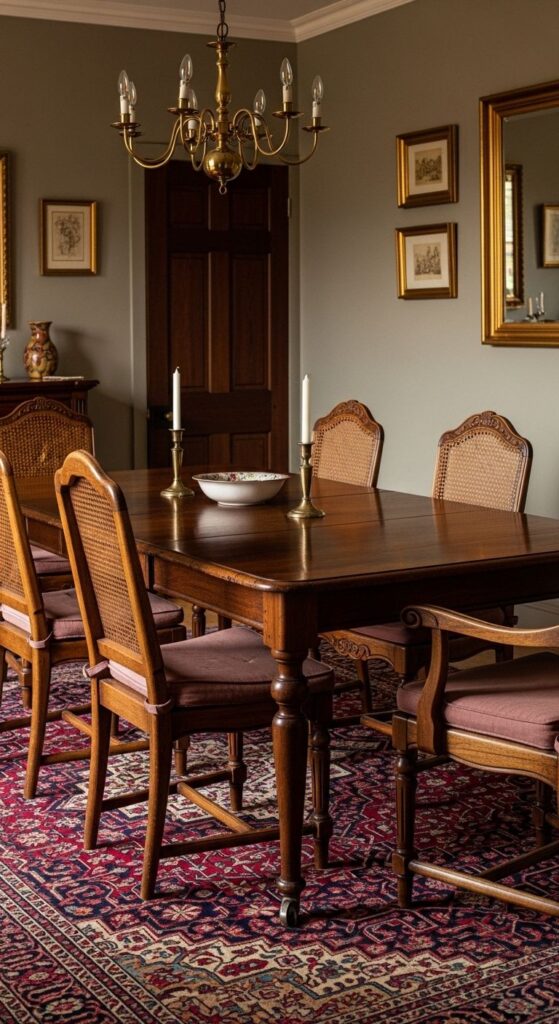
Turned legs on a dining table are one of those details that immediately signals a different design sensibility than the clean-line furniture of contemporary interiors — and in a vintage dining room, they’re essentially the most important furniture decision you’ll make.
A dark walnut or mahogany table with turned or tapered legs in the Queen Anne, William and Mary, or simple Victorian tradition anchors a vintage dining room with genuine authenticity. The leg profile is the historical fingerprint; get it right and the table reads as a real piece from a real era even if it was made last year.
For finish, look for a satin rather than high-gloss lacquer — the visual depth of a satin finish reads as older and more genuine, and it shows the wood grain without the plasticky reflectiveness of a full gloss. If you’re refinishing an existing table, use a penetrating oil stain followed by a hand-rubbed wax for the most authentically aged result.
Edge profile matters too: a slightly rounded or bullnose edge has more period character than a sharp modern square edge. Many vintage tables have this naturally through decades of use; if you’re commissioning or buying new, specify it.
One watch-out: very dark wood tables in small rooms with limited natural light can make the space feel oppressive. Balance with lighter wall tones, pale upholstery on chairs, and maximum reflective surfaces — mirrors, crystal, polished silver — to keep the room luminous.
2. Mismatched Antique Chairs in a Unified Palette
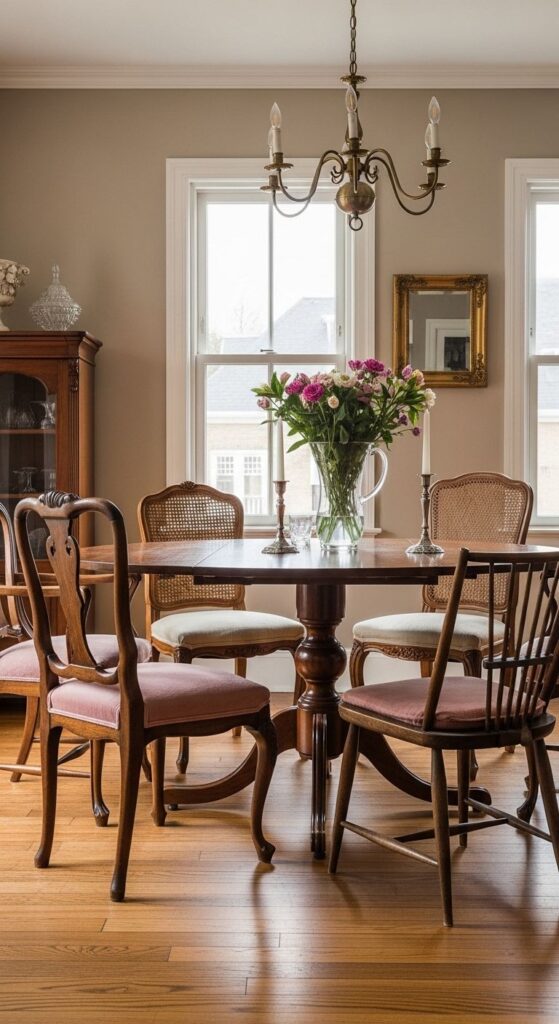
Matching dining chairs are a modern convention. For most of furniture history, chairs around a dining table were collected over time — inherited from different relatives, purchased at different markets, acquired across different decades. The mismatched dining chair arrangement isn’t an aesthetic trend; it’s a historical norm. And in a vintage dining room, it’s the approach most likely to produce a result that feels genuinely authentic.
The secret to making it work is the same principle that holds any eclectic arrangement together: find one element to share across all the pieces. Upholstery is the most practical unifier — the same linen or velvet in the same tone on every seat cushion creates visual cohesion regardless of how different the chair frames are. Alternatively, paint all the frames in a single color while keeping their profiles varied.
When sourcing chairs, look for pieces in the same broad historical period — mixing a baroque carved chair with a mid-century modern shell chair will create confusion rather than depth. Victorian, Edwardian, and early American country chairs from the same 50-year window all share a design sensibility that makes them read as a family.
Flea markets, estate sales, and architectural salvage dealers are the right hunting grounds. Patience matters: the best mismatched sets happen over months, not in an afternoon.
One constraint: mismatched chairs with different seat heights can make a table feel imbalanced. When sourcing, bring a tape measure and aim for all seat heights to land within one inch of each other — typically 17 to 18 inches from the floor.
3. Vintage Botanical and Toile Wallpaper
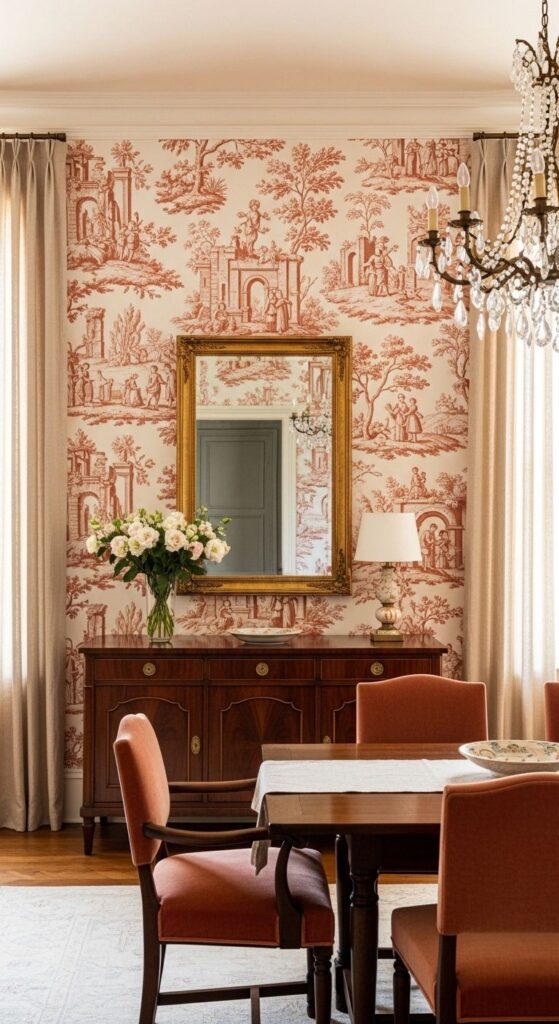
Pattern is where vintage dining rooms earn their depth, and no pattern has a longer or more distinguished history in the dining room than toile de jouy. Developed in 18th-century France and named for the town of Jouy-en-Josas where it was first produced, toile’s characteristic narrative scenes — pastoral landscapes, classical figures, architectural vignettes — in a single color on cream or white carry centuries of dining room credibility that no contemporary print can rival.
The scale of the repeat matters enormously in a dining room. A small-scale toile with tiny figures repeated at a four-inch interval reads as a texture from room distance rather than a pattern. Look for large-scale prints where individual scene elements are at least 12 to 18 inches in height — these read clearly as images rather than visual noise.
For color, the most authentic vintage colorways are classic for a reason: blue and white is the most historically common, terracotta and cream has a Mediterranean warmth, and deep burgundy on cream reads as the most formally traditional. Avoid neon or synthetic recolorings of historical toile patterns — they undermine the period quality instantly.
Botanical wallpaper — large hand-painted or printed botanical illustrations in the tradition of 18th and 19th century natural history publications — is another vintage dining room pattern with genuine period character. Look for papers with a slightly aged quality: a cream rather than white ground, slightly muted colors, some visible brushwork.
One constraint: toile and large botanical patterns are assertive enough to require calm furniture and minimal additional pattern. If the wallpaper is doing the work, the upholstery, rug, and curtains should be solid or very subtly textured.
4. Brass and Crystal Chandelier for Period Lighting
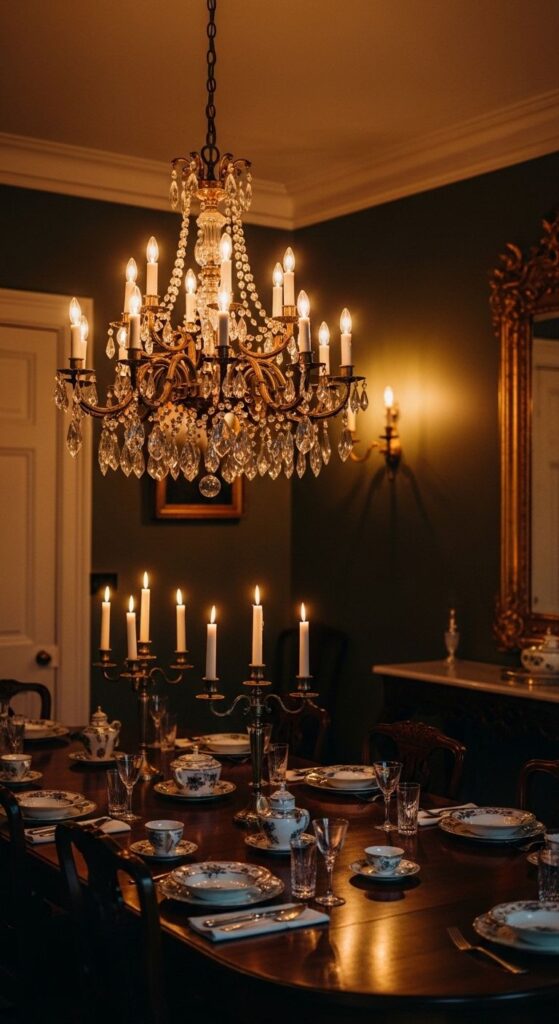
Lighting is where vintage dining rooms can go subtly wrong even when everything else is right. A contemporary fixture — a minimalist pendant, a geometric cluster of globe lights, anything with visible Edison filament marketed as “industrial” — will undermine a carefully assembled vintage room in a way that’s immediately felt but hard to articulate. The chandelier has to speak the same historical language as the rest of the room.
Brass and crystal is the canonical vintage dining room combination because it spans several centuries of design tradition. Georgian, Victorian, Edwardian, and early 20th-century dining rooms all had some version of this formula — the specific profile changed across eras, but the material language of warm metal and reflective crystal remained constant.
For authenticity, look for chandeliers with candle-style arms rather than exposed Edison bulbs. Candle arms with small chandelier bulbs in a soft white are the period-appropriate choice; exposed bulbs read as a contemporary retrofit of a historical form and don’t have the same quality of light.
The dimmer is non-negotiable in a vintage dining room. Chandelier and crystal at dinner should always be at 30 to 50 percent brightness — the aim is the quality of candlelight, not the flat brightness of a well-lit ceiling.
One watch-out: very ornate chandeliers with maximum crystal drops can read as pastiche in a room that isn’t equally formal in every other respect. Match the chandelier’s level of ornamentation to the room’s overall formality — a slightly simpler brass fixture in a more casual vintage room is better than an overly grand one that sits without context.
5. Antique Sage or Dusty Heritage Wall Colors
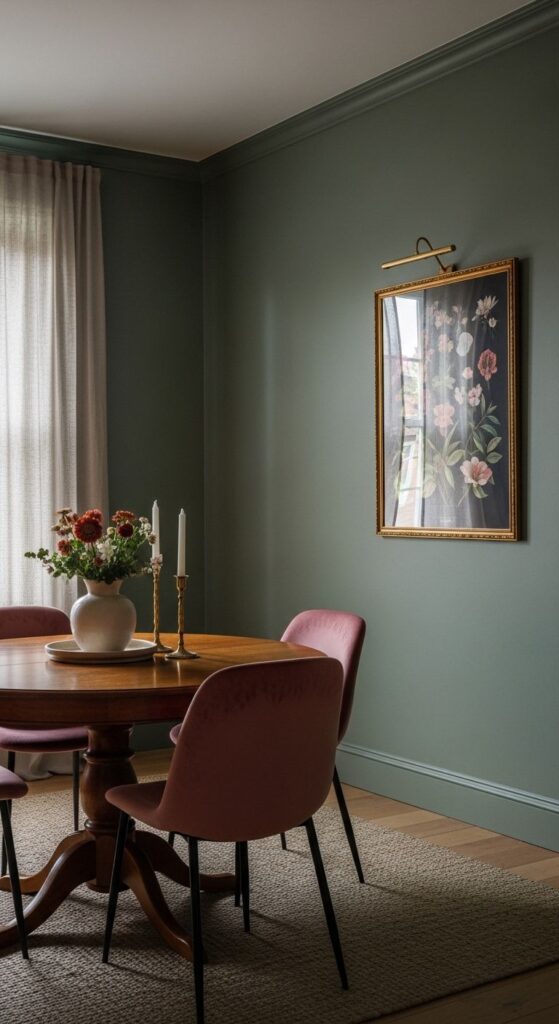
Color is one of the most powerful tools for establishing a vintage atmosphere — and the specific tones that read as authentically historical are more nuanced than a generic “dusty” or “muted” palette description suggests.
Antique sage green — the color of aged Italian fresco plaster, slightly grey, slightly yellow, without any of the blue-green brightness of contemporary sage — is one of the most reliably beautiful vintage dining room colors. It’s warm enough to work under both natural and artificial light, dark enough to add atmosphere without blackening the room, and historically plausible across a wide range of period references from Georgian England to Provençal France.
Other heritage colors that consistently deliver vintage authenticity in dining rooms: dusty terracotta with a grayed quality (not the bright orange of contemporary terracotta), deep burgundy with a slightly brown undertone (oxblood rather than red), aged parchment (the color of an old book page, not a clean cream), and faded Prussian blue (deep but dulled, nothing bright or electric about it).
The finish is as important as the color: matte or flat paint only. A heritage color in an eggshell or satin finish will read as a contemporary interpretation of a vintage palette. Matte paint absorbs light and creates the kind of soft, dimensional wall surface that actually evokes period plaster and pigment-based historic paints.
One practical note: very deep heritage colors can be difficult to match exactly if touch-ups are needed later. Always keep a labeled quart of the exact paint mix used for repairs.
6. A Marble-Topped Antique Sideboard and Styling Vignette
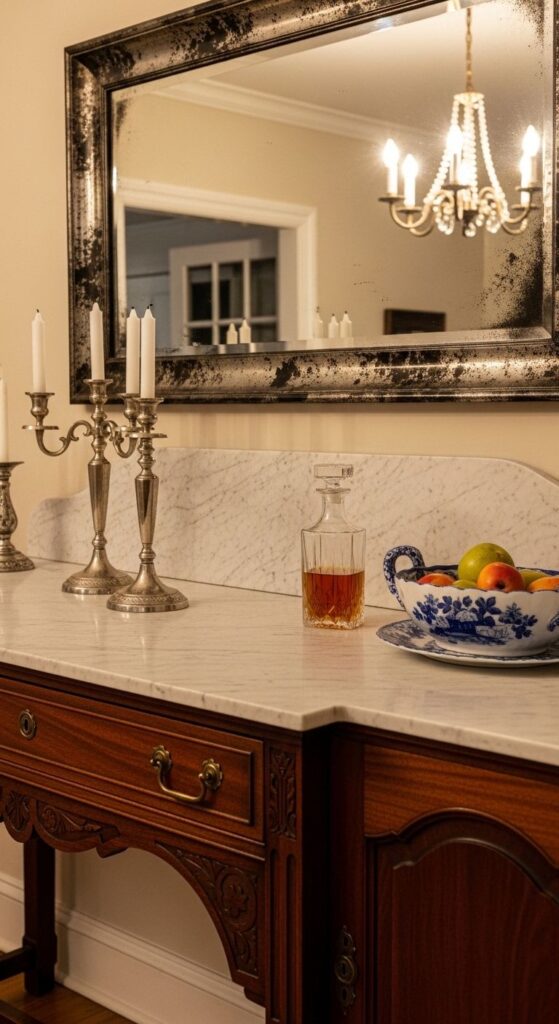
A marble-topped sideboard in a vintage dining room is the piece that quietly elevates everything around it. The marble isn’t new marble — or if it is, it should look as though it isn’t. Slightly yellowed at the edges, with visible veining and perhaps the ghost of a ring stain from decades of decanters: this is marble that has been used for its intended purpose and carries the evidence of it.
If you’re hunting for a genuine antique sideboard, Victorian and Edwardian pieces with marble tops appear regularly at estate sales, auction houses, and antique markets — often at prices well below their contemporary reproduction equivalents because the weight makes them inconvenient to ship. Be prepared to arrange your own transport.
The vignette on the marble surface is as important as the piece itself. A vintage sideboard styled with minimal contemporary objects loses its period character. Lean into the historical still life: a pair of silver or silver-plate candelabras, a crystal decanter, a piece of antique ceramics, a small framed oil study, or a botanical specimen in a glass dome.
Height variation in the vignette is the practical styling principle: one tall object (candelabra or lamp), one medium (decanter or vase), one low (bowl, small framed piece). The arrangement should look as though it evolved over time rather than being placed in an afternoon.
One constraint: genuine antique marble tops can be damaged by acidic foods and drinks. Use trays and coasters diligently, and avoid placing citrus, wine glasses without protection, or anything with a high acid content directly on the surface.
7. Vintage China and Silverware as Decorative Display
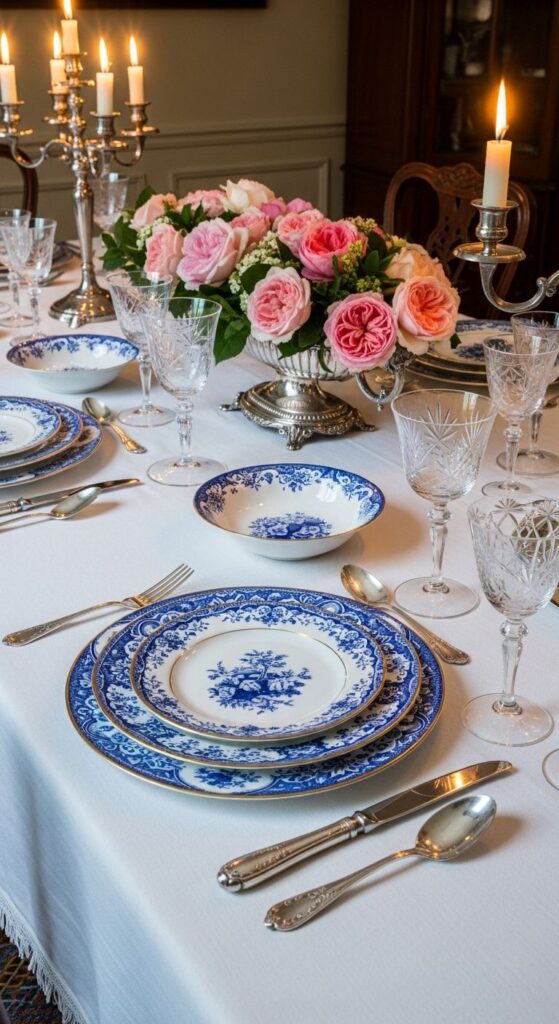
The table setting in a vintage dining room is where the philosophy of the whole room is most completely expressed — and where the difference between a room that feels genuinely collected and one that feels themed becomes most apparent. A vintage table setting embraces purposeful mismatch: different china patterns in a shared color family, varied silver patterns in the same metal tone, crystal glasses that don’t perfectly match but all belong to the same era of glassware.
This is historically accurate, not improvised. Until the 20th-century convention of matching sets became the domestic standard, most well-appointed dining tables were set with pieces accumulated across decades of gifting, inheritance, and selective acquisition. The result was richer and more interesting than a uniform set precisely because every piece had its own provenance.
For china patterns, the layering rule: they can differ in motif as long as they share at least one color. Blue and white transfer-ware dinner plates beneath a white-and-gold rim soup bowl creates a layered place setting that reads as eclectic and intentional rather than random.
Silver (or silver plate) for cutlery should be a single metal tone — all silver, not silver mixed with stainless — but the pattern can vary. Victorian bead-edge forks beside Georgian fiddle-pattern knives are perfectly compatible at a vintage table.
One watch-out: antique silver requires polishing before use. Factor in the maintenance time when planning a dinner party — nothing undermines a beautiful vintage table setting like tarnished cutlery.
8. Faded Persian or Oriental Rugs as the Room’s Foundation
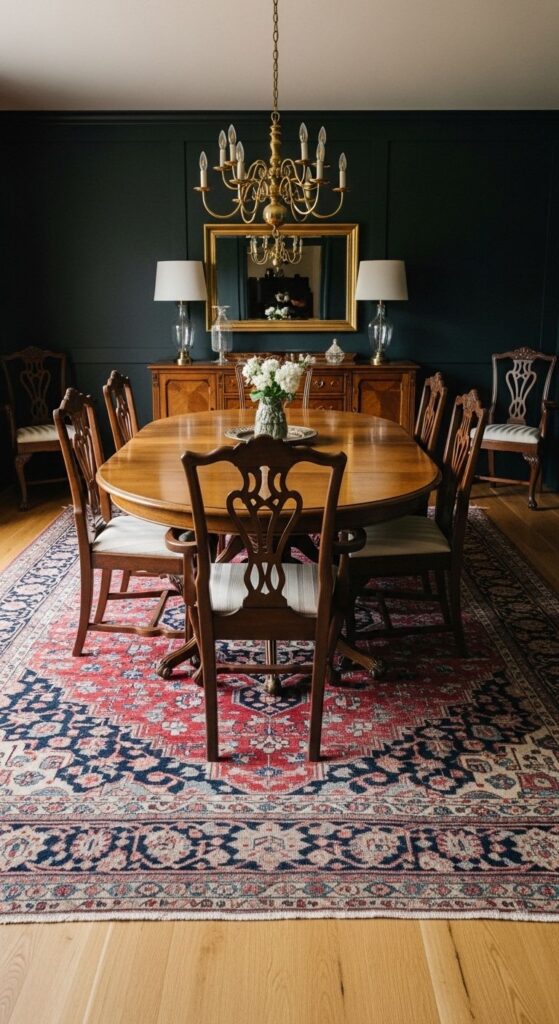
A faded Persian rug in a vintage dining room is one of those elements that does more work than its apparent simplicity suggests. The fading — the softening of what were once vivid ruby and cobalt tones into a more complex, aged palette of rose and dusty blue — is not a flaw. It’s the most desirable quality of an antique Oriental rug, and the reason genuine antique rugs command significant premiums over their new equivalents.
In a vintage dining room specifically, the faded rug provides a visual foundation that connects every historical element above it — the dark wood table, the period chairs, the gilt frames on the walls — without competing with any of them. The complexity of a traditional rug pattern, subdued by age, adds tremendous depth to the floor without introducing any visual aggression.
For sourcing, genuine antique Persian rugs are available through specialist rug dealers, auction houses, and increasingly through estate sales and online marketplaces at widely varying prices. The quality range is enormous — bring someone knowledgeable, or buy from a reputable dealer with a return policy.
If the genuine article is outside the budget, there are exceptionally good reproduction rugs that convincingly mimic the washed, faded quality of antique Orientals. Look for flat-woven or hand-knotted wool versions rather than machine-made synthetic pile, which never achieves the same visual quality regardless of pattern.
One constraint: genuine antique wool rugs under dining tables will show wear in the traffic paths around the table over time. This is not a dealbreaker — it’s the continuation of the rug’s aging story — but it’s worth knowing before placing an irreplaceable heirloom piece in a high-use location.
9. Gilt-Framed Mirrors and Oil Paintings in a Salon Arrangement
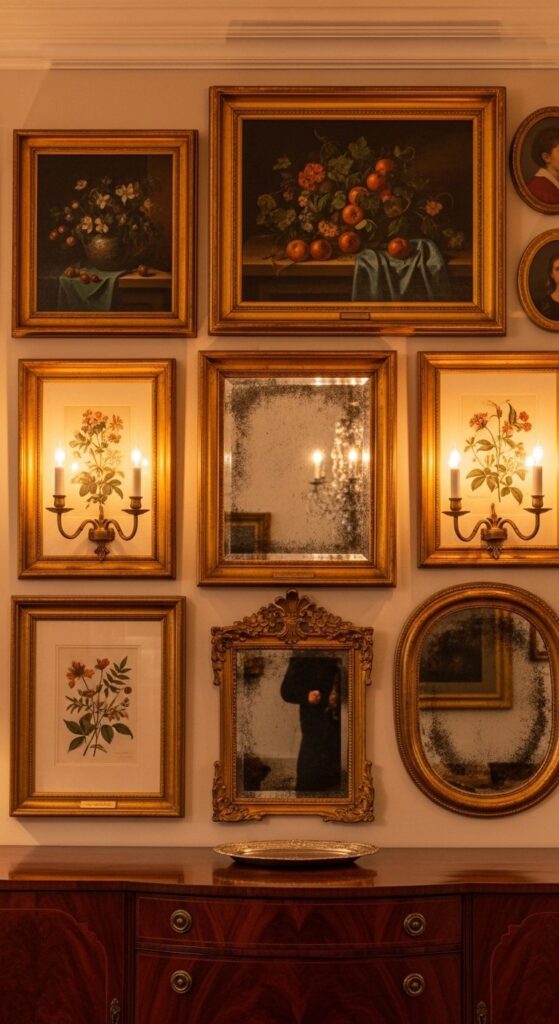
The salon-style wall arrangement — a densely hung collection of frames covering most of a wall’s surface from low to high — is the most historically authentic approach to art display in a vintage dining room, borrowed directly from 19th-century European interior tradition where walls were treated as display surfaces for everything accumulated and valued.
The density is the point. In contemporary gallery hanging, breathing room between frames is essential. In a Victorian salon arrangement, frames cluster together, edges nearly touching, creating a tapestry of images that the eye moves through rather than settling on any single piece. This is a different kind of looking, and it suits a dining room — a space where guests have time to explore a wall across the length of a meal.
For frame consistency in a salon arrangement, a single family of gilt finishes — antique gold, tarnished brass, and aged bronze all belong together — creates enough unity to hold a disparate collection of images together. Introducing a different frame material (matte black, natural wood) breaks the spell.
Include mirrors in the salon arrangement, not just art. A foxed convex mirror or two interspersed among paintings adds reflective depth and light to the wall, prevents it from reading as flat, and has strong historical precedent in period dining room design.
One constraint: a full salon wall requires a significant collection of frames to execute properly. Start with what you have, adding pieces over time, and avoid filling gaps with cheap prints just to complete the wall quickly. A wall still in progress is more interesting than a wall artificially rushed to completion.
10. Velvet Dining Chair Upholstery in Historical Colorways
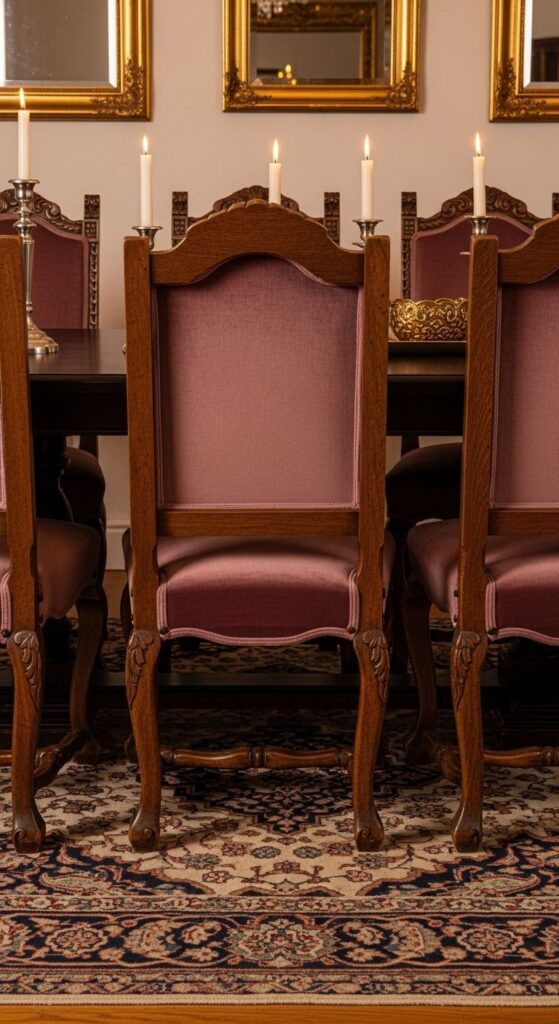
Velvet in vintage dining rooms belongs to a specific tonal register that’s quite different from the saturated jewel tones popular in contemporary interior design. Historical velvet — the kind that survives in period rooms, old country houses, and properly aged antique chairs — has lost some of its original brightness. It’s not quite faded, but it’s softer and more complex than the same color would be new.
This quality is what you’re aiming for when selecting velvet for vintage dining chair upholstery: dusty burgundy rather than cherry red, faded gold rather than bright ochre, muted sage rather than fresh green, aged rose rather than coral pink. The key adjective in every case is some version of “softened” — a color that looks as though it has been through several decades of afternoon light and human use.
For genuinely vintage chairs with original upholstery showing wear, the decision of whether to reupholster is worth considering carefully. Some original fabric, even in worn condition, has a quality and a color that a new reproduction cannot replicate. If the existing velvet is only worn at the seat center and the frame is sound, it may be worth living with the patina.
When reupholstering antique chair frames, use a cut pile velvet (not velboa or synthetic velvet) in a natural or natural-blend fiber. The way real velvet catches light — shifting from dark to bright as the viewing angle changes — is part of what makes it look historical and appropriate in a vintage context.
One practical note: velvet pile direction matters. When multiple chairs are upholstered in the same fabric, ensure the pile runs in the same direction on every seat, otherwise the chairs will reflect light differently and read as mismatched even when they’re identical.
11. Vintage-Style Table Lamps on the Dining Sideboard
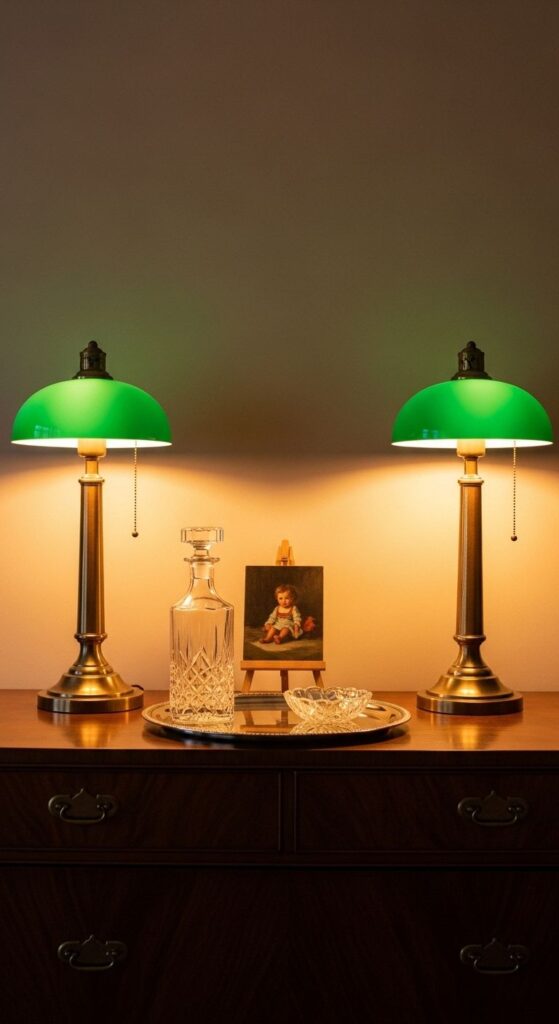
Table lamps on the dining room sideboard are a detail that contemporary dining room design almost entirely ignores — and vintage rooms use to transformative effect. A pair of properly chosen sideboard lamps fundamentally changes the atmosphere of the room at dinner, adding two warm light sources at a low, intimate height that no pendant or chandelier can replicate.
The lamp profile for a vintage dining sideboard: tall and slender, with a base in aged brass, ceramic with a hand-painted or aged quality, or dark-toned glass. A column brass base with a subtle hammered or aged surface reads most authentically in a vintage context. Avoid anything too clean, too geometric, or too contemporary in silhouette — the base should look as though it might have been in the room for decades.
Shade selection is where the lamp earns its vintage character. A dark green glass shade in the library lamp tradition, a pleated silk shade in ivory or champagne, or a classic drum shade in a period-appropriate fabric all work beautifully. Avoid linen drum shades with visible machine stitching — they read as contemporary regardless of the base they sit on.
Use warm bulbs at a wattage that provides gentle ambient light rather than task light. Sideboard lamps in a dining room are atmosphere, not illumination.
One constraint: table lamps on a sideboard require accessible electrical outlets at the right location on that wall. If your sideboard is positioned away from outlets, consider a period-appropriate cord cover or discreet cord management rather than leaving cables exposed across the floor.
12. Antique Botanical Prints and Natural History Illustrations

Botanical prints have decorated dining rooms since the 18th century, when natural history illustration was both a scientific endeavor and a domestic art form — and in a vintage dining room, they remain one of the most reliably beautiful and thematically appropriate wall treatments available. They connect to the room’s function (food, nature, the pleasures of the grown world), they age beautifully in reproduction, and they work in almost every vintage color palette.
The quality of a botanical print — whether original antique or reproduction — is readable at room distance in a few specific ways. Period-accurate illustration style (the slightly formal, precisely rendered quality of 18th and 19th-century natural history plates), a cream or slightly yellowed ground rather than bright white paper, visible plate marks or printing texture, and handwritten or hand-set Latin annotations below each specimen: these details signal period authenticity whether the piece is genuinely old or a well-made reproduction.
For arrangement, botanical prints have enough visual weight to carry a salon-style grouping on their own — six to eight prints in related gilt frames, covering a significant portion of a dining room wall, read as a coherent collection rather than a mixed gallery.
Alternatively, a single large botanical print — a hand-painted specimen in a generous format — used as the room’s sole wall art above the sideboard has a quiet authority that smaller prints in a group can’t achieve.
One watch-out: genuine antique botanical prints (from 18th and 19th-century books) can be purchased from specialist dealers and auction houses, but they vary enormously in quality of paper, hand-coloring, and condition. Buying reproductions from reputable art print publishers who specialize in historical illustration is often a better investment than purchasing damaged originals.
On the Art of Collecting Rather Than Decorating
If this article has a single underlying argument, it’s this: vintage dining rooms are made rather than bought. The rooms in this category that genuinely move people — that make guests feel they’ve entered a space with real history and real personality — are the result of patient accumulation, of decisions made over months and years rather than in a single shopping afternoon.
That’s actually a liberating way to approach a dining room. You don’t have to get it right all at once. Start with the table. Find two chairs you love and add more as you encounter them. Hang one botanical print and let the wall grow around it. Buy a Persian rug when you find the right one rather than settling for a replacement.
The vintage dining room rewards patience above almost every other quality. Each piece added through genuine discovery — through an estate sale, an antique fair, an inherited object finally brought out of storage — carries more energy than anything selected from a catalogue. That accumulated energy is what makes these rooms feel like they were lived in before you arrived, and will be long after you leave.