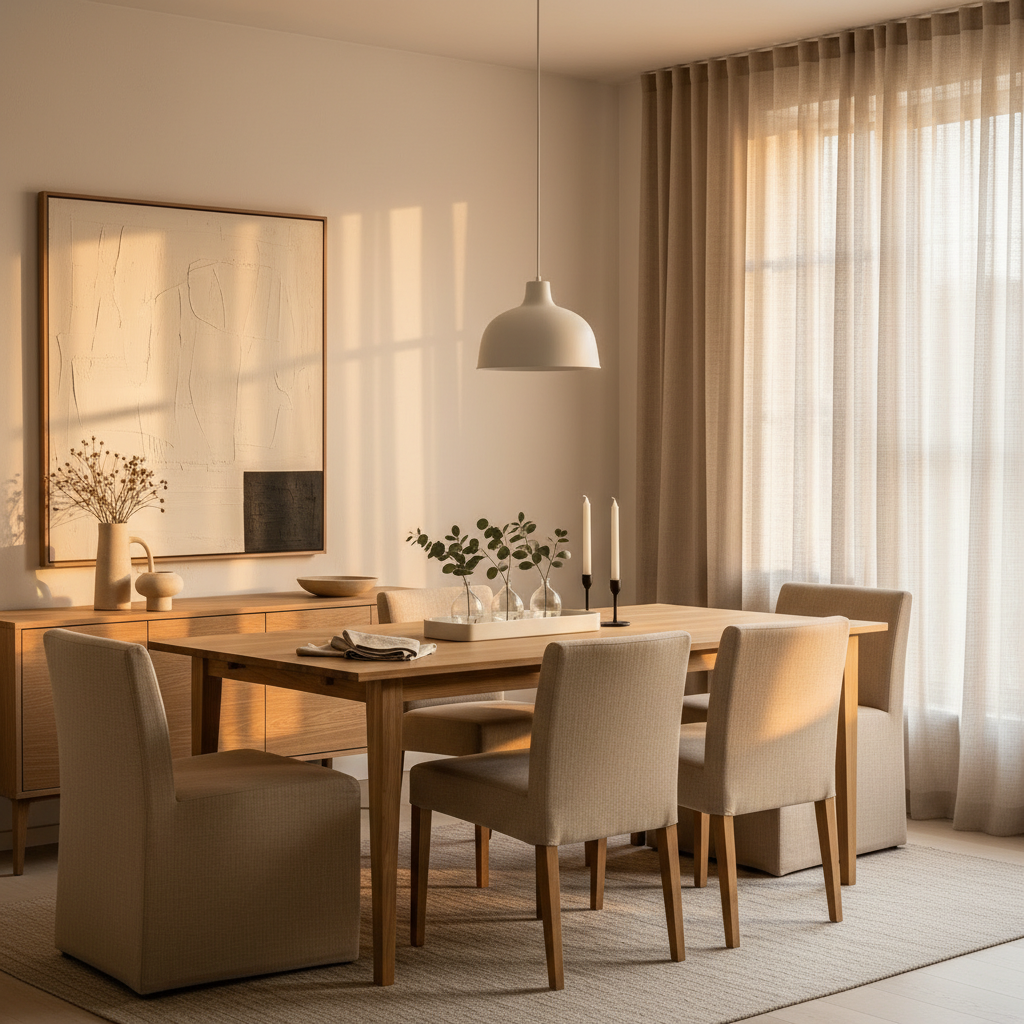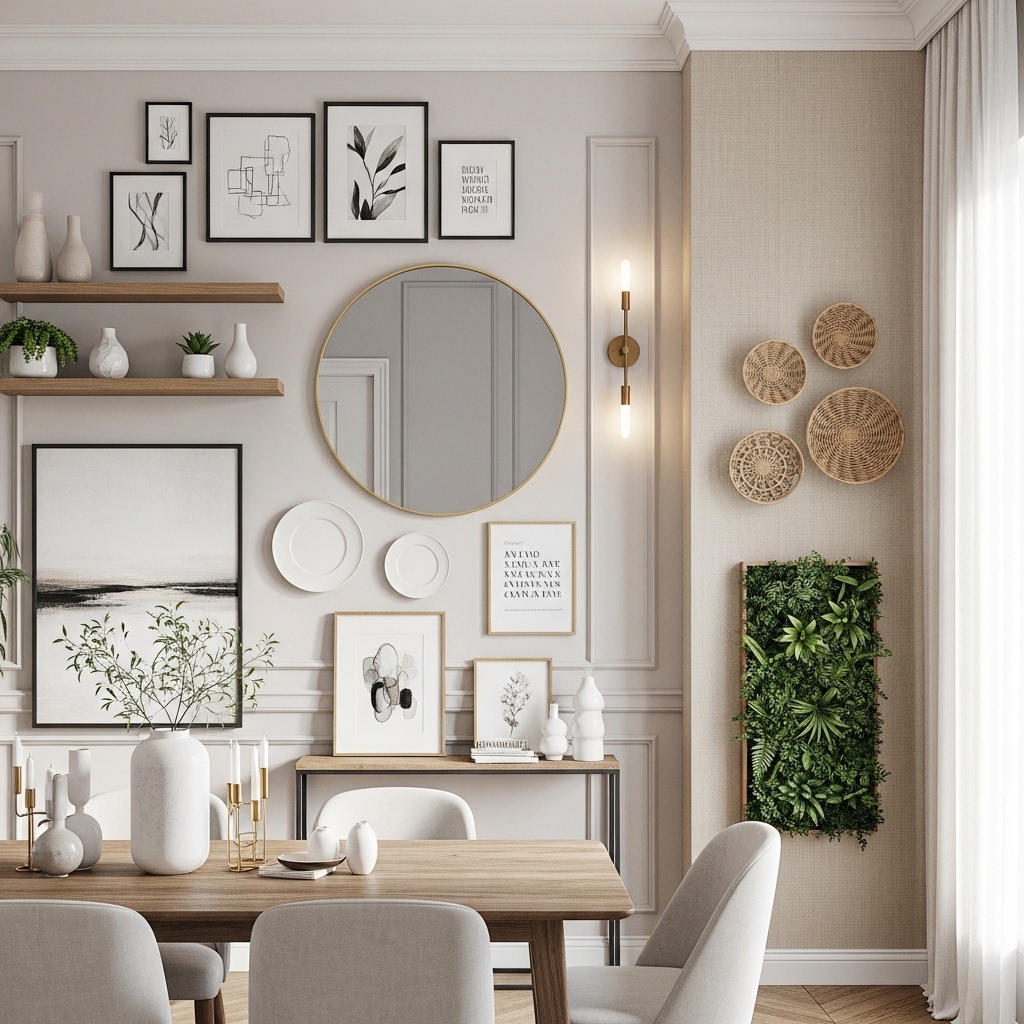
Let’s be real: most of us aren’t working with a grand formal dining room. We’re squeezing a table into whatever space the floor plan allows — a narrow room off the kitchen, a corner of an open-plan living area, or a dedicated room that’s technically a dining room but really doubles as a homework station, a Zoom background, and a weekend puzzle zone. And that’s completely fine.
The secret that most people miss isn’t that small dining rooms need to look bigger — it’s that they need to feel less cramped. Those are two different problems with two different solutions. A room can be visually “larger” but still feel airless and stiff. What you actually want is a space that breathes, flows, and makes your guests feel comfortable enough to linger over a second glass of wine. These twelve ideas will get you there, whether you’re decorating from scratch or just tired of how your current setup feels.
1. Use a Round Table — And Stop Apologizing for It
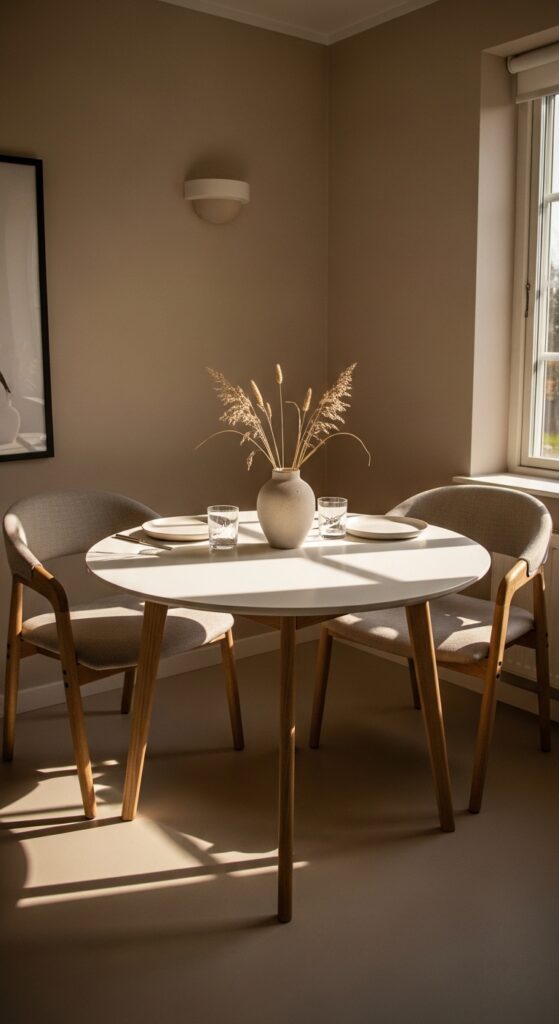
Round tables are consistently underestimated, and it’s one of the things that genuinely baffles me about how people shop for small dining rooms. Everyone walks into a furniture store and gravitates toward a rectangular table — as if that’s the only dignified option — when a round table would solve half their spatial problems instantly.
Here’s what round tables actually do: they eliminate sharp corners that interrupt traffic flow, they allow seating from all angles so you can always squeeze in one more person, and they visually anchor a space without dominating it. A 36-inch round table comfortably seats four, and a 42-inch can handle five if you’re friendly.
For materials, white oak with a matte finish feels current without being trendy. Avoid high-gloss finishes — they reflect clutter and show every fingerprint in a small room. Marble looks luxurious but adds visual weight. If you love the look, opt for a marble-top with slim legs to balance it out.
One thing to watch: round tables can feel isolated in very long, narrow rooms. In that case, an oval is your friend.
2. Mount Your Lighting Low and Deliberately

Most small dining rooms suffer from the same lighting mistake: a ceiling fixture installed dead-center at standard height that throws flat, unflattering light across the entire room. It makes everything look like a cafeteria.
The fix is embarrassingly simple — hang your pendant lower. For dining tables, the bottom of your light fixture should sit roughly 30 to 36 inches above the table surface. This creates a defined “room within a room,” making your dining area feel like an intentional destination rather than a pass-through space.
Go larger than you think you should. A generously scaled pendant — rattan, woven seagrass, or a hand-blown glass dome — commands attention upward, drawing the eye away from floor-level constraints. In small rooms, a bold light fixture functions like a piece of art.
That said, skip multi-bulb chandeliers with lots of arms if your ceiling is below nine feet. They’ll visually compress the space rather than lift it.
Warm bulbs only. 2700K. Non-negotiable.
3. Paint the Walls Darker Than You Think You Should

I know. Every instinct says go light to make a small room feel bigger. And for some rooms, that’s exactly right. But dark walls in a small dining room can work a kind of magic that pale walls simply can’t — they erase the boundaries of the space, so instead of feeling boxed in, you feel cocooned.
The trick is in the finish: always use matte or flat paint in deep tones. Eggshell reflects too much light and shows every imperfection. Matte absorbs light and gives walls that rich, plaster-like depth that looks genuinely expensive.
Colors that consistently perform well in small dining rooms: deep charcoal, forest green, terracotta, and French navy. Avoid purple-adjacent tones — they almost always read differently under artificial light than in the store.
If you hate repainting, this idea might not be for you. But if you’re willing to commit, a dark dining room almost always photographs better and feels more intentional than its pale counterpart.
Pair with warm metal accents — brass or unlacquered bronze — and the room will feel rich rather than heavy.
4. Lean a Large Mirror Against One Wall
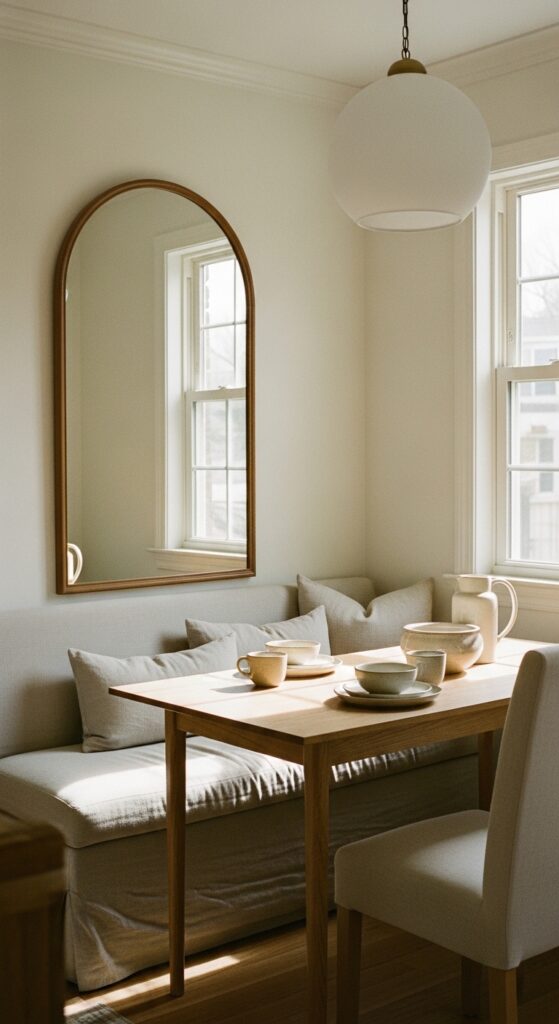
Mirrors are one of the most reliable tools in small-space decorating, but the way people use them in dining rooms is usually too timid. A small decorative mirror hung at eye level does almost nothing. What actually moves the needle is scale.
An arched or oversized rectangular mirror — leaned casually against the wall rather than hung — reflects the light source on the opposite side and gives the illusion of an additional window or doorway. Your room suddenly reads as twice its actual depth.
Leaning is also a better move than hanging for renters, or for anyone who doesn’t want to commit to a specific wall arrangement. It’s flexible, it looks deliberately relaxed (in a good way), and you can reposition it as your furniture changes.
For frame finish, go thin and simple. Chunky ornate gold frames will date quickly and fight with everything else in the room. Thin brass, raw wood, or matte black all work depending on your palette.
One constraint: make sure the mirror reflects something beautiful — a window, a plant, a piece of art. A mirror facing a blank wall or a cluttered counter defeats the purpose entirely.
5. Try a Built-In Banquette Along One Wall

If your dining room is long and narrow, or if it exists in a corner or alcove, a banquette bench along one or two walls might be the single best investment you can make. It’s a spatial transformation, not just a decor choice.
Here’s the functional logic: a banquette seat requires no clearance behind it, unlike a dining chair that needs 36 inches of space to pull out. That means you can push the table significantly closer to the wall and reclaim square footage for actual movement. You can also seat more people on a banquette per linear foot than you can with individual chairs.
Upholstery matters enormously here. Boucle is the obvious current choice — it photographs well and feels cozy — but it’s a nightmare to clean if you have children or anyone who eats messily. In that case, choose a performance velvet or an indoor-outdoor fabric in a solid tone. Avoid linen blends unless you’re committed to slipcovers.
Add storage underneath if you’re building from scratch. It’s a dining room, not a museum — use every inch.
6. Swap Solid Chairs for Transparent or Open-Frame Ones
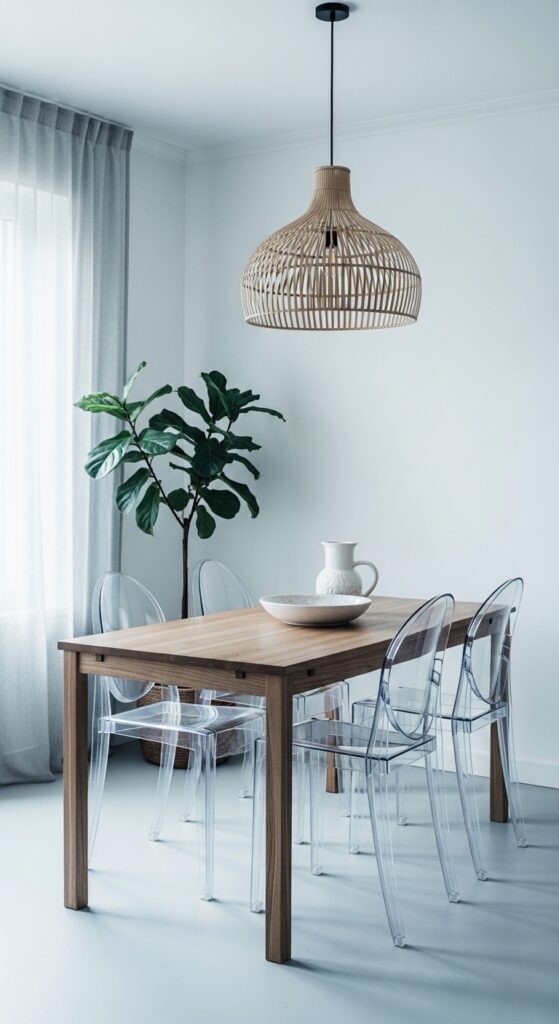
This is one of the fastest, most effective changes you can make to a crowded-feeling dining room — and it works especially well if you’re not in a position to replace your table or change your paint color.
Transparent acrylic chairs (the ghost chair silhouette has been around long enough to feel like a classic now) essentially disappear into the room. Your eye doesn’t stop at the chair — it travels through it to the wall behind, creating continuous visual depth. The table looks less surrounded, the floor reads as larger, and the whole room breathes more freely.
Open-frame chairs in metal or bent wood do a similar job with a warmer, more organic feel. A hairpin-leg chair, a simple wire frame, or a sculptural bentwood design all keep the visual weight low.
This can feel slightly cold in rooms that already lean minimal and stark. If your room is very white and very empty, the transparency of acrylic can tip into clinical. Warm it up with a textured table runner in linen or a chunky ceramic centerpiece.
Skip this if you have older relatives visiting frequently — chairs without back padding are genuinely less comfortable for long dinners.
7. Go Vertical With Shelving and Art
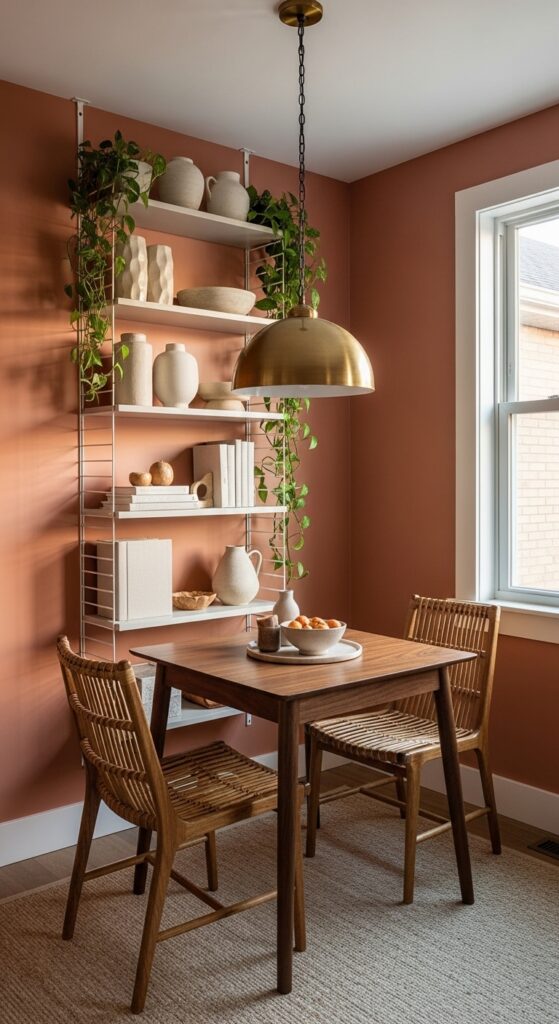
In a small room, the walls aren’t just backdrop — they’re real estate. Most people leave the top two-thirds of their walls completely empty, which makes a small dining room feel squat and unresolved. The solution is to send your eye upward.
Tall, slim shelving that extends toward the ceiling does several things at once: it provides storage or display space, it draws the eye up and makes ceilings feel higher, and it gives the room a collected, layered look that short furniture simply can’t achieve.
The key is restraint in what you put on those shelves. A mix of ceramics in complementary tones, one or two trailing plants in terracotta pots, and a few objects with interesting texture (woven baskets, rough-hewn wooden bowls, stone bookends) reads as thoughtfully curated. Rows of identical objects look corporate. Complete randomness looks chaotic.
If your room faces north and gets limited natural light, keep shelf objects light in tone — cream, sand, natural clay — so they don’t disappear into shadow.
Vertical art groupings work too. Three thin frames stacked in a column rather than spread across a wall draw the eye up rather than sideways.
8. Choose a Pedestal Table to Free Up Floor Space
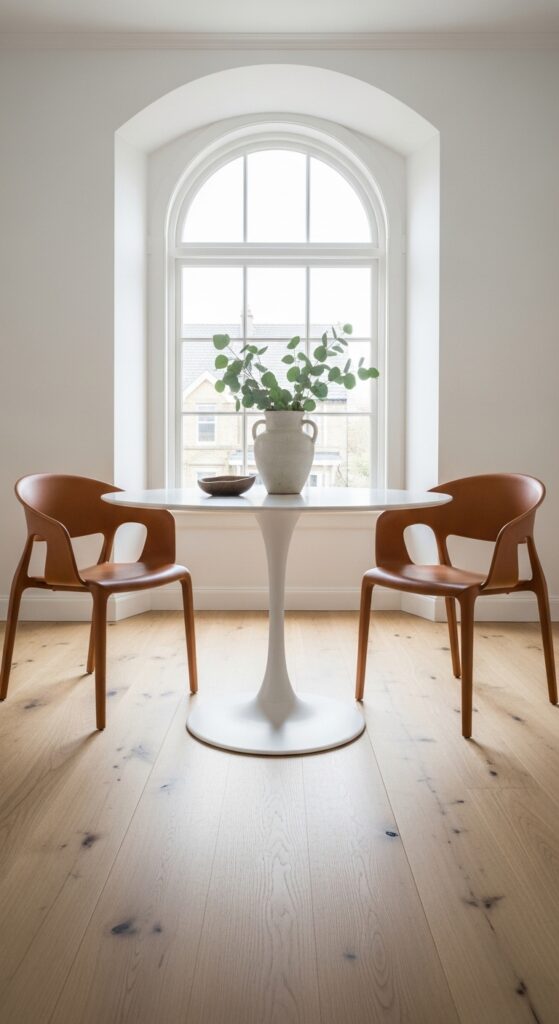
Leg count matters more than most people realize when choosing a dining table for a small room. A table with four corner legs creates visual anchors at each corner — and when you add chairs with their own four legs, the floor beneath the table becomes a forest of vertical lines that makes everything feel cluttered and compressed.
A pedestal table — one with a single central base — eliminates that problem entirely. The floor reads as open and continuous beneath and around the table. It’s one of those spatial tricks that you can’t un-see once you notice it.
Pedestal bases also make seating more flexible. Without corner legs getting in the way, you can seat people at any position around the table, which matters when you’re fitting in one extra guest.
Practically speaking, pedestal bases can feel slightly less stable than four-legged tables, especially at larger sizes. For a table under 48 inches in diameter, you won’t notice it. Above that, look for a base with a weighted bottom or a cross-foot support for stability.
A clean matte finish on the base will read lighter than wood stain, which can feel heavy in smaller footprints.
9. Use Curtains to Add Height, Not Just Coverage
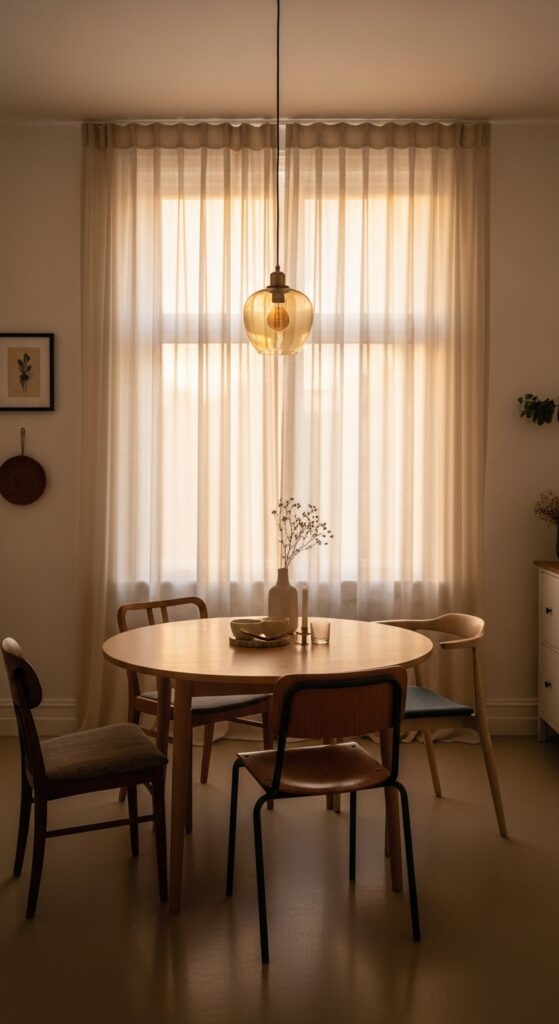
Window treatments are one of the most overlooked height tricks in small room decorating. Where you hang your curtains matters far more than which curtains you choose.
The rule is simple: mount the rod as high as possible — ideally within three or four inches of the ceiling — and let the curtains hang all the way to the floor. Even if your window is a fairly standard size, this creates the visual impression that the window is much taller than it actually is. Ceiling height reads as greater. The whole room feels more proportional.
In a dining room, sheer linen curtains work especially well. They diffuse natural light rather than blocking it, which keeps the room feeling open and soft during the day while still providing some privacy. Heavy blackout curtains can feel ponderous in a small dining room — save those for bedrooms.
For color, stick within two to three shades of your wall color. A curtain that matches the wall makes the window look like a continuation of the surface rather than an interruption. If your walls are warm greige, choose curtains in cream or warm white, not bright optical white.
That said, a curtain in a deep tone — forest green, terracotta, dusty blue — can frame a window beautifully and add depth. Just make sure it ties into the rest of the room’s palette.
10. Create a Monochromatic Palette (With Textural Variation)
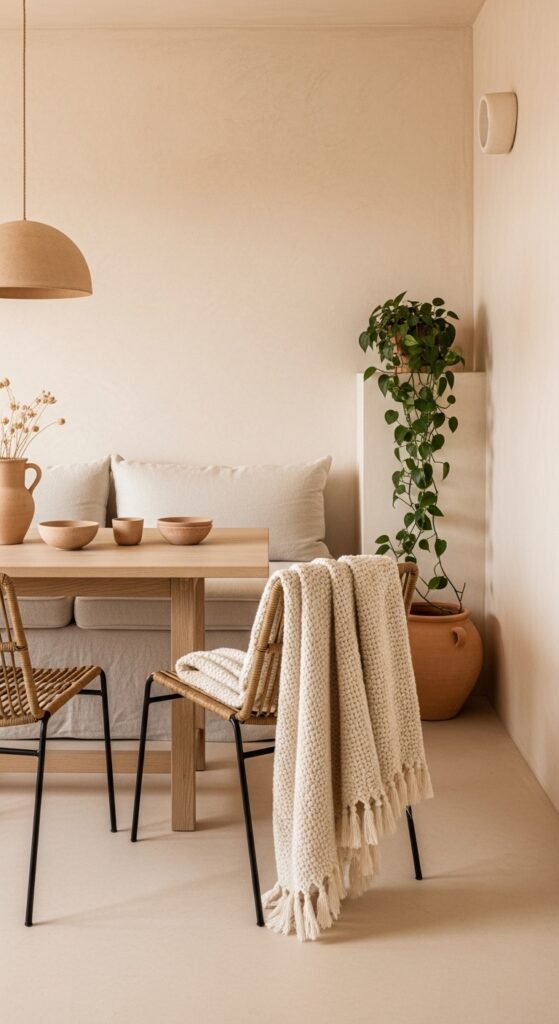
Color contrast — the visual boundary between one thing and another — is one of the primary things that makes a small room feel chopped up and crowded. When walls are one color, trim is another, the table is a third, and the chairs are a fourth, the room reads as a collection of competing elements rather than a unified whole.
A monochromatic approach, where walls, furniture, and textiles share the same tonal family, makes a room read as singular and spacious. The eye doesn’t have to work as hard. Space seems to expand.
The common fear is that it will look boring. It doesn’t — as long as you vary texture aggressively. A room in creams and warm whites can have plaster walls, a linen banquette, boucle chair cushions, an oak table, woven rattan, and a ceramic pendant — and it will feel incredibly rich and layered. The variation is all tactile, not chromatic.
This approach works best in rooms that get decent natural light. In a very dark, north-facing room, a warm monochromatic palette can feel beige and forgettable. In that case, add one accent — a deep green plant, a rust-toned runner — to give the eye something to land on.
11. Decorate With Plants Strategically, Not Randomly
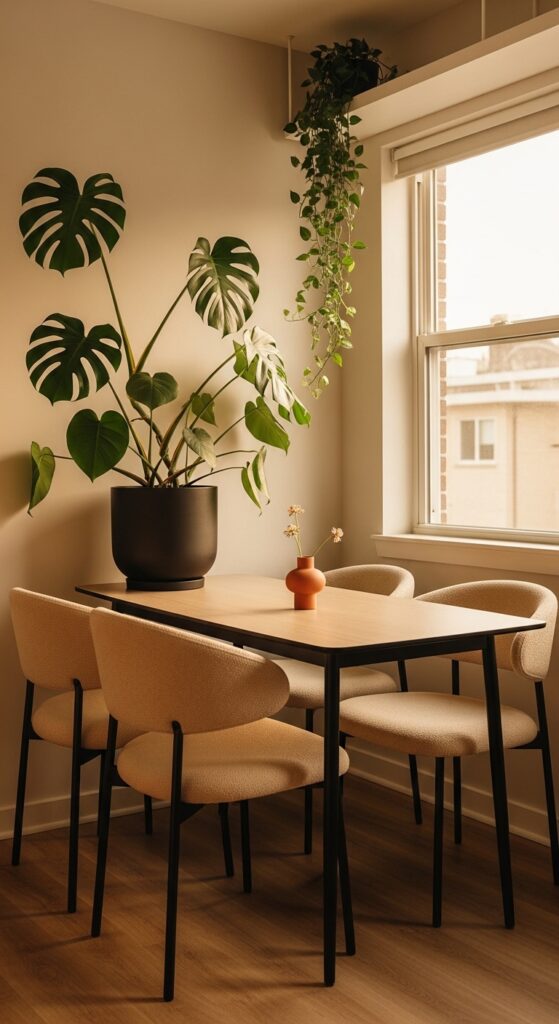
Plants in a dining room should be doing structural work, not decorating for decoration’s sake. A scattering of small plants on every surface looks busy in a small room and actually makes it feel more crowded, not more alive.
Instead, think in terms of scale and placement. One large statement plant — a monstera, a fiddle leaf fig, a large pothos in a hanging planter — in a corner brings a vertical element that no furniture piece can replicate. It introduces color, softens hard edges, and signals that the room is cared for. It also does the work of filling dead space in a corner without adding a piece of furniture that would take up floor area.
On the table itself, keep it minimal: a single bud vase, a small trailing plant, or a low bowl of seasonal objects. Anything taller than 8–10 inches obstructs sightlines across the table and makes dinner conversation slightly awkward.
One real constraint: plants need light. If your dining room doesn’t get much natural light, don’t fight it with high-maintenance plants that will slowly decline and make the whole room feel sad. Opt for pothos, ZZ plants, or cast iron plants — they genuinely don’t mind lower light, and they look good doing it.
12. Use a Statement Rug to Define the Space
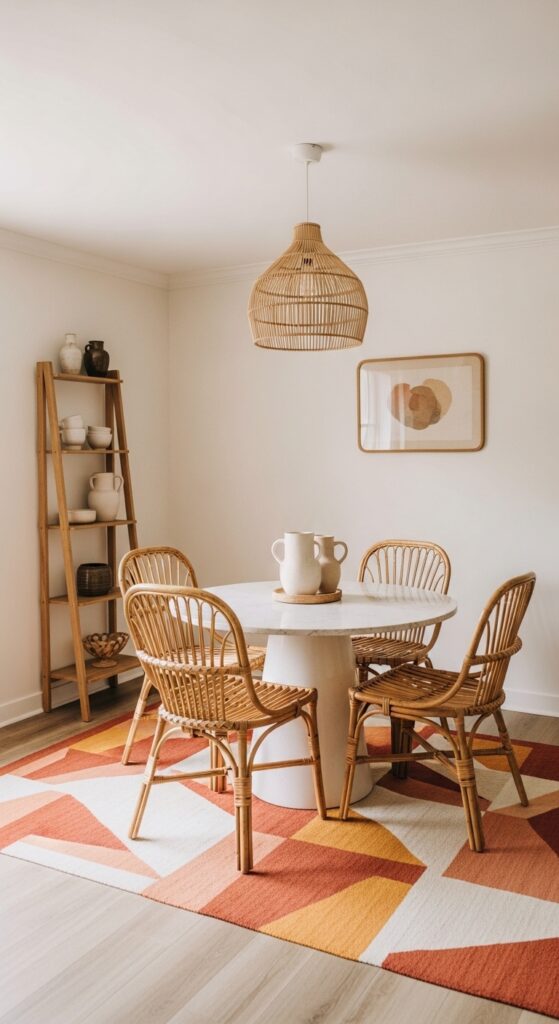
In an open-plan home where the dining area is carved out of a larger living space, nothing defines the zone more immediately — or more effectively — than a rug. It tells the room, and anyone standing in it, that this is a specific place with a specific purpose.
The most common mistake? Choosing a rug that’s too small. In a dining area, the rug should extend at least 24 inches beyond the edge of the table on all sides. This ensures that when chairs are pulled back, they stay on the rug — which is both visually cleaner and prevents the annoying scraping of chair legs catching the rug edge every time someone sits down.
For pattern and color, this is one place where you can afford to be bold. A solid rug in a small dining room can disappear; a geometric print, a simple stripe, or a faded vintage-style pattern gives the floor a visual anchor that makes the whole space feel more grounded and deliberate. Terracotta, rust, and warm ochre tones in a rug can bring an enormous amount of warmth without requiring any changes to walls or furniture.
Material consideration: avoid shag or high-pile rugs in dining areas. Food happens. A flat-weave cotton or a low-pile wool is infinitely more practical and still looks beautiful.
A Few Final Thoughts
Small dining rooms have this wonderful potential to be the most personal, most intimate spaces in a home — precisely because they’re small. You’re not designing for a crowd; you’re designing for the people you love to feed. That changes the brief entirely.
The ideas in this article aren’t about tricking anyone into thinking your dining room is larger than it is. They’re about removing the friction — the visual clutter, the awkward furniture, the dead corners — so that the space feels as good as it actually can. A round table, a low pendant, a bold dark wall, one enormous plant in a corner: none of these are complicated or expensive interventions. But each one shifts something real about how a room feels to be inside.
If you’re walking away with one thing, let it be this: stop treating your small dining room as a problem to solve and start treating it as a room to live in well. The best small dining rooms aren’t ones that look like they’re pretending to be bigger. They’re the ones that feel exactly right for the life happening inside them.