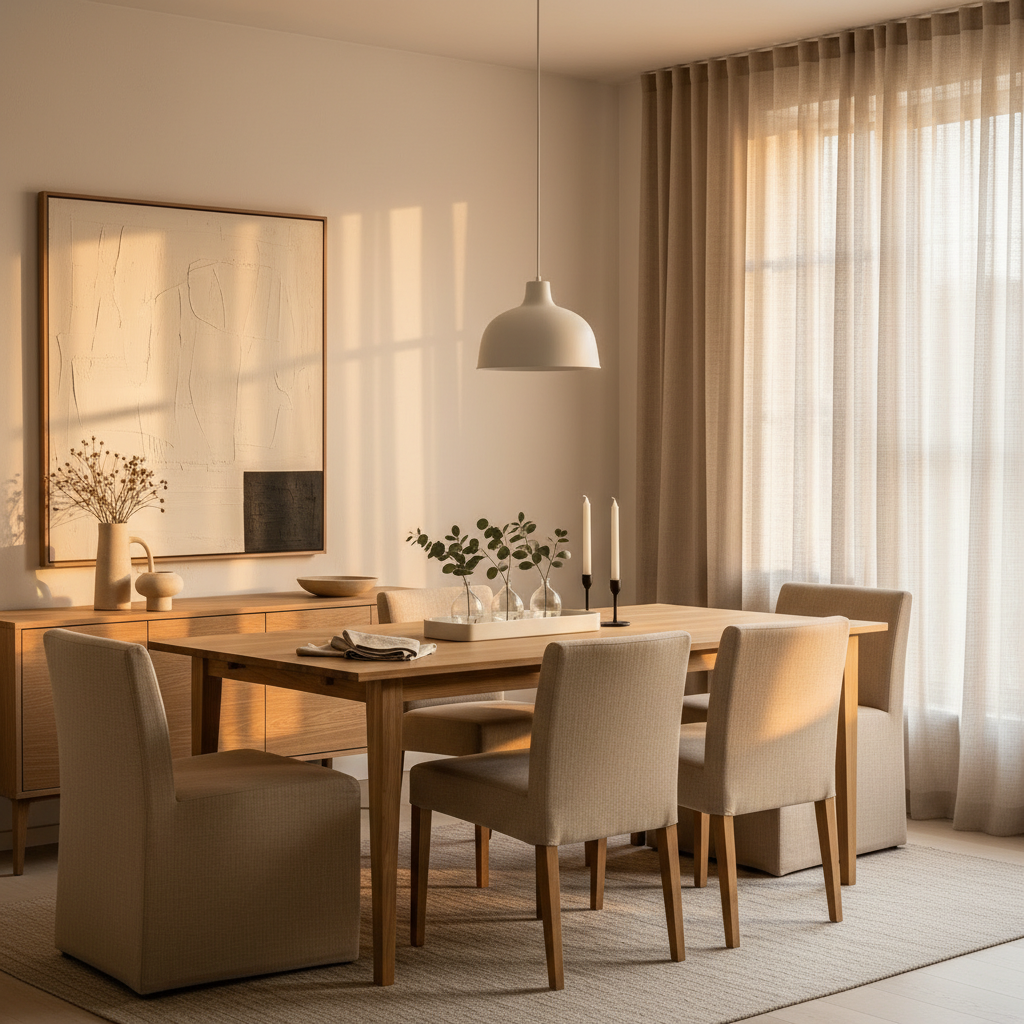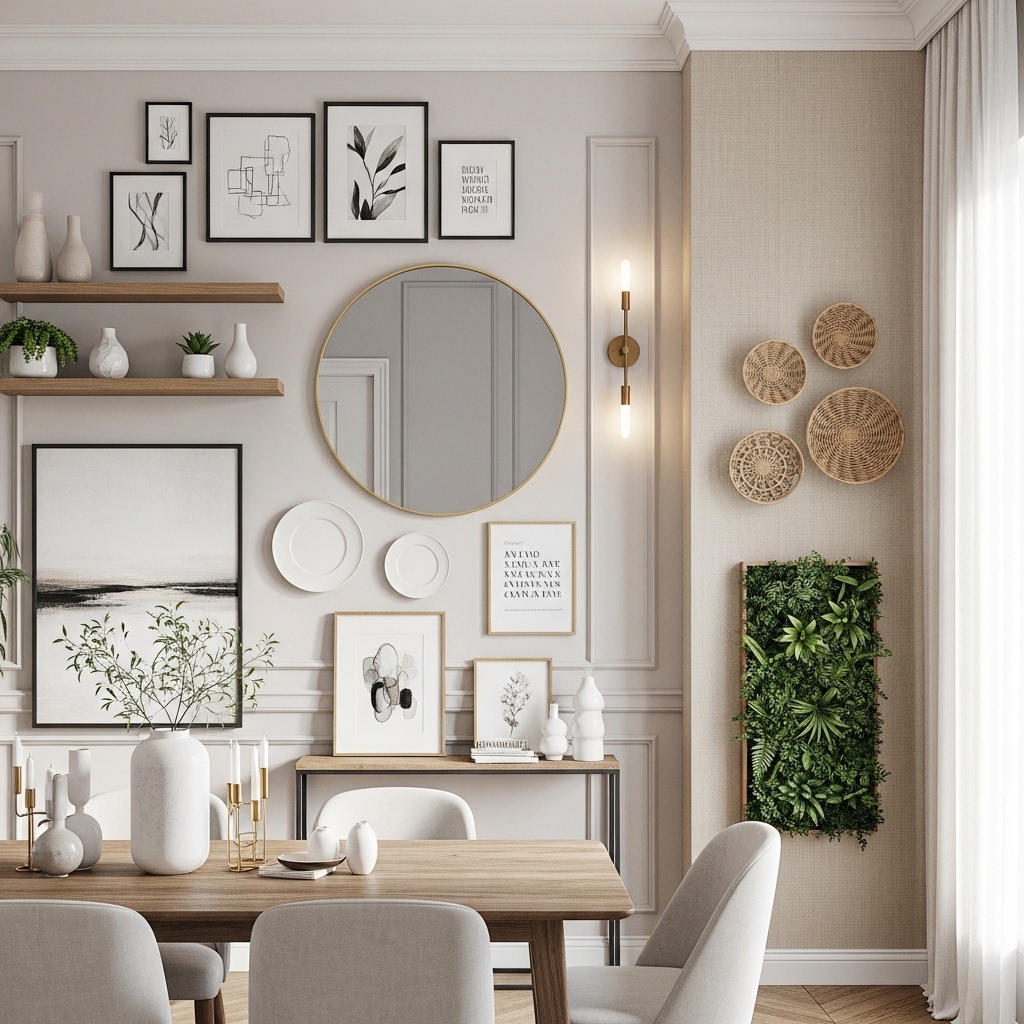
Modern luxury in interior design is one of those phrases that gets applied to almost everything — and because of that, it has lost most of its meaning. A chrome light fixture and some velvet chairs gets labeled “modern luxury.” A dark wall with a marble table gets called “modern luxury.” The word luxury, specifically, has been so thoroughly diluted by marketing that it barely registers anymore as a signal of anything real.
Real modern luxury, in a dining room context, is about something more specific: the quality of materials at close range, the precision of proportion and detail, the sense that every decision in the room was made with intention rather than convenience. It’s the difference between marble that’s been carefully selected and marble that’s been slapped on a surface. Between velvet that’s been properly cut and fitted and velvet that’s been stapled. Between lighting that was designed for the room and lighting that was ordered from a website. These twelve ideas address that distinction directly, with specific, honest advice for getting it right.
1. A Book-Matched Marble or Stone Dining Table
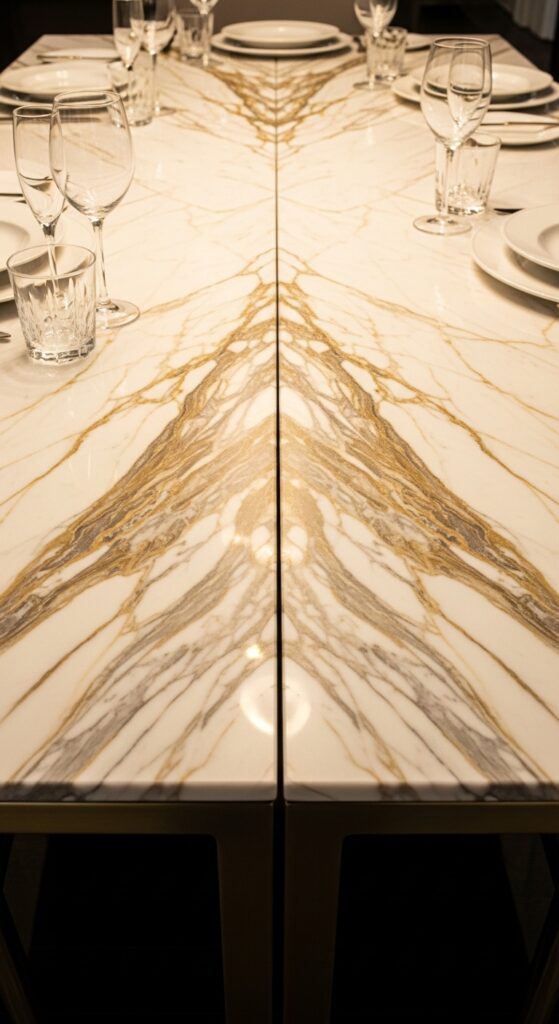
A book-matched stone dining table is the single most unambiguous signal of genuine material investment in a modern dining room. Book-matching — the technique of splitting a stone slab and opening it like a book so the veining pattern mirrors itself symmetrically — transforms a material that’s already beautiful into something genuinely extraordinary. The symmetrical vein becomes a composition, almost like a painting, unique to that exact slab pair.
Calacatta marble with its dramatic gold and grey veining on a bright white ground is the most recognizable book-match choice. Nero Marquina in black and white reads as more graphic and contemporary. Quartzite in warm gold tones offers similar visual drama with better practical durability — it’s harder and less porous than marble, which matters in a dining context where spills happen.
The base matters as much as the top. A stone slab on a base that’s too heavy creates a tomb-like impression. A slim brass trestle or a single sculpted pedestal lets the stone be the star.
One watch-out: genuine marble requires sealing and ongoing maintenance. Etching from acidic foods and drinks happens even on sealed marble — it’s not a matter of if but when. If you want the look without the anxiety, quartzite or sintered stone surfaces achieve a similar visual effect with significantly better resistance.
The quality of the stone selection — the specific slab chosen — is where this investment is made or lost. Always select the actual slab in person, never from a sample tile.
2. Fluted Plaster Walls or Panelled Wall Treatments
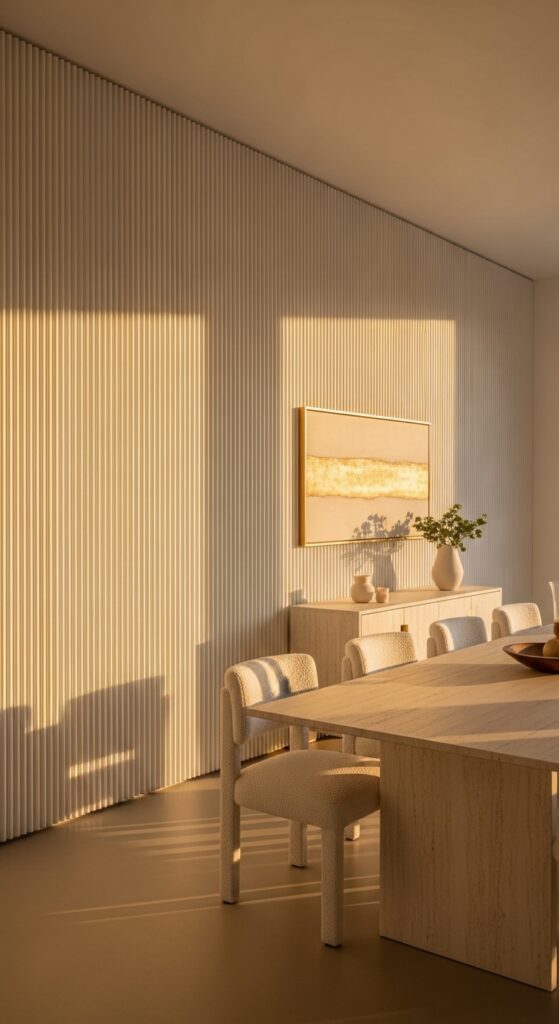
Fluted plaster — vertical ridged channels running top to bottom of a wall or panel — is one of the defining surface treatments of contemporary luxury interiors, and it earns that status by doing something that flat walls cannot: creating depth, shadow play, and tactile interest without introducing color or pattern. The wall becomes textural rather than merely colored.
Applied as full-height panels, fluted plaster reads as genuinely architectural — as if the texture is part of the building’s structure rather than applied decoration. This is the distinction that separates it from wallpaper or surface finishes that sit visibly on top of the wall. Fluted plaster, properly executed, looks like the wall is the texture.
For a dining room, fluted plaster works best on a single feature wall — the one most visible from the table — rather than all four walls, where the continuous texture can become visually fatiguing. The remaining walls should be in a complementary smooth matte plaster or paint.
The finish color should be warm: warm ivory, soft greige, warm white with a slight ochre undertone. Cool greys in fluted plaster tend to read as institutional rather than luxurious.
One constraint: genuine plaster fluting is a skilled craftsperson’s work and priced accordingly. High-quality MDF fluted panels, properly primed and painted, achieve a very similar effect at a fraction of the cost — and at room distance, the difference is minimal if the installation is clean.
3. Sculptural Statement Chandelier as Functional Art
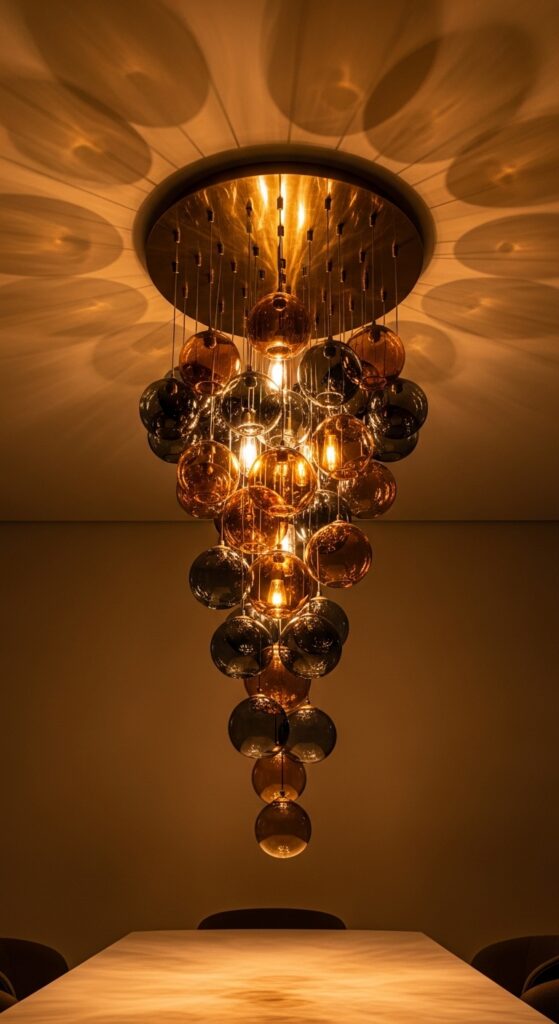
In a modern luxury dining room, the chandelier is not a light fixture that happens to look interesting. It’s an art object that also produces light — and the distinction changes how you approach the selection entirely. The best luxury dining room chandeliers are the kind you’d notice even if they weren’t turned on.
Sculptural chandeliers in contemporary luxury interiors fall into a few distinct categories: cascading hand-blown glass in organic or geometric arrangements, large-scale plaster or stone sculptural forms with concealed lighting, geometric metal structures in brass or blackened steel, and organic forms inspired by natural materials. Each speaks a different design language, and the right choice depends entirely on the room’s existing vocabulary.
For scale: in a modern luxury dining room with high ceilings, the chandelier should be larger than almost any commercial fixture suggests. A piece that spans 40 to 60 inches in diameter in a room with 10-foot ceilings creates the kind of visual presence that defines the room. Anything smaller reads as an accessory rather than a statement.
Commission-worthy pieces from independent glass artists, metalworkers, and lighting designers are increasingly accessible through online studio platforms and trade shows. A custom chandelier made specifically for your room’s dimensions and design language is genuinely achievable at prices comparable to high-end retail fixtures.
One watch-out: an extraordinary chandelier above a table that doesn’t deserve it creates an imbalance that makes the furniture look underdressed rather than making the fixture look more spectacular.
4. High-Back Dining Chairs in Performance Velvet
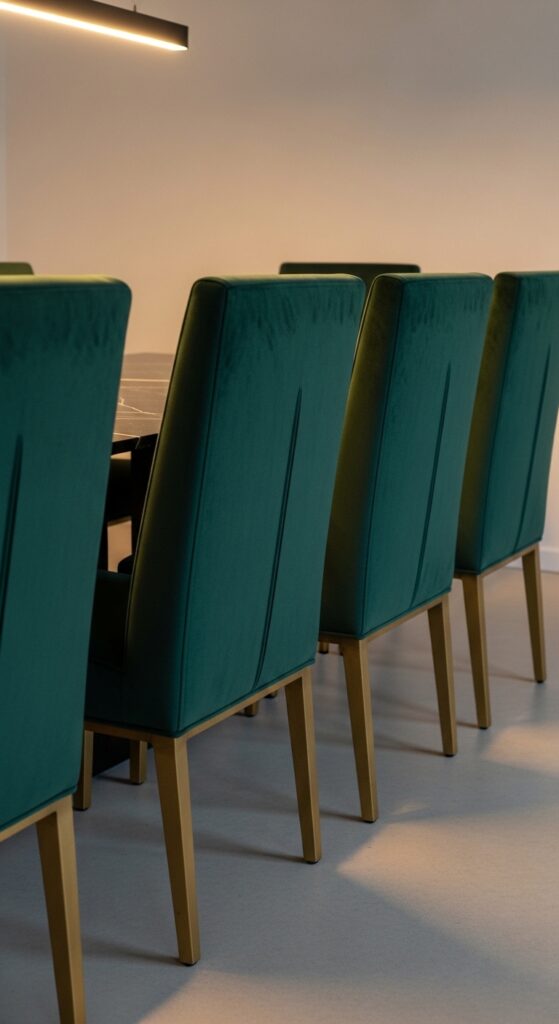
The chair is where modern luxury dining rooms either deliver or disappoint at the level of physical experience. A dining room can look extraordinary in photographs and feel generic the moment you sit down, because the chair — its proportions, its fabric quality, its construction — is something photography can suggest but never fully convey.
High-back chairs in a cut-pile performance velvet hit every requirement for modern luxury dining simultaneously: they’re visually substantial, physically comfortable for long meals, and constructed in a fabric that holds up to genuine use without looking institutional. Performance velvet has come an extraordinarily long way — the best versions are indistinguishable from genuine silk velvet at room distance and handle spills, pets, and daily use with equanimity.
The tailoring is what separates a luxury chair from an approximation of one. Corners should be crisp, not gathered. Welting (if present) should be consistent in width and perfectly aligned. The back should be clean with no visible stapling or gathering at the top edge. These are the details that read as quality at close range.
Color selection: deep forest green, warm charcoal, cognac, dusty sage, and dusty rose all perform beautifully in high-back velvet chairs against a luxury dining table. Avoid overly bright or saturated tones — they read as fashion rather than design, and fashion dates.
One constraint: even performance velvet requires proper cleaning protocols. No steam cleaning without manufacturer confirmation, and always treat spills immediately rather than allowing them to set.
5. A Dramatic Dark Palette: Walls, Table, and Textiles
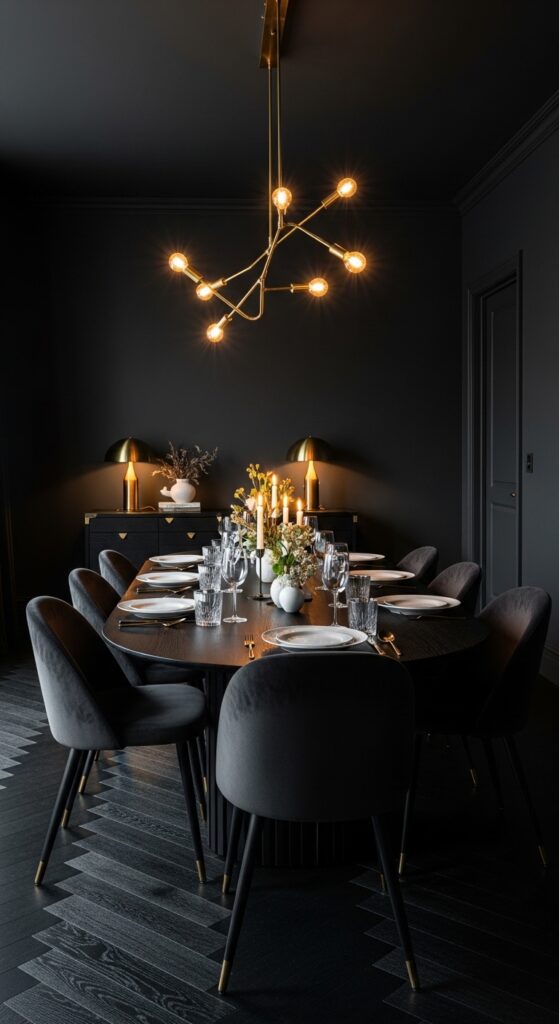
There is a version of modern luxury that refuses light and is better for it. An entirely dark dining room — walls in deep matte charcoal or warm black, a dark table, dark upholstery, dark floors — creates an atmosphere of total enclosure that’s genuinely unlike anything a pale room can achieve. At dinner, under warm lighting, it feels like the room has contracted to exactly the table, the people, and the food. Nothing else exists.
This approach requires absolute commitment to warm light sources throughout. The room cannot have a single cool or neutral light — every bulb must be at 2200K to 2700K, every source on a dimmer, every fixture in a warm metal (brass, bronze, unlacquered copper). Against a dark backdrop, the warmth of brass and the glow of crystal and white ceramic become luminous in a way they never are in a light room.
The surface that keeps a dark dining room from reading as oppressive is material variation. Dark walls in matte plaster, a table in a different dark tone with visible grain or texture, chairs in a dark velvet with slight sheen — the variations in darkness prevent the room from flattening into a single uniform shadow.
One constraint: a fully dark dining room with inadequate lighting, or with cool-toned light sources, becomes genuinely unpleasant. This palette demands excellent lighting design. If you’re not prepared to invest in the lighting simultaneously, don’t start with the walls.
6. Travertine and Natural Stone as Texture Elements
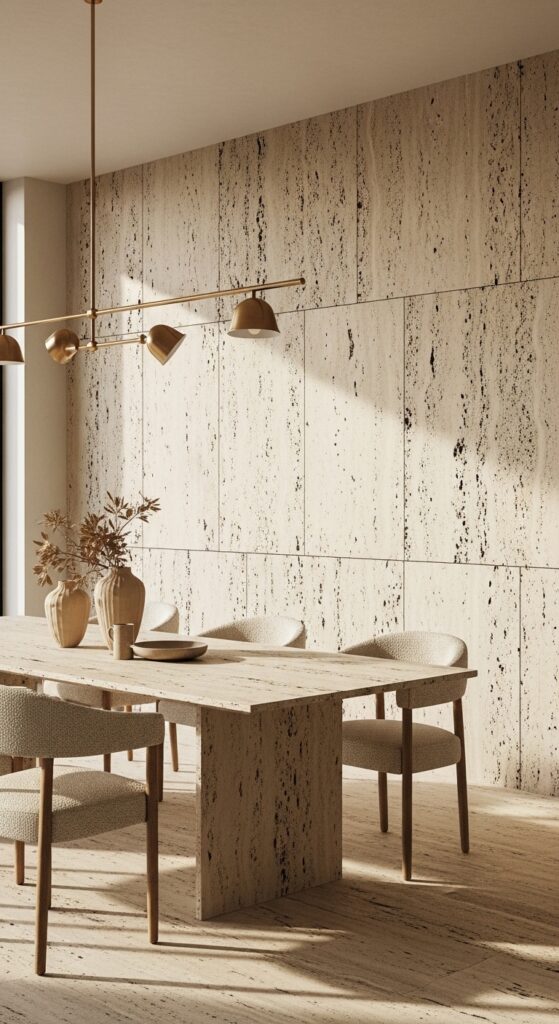
Travertine is having its most significant interior design moment in decades — and it deserves it. The warm, pitted, slightly imperfect surface of natural travertine is the antithesis of the cold perfection of polished white marble, and in a modern luxury dining room, that imperfection is exactly what gives the space its humanity and warmth.
Travertine used as a wall cladding material — large-format panels covering a feature wall floor to ceiling — achieves something that no paint or wallpaper can: the visual and tactile quality of geological time. The natural variation in tone from pale ivory to warm honey, the visible pitting and vein structure, the slight texture under a raking light — these are qualities that improve the longer you look at them.
For a dining room, travertine as both table surface and wall cladding material creates a tonal and material unity that reads as fully designed rather than assembled from separate decisions. The table and wall speak the same material language, with slight natural variation between pieces keeping the effect from reading as matching-set monotony.
Filled travertine (where the natural voids have been filled with grout or resin) is the practical choice for dining surfaces and high-touch walls — the fills prevent trapping food and bacteria. Unfilled travertine has a more raw, textural quality appropriate for purely decorative wall applications.
One watch-out: travertine, like all calcium-based stones, is vulnerable to etching from acids. Proper sealing before installation and regular resealing on any surface that contacts food or drink is non-negotiable.
7. Bespoke Joinery: Built-In Credenza and Display Shelving
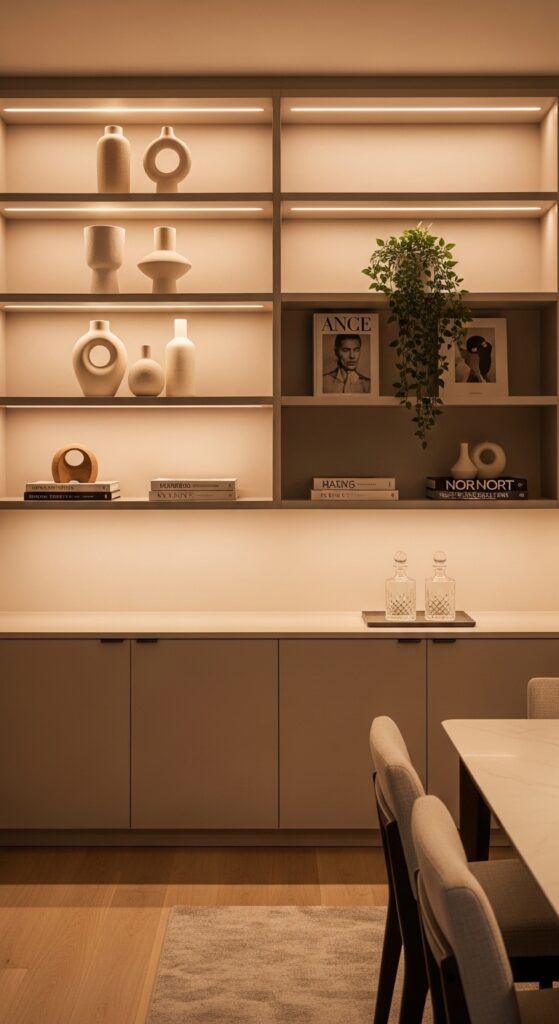
Custom joinery is where modern luxury dining rooms make their most decisive statement — and it’s also where the distinction between expensive and genuinely well-designed becomes clearest. A bespoke built-in credenza that runs the full width of a wall, with proportions calibrated to that specific room’s ceiling height and wall length, achieves something that no freestanding furniture can: it looks like it was always there, as if the architecture anticipated it.
The design details that separate excellent joinery from merely expensive joinery: flush-front cabinet doors with no visible hardware (push-to-open mechanisms or recessed finger pulls), continuous grain matching across multiple doors so the wood or lacquer reads as a single surface rather than a row of individual panels, integrated lighting that illuminates the display shelving section from concealed strip positions, and a countertop material — stone, sintered stone, or solid brass — that elevates the piece to something genuinely architectural.
The display shelving section above the credenza is the room’s gallery — and it should be curated with the same discipline as a gallery wall. Four or five objects maximum per shelf section, significant empty space, a mix of heights, and objects that relate to each other in tone and material.
One constraint: bespoke joinery is the most permanent and most expensive intervention in this list. It’s genuinely not for renters, and it’s not for homeowners who might change their mind about the room’s direction in two years. Make this decision when you’re certain of the design language you’re committing to.
8. An Oversized Abstract Canvas in a Neutral Palette
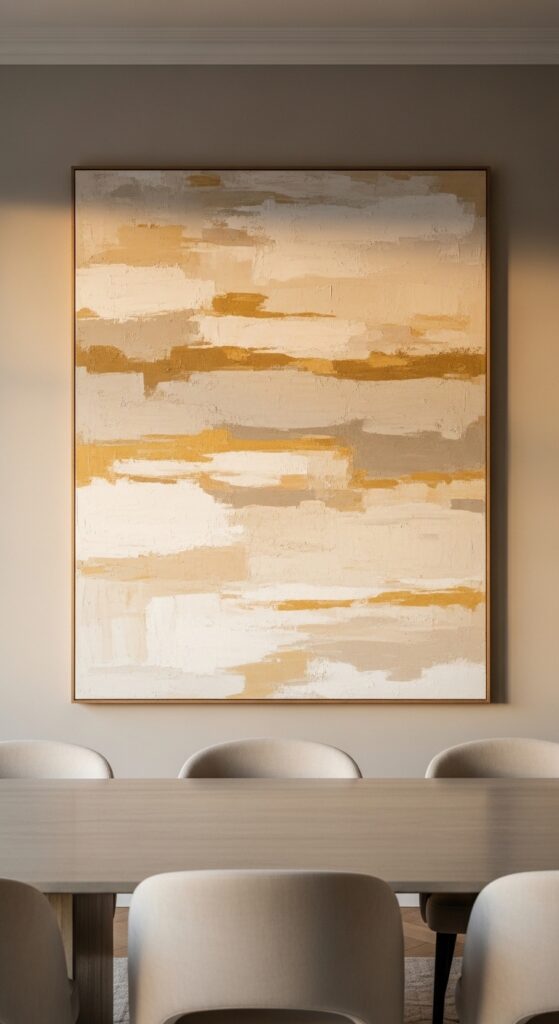
The art in a modern luxury dining room is not decoration — it’s the room’s intellectual credential, the thing that signals a sensibility beyond furniture purchasing. And the approach to art selection in this context is almost the opposite of what instinct suggests: rather than choosing something bold and colorful to make a statement, the most sophisticated modern luxury dining rooms tend toward tonal, abstract work that rewards sustained looking rather than immediate impact.
A large-scale abstract canvas in warm neutrals — ivory, putty, soft gold, warm grey — is the art equivalent of quiet confidence. It doesn’t announce itself. But it reveals its quality the longer it’s in the room, through the quality of the mark-making, the depth of the layered paint surface, the relationship between the work and the changing light throughout the day.
Original works by emerging and mid-career artists are accessible through online gallery platforms, art fairs, and studio visits at prices that compare favorably with high-end reproduction prints. The difference between an original canvas and a printed reproduction is immediately apparent in person — the surface, the edge, the depth — and it’s the difference between art and illustration.
For placement: centered on the wall, hung at 57 to 60 inches to center from the floor, with adequate clear wall on all sides. Art that feels crowded by adjacent furniture or architecture loses its ability to breathe and read as art.
One watch-out: very pale, tonal abstract work can disappear against pale walls. Ensure sufficient tonal contrast between the canvas and the wall behind it — either through a slightly deeper wall tone or a work with enough surface texture to read against a light background.
9. Integrated Acoustic Panels as a Design Feature
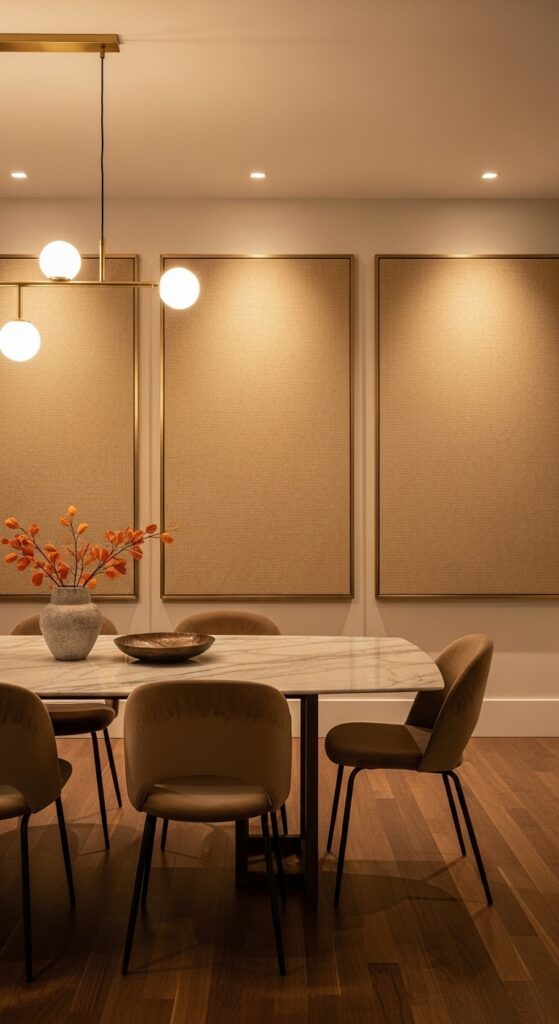
This is the idea that genuinely separates thoughtfully designed luxury dining rooms from rooms that merely look expensive: acoustic treatment. A dining room with hard floors, plaster walls, a glass table, and high ceilings is an acoustic nightmare — conversations echo, glasses clink at a frequency that’s fatiguing over a long dinner, and the general sound environment works against the social function the room is meant to serve.
The luxury solution is to make the acoustic treatment a design element. Large rectangular panels in a tightly woven wool or linen fabric, framed in thin brass channels and mounted symmetrically on the primary dining wall, read at room distance as oversized framed textile art. They function as significant acoustic absorbers — reducing reverberation substantially in a parallel-surfaced room — while adding warmth, texture, and visual structure to a wall that might otherwise be bare.
The fabric selection is where the design quality lives. A tightly woven wool bouclé in warm oatmeal, a smooth linen in warm greige, or a hand-woven textile in a natural fiber all have the right surface density for effective acoustic absorption while reading as deliberate material choices rather than functional additions.
This approach requires custom fabrication — acoustic panels in luxury finishes are not off-the-shelf products. However, specialist acoustic design firms increasingly offer bespoke panel services specifically for residential applications.
One constraint: panels must be sized and positioned based on acoustic calculations for your specific room dimensions, not simply aesthetic preference. Consult an acoustic specialist before specifying size and placement.
10. Concealed Cabinetry and Seamless Storage
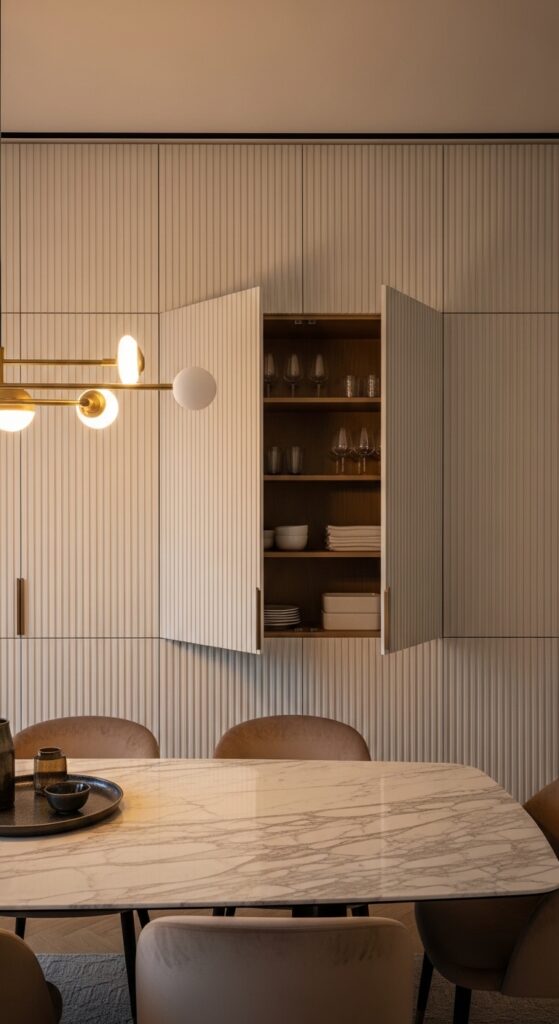
Concealed storage is one of the most reliable markers of genuinely high-end interior design, because it requires planning, precision, and craft that simply cannot be improvised. A dining room where the storage is completely invisible — where cabinet doors are indistinguishable from the surrounding wall panelling — reads as designed from the inside out rather than furnished from the outside in.
The mechanism is simple in concept and demanding in execution: cabinet doors built to match the surrounding wall treatment exactly, with concealed hinges, push-to-open or recessed finger-pull hardware, and edge profiles calibrated to the panelling’s geometry. When done correctly, the storage is completely invisible until accessed — the wall appears continuous and seamless.
For dining rooms, the most valuable concealed storage holds glassware, linens, serving pieces, and the objects that are needed during dinner parties but create visual clutter when displayed. The freedom from visible storage means the displayed objects — on the open shelving, on the marble sideboard surface — can be edited to a true curation rather than a compromise.
The joinery cost of concealed storage is substantially higher than standard cabinetry — the tolerance requirements for seamless integration are significantly more demanding. Budget accordingly, and work only with craftspeople who have verifiable examples of this work in their portfolio.
One watch-out: concealed storage is only as good as its organization. The interior of a concealed cabinet that becomes a disorganized catch-all defeats its purpose entirely. Invest in proper interior organization — custom shelf heights, drawer inserts, velvet-lined compartments for glassware — to make the storage genuinely functional.
11. A Double-Height or Dramatic Ceiling Treatment
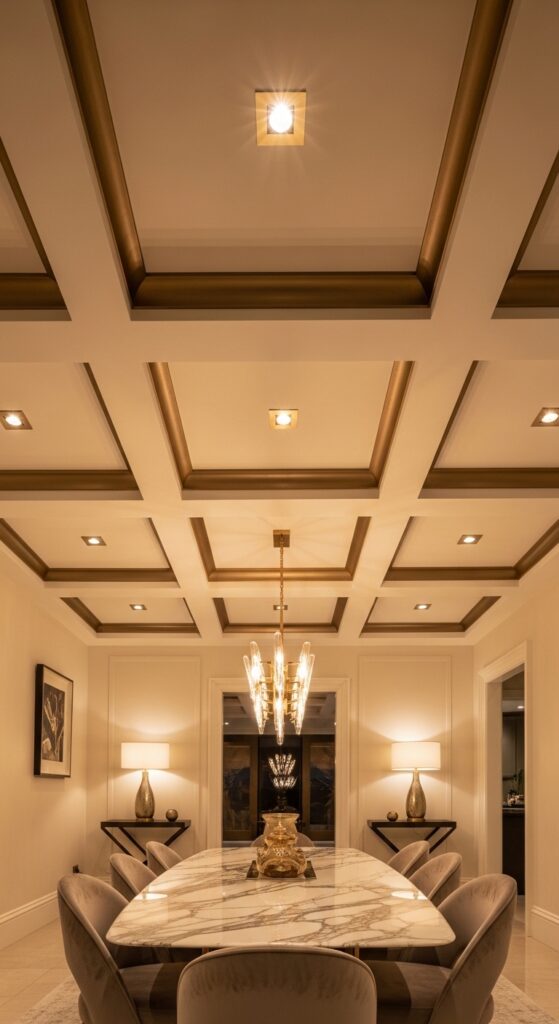
Luxury announces itself from the ceiling in a way that no floor or wall treatment can fully replicate — because the ceiling is the surface we instinctively assess for quality and proportion when entering a room, and it’s the surface that most residential design leaves completely untreated. A coffered ceiling, a plaster-detailed ceiling, or a ceiling with integrated lighting architecture immediately signals that a room has been designed from every plane, not just at eye level.
A coffered ceiling — a grid of recessed panels framed by structural or decorative beams — has been a luxury dining room standard across multiple centuries of architectural tradition because it works so consistently well. The coffers add visual weight and articulation to a large ceiling, reduce the flat, undifferentiated quality of a standard ceiling, and provide a natural grid for integrating concealed or recessed lighting.
For a modern interpretation, keep the coffer profiles clean and geometric rather than highly ornamented. A slim reveal at the coffer edge, perhaps with a brass or bronze inset detail, reads as contemporary rather than historical. The plaster should be smooth and perfectly painted — no texture or brush marks in a modern context.
The lighting integration within a coffered ceiling is where contemporary luxury and traditional architecture merge: recessed fixtures at the coffer edges provide ambient light, while the central pendant (dropping from the center coffer directly over the table) provides the dining zone’s primary warm source.
One constraint: coffered ceilings require ceiling height. Below 9 feet, even shallow coffers can compress the room uncomfortably. At 10 feet and above, they enhance rather than diminish the sense of space.
12. Curated Table Setting as the Room’s Final Layer
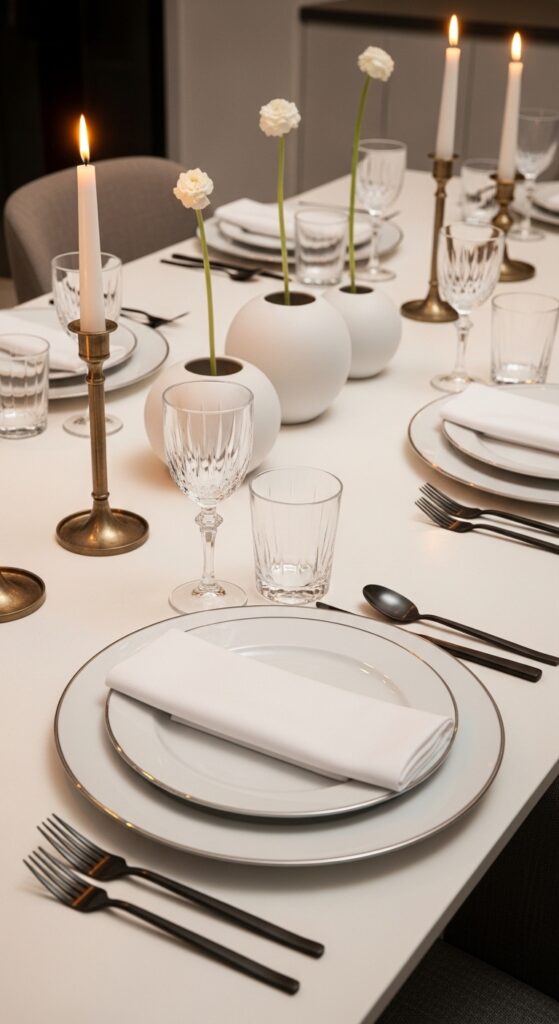
The table setting is where a modern luxury dining room’s philosophy reaches its fullest expression — and where the approach is almost completely the opposite of traditional formal dining conventions. Where classical table settings layer china, crystal, and silver in accumulating complexity, modern luxury table settings achieve their impact through precision, restraint, and the quality of each individual element rather than the quantity.
The modern luxury table setting uses fewer objects, chosen at a higher quality threshold. One large-format charger in matte white ceramic — with a rim detail so subtle it barely registers — rather than layered charger, dinner plate, and salad plate stacked in a conventional arrangement. Cutlery in a clean geometric profile in matte black or brushed brass rather than ornate silver-plate. Crystal glasses with a delicate stem that catches the light rather than a heavy goblet profile. Linen napkins in true linen — not polyester, not a blend — folded simply and placed directly on the charger rather than architecturally constructed into a standing form.
The centerpiece should be horizontal and low: three ceramic vessels at varying heights with single white or cream stems, or a flat arrangement of stones, moss, and a single architectural plant. Nothing that interrupts sight lines. Nothing that requires explaining.
Candles are non-negotiable at the modern luxury table — the specific quality of candlelight at dinner is irreplaceable by any electrical source. White tapers in brushed brass holders, one or two candelabras, or a collection of pillar candles at varying heights all work within the modern aesthetic.
One constraint: the modern luxury table setting requires genuinely high-quality linens and tableware to read as intended. The same minimal composition in lower-quality materials doesn’t read as restrained modernism — it reads as cheap. This is the table setting where material quality matters most precisely because there’s nothing else to distract from it.
Luxury Is a Standard, Not a Style
The throughline across every idea in this article is something that the word “luxury” obscures more than it reveals: quality at close range. A modern luxury dining room isn’t a collection of expensive objects assembled in proximity. It’s a space where every material, every detail, and every proportion has been chosen with the understanding that the people in this room will be sitting still, looking closely, and running their hands across surfaces for hours at a time.
That standard — material quality that holds up to sustained, close inspection — is what separates the dining rooms in this category from rooms that look expensive in photographs but feel ordinary in person. It’s the marble slab chosen in person from the yard. The velvet tailored to fit the chair frame perfectly. The joinery built to tolerances that make it look seamless rather than close.
Visit us again when your room is ready for its next layer. Every genuinely great interior takes multiple passes to complete — and knowing which layer comes next is often the most valuable thing a good article can give you.