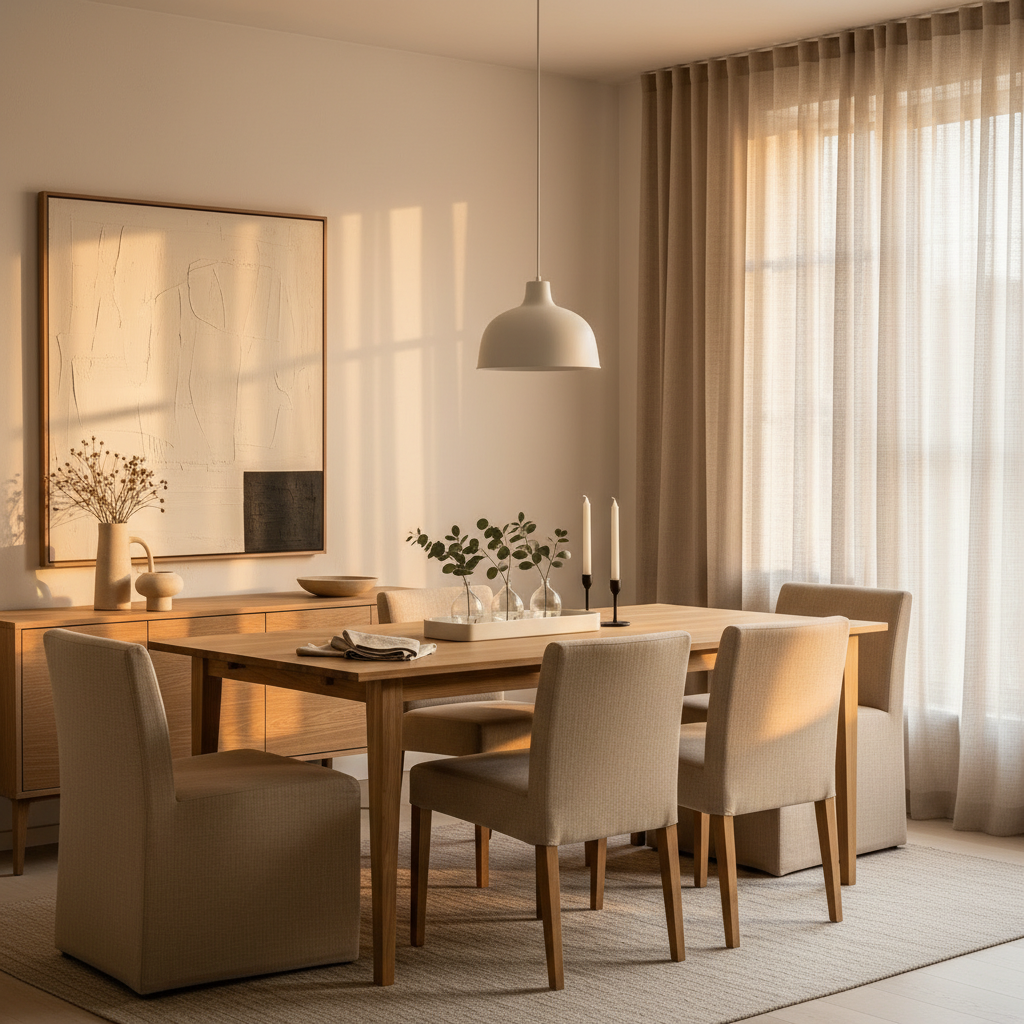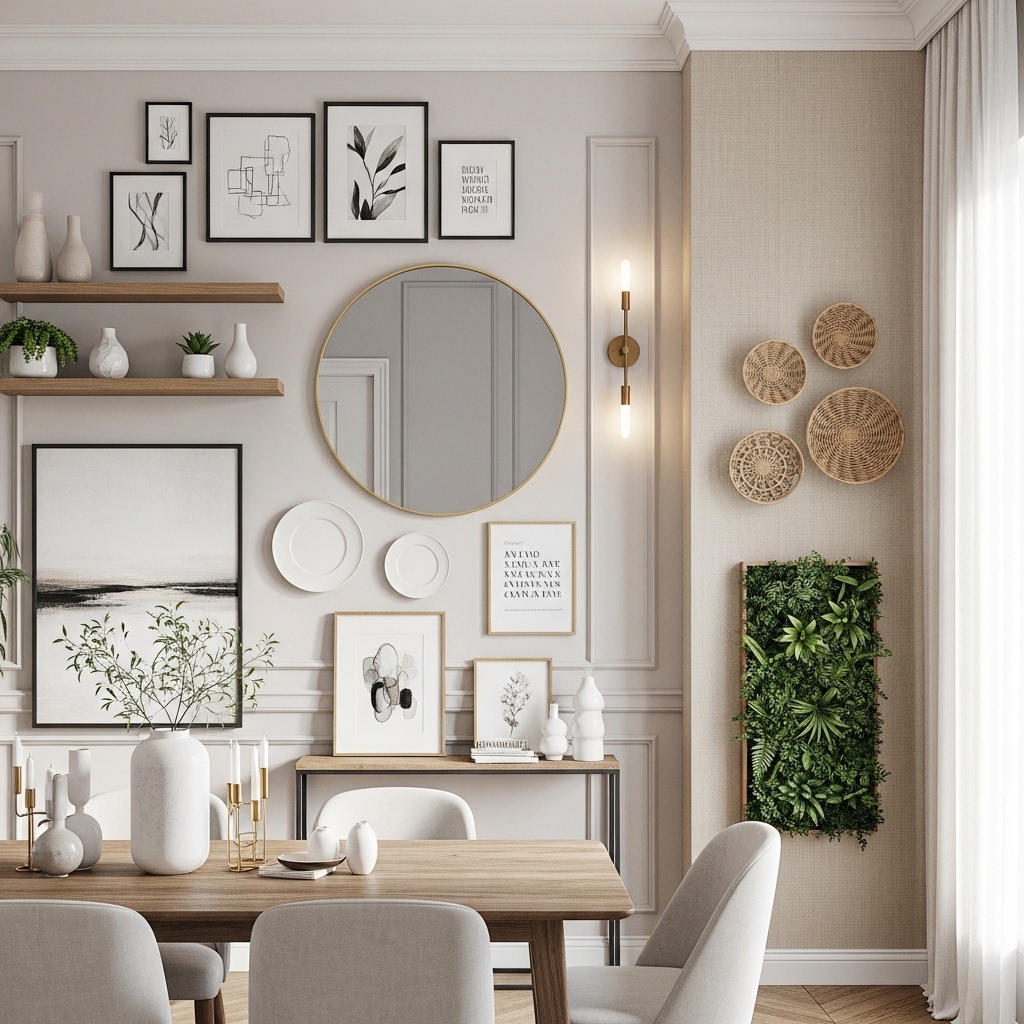
Large dining room walls are one of those decorating challenges that sound like a luxury problem — and technically they are — but they’re genuinely harder to solve than small walls. A small wall is forgiving. Put something on it and the room feels more complete. A large wall, left to its own devices, creates a specific kind of visual anxiety: the furniture feels adrift, the room feels unanchored, and no matter how beautiful everything else is, the eye keeps returning to all that unresolved space.
The instinct is usually to scale up — get a bigger piece of art, a wider mirror, a longer sideboard. That’s often right, but it’s not the only answer. Some of the most successful large dining room walls are solved with layering, with architectural intervention, with textile and texture rather than a single dominant object. These twelve ideas cover the full spectrum of approaches, from bold single-statement pieces to complex layered arrangements, so you can find the one that matches how your room actually lives.
1. An Oversized Abstract Painting That Commands the Room
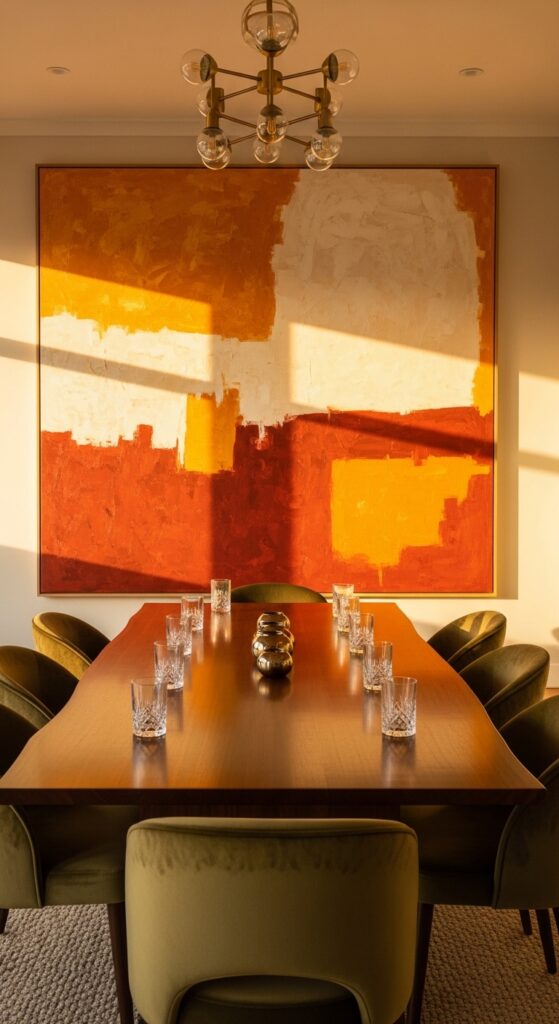
There is a version of “large wall art” that is timid — a 36-inch canvas on a 14-foot wall, floating helplessly in a sea of paint. Don’t do that. When you go for a single painting on a large dining room wall, you have to actually commit to scale.
An oversized abstract canvas — one that spans at least two-thirds of the wall’s width and rises to within 12 to 18 inches of the ceiling — transforms the entire room. It becomes the conversation piece, the color reference for everything else in the space, and the visual anchor that makes all the furniture below it feel deliberately placed rather than randomly arranged.
Abstract works best in large formats because the scale allows the composition to breathe. Landscapes and portraits can feel distorted when pushed to mural dimensions; abstraction only gets more interesting.
For color, choose a painting that pulls from at least one tone already present in the room — the wood of the table, the upholstery, even the floor. This connects the art to the space rather than making it feel imported from a gallery that has nothing to do with the room around it.
One watch-out: an overly busy, multi-colored abstract in a room that already has a patterned rug, wallpaper, or highly figured wood will create visual competition rather than harmony. In a layered room, go for a more tonal, restrained abstract. Save the bold multi-color work for rooms with quieter surroundings.
2. A Floor-to-Ceiling Gallery Wall With Intentional Curation

A gallery wall on a large dining room wall only works if it’s treated as a single unified composition rather than a collection of things that needed homes. The difference between a gallery wall that looks designed and one that looks like a flea market is almost entirely about the approach to frame cohesion and arrangement logic.
Start with frame consistency. Choose one or two frame finishes and don’t deviate — thin brass and natural oak work together; matte black and antique gold work together. The moment you introduce a third finish, the wall starts to look like it evolved without direction rather than being composed.
For a truly large wall — anything over 12 feet wide — the gallery needs to extend to the ceiling to feel proportional. A gallery that stops at 7 feet on a 10-foot wall leaves an awkward band of empty space above that no amount of art below will resolve. Embrace the full vertical run.
Mix scales deliberately: anchor the composition with two or three large pieces (at least 24 by 30 inches), fill the middle zones with medium pieces, and use small items — a tiny mirror, a small framed illustration — to complete corners and transitions. Everything over 4 inches of gap between frames will cause the arrangement to fragment visually.
One constraint: a floor-to-ceiling gallery wall requires a significant investment of time in planning. Lay everything on the floor first, photograph it from above, then transfer measurements to the wall using paper templates before making a single hole.
3. Dramatic Wallpaper on the Dining Room Accent Wall
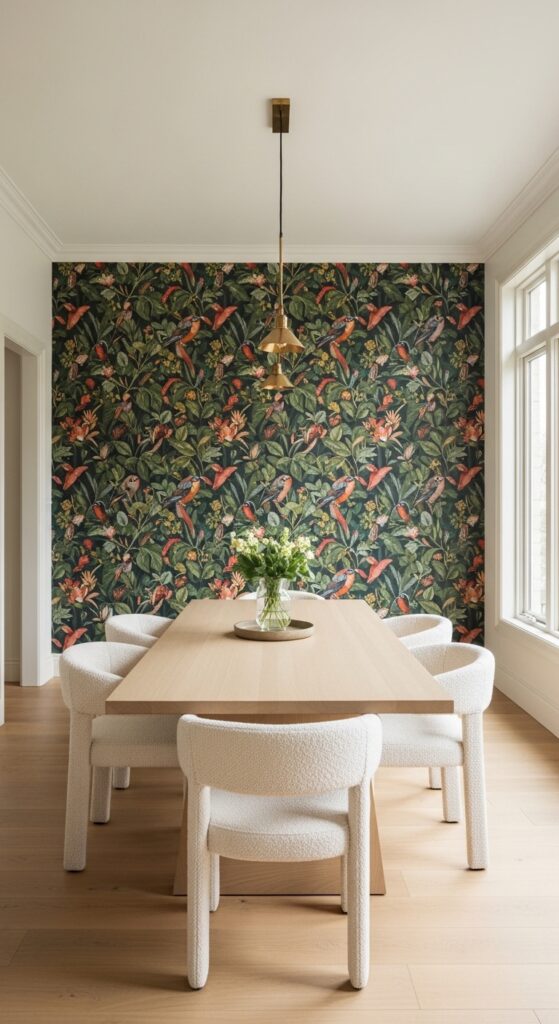
A single wallpapered accent wall on a large dining room scale is one of the most impactful things you can do to a room — but only if you choose the pattern with the understanding that at this scale, every design decision in the paper gets amplified.
The scale of the repeat matters enormously on a large wall. A small-scale pattern — delicate toile, narrow stripe, petite geometric — can look like visual noise when repeated across 12 or more feet of wall. Large dining room accent walls want large-scale patterns: oversized botanicals, bold geometric shapes, dramatic murals, wide-format stripes.
For color, the wallpaper should anchor the room’s palette rather than introduce new colors from outside it. A paper in forest green, terracotta, and gold works if the room already has at least two of those tones present in upholstery, wood, or accessories. A paper that introduces an entirely new palette is hard to harmonize with the existing space.
Installation advice: on a large wall, pattern alignment is critical. Even a slightly misaligned repeat becomes dramatically obvious at room distance. Hire a professional wallpaper installer for any large-scale, pattern-repeat work — this is not the project to DIY with an expensive paper.
One constraint: wallpaper is a commitment. If you move frequently or rent your home, consider peel-and-stick mural wallpaper — the quality has improved substantially and some products are genuinely convincing at room distance.
4. Architectural Panelling and Moulding as Wall Decor
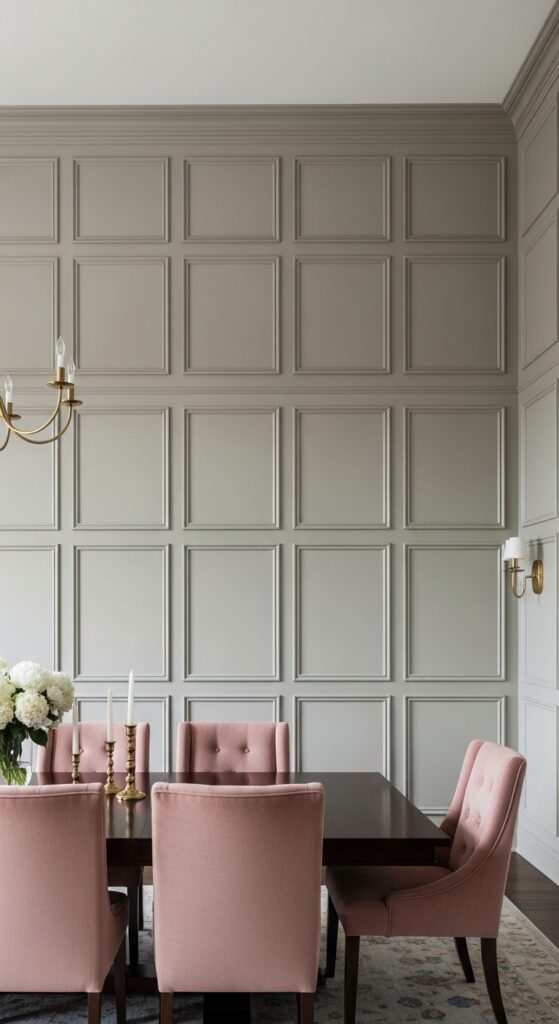
Here’s an approach that most decorating articles never mention: you don’t need to put anything on a large dining room wall if the wall itself has been made interesting enough through architecture. Full-height panelling — raised-panel moulding in a grid that runs from baseboard to crown — is a wall treatment that requires nothing hung on it to feel complete and considered.
This is classical interior design at its most disciplined, and it works particularly well in formal dining rooms where the furniture and lighting already have enough visual weight. The panelling provides rhythm, depth, and shadow-line without introducing additional color or pattern.
The panel proportions matter. A traditional formula: panels should be roughly twice as tall as they are wide. So a 9-foot wall with 36-inch-wide panels would have panels approximately 60 to 72 inches tall, with a horizontal rail dividing them somewhere around 36 inches from the floor. This creates a natural chair-rail relationship that’s been visually tested over centuries of interior design.
Paint color choice: a single matte tone painted over all the panelling — panel faces, stiles, rails, and crown — reads as contemporary and architectural. Painting the panel face a slightly different tone from the frame is more traditional. Both work; the choice depends on whether you want the texture to read as subtle or pronounced.
One watch-out: this approach requires either skilled carpentry or very high-quality MDF panel kits. Poor-quality moulding or visible nail heads will undermine the entire effect. Spend more on materials and installation — it’s a permanent addition to the house.
5. A Large-Scale Tapestry or Textile Wall Hanging
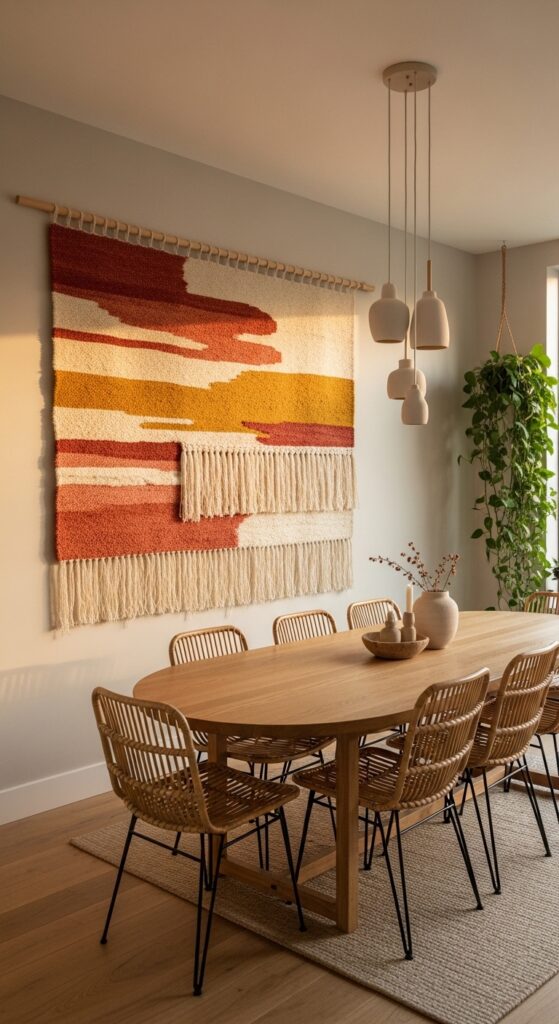
Textile wall hangings on a large dining room wall solve a specific problem that art and mirrors can’t: they introduce warmth, softness, and acoustic absorption in a single move. Hard-surfaced dining rooms with large walls, wood floors, and plaster ceilings can have significant echo problems — a large woven textile genuinely dampens sound in a way that a canvas painting or framed print cannot.
For a large wall, the hanging needs to be substantial — at least 60 to 80 percent of the wall’s width and proportionally tall. A large wall overwhelms a small textile; the piece needs genuine scale to anchor the space.
Hand-woven tapestries in natural fibers — wool, cotton, jute, or a blend — have the right visual texture for this application. The slight irregularity of hand-weaving reads as quality and craft at room distance. Machine-made versions can feel flat and slightly synthetic, even when the pattern is identical.
Mounting matters: a thick wooden dowel or a rough-hewn branch rather than a commercial curtain rod gives the hanging a more considered, gallery-quality feel. The dowel should extend an inch or two beyond the hanging on each side so the whole width is visible.
One constraint: large woven textiles attract dust and require periodic cleaning. Most can be gently vacuumed on a low setting; few can be washed without risk of shrinkage or distortion. Consider placement carefully if your dining room connects to a kitchen with significant cooking activity.
6. A Full-Wall Mural — Painted or Wallpaper Format
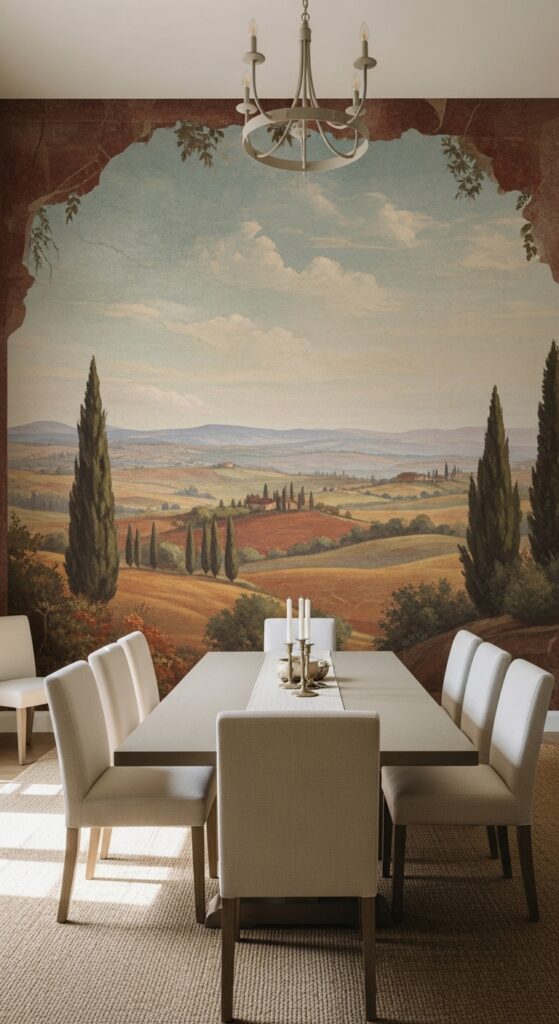
A full-wall mural is the most maximalist answer to a large dining room wall, and when it’s the right choice for the right room, it produces an effect that simply cannot be achieved by any other means. A well-executed mural doesn’t just decorate a wall — it dissolves it, replacing a flat surface with an implied world beyond the room.
Scenic murals with depth — landscapes, architectural vistas, forest scenes, cloudscapes — work especially well in dining rooms because they create an expansive visual experience that enhances the feeling of space during meals. The wall appears to recede rather than advance.
For style, faded fresco murals in muted, aged tones feel more sophisticated and durable in taste than photorealistic high-contrast murals, which can feel novelty-driven. A fresco-tone landscape in sage, terracotta, dusty blue, and warm ochre looks as appropriate in five years as it does today.
Hand-painted murals by a commissioned artist are the highest-expression version of this idea, and they can be remarkably affordable compared to other major interior investments. Get quotes from local artists — the results are often stunning and the piece is genuinely one of a kind.
Wallpaper murals in wide-format single-image prints are the more accessible option. The key is choosing a mural that’s been designed for large-scale output, with enough resolution that it doesn’t pixelate at room distance.
One constraint: murals are essentially permanent. Be very sure of the scene and palette before you commit — this isn’t a decision to make quickly or under showroom lighting.
7. Floating Shelves Styled as a Display Wall

Floating shelves across a large dining room wall are a practical and visual solution simultaneously — and that combination is genuinely rare in wall decor decisions. A single shelf above a sideboard is a supporting player; three tiers spanning the full wall length become the room’s primary decorative feature.
The key to making full-wall shelving read as design rather than storage is the styling philosophy. Think in terms of compositions within each shelf run, not just filling space. Each section of shelf should have a visual anchor — a large ceramic vessel, an oversized art book stack — surrounded by smaller complementary objects. Leave 30 to 40 percent of the shelf empty. Negative space is what separates a styled shelf from a storage shelf.
Oak shelving in a natural or lightly oiled finish works with almost every dining room palette and has the material weight to carry substantial objects without looking flimsy. Avoid glass shelves on a large wall — the visual lightness that works in small spaces reads as insufficient and slightly commercial at full wall scale.
Layer in some depth by leaning framed prints or mirrors against the wall on the shelves rather than hanging everything flat. This adds dimension and makes the arrangement feel less like a furniture showroom installation.
One honest constraint: a fully styled shelf wall at this scale requires regular maintenance. Objects accumulate dust, plants need tending, and the composition naturally drifts as things get moved. If you’re not someone who finds that kind of ongoing curation enjoyable, a simpler wall treatment will serve you better.
8. A Triptych of Large Framed Prints or Photography
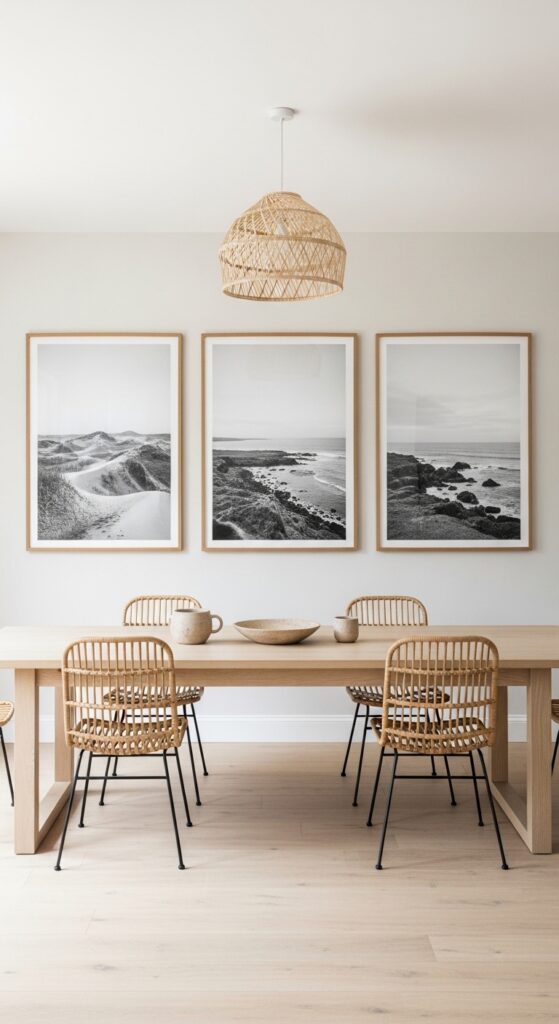
Three large prints hung as a triptych are simultaneously one of the simplest and most effective solutions for a large dining room wall — and they’re significantly easier to execute than a gallery arrangement because the rules are so clear. Three pieces, matching frames, consistent spacing, horizontal alignment at center. That’s essentially the whole brief.
What makes a triptych work on a large wall is scale. Each individual print should be large enough to command attention on its own — at least 24 by 30 inches, ideally 30 by 40 inches for walls over 12 feet wide. Three small prints in a row don’t read as a triptych; they read as three small prints.
The images themselves should have a clear visual relationship — same photographer, same color palette, same subject matter, or a sequential narrative. Three completely unrelated images in matching frames is a gallery wall with only three pieces, not a triptych. The thematic connection is what gives the arrangement its compositional authority.
Black and white photography is the most compositionally safe choice for triptych dining rooms because it introduces texture and depth without adding color variables. That said, three large botanical prints in soft watercolor tones, three abstract canvases in the same palette, or three landscape photographs in coordinated warm tones all work beautifully.
One watch-out: precise horizontal alignment is non-negotiable in a triptych. Even a half-inch of variation between the center lines of adjacent frames is immediately visible and distracting. Use a level, measure twice, and consider having a second person verify before driving any nails.
9. Wainscoting Plus Bold Paint Plus Oversized Mirror Combination
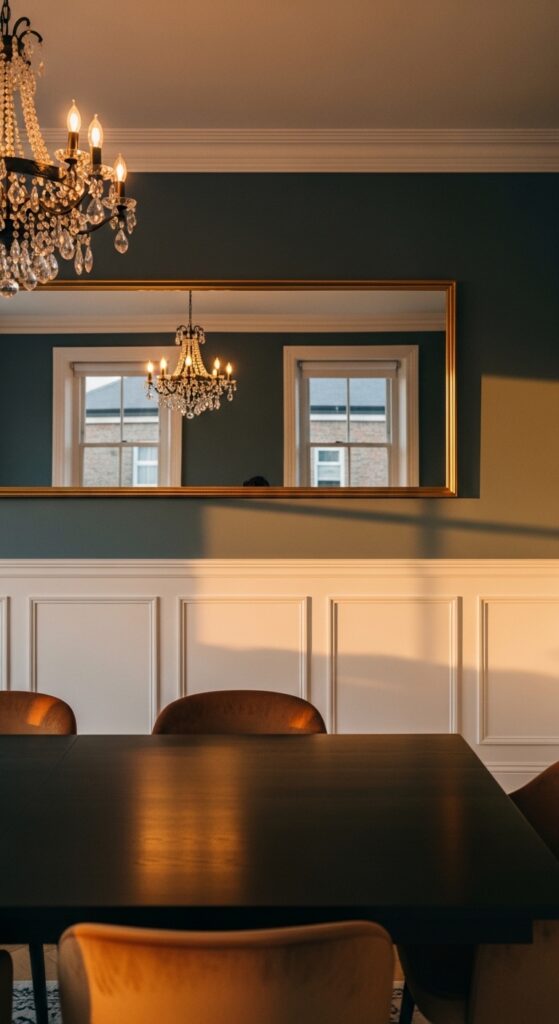
This is a three-part wall treatment that does something none of its individual components can do alone: it gives a large dining room wall genuine architectural completeness. Wainscoting provides the base, bold paint provides the depth and color, and an oversized mirror provides the reflective light and visual expansion.
The proportions: wainscoting to chair-rail height (32 to 36 inches), bold paint from there to the ceiling. The mirror should be centered in the upper painted section and scaled so that its width is roughly half to two-thirds the wall’s total width. Any narrower and it looks lost in all that paint; the same width as the wall begins to compete with the wainscoting below.
For the mirror frame, a gilt or burnished gold profile in an ornate style works best against a deep-toned wall — it reads as a piece of furniture rather than just a reflective surface. Against a lighter wall, a thin natural wood or matte metal frame is more appropriate.
The paint color in the upper section should be confident. Dusty teal, deep sage, terracotta, charcoal, or navy — these are the tones that justify the effort of this three-part treatment. A pale or mid-tone color between wainscoting and mirror will make the whole composition feel irresolute.
This combination works best in rooms with ceilings of 9 feet or higher. In an 8-foot room, the proportions become compressed and the three elements start to crowd each other.
10. A Large Ceramic or Sculptural Wall Installation
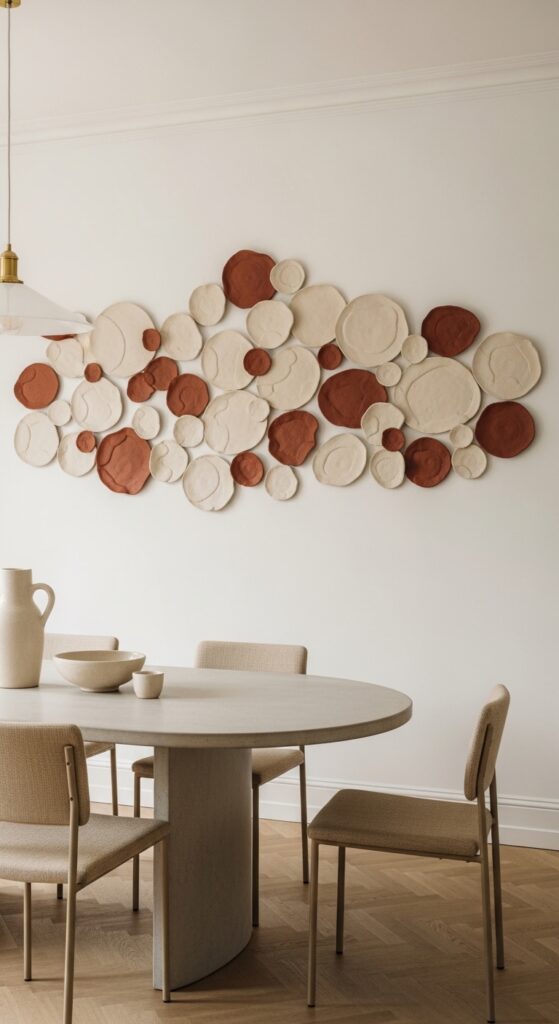
Three-dimensional wall installations — ceramic pieces, sculptural objects, carved wood panels, or layered metal works — are still relatively rare in dining rooms, which is precisely why they’re so effective when done well. In a world of flat art and framed prints, something that casts its own shadows and changes appearance as light moves through the day feels genuinely original.
Ceramic wall installations in particular have the right material quality for a dining room: their handmade irregularity, their matte or subtly glazed surfaces, and their connection to the traditions of vessels and tableware give them a specific thematic resonance with the function of the room.
When sourcing or commissioning a ceramic wall piece for a large wall, think about it as a composition with an organic center of gravity — denser in the middle, tapering at the edges — rather than a rigid geometric arrangement. The organic approach reads as more artisanal and less corporate.
Color should relate to the room: cream, terracotta, and sand pieces belong in warm-toned dining rooms; slate, ash, and pale grey pieces work in cooler, more contemporary spaces.
One practical constraint: individual ceramic wall pieces need to be individually anchored to the wall with appropriate hardware. This is not a one-afternoon project, and the planning phase — determining arrangement and drilling positions — takes longer than the actual installation. Budget accordingly, and consider having the artist install their own work if that option is available.
11. Vertical Wood Cladding or Slatted Panels as a Feature Wall
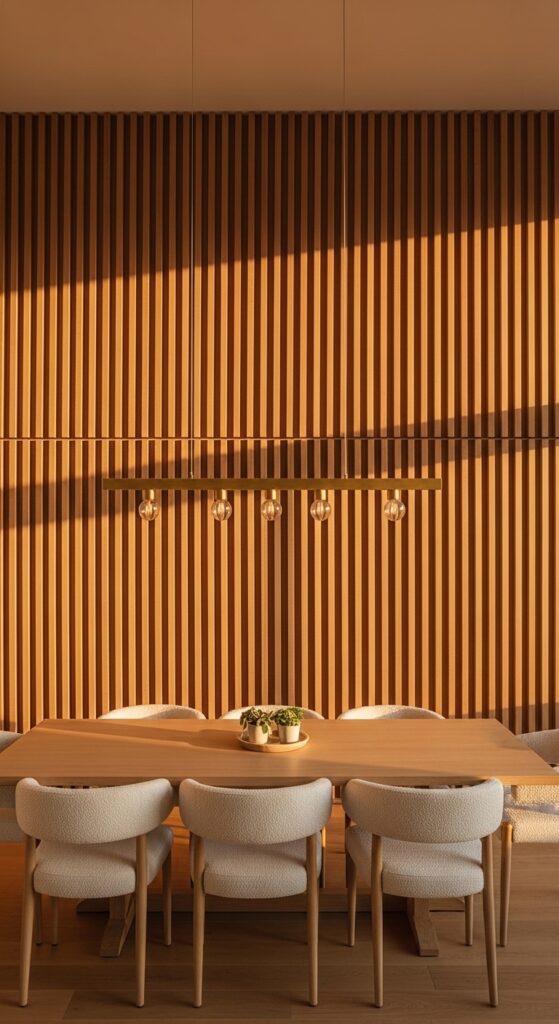
Vertical wood slatting — evenly spaced narrow panels running floor to ceiling — is one of the most quietly sophisticated wall treatments available for a large dining room, and it’s underused in ways that genuinely surprise me. It’s architectural without being formal, warm without being rustic, and it adds acoustic dampening as a bonus.
The visual effect of vertical slats on a large wall is a rhythmic play of light and shadow that changes throughout the day as light moves across the room. In morning light, the shadows fall one direction; by late afternoon, they reverse. The wall is never static, which gives the room an energy that flat paint simply cannot match.
Oak is the natural choice for dining rooms — its warm grain tone relates to dining table finishes and wooden furniture without being identical. The slats should be finished with a light natural oil rather than varnish, which gives the wood a tactile matte quality that’s appropriate to the application.
Spacing between slats is a design decision: tighter spacing (half an inch to one inch) reads as more refined and contemporary; wider spacing (one and a half to two inches) is more casual and shows more wall behind, which can be painted in a contrasting or complementary tone for additional depth.
One watch-out: vertical slatting on a wall that’s more wide than tall can accidentally visually widen the room rather than lifting it. If your dining room has proportionally low ceilings relative to its width, consult with a designer before committing to full-wall vertical slatting.
12. A Curated Sideboard Wall With Art, Mirror, and Objects
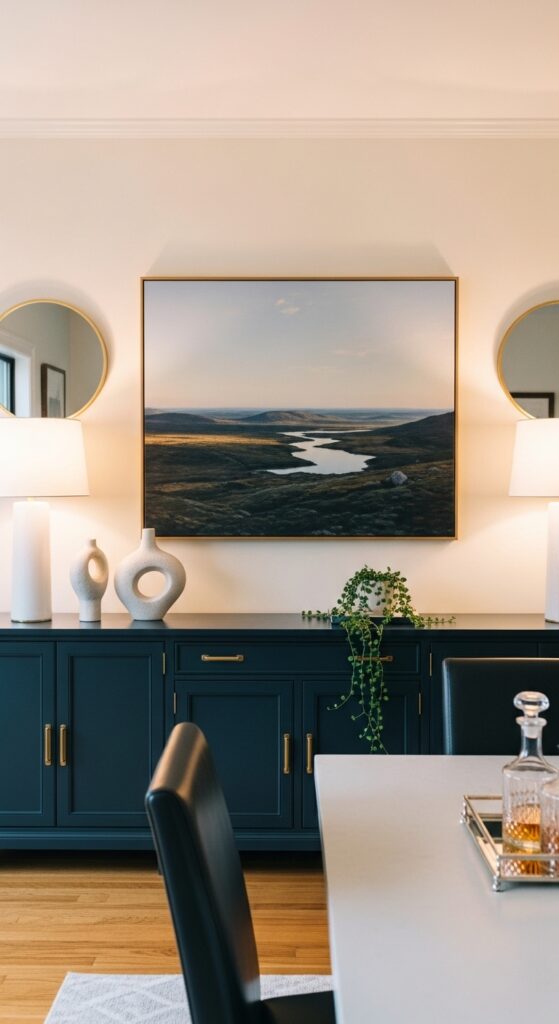
Sometimes the most effective solution for a large dining room wall isn’t a single dramatic gesture — it’s a layered composition that combines furniture, art, mirror, and styled objects into a unified vignette that reads as a whole. The sideboard wall, when properly composed, is the most complete expression of this idea.
The layering logic works in levels: the sideboard provides the base, table lamps and taller objects on the surface create the middle layer, and art or mirror hung above provides the upper layer. Each level serves a different function — the sideboard is storage and display, the lamps provide ambient light, the art anchors the eye at height.
For the art-and-mirror combination above the sideboard, the arrangement that works most consistently on a large wall is a single large painting centered with a mirror on each side. The mirrors add width, reflect the dining table’s candlelight, and frame the central painting without competing with it.
Lamp placement: position table lamps so their shades sit at roughly 66 to 70 inches from the floor — this places them at a height that illuminates the wall surface above the credenza without the glare that comes from a lamp shade at eye level when seated.
One constraint: the sideboard must be properly scaled to the wall. A 60-inch credenza on a 14-foot wall looks marooned. For large walls, look for sideboards in the 84- to 96-inch range, or consider two identical units placed together — a common designer trick for achieving the right width without the cost of custom furniture.
Filling a Large Wall Is Really About Respecting the Space
The single most important thing to understand about large dining room walls is that scale isn’t just about size — it’s about the relationship between the wall, the room, and the life being lived in it. A wall treatment that’s technically too large for a small room is exactly right for a large one. A detail that reads as subtle in a compact space becomes invisible against a 14-foot expanse.
What unites all twelve of the ideas in this article is that each one takes the wall seriously as a design surface rather than treating it as a backdrop. The walls of a dining room are visible during every meal, every conversation, every occasion the room is used for. They deserve the same level of thought as the table, the lighting, and the seating.
If you’ve found an idea here that resonates, the next step is always the same: measure carefully, plan the composition on paper or digitally before committing, and scale up more than your instinct tells you to. Large walls consistently reward boldness and punish timidity. Trust that, and your dining room will be better for it.