Walls in a farmhouse dining room are doing more work than they get credit for. The furniture gets all the attention — the reclaimed table, the mismatched chairs, the vintage sideboard — but it’s the walls that set the room’s emotional register. Get them right, and everything else clicks into place. Get them wrong, and even the most beautiful furniture arrangement feels like it’s floating in an undefined space.
The challenge with farmhouse wall decor specifically is avoiding the version of it that feels assembled from a single shopping trip to a chain home store. That particular iteration — the word-art signs, the identical galvanized metal frames, the “gather” typography printed on burlap — has aged badly and it aged fast. What holds up is the approach that treats walls the way you’d treat any other element of a collected, thoughtful interior: with patience, with genuine materials, and with a willingness to let the room evolve over time rather than finishing it all at once.
These twelve ideas will give you a real roadmap for farmhouse dining room walls that feel genuinely considered.
1. An Oversized Antique or Vintage Clock
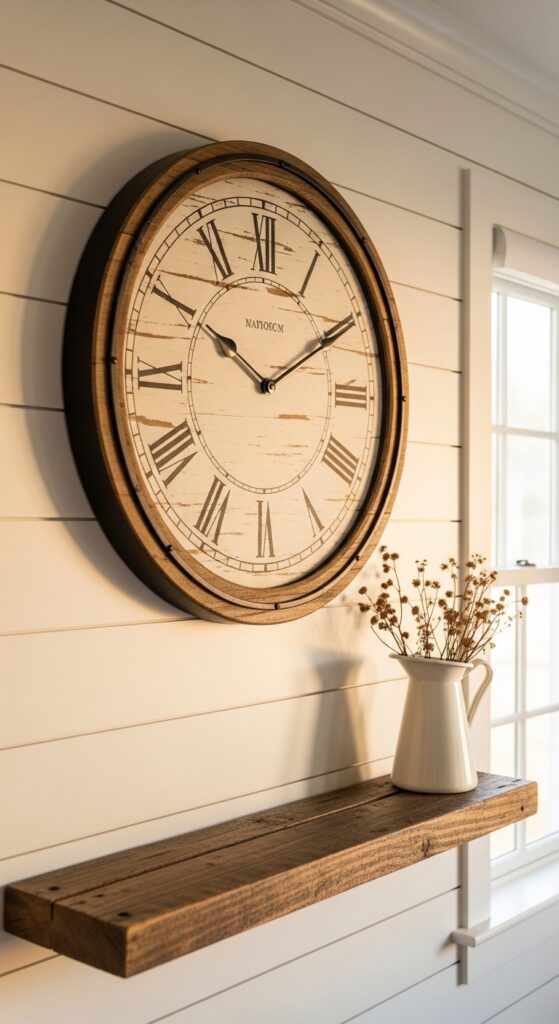
An oversized vintage clock on a farmhouse dining room wall is one of those decor decisions that feels almost too obvious until you see it done well — and then you understand why it keeps appearing in every well-styled farmhouse interior. The scale, the circular form, the suggestion of age: a large clock anchors a wall with an authority that most framed art simply can’t match.
The sizing rule here is go bigger than feels comfortable. A clock that seems slightly too large in the store will almost always read as just right once it’s on the wall. For a standard dining room wall, aim for a diameter between sixty and eighty centimeters. Smaller than that and the clock becomes a decoration; larger and it becomes the room’s architectural feature.
Choose a clock with a genuine aged quality — a distressed face, slightly worn paint, visible patina on any metal elements. A brand-new clock with an artificially distressed finish is detectable and reads as costume-y. If you can find an actual vintage piece at an estate sale or antique market, the real age is always worth the effort.
One constraint: a large clock demands wall space with enough breathing room around it. If your dining room wall is broken up by windows, doors, or built-ins, you may not have a suitable uninterrupted surface. In that case, a medium-scale clock grouped with smaller complementary pieces works better than forcing a large single piece into a fragmented space.
The right clock makes a wall feel finished before you add anything else.
2. A Shiplap Accent Wall With Floating Shelves
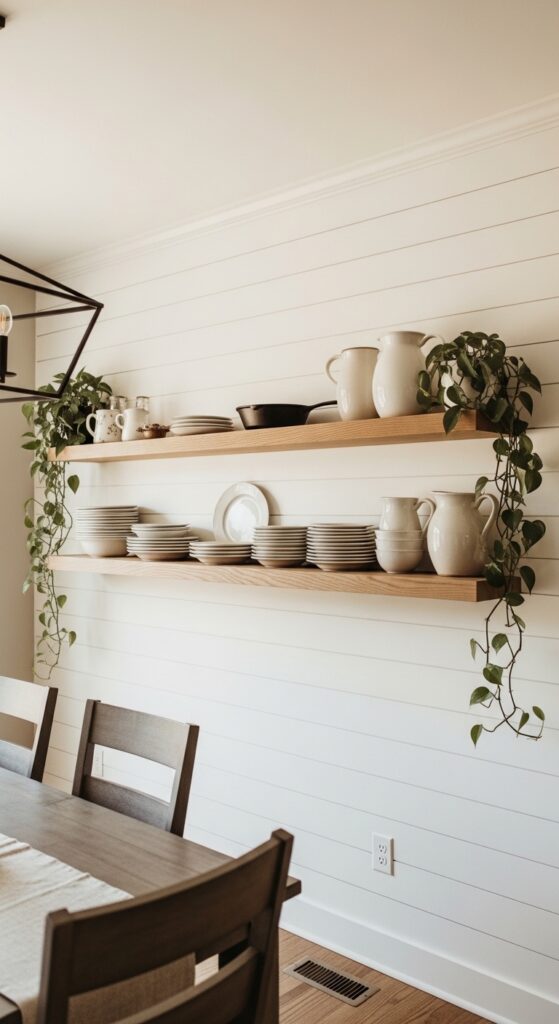
Shiplap and floating shelves together are one of the great farmhouse wall combinations, and the reason they work so well is that they solve two different problems simultaneously. The shiplap brings texture, warmth, and architectural character to a plain wall. The floating shelves give you a display surface that makes the wall three-dimensional and genuinely functional.
Use oak, walnut, or pine shelves in a natural or lightly oiled finish — the wood grain should be visible and warm. Avoid painted shelves on a shiplap wall; the two painted surfaces compete and flatten the overall effect. The contrast between the painted horizontal planks and the natural wood shelf is exactly what creates visual interest.
Style the shelves with the kinds of objects that belong in a farmhouse dining room context: stacked vintage plates in varied cream and white tones, ceramic pitchers in earthy glazes, a cast iron skillet, a wooden bread board leaned casually against the wall. Add one trailing plant — pothos or ivy — to soften the shelf’s edge and bring organic life to what could otherwise feel like a static display.
Shelf height matters more than people think. Mount the lower shelf at roughly eye level when seated, so the display reads correctly from the dining table. A shelf mounted too high turns into something you see when standing in the doorway but never notice during the meal itself.
One watch-out: open shelves collect dust with remarkable efficiency. If you’re not a natural tidier, floating shelves in a dining room will require weekly maintenance to stay looking good.
3. A Gallery Wall of Botanical Illustrations
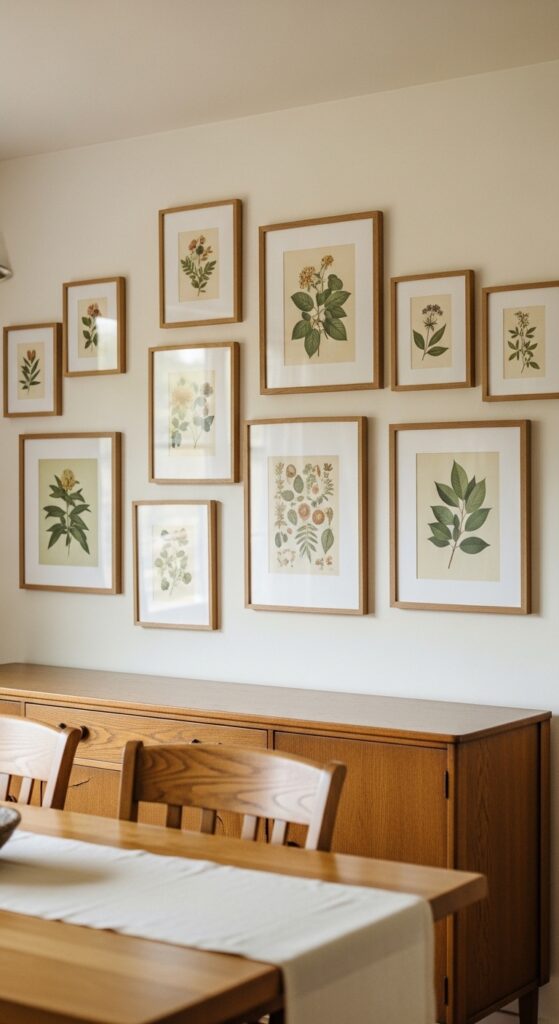
Botanical illustration as gallery wall content is genuinely timeless in a way that a lot of art print trends simply aren’t. The subject matter — hand-drawn plants, herbs, seed studies, pressed flower diagrams — connects naturally to the farmhouse aesthetic’s roots in agricultural and domestic life, and the muted, scholarly palette of classic botanical prints works with virtually every wall color and furniture tone.
The arrangement should be asymmetrical. A rigid grid of evenly spaced identical frames looks more like an office wall than a farmhouse one. Instead, anchor the arrangement with one or two larger pieces — perhaps an A3 or larger botanical study — and build outward with progressively smaller frames. The overall shape of the arrangement can be irregular; what matters is that it reads as a unified group rather than a scattered collection.
Frame consistency is more important than frame uniformity. Choose frames in a shared family of finishes — natural oak, light walnut, unfinished wood — in varying widths and profiles. Keep the mat boards consistent: all warm white or all natural cream. This gives the gallery wall coherence without making it look like a matched set.
For the prints themselves, vintage botanical illustrations are available as high-quality public domain downloads, which means you can print and frame an entire gallery wall for the cost of the frames alone.
One constraint: a gallery wall requires committing multiple holes to the wall. For renters, adhesive hanging strips in appropriate weight ratings are a legitimate alternative — just be realistic about the weight of each frame.
Botanical prints age with the room. Add one new piece each year and the wall tells a story.
4. A Reclaimed Wood Plank Feature Wall
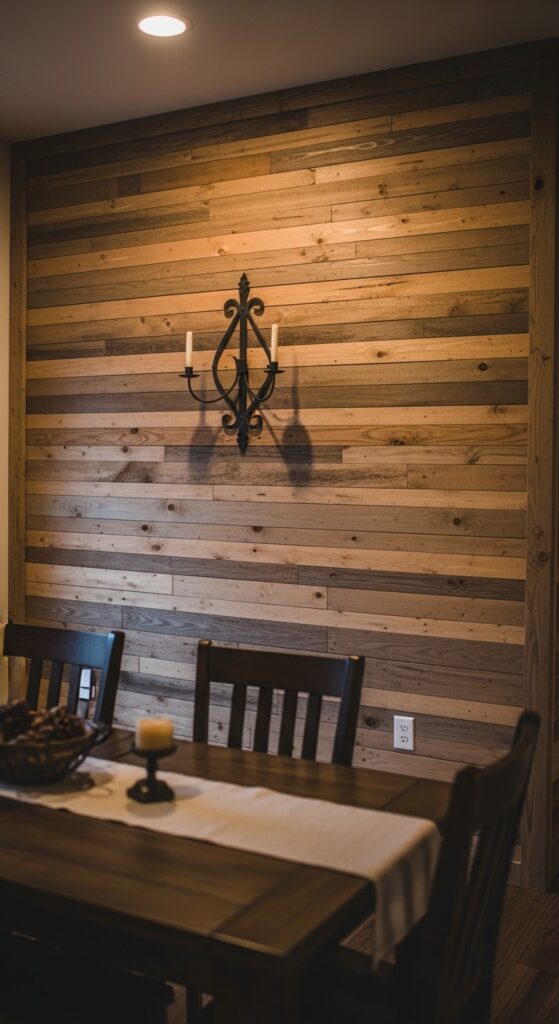
A reclaimed wood plank wall is the most committed version of the farmhouse accent wall — more textural than shiplap, more materially honest, and significantly more dramatic. The color variation between planks, the natural weathering, the occasional visible nail holes and saw marks: these are qualities that shiplap painted white simply doesn’t have, and in the right room they’re extraordinary.
The most important decision is sourcing. True reclaimed wood — salvaged from barns, factories, old buildings — has a character that new wood artificially distressed cannot replicate. The patina is different, the grain is different, even the smell is different. If you have access to a reclaimed wood supplier, this is worth the extra effort and cost.
Installation runs horizontally for the most traditional farmhouse reading. Varying the plank widths slightly — mixing six-inch and eight-inch boards, for instance — creates a more authentic, assembled-over-time quality that uniform-width planks don’t have.
Keep the rest of the room simple when you have a reclaimed wood feature wall. This surface has enough visual information on its own that it doesn’t need competing elements. A simple iron sconce or two mounted directly to the planks is the right hardware choice — it complements the rough texture without overcrowding it.
One honest watch-out: reclaimed wood walls are permanent. This is not a renter-friendly option, and it’s not easily reversed if your taste changes. Be certain before you commit.
5. An Antique Mirror With a Wooden Frame
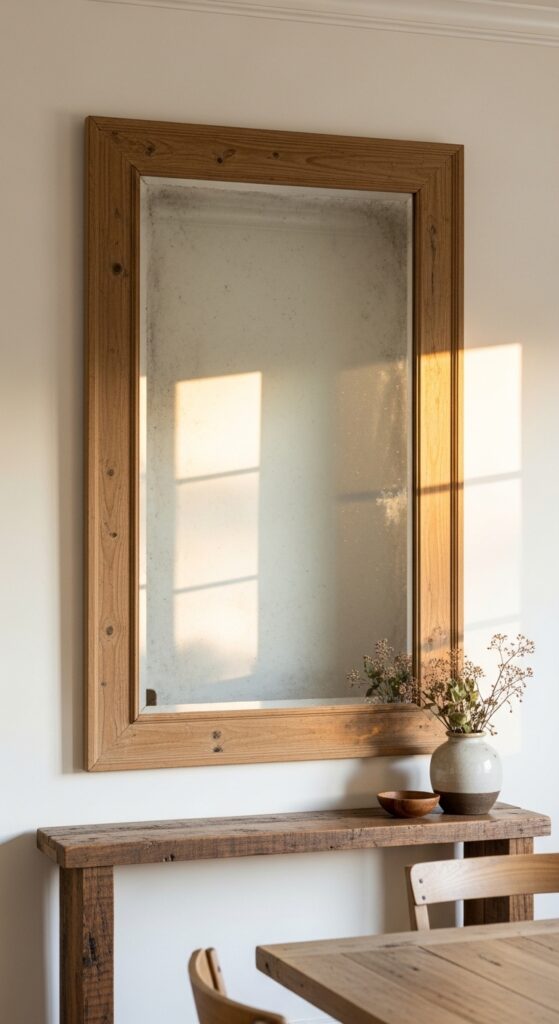
Mirrors in dining rooms serve a function that goes beyond reflection — they amplify light, extend the perceived depth of the room, and in a north-facing dining room that struggles with natural light, a large mirror on the wall opposite the window is one of the most effective tools available. A vintage or antique mirror with a wooden frame brings all of this functionality while fitting perfectly into the farmhouse material vocabulary.
The frame is the critical element. An ornate gilded frame belongs in a different aesthetic entirely; a distressed or natural wood frame — wide, substantial, slightly imperfect — grounds the mirror in the warmth of the farmhouse vernacular. Look for frames made from oak, pine, or reclaimed wood, either in a natural finish or with a very lightly whitewashed treatment.
The glass itself should have some age or character to it. Antique mirrors with foxed or slightly wavy glass catch light differently than modern mirrors and have an irreplaceable warmth. If you’re working with a new mirror, a slightly antiqued glass option is available from most custom mirror suppliers and is worth specifying.
Size up. A mirror that feels appropriately large in a showroom will often feel modest once it’s on your dining room wall. For a standard dining room, aim for a mirror at least thirty inches wide — larger if the wall allows.
One constraint: a large mirror directly opposite a busy or cluttered area of the room will reflect that disorder. Position it to reflect the room’s best angle — the window, the table, the light.
6. Woven Wall Baskets in an Organic Arrangement
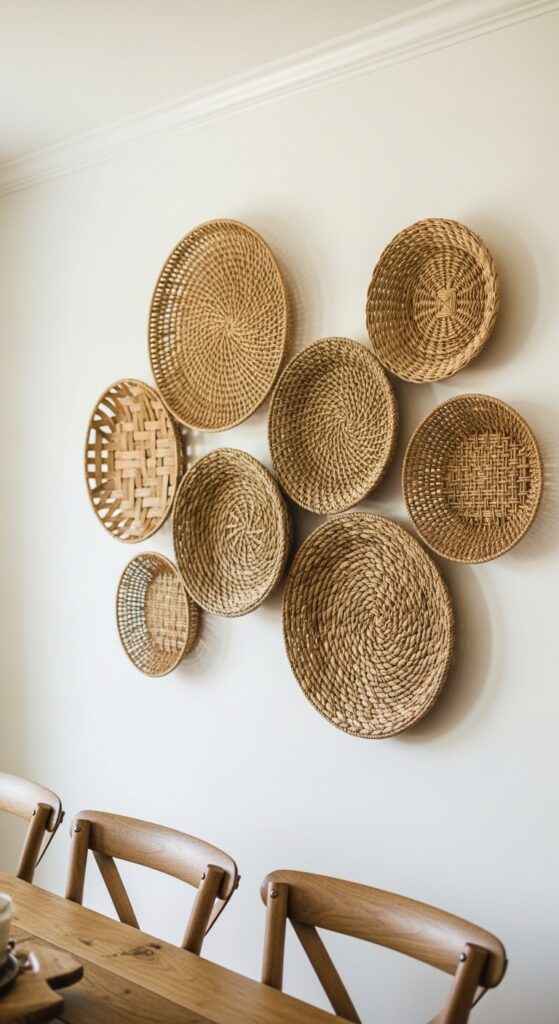
Woven wall baskets are having a genuine moment in farmhouse and natural interior design, and unlike some trends that feel borrowed from a specific era, this one has real staying power. The reason is material: rattan, seagrass, and wicker are natural, tactile, and carry the kind of humble craftsmanship that the farmhouse aesthetic celebrates. A collection of woven baskets on a dining room wall is simultaneously art, texture, and a nod to traditional domestic craft.
The arrangement is organic by nature — that’s the whole point. Unlike a gallery wall where the frames provide visual order, a basket wall works precisely because the forms are irregular. Hang them at varying heights, overlapping slightly at the edges, mixing different weave patterns and basket depths. Some flat, some with more three-dimensional form. The variation creates the richness.
Color matters more than you’d expect. Natural, undyed rattan and seagrass in warm honey and tan tones read warmest. Darker, more weathered baskets add depth but can make the arrangement feel heavier. Mixing both creates the most interesting arrangement.
The sizing principle: vary dramatically. One large basket — eighteen inches or more — anchors the arrangement. Several medium pieces fill the composition. A few small ones (eight to ten inches) complete the edges. Without this scale variation the arrangement reads flat and repetitive.
One watch-out: woven baskets collect dust in their weave. In a dining room, where cooking vapors travel, plan to take them down for a gentle clean a couple of times a year.
7. A Large-Scale Farmhouse Sign or Typographic Wood Art

Let me be honest about this one: farmhouse typography wall art has a well-earned reputation for being the most clichéd element of the entire aesthetic. The word “gather” stenciled on a pallet board is genuinely exhausted as an idea. But the underlying instinct — a large-scale text element that brings graphic weight and personal meaning to a dining room wall — is sound when it’s executed with real restraint and genuine craft.
The difference between typography art that works and the version that doesn’t comes down to three things: scale, typography quality, and word choice. A single word or very short phrase in a well-proportioned serif typeface on a large reclaimed wood board reads as design. A busy inspirational quote in a curly script on a medium-sized board reads as craft fair.
Choose words with actual resonance for your household — a family name, a meaningful place, a single concept that genuinely connects to how the room is used. The most enduring examples I’ve seen use proper nouns rather than generic sentiments.
The wood surface is as important as the lettering. Wide-plank reclaimed pine or oak with visible grain and natural imperfections gives the text a material context that elevates the whole piece. Smooth MDF with a faux wood grain finish does the opposite.
One constraint: this is a very specific style commitment. If your aesthetic evolves, a large typographic piece is harder to work around than neutral art. Buy it because the words mean something, not just because the style fits right now.
8. Framed Vintage Maps or Architectural Prints

Vintage maps and antique architectural drawings are one of the most underused categories of farmhouse wall art, which makes them one of the most interesting choices right now precisely because they don’t read as expected. A large framed topographic map or an architectural elevation drawing brings intellectual warmth to a dining room — the sense that the people who live here are curious about the world — in a way that botanical prints and farmhouse signage simply don’t.
The most effective approach is choosing maps with personal relevance: the region where your family has roots, the town where the house is located, a coastline or landscape that means something specific to the household. This transforms what could be a purely decorative choice into something genuinely meaningful.
For framing, keep it simple and consistent with the farmhouse material palette. Dark walnut frames on a warm white wall, or natural oak frames on a greige wall — the frame should honor the aged quality of the print without competing with it. Wide mat boards in cream or warm white give the prints space to breathe and make even a mid-sized print read as significant.
Scale up on the central anchor piece. A map framed at A2 or larger has genuine presence; anything smaller starts to look like an afterthought.
One thing to watch: highly saturated or brightly colored modern map reproductions read as children’s room art rather than farmhouse decor. Stick to antique, sepia-toned, or muted-palette originals and reproductions.
The right map makes people stop and look — which is exactly what good wall art should do.
9. A Wreath as a Permanent Wall Feature
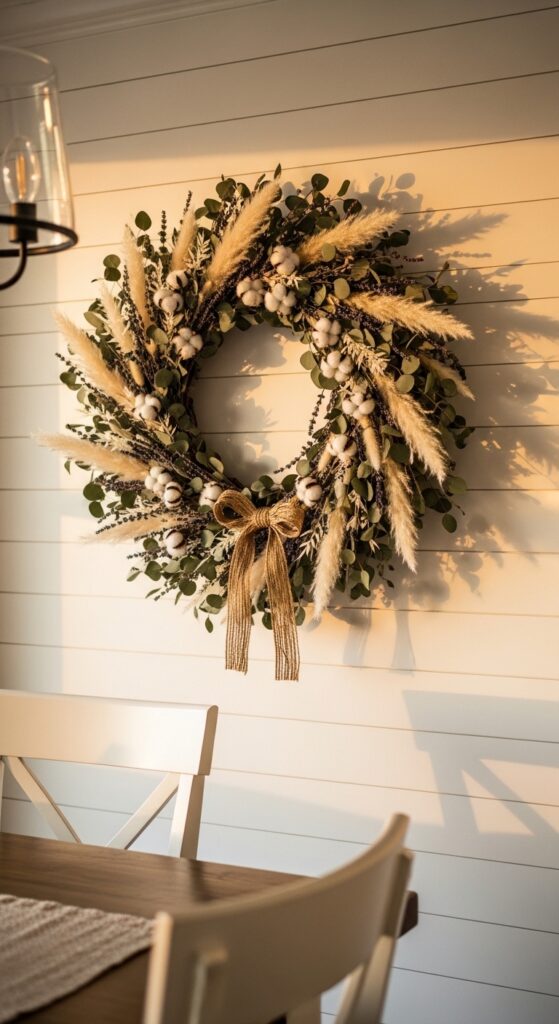
Most people think of wreaths as seasonal objects — something you put up for a month and take down again. But a large, well-made dried botanical wreath used as a permanent wall feature is a genuinely elegant idea that works year-round and brings a quality of organic warmth to a wall that framed art simply doesn’t achieve.
The scale needs to be generous for this to read as a wall feature rather than a holiday decoration. A wreath under forty centimeters in diameter will look small and seasonal. Something in the fifty to seventy centimeter range has enough presence to function as the room’s primary wall element.
The material composition is what gives the wreath its longevity and its character. Dried pampas grass, preserved eucalyptus, cotton stems, dried lavender, and bleached botanicals all hold their form for months to years with minimal care. Avoid fresh materials for a permanent installation, obviously — but also avoid silk or artificial botanicals, which never achieve the softness and warmth of genuinely dried natural material.
Hang it with a simple loop of jute twine or a leather cord rather than a standard picture hook. The hanging material is visible and contributes to the overall aesthetic — it should be as considered as everything else.
One constraint: dried botanicals are fragile. In a high-traffic dining room where people brush past walls, a wreath at shoulder height will shed and degrade faster than one mounted higher up. Position it where it can be seen but not accidentally disturbed.
A great dried wreath is a year-round presence that changes subtly as it ages, which is its own kind of beauty.
10. A Wooden Floating Shelf With a Curated Vignette
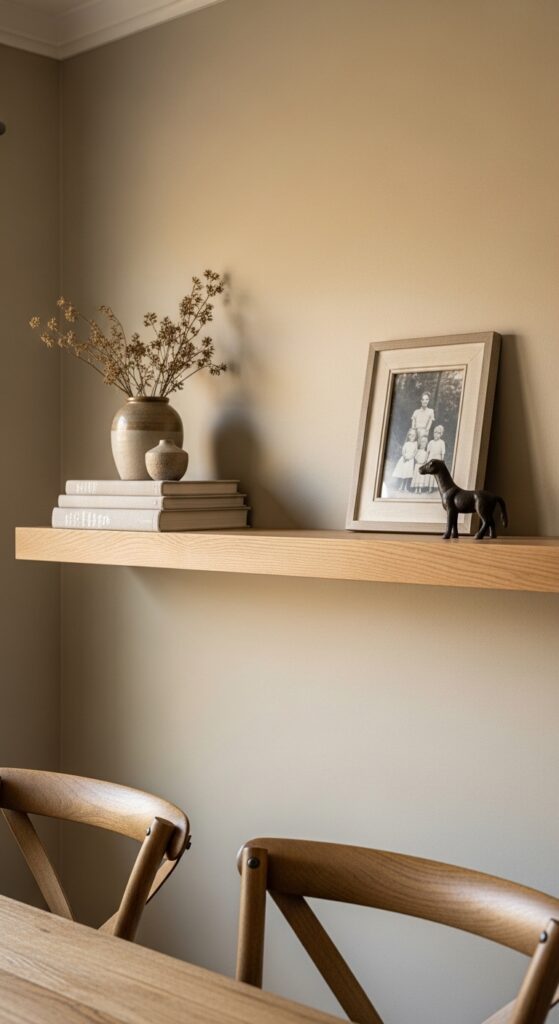
A single floating shelf, styled with genuine intention, is one of the most quietly effective wall decor strategies in a farmhouse dining room. It sits in a specific sweet spot between art and furniture — it’s not a piece that demands attention the way a large framed print does, but it adds dimension and personality to a wall in a way that flat art doesn’t.
The shelf itself should be substantial. A thin shelf — anything under two inches in depth — looks inadequate for this application. A thick, chunky oak or pine plank with a natural or lightly oiled finish has the visual weight to anchor the vignette it’s meant to carry. Live-edge shelves in natural wood are a particularly beautiful option for farmhouse contexts because the organic edge profiles add character without requiring additional styling.
The vignette edit is everything. Three to five objects, maximum. A small stack of books with interesting spines or linen covers. One ceramic or stoneware vessel with a simple dried stem. A framed photograph or small artwork leaned casually against the wall. One object with texture — a small woven basket, a smooth stone, a piece of aged iron. The negative space between the objects is as important as the objects themselves.
Change the vignette seasonally rather than redesigning the whole wall. Swap the vessel’s contents, add a seasonal botanical, replace one object with something new. The shelf becomes a living element of the room rather than a fixed installation.
One watch-out: a styled shelf in a dining room is in close proximity to cooking vapors and meal activities. Dust and grease can accumulate faster than you’d expect — factor in a monthly wipe-down as part of the maintenance.
11. Limewash or Textured Paint as the Wall Decor Itself
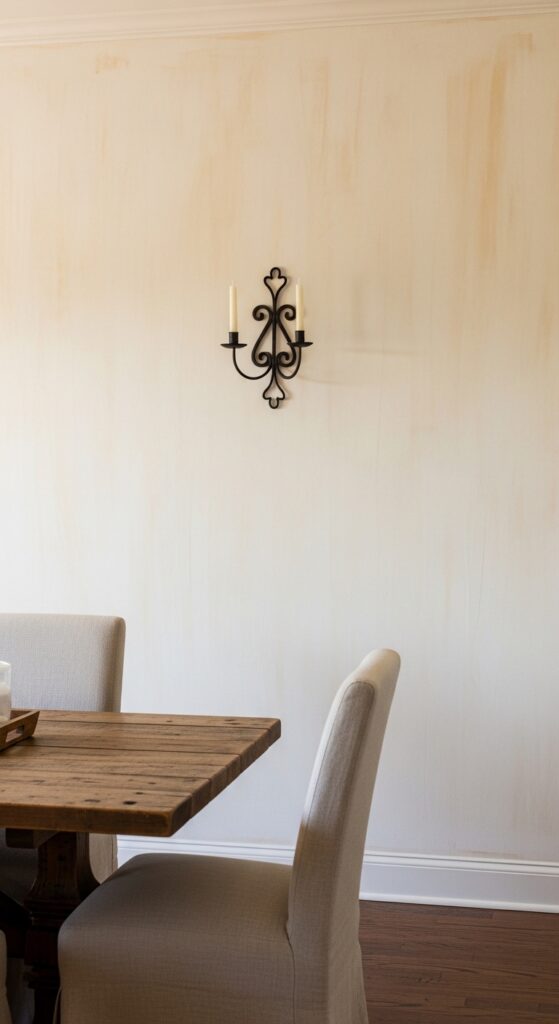
Here’s a genuinely contrarian take: sometimes the most beautiful wall in a farmhouse dining room is one with nothing on it — or almost nothing — where the wall’s own texture and finish do all the decorative work. Limewash and venetian plaster finishes have experienced a significant revival recently, and for good reason. Applied well, they bring a quality of warmth, age, and organic variation that no paint color on a smooth wall ever achieves.
Limewash is the more accessible of the two techniques. It can be applied over existing paint in many cases and doesn’t require the skim-coat preparation that venetian plaster does. The characteristic depth comes from the application method — multiple thin layers brushed on and partially wiped back, creating subtle color variation across the wall surface that responds beautifully to directional natural light.
The color selection is critical. Warm white, off-white, and very muted ochre or clay tones work best in a farmhouse dining room context. The undertones should read warm — avoid anything with grey or blue undertones, which will fight with wood tones and warm textiles.
With a limewash wall, the rest of the room’s decor needs to be considered rather than dense. A single iron candle sconce, a large wreath, or one significant framed piece is enough. You’re not decorating over the wall — you’re letting the wall be the decor.
One practical note: limewash finishes are not as wipeable as standard paint. In a dining room where food-adjacent activities happen near walls, consider limiting the limewash finish to walls that aren’t directly adjacent to the table.
12. Layered Mirrors in Mixed Vintage Frames
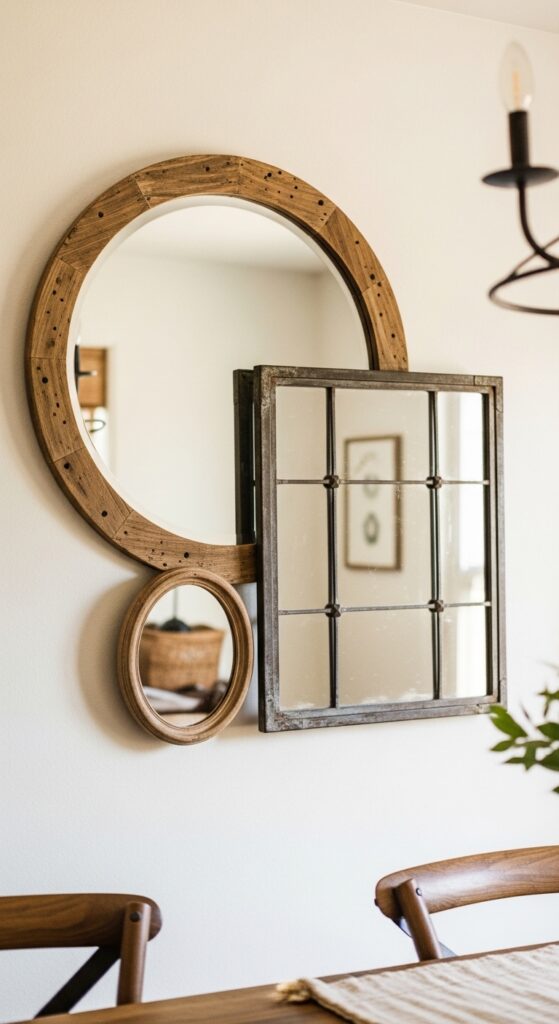
A single large mirror works beautifully on a farmhouse wall — but a layered arrangement of three mirrors in mixed vintage frames does something more interesting. It creates depth, catches light at multiple angles, and has the kind of assembled-over-time quality that defines the farmhouse aesthetic at its most confident.
The key to making mixed mirrors work as a cohesive arrangement is having one unifying element. It might be the finish of the frames — all distressed wood, or a combination of wood and aged iron — or it might be the overall scale relationship between the three pieces. What you can’t have is three mirrors of similar size in similar frames, because that reads as a matched set rather than a curated collection.
The arrangement should feel intentional without being symmetrical. Center the largest mirror first, then position the second and third pieces in relationship to it, slightly lower or to one side. The mirrors don’t need to be perfectly aligned — a slightly organic arrangement suits the farmhouse vernacular far better than a rigid geometric one.
Frames with genuine age — estate sale finds, antique market pieces, inherited mirrors — are always better than new mirrors with artificial distressing. The real patina of an old frame, the slight irregularity of the glass, the depth of the aged wood: these qualities are worth hunting for.
One constraint: a wall of mirrors in a small dining room can create a slightly dizzying effect if every surface is reflective. Balance with matte, textured elements in the surrounding space — a linen runner, a wooden shelf, a matte-painted wall adjacent — to prevent the room from feeling like it’s made entirely of light and reflection.
Three mirrors, one wall, an arrangement that looks collected over years.
The Wall Is the Foundation
The most important thing this guide can leave you with is deceptively simple: farmhouse wall decor works when it feels earned rather than installed. The difference between a wall that looks beautiful and one that looks like a style exercise is usually time — not the time it took to hang things, but the sense that the objects on the wall arrived there gradually, each one chosen because it meant something or because it was genuinely beautiful.
You don’t need all twelve of these ideas. You need two or three that genuinely suit your space and your temperament, executed with patience and the right materials. Start with the anchor — the clock, the shiplap treatment, the mirror — and let the rest of the wall develop from there.
Come back to this guide when a wall feels unfinished or when a new piece needs context. The best farmhouse rooms are never quite done, and that’s exactly what makes them worth living in.