The sideboard is the dining room’s most underappreciated piece of furniture. People spend months agonizing over the right dining table, weeks finding the perfect chairs, considerable time and money on the right pendant — and then push a sideboard against the wall, put a fruit bowl on it, and declare the room finished. It’s a missed opportunity of the first order.
A properly styled sideboard is the room’s secondary focal point, the surface that guests look at during every meal, and the place where the dining room’s design personality gets its fullest expression. It’s also genuinely functional — a working surface for serving during dinner parties, a storage solution for table linens and serving pieces, and a platform for the lamp that makes the room feel warm rather than just lit. Getting the sideboard right changes the whole room. These twelve ideas will help you figure out exactly how to do that.
1. The Classic Lamp-and-Mirror Composition

Symmetry gets a bad reputation in contemporary styling — people associate it with formality, with the kind of staged-show-home look that nobody actually wants to live in. But a symmetric lamp-and-mirror composition on a dining room sideboard isn’t a show-home move. It’s a design grammar that has worked for centuries because it satisfies the eye’s instinct for balance in a way that asymmetric arrangements have to work harder to achieve.
The formula: two matching lamps at the outer edges of the sideboard, a mirror or large artwork centered on the wall above, and a composed but not rigid arrangement of objects in between. The lamps provide warm ambient light from a low, intimate height that no overhead fixture can replicate. The mirror doubles the lamp glow and the room’s depth simultaneously.
For lamp selection, the shade shape matters as much as the base. A drum shade in white or cream linen at approximately 15 to 18 inches in diameter sits correctly in proportion with most sideboard lengths. Coolie shades (wider at the bottom) spread light downward beautifully. Avoid pleated silk if the room has a casual or contemporary character — it reads too formally for the context.
The mirror above should be circular or have a softened profile to contrast with the sideboard’s horizontal rectangular form. An oversized round mirror in thin brass or aged wood, centered at 57 to 60 inches from the floor, completes the composition.
One watch-out: identical lamps in a symmetric composition work only when they’re genuinely identical — same base, same shade, same height. Even minor variations in shade tilt or base orientation will make the arrangement read as careless rather than symmetric.
2. The Asymmetric Vignette With Collected Objects
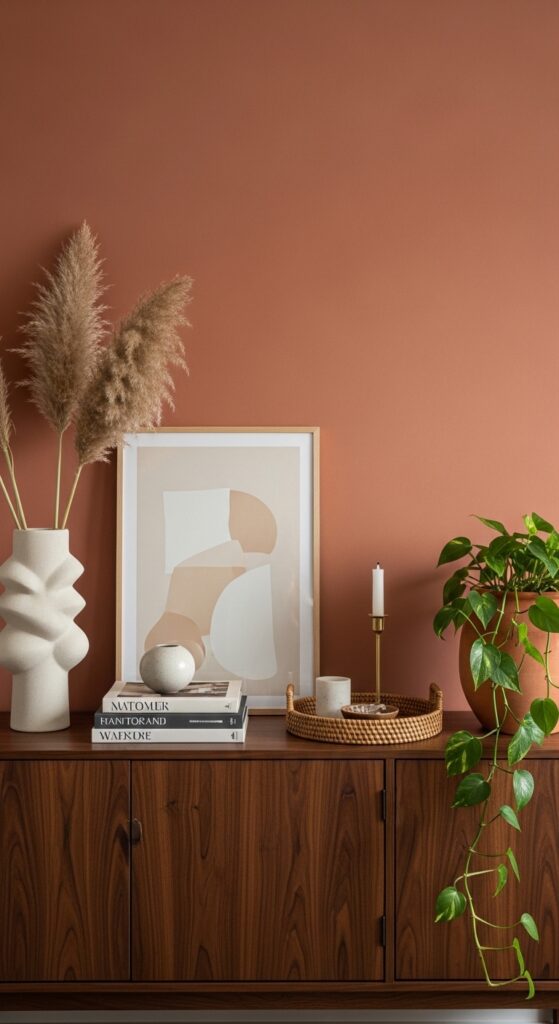
Asymmetric sideboard styling is the approach that reads as most naturally collected — as though the objects arrived over time from different places rather than being purchased in an afternoon. It requires more confidence than symmetric styling because there’s no formula to follow, but when it works, it produces vignettes that feel genuinely personal.
The principle that holds asymmetric compositions together isn’t balance of objects — it’s balance of visual weight. A tall ceramic vase on the left with a stack of books creates visual weight that needs something on the right side to answer it, even if the right-side objects are smaller in scale. The trick is in arranging your tallest element off-center (not at the far edge, not at the center — roughly at the one-third mark of the composition) and building outward from there.
The center of the sideboard in an asymmetric arrangement should be relatively open. The natural instinct is to fill it, but restraint in the center is what allows the composition on either side to read as intentional rather than crowded.
One object that changes every asymmetric composition for the better: a trailing plant whose vines extend beyond the pot’s footprint, adding organic movement and horizontal reach that no rigid object can provide. Position it near one end of the sideboard so the vines trail inward toward the center.
One constraint: asymmetric vignettes are less forgiving of clutter accumulation. Keys, mail, and stray objects undermine an asymmetric composition more visibly than a symmetric one. Be more diligent about maintenance if this is your approach.
3. A Painted Sideboard as the Room’s Color Anchor
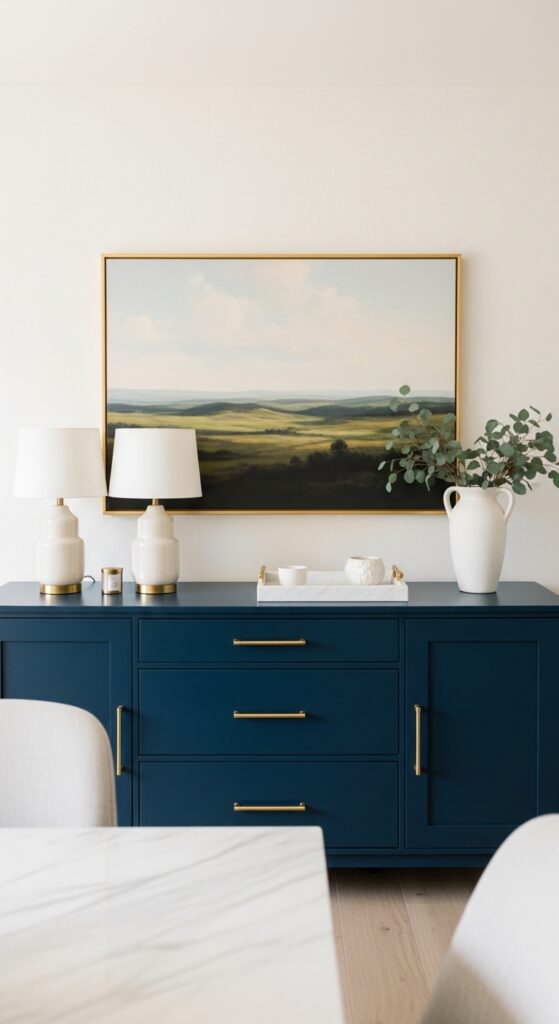
A painted sideboard in a bold tone is one of those decisions that feels risky right up until the moment you see it in the room — and then immediately obvious. The sideboard, positioned against a wall and viewed from the dining table, functions as a color anchor that the whole room can orient around. Deep navy, forest green, oxblood, and dusty sage are all colors that work on a sideboard in a way they might not on four walls.
The technique: paint a solid wood or MDF sideboard in a furniture-specific paint with a matte or eggshell finish. Chalk-based paints adhere well and produce the right depth of color — avoid standard wall paint on furniture as it chips at corners and drawer edges. Two coats over a bonding primer, with a light sanding between coats, produces a professional result.
Hardware upgrade is the second half of this decision. The paint color determines the hardware metal: navy and forest green read best with brass; oxblood and terracotta with unlacquered bronze; dark charcoal with either brass or matte black depending on whether you want warmth or graphic contrast.
Keep everything on the sideboard surface lighter than the painted body — white, cream, or pale natural tones — so the bold color reads clearly as a piece of furniture rather than a dark object with things on top of it.
One constraint: painting a solid wood antique sideboard is irreversible without significant stripping work. Consider whether the piece has intrinsic value that would be better preserved with a natural finish before committing to paint.
4. The Minimalist Sideboard: Less as a Statement
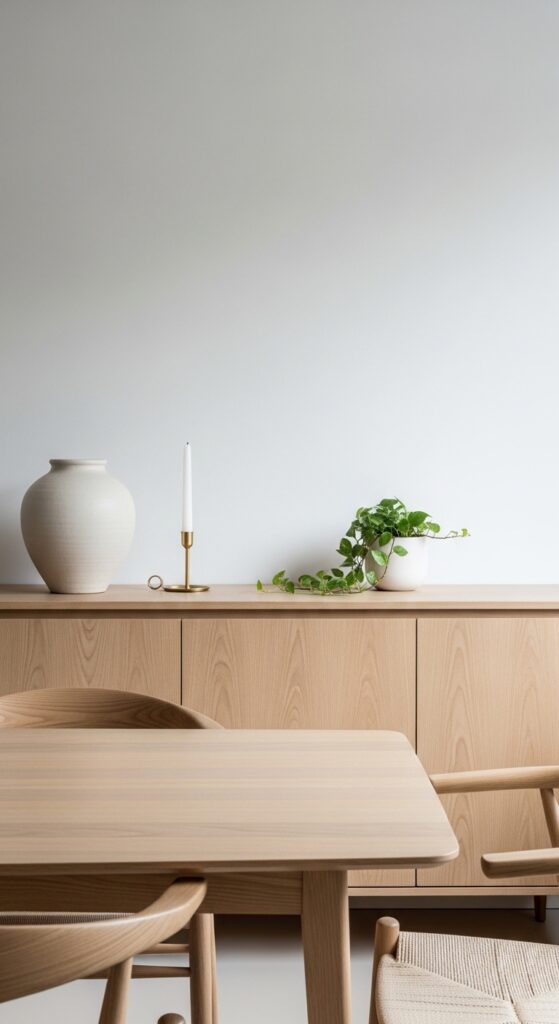
A minimalist sideboard vignette is harder to achieve than it sounds. Putting fewer objects on a surface and making it look considered — rather than empty or unfinished — requires that each object be genuinely interesting on its own terms, because there’s no supporting cast to compensate for a weak central piece.
The rule for a minimalist sideboard: three objects maximum, visible empty space as an intentional design element, and each object chosen for the quality of its form rather than its function. A matte ceramic vessel with a satisfying profile. A single candlestick in unlacquered brass that catches light in a way you notice. One small plant whose shape has a sculptural quality.
The sideboard itself carries more visual weight in a minimal arrangement — which means the furniture quality matters more here than in any other styling approach. A sideboard with clean proportions, invisible hardware, and a beautiful material finish earns the attention that fewer objects direct toward it.
For the wall above a minimalist sideboard, one large piece of art — canvas or framed print, appropriately scaled — completes the composition without adding to the surface. The wall above is the fourth element in the vignette even when nothing physical occupies it.
One constraint: a minimalist sideboard vignette accumulates disorder faster than any other approach because there’s nowhere to hide anything that doesn’t belong. This is the styling choice that demands the most disciplined daily maintenance.
5. Using the Sideboard as a Dining Bar and Drinks Station
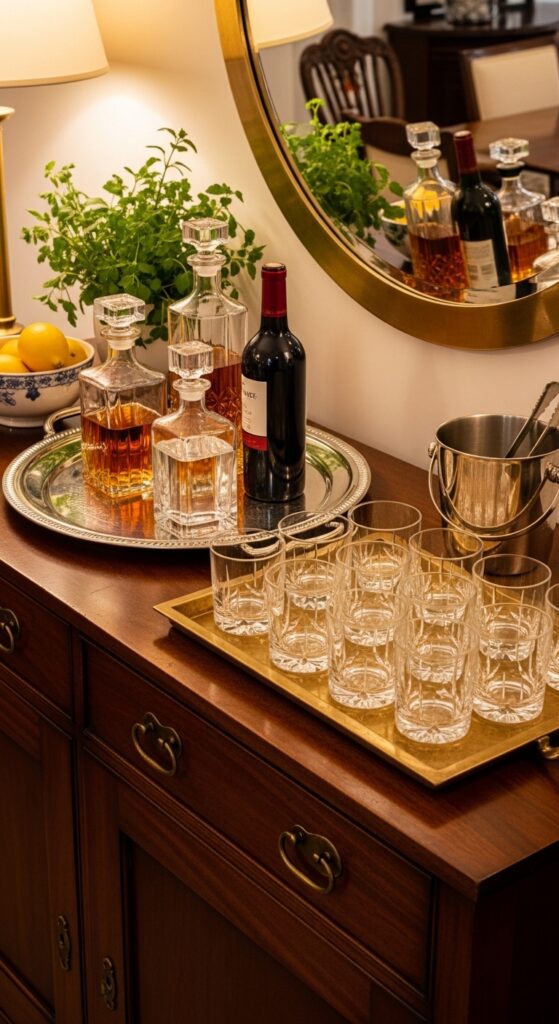
Converting a dining room sideboard into a proper drinks station is one of those ideas that sounds obvious once someone says it — and yet most people never do it. The sideboard is already in the right location (adjacent to the dining table, accessible from both kitchen and dining area), at the right height for standing service, and has the right closed storage for overflow bottles and barware. It’s essentially a bar cabinet by nature.
The surface composition of a functional bar sideboard has its own logic: group active items on trays so they can be moved as a unit when the surface is needed for serving during meals. A large silver or brass tray holding decanters and the most-used glasses; a separate smaller tray for cocktail tools (jigger, strainer, bar spoon, bottle opener). Everything else — backup bottles, extra glassware, cocktail napkins — goes in the cabinet below.
Crystal decanters earn their place on a drinks sideboard in a way that bottles often don’t. Four filled decanters of varying heights in a coordinated crystal style look genuinely beautiful on a dark wood surface. If you prefer to display original bottles, edit ruthlessly — three beautifully designed bottles on a tray look curated; eight miscellaneous bottles look like a liquor cabinet.
One practical note: fresh citrus in a ceramic bowl, a small plant, or fresh herbs in a bud vase introduces color and the suggestion of active hospitality. It signals that this sideboard is used, not displayed.
One watch-out: decanters left in direct sunlight will cause spirits to degrade over time. Position the drinks sideboard away from direct sun exposure, or use opaque decanters for spirits you’ll be storing long-term.
6. Layering Art Above the Sideboard: Multiple Frames
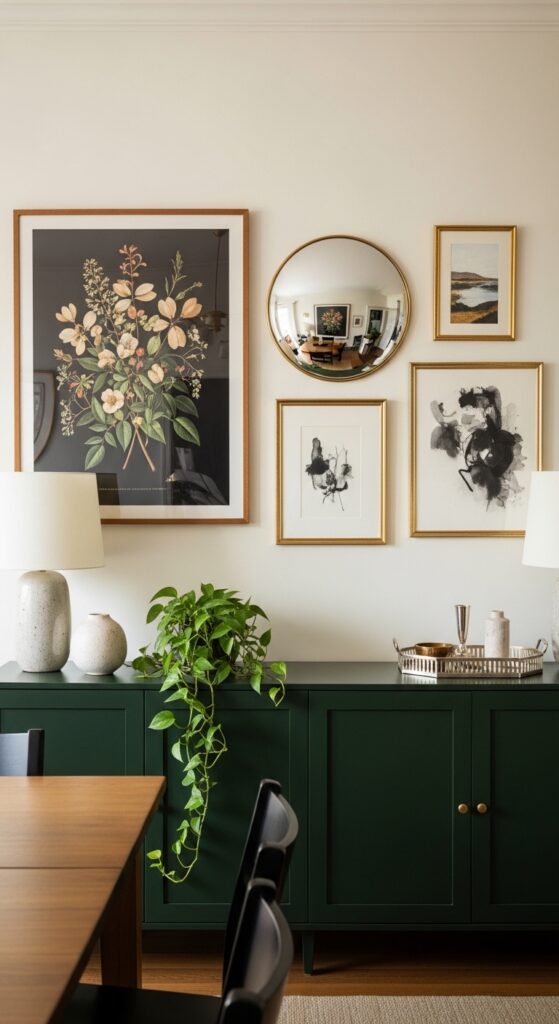
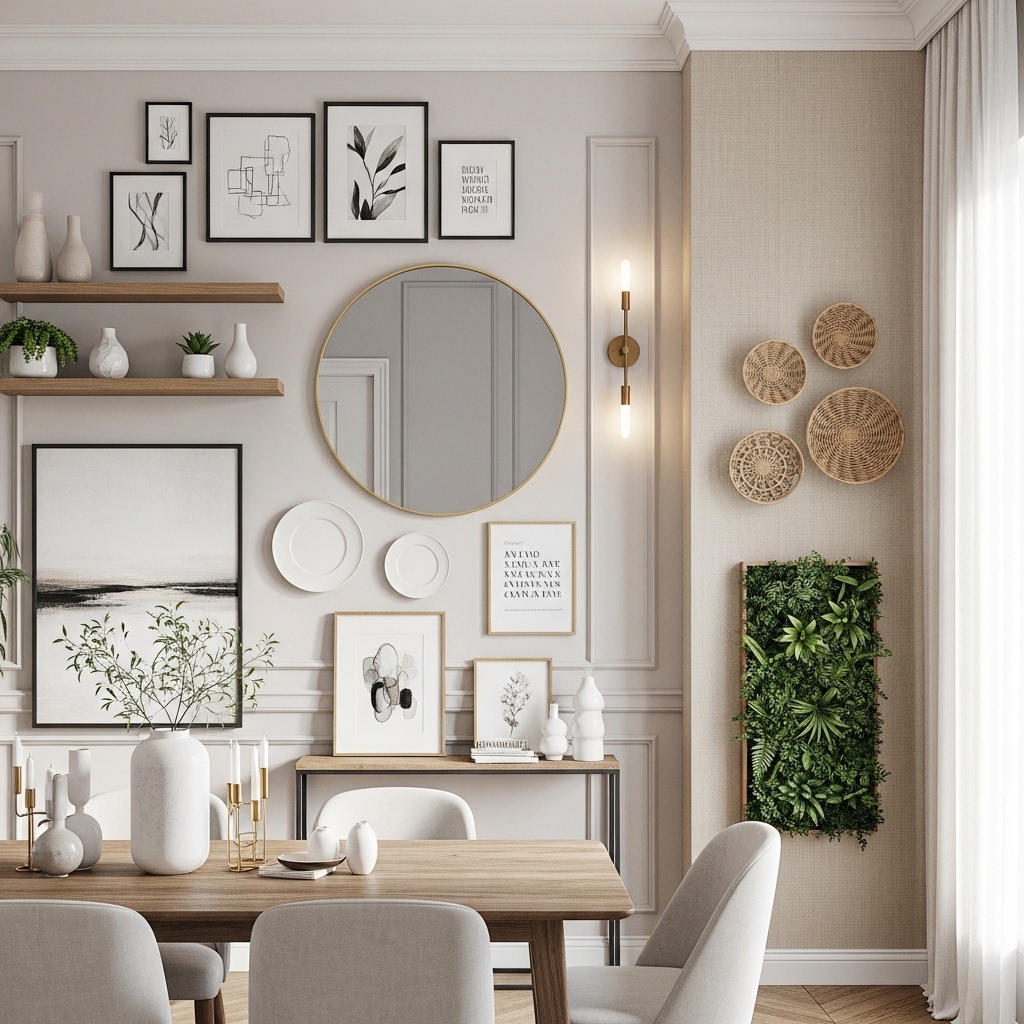
The wall above the sideboard is the most important wall in the dining room — it’s at eye level during meals, it’s the backdrop for the sideboard vignette, and it’s the surface that receives the most sustained visual attention in the room. A single piece of art hung there is the standard approach. A carefully composed arrangement of multiple frames is the approach that rewards longer looking.
The multi-frame gallery above a sideboard works differently from a full gallery wall because it’s constrained by the sideboard’s width below. The arrangement should not extend more than a foot beyond the sideboard on either side — the sideboard anchors the composition, and frames floating far outside that footprint will read as disconnected from the furniture below.
Frame consistency matters more above a sideboard than on a full gallery wall, because the arrangement is smaller and any inconsistency is closer to the eye. Two finishes at most: thin brass and natural wood, matte black and warm grey, antique gold and tortoiseshell — choose a pair that share a warmth level and commit.
Include one mirror in the arrangement — ideally a round convex mirror in a brass frame, interspersed among the flat art pieces. It adds reflective depth, catches the lamp light from the sideboard below, and creates a moment of visual surprise within the composition.
One constraint: frames hung too close to the sideboard surface — less than 6 to 8 inches above the lamp shades or tallest objects — will crowd the composition. Always measure the clearance between the highest point on the sideboard and the lowest frame in the arrangement before drilling.
7. Seasonal Styling: Changing the Sideboard Through the Year
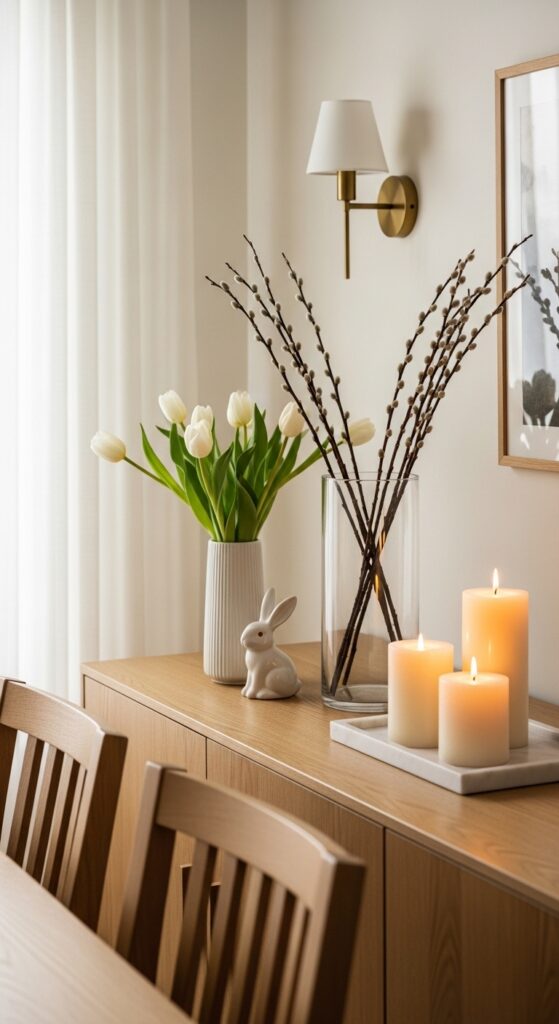
A dining room sideboard that looks identical in February and August is missing one of its greatest possibilities: the capacity to mark the passage of time and the rhythm of the seasons through small, considered changes to the display. This doesn’t require buying new objects for every season — it requires maintaining a core permanent arrangement and rotating a small category of seasonal elements within it.
The approach: identify two or three permanent objects that anchor the sideboard year-round — the lamps if you use them, a favorite ceramic vessel, a mirror above. These stay. Around them, rotate seasonal elements: spring brings fresh tulips and forcing branches; summer brings a bowl of garden fruit and linen in lighter colors; autumn introduces dried botanicals, small gourds in terracotta, and deeper candle tones; winter adds evergreen branches, more candlelight, and warmer metallic objects.
The seasonal objects should be stored in the sideboard’s lower cabinets between rotations — which means your permanent storage organization needs to accommodate rotation, not just daily-use items. Build the seasonal inventory gradually rather than buying everything at once; the best seasonal objects are often found in the moment (a branch from the garden, a few stems from the farmers market) rather than purchased in advance.
One constraint: very theme-heavy seasonal styling — think Halloween decorations or explicitly Christmas-themed objects — can make the sideboard look more like a retail display than a home interior. The most sophisticated seasonal styling suggests the season’s mood without explicitly announcing it.
8. A Marble or Stone Tray as the Sideboard’s Organizing Center
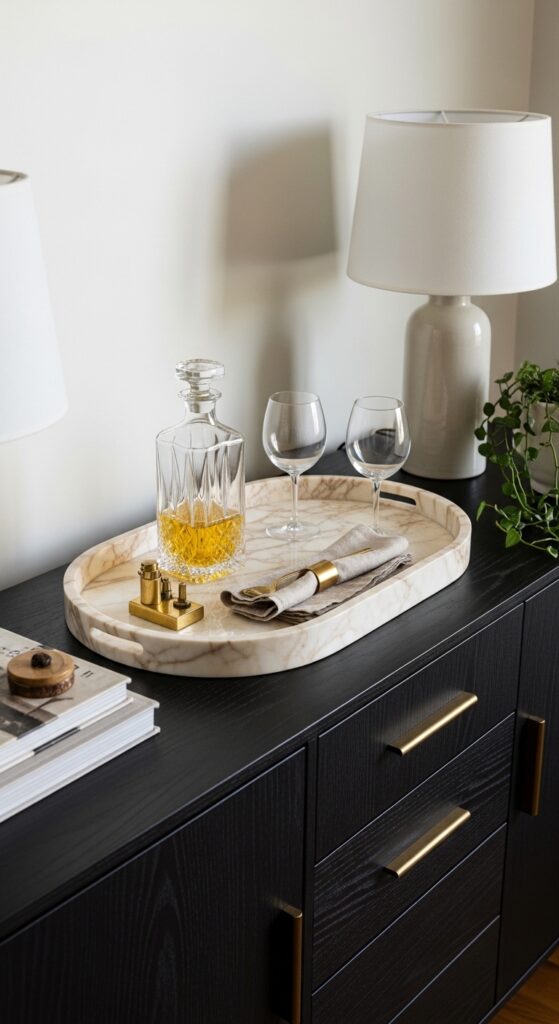
A stone or marble tray on a sideboard is not a decorating object — it’s an organizational architecture that transforms how the entire surface reads. A tray corrals objects into a defined zone, creates a visual boundary between what belongs together and what doesn’t, and elevates whatever sits within it to the status of a deliberate vignette rather than a collection of things placed near each other.
For a sideboard specifically, a large tray — oval or rectangular, in marble, travertine, slate, or brass — serves as the functional center of the drinks and service zone. Decanters, glasses, and cocktail accessories that live on the tray can be moved as a single unit when the surface needs to function for serving. The tray’s edges create a permanent visual structure that maintains even when individual objects within it change.
Marble is the best tray material for a dining sideboard because it’s impervious to rings from glasses and bottles, easy to clean, and has the right visual weight to anchor without dominating. Oval marble trays in warm Calacatta or travertine tones are the most versatile — they relate to wood tones in a way that cooler grey or white marble doesn’t always achieve.
Stack one or two books at the tray’s edge to connect it to the objects beyond its perimeter. This small detail prevents the tray from reading as an island and integrates it with the broader sideboard composition.
One watch-out: a tray too large for the sideboard’s surface area — one that extends to within a few inches of the sideboard edges — makes the surface look occupied rather than organized. Leave at least 6 inches of sideboard surface visible beyond each tray edge.
9. Plants as the Sideboard’s Primary Statement
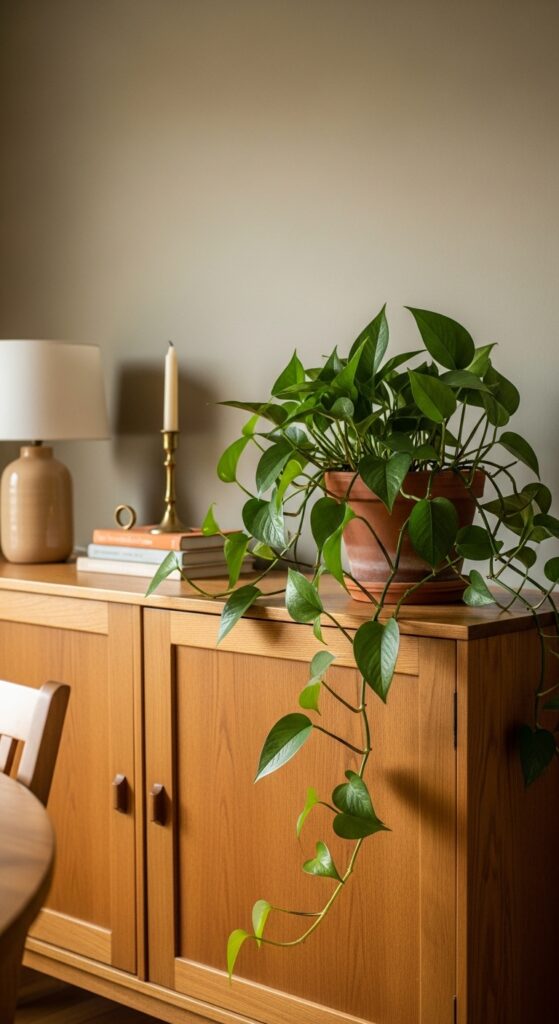
Most sideboard styling treats plants as supporting elements — a small succulent here, a bud vase with a single stem there. The approach where a plant is the primary statement is rarer and, when done with confidence, considerably more interesting. A large, dramatically trailing pothos whose vines extend beyond the pot in multiple directions introduces movement, scale, and organic energy that no ceramic or artwork can replicate.
For a plant to carry the weight of primary sideboard statement, it needs to be genuinely large — a mature pothos with multiple long vines, a monstera with three or four substantial leaves, or a trailing string of pearls in a pot elevated on a small stand to exaggerate the trailing effect. A small plant placed in a dominant position doesn’t read as a statement; it reads as a plant that needs a larger pot.
The container is as important as the plant. A handmade terracotta pot with visible finger marks and natural irregularity has more character than a factory-produced glazed pot, even when the glazed pot is objectively more refined. The organic quality of handmade pottery connects to the organic quality of the plant in a way that commercial containers don’t.
One care consideration: a large trailing plant on a sideboard needs accessible watering — the pot must be movable or the sideboard must be positioned near enough to a water source that maintenance is practical. A plant that’s difficult to water will decline slowly and undermine the effect it was placed to create.
10. The Sculptural Object Approach: Art Over Decoration
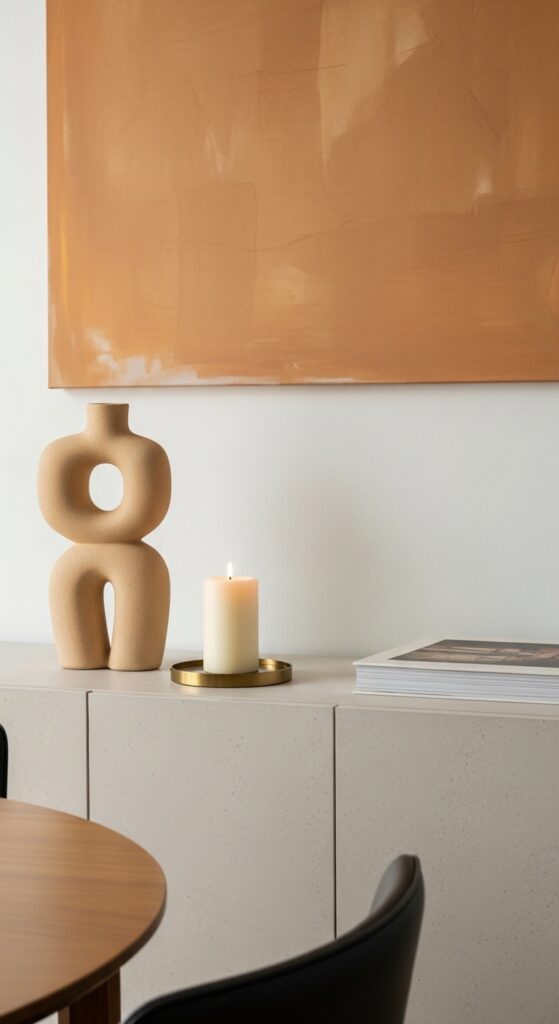
Treating the sideboard as a plinth for sculptural objects rather than a surface for decorative arrangements is the approach that brings the most genuine art-world sensibility to a dining room. It requires the most confidence — there are no lamps, no trays, no plants providing context — but the result is a sideboard that reads as a display in the most considered sense of the word.
The sculptural object approach works when you have one genuinely interesting three-dimensional piece worth centering: a large ceramic vessel with an unusual form, a carved stone object, a cast bronze sculpture, a glass piece with significant visual presence. The object sits alone or with one or two minimally supportive elements (a flat book beneath it, a candle at its edge), and the wall above it holds one large piece of art that the sculptural piece relates to in tone or material.
Finding objects with genuine sculptural quality requires different shopping than typical decor purchasing. Ceramic artist studios, craft fairs, gallery gift shops, and online ceramic markets all carry work with the kind of hand-finished quality and considered form that earns this position on a sideboard.
The practical question: is this sideboard ever used for serving during dinner parties? If yes, the sculptural object approach requires objects that can be moved and safely stored during use. If the sideboard functions purely as a display piece with closed storage below handling all function, the sculpture can be permanent.
One constraint: this approach fails if the sculptural object isn’t genuinely interesting. A mass-market decorative object given a prominent solo position reads as a styling mistake rather than a curatorial decision. Invest in one genuinely good piece rather than using several adequate ones.
11. Integrating the Sideboard Into a Full Wall Composition
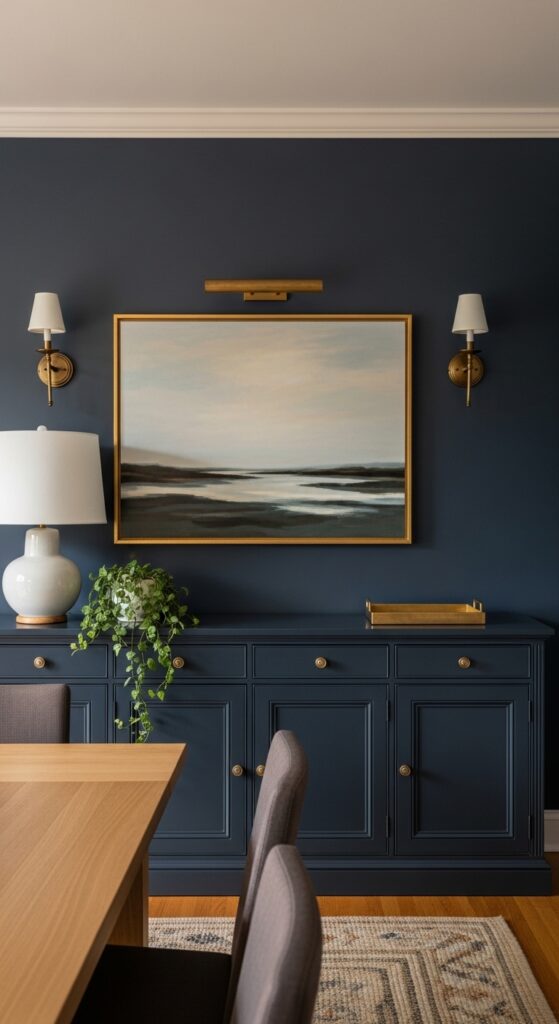
The most resolved sideboard arrangements aren’t just about the surface — they treat the sideboard and the wall above it as a single compositional unit, designed from baseboard to ceiling as one continuous element. This is the approach that makes a sideboard look like it was designed for the room rather than positioned in it.
The technique is to paint the wall behind and above the sideboard in the same tone as the sideboard’s painted finish, creating visual continuity between furniture and architecture. A dark navy sideboard against a dark navy wall, with a large gold-framed painting centered above and two sconces flanking it, reads as a single designed moment — an alcove effect achieved through paint rather than construction.
This approach works best when the sideboard is positioned against a single clearly defined wall section rather than a wall with multiple interruptions (doors, windows, switches). A continuous wall surface of at least 8 feet wide gives the composition enough room to breathe.
Wall sconces flanking the central artwork above the sideboard are the lighting detail that completes this approach. Positioned symmetrically at the same height as the painting’s center, in a finish that relates to the sideboard hardware, they provide warm ambient light at exactly the right level and integrate lighting into the wall composition as an architectural element rather than an accessory.
One constraint: painting the wall to match the sideboard commits you to repainting the wall if you ever change the sideboard color or replace the piece. Consider whether you’re ready for that coupling before committing.
12. The Everyday Sideboard: Styled for Real Life
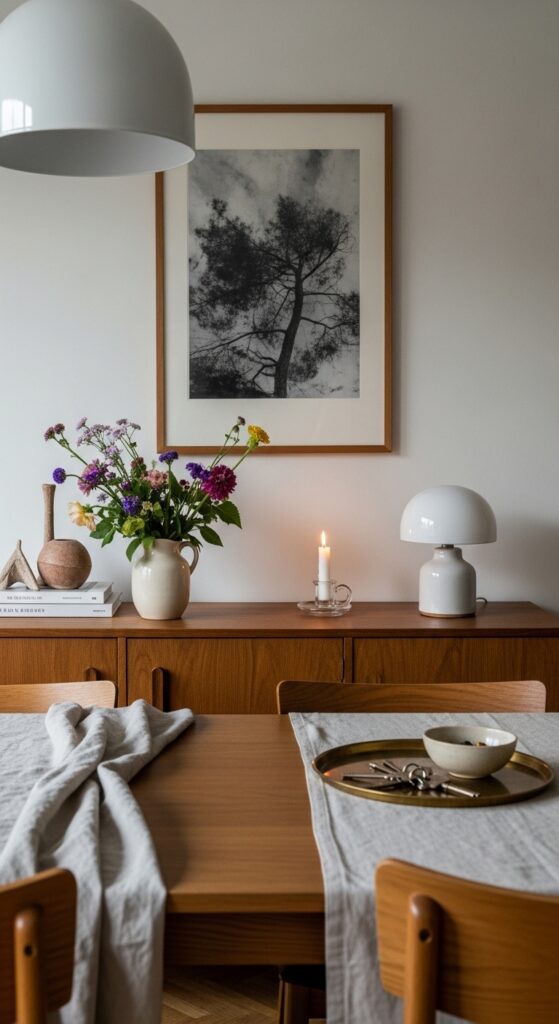
Here’s the idea that ties all the others together, and the one that most decor articles never admit: the most beautiful sideboard in a real home is not the one that looks like a styled photoshoot every day. It’s the one that has been thought about carefully enough that it looks good even when life has happened to it — when the candle is half-burned, when the flowers aren’t perfect, when the books have been moved and not quite put back in the right order.
The everyday sideboard is styled with real life in mind. It has a brass tray for the objects that inevitably land there (keys, sunglasses, a phone charger you actually need). It has a lamp that gets used every evening. It has a plant you actually remember to water. It has enough space in the arrangement that things can be moved around without the whole composition collapsing.
The trick is designing the sideboard around your actual habits rather than against them. If you always put mail there, give the mail a home within the composition — a small tray or a lidded bowl — so it doesn’t become clutter. If you use the sideboard for serving every Sunday, make the surface objects easy to relocate as a unit rather than individually.
Beauty that survives contact with real life is always more interesting than beauty that exists only in photographs. A sideboard that works in both registers — that looks considered when everything is in its place and still functions gracefully when it isn’t — is the real achievement.
One final thought: the sideboard that gets the most use, touched every day and rearranged by the life around it, is the one that becomes most genuinely yours. Let it.
The Sideboard Deserves Your Best Thinking
If you’ve made it to the end of this article, you’ve spent time with twelve genuinely different approaches to the same piece of furniture — and the range of those approaches should tell you something important: the sideboard is one of the most design-rich surfaces in the home precisely because it sits at the intersection of function and display in a way that most furniture doesn’t.
The practical lesson worth carrying into your own room is this: start with how you actually use the sideboard, then let the styling follow. If it’s a bar, style it as a bar. If it’s a display for collected objects, give those objects the space they need. If it’s a catch-all that needs taming, give the everyday objects a home within the composition rather than fighting them.
The best sideboard styling is always a little bit personal — it tells you something specific about the people who live in the house. That’s the detail no article can give you, and the reason your version will always be more interesting than any photograph you’ve seen of someone else’s.