There’s a reason mirrors have shown up in well-designed dining rooms for centuries. They do things that no other decorating tool can: they multiply light, extend a space visually, and add a layer of glamour that feels simultaneously classic and fresh. But most people either underuse them — one small mirror hung timidly above a sideboard — or overdo it with an entire mirrored wall that feels more Las Vegas hotel than cozy family home.
The sweet spot is in between, and it takes more thought than you’d expect. Which shape? What frame finish? How high? How many? Should it be one statement piece or a collected arrangement? These are genuinely interesting decisions, and the answers depend on your room, your light, and your taste. These twelve ideas cover real, distinct approaches — from bold gallery walls to simple arched statements — with the practical details you actually need to pull them off.
1. The Floor-to-Ceiling Arched Mirror as a Focal Point
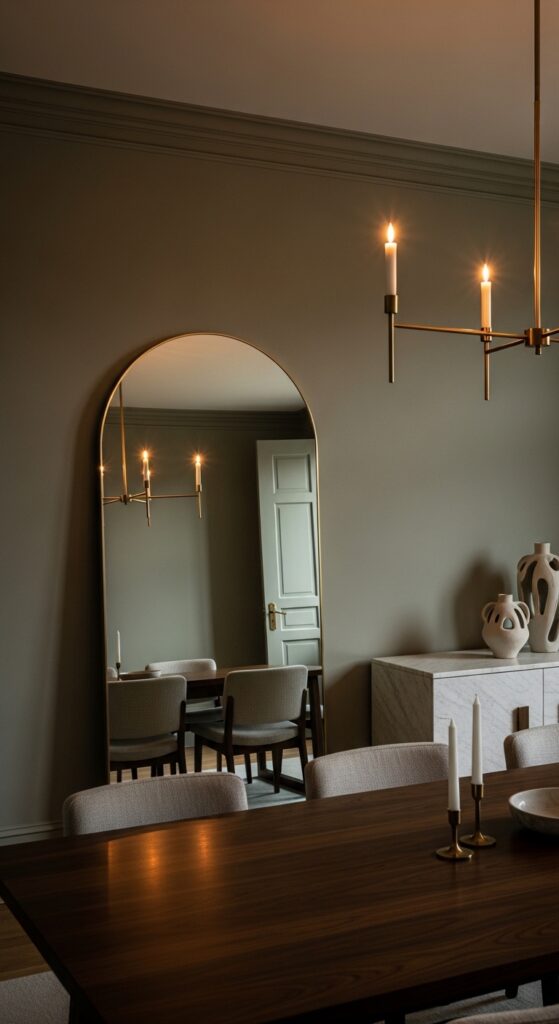
One large mirror done right will always outperform a gallery of smaller ones — if your dining room has the wall space and ceiling height to carry it.
An oversized arched mirror, leaned against the wall rather than hung, brings an instant sense of architecture to a room. The arch adds visual softness that rectangular mirrors can’t, making it feel less like a functional object and more like a design feature you would have built-in. Lean it behind a sideboard or directly against a dining wall so it reflects the table, the chandelier, and the window across the room.
For frame finish, thin brass is the most forgiving — warm enough to work with natural wood tones, cool enough to sit alongside whites and greys. Matte black is striking but commits you to a slightly more modern, graphic aesthetic.
The practical constraint: a leaned mirror this large needs to be secured to the wall with a furniture strap or properly placed against a baseboard. It’s not optional — it’s a safety requirement.
If your dining room is already small, this is still worth considering. A leaned arch in a small room creates depth rather than mass, especially if it reflects a window.
2. A Vintage-Inspired Gallery Wall of Mixed Mirror Frames
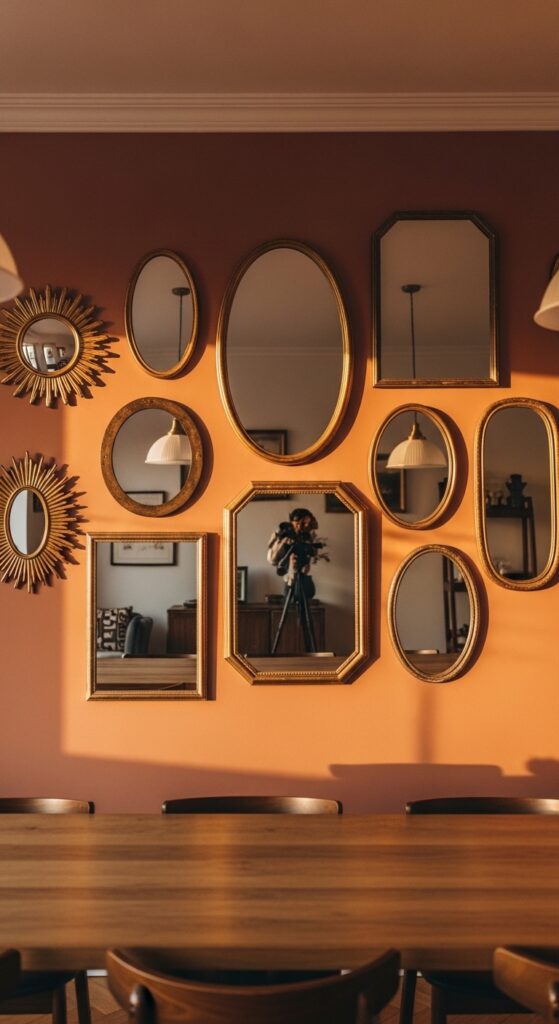
This is the most personality-forward approach to mirror walls, and it’s also the hardest to execute well. The difference between a gallery wall that looks collected and intentional and one that just looks busy is almost entirely about frame tone.
The rule: every frame in the arrangement should share at least one material or finish. Antique gold, tarnished brass, and aged bronze all belong in the same family. Mixing brass with chrome or matte black with polished nickel will look incoherent rather than eclectic.
Vary the shapes aggressively — round, sunburst, rectangular, arched, oval — but keep the sizes relatively balanced. One enormous mirror surrounded by tiny ones will look awkward unless you have a very specific reason for the scale difference.
For layout, arrange everything on the floor first before committing to any holes in the wall. Photograph it from above to see how it reads at room distance. Adjust until the negative space between pieces feels even and rhythmic — not uniform, but balanced.
One watch-out: sunburst mirrors are beautiful, but multiple sunbursts on the same wall start to compete. Keep it to one statement sunburst and fill the rest with simpler profiles.
This approach works best when the rest of the room is relatively calm. Busy wallpaper plus a mirror gallery is genuinely too much.
3. A Horizontal Band of Matching Mirrors Above a Sideboard
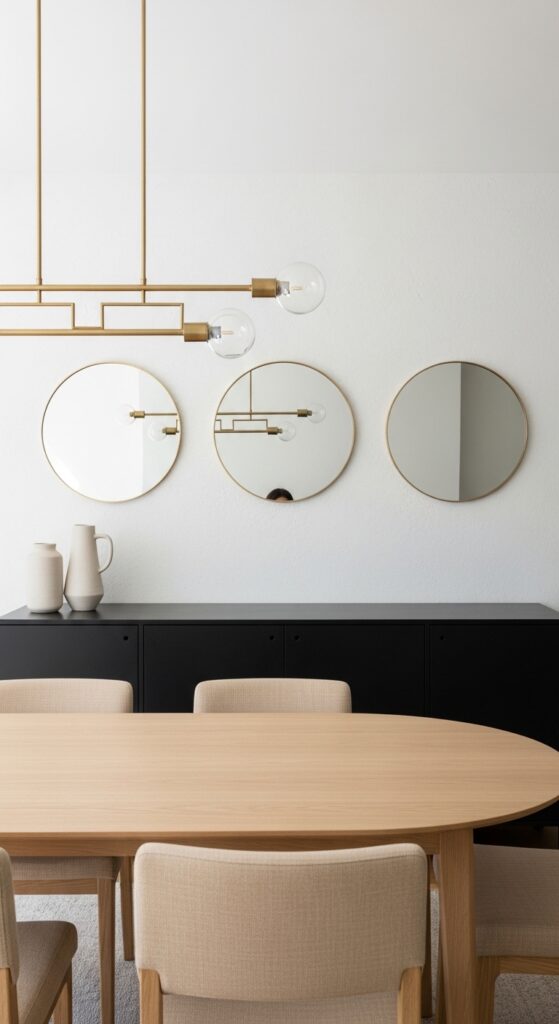
Sometimes restraint is the whole point. Three identical mirrors in a row sounds almost too simple, but when done with a well-proportioned credenza and the right frame finish, it reads as quietly confident rather than cautious.
The key is getting the sizing right. Each mirror should be scaled to roughly one-third the height of the wall space between the credeboard top and ceiling. Too small and they float aimlessly; too large and they crowd the wall. For a standard-height room with a credenza sitting around 36 inches tall, mirrors with a 20- to 24-inch diameter tend to work beautifully.
Round mirrors in this configuration avoid the stiffness that three rectangular mirrors would create. If you prefer rectangles, hang them vertically (portrait) rather than horizontally — it adds elegance and avoids a calendar-on-the-wall effect.
Matching frames here is non-negotiable. The visual power of this arrangement comes from repetition. Varying the frames defeats the purpose.
That said, this approach requires you to like visual simplicity. If you’re someone who loves collected, layered interiors — this will feel too neat. It’s essentially the opposite design philosophy of the gallery wall, and that’s fine. Pick the one that matches how you actually live.
4. Antique Mirror Panels as a Textured Wall Treatment
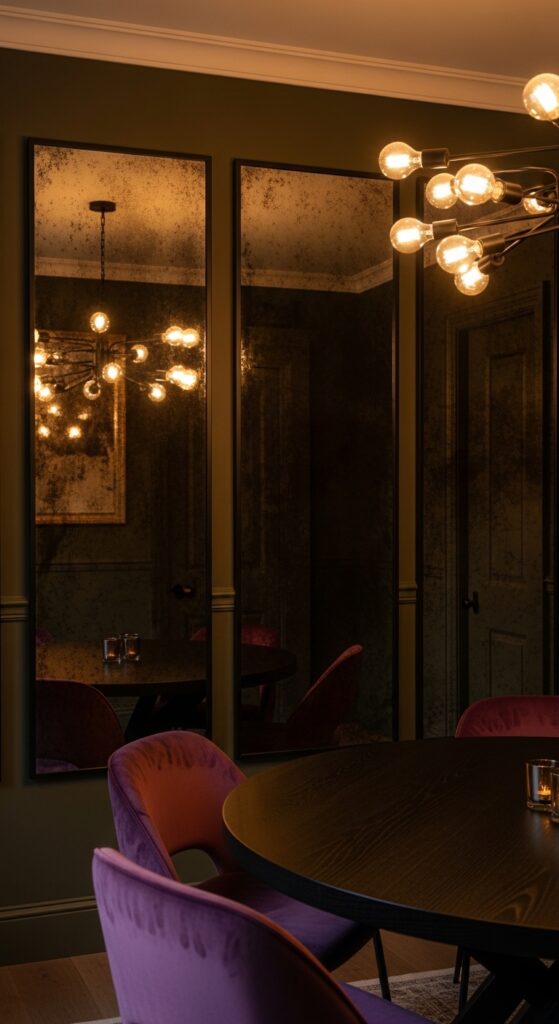
Antique mirror — glass that has been deliberately aged or chemically treated to produce a darkened, foxed, or smoky surface — reflects light without reflecting images crisply. This is the version of mirror you want when you love the light-amplifying quality but find the funhouse-mirror effect of modern glass a bit much in a small space.
Antique mirror panels installed as a wall treatment (essentially wainscoting-height or full-height glass panels) read as a material rather than a collection of individual mirrors. It’s the difference between decorating a wall and actually finishing it. The effect is deeply glamorous in a way that feels earned rather than try-hard.
Pair this with dark, saturated wall colors on adjacent walls — deep olive, aubergine, inky navy — so the panels feel like they belong to a rich, considered palette rather than sitting in contrast to it.
The practical constraint: antique mirror panels are typically custom-cut to your specifications and are genuinely more expensive than standard mirrors. If budget is a concern, there are peel-and-stick antique mirror tiles that approximate the effect, though the grout lines can look slightly commercial up close.
This is a commitment, not a weekend project. But the payoff is a dining room that genuinely looks like no one else’s.
5. A Sunburst Mirror Over a Painted Dining Sideboard
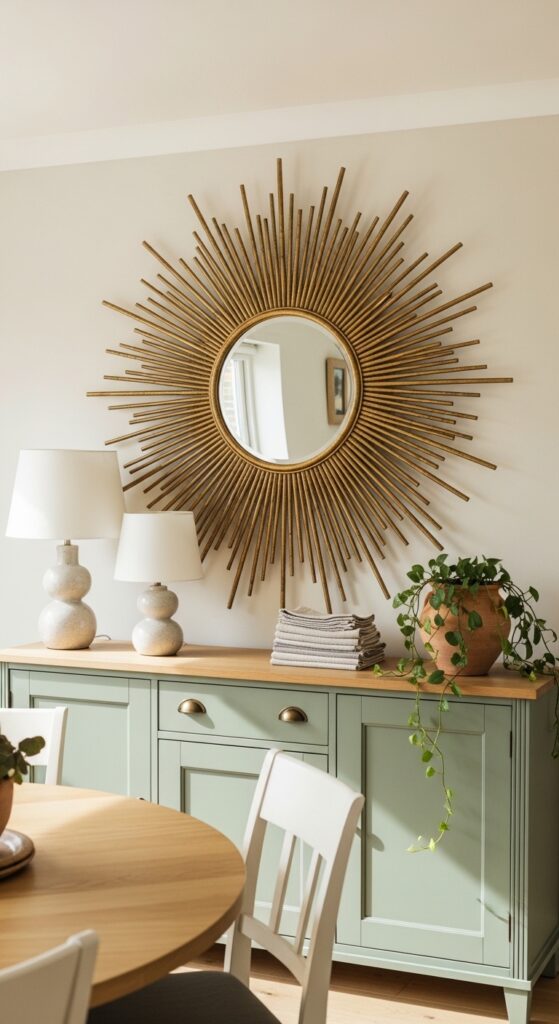
The sunburst mirror is the jewelry of the mirror world — it exists purely to be looked at, and when it’s the right scale in the right room, it earns every inch of wall space it takes.
Placement matters enormously. A sunburst mirror works best when it has breathing room on all sides. Mount it centered above a sideboard or console, with at least 8 to 12 inches of clearance between the bottom of the mirror frame and the top of the furniture below. Let the spokes extend upward into open wall space rather than crowding into a gallery.
The frame finish — aged gold, raw brass, or burnished iron — should feel slightly worn rather than shiny-new. High-polish gold sunbursts can read as cheap; a matte or oxidized finish communicates quality and age even when the piece is brand new.
Color pairing tip: a sunburst in gold against a deep-toned wall — forest green, dusty terracotta, or warm charcoal — is almost always beautiful. Against stark white, even a gorgeous sunburst can feel isolated and underwhelming.
One constraint: if your ceiling is below 8.5 feet and the room is small, a large sunburst can overwhelm. Scale down to a 24-inch diameter, or save this one for a larger wall.
6. Mirror Tiles in a Geometric Pattern
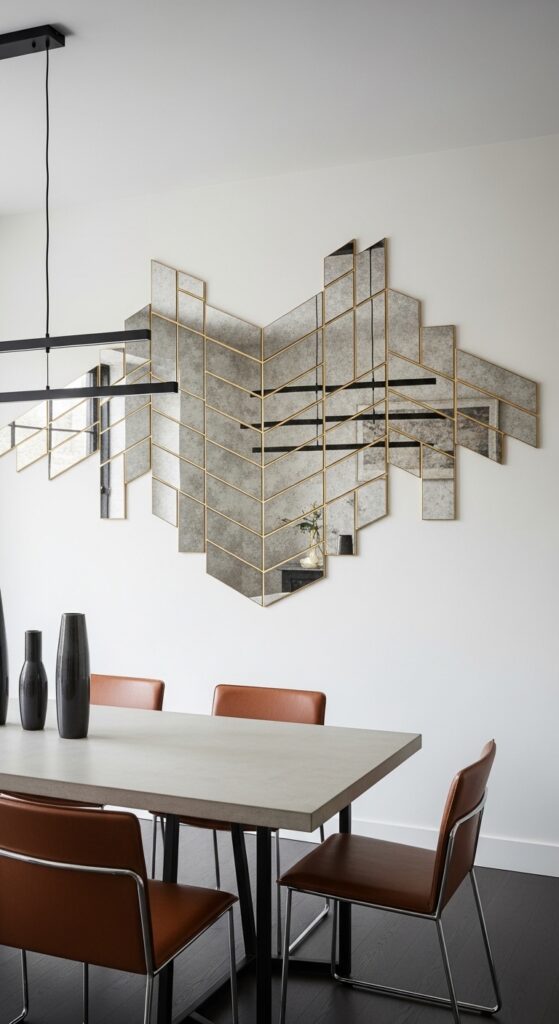
This is the modern, architectural take on the mirror wall — and it requires more planning and precision than almost anything else on this list, but the result can be genuinely jaw-dropping.
Geometric mirror tile arrangements — whether chevron, herringbone, stacked horizontal, or a more complex tessellated pattern — treat the mirror surface as a building material rather than a decorating accessory. The effect is more related to tile work than traditional mirror decor, and it functions as a full wall treatment in the truest sense.
The grout or gap between tiles is where the detail lives. A thin line of brushed gold between tiles adds warmth and prevents the wall from reading as a single mirrored surface. Too wide a gap and the geometry starts to fall apart visually; too narrow and it looks like a continuous mirror with cracks.
This approach demands a relatively neutral room around it. If your dining room has competing patterns — a busy rug, bold wallpaper, a heavily grained wood table — the mirror tiles will fight rather than anchor.
For renters, this is essentially off the table without landlord approval. But for homeowners who want a dining room that looks genuinely custom, it’s hard to beat.
7. A Single Oversized Round Mirror as the Only Wall Decor

Minimalism has a mirror strategy too, and it’s this: one circle, one wall, nothing else.
The psychological effect of a large round mirror hung in isolation is surprisingly powerful. Without competing elements, the eye settles on the mirror immediately and then travels into the reflected image — the room behind you, the light from the window, the movement of people around the table. The mirror becomes less of a decorating object and more of a living picture frame.
For this to work, the mirror needs to be genuinely large — at minimum 36 inches, ideally 42 to 48 inches in diameter. Anything smaller looks like it got lost on the wall. The frame should be minimal: whitewashed wood, raw oak, thin matte metal. An ornate frame competes with the simplicity of the concept.
Hang it slightly lower than instinct suggests — center it at approximately 57 to 60 inches from the floor rather than the standard 65 inches. This brings it into direct relationship with people seated at the table, making the reflection feel more intimate and connected to the room’s actual function.
This idea is for people who appreciate restraint. If the rest of your home is layered and eclectic, one plain round mirror might feel out of character. But if you’re building toward a quieter, more considered aesthetic, it’s a near-perfect solution.
8. Leaning Multiple Mirrors of Different Heights Against One Wall
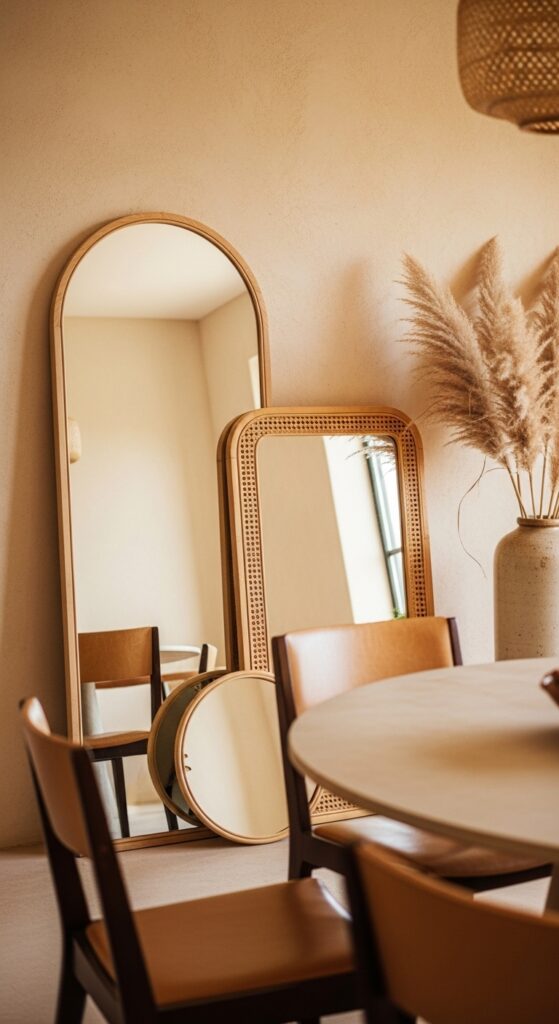
Leaning mirrors rather than hanging them is one of those renter-friendly moves that also happens to look more deliberately styled than a hung arrangement — which is a rare combination worth acknowledging.
The idea is to treat the mirrors as floor-level objects rather than wall objects. Lean two or three of varying heights and shapes against the same wall, overlapping slightly or spread with deliberate gaps. A tall arched mirror, a medium rattan-framed rectangle, and a small round mirror propped against or in front of them creates a layered, collected look that feels like it evolved over time rather than being installed in an afternoon.
The trick is in the deliberateness. Each mirror should be intentionally angled — not just flopped against the wall — and the grouping should be anchored by a floor-level object: a ceramic pot with a large plant, a stack of art books, a sculptural object. Without that grounding element, the mirrors look like they’re waiting to be hung.
One real constraint: this arrangement reduces usable floor space along that wall. In a very small dining room, three leaned mirrors can start to feel like an obstacle course. In a larger room or against a wall without traffic flow, it’s perfect.
9. A Mirror Wall Behind a Banquette
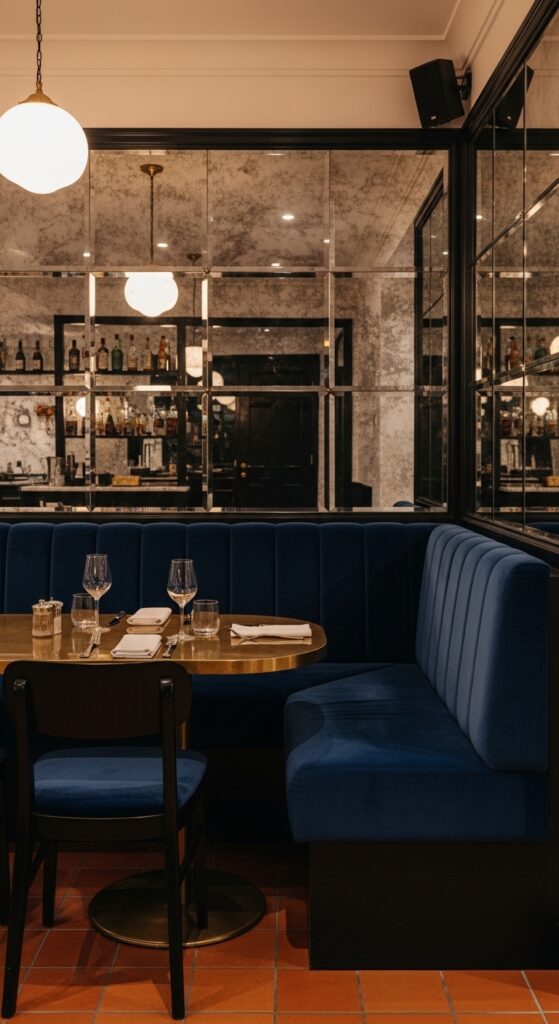
This is the bistro trick, borrowed directly from Parisian brasseries that have been using it for a hundred years: a mirror wall behind banquette seating makes the dining nook feel twice as large, twice as sociable, and about ten times more interesting.
The mechanics are simple — you’re reflecting the entire room back on itself, which visually doubles the space. But what makes it work socially is that people seated at the banquette can see the whole room in front of them rather than staring at a blank wall. Conversations feel more animated. The space feels more alive.
The mirror in this context should be one continuous panel or two large panels with a minimal frame or seam — not a collection of smaller pieces. The banquette back will partially conceal the lower edge of the mirror, which means you don’t need to obsess over the bottom trim. Focus on the upper edge and ceiling junction, which will be the most visible.
Wall color on adjacent surfaces matters here. Deep tones — navy, forest green, black — make the reflection feel rich and intentional. Pale or white walls reflected in a banquette mirror can look a bit clinical.
This is one of the most impactful things you can do in a small dining space, full stop.
10. Mixing Mirrors With Artwork in a Curated Wall Arrangement
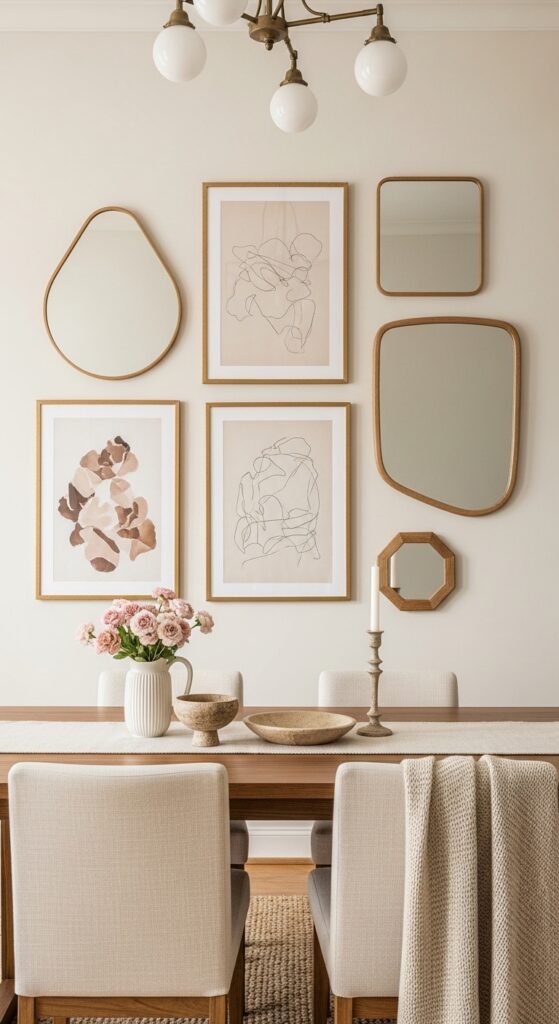
Most people treat mirrors and artwork as separate categories, never to be combined. Breaking that rule — carefully — produces some of the most sophisticated wall arrangements possible.
The key to mixing mirrors with framed art is visual consistency in frame material. If your art frames are thin brass, your mirror frames should be in the same family — perhaps the same brass, or aged gold, or burnished bronze. The objects are different; the container should feel unified.
In terms of arrangement, treat mirrors as you would art: vary sizes, alternate shapes, and use the same spacing rules you’d apply to a gallery wall. A mirror at the center flanked by prints, or prints clustered at the left with mirrors stepping down to the right — both work as long as the whole arrangement has a visual center of gravity.
One constraint: don’t let the mirrors outnumber the art pieces more than two-to-one. At that ratio, the wall tips from “curated mix” into “just a lot of mirrors with a couple of frames in it.” The art is what keeps the arrangement feeling personal and specific.
Avoid abstract prints with very busy colors if your mirrors are reflecting a lot of the room — the colors in the reflection and the colors in the prints can start to fight.
11. A Venetian-Style Mirror as a Single Ornate Statement
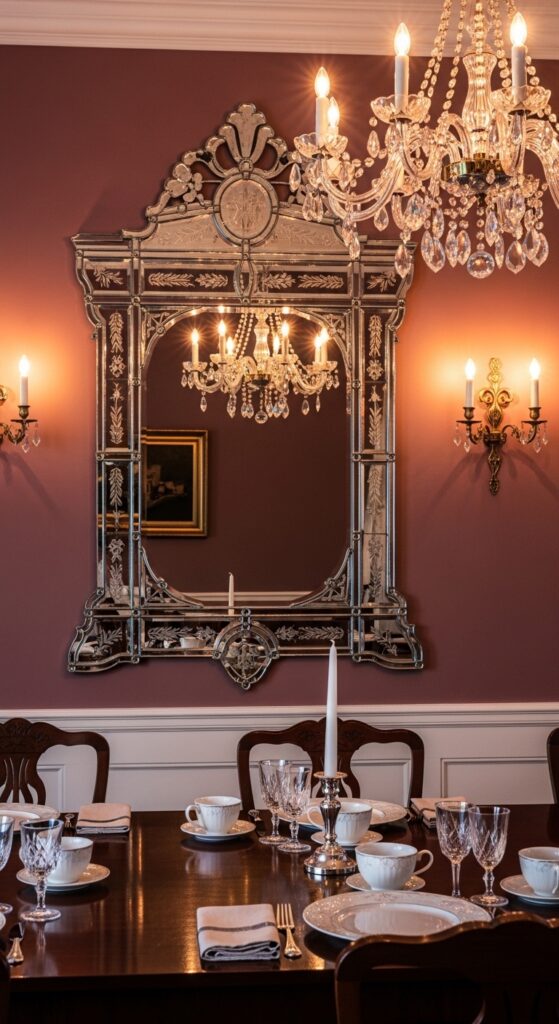
Venetian mirrors — those elaborate pieces with etched glass frames, beveled edges, and antique foxing — occupy a different design category than every other mirror on this list. They’re not primarily about amplifying light or expanding space. They’re about beauty as an end in itself.
A genuine Venetian mirror (or a well-made reproduction) is one of those objects that makes a room feel as though it has a real history. Hang one on a deep-toned wall — dusty rose, burgundy, aged terracotta — and the combination reads as something between a European country house and a well-traveled apartment.
These mirrors work best in formal or at least semi-formal dining rooms. In a very casual, white-and-wood Scandinavian-style dining space, a Venetian mirror will look like it wandered in from a different house. Context matters enormously here.
Flank the mirror with a pair of wall sconces at eye level — candle-style in antique brass or unlacquered bronze — to complete the effect. The layered light from sconces plus the chandelier above plus the reflection in the mirror creates the kind of evening atmosphere in a dining room that genuinely makes people want to linger.
One note on scale: err on the side of larger. A small Venetian mirror looks like a souvenir. A large one looks like an heirloom.
12. Frameless Mirrors in a Grid Formation for a Modern Edge
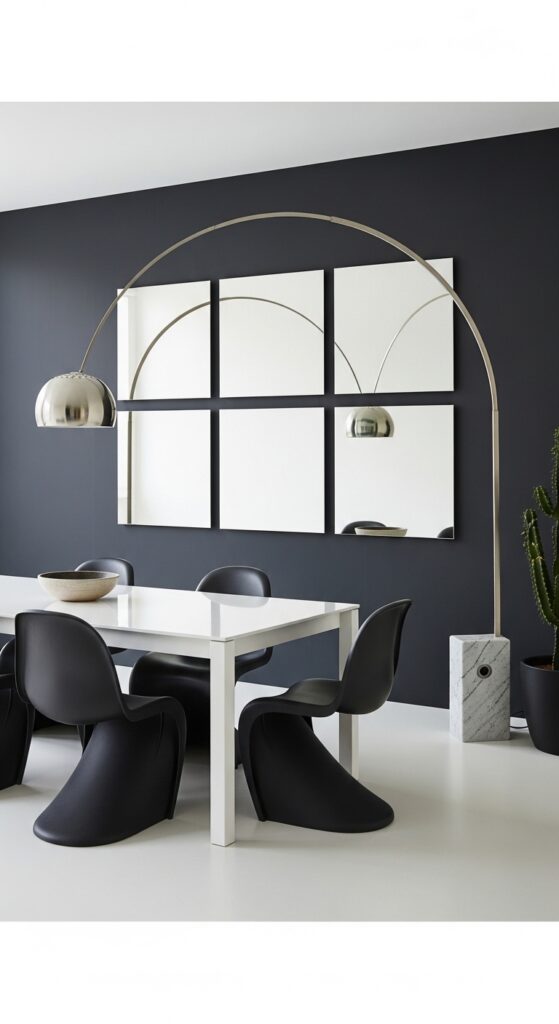
Frameless mirrors in a structured grid arrangement is arguably the most contemporary approach to mirror wall decor — and it’s also the most demanding in terms of installation precision. Unlike a casual gallery of mixed pieces, a grid arrangement has nowhere to hide. Every mirror needs to be perfectly level, perfectly spaced, and perfectly aligned.
The payoff for that precision is a wall treatment that feels genuinely architectural — almost like a structural design choice rather than a decor decision. In a modern dining room with clean lines, a graphite or white palette, and minimal furniture, a frameless mirror grid adds texture and dimension without introducing any additional color or material into the palette.
For spacing, 1 to 2 inches between each mirror is the sweet spot. Closer than 1 inch looks like a single mirror that’s cracked. Further than 3 inches and the grid starts to dissolve into individual objects rather than reading as a cohesive pattern.
This does not work in traditional, warm, or eclectic dining rooms. The visual grammar is too strict and too cold. It belongs in rooms that already speak in the language of precision and restraint.
For renters, this is genuinely difficult to execute without many wall holes. Consider large frameless adhesive mirror panels as an alternative — some are impressive up close and don’t require a single nail.
Before You Hang Anything
Mirrors in a dining room are one of those decisions that compound across the life of the space — the right mirror improves everything it touches, and the wrong one is visible at every meal. If you’ve read this far, you’re already thinking about it more carefully than most people do, and that matters.
The single most important thing to remember: always check what your mirror is going to reflect before you hang it. A mirror positioned across from a beautiful window is a gift. A mirror facing directly into a cluttered kitchen pass-through, an uninspiring wall, or a bathroom door is a problem that no frame finish can fix. Walk the room at the time of day you use it most. See the light. Understand the reflection. Then commit.
Good mirrors, placed well, last a lifetime in a room. They’re the kind of investment that makes a dining room feel genuinely considered — and that’s the kind of space people remember long after the meal is over.